
Slide 17 Why need and 24 Bragg reflectors
Slide #17 (Why need…) and #24 (Bragg reflectors) are inserted later on. Extreme UV (EUV) lithography 1. 2. 3. 4. 5. 6. Overview, why EUV lithography? EUV source (hot and dense plasma). Optics (reflection mirrors). Mask (absorber on mirrors). Resist (sensitivity, LER, out-gassing). Contamination control. Textbook page 16 -20. You can read the book by Vivek if you want to learn more. http: //books. google. ca/books? id=91 Xe. KLC 9 MUEC&pg=PA 393&lpg=PA 393&dq=Elemental+absorption+at+13. 5 nm&source=bl&ots=u 2 vs. Ba 2 d gr&sig=a 1 JKcj 0 v. E 6 Gx 7 X_6 m_z. UR 9 CT 5 k&hl=en&ei=QZs. QSp. TVKZS 8 M 5 a. T 2 FI&sa=X&oi=book_r esult&ct=result&resnum=1#PPR 7, M 1 Use Firefox to open the file, since somehow IE doesn’t work properly ECE 730: Fabrication in the nanoscale: principles, technology and applications Instructor: Bo Cui, ECE, University of Waterloo; http: //ece. uwaterloo. ca/~bcui/ Textbook: Nanofabrication: principles, capabilities and limits, by Zheng Cui 1
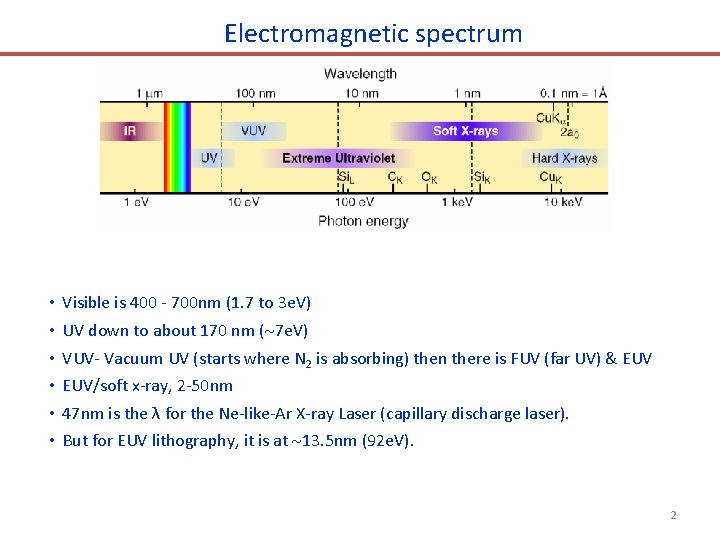
Electromagnetic spectrum • • • Visible is 400 - 700 nm (1. 7 to 3 e. V) UV down to about 170 nm ( 7 e. V) VUV- Vacuum UV (starts where N 2 is absorbing) then there is FUV (far UV) & EUV/soft x-ray, 2 -50 nm 47 nm is the λ for the Ne-like-Ar X-ray Laser (capillary discharge laser). But for EUV lithography, it is at 13. 5 nm (92 e. V). 2
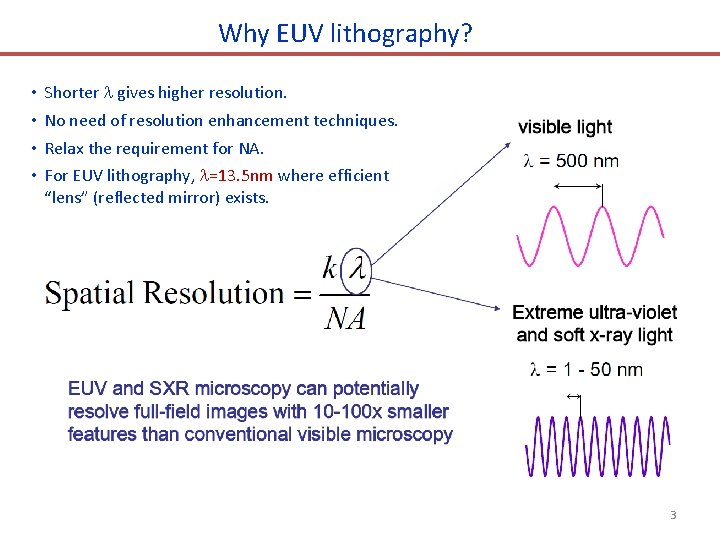
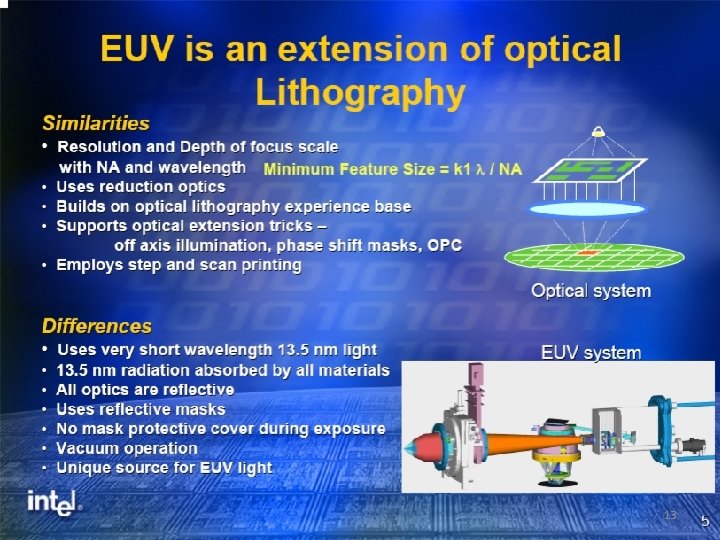
Why EUV lithography? • • Shorter gives higher resolution. No need of resolution enhancement techniques. Relax the requirement for NA. For EUV lithography, =13. 5 nm where efficient “lens” (reflected mirror) exists. 3
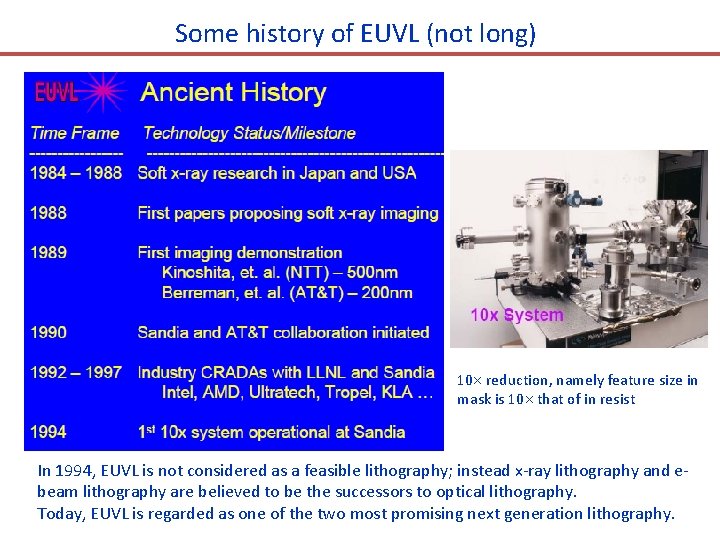
Some history of EUVL (not long) 10 reduction, namely feature size in mask is 10 that of in resist In 1994, EUVL is not considered as a feasible lithography; instead x-ray lithography and ebeam lithography are believed to be the successors to optical lithography. Today, EUVL is regarded as one of the two most promising next generation lithography.
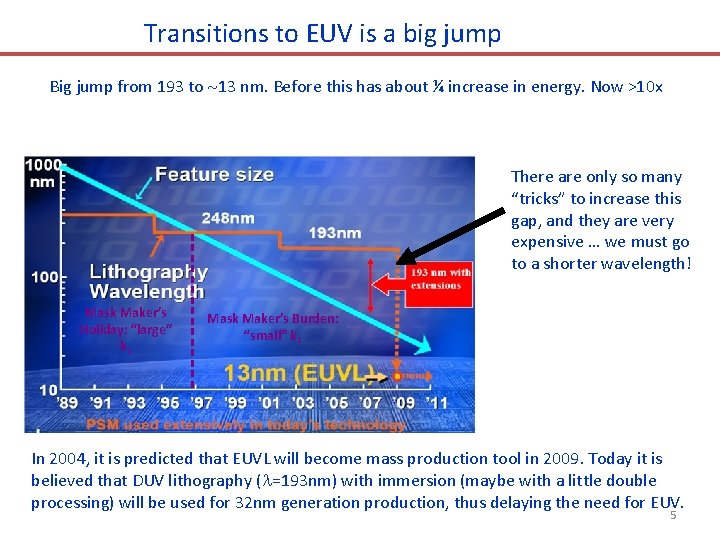
Transitions to EUV is a big jump Big jump from 193 to 13 nm. Before this has about ¼ increase in energy. Now >10 x There are only so many “tricks” to increase this gap, and they are very expensive … we must go to a shorter wavelength! Mask Maker’s Holiday: “large” k 1 Mask Maker’s Burden: “small” k 1 In 2004, it is predicted that EUVL will become mass production tool in 2009. Today it is believed that DUV lithography ( =193 nm) with immersion (maybe with a little double processing) will be used for 32 nm generation production, thus delaying the need for EUV. 5
Transitions in optical lithographic technologies 6
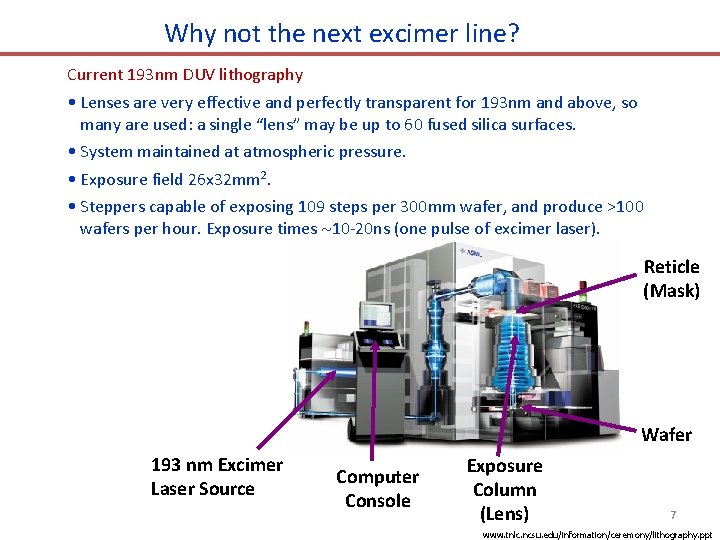
Why not the next excimer line? Current 193 nm DUV lithography • Lenses are very effective and perfectly transparent for 193 nm and above, so many are used: a single “lens” may be up to 60 fused silica surfaces. • System maintained at atmospheric pressure. • Exposure field 26 x 32 mm 2. • Steppers capable of exposing 109 steps per 300 mm wafer, and produce >100 wafers per hour. Exposure times 10 -20 ns (one pulse of excimer laser). Reticle (Mask) Wafer 193 nm Excimer Laser Source Computer Console Exposure Column (Lens) 7 www. tnlc. ncsu. edu/information/ceremony/lithography. ppt

Current 193 nm deep UV (DUV) lithography: mask material • Photo-masks today are made from fused silica. • Fused silica has a number of advantageous properties. o Chemical stability. o Transparency for ultraviolet light. o No intrinsic birefringence (i. e. refractive index is polarization independent). o A low coefficient of thermal expansion. • A low coefficient of thermal expansion: 0. 5 ppm/o. C. o If a mask changes temperature by 0. 1 o. C, then the distance between two features separated by 50 mm will change by 2. 5 nm. o This change in registration can be absorbed into overlay budgets, after reduction by 4× (i. e. pattern on resist misaligns by 2. 5/4=0. 6 nm, OK). 8
Why not the next excimer line (157 nm)? Why not a stop at 157 nm? • Fused silica and atmospheric oxygen become absorptive by 157 nm, so even incremental decreases in wavelength (by only 36 nm) start to require a major system modification: vacuum exposure, use Ca. F 2 as lens material (resist materials also different). • Ca. F 2 has a crystalline structure (not “glassy/amorphous” like fused silica), with significant birefringence (i. e. light propagation through the lens depends on the polarization relative to crystalline orientation). • The coefficient of thermal expansion of Ca. F 2 is 19 ppm/o. C, versus 0. 5 ppm/o. C for fused silica. • The 2. 5 nm of mask registration error fused silica now becomes nearly 100 nm (25 nm after ¼ reduction, still too high). • Below 157 nm, no excimer laser line has the required output power. • The development of EUV lithography further makes 157 nm lithography unnecessary.
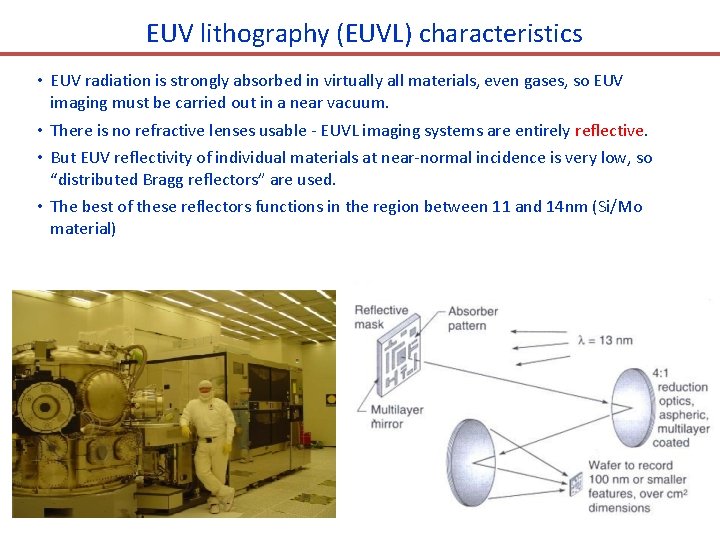
EUV lithography (EUVL) characteristics • EUV radiation is strongly absorbed in virtually all materials, even gases, so EUV imaging must be carried out in a near vacuum. • There is no refractive lenses usable - EUVL imaging systems are entirely reflective. • But EUV reflectivity of individual materials at near-normal incidence is very low, so “distributed Bragg reflectors” are used. • The best of these reflectors functions in the region between 11 and 14 nm (Si/Mo material)
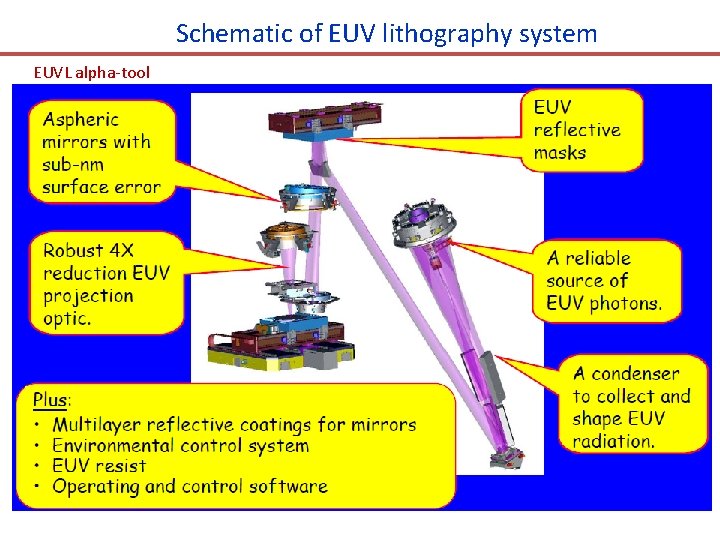
Schematic of EUV lithography system EUVL alpha-tool
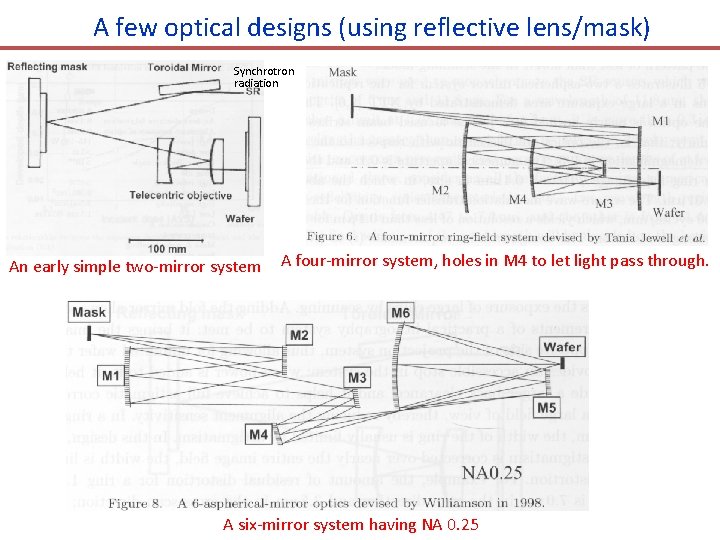
A few optical designs (using reflective lens/mask) Synchrotron radiation An early simple two-mirror system A four-mirror system, holes in M 4 to let light pass through. A six-mirror system having NA 0. 25
13
Extreme UV (EUV) lithography 1. 2. 3. 4. 5. 6. Overview, why EUV lithography? EUV source (hot and dense plasma). Optics (reflection mirrors). Mask (absorber on mirrors). Resist (sensitivity, LER, out-gassing). Contamination control. 14
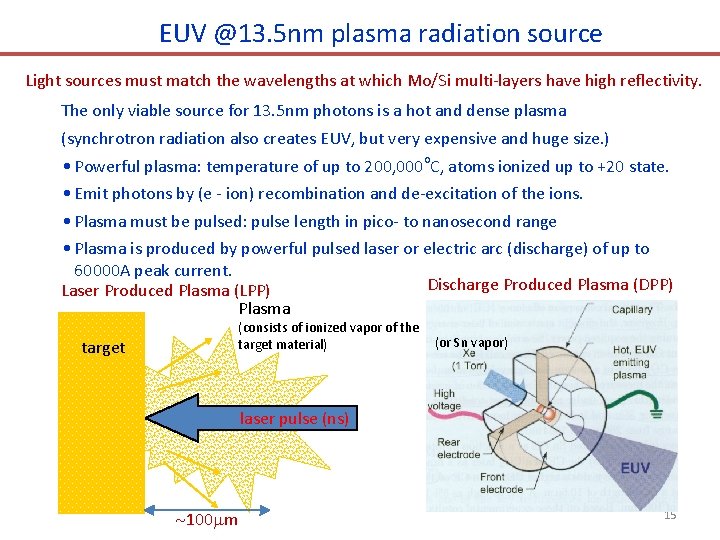
EUV @13. 5 nm plasma radiation source Light sources must match the wavelengths at which Mo/Si multi-layers have high reflectivity. The only viable source for 13. 5 nm photons is a hot and dense plasma (synchrotron radiation also creates EUV, but very expensive and huge size. ) • Powerful plasma: temperature of up to 200, 000 o. C, atoms ionized up to +20 state. • Emit photons by (e - ion) recombination and de-excitation of the ions. • Plasma must be pulsed: pulse length in pico- to nanosecond range • Plasma is produced by powerful pulsed laser or electric arc (discharge) of up to 60000 A peak current. Discharge Produced Plasma (DPP) Laser Produced Plasma (LPP) Plasma (consists of ionized vapor of the target material) target (or Sn vapor) laser pulselaser (ns) 100 m 15

Plasma radiation source for 13. 5 nm: Sn Plasma: ionized gas, similar to the plasma used for reactive ion etching (RIE). But in regular RIE, only <10% gas molecules are ionized; here all ions are ionized, and to a high ionization state (up to Sn 20+). Since the mass of electron is << that of ion, electrons transfer little of its energy to ions upon collision. As a result, electrons and ions are not in thermal equilibrium in a plasma, with electrons much “hotter” than ions. Emission peak wavelength (nm) versus atomic number Laser produced Sn plasma Target, Z=50 [Kr]5 s 24 d 105 p 2 Laser wavelength, Laser flux, Electron temperature, Te Electron density, ne Sn 1. 064 m 1 x 10¹¹ W/cm 2 48. 8 e. V 9. 88 x 1020 cm-3 (300 K is 26 me. V, 1 e. V is 1. 15 104 K) Ion distribution Sn X 0. 046 (Sn 10+) Sn XIII Sn XIV (4. 6%) 0. 243 0. 306 0. 330 0. 068 16
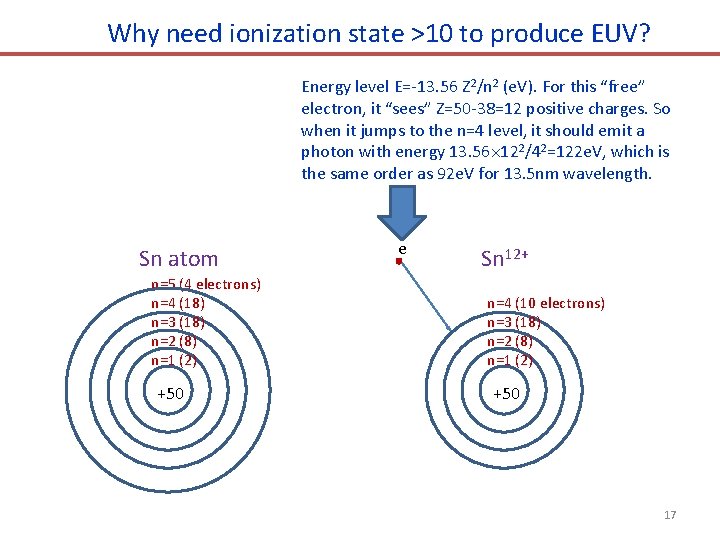
Why need ionization state >10 to produce EUV? Energy level E=-13. 56 Z 2/n 2 (e. V). For this “free” electron, it “sees” Z=50 -38=12 positive charges. So when it jumps to the n=4 level, it should emit a photon with energy 13. 56 122/42=122 e. V, which is the same order as 92 e. V for 13. 5 nm wavelength. Sn atom n=5 (4 electrons) n=4 (18) n=3 (18) n=2 (8) n=1 (2) +50 e Sn 12+ n=4 (10 electrons) n=3 (18) n=2 (8) n=1 (2) +50 17
Extreme UV (EUV) lithography 1. 2. 3. 4. 5. 6. Overview, why EUV lithography? EUV source (hot and dense plasma). Optics (reflection mirrors). Mask (absorber on mirrors). Resist (sensitivity, LER, out-gassing). Contamination control. 18
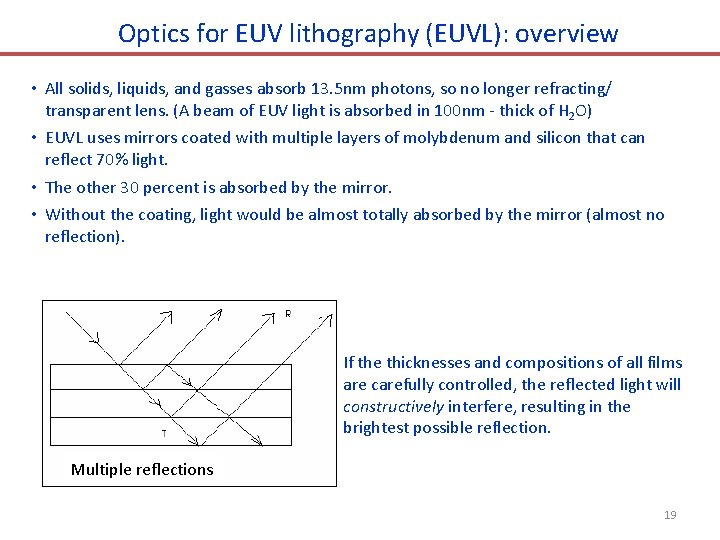
Optics for EUV lithography (EUVL): overview • All solids, liquids, and gasses absorb 13. 5 nm photons, so no longer refracting/ transparent lens. (A beam of EUV light is absorbed in 100 nm - thick of H 2 O) • EUVL uses mirrors coated with multiple layers of molybdenum and silicon that can reflect 70% light. • The other 30 percent is absorbed by the mirror. • Without the coating, light would be almost totally absorbed by the mirror (almost no reflection). If the thicknesses and compositions of all films are carefully controlled, the reflected light will constructively interfere, resulting in the brightest possible reflection. Multiple reflections 19

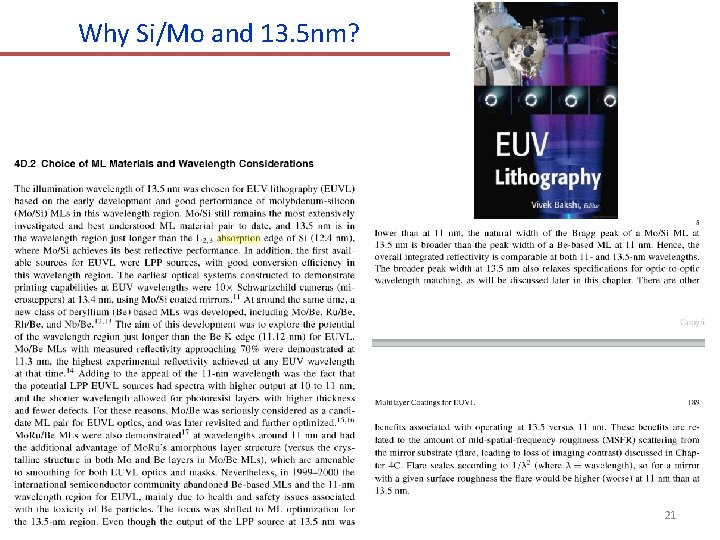
Why Si/Mo and 13. 5 nm? Absorption in solids for EUV and soft x-rays For high reflection, the absorption should be low (i. e. attenuation length should be large). So Mo, Si, Be are good candidates at 10 -15 nm. I=I 0 e- t=I 0 e-t/ t: depth into the material : absorption coefficient : attenuation length • Mo/Si 40 layer pairs give 70% reflectance where Mo and Si are most transparent. • Mo/Be is higher (at =11 nm) but narrower ; and more importantly, Be is toxic. 20
Why Si/Mo and 13. 5 nm? 21
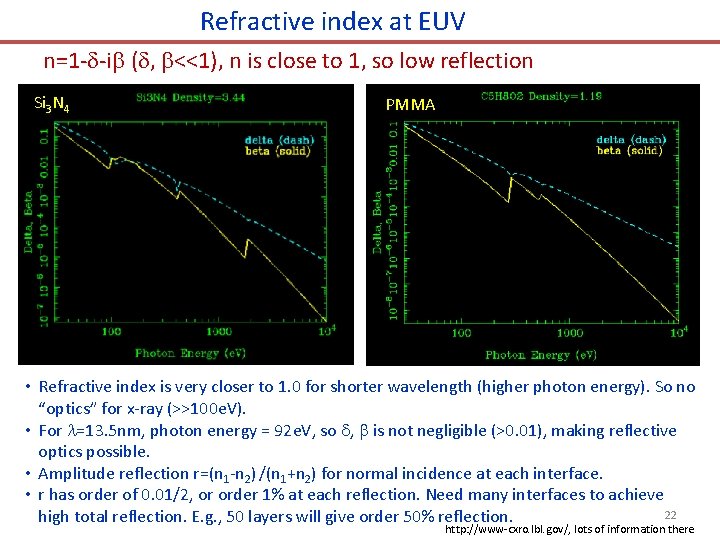
Refractive index at EUV n=1 - -i ( , <<1), n is close to 1, so low reflection Si 3 N 4 PMMA • Refractive index is very closer to 1. 0 for shorter wavelength (higher photon energy). So no “optics” for x-ray (>>100 e. V). • For =13. 5 nm, photon energy = 92 e. V, so , is not negligible (>0. 01), making reflective optics possible. • Amplitude reflection r=(n 1 -n 2) /(n 1+n 2) for normal incidence at each interface. • r has order of 0. 01/2, or order 1% at each reflection. Need many interfaces to achieve 22 high total reflection. E. g. , 50 layers will give order 50% reflection. http: //www-cxro. lbl. gov/, lots of information there
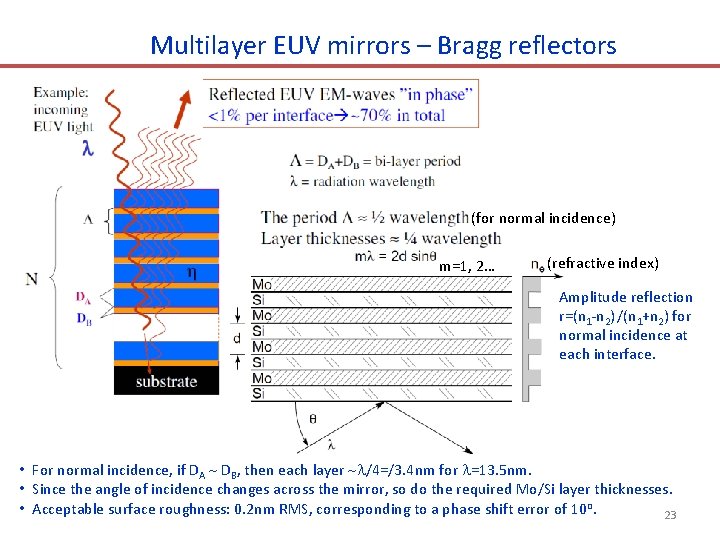
Multilayer EUV mirrors – Bragg reflectors (for normal incidence) m=1, 2… (refractive index) Amplitude reflection r=(n 1 -n 2) /(n 1+n 2) for normal incidence at each interface. • For normal incidence, if DA DB, then each layer /4=/3. 4 nm for =13. 5 nm. • Since the angle of incidence changes across the mirror, so do the required Mo/Si layer thicknesses. • Acceptable surface roughness: 0. 2 nm RMS, corresponding to a phase shift error of 10 o. 23
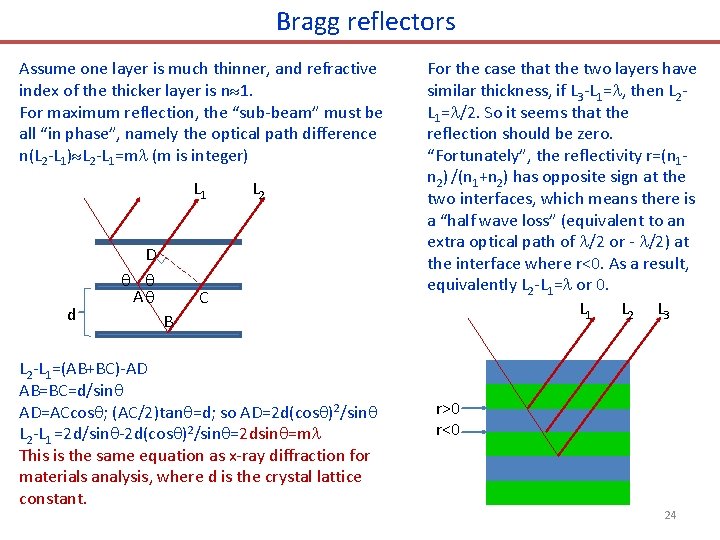
Bragg reflectors Assume one layer is much thinner, and refractive index of the thicker layer is n 1. For maximum reflection, the “sub-beam” must be all “in phase”, namely the optical path difference n(L 2 -L 1) L 2 -L 1=m (m is integer) L 1 d D A L 2 C B L 2 -L 1=(AB+BC)-AD AB=BC=d/sin AD=ACcos ; (AC/2)tan =d; so AD=2 d(cos )2/sin L 2 -L 1 =2 d/sin -2 d(cos )2/sin =2 dsin =m This is the same equation as x-ray diffraction for materials analysis, where d is the crystal lattice constant. For the case that the two layers have similar thickness, if L 3 -L 1= , then L 2 L 1= /2. So it seems that the reflection should be zero. “Fortunately”, the reflectivity r=(n 1 n 2) /(n 1+n 2) has opposite sign at the two interfaces, which means there is a “half wave loss” (equivalent to an extra optical path of /2 or - /2) at the interface where r<0. As a result, equivalently L 2 -L 1= or 0. L 1 L 2 L 3 r>0 r<0 24
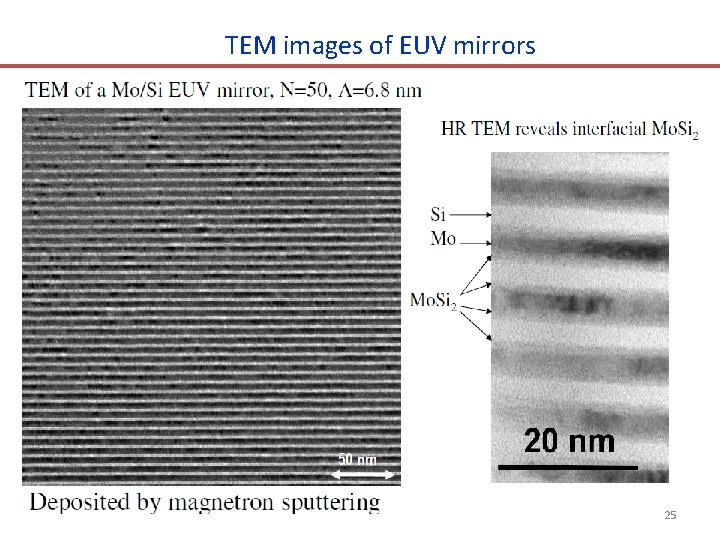
TEM images of EUV mirrors 25
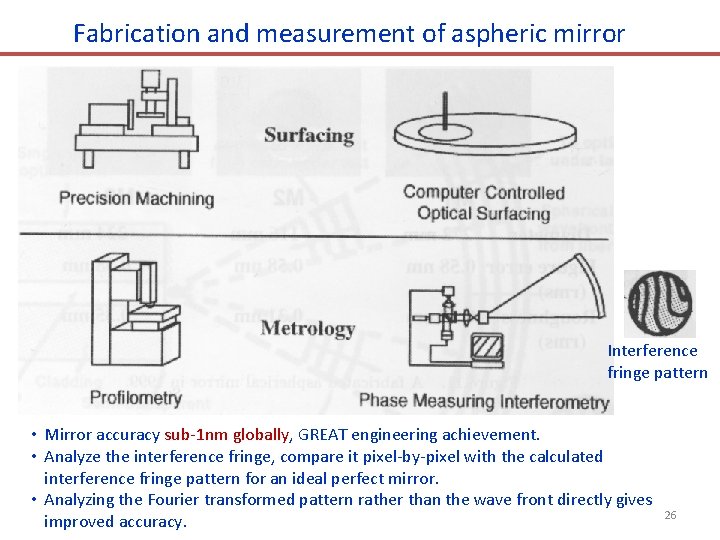
Fabrication and measurement of aspheric mirror Interference fringe pattern • Mirror accuracy sub-1 nm globally, GREAT engineering achievement. • Analyze the interference fringe, compare it pixel-by-pixel with the calculated interference fringe pattern for an ideal perfect mirror. • Analyzing the Fourier transformed pattern rather than the wave front directly gives improved accuracy. 26
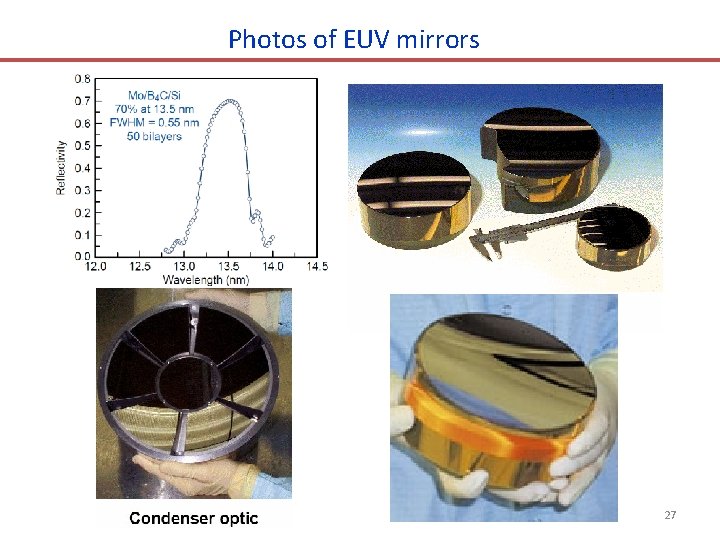
Photos of EUV mirrors 27
Extreme UV (EUV) lithography 1. 2. 3. 4. 5. 6. Overview, why EUV lithography? EUV source (hot and dense plasma). Optics (reflection mirrors). Mask (absorber on mirrors). Resist (sensitivity, LER, out-gassing). Contamination control. 28
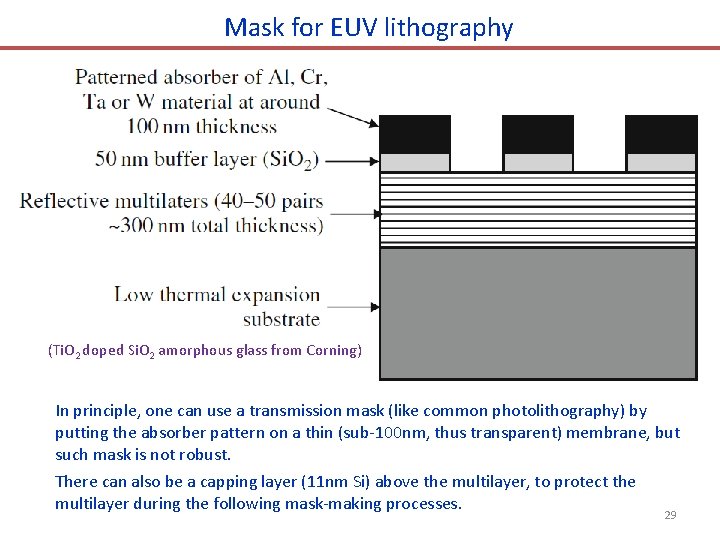
Mask for EUV lithography (Ti. O 2 doped Si. O 2 amorphous glass from Corning) In principle, one can use a transmission mask (like common photolithography) by putting the absorber pattern on a thin (sub-100 nm, thus transparent) membrane, but such mask is not robust. There can also be a capping layer (11 nm Si) above the multilayer, to protect the multilayer during the following mask-making processes. 29
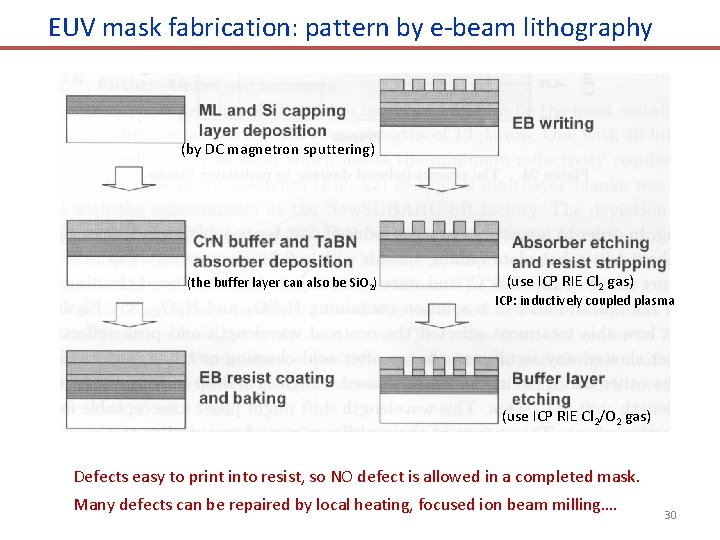
EUV mask fabrication: pattern by e-beam lithography (by DC magnetron sputtering) (the buffer layer can also be Si. O 2) (use ICP RIE Cl 2 gas) ICP: inductively coupled plasma (use ICP RIE Cl 2/O 2 gas) Defects easy to print into resist, so NO defect is allowed in a completed mask. Many defects can be repaired by local heating, focused ion beam milling…. 30
Extreme UV (EUV) lithography 1. 2. 3. 4. 5. 6. Overview, why EUV lithography? EUV source (hot and dense plasma). Optics (reflection mirrors). Mask (absorber on mirrors). Resist (sensitivity, LER, out-gassing). Contamination control. 31
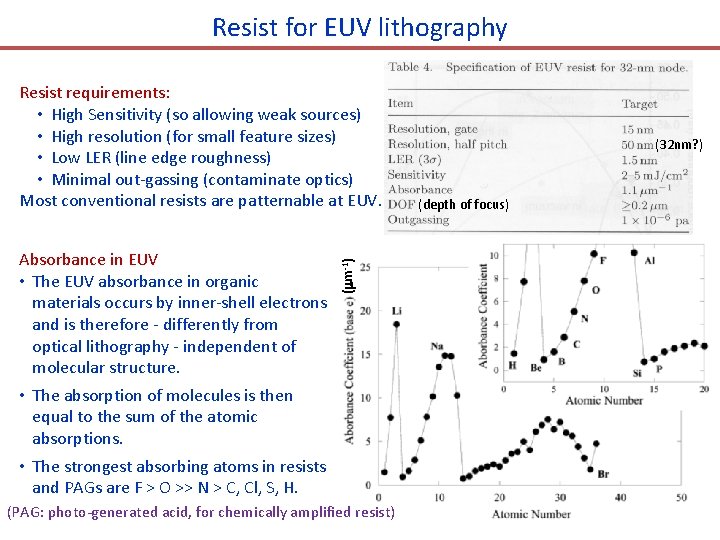
Resist for EUV lithography Absorbance in EUV • The EUV absorbance in organic materials occurs by inner-shell electrons and is therefore - differently from optical lithography - independent of molecular structure. (32 nm? ) (depth of focus) ( m-1) Resist requirements: • High Sensitivity (so allowing weak sources) • High resolution (for small feature sizes) • Low LER (line edge roughness) • Minimal out-gassing (contaminate optics) Most conventional resists are patternable at EUV. • The absorption of molecules is then equal to the sum of the atomic absorptions. • The strongest absorbing atoms in resists and PAGs are F > O >> N > C, Cl, S, H. (PAG: photo-generated acid, for chemically amplified resist) 32
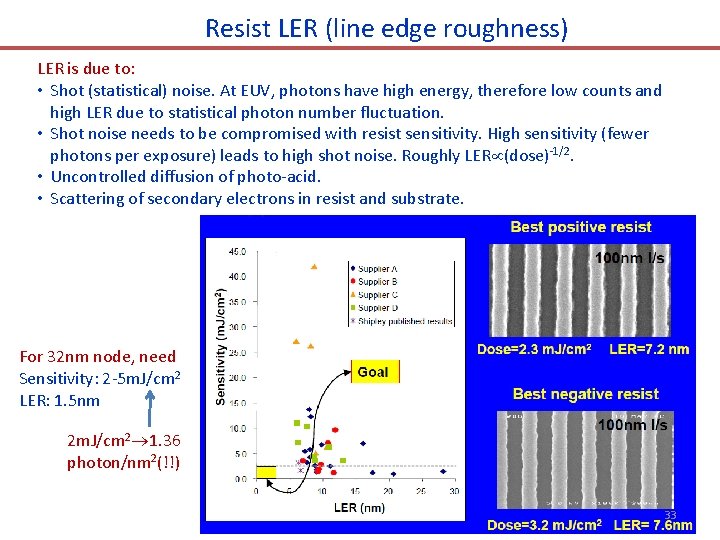
Resist LER (line edge roughness) LER is due to: • Shot (statistical) noise. At EUV, photons have high energy, therefore low counts and high LER due to statistical photon number fluctuation. • Shot noise needs to be compromised with resist sensitivity. High sensitivity (fewer photons per exposure) leads to high shot noise. Roughly LER (dose)-1/2. • Uncontrolled diffusion of photo-acid. • Scattering of secondary electrons in resist and substrate. For 32 nm node, need Sensitivity: 2 -5 m. J/cm 2 LER: 1. 5 nm 2 m. J/cm 2 1. 36 photon/nm 2(!!) 33
Extreme UV (EUV) lithography 1. 2. 3. 4. 5. 6. Overview, why EUV lithography? EUV source (hot and dense plasma). Optics (reflection mirrors). Mask (absorber on mirrors). Resist (sensitivity, LER, out-gassing). Contamination control. 34
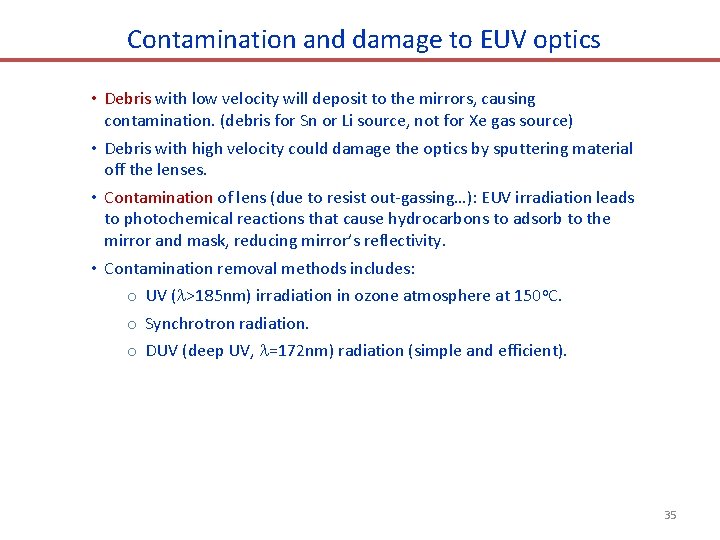
Contamination and damage to EUV optics • Debris with low velocity will deposit to the mirrors, causing contamination. (debris for Sn or Li source, not for Xe gas source) • Debris with high velocity could damage the optics by sputtering material off the lenses. • Contamination of lens (due to resist out-gassing…): EUV irradiation leads to photochemical reactions that cause hydrocarbons to adsorb to the mirror and mask, reducing mirror’s reflectivity. • Contamination removal methods includes: o UV ( >185 nm) irradiation in ozone atmosphere at 150 o. C. o Synchrotron radiation. o DUV (deep UV, =172 nm) radiation (simple and efficient). 35
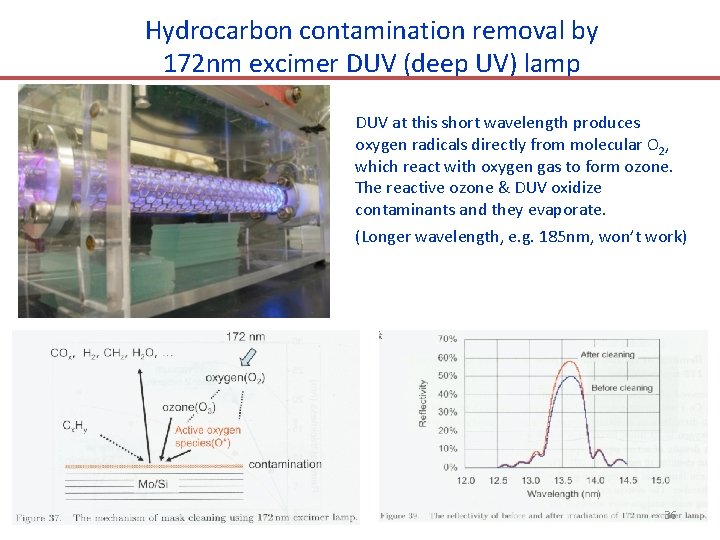
Hydrocarbon contamination removal by 172 nm excimer DUV (deep UV) lamp DUV at this short wavelength produces oxygen radicals directly from molecular O 2, which react with oxygen gas to form ozone. The reactive ozone & DUV oxidize contaminants and they evaporate. (Longer wavelength, e. g. 185 nm, won’t work) 36
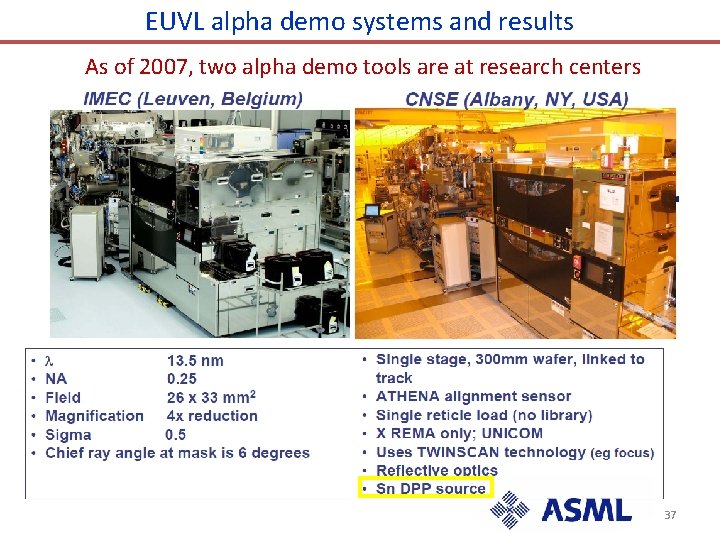
EUVL alpha demo systems and results As of 2007, two alpha demo tools are at research centers 37
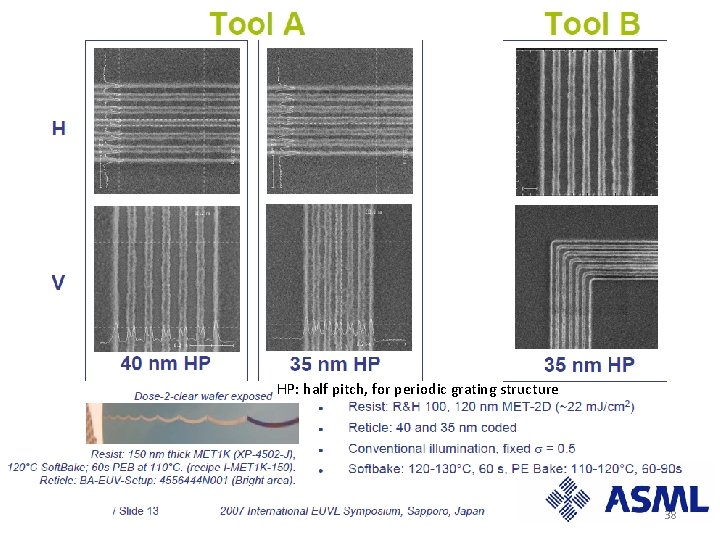
HP: half pitch, for periodic grating structure 38
- Slides: 38