
Slide 17 1 Meaning of Competence and Competencies
- Slides: 24
Slide 17. 1 Meaning of Competence and Competencies • Terms pervade much of HRM literature • Terms are often used confusingly • Competence – ability to carry out a specific task • Competency – refers to behaviour Torrington, Hall & Taylor, Human Resource Management 6 e, © Pearson Education Limited 2005
Slide 17. 2 Government Initiatives • Investors in people • Sector Skills Councils (SSCs) • Learning and Skills Councils (LSCs) Torrington, Hall & Taylor, Human Resource Management 6 e, © Pearson Education Limited 2005
Slide 17. 3 Competence Movement • Tension between what a trainee knows and what they can do after training • Knowledge rather than practical skills carries status • Government policy around schools – heightened emphasis on practical vocational skills Torrington, Hall & Taylor, Human Resource Management 6 e, © Pearson Education Limited 2005
Slide 17. 4 NVQs • Bringing together a range of vocational qualifications • Developed for all occupational areas • Five levels – basic to more complex Torrington, Hall & Taylor, Human Resource Management 6 e, © Pearson Education Limited 2005
Slide 17. 5 Training for Competence • Criterion related • Developing ability of trainees to perform tasks related to job • Expressed in terms of performance outcomes and specific indicators Torrington, Hall & Taylor, Human Resource Management 6 e, © Pearson Education Limited 2005
Slide 17. 6 NVQ Standards Divided into job roles Key roles then subdivided into units of competence Then subdivision into elements of competence with attached performance criteria and range statements Torrington, Hall & Taylor, Human Resource Management 6 e, © Pearson Education Limited 2005
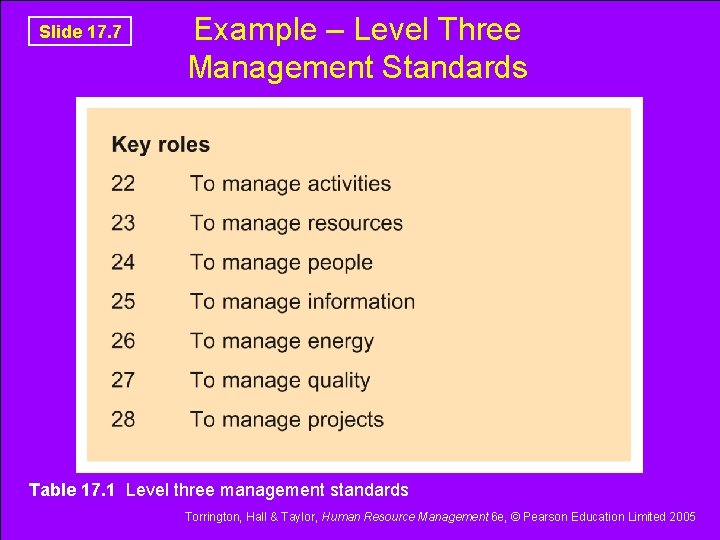
Slide 17. 7 Example – Level Three Management Standards Table 17. 1 Level three management standards Torrington, Hall & Taylor, Human Resource Management 6 e, © Pearson Education Limited 2005
Slide 17. 8 Principles of Competencies Leading to National Qualifications (1 of 2) 1. Open access 2. Focus on what people can do 3. Qualification same wherever training takes place 4. Feature performance standards as basis of assessment 5. Flexibility and modularisation 6. Accreditation of prior experience and learning Torrington, Hall & Taylor, Human Resource Management 6 e, © Pearson Education Limited 2005
Slide 17. 9 Principles of Competencies Leading to National Qualifications (2 of 2) 7. Establishment of learning contract 8. Flexibility in assessment achieved by the portfolio principle 9. Continuous development 10. Standards determined by designated lead bodies 11. Assessment 12. GNVQs Torrington, Hall & Taylor, Human Resource Management 6 e, © Pearson Education Limited 2005
Slide 17. 10 Problematic Aspects of NVQs (1 of 2) 1. Assessment process can be laborious 2. A lot of terminology around NVQs 3. Generality of standards leads employers to modify for own use 4. Difficult to measure satisfactory quality of assessment 5. Standards are reductionist 6. Functional approach can be narrow Torrington, Hall & Taylor, Human Resource Management 6 e, © Pearson Education Limited 2005
Slide 17. 11 Problematic Aspects of NVQs (2 of 2) 7. Early management standards gave incomplete representation of management 8. Lack of attention to learning and cognitive processes 9. May not stimulate further development 10. Some resistance to idea that educators are not competent to set the training agenda Torrington, Hall & Taylor, Human Resource Management 6 e, © Pearson Education Limited 2005
Slide 17. 12 Characteristics of Behavioural Competencies • • • Trait Motive Skill Self image Social role Torrington, Hall & Taylor, Human Resource Management 6 e, © Pearson Education Limited 2005
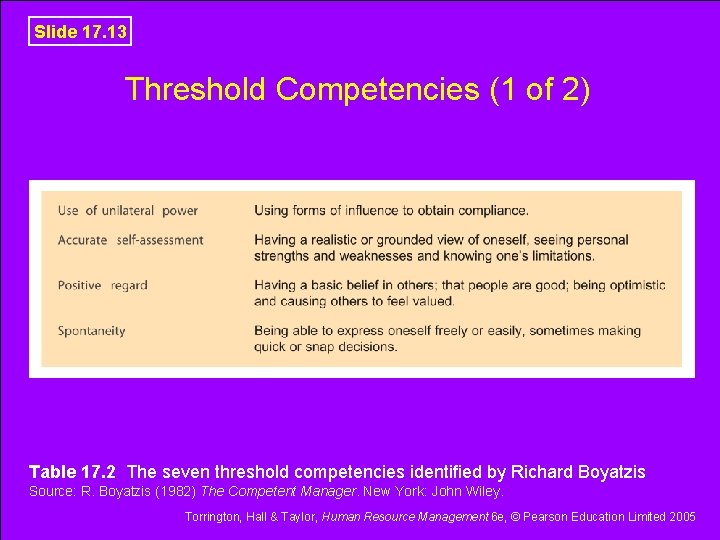
Slide 17. 13 Threshold Competencies (1 of 2) Table 17. 2 The seven threshold competencies identified by Richard Boyatzis Source: R. Boyatzis (1982) The Competent Manager. New York: John Wiley. Torrington, Hall & Taylor, Human Resource Management 6 e, © Pearson Education Limited 2005
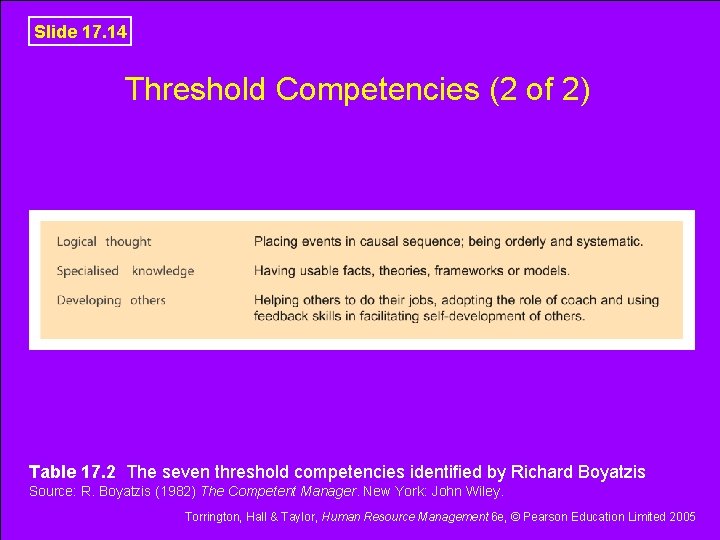
Slide 17. 14 Threshold Competencies (2 of 2) Table 17. 2 The seven threshold competencies identified by Richard Boyatzis Source: R. Boyatzis (1982) The Competent Manager. New York: John Wiley. Torrington, Hall & Taylor, Human Resource Management 6 e, © Pearson Education Limited 2005
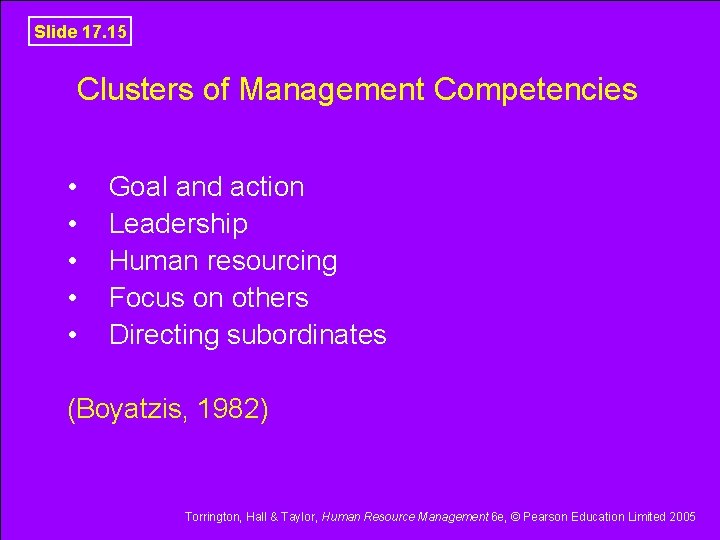
Slide 17. 15 Clusters of Management Competencies • • • Goal and action Leadership Human resourcing Focus on others Directing subordinates (Boyatzis, 1982) Torrington, Hall & Taylor, Human Resource Management 6 e, © Pearson Education Limited 2005
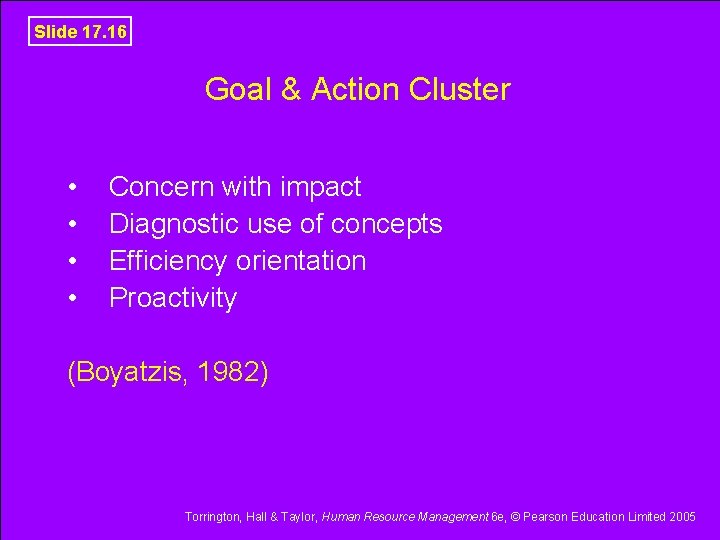
Slide 17. 16 Goal & Action Cluster • • Concern with impact Diagnostic use of concepts Efficiency orientation Proactivity (Boyatzis, 1982) Torrington, Hall & Taylor, Human Resource Management 6 e, © Pearson Education Limited 2005
Slide 17. 17 Leadership Cluster • • • Conceptualisation Self confidence Oral presentations (Boyatzis, 1982) Torrington, Hall & Taylor, Human Resource Management 6 e, © Pearson Education Limited 2005
Slide 17. 18 Human Resource Management Cluster • • Use of socialised power Managing group processes (Boyatzis, 1982) Torrington, Hall & Taylor, Human Resource Management 6 e, © Pearson Education Limited 2005
Slide 17. 19 Focus on Others Cluster • • • Perceptual objectivity Self control Stamina and adaptability (Boyatzis, 1982) Torrington, Hall & Taylor, Human Resource Management 6 e, © Pearson Education Limited 2005
Slide 17. 20 Directing Subordinates Cluster • • • Developing others Spontaneity Use of unilateral power (Boyatzis, 1982) Torrington, Hall & Taylor, Human Resource Management 6 e, © Pearson Education Limited 2005
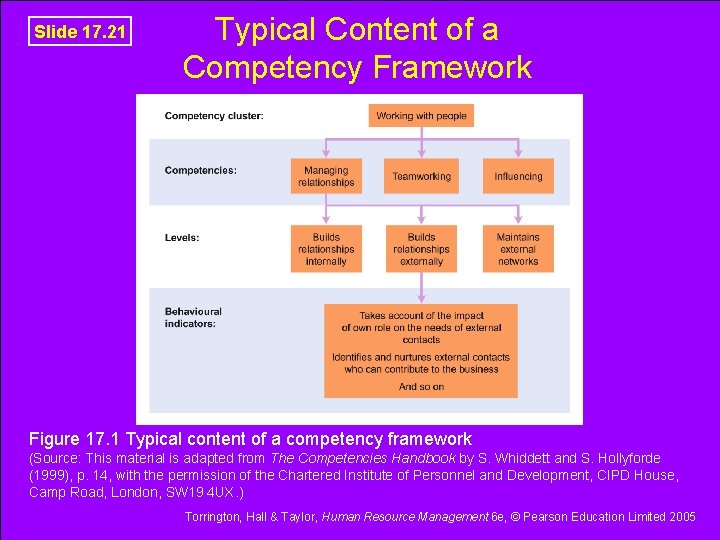
Slide 17. 21 Typical Content of a Competency Framework Figure 17. 1 Typical content of a competency framework (Source: This material is adapted from The Competencies Handbook by S. Whiddett and S. Hollyforde (1999), p. 14, with the permission of the Chartered Institute of Personnel and Development, CIPD House, Camp Road, London, SW 19 4 UX. ) Torrington, Hall & Taylor, Human Resource Management 6 e, © Pearson Education Limited 2005
Slide 17. 22 Advantages of Behavioural Competencies • • Way of expressing what is valued by an organisation Provide a critical mechanism for integrating HR practices to strategic approach to HR Competency framework can be used across HR practices Employees can be given a consistent message about what is valued and expected Torrington, Hall & Taylor, Human Resource Management 6 e, © Pearson Education Limited 2005
Slide 17. 23 Problematic Aspects of Behavioural Competencies • • • Complex research processes required Due to research process competencies will be backward looking May not include every aspect critical to superior performance A wider perspective needs to be taken People’s behaviour may not always be consistent Torrington, Hall & Taylor, Human Resource Management 6 e, © Pearson Education Limited 2005
Slide 17. 24 Summary • • • IIP, SSCs and LSCs encourage the competence movement and NVQs Competence is concerned with job standards and output Competency refers to behaviour or input Main vehicle for learning to achieve competence is NVQs continually criticised Torrington, Hall & Taylor, Human Resource Management 6 e, © Pearson Education Limited 2005