
Slide 13 Unbypassed RE CE EmitterBias Configuration Slide
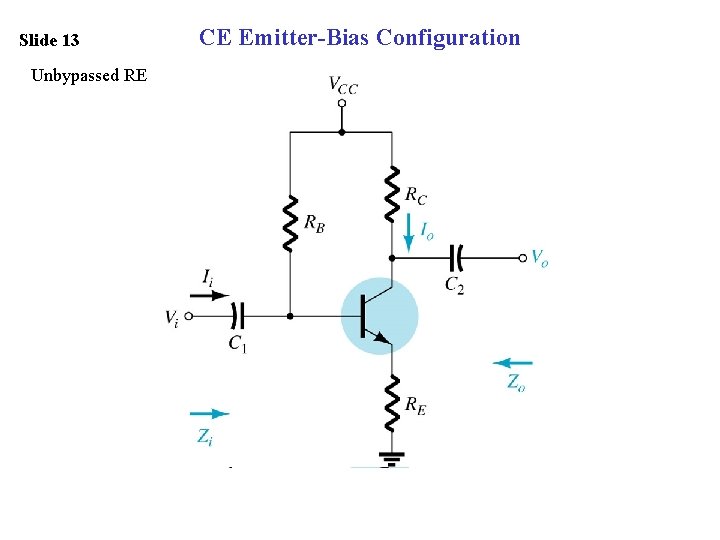
Slide 13 Unbypassed RE CE Emitter-Bias Configuration
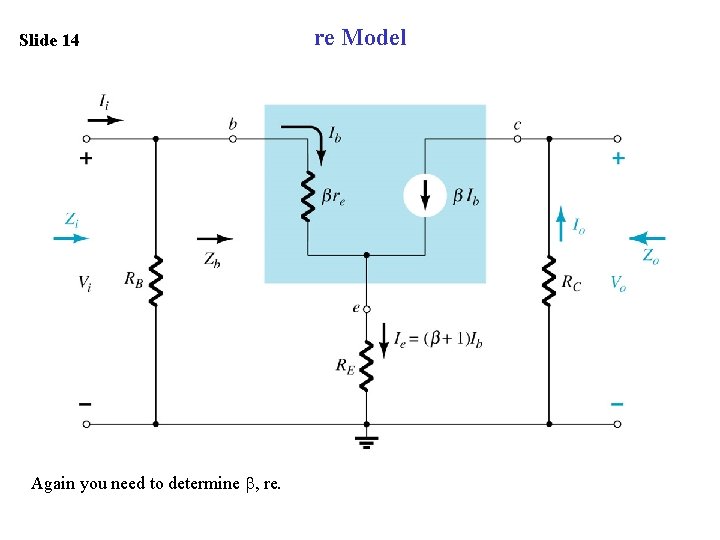
Slide 14 Again you need to determine , re. re Model
![Slide 15 Impedance Calculations Input Impedance: [Formula 8. 20] [Formula 8. 21] [Formula 8.](http://slidetodoc.com/presentation_image_h/235b6840cf966bc71d096fe8793ab000/image-3.jpg "Slide 15 Impedance Calculations Input Impedance: [Formula 8. 20] [Formula 8. 21] [Formula 8.")
Slide 15 Impedance Calculations Input Impedance: [Formula 8. 20] [Formula 8. 21] [Formula 8. 22] [Formula 8. 23] Output Impedance: [Formula 8. 33]
![Gain Calculations Slide 16 Voltage Gain (Av): [Formula 8. 25] [Formula 8. 26] or](http://slidetodoc.com/presentation_image_h/235b6840cf966bc71d096fe8793ab000/image-4.jpg "Gain Calculations Slide 16 Voltage Gain (Av): [Formula 8. 25] [Formula 8. 26] or")
Gain Calculations Slide 16 Voltage Gain (Av): [Formula 8. 25] [Formula 8. 26] or [Formula 8. 27] Current Gain (Ai): [Formula 8. 28] Current Gain from Voltage Gain: [Formula 8. 29]
Slide 17 Phase Relationship A CE amplifier configuration will always have a phase relationship between input and output is 180 degrees. This is independent of the DC bias.
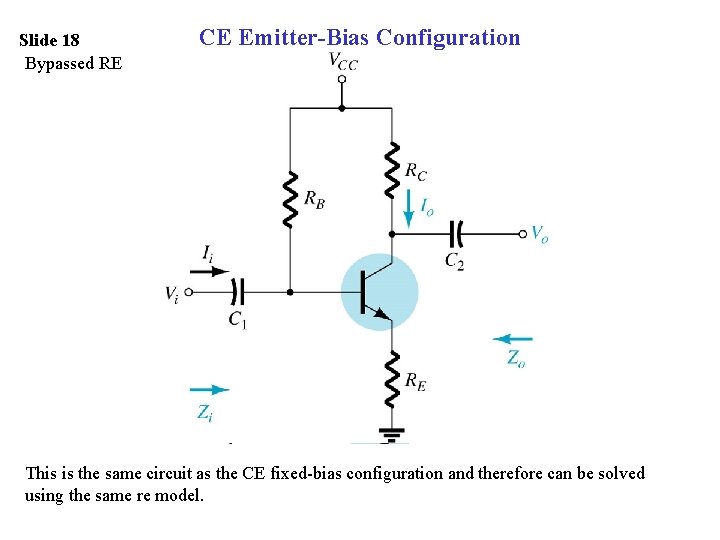
Slide 18 Bypassed RE CE Emitter-Bias Configuration This is the same circuit as the CE fixed-bias configuration and therefore can be solved using the same re model.
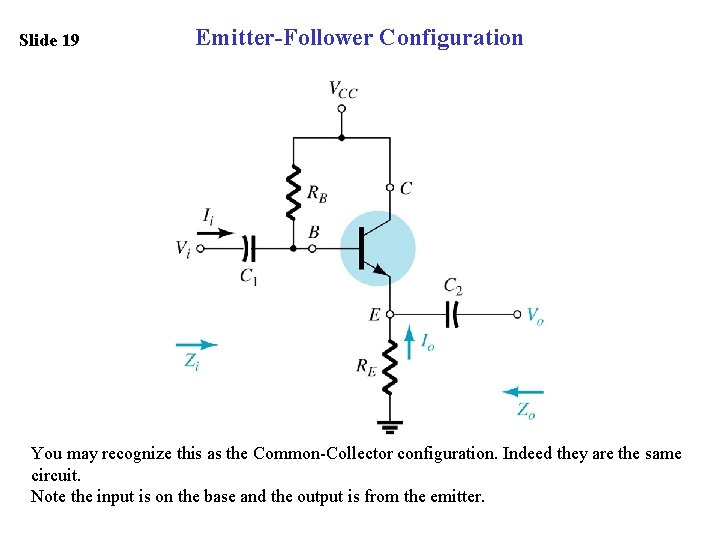
Slide 19 Emitter-Follower Configuration You may recognize this as the Common-Collector configuration. Indeed they are the same circuit. Note the input is on the base and the output is from the emitter.
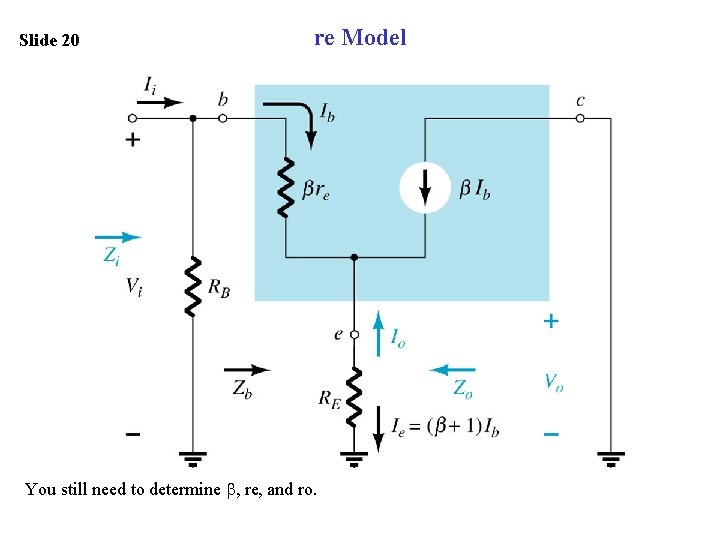
Slide 20 re Model You still need to determine , re, and ro.
![Slide 21 Impedance Calculations Input Impedance: [Formula 8. 37] [Formula 8. 38] [Formula 8.](http://slidetodoc.com/presentation_image_h/235b6840cf966bc71d096fe8793ab000/image-9.jpg "Slide 21 Impedance Calculations Input Impedance: [Formula 8. 37] [Formula 8. 38] [Formula 8.")
Slide 21 Impedance Calculations Input Impedance: [Formula 8. 37] [Formula 8. 38] [Formula 8. 39] [Formula 8. 40]
![Slide 22 Impedance Calculations (cont’d) Output Impedance: [Formula 8. 42] [Formula 8. 43]](http://slidetodoc.com/presentation_image_h/235b6840cf966bc71d096fe8793ab000/image-10.jpg "Slide 22 Impedance Calculations (cont’d) Output Impedance: [Formula 8. 42] [Formula 8. 43]")
Slide 22 Impedance Calculations (cont’d) Output Impedance: [Formula 8. 42] [Formula 8. 43]
![Slide 23 Gain Calculations Voltage Gain (Av): [Formula 8. 44] [Formula 8. 45] Current](http://slidetodoc.com/presentation_image_h/235b6840cf966bc71d096fe8793ab000/image-11.jpg "Slide 23 Gain Calculations Voltage Gain (Av): [Formula 8. 44] [Formula 8. 45] Current")
Slide 23 Gain Calculations Voltage Gain (Av): [Formula 8. 44] [Formula 8. 45] Current Gain (Ai): [Formula 8. 46] Current Gain from Voltage Gain: [Formula 8. 47]
Slide 24 Phase Relationship A CC amplifier or Emitter Follower configuration has no phase shift between input and output.
- Slides: 12