
Slide 11 1 Part III Strategy in Action


- Slides: 35
Slide 11. 1 Part III: Strategy in Action Johnson, Whittington and Scholes, Exploring Strategy, 9 th Edition, © Pearson Education Limited 2011
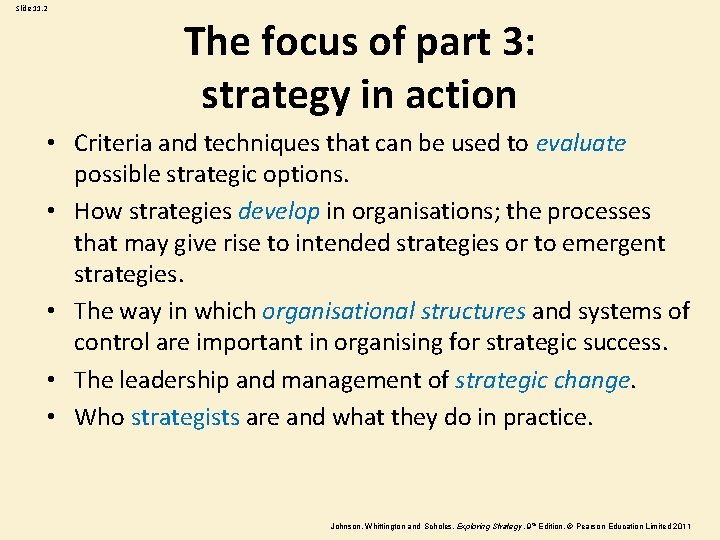
Slide 11. 2 The focus of part 3: strategy in action • Criteria and techniques that can be used to evaluate possible strategic options. • How strategies develop in organisations; the processes that may give rise to intended strategies or to emergent strategies. • The way in which organisational structures and systems of control are important in organising for strategic success. • The leadership and management of strategic change. • Who strategists are and what they do in practice. Johnson, Whittington and Scholes, Exploring Strategy, 9 th Edition, © Pearson Education Limited 2011
Slide 11. 3 Strategy in Action 11: Evaluating Strategies Johnson, Whittington and Scholes, Exploring Strategy, 9 th Edition, © Pearson Education Limited 2011
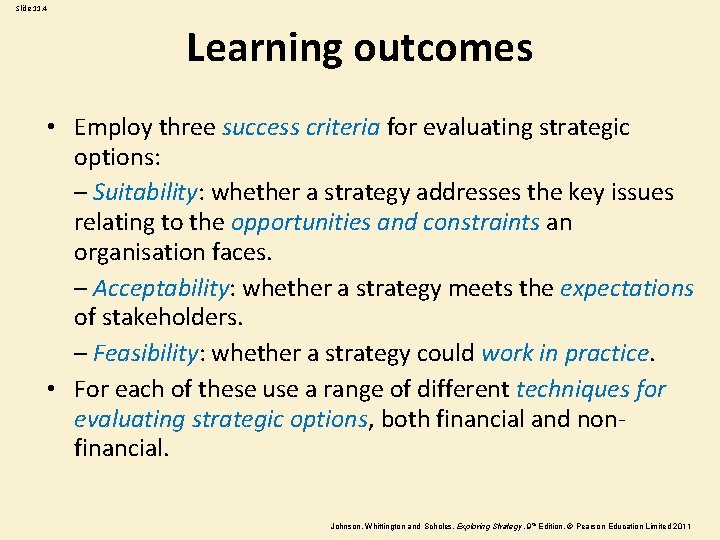
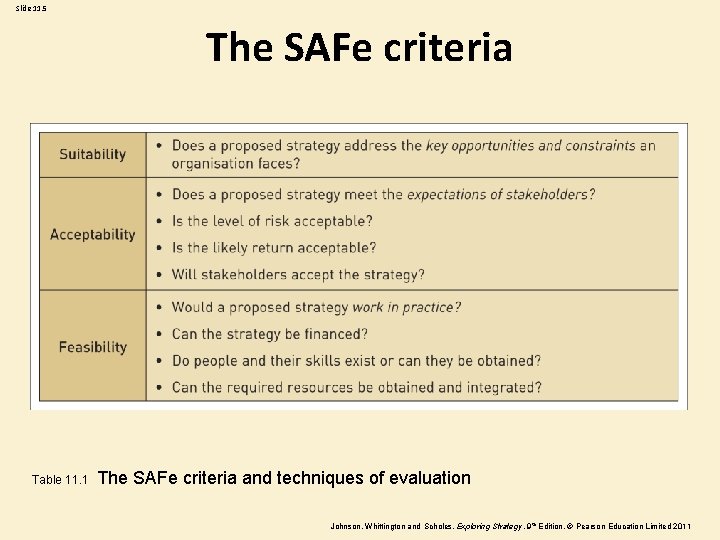
Slide 11. 4 Learning outcomes • Employ three success criteria for evaluating strategic options: – Suitability: whether a strategy addresses the key issues relating to the opportunities and constraints an organisation faces. – Acceptability: whether a strategy meets the expectations of stakeholders. – Feasibility: whether a strategy could work in practice. • For each of these use a range of different techniques for evaluating strategic options, both financial and nonfinancial. Johnson, Whittington and Scholes, Exploring Strategy, 9 th Edition, © Pearson Education Limited 2011
Slide 11. 5 The SAFe criteria Table 11. 1 The SAFe criteria and techniques of evaluation Johnson, Whittington and Scholes, Exploring Strategy, 9 th Edition, © Pearson Education Limited 2011
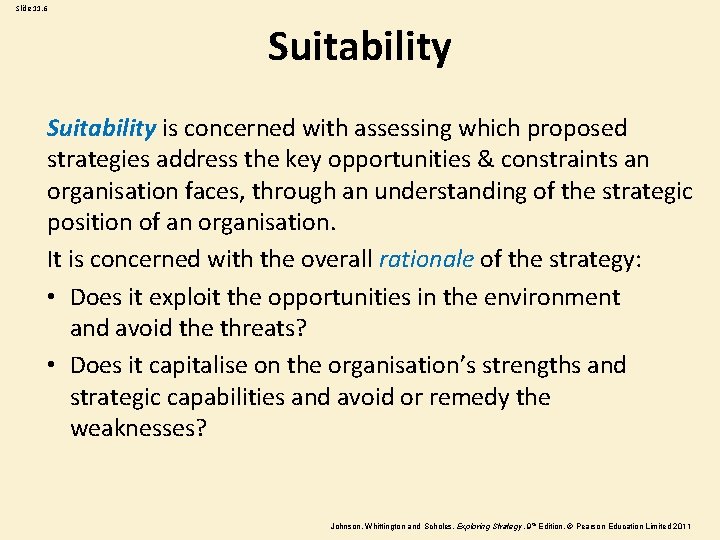
Slide 11. 6 Suitability is concerned with assessing which proposed strategies address the key opportunities & constraints an organisation faces, through an understanding of the strategic position of an organisation. It is concerned with the overall rationale of the strategy: • Does it exploit the opportunities in the environment and avoid the threats? • Does it capitalise on the organisation’s strengths and strategic capabilities and avoid or remedy the weaknesses? Johnson, Whittington and Scholes, Exploring Strategy, 9 th Edition, © Pearson Education Limited 2011
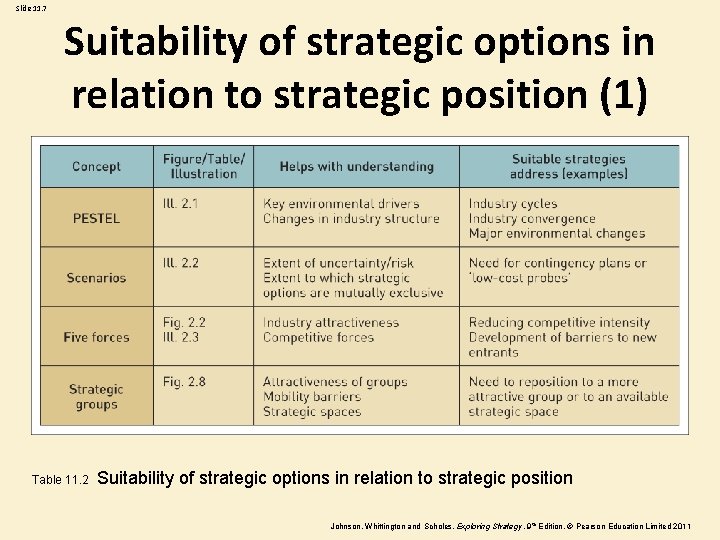
Slide 11. 7 Suitability of strategic options in relation to strategic position (1) Table 11. 2 Suitability of strategic options in relation to strategic position Johnson, Whittington and Scholes, Exploring Strategy, 9 th Edition, © Pearson Education Limited 2011
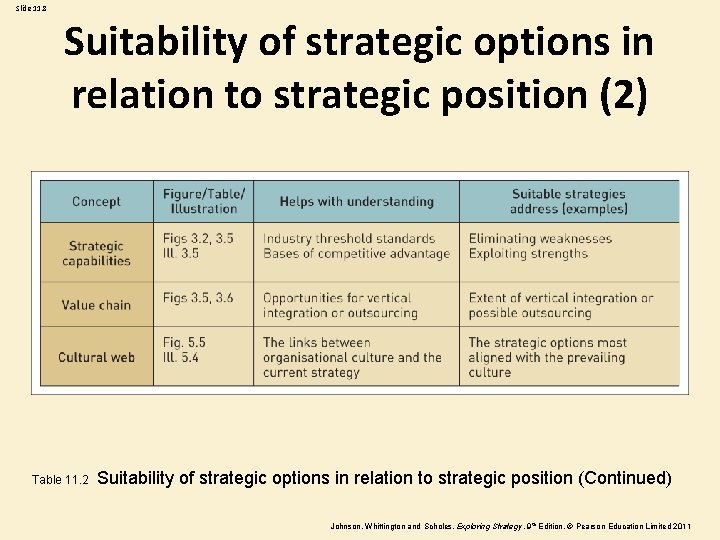
Slide 11. 8 Suitability of strategic options in relation to strategic position (2) Table 11. 2 Suitability of strategic options in relation to strategic position (Continued) Johnson, Whittington and Scholes, Exploring Strategy, 9 th Edition, © Pearson Education Limited 2011
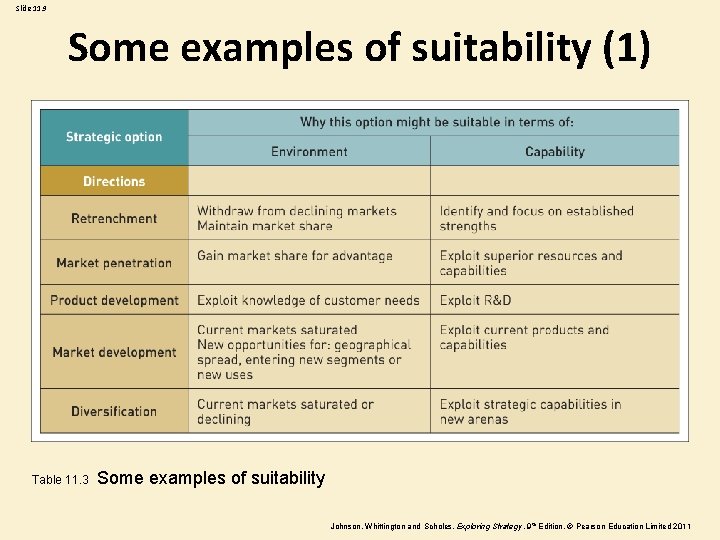
Slide 11. 9 Some examples of suitability (1) Table 11. 3 Some examples of suitability Johnson, Whittington and Scholes, Exploring Strategy, 9 th Edition, © Pearson Education Limited 2011
Slide 11. 10 Some examples of suitability (2) Table 11. 3 Some examples of suitability (Continued) Johnson, Whittington and Scholes, Exploring Strategy, 9 th Edition, © Pearson Education Limited 2011
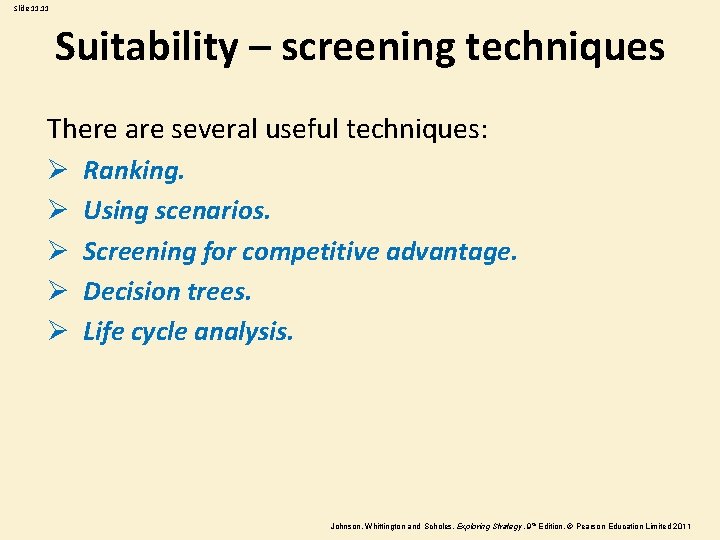
Slide 11. 11 Suitability – screening techniques There are several useful techniques: Ø Ø Ø Ranking. Using scenarios. Screening for competitive advantage. Decision trees. Life cycle analysis. Johnson, Whittington and Scholes, Exploring Strategy, 9 th Edition, © Pearson Education Limited 2011
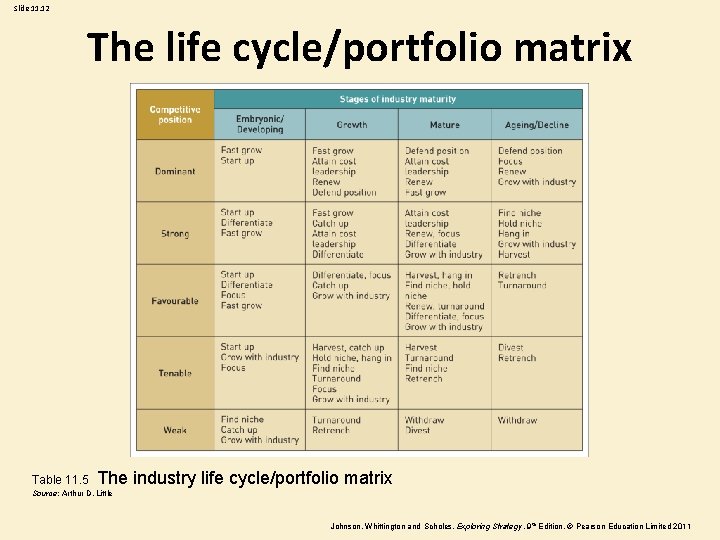
Slide 11. 12 The life cycle/portfolio matrix Table 11. 5 The industry life cycle/portfolio matrix Source: Arthur D. Little Johnson, Whittington and Scholes, Exploring Strategy, 9 th Edition, © Pearson Education Limited 2011
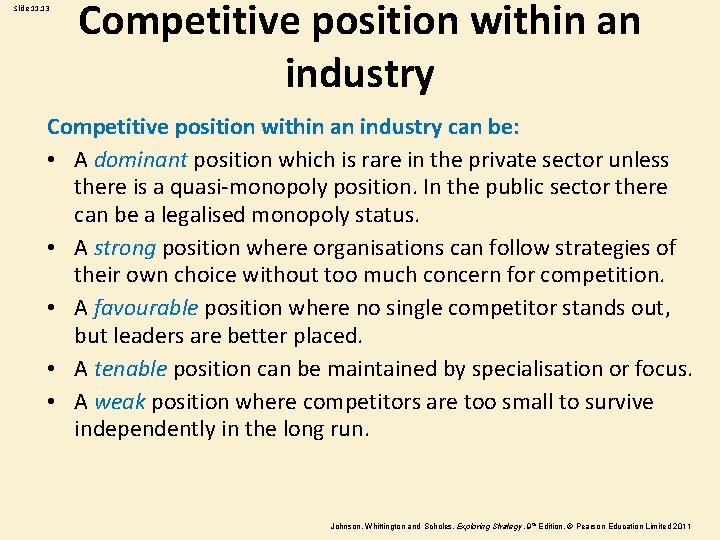
Slide 11. 13 Competitive position within an industry can be: • A dominant position which is rare in the private sector unless there is a quasi-monopoly position. In the public sector there can be a legalised monopoly status. • A strong position where organisations can follow strategies of their own choice without too much concern for competition. • A favourable position where no single competitor stands out, but leaders are better placed. • A tenable position can be maintained by specialisation or focus. • A weak position where competitors are too small to survive independently in the long run. Johnson, Whittington and Scholes, Exploring Strategy, 9 th Edition, © Pearson Education Limited 2011
Slide 11. 14 Acceptability (1) Acceptability is concerned with whether the expected performance outcomes of a proposed strategy meet the expectations of stakeholders. Johnson, Whittington and Scholes, Exploring Strategy, 9 th Edition, © Pearson Education Limited 2011
Slide 11. 15 Acceptability (2) There are three key aspects of acceptability - the ‘ 3 R’s’: • Risk. • Return. • Reactions (of stakeholders). Johnson, Whittington and Scholes, Exploring Strategy, 9 th Edition, © Pearson Education Limited 2011
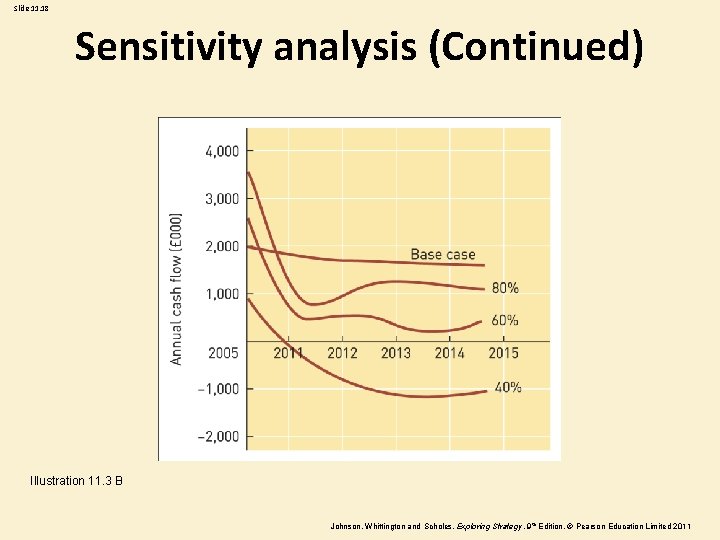
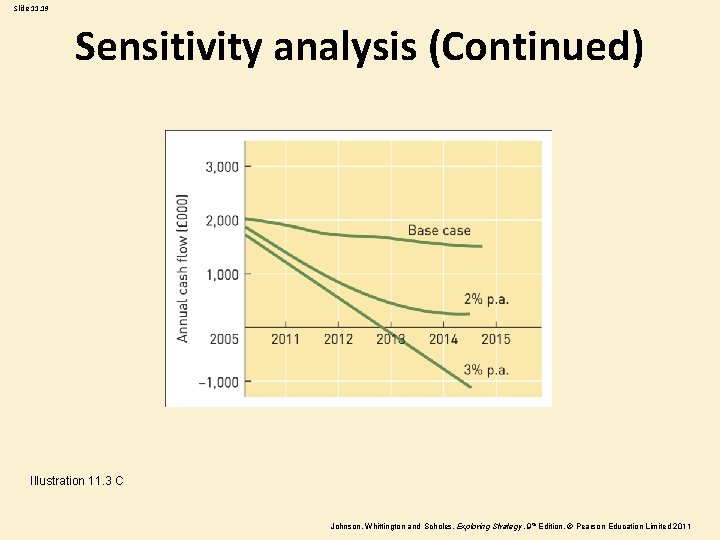
Slide 11. 16 Risk • Risk concerns the extent to which the outcomes of a strategy can be predicted. • Risk can be assessed using: ØSensitivity analysis. ØFinancial ratios – e. g. gearing and liquidity. ØBreak-even analysis. Johnson, Whittington and Scholes, Exploring Strategy, 9 th Edition, © Pearson Education Limited 2011
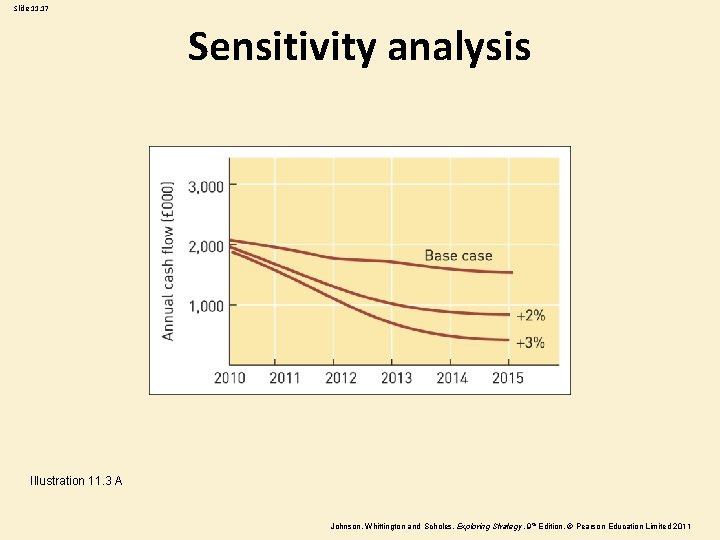
Slide 11. 17 Sensitivity analysis Illustration 11. 3 A Johnson, Whittington and Scholes, Exploring Strategy, 9 th Edition, © Pearson Education Limited 2011
Slide 11. 18 Sensitivity analysis (Continued) Illustration 11. 3 B Johnson, Whittington and Scholes, Exploring Strategy, 9 th Edition, © Pearson Education Limited 2011
Slide 11. 19 Sensitivity analysis (Continued) Illustration 11. 3 C Johnson, Whittington and Scholes, Exploring Strategy, 9 th Edition, © Pearson Education Limited 2011
Slide 11. 20 Return • Returns are the financial benefits which stakeholders are expected to receive from a strategy. • Different approaches to assessing return: Ø Financial analysis. Ø Shareholder value analysis. Ø Cost–benefit analysis. Ø Real options. Johnson, Whittington and Scholes, Exploring Strategy, 9 th Edition, © Pearson Education Limited 2011
Slide 11. 21 Real options evaluation Illustration 11. 6 Johnson, Whittington and Scholes, Exploring Strategy, 9 th Edition, © Pearson Education Limited 2011
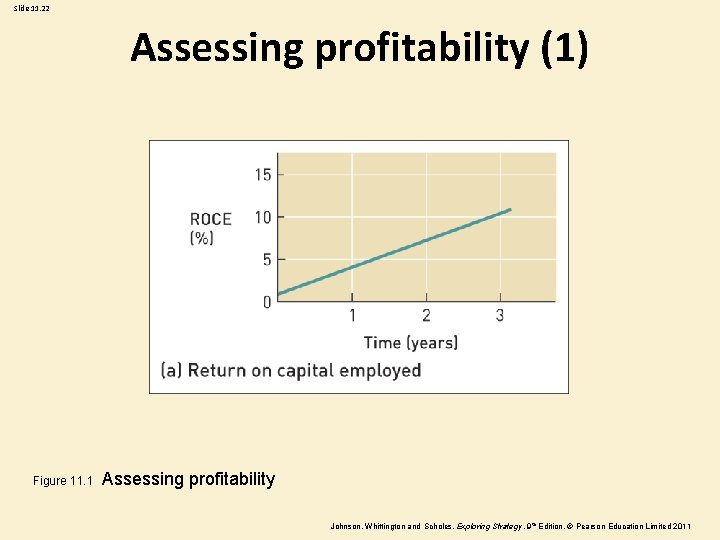
Slide 11. 22 Assessing profitability (1) Figure 11. 1 Assessing profitability Johnson, Whittington and Scholes, Exploring Strategy, 9 th Edition, © Pearson Education Limited 2011
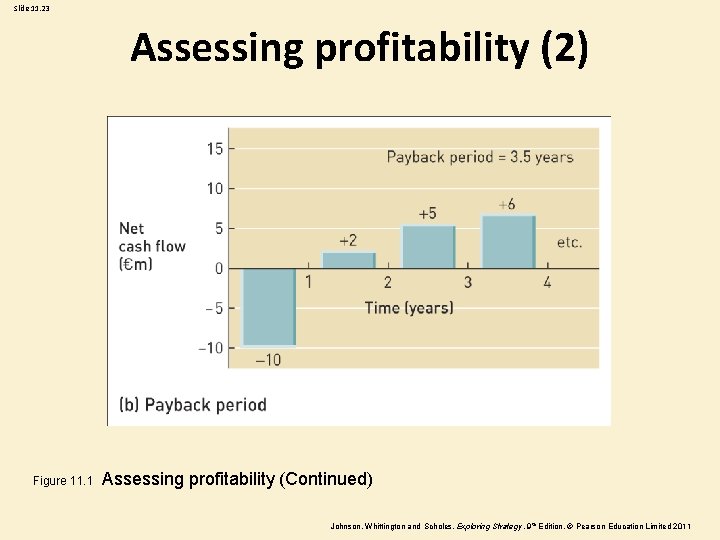
Slide 11. 23 Assessing profitability (2) Figure 11. 1 Assessing profitability (Continued) Johnson, Whittington and Scholes, Exploring Strategy, 9 th Edition, © Pearson Education Limited 2011
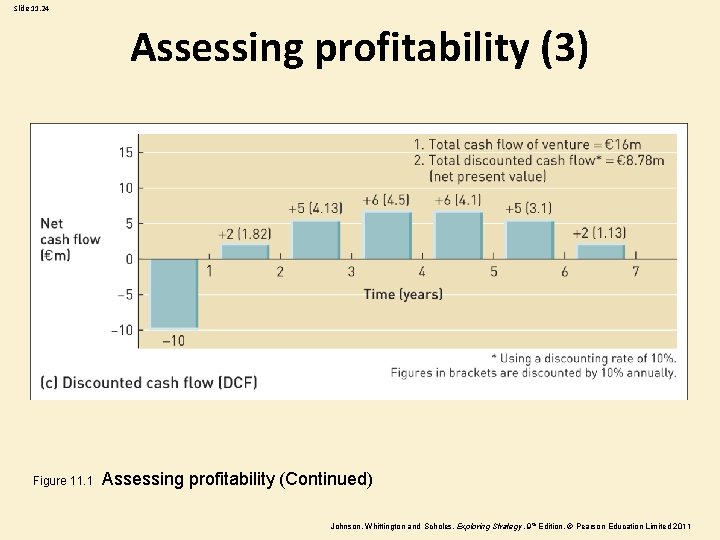
Slide 11. 24 Assessing profitability (3) Figure 11. 1 Assessing profitability (Continued) Johnson, Whittington and Scholes, Exploring Strategy, 9 th Edition, © Pearson Education Limited 2011
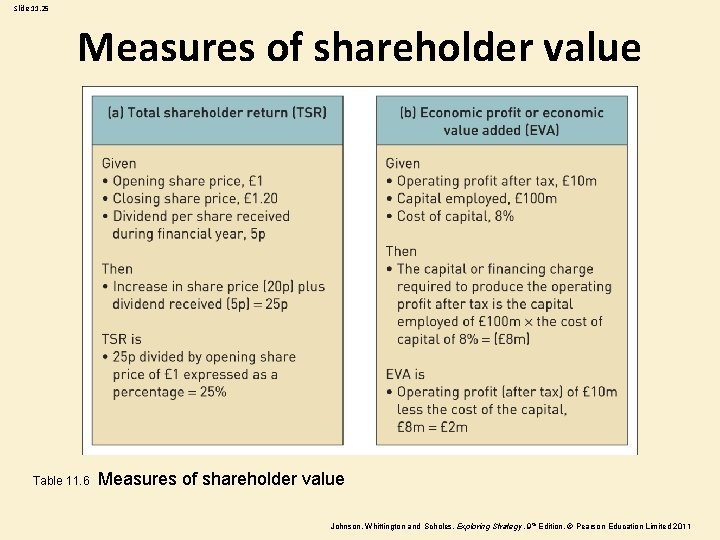
Slide 11. 25 Measures of shareholder value Table 11. 6 Measures of shareholder value Johnson, Whittington and Scholes, Exploring Strategy, 9 th Edition, © Pearson Education Limited 2011
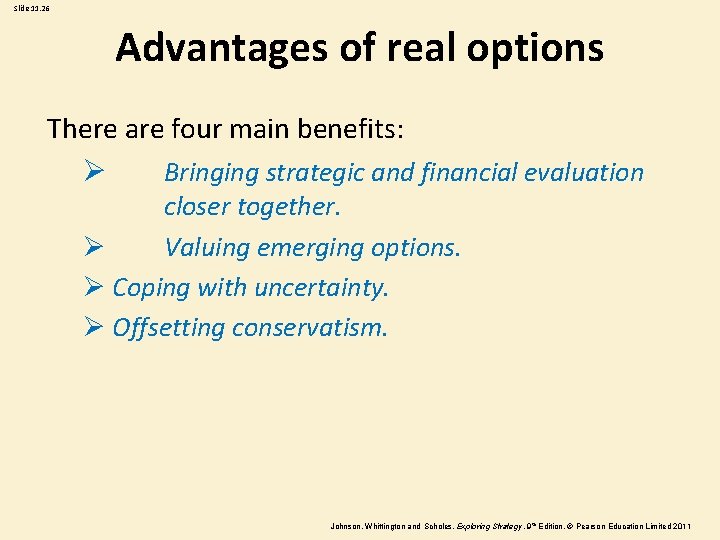
Slide 11. 26 Advantages of real options There are four main benefits: Ø Bringing strategic and financial evaluation closer together. Ø Valuing emerging options. Ø Coping with uncertainty. Ø Offsetting conservatism. Johnson, Whittington and Scholes, Exploring Strategy, 9 th Edition, © Pearson Education Limited 2011
Slide 11. 27 Reaction of stakeholders • Stakeholder mapping and the power/interest matrix can be used to: Ø understand the political context of strategies. Ø understand the political agenda. Ø gauge the likely reaction of stakeholders to specific strategies. • If key stakeholders find a strategy to be unacceptable then it is likely to fail Johnson, Whittington and Scholes, Exploring Strategy, 9 th Edition, © Pearson Education Limited 2011
Slide 11. 28 Feasibility is concerned with whether a strategy could work in practice i. e. whether an organisation has the capabilities to deliver a strategy Two key questions: • Do the resources and competences currently exist to implement the strategy effectively? • If not, can they be obtained? Johnson, Whittington and Scholes, Exploring Strategy, 9 th Edition, © Pearson Education Limited 2011
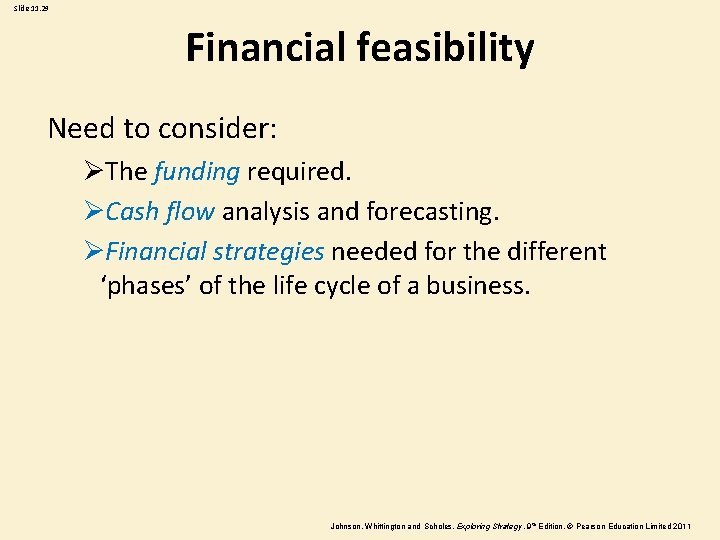
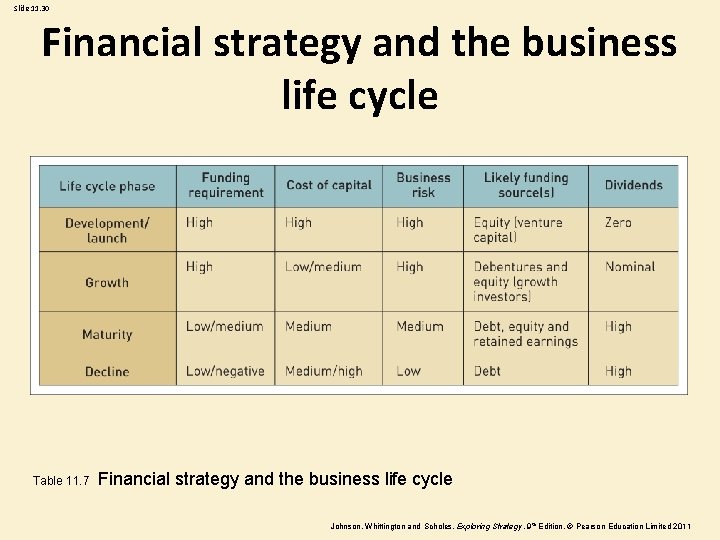
Slide 11. 29 Financial feasibility Need to consider: ØThe funding required. ØCash flow analysis and forecasting. ØFinancial strategies needed for the different ‘phases’ of the life cycle of a business. Johnson, Whittington and Scholes, Exploring Strategy, 9 th Edition, © Pearson Education Limited 2011
Slide 11. 30 Financial strategy and the business life cycle Table 11. 7 Financial strategy and the business life cycle Johnson, Whittington and Scholes, Exploring Strategy, 9 th Edition, © Pearson Education Limited 2011
Slide 11. 31 People and skills (1) Three questions arise: • Do people in the organisation currently have the competences to deliver a proposed strategy? • Are the systems to support those people fit for the strategy? • If not, can the competences be obtained or developed? Johnson, Whittington and Scholes, Exploring Strategy, 9 th Edition, © Pearson Education Limited 2011
Slide 11. 32 People and skills (2) Critical issues that need to be considered: ØWork organisation – will this need to change? ØRewards – are the incentives appropriate? ØRelationships – will people interact differently? ØTraining and development – are current systems appropriate? ØStaffing – are the levels and skills of the staff appropriate? Johnson, Whittington and Scholes, Exploring Strategy, 9 th Edition, © Pearson Education Limited 2011
Slide 11. 33 Integrating resources • The success of a strategy depends on the management of many resource areas, for example: Ø people, Ø finance, Ø physical resources, Ø information, Ø technology and Ø resources provided by suppliers and partners. • It is essential to integrate resources – inside the organisation and in the wider value network. Johnson, Whittington and Scholes, Exploring Strategy, 9 th Edition, © Pearson Education Limited 2011
Slide 11. 34 Evaluation criteria Four qualifications: ØConflicting conclusions and the need for management judgement. ØConsistency between the different elements of a strategy is essential. ØThe implementation and development of strategies might reveal unanticipated problems. ØStrategy development in practice – it isn’t always a logical or even rational process. Johnson, Whittington and Scholes, Exploring Strategy, 9 th Edition, © Pearson Education Limited 2011
Slide 11. 35 Summary • Proposed strategies may be evaluated using the three SAFe criteria: Ø Suitability is concerned with assessing which proposed strategies address the key opportunities and constraints an organisation faces. It is about the rationale of a strategy. Ø The acceptability of a strategy relates to three issues: the level of risk of a strategy, the expected return from a strategy and the likely reaction of stakeholders. Ø Feasibility is concerned with whether an organisation has or can obtain the capabilities to deliver a strategy. Johnson, Whittington and Scholes, Exploring Strategy, 9 th Edition, © Pearson Education Limited 2011