
Slide 11 1 Organisational Performance Once performance viewed
- Slides: 31
Slide 11. 1 Organisational Performance • Once performance viewed in terms of individual motivation and performance • Focus shift now to emphasise performance of organisation as a whole • Organisational performance can be affected by systems, processes, structures and culture Torrington, Hall & Taylor, Human Resource Management 6 e, © Pearson Education Limited 2005
Slide 11. 2 Organisational Performance Initiatives • Business process re-engineering (BPR) • Total quality management (TQM) • Learning organisations Torrington, Hall & Taylor, Human Resource Management 6 e, © Pearson Education Limited 2005
Slide 11. 3 Learning Organisations • • • Learning is considered to be only way of obtaining and keeping competitive edge Concept of organisational learning comparatively new Can be defined as ‘an organisation which facilitates the learning of all its members and continually transforms itself’ (Pedlar, Boydell & Burgoyne, 1987) Torrington, Hall & Taylor, Human Resource Management 6 e, © Pearson Education Limited 2005
Slide 11. 4 Have Companies Transformed Themselves? Little empirical evidence Sloman 1999 suggests that the learning organisation concept was in decline Problems include – • Confusion over the concept • Lack of tangible practices to implement Torrington, Hall & Taylor, Human Resource Management 6 e, © Pearson Education Limited 2005
Slide 11. 5 Organisational Learning & The Learning Organisational learning – based on detached observations of individual and collective learning processes in an organisation Learning organisations – ‘focus on normative models for creating change in the direction of improved learning processes’ (Easterby-Smith & Araujo, 1999) Torrington, Hall & Taylor, Human Resource Management 6 e, © Pearson Education Limited 2005
Slide 11. 6 Organisational Learning Mechanisms The structural and procedural arrangements that allow organisations to learn (Popper & Lipshitz, 1998) Torrington, Hall & Taylor, Human Resource Management 6 e, © Pearson Education Limited 2005
Slide 11. 7 Organisational & Individual Learning Organisational learning is more than just the sum of individual learning Members learn together when individual’s learning impacts on and interrelates with others and begin to change the way things are done Torrington, Hall & Taylor, Human Resource Management 6 e, © Pearson Education Limited 2005
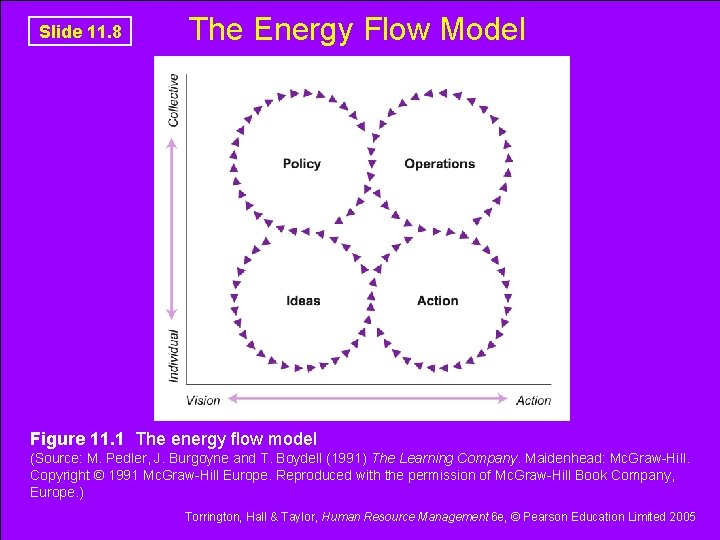
Slide 11. 8 The Energy Flow Model Figure 11. 1 The energy flow model (Source: M. Pedler, J. Burgoyne and T. Boydell (1991) The Learning Company. Maidenhead: Mc. Graw-Hill. Copyright © 1991 Mc. Graw-Hill Europe. Reproduced with the permission of Mc. Graw-Hill Book Company, Europe. ) Torrington, Hall & Taylor, Human Resource Management 6 e, © Pearson Education Limited 2005
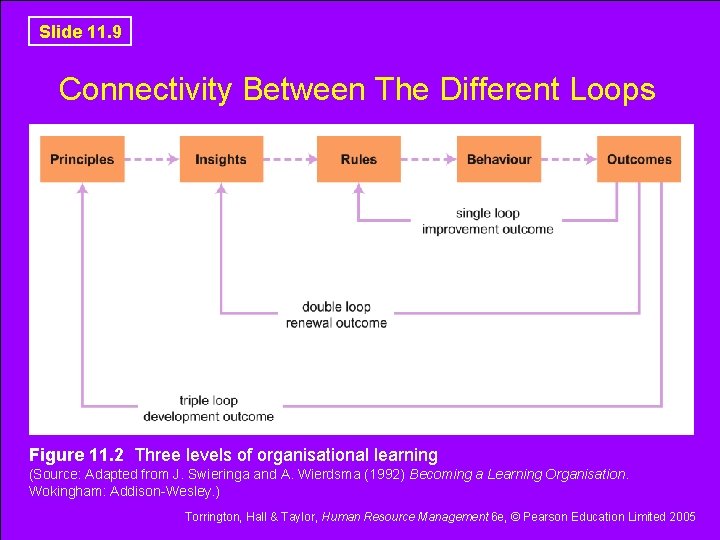
Slide 11. 9 Connectivity Between The Different Loops Figure 11. 2 Three levels of organisational learning (Source: Adapted from J. Swieringa and A. Wierdsma (1992) Becoming a Learning Organisation. Wokingham: Addison-Wesley. ) Torrington, Hall & Taylor, Human Resource Management 6 e, © Pearson Education Limited 2005
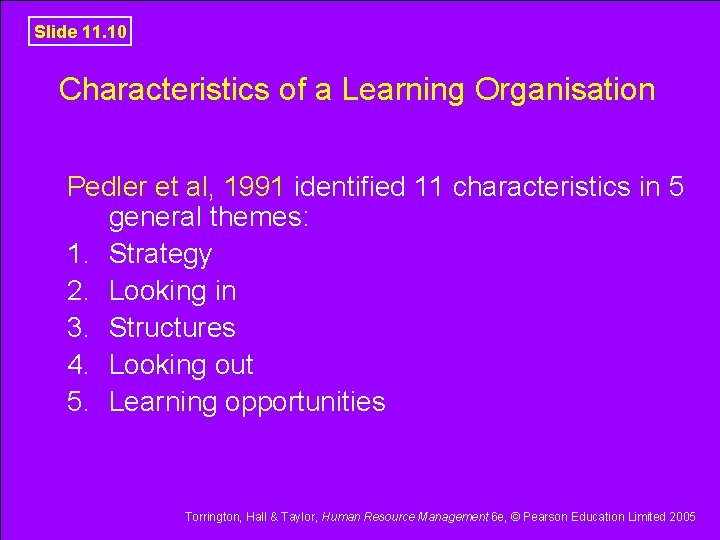
Slide 11. 10 Characteristics of a Learning Organisation Pedler et al, 1991 identified 11 characteristics in 5 general themes: 1. Strategy 2. Looking in 3. Structures 4. Looking out 5. Learning opportunities Torrington, Hall & Taylor, Human Resource Management 6 e, © Pearson Education Limited 2005
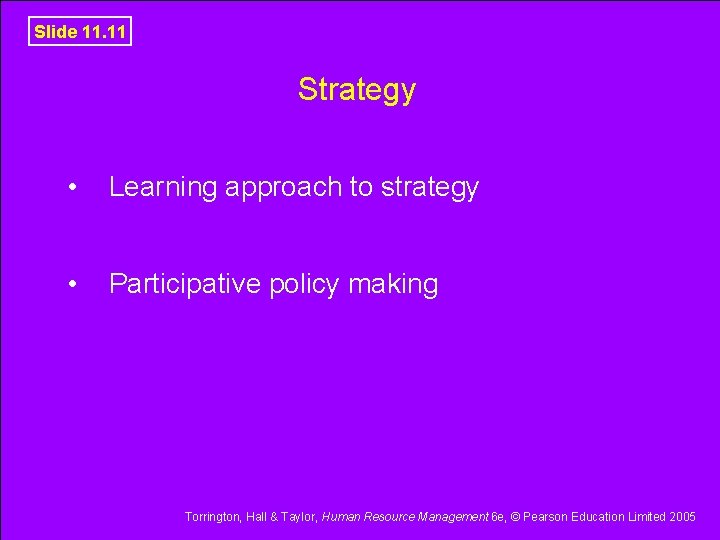
Slide 11. 11 Strategy • Learning approach to strategy • Participative policy making Torrington, Hall & Taylor, Human Resource Management 6 e, © Pearson Education Limited 2005
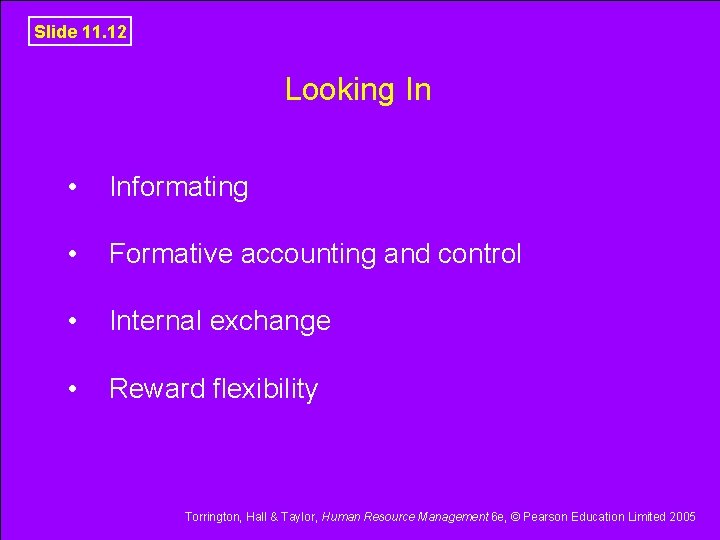
Slide 11. 12 Looking In • Informating • Formative accounting and control • Internal exchange • Reward flexibility Torrington, Hall & Taylor, Human Resource Management 6 e, © Pearson Education Limited 2005
Slide 11. 13 Structures Enabling structures loosely structured in line with internal customers and suppliers in a way that allows for personal growth and experimentation Torrington, Hall & Taylor, Human Resource Management 6 e, © Pearson Education Limited 2005
Slide 11. 14 Looking Out • Boundary workers as environmental scanners • Inter-company learning Torrington, Hall & Taylor, Human Resource Management 6 e, © Pearson Education Limited 2005
Slide 11. 15 Learning Opportunities • Learning climate • Self development opportunities for all Torrington, Hall & Taylor, Human Resource Management 6 e, © Pearson Education Limited 2005
Slide 11. 16 Senge’s Approach 1. 2. 3. 4. 5. Systems thinking Personal mastery Mental models Shared visions Team learning Torrington, Hall & Taylor, Human Resource Management 6 e, © Pearson Education Limited 2005
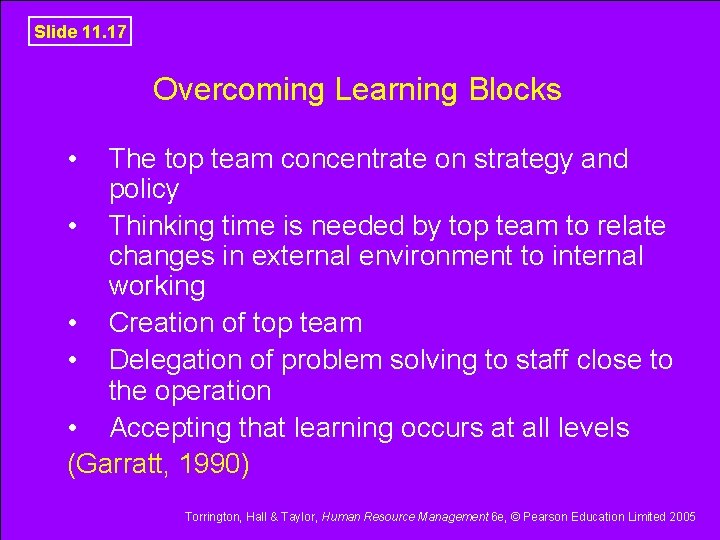
Slide 11. 17 Overcoming Learning Blocks • The top team concentrate on strategy and policy • Thinking time is needed by top team to relate changes in external environment to internal working • Creation of top team • Delegation of problem solving to staff close to the operation • Accepting that learning occurs at all levels (Garratt, 1990) Torrington, Hall & Taylor, Human Resource Management 6 e, © Pearson Education Limited 2005
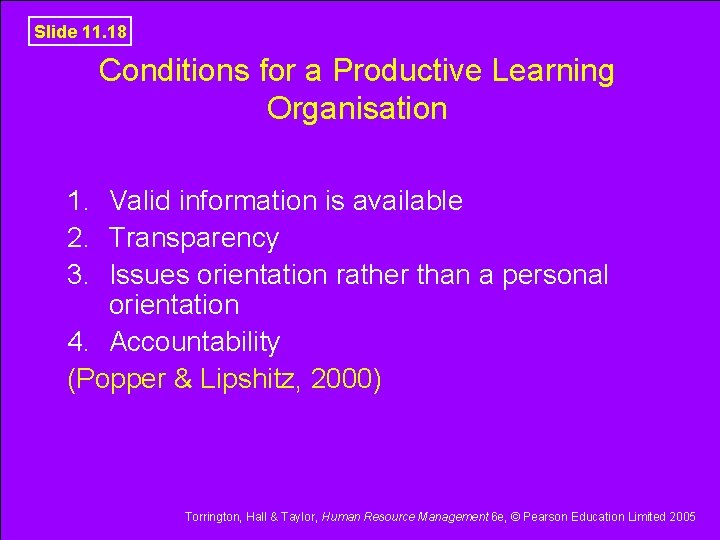
Slide 11. 18 Conditions for a Productive Learning Organisation 1. Valid information is available 2. Transparency 3. Issues orientation rather than a personal orientation 4. Accountability (Popper & Lipshitz, 2000) Torrington, Hall & Taylor, Human Resource Management 6 e, © Pearson Education Limited 2005
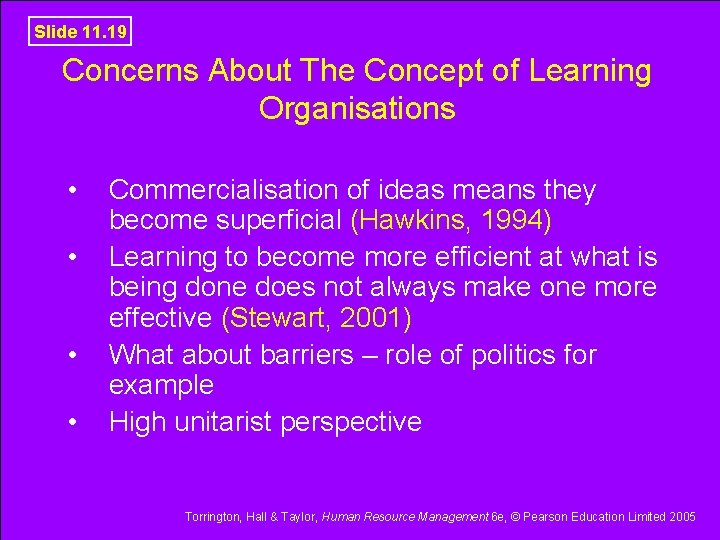
Slide 11. 19 Concerns About The Concept of Learning Organisations • • Commercialisation of ideas means they become superficial (Hawkins, 1994) Learning to become more efficient at what is being done does not always make one more effective (Stewart, 2001) What about barriers – role of politics for example High unitarist perspective Torrington, Hall & Taylor, Human Resource Management 6 e, © Pearson Education Limited 2005
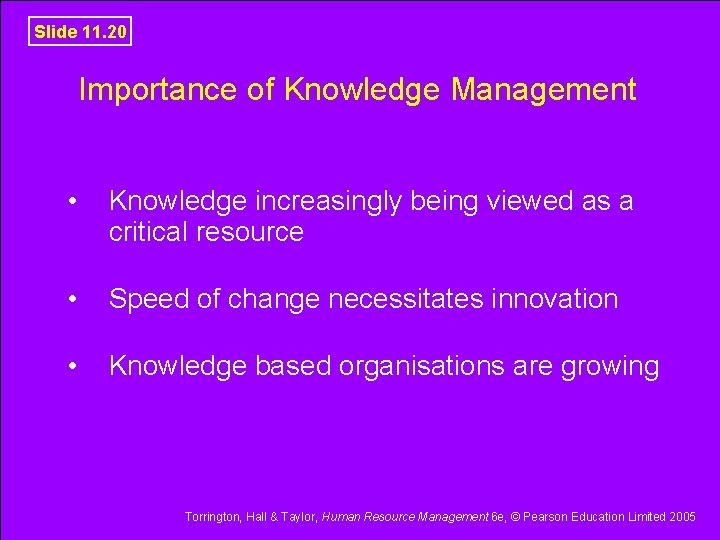
Slide 11. 20 Importance of Knowledge Management • Knowledge increasingly being viewed as a critical resource • Speed of change necessitates innovation • Knowledge based organisations are growing Torrington, Hall & Taylor, Human Resource Management 6 e, © Pearson Education Limited 2005
Slide 11. 21 Defining Knowledge • • Many different perspectives Knowledge is more than information – it has to be reflected on and processed to an extent it is then applied Explicit knowledge is often referred to as operational knowledge Tacit knowledge – residing in a person’s head often unaware of what we know until it is used Torrington, Hall & Taylor, Human Resource Management 6 e, © Pearson Education Limited 2005
Slide 11. 22 To Be Of Value Knowledge needs to be: • • • Accessed Applied appropriately Used to enhance organisational ability It needs to be turned into action Torrington, Hall & Taylor, Human Resource Management 6 e, © Pearson Education Limited 2005
Slide 11. 23 Managing Knowledge ‘Defined broadly and inclusively to cover a loosely connected set of ideas, tools and practices centring on the communication and exploitation of knowledge in organisations (Scarbrough & Swan, 2001) Torrington, Hall & Taylor, Human Resource Management 6 e, © Pearson Education Limited 2005
Slide 11. 24 An Alternative Perspective ‘Knowledge to be. . . pragmatic, partial, tentative and always open to revision – it is no more and no less than a collective interpretation’ (Blackler, 2000) Torrington, Hall & Taylor, Human Resource Management 6 e, © Pearson Education Limited 2005
Slide 11. 25 Knowledge Management Initiatives • • Socialisation Externalisation Combined approach Internalisation (Kermally, 1995) Torrington, Hall & Taylor, Human Resource Management 6 e, © Pearson Education Limited 2005
Slide 11. 26 Barriers to Knowledge Management • • Organisational culture Risk of admitting failure Lack of incentive to change Resistance to ideas and learning from other contexts • Internal competition • Individual reward practices Torrington, Hall & Taylor, Human Resource Management 6 e, © Pearson Education Limited 2005
Slide 11. 27 Factors Encouraging Knowledge Management • • Engendering trust and openness Knowledge centric culture Defined roles and responsibilities Support through performance management systems • Team/organisational rewards • Building on informal practices that already exist Torrington, Hall & Taylor, Human Resource Management 6 e, © Pearson Education Limited 2005
Slide 11. 28 Roles in Knowledge Management • The knowledge architects • The knowledge facilitators • The knowledge aware (Lank, 2002) Torrington, Hall & Taylor, Human Resource Management 6 e, © Pearson Education Limited 2005
Slide 11. 29 Knowledge Management & HRM – Different Viewpoints • Lack of research in links (Mac. Neil, 2003) • Knowledge facilitator is a key HR role (Lengnick -Hall, 2003) Torrington, Hall & Taylor, Human Resource Management 6 e, © Pearson Education Limited 2005
Slide 11. 30 Knowledge Management & Implications for HRM 1. 2. 3. 4. 5. Best practice perspective Knowledge work perspective Congruence perspective Human and social capital perspective Learning perspective (Scarbrough & Carter, 2000) Torrington, Hall & Taylor, Human Resource Management 6 e, © Pearson Education Limited 2005
Slide 11. 31 Summary • • Increasing emphasis on organisational performance and factors affecting it Concentration on learning organisations has not fulfilled its potential Further investigation into organisational learning process would be helpful Knowledge management is proposed as an alternative way forward Torrington, Hall & Taylor, Human Resource Management 6 e, © Pearson Education Limited 2005