
Slide 10 1 The costs and benefits of
Slide 10. 1 The costs and benefits of IS Ch 10 – Boddy et al • Formal–rational methods for evaluating IS proposals • Costs of IS • Benefits of IS • Creating a balanced portfolio of project types • Problems of formal–rational evaluation • Wider criteria for evaluating IS • Organising for IS evaluation Boddy et al. , Managing Information Systems, 3 rd Edition, © Pearson Education Limited 2009
Slide 10. 2 Challenges of IS evaluation • Assessing the costs and benefits of information systems is notoriously difficult – Many spectacular failures! • Several methods – each with strengths and weaknesses • Aim to understand the basic elements of IS costs and benefits • Organisational factors also affect evaluation – Structure – Cultures – Power bases Boddy et al. , Managing Information Systems, 3 rd Edition, © Pearson Education Limited 2009
Slide 10. 3 Formal–Rational methods • Traditional cost-benefit analysis methods that are widespread in organisations and popular for their transparency: – Payback period – Return on investment – Discounted cash flow • Require careful identification of the elements of costs and benefits that make up a proposal. Boddy et al. , Managing Information Systems, 3 rd Edition, © Pearson Education Limited 2009
Slide 10. 4 Costs of information systems • Tend to be relatively easy to identify and quantify • Costs of purchase – Hardware costs: Monitors, keyboards, scanners, servers, cabling, routers, processors, mainframes, servers, etc. – Software costs: Operating systems, application development tools, security systems, communications software, databases, etc. • Implementation, ownership and change – – – Support costs Upgrades Maintenance Obsolescence Staffing Boddy et al. , Managing Information Systems, 3 rd Edition, © Pearson Education Limited 2009

Slide 10. 5 Benefits of information systems • Relatively qualitative, vague and uncertain • Tangible benefits – – Cost savings Quality improvements Avoiding cost increases Revenue increases • Intangible benefits – see Table 10. 1 – – – – Improved communications Increased awareness Customer satisfaction Reputation Flexibility Speed of response Differentiation Boddy et al. , Managing Information Systems, 3 rd Edition, © Pearson Education Limited 2009

Slide 10. 6 Creating a balanced project portfolio • Some projects are necessarily cost-based with few tangible benefits – e. g. investments in infrastructure • Some projects have a high benefits return, but are not achievable on their own – e. g. require a well-developed infrastructure to work • Organisations must balance their projects to achieve a mix of costs and benefits that as a whole make up a positive business case – a programme Boddy et al. , Managing Information Systems, 3 rd Edition, © Pearson Education Limited 2009
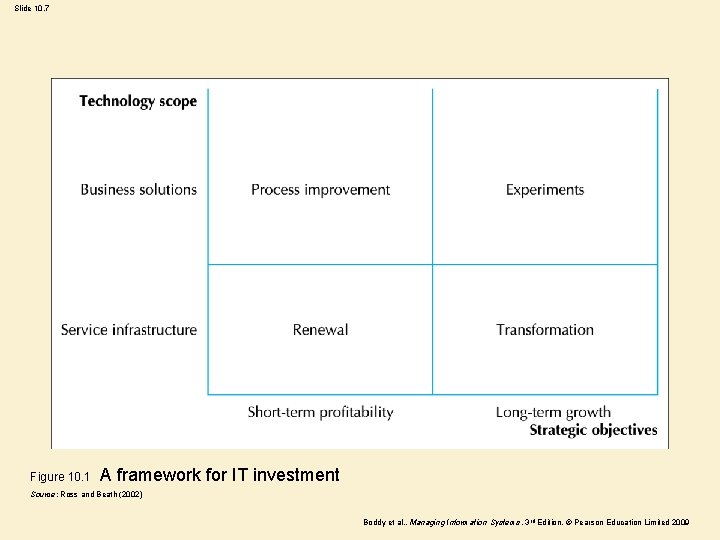
Slide 10. 7 Figure 10. 1 A framework for IT investment Source: Ross and Beath (2002) Boddy et al. , Managing Information Systems, 3 rd Edition, © Pearson Education Limited 2009
Slide 10. 8 Problems of formal–rational evaluation • Relies on accurate identification and valuation of costs and benefits – rarely simple with IS. • Many reasons for failures in evaluating IS projects: – Over-emphasis on purchase costs, and ignorance of other costs – Over-ambitious rates of return – Under-estimation of implementation time and costs – Poor communication with users and customers • The quantitative approach of formal–rational evaluation techniques does not lend itself well to IS projects • IS integrates itself deeply into organisations – their value requires consideration of a wide range of factors beyond the system itself Boddy et al. , Managing Information Systems, 3 rd Edition, © Pearson Education Limited 2009
Slide 10. 9 Wider criteria for evaluating IS • Many theories exist for how best to broaden the criteria used: – Doherty’s measures for system success – Saarinen’s four-dimensional model – Strassman – no relation between investment in IT and company profitability – Kaplan and Norton – balanced scorecard of measures • It is necessary to relate IS to organisational strategy, end-users, customers, quality, etc. Boddy et al. , Managing Information Systems, 3 rd Edition, © Pearson Education Limited 2009
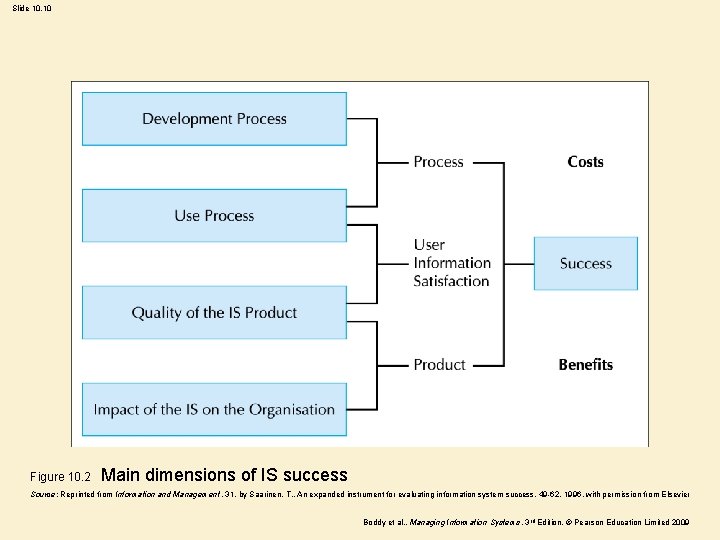
Slide 10. 10 Figure 10. 2 Main dimensions of IS success Source: Reprinted from Information and Management , 31, by Saarinen, T. , An expanded instrument for evaluating information system success, 49 -62, 1996, with permission from Elsevier Boddy et al. , Managing Information Systems, 3 rd Edition, © Pearson Education Limited 2009
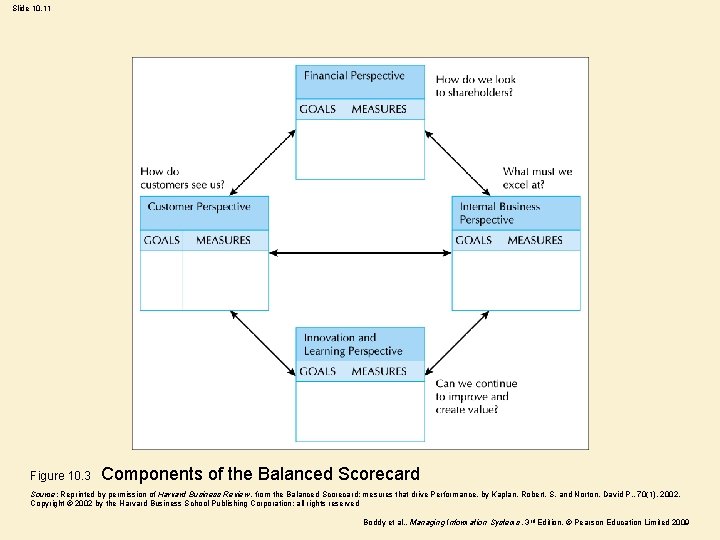
Slide 10. 11 Figure 10. 3 Components of the Balanced Scorecard Source: Reprinted by permission of Harvard Business Review, from the Balanced Scorecard: mesures that drive Performance, by Kaplan, Robert. S. and Norton, David P. , 70(1), 2002. Copyright © 2002 by the Harvard Business School Publishing Corporation: all rights reserved Boddy et al. , Managing Information Systems, 3 rd Edition, © Pearson Education Limited 2009
Slide 10. 12 Organising for IS evaluation • How best to fit the evaluation function into the organisation structure? • Central project evaluation teams – Pool knowledge and experience – Objective and detached – But, lack of local awareness, bureaucratic and unresponsive • Budget ownership – Business control is essential – IT function should ‘compete’ for budget allocation along with alternative suppliers and options (e. g. outsourcing) Boddy et al. , Managing Information Systems, 3 rd Edition, © Pearson Education Limited 2009
- Slides: 12