
Slide 10 1 Chapter 10 Liabilities Financial Accounting
Slide 10 -1
Chapter 10 Liabilities Financial Accounting, IFRS Edition Weygandt Kimmel Kieso Slide 10 -2
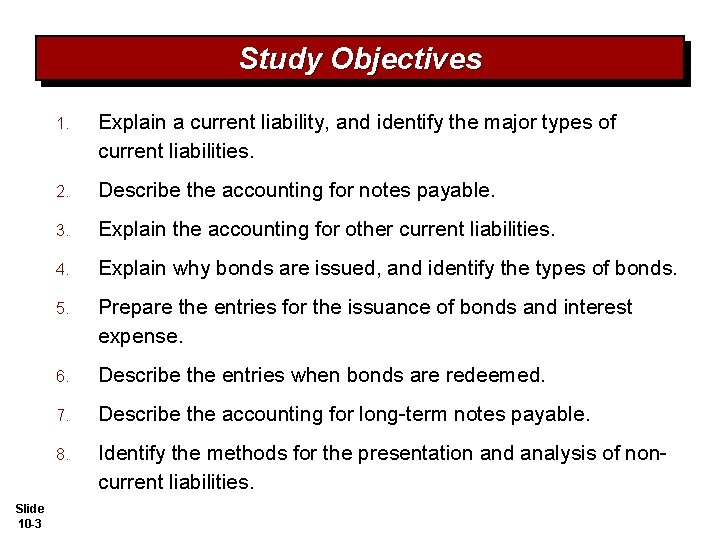
Study Objectives Slide 10 -3 1. Explain a current liability, and identify the major types of current liabilities. 2. Describe the accounting for notes payable. 3. Explain the accounting for other current liabilities. 4. Explain why bonds are issued, and identify the types of bonds. 5. Prepare the entries for the issuance of bonds and interest expense. 6. Describe the entries when bonds are redeemed. 7. Describe the accounting for long-term notes payable. 8. Identify the methods for the presentation and analysis of noncurrent liabilities.
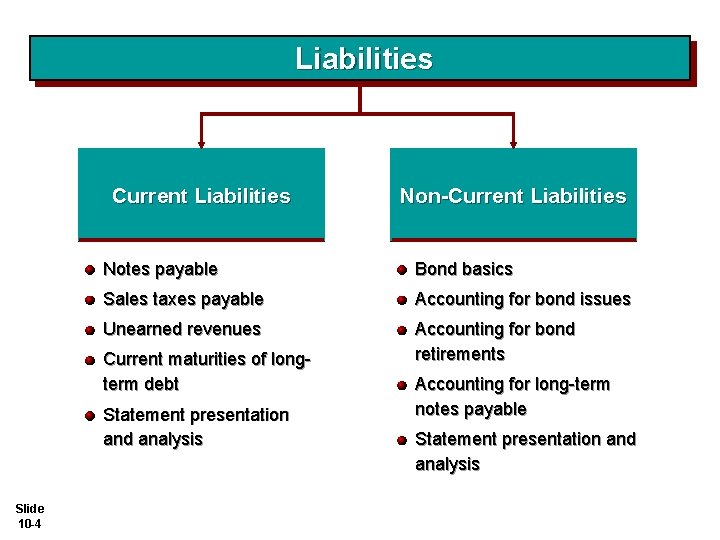
Liabilities Current Liabilities Notes payable Bond basics Sales taxes payable Accounting for bond issues Unearned revenues Accounting for bond retirements Current maturities of longterm debt Statement presentation and analysis Slide 10 -4 Non-Current Liabilities Accounting for long-term notes payable Statement presentation and analysis
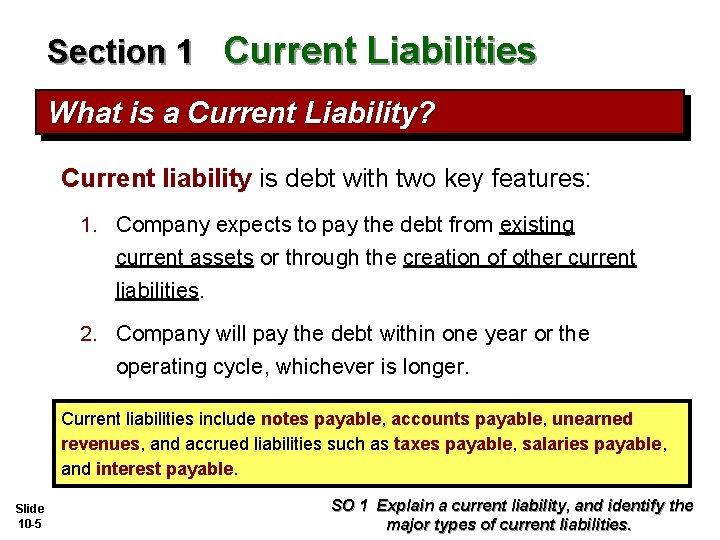
Section 1 Current Liabilities What is a Current Liability? Current liability is debt with two key features: 1. Company expects to pay the debt from existing current assets or through the creation of other current liabilities. 2. Company will pay the debt within one year or the operating cycle, whichever is longer. Current liabilities include notes payable, accounts payable, unearned revenues, and accrued liabilities such as taxes payable, salaries payable, and interest payable. Slide 10 -5 SO 1 Explain a current liability, and identify the major types of current liabilities.
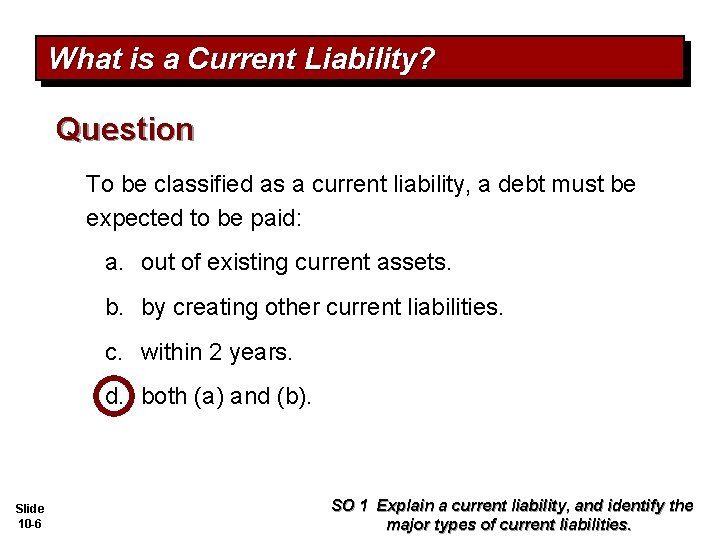
What is a Current Liability? Question To be classified as a current liability, a debt must be expected to be paid: a. out of existing current assets. b. by creating other current liabilities. c. within 2 years. d. both (a) and (b). Slide 10 -6 SO 1 Explain a current liability, and identify the major types of current liabilities.
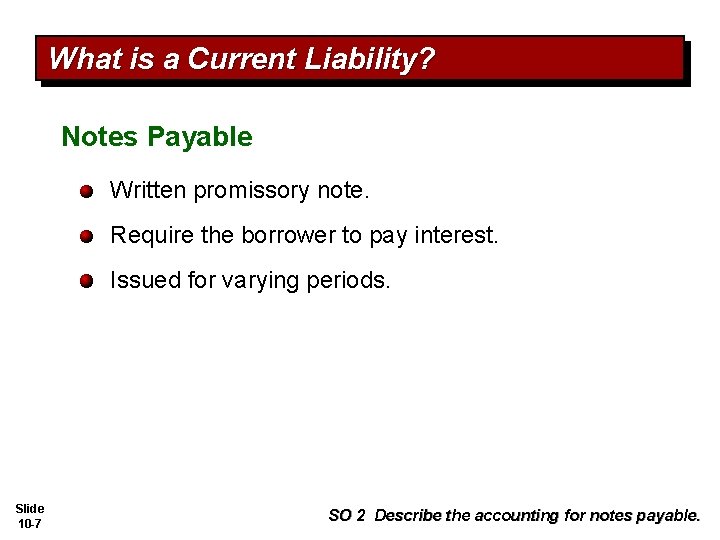
What is a Current Liability? Notes Payable Written promissory note. Require the borrower to pay interest. Issued for varying periods. Slide 10 -7 SO 2 Describe the accounting for notes payable.
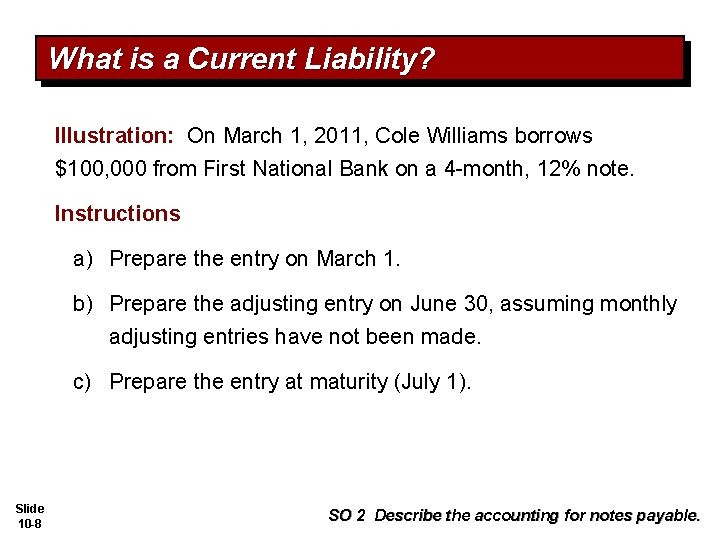
What is a Current Liability? Illustration: On March 1, 2011, Cole Williams borrows $100, 000 from First National Bank on a 4 -month, 12% note. Instructions a) Prepare the entry on March 1. b) Prepare the adjusting entry on June 30, assuming monthly adjusting entries have not been made. c) Prepare the entry at maturity (July 1). Slide 10 -8 SO 2 Describe the accounting for notes payable.
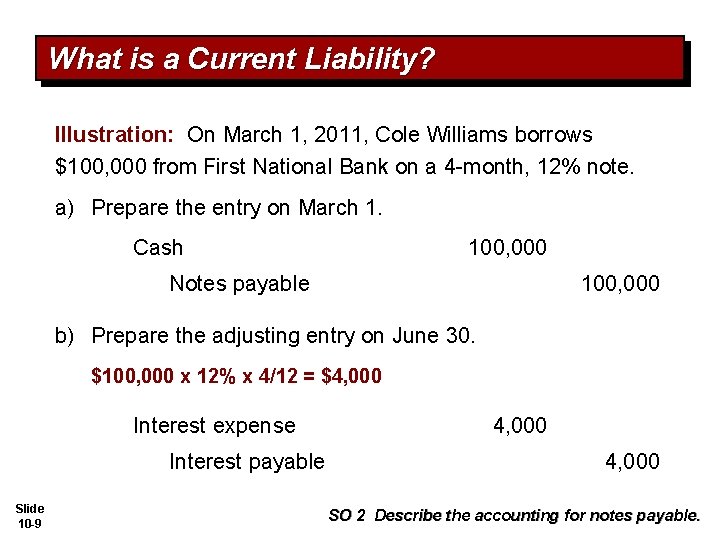
What is a Current Liability? Illustration: On March 1, 2011, Cole Williams borrows $100, 000 from First National Bank on a 4 -month, 12% note. a) Prepare the entry on March 1. Cash 100, 000 Notes payable 100, 000 b) Prepare the adjusting entry on June 30. $100, 000 x 12% x 4/12 = $4, 000 Interest expense Interest payable Slide 10 -9 4, 000 SO 2 Describe the accounting for notes payable.
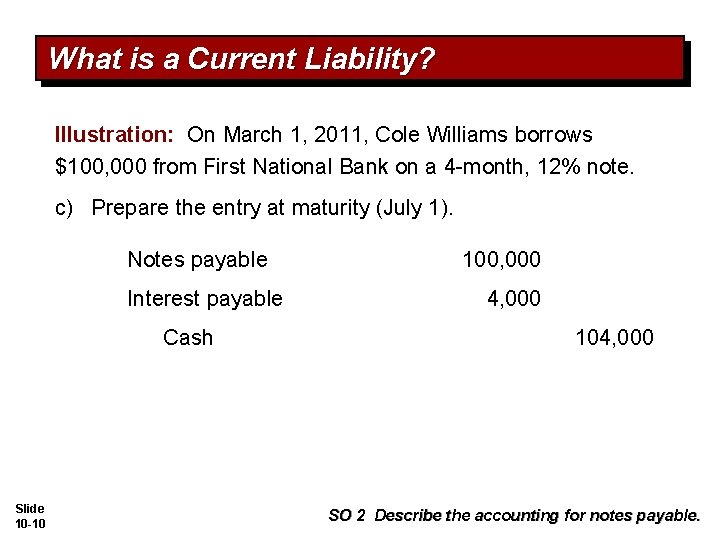
What is a Current Liability? Illustration: On March 1, 2011, Cole Williams borrows $100, 000 from First National Bank on a 4 -month, 12% note. c) Prepare the entry at maturity (July 1). Notes payable Interest payable Cash Slide 10 -10 100, 000 4, 000 104, 000 SO 2 Describe the accounting for notes payable.
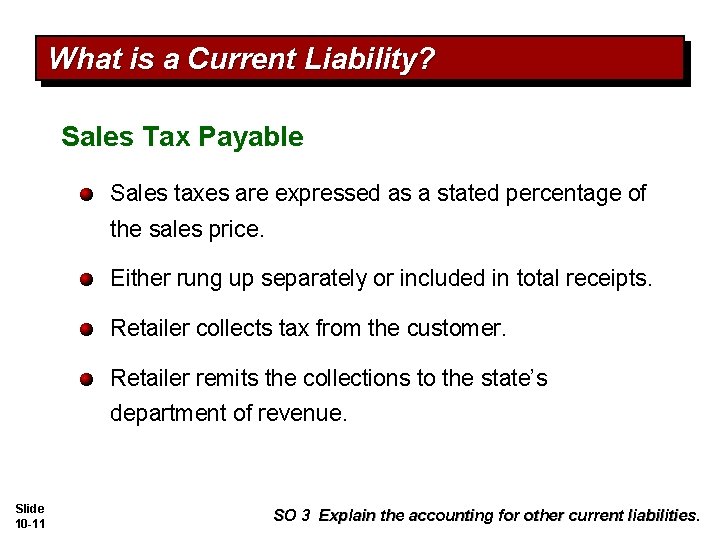
What is a Current Liability? Sales Tax Payable Sales taxes are expressed as a stated percentage of the sales price. Either rung up separately or included in total receipts. Retailer collects tax from the customer. Retailer remits the collections to the state’s department of revenue. Slide 10 -11 SO 3 Explain the accounting for other current liabilities.
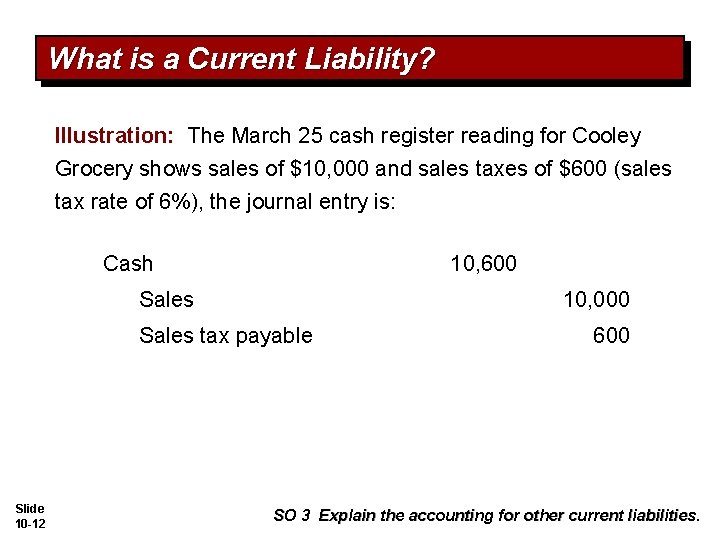
What is a Current Liability? Illustration: The March 25 cash register reading for Cooley Grocery shows sales of $10, 000 and sales taxes of $600 (sales tax rate of 6%), the journal entry is: Cash 10, 600 Sales 10, 000 Sales tax payable Slide 10 -12 600 SO 3 Explain the accounting for other current liabilities.
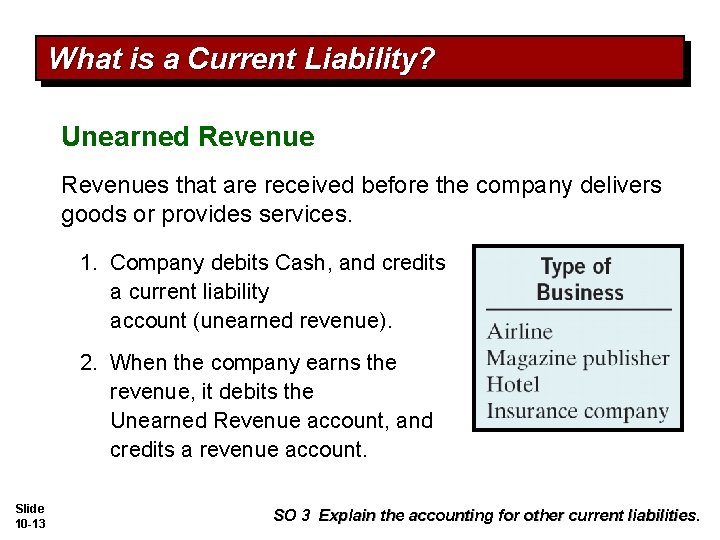
What is a Current Liability? Unearned Revenues that are received before the company delivers goods or provides services. 1. Company debits Cash, and credits a current liability account (unearned revenue). 2. When the company earns the revenue, it debits the Unearned Revenue account, and credits a revenue account. Slide 10 -13 SO 3 Explain the accounting for other current liabilities.
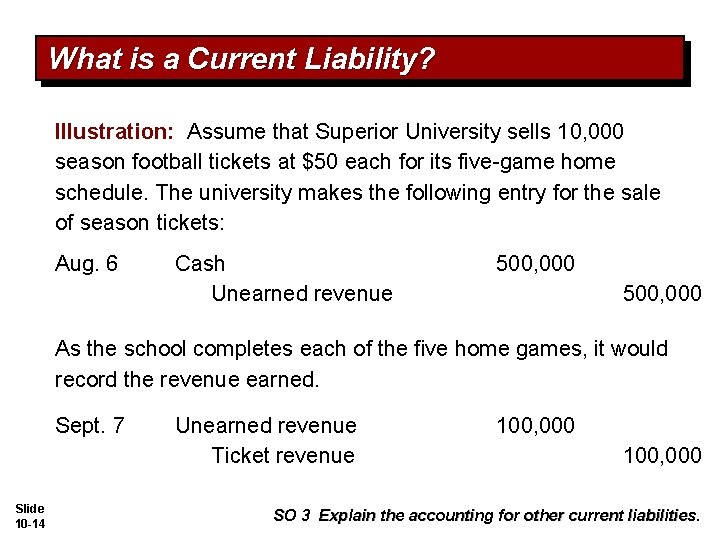
What is a Current Liability? Illustration: Assume that Superior University sells 10, 000 season football tickets at $50 each for its five-game home schedule. The university makes the following entry for the sale of season tickets: Aug. 6 Cash Unearned revenue 500, 000 As the school completes each of the five home games, it would record the revenue earned. Sept. 7 Slide 10 -14 Unearned revenue Ticket revenue 100, 000 SO 3 Explain the accounting for other current liabilities.
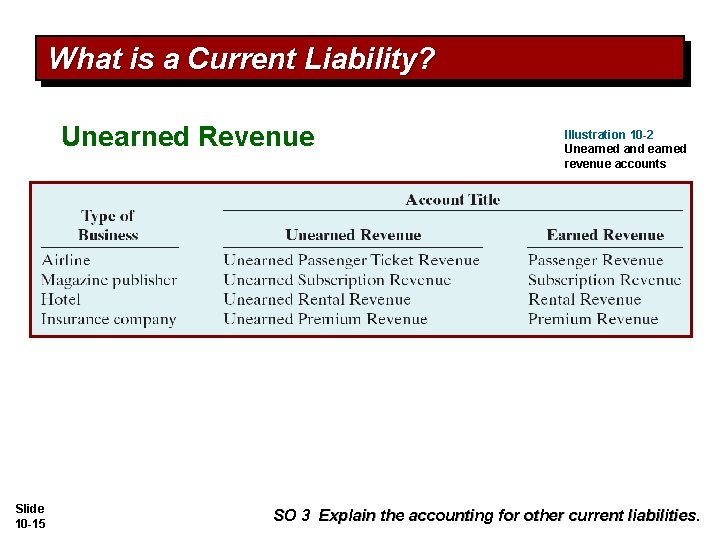
What is a Current Liability? Unearned Revenue Slide 10 -15 Illustration 10 -2 Unearned and earned revenue accounts SO 3 Explain the accounting for other current liabilities.
What is a Current Liability? Current Maturities of Long-Term Debt Portion of long-term debt that comes due in the current year. No adjusting entry required. Slide 10 -16 SO 3 Explain the accounting for other current liabilities.
Copyright “Copyright © 2011 John Wiley & Sons, Inc. All rights reserved. Reproduction or translation of this work beyond that permitted in Section 117 of the 1976 United States Copyright Act without the express written permission of the copyright owner is unlawful. Request for further information should be addressed to the Permissions Department, John Wiley & Sons, Inc. The purchaser may make back-up copies for his/her own use only and not for distribution or resale. The Publisher assumes no responsibility for errors, omissions, or damages, caused by the use of these programs or from the use of the information contained herein. ” Slide 10 -17
- Slides: 17