
Slide 1 VIETNAM 1946 75 the 10 000
- Slides: 22
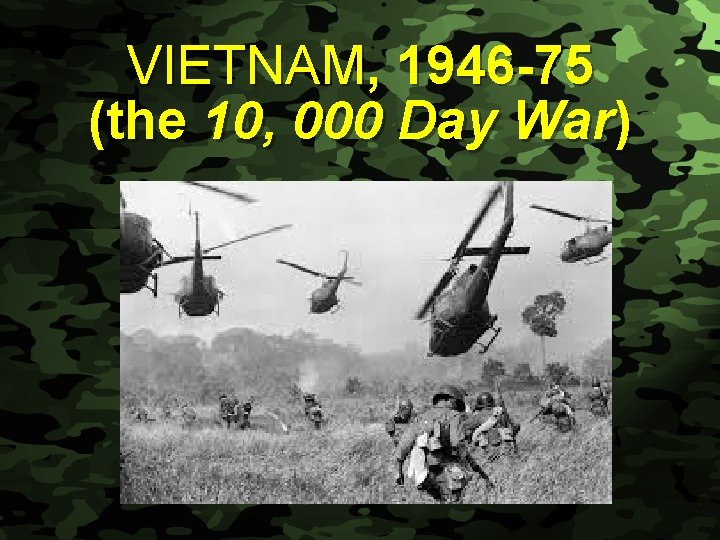
Slide 1 VIETNAM, 1946 -75 (the 10, 000 Day War)
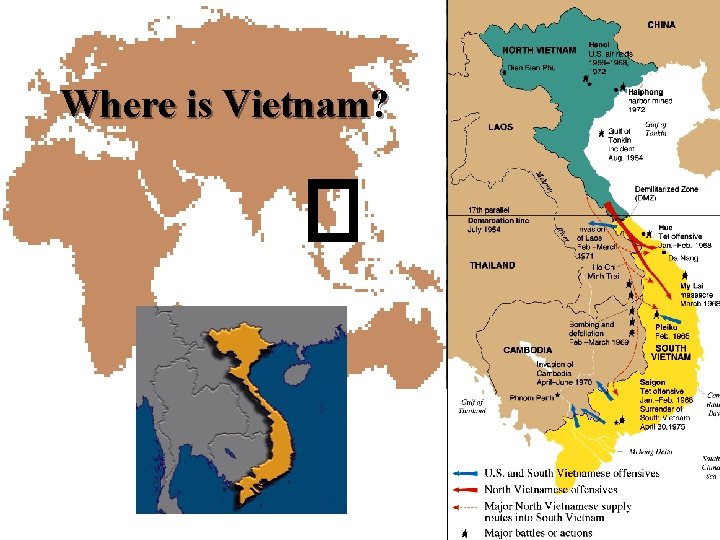
Slide 2 Where is Vietnam?
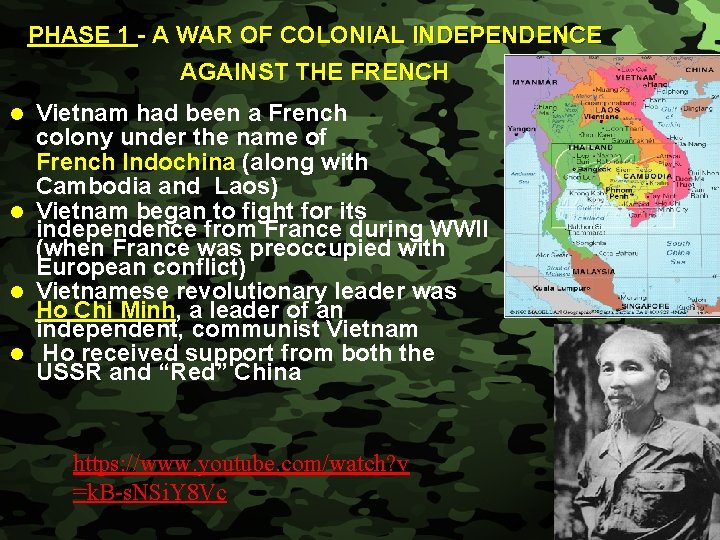
Slide 3 PHASE 1 - A WAR OF COLONIAL INDEPENDENCE AGAINST THE FRENCH Vietnam had been a French colony under the name of French Indochina (along with Cambodia and Laos) l Vietnam began to fight for its independence from France during WWII (when France was preoccupied with European conflict) l Vietnamese revolutionary leader was Ho Chi Minh, a leader of an independent, communist Vietnam l Ho received support from both the USSR and “Red” China l https: //www. youtube. com/watch? v =k. B-s. NSi. Y 8 Vc
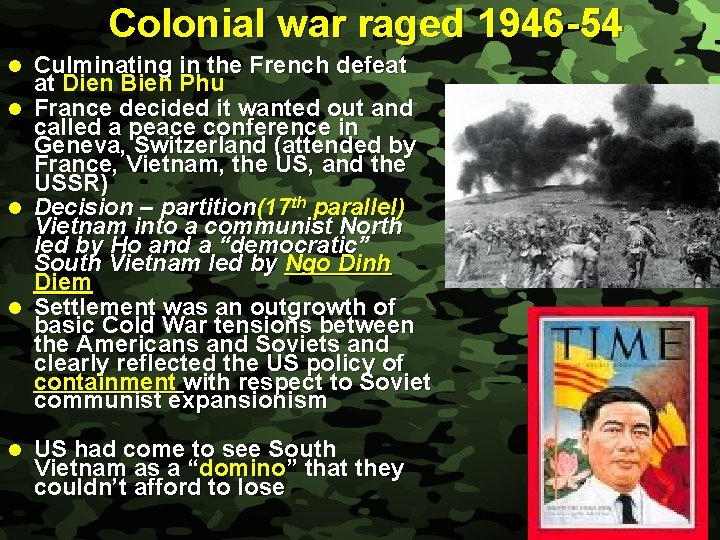
Slide 4 l l l Colonial war raged 1946 -54 Culminating in the French defeat at Dien Bien Phu France decided it wanted out and called a peace conference in Geneva, Switzerland (attended by France, Vietnam, the US, and the USSR) Decision – partition(17 th parallel) Vietnam into a communist North led by Ho and a “democratic” South Vietnam led by Ngo Dinh Diem Settlement was an outgrowth of basic Cold War tensions between the Americans and Soviets and clearly reflected the US policy of containment with respect to Soviet communist expansionism US had come to see South Vietnam as a “domino” that they couldn’t afford to lose
Slide 5 Containment Policy in Action l In 1950, the U. S. established the U. S. Military Advisory Group-Indochina. In the same year, the Soviet Union and the People’s Republic of China officially recognized the DRV and sent aid to Ho Chi Minh. l From 1950 -52, the U. S. spent $50 million in military and economic aid to support nation-building and fight the communists in South Vietnam.
Slide 6 Bell Ringer “Why are we in South Vietnam? We are there because we have a promise to keep. Since 1954 every American President has offered support to the people of South Vietnam. We have helped to build, and we have helped to defend. Thus, over many years, we have made a national pledge to help South Vietnam defend its independence. And I intend to keep our promise. To dishonor that pledge, to abandon this small and brave nation to its enemy, and to the terror that must follow, would be an unforgivable wrong. . ” — Lyndon B. Johnson, April 26, 1965 Vietnam War Under Johnson Use the excerpt below to answer the following question. According to this document, what are two reasons President Lyndon B. Johnson sent troops to Vietnam?
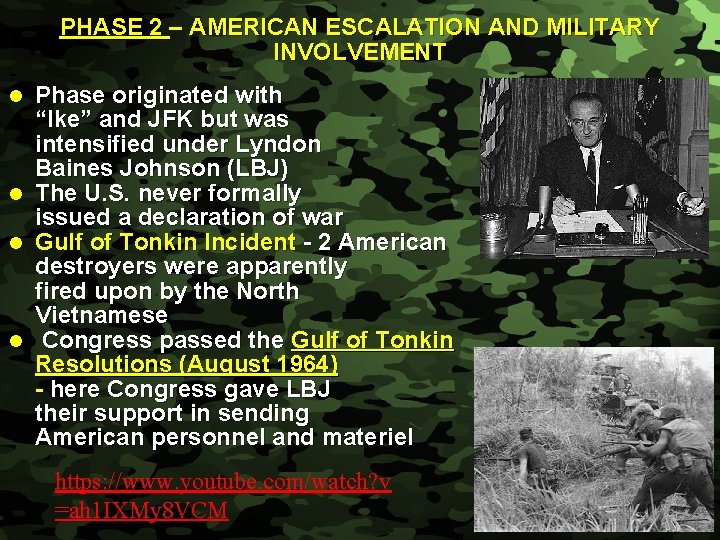
Slide 7 l l PHASE 2 – AMERICAN ESCALATION AND MILITARY INVOLVEMENT Phase originated with “Ike” and JFK but was intensified under Lyndon Baines Johnson (LBJ) The U. S. never formally issued a declaration of war Gulf of Tonkin Incident - 2 American destroyers were apparently fired upon by the North Vietnamese Congress passed the Gulf of Tonkin Resolutions (August 1964) - here Congress gave LBJ their support in sending American personnel and materiel https: //www. youtube. com/watch? v =ah 1 IXMy 8 VCM
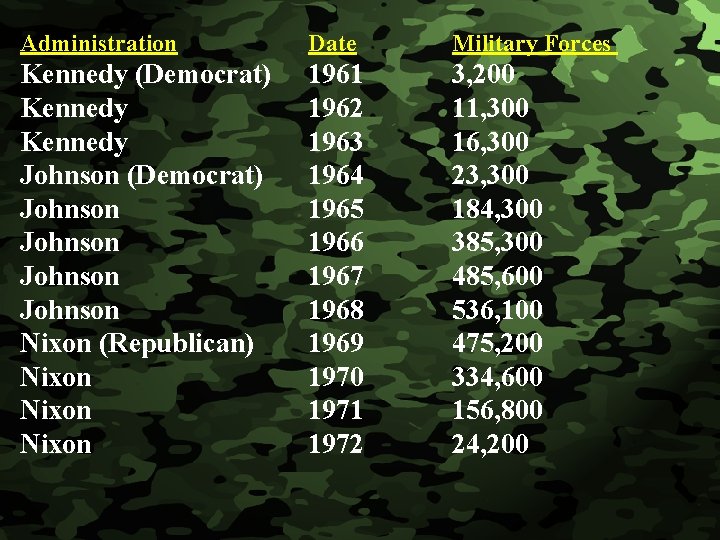
Slide 8 Administration Date Military Forces Kennedy (Democrat) Kennedy Johnson (Democrat) Johnson Nixon (Republican) Nixon 1961 1962 1963 1964 1965 1966 1967 1968 1969 1970 1971 1972 3, 200 11, 300 16, 300 23, 300 184, 300 385, 300 485, 600 536, 100 475, 200 334, 600 156, 800 24, 200
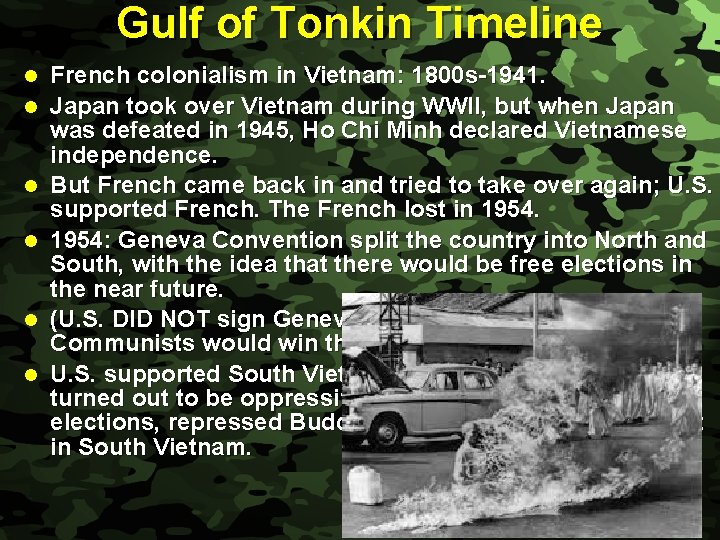
Slide 9 l l l Gulf of Tonkin Timeline French colonialism in Vietnam: 1800 s-1941. Japan took over Vietnam during WWII, but when Japan was defeated in 1945, Ho Chi Minh declared Vietnamese independence. But French came back in and tried to take over again; U. S. supported French. The French lost in 1954: Geneva Convention split the country into North and South, with the idea that there would be free elections in the near future. (U. S. DID NOT sign Geneva Accords, for fear that Communists would win the general elections). U. S. supported South Vietnam leader, Diem. But Diem turned out to be oppressive and unpopular. He canceled elections, repressed Buddhists; caused major discontent in South Vietnam.
Slide 10 l l l Gulf of Tonkin Timeline U. S. feared that Diem’s unpopularity will push more South Vietnamese to support Communists. So they supported a coup and Diem was overthrown and assassinated—Nov. 1, 1963. JFK assassinated only weeks later. LBJ inherited the problem in Vietnam. Under new weak South Vietnam government, support for Communism grew North Vietnam smuggled weapons into South Vietnam to support Communist insurgents through a network of trails through Laos and Cambodia (Ho Chi Minh trails). Aug. 2, 1964 - North Vietnamese attacked U. S. S. Maddox; Aug. 4. –another attack provided grounds for Gulf of Tonkin Resolution (second attack turned out to be fake— never happened). President Johnson asked Congress to pass Gulf of Tonkin Resolution which gave him authorization to use military force in Vietnam (not a declaration of war).
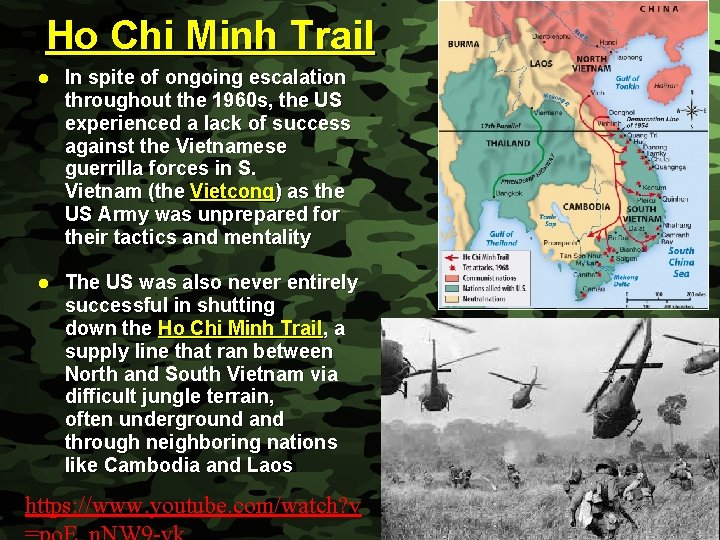
Slide 11 Ho Chi Minh Trail l l In spite of ongoing escalation throughout the 1960 s, the US experienced a lack of success against the Vietnamese guerrilla forces in S. Vietnam (the Vietcong) as the US Army was unprepared for their tactics and mentality The US was also never entirely successful in shutting down the Ho Chi Minh Trail, a supply line that ran between North and South Vietnam via difficult jungle terrain, often underground and through neighboring nations like Cambodia and Laos https: //www. youtube. com/watch? v
Slide 12 Quagmire and Attrition l In 1965, General Westmoreland began to implement a search-and-destroy strategy that sent U. S. troops out into the field to find and kill Viet Cong members l War of attrition—a strategy of extended combat meant to inflict so many casualties on the enemy that it could no longer continue l U. S. commanders were instructed to begin keeping body counts of enemy soldiers killed l Viet Cong’s guerrilla tactics frustrated and demoralized U. S. troops
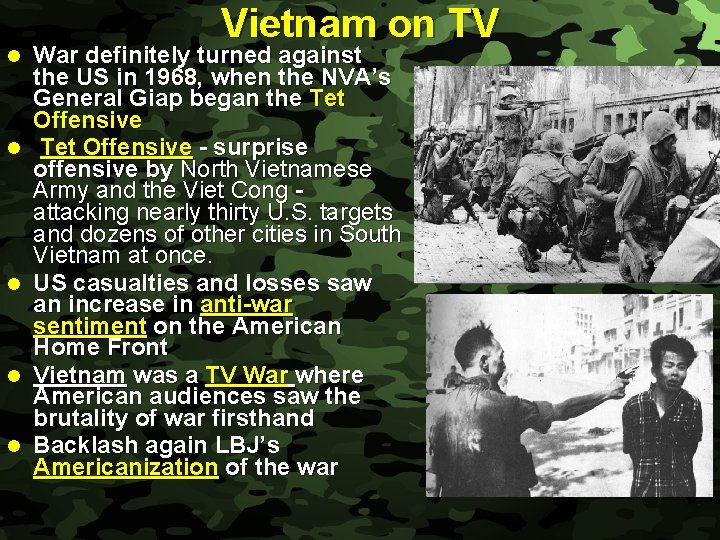
Slide 13 l l l Vietnam on TV War definitely turned against the US in 1968, when the NVA’s General Giap began the Tet Offensive - surprise offensive by North Vietnamese Army and the Viet Cong - attacking nearly thirty U. S. targets and dozens of other cities in South Vietnam at once. US casualties and losses saw an increase in anti-war sentiment on the American Home Front Vietnam was a TV War where American audiences saw the brutality of war firsthand Backlash again LBJ’s Americanization of the war
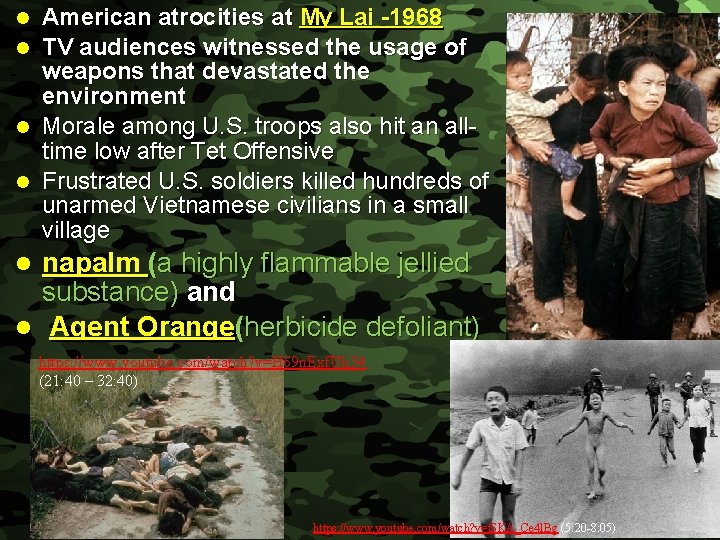
Slide 14 American atrocities at My Lai -1968 TV audiences witnessed the usage of weapons that devastated the environment l Morale among U. S. troops also hit an alltime low after Tet Offensive l Frustrated U. S. soldiers killed hundreds of unarmed Vietnamese civilians in a small village l napalm (a highly flammable jellied l l substance) and l Agent Orange(herbicide defoliant) https: //www. youtube. com/watch? v=H 69 n. Exf. Uh 34 (21: 40 – 32: 40) https: //www. youtube. com/watch? v=t. SKA_Ce 4 l. Bg (5: 20 -8: 05)
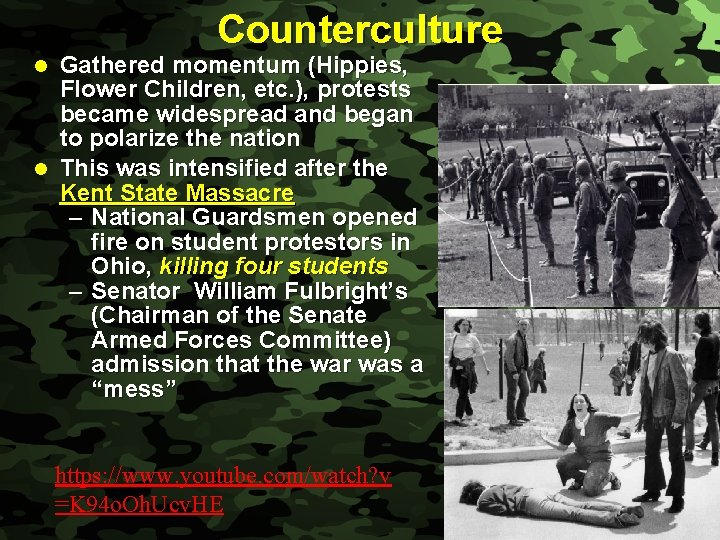
Slide 15 Counterculture Gathered momentum (Hippies, Flower Children, etc. ), protests became widespread and began to polarize the nation l This was intensified after the Kent State Massacre – National Guardsmen opened fire on student protestors in Ohio, killing four students – Senator William Fulbright’s (Chairman of the Senate Armed Forces Committee) admission that the war was a “mess” l https: //www. youtube. com/watch? v =K 94 o. Oh. Ucv. HE
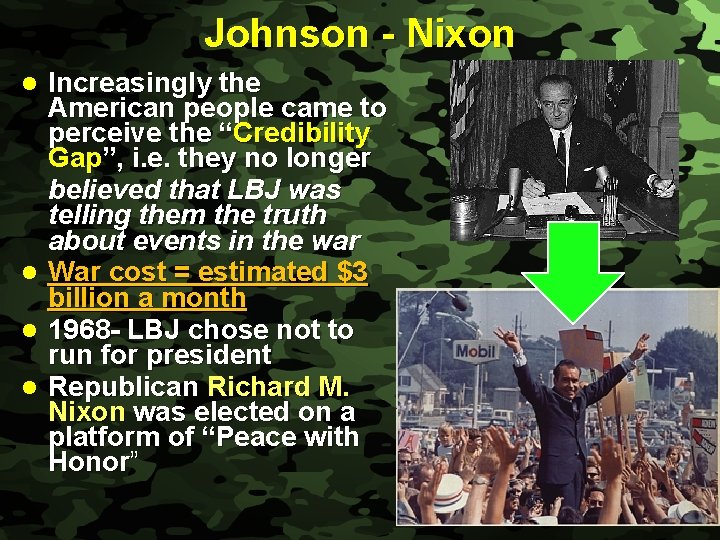
Slide 16 l l Johnson - Nixon Increasingly the American people came to perceive the “Credibility Gap”, i. e. they no longer believed that LBJ was telling them the truth about events in the war War cost = estimated $3 billion a month 1968 - LBJ chose not to run for president Republican Richard M. Nixon was elected on a platform of “Peace with Honor”
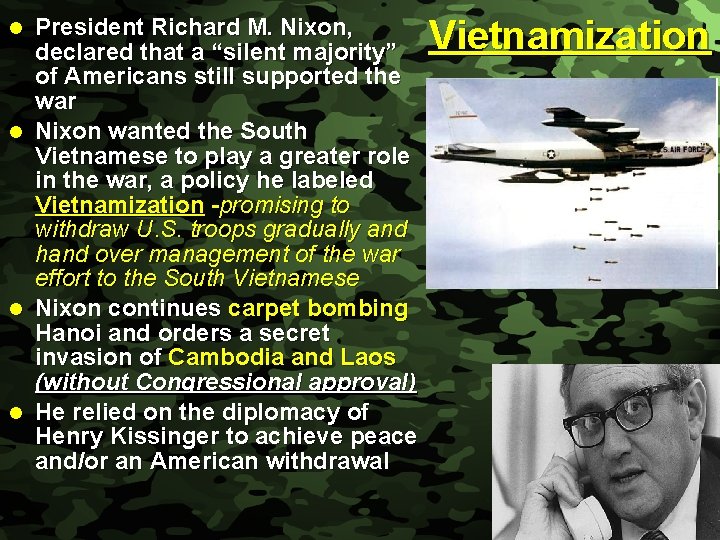
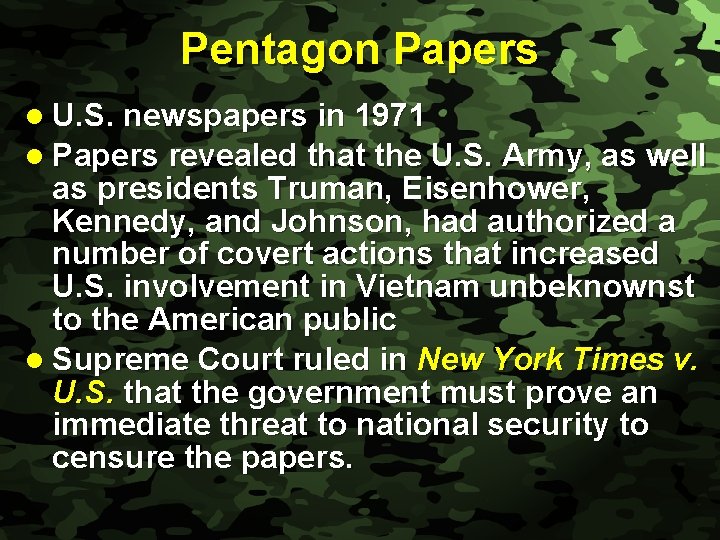
Slide 17 l l President Richard M. Nixon, declared that a “silent majority” of Americans still supported the war Nixon wanted the South Vietnamese to play a greater role in the war, a policy he labeled Vietnamization -promising to withdraw U. S. troops gradually and hand over management of the war effort to the South Vietnamese Nixon continues carpet bombing Hanoi and orders a secret invasion of Cambodia and Laos (without Congressional approval) He relied on the diplomacy of Henry Kissinger to achieve peace and/or an American withdrawal Vietnamization
Slide 18 Pentagon Papers l U. S. newspapers in 1971 l Papers revealed that the U. S. Army, as well as presidents Truman, Eisenhower, Kennedy, and Johnson, had authorized a number of covert actions that increased U. S. involvement in Vietnam unbeknownst to the American public l Supreme Court ruled in New York Times v. U. S. that the government must prove an immediate threat to national security to censure the papers.
Slide 19 The Cease-fire and the Fall of Saigon After secret negotiations between U. S. emissary Henry A. Kissinger and North Vietnamese representative Le Duc Tho in 1972, Nixon engaged in diplomatic maneuvering with China and the USSR—and stepped up bombing of North Vietnam—to pressure the North Vietnamese into a settlement. The Paris Peace Accords were finally signed in January 1973, and the last U. S. military personnel left Vietnam in March 1973. l Nixon pledged to withdraw all remaining military personnel from Vietnam and allow the tens of thousands of NVA troops in South Vietnam to remain there, despite the fact that they controlled a quarter of South Vietnamese territory. l However, Nixon promised to intervene if North Vietnam moved against the South. In exchange, North Vietnam promised that elections would be held to determine the fate of the entire country. Although Nixon insisted that the agreement brought “peace with honor, ” South Vietnamese leaders complained that the terms amounted to little more than a surrender for South Vietnam. l The U. S. government continued to fund the South Vietnamese army, but this funding quickly dwindled. l
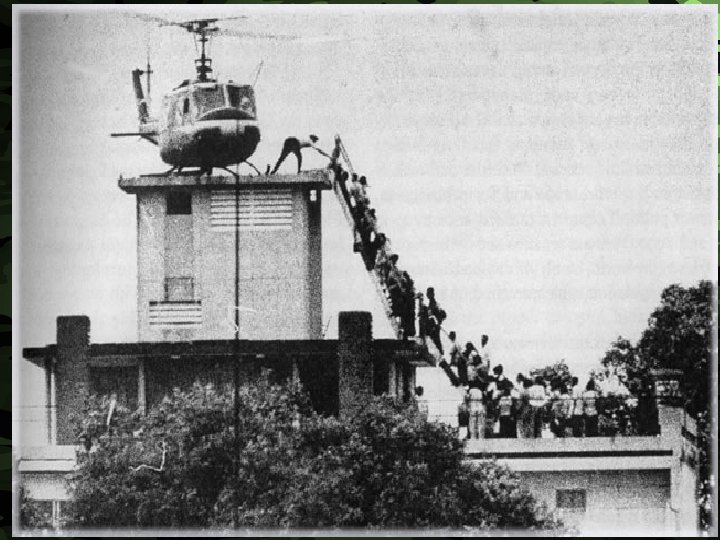
Slide 20 PHASE 3 – VIETNAMESE CIVIL WAR 1973 -75 l l l President Nixon became embroiled in the Watergate scandal that led to his resignation in August 1974. He was in essence a “lame duck”! North Vietnamese forces stepped up their attacks on the South and finally launched an all-out offensive in the spring of 1975. On April 30, 1975, the South Vietnamese capital of Saigon fell to the North Vietnamese, who reunited the country under Communist rule as the Socialist Republic of Vietnam, ending the Vietnam War. The US abandoned its embassy in Saigon, which was renamed Ho Chi Minh City in the newly unified and communist Vietnam
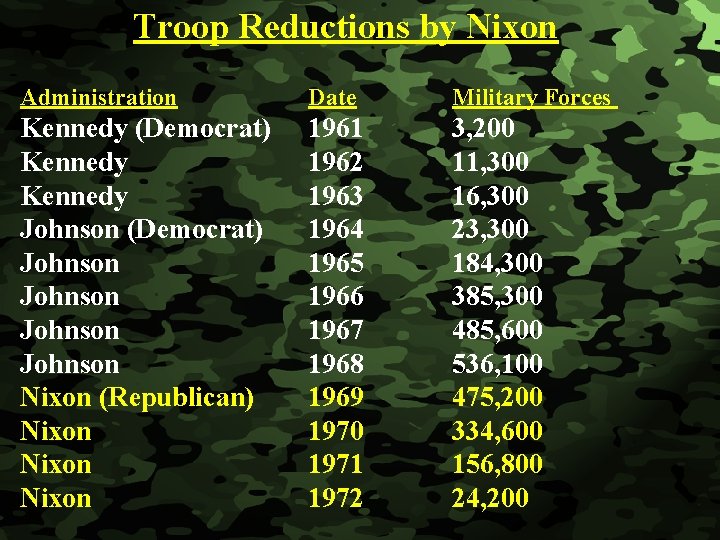
Slide 21 Troop Reductions by Nixon Administration Date Military Forces Kennedy (Democrat) Kennedy Johnson (Democrat) Johnson Nixon (Republican) Nixon 1961 1962 1963 1964 1965 1966 1967 1968 1969 1970 1971 1972 3, 200 11, 300 16, 300 23, 300 184, 300 385, 300 485, 600 536, 100 475, 200 334, 600 156, 800 24, 200
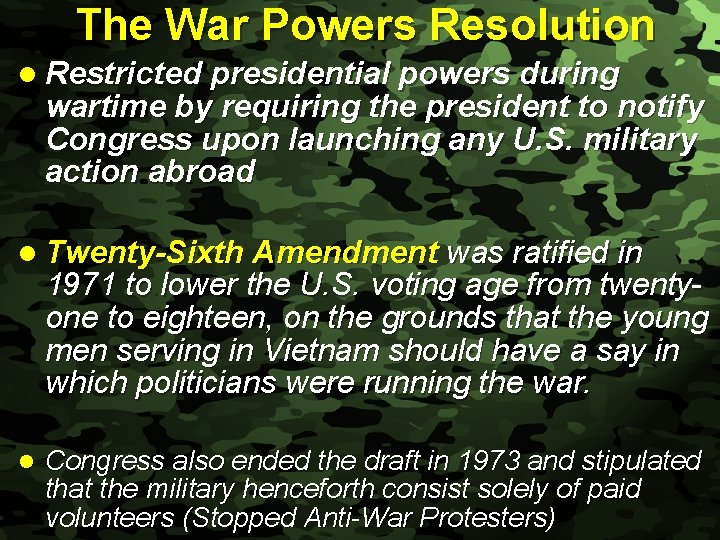
Slide 22 The War Powers Resolution l Restricted presidential powers during wartime by requiring the president to notify Congress upon launching any U. S. military action abroad l Twenty-Sixth Amendment was ratified in 1971 to lower the U. S. voting age from twentyone to eighteen, on the grounds that the young men serving in Vietnam should have a say in which politicians were running the war. l Congress also ended the draft in 1973 and stipulated that the military henceforth consist solely of paid volunteers (Stopped Anti-War Protesters)