
Slide 1 Cognitive Revolution X Mansfield University Introductory
- Slides: 14
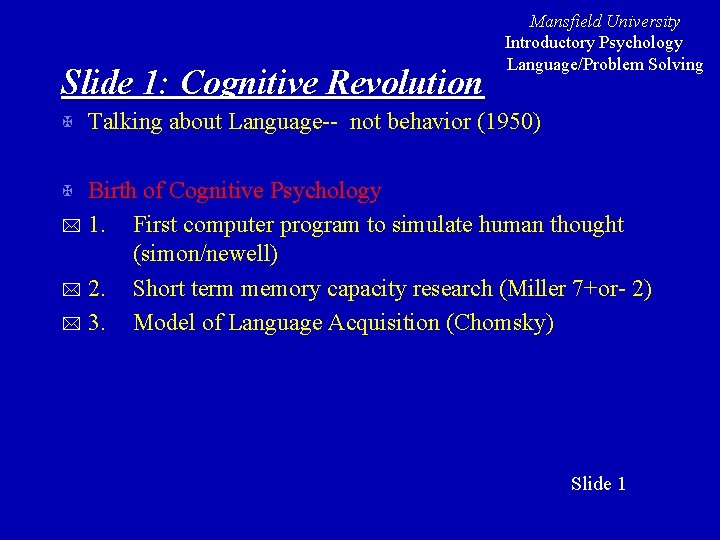
Slide 1: Cognitive Revolution X Mansfield University Introductory Psychology Language/Problem Solving Talking about Language-- not behavior (1950) Birth of Cognitive Psychology * 1. First computer program to simulate human thought (simon/newell) * 2. Short term memory capacity research (Miller 7+or- 2) * 3. Model of Language Acquisition (Chomsky) X Slide 1
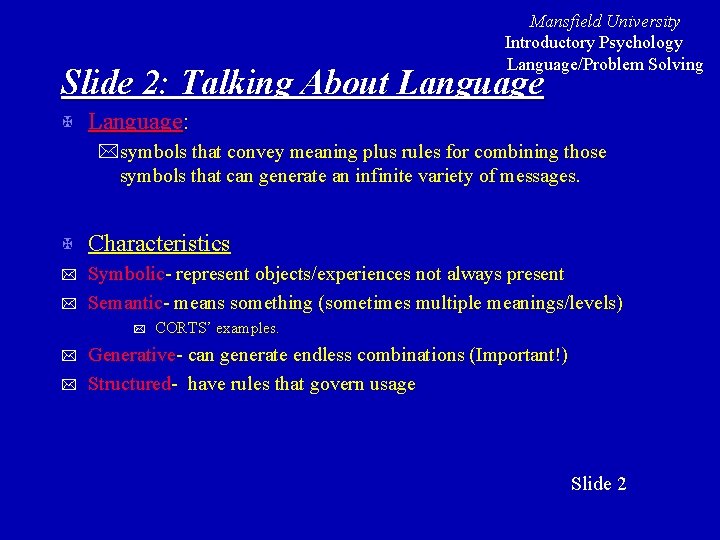
Mansfield University Introductory Psychology Language/Problem Solving Slide 2: Talking About Language X Language: *symbols that convey meaning plus rules for combining those symbols that can generate an infinite variety of messages. X Characteristics * Symbolic represent objects/experiences not always present Semantic means something (sometimes multiple meanings/levels) * * CORTS’ examples. Generative can generate endless combinations (Important!) Structured have rules that govern usage Slide 2
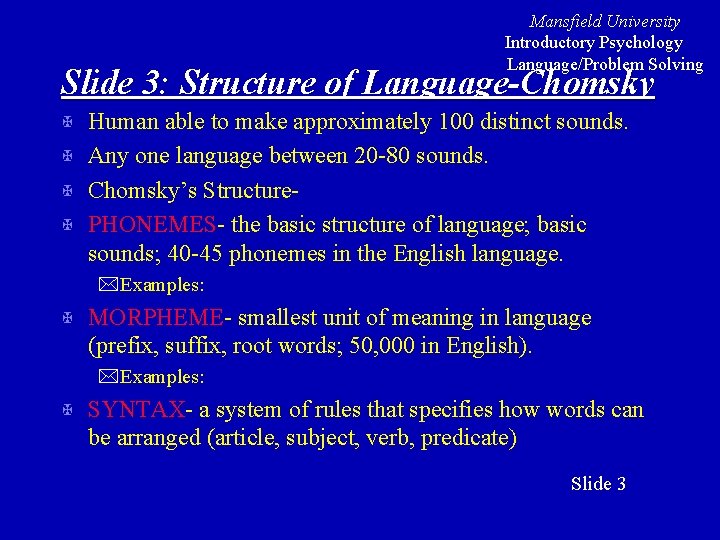
Mansfield University Introductory Psychology Language/Problem Solving Slide 3: Structure of Language-Chomsky X X Human able to make approximately 100 distinct sounds. Any one language between 20 -80 sounds. Chomsky’s Structure. PHONEMES the basic structure of language; basic sounds; 40 -45 phonemes in the English language. *Examples: X MORPHEME smallest unit of meaning in language (prefix, suffix, root words; 50, 000 in English). *Examples: X SYNTAX a system of rules that specifies how words can be arranged (article, subject, verb, predicate) Slide 3
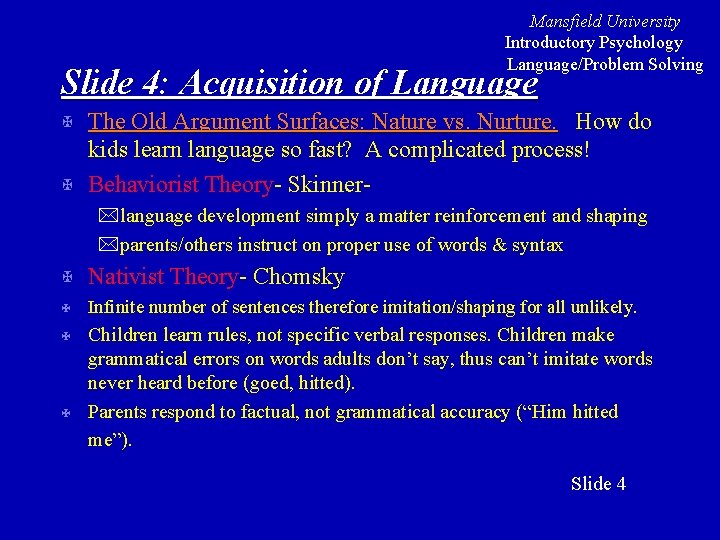
Mansfield University Introductory Psychology Language/Problem Solving Slide 4: Acquisition of Language X X The Old Argument Surfaces: Nature vs. Nurture. How do kids learn language so fast? A complicated process! Behaviorist Theory Skinner*language development simply a matter reinforcement and shaping *parents/others instruct on proper use of words & syntax X Nativist Theory Chomsky X Infinite number of sentences therefore imitation/shaping for all unlikely. X Children learn rules, not specific verbal responses. Children make grammatical errors on words adults don’t say, thus can’t imitate words never heard before (goed, hitted). Parents respond to factual, not grammatical accuracy (“Him hitted me”). X Slide 4
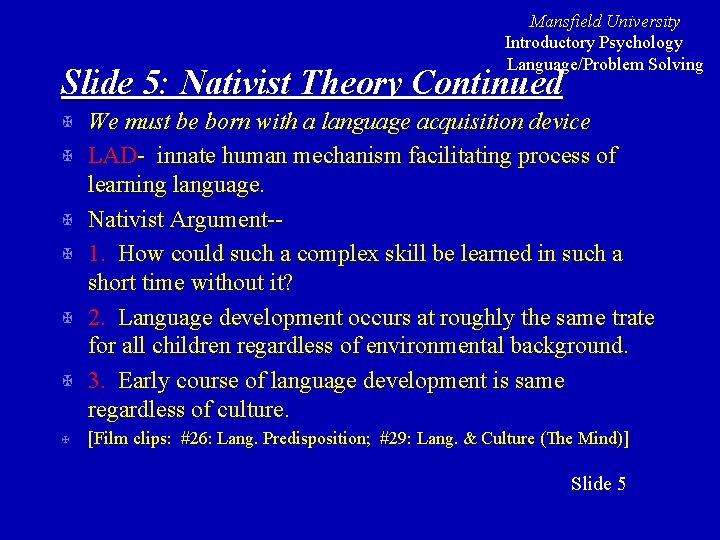
Mansfield University Introductory Psychology Language/Problem Solving Slide 5: Nativist Theory Continued X X X X We must be born with a language acquisition device LADLAD innate human mechanism facilitating process of learning language. Nativist Argument-1. How could such a complex skill be learned in such a short time without it? 2. Language development occurs at roughly the same trate for all children regardless of environmental background. 3. Early course of language development is same regardless of culture. [Film clips: #26: Lang. Predisposition; #29: Lang. & Culture (The Mind)] Slide 5
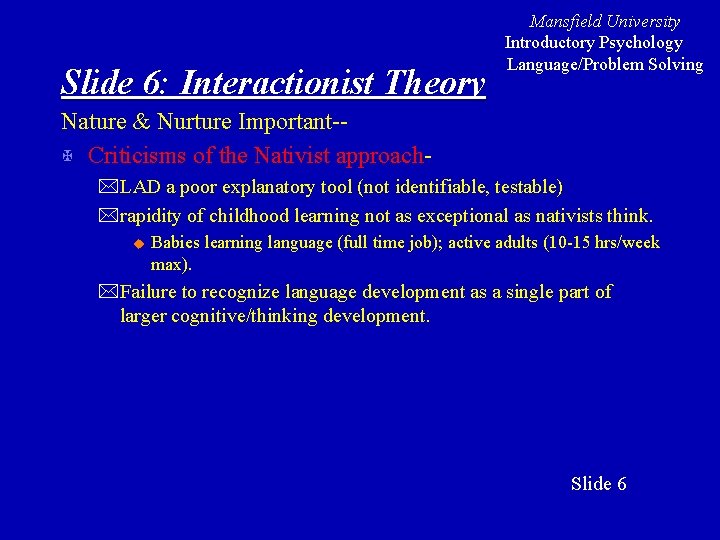
Slide 6: Interactionist Theory Mansfield University Introductory Psychology Language/Problem Solving Nature & Nurture Important-X Criticisms of the Nativist approach *LAD a poor explanatory tool (not identifiable, testable) *rapidity of childhood learning not as exceptional as nativists think. u Babies learning language (full time job); active adults (10 -15 hrs/week max). *Failure to recognize language development as a single part of larger cognitive/thinking development. Slide 6
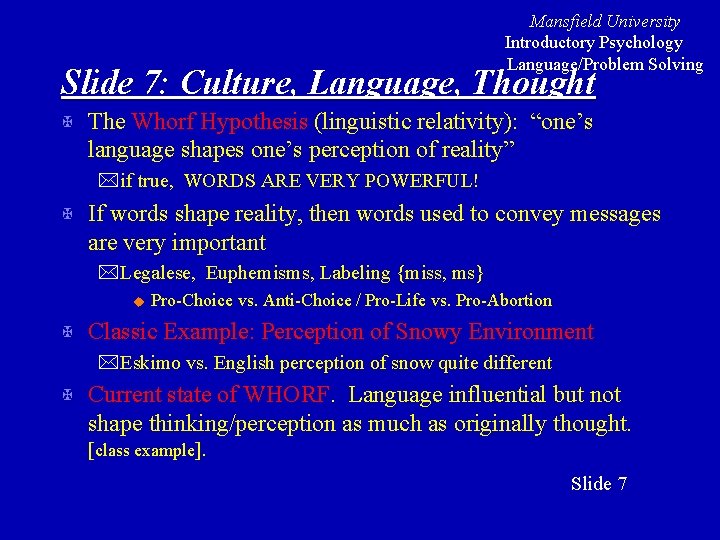
Mansfield University Introductory Psychology Language/Problem Solving Slide 7: Culture, Language, Thought X The Whorf Hypothesis (linguistic relativity): “one’s language shapes one’s perception of reality” *if true, WORDS ARE VERY POWERFUL! X If words shape reality, then words used to convey messages are very important *Legalese, Euphemisms, Labeling {miss, ms} u X Pro-Choice vs. Anti-Choice / Pro-Life vs. Pro-Abortion Classic Example: Perception of Snowy Environment *Eskimo vs. English perception of snow quite different X Current state of WHORF Language influential but not shape thinking/perception as much as originally thought. [class example]. Slide 7
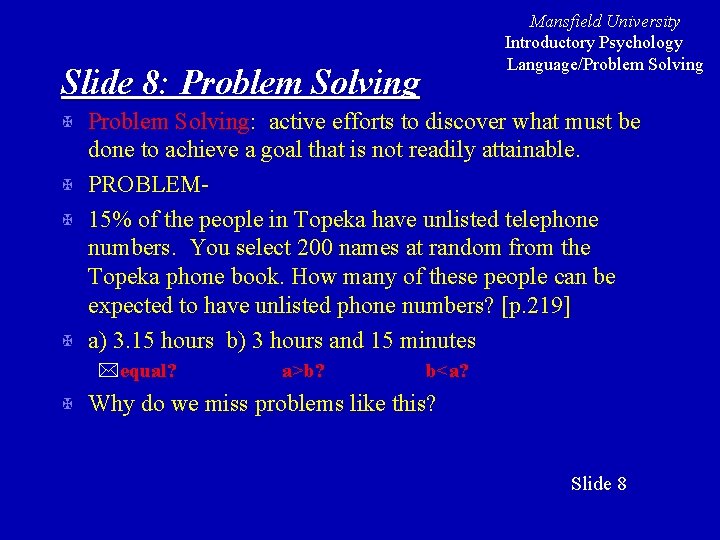
Mansfield University Introductory Psychology Language/Problem Solving Slide 8: Problem Solving X X Problem Solving: Solving active efforts to discover what must be done to achieve a goal that is not readily attainable. PROBLEM 15% of the people in Topeka have unlisted telephone numbers. You select 200 names at random from the Topeka phone book. How many of these people can be expected to have unlisted phone numbers? [p. 219] a) 3. 15 hours b) 3 hours and 15 minutes *equal? X a>b? b<a? Why do we miss problems like this? Slide 8
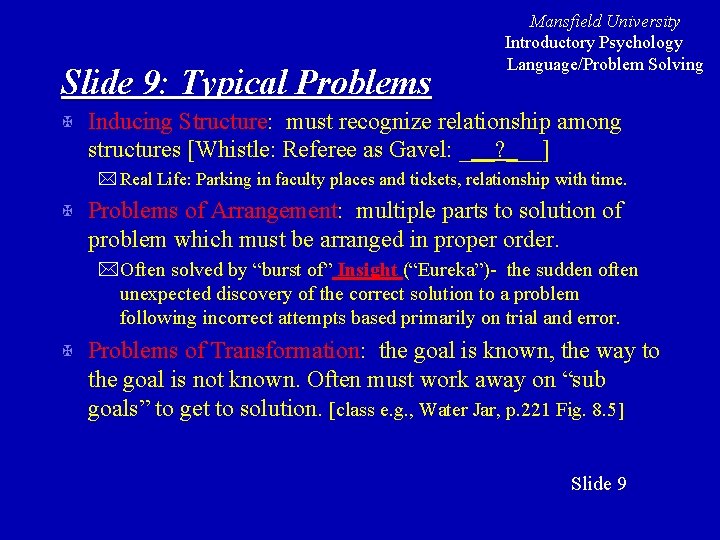
Slide 9: Typical Problems X Mansfield University Introductory Psychology Language/Problem Solving Inducing Structure: Structure must recognize relationship among structures [Whistle: Referee as Gavel: ___? ___] * Real Life: Parking in faculty places and tickets, relationship with time. X Problems of Arrangement: Arrangement multiple parts to solution of problem which must be arranged in proper order. *Often solved by “burst of” Insight (“Eureka”)- the sudden often unexpected discovery of the correct solution to a problem following incorrect attempts based primarily on trial and error. X Problems of Transformation: Transformation the goal is known, the way to the goal is not known. Often must work away on “sub goals” to get to solution. [class e. g. , Water Jar, p. 221 Fig. 8. 5] Slide 9
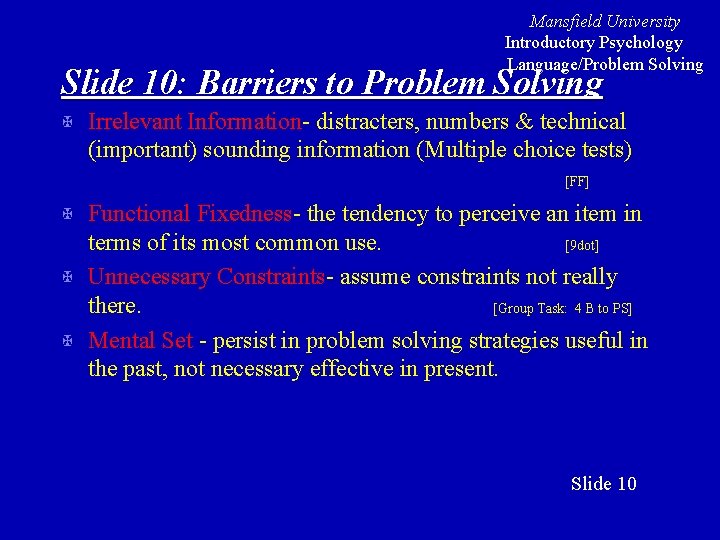
Mansfield University Introductory Psychology Language/Problem Solving Slide 10: Barriers to Problem Solving X Irrelevant Information distracters, numbers & technical (important) sounding information (Multiple choice tests) [FF] X X X Functional Fixedness the tendency to perceive an item in terms of its most common use. [9 dot] Unnecessary Constraints assume constraints not really there. [Group Task: 4 B to PS] Mental Set - persist in problem solving strategies useful in the past, not necessary effective in present. Slide 10
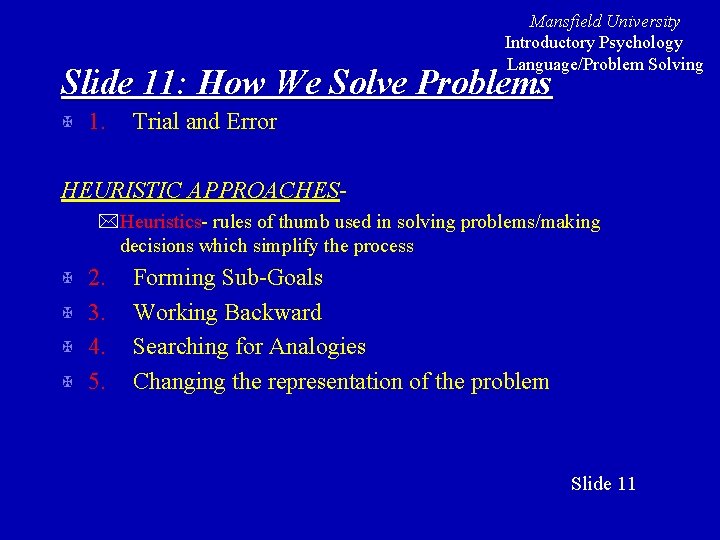
Mansfield University Introductory Psychology Language/Problem Solving Slide 11: How We Solve Problems X 1. Trial and Error HEURISTIC APPROACHES*Heuristics rules of thumb used in solving problems/making decisions which simplify the process X X 2. 3. 4. 5. Forming Sub-Goals Working Backward Searching for Analogies Changing the representation of the problem Slide 11
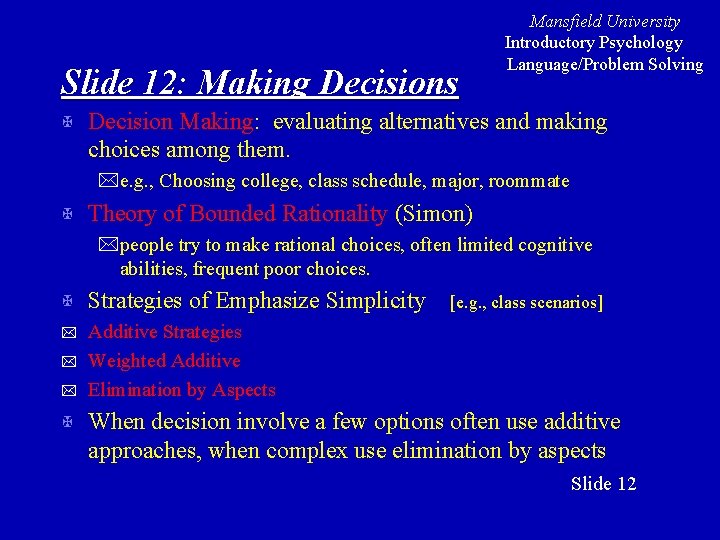
Slide 12: Making Decisions X Mansfield University Introductory Psychology Language/Problem Solving Decision Making: Making evaluating alternatives and making choices among them. *e. g. , Choosing college, class schedule, major, roommate X Theory of Bounded Rationality (Simon) *people try to make rational choices, often limited cognitive abilities, frequent poor choices. X Strategies of Emphasize Simplicity * Additive Strategies Weighted Additive Elimination by Aspects * * X [e. g. , class scenarios] When decision involve a few options often use additive approaches, when complex use elimination by aspects Slide 12
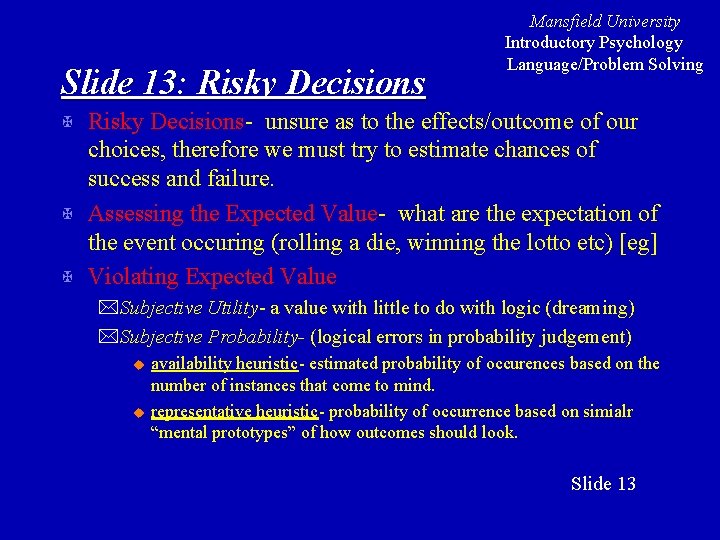
Slide 13: Risky Decisions X X X Mansfield University Introductory Psychology Language/Problem Solving Risky Decisions unsure as to the effects/outcome of our choices, therefore we must try to estimate chances of success and failure. Assessing the Expected Value what are the expectation of the event occuring (rolling a die, winning the lotto etc) [eg] Violating Expected Value *Subjective Utility- a value with little to do with logic (dreaming) *Subjective Probability- (logical errors in probability judgement) u u availability heuristic- estimated probability of occurences based on the number of instances that come to mind. representative heuristic- probability of occurrence based on simialr “mental prototypes” of how outcomes should look. Slide 13
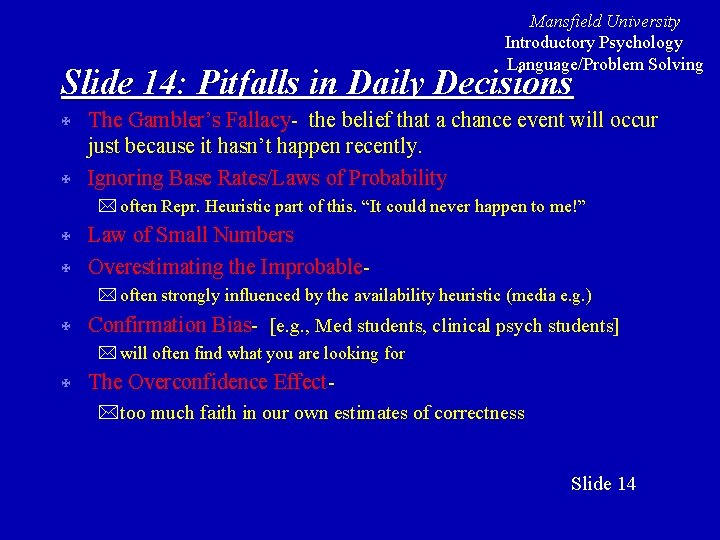
Mansfield University Introductory Psychology Language/Problem Solving Slide 14: Pitfalls in Daily Decisions X X The Gambler’s Fallacy the belief that a chance event will occur just because it hasn’t happen recently. Ignoring Base Rates/Laws of Probability * often Repr. Heuristic part of this. “It could never happen to me!” X X Law of Small Numbers Overestimating the Improbable * often strongly influenced by the availability heuristic (media e. g. ) X Confirmation Bias [e. g. , Med students, clinical psych students] * will often find what you are looking for X The Overconfidence Effect *too much faith in our own estimates of correctness Slide 14