
Slide 1 Basics of Business and Professional Communication
Slide 1 Basics of Business and Professional Communication Copyright © 2002 by The Mc. Graw-Hill Companies, Inc. All rights reserved.
C h a p t e r Slide 2 1 Communicating At Work Chapter Summary ©The Importance of Communication ©The Nature of Communication ©Using Communication Networks ©Choosing the Optimal Communication Channel Copyright © 2002 by The Mc. Graw-Hill Companies, Inc. All rights reserved.

Slide 3 The Importance of Communication ©Communication skills are the key to job advancement ©Executives spend 75 to 80 percent of their time communicating ©Communicating effectively often makes the difference in getting hired Copyright © 2002 by The Mc. Graw-Hill Companies, Inc. All rights reserved.
Slide 4 Employers want… © Communication Skills © Strong work ethic © Teamwork skills © Initiative © Analytical skills © Computer skills © Flexibility/adaptability © Interpersonal skills © Problem-solving skills © Technical skills Copyright © 2002 by The Mc. Graw-Hill Companies, Inc. All rights reserved.
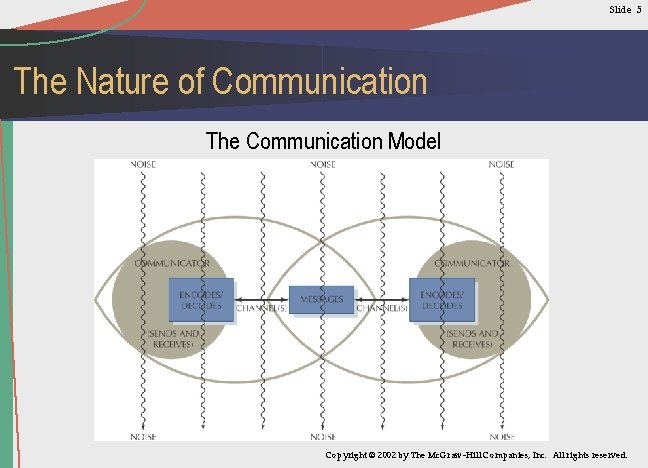
Slide 5 The Nature of Communication The Communication Model Copyright © 2002 by The Mc. Graw-Hill Companies, Inc. All rights reserved.
Slide 6 The Nature of Communication The Process of Communication ©Sender ©Message ©Encoding ©Channel ©Receiver ©Decoding Continued. . . Copyright © 2002 by The Mc. Graw-Hill Companies, Inc. All rights reserved.
Slide 7 The Nature of Communication The Process of Communication ©Feedback ©Noise ©Context ©Social Context ©Chronological Context ©Cultural Context Copyright © 2002 by The Mc. Graw-Hill Companies, Inc. All rights reserved.
Slide 8 The Nature of Communication Principles ©Communication is Unavoidable ©Communication Operates on Two Levels © Content Messages © Relational Messages ©Communication is Irreversible ©Communication is a Process Continued. . . Copyright © 2002 by The Mc. Graw-Hill Companies, Inc. All rights reserved.
Slide 9 The Nature of Communication Principles ©Communication is Not a Panacea ©Communication Often Presents Ethical Challenges © The Golden Rule Standard © The Professional Ethic © Immanuel Kant’s Categorical Imperative © The Utilitarian Rule © The “ 60 Minutes” Test Copyright © 2002 by The Mc. Graw-Hill Companies, Inc. All rights reserved.
Slide 10 Ethical Communication © The Golden Rule Standard © Is this the way in which I would want to be treated by others? © The Professional Ethic © How would this action be judged by an impartial jury of my peers? © The “ 60 Minutes” Test © Would you feel comfortable explaining your behavior on the national television? © Immanuel Kant’s Categorical Imperative (Rights Approach) © Could our society continue to function if everyone acted in this fashion? Does the action respect others moral rights? © The Utilitarian Rule © Does this action do the most good for the most people over the greatest period of time? Copyright © 2002 by The Mc. Graw-Hill Companies, Inc. All rights reserved.
Slide 11 Ethical Communication, cont’d ©Common Good Approach- Does the action further the common or community good? ©Virtue Approach- Does the action promote the development of moral virtue in me or the community? ©Fairness/Justice Approach- is the action free of bias, discrimination, or favoritism? Copyright © 2002 by The Mc. Graw-Hill Companies, Inc. All rights reserved.
Slide 12 Using Communication Networks Formal Communication Networks ©Downward Communication © Job Instructions © Job Rationale © Procedures and Practices © Feedback © Indoctrination Copyright © 2002 by The Mc. Graw-Hill Companies, Inc. All rights reserved.

Slide 13 Using Communication Networks Formal Communication Networks ©Upward Communication © What Subordinates are Doing © Unsolved Work Problems © Suggestions for Improvement © How Subordinates Feel About Each Other and the Job Copyright © 2002 by The Mc. Graw-Hill Companies, Inc. All rights reserved.
Slide 14 Using Communication Networks Formal Communication Networks ©Horizontal Communication © Task Coordination © Problem Solving © Sharing Information © Conflict Resolution © Building Rapport Copyright © 2002 by The Mc. Graw-Hill Companies, Inc. All rights reserved.
Slide 15 Using Communication Networks Informal Communication Networks ©Cultivating Personal Networks on the Job and Beyond © View Everyone as a Networking Prospect © Get Referrals to Secondary Sources © Seek a Mentor © Become a Bridge © Ask Questions © Don’t Flaunt Informal Shortcuts Copyright © 2002 by The Mc. Graw-Hill Companies, Inc. All rights reserved.
Slide 16 Choosing the Optimal Communication Channel Available Channels ©Face-to-Face Communication ©Teleconferencing ©Telephone and Voice Mail ©Written Communication © E-mail © Computer Conferencing © Instant Messaging Copyright © 2002 by The Mc. Graw-Hill Companies, Inc. All rights reserved.
Slide 17 Choosing the Optimal Communication Channel Considerations When Choosing a Channel ©Speed of Establishing Contact ©Time Required for Feedback ©Amount of Information Conveyed ©Control Over How Message is Composed and Delivered Continued. . . Copyright © 2002 by The Mc. Graw-Hill Companies, Inc. All rights reserved.
Slide 18 Choosing the Optimal Communication Channel Considerations When Choosing a Channel ©Control Over Receiver’s Attention ©Personal vs. Formal ©Cost ©Permanent Record ©Effective for Detailed Messages Copyright © 2002 by The Mc. Graw-Hill Companies, Inc. All rights reserved.
- Slides: 18