
SLIDE 1 Analysis of the hidden terminal effect

- Slides: 14
SLIDE 1 Analysis of the hidden terminal effect in multi-rate IEEE 802. 11 b networks Simone Merlin Department of Information Engineering Università degli Studi di Padova Napoli - 21 February 2004 – Simone Merlin
Outline SLIDE 2 q Introduction: Ø q 802. 11 b: Ø Ø q Multirate standard specifications Basic access VS RTS/CTS mechanism Numerical Results: Ø Ø q the Hidden Terminal Problem in DCF (distributed Coordination Function) access method. Distance Ratio for a target BER Average Nominal Goodput Conclusion Napoli - 21 February 2004 – Simone Merlin
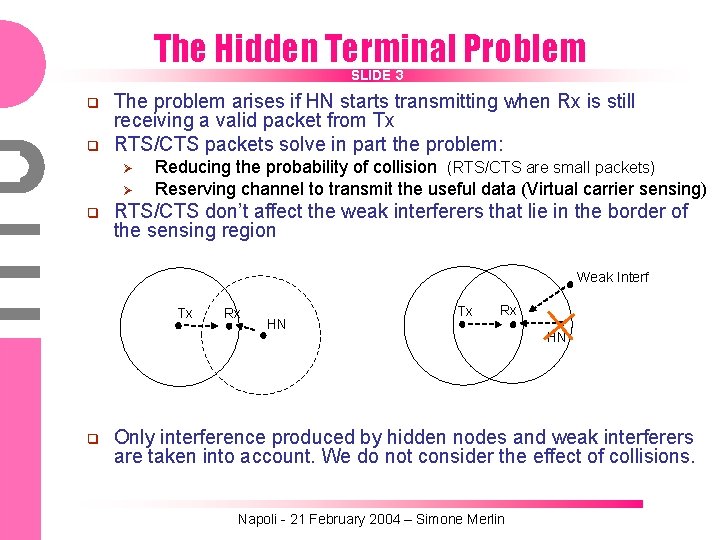
The Hidden Terminal Problem SLIDE 3 q q The problem arises if HN starts transmitting when Rx is still receiving a valid packet from Tx RTS/CTS packets solve in part the problem: Ø Ø q Reducing the probability of collision (RTS/CTS are small packets) Reserving channel to transmit the useful data (Virtual carrier sensing) RTS/CTS don’t affect the weak interferers that lie in the border of the sensing region Weak Interf Tx q Rx HN Tx Rx HN Only interference produced by hidden nodes and weak interferers are taken into account. We do not consider the effect of collisions. Napoli - 21 February 2004 – Simone Merlin
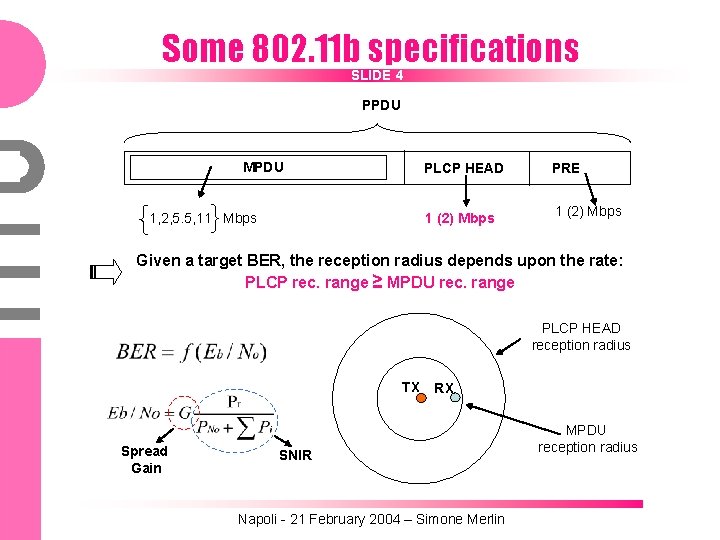
Some 802. 11 b specifications SLIDE 4 PPDU MPDU 1, 2, 5. 5, 11 Mbps PLCP HEAD PRE 1 (2) Mbps Given a target BER, the reception radius depends upon the rate: PLCP rec. range ≥ MPDU rec. range PLCP HEAD reception radius TX Spread Gain RX SNIR Napoli - 21 February 2004 – Simone Merlin MPDU reception radius
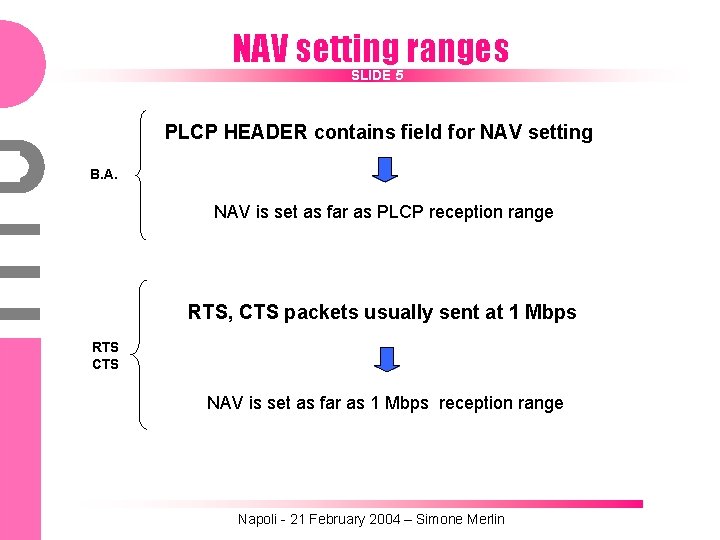
NAV setting ranges SLIDE 5 PLCP HEADER contains field for NAV setting B. A. NAV is set as far as PLCP reception range RTS, CTS packets usually sent at 1 Mbps RTS CTS NAV is set as far as 1 Mbps reception range Napoli - 21 February 2004 – Simone Merlin
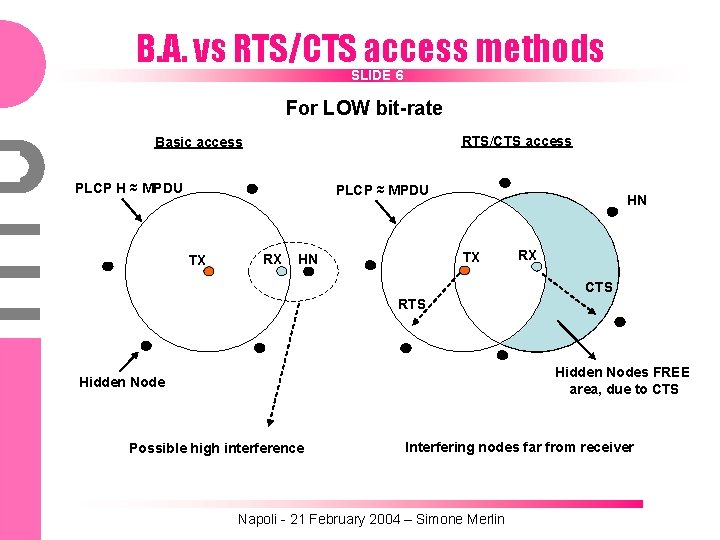
B. A. vs RTS/CTS access methods SLIDE 6 For LOW bit-rate RTS/CTS access Basic access PLCP H ≈ MPDU PLCP ≈ MPDU TX RX HN TX HN RX CTS RTS Hidden Nodes FREE area, due to CTS Hidden Node Possible high interference Interfering nodes far from receiver Napoli - 21 February 2004 – Simone Merlin
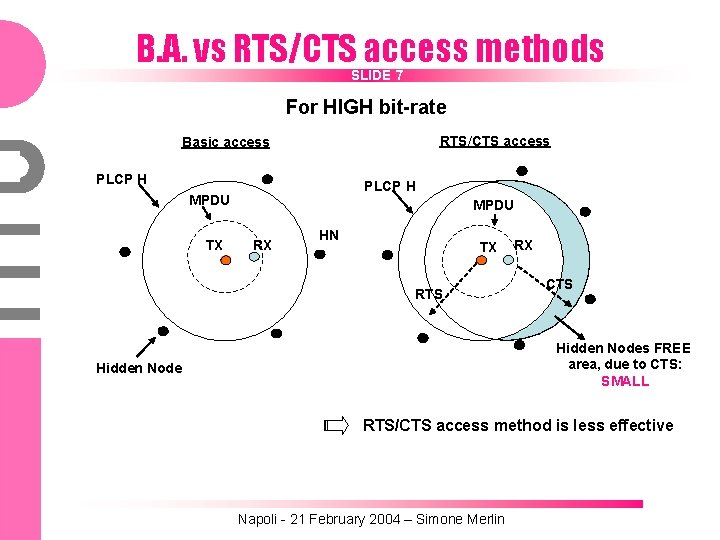
B. A. vs RTS/CTS access methods SLIDE 7 For HIGH bit-rate RTS/CTS access Basic access PLCP H MPDU TX MPDU RX HN TX RTS RX CTS Hidden Nodes FREE area, due to CTS: SMALL Hidden Node RTS/CTS access method is less effective Napoli - 21 February 2004 – Simone Merlin
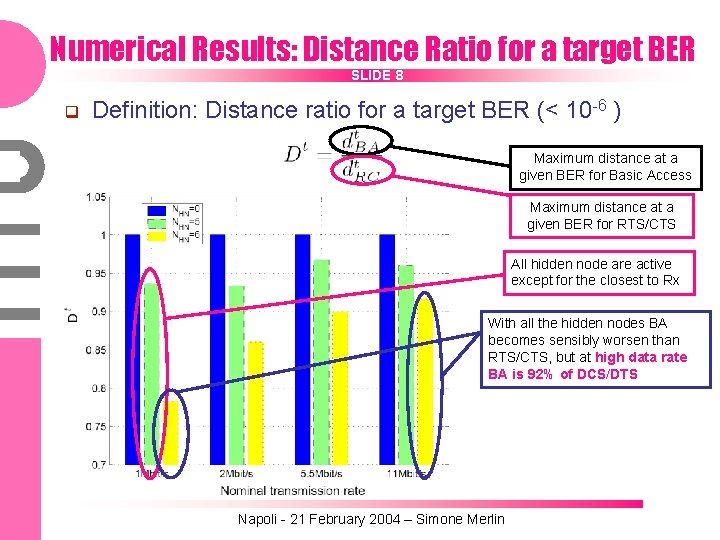
Numerical Results: Distance Ratio for a target BER SLIDE 8 q Definition: Distance ratio for a target BER (< 10 -6 ) Maximum distance at a given BER for Basic Access Maximum distance at a given BER for RTS/CTS All hidden node are active except for the closest to Rx With all the hidden nodes BA becomes sensibly worsen than RTS/CTS, but at high data rate BA is 92% of DCS/DTS Napoli - 21 February 2004 – Simone Merlin
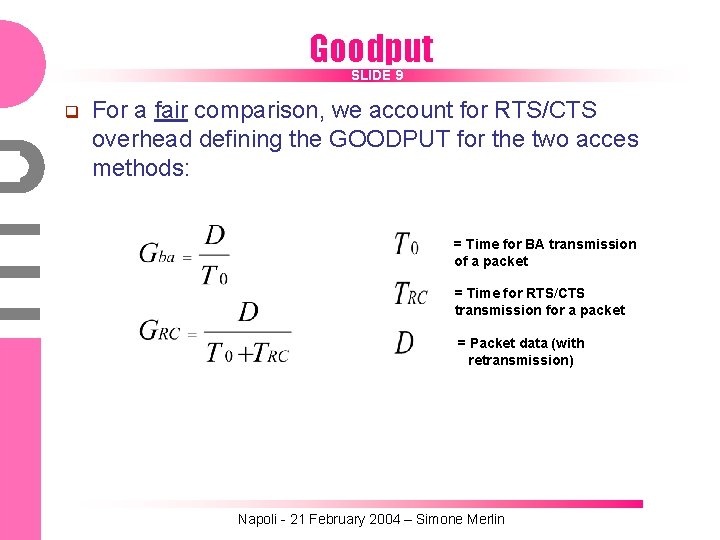
Goodput SLIDE 9 q For a fair comparison, we account for RTS/CTS overhead defining the GOODPUT for the two acces methods: = Time for BA transmission of a packet = Time for RTS/CTS transmission for a packet = Packet data (with retransmission) Napoli - 21 February 2004 – Simone Merlin
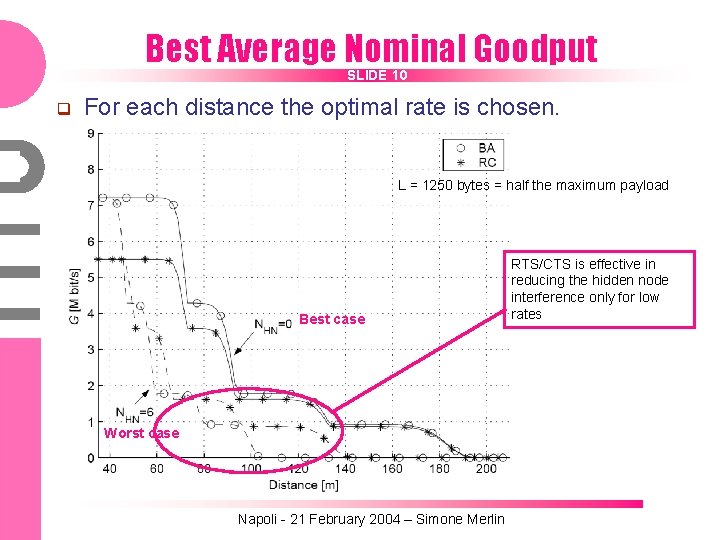
Best Average Nominal Goodput SLIDE 10 q For each distance the optimal rate is chosen. L = 1250 bytes = half the maximum payload Best case Worst case Napoli - 21 February 2004 – Simone Merlin RTS/CTS is effective in reducing the hidden node interference only for low rates
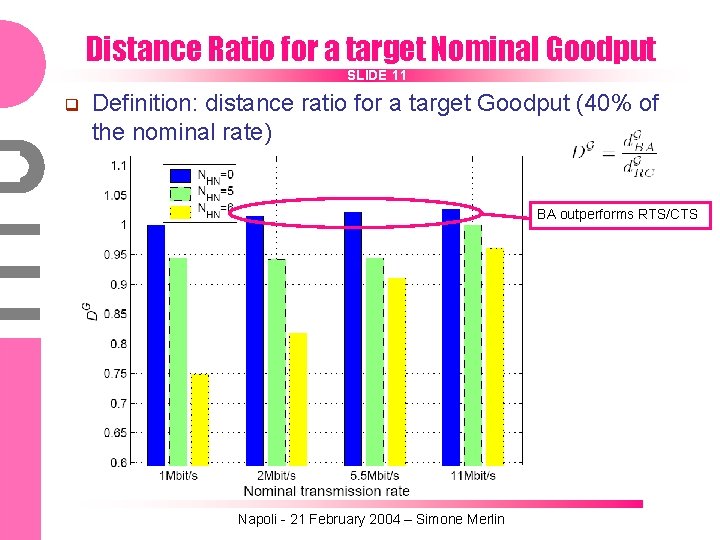
Distance Ratio for a target Nominal Goodput SLIDE 11 q Definition: distance ratio for a target Goodput (40% of the nominal rate) BA outperforms RTS/CTS Napoli - 21 February 2004 – Simone Merlin
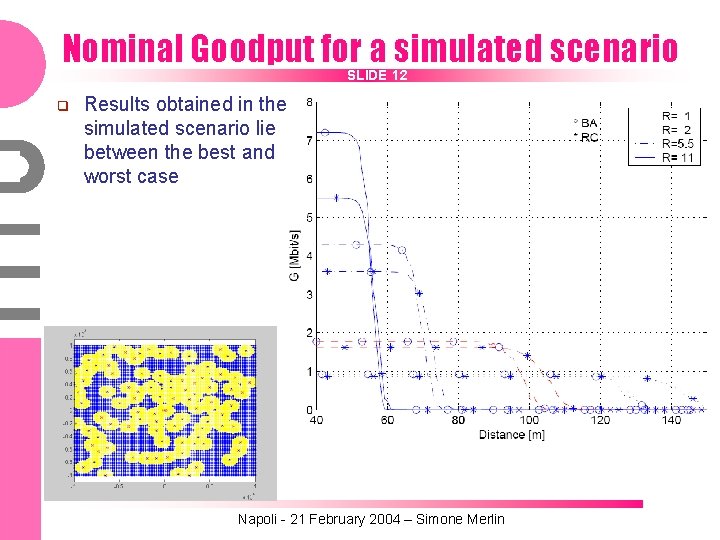
Nominal Goodput for a simulated scenario SLIDE 12 q Results obtained in the simulated scenario lie between the best and worst case Napoli - 21 February 2004 – Simone Merlin
Conclusion SLIDE 13 q Under the assumption of no collision and retransmission we have found: Ø Ø q . . however for highly loaded networks Ø q RTS /CTS results to be effective against hidden node interference only for low transmission rate At high data rate both techniques attain similar performance RTS/CTS could be convenient also at high transmission rate. Future Work. . Ø Ø Evaluate in a ‘real’ scenario the effectiveness of RTS/CTS method against traffic load Extend study to 802. 11 a Napoli - 21 February 2004 – Simone Merlin
SLIDE 14 Napoli - 21 February 2004 – Simone Merlin