
Slide 1 1 PSY 411 Health Psychology Assist
- Slides: 21
Slide 1. 1 PSY 411 Health Psychology Assist. Prof. Merve Topcu Department of Psy, Çankaya University 2016 -2017, Fall Val Morrison and Paul Bennett, An Introduction to Health Psychology , 3 rd Edition, © Pearson Education Limited 2013
Slide 1. 2 Ch. 1 – What is health? Learning outcomes By the end, you should have an understanding of: • key models of thinking about health and illness: the biomedical and the biopsychosocial • how health is more than simply the absence of physical disease • the domains of health considered important by different populations • the influence of age/lifestage and culture on health concepts • the role of psychology in understanding health and illness • the aims and interests of the discipline of health psychology Val Morrison and Paul Bennett, An Introduction to Health Psychology , 3 rd Edition, © Pearson Education Limited 2013
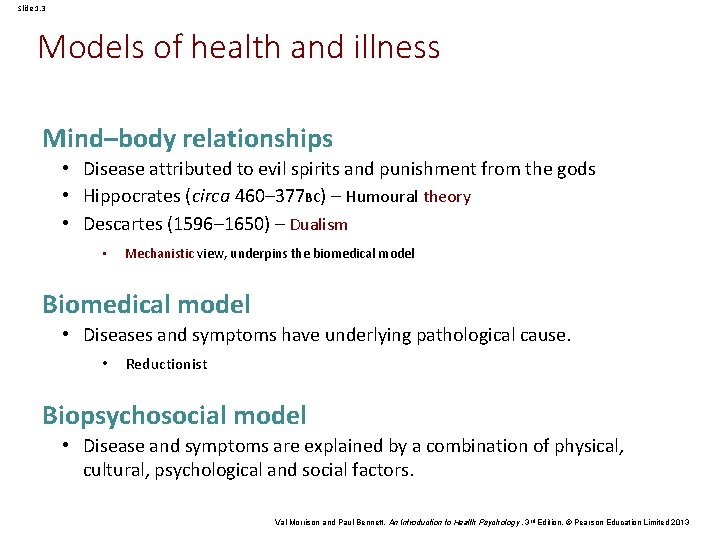
Slide 1. 3 Models of health and illness Mind–body relationships • Disease attributed to evil spirits and punishment from the gods • Hippocrates (circa 460– 377 BC) – Humoural theory • Descartes (1596– 1650) – Dualism • Mechanistic view, underpins the biomedical model Biomedical model • Diseases and symptoms have underlying pathological cause. • Reductionist Biopsychosocial model • Disease and symptoms are explained by a combination of physical, cultural, psychological and social factors. Val Morrison and Paul Bennett, An Introduction to Health Psychology , 3 rd Edition, © Pearson Education Limited 2013
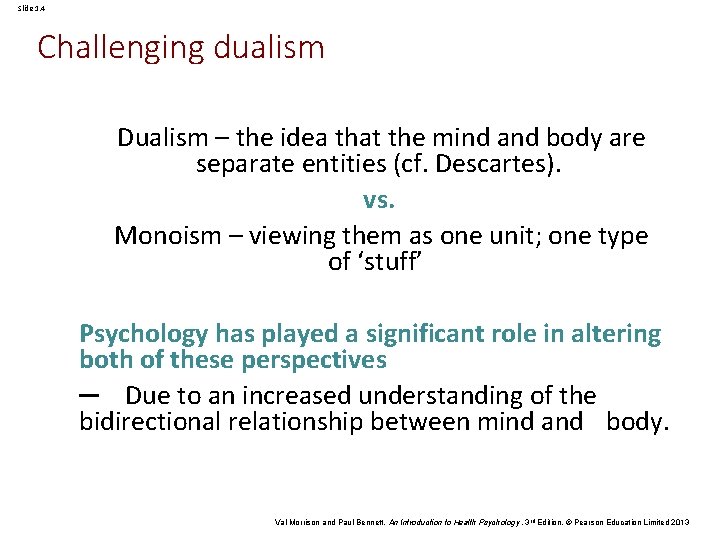
Slide 1. 4 Challenging dualism Dualism – the idea that the mind and body are separate entities (cf. Descartes). vs. Monoism – viewing them as one unit; one type of ‘stuff’ Psychology has played a significant role in altering both of these perspectives ─ Due to an increased understanding of the bidirectional relationship between mind and body. Val Morrison and Paul Bennett, An Introduction to Health Psychology , 3 rd Edition, © Pearson Education Limited 2013
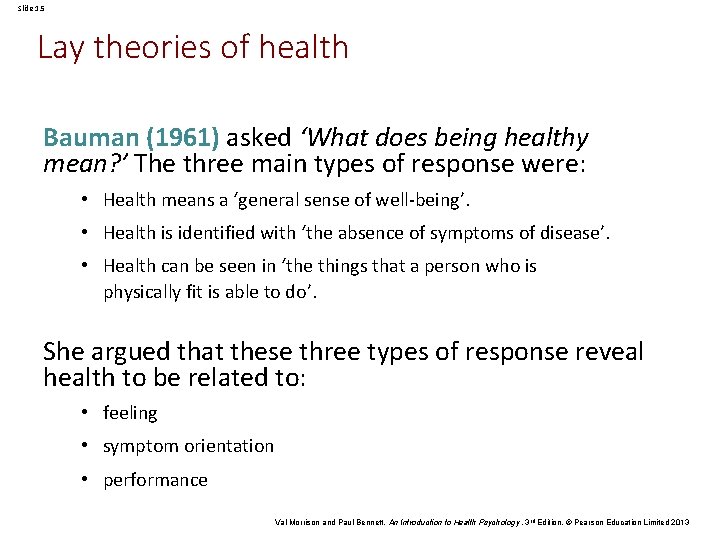
Slide 1. 5 Lay theories of health Bauman (1961) asked ‘What does being healthy mean? ’ The three main types of response were: • Health means a ‘general sense of well-being’. • Health is identified with ‘the absence of symptoms of disease’. • Health can be seen in ‘the things that a person who is physically fit is able to do’. She argued that these three types of response reveal health to be related to: • feeling • symptom orientation • performance Val Morrison and Paul Bennett, An Introduction to Health Psychology , 3 rd Edition, © Pearson Education Limited 2013
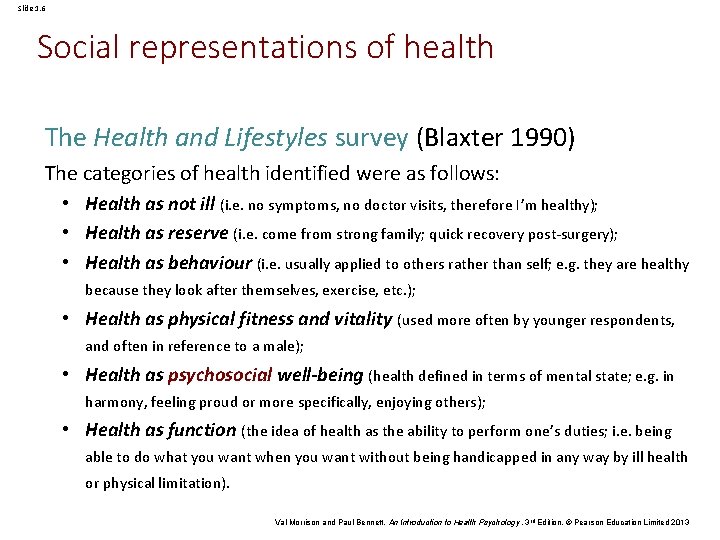
Slide 1. 6 Social representations of health The Health and Lifestyles survey (Blaxter 1990) The categories of health identified were as follows: • Health as not ill (i. e. no symptoms, no doctor visits, therefore I’m healthy); • Health as reserve (i. e. come from strong family; quick recovery post-surgery); • Health as behaviour (i. e. usually applied to others rather than self; e. g. they are healthy because they look after themselves, exercise, etc. ); • Health as physical fitness and vitality (used more often by younger respondents, and often in reference to a male); • Health as psychosocial well-being (health defined in terms of mental state; e. g. in harmony, feeling proud or more specifically, enjoying others); • Health as function (the idea of health as the ability to perform one’s duties; i. e. being able to do what you want when you want without being handicapped in any way by ill health or physical limitation). Val Morrison and Paul Bennett, An Introduction to Health Psychology , 3 rd Edition, © Pearson Education Limited 2013
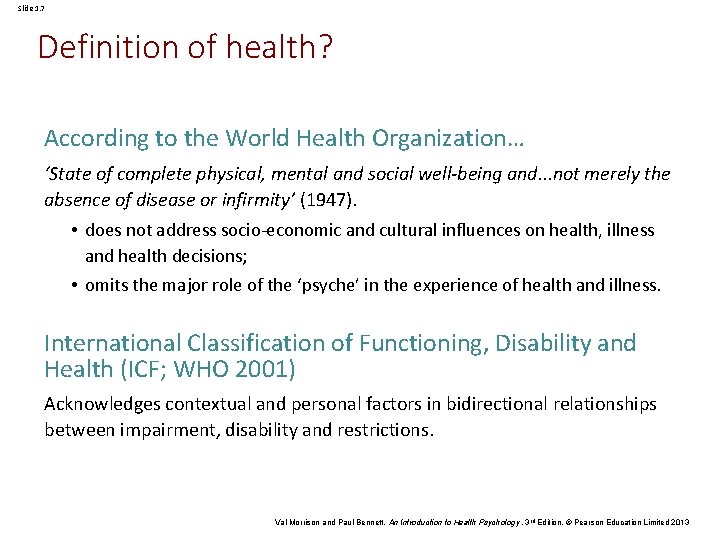
Slide 1. 7 Definition of health? According to the World Health Organization… ‘State of complete physical, mental and social well-being and. . . not merely the absence of disease or infirmity’ (1947). • does not address socio-economic and cultural influences on health, illness and health decisions; • omits the major role of the ‘psyche’ in the experience of health and illness. International Classification of Functioning, Disability and Health (ICF; WHO 2001) Acknowledges contextual and personal factors in bidirectional relationships between impairment, disability and restrictions. Val Morrison and Paul Bennett, An Introduction to Health Psychology , 3 rd Edition, © Pearson Education Limited 2013
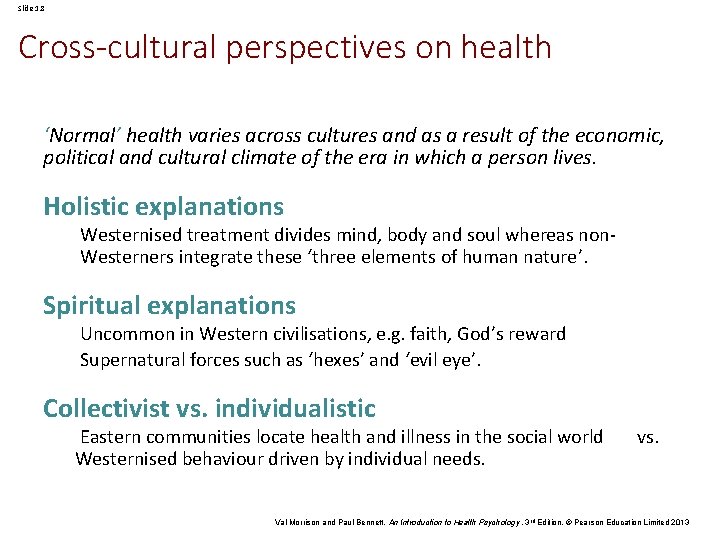
Slide 1. 8 Cross-cultural perspectives on health ‘Normal’ health varies across cultures and as a result of the economic, political and cultural climate of the era in which a person lives. Holistic explanations Westernised treatment divides mind, body and soul whereas non. Westerners integrate these ‘three elements of human nature’. Spiritual explanations Uncommon in Western civilisations, e. g. faith, God’s reward Supernatural forces such as ‘hexes’ and ‘evil eye’. Collectivist vs. individualistic Eastern communities locate health and illness in the social world Westernised behaviour driven by individual needs. vs. Val Morrison and Paul Bennett, An Introduction to Health Psychology , 3 rd Edition, © Pearson Education Limited 2013
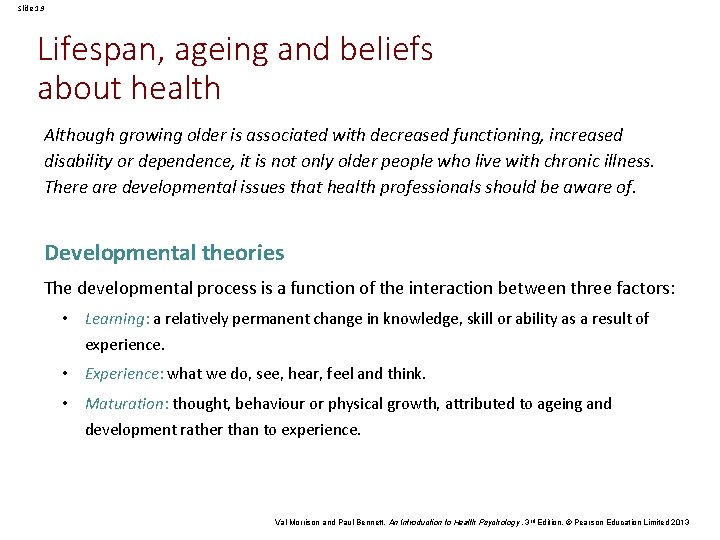
Slide 1. 9 Lifespan, ageing and beliefs about health Although growing older is associated with decreased functioning, increased disability or dependence, it is not only older people who live with chronic illness. There are developmental issues that health professionals should be aware of. Developmental theories The developmental process is a function of the interaction between three factors: • Learning: a relatively permanent change in knowledge, skill or ability as a result of experience. • Experience: what we do, see, hear, feel and think. • Maturation: thought, behaviour or physical growth, attributed to ageing and development rather than to experience. Val Morrison and Paul Bennett, An Introduction to Health Psychology , 3 rd Edition, © Pearson Education Limited 2013
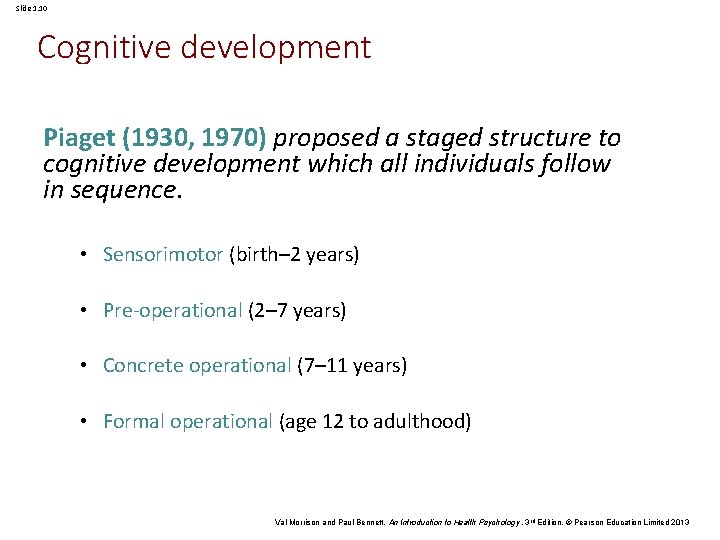
Slide 1. 10 Cognitive development Piaget (1930, 1970) proposed a staged structure to cognitive development which all individuals follow in sequence. • Sensorimotor (birth– 2 years) • Pre-operational (2– 7 years) • Concrete operational (7– 11 years) • Formal operational (age 12 to adulthood) Val Morrison and Paul Bennett, An Introduction to Health Psychology , 3 rd Edition, © Pearson Education Limited 2013
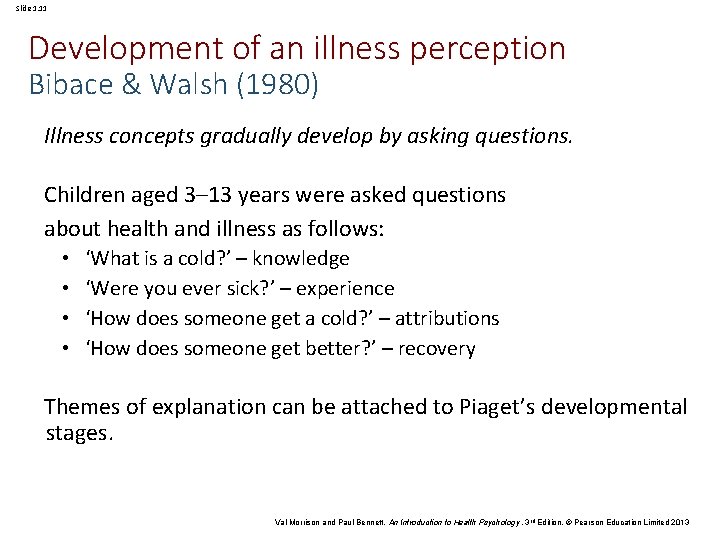
Slide 1. 11 Development of an illness perception Bibace & Walsh (1980) Illness concepts gradually develop by asking questions. Children aged 3– 13 years were asked questions about health and illness as follows: • • ‘What is a cold? ’ – knowledge ‘Were you ever sick? ’ – experience ‘How does someone get a cold? ’ – attributions ‘How does someone get better? ’ – recovery Themes of explanation can be attached to Piaget’s developmental stages. Val Morrison and Paul Bennett, An Introduction to Health Psychology , 3 rd Edition, © Pearson Education Limited 2013
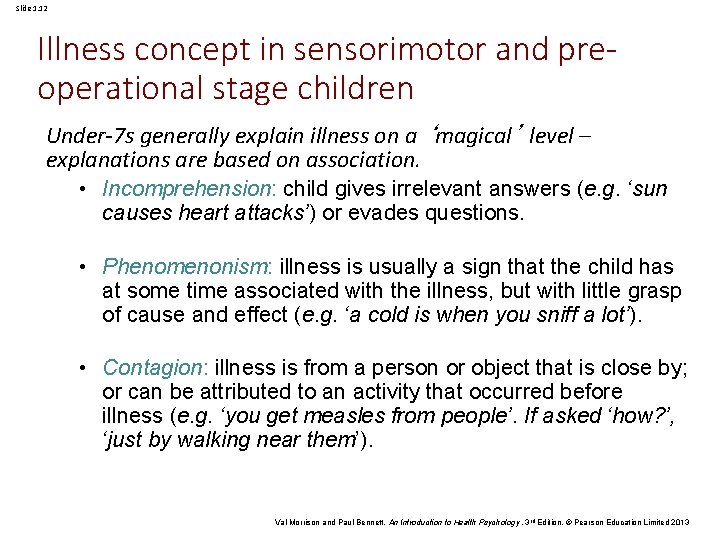
Slide 1. 12 Illness concept in sensorimotor and preoperational stage children Under-7 s generally explain illness on a ‘magical’ level – explanations are based on association. • Incomprehension: child gives irrelevant answers (e. g. ‘sun causes heart attacks’) or evades questions. • Phenomenonism: illness is usually a sign that the child has at some time associated with the illness, but with little grasp of cause and effect (e. g. ‘a cold is when you sniff a lot’). • Contagion: illness is from a person or object that is close by; or can be attributed to an activity that occurred before illness (e. g. ‘you get measles from people’. If asked ‘how? ’, ‘just by walking near them’). Val Morrison and Paul Bennett, An Introduction to Health Psychology , 3 rd Edition, © Pearson Education Limited 2013
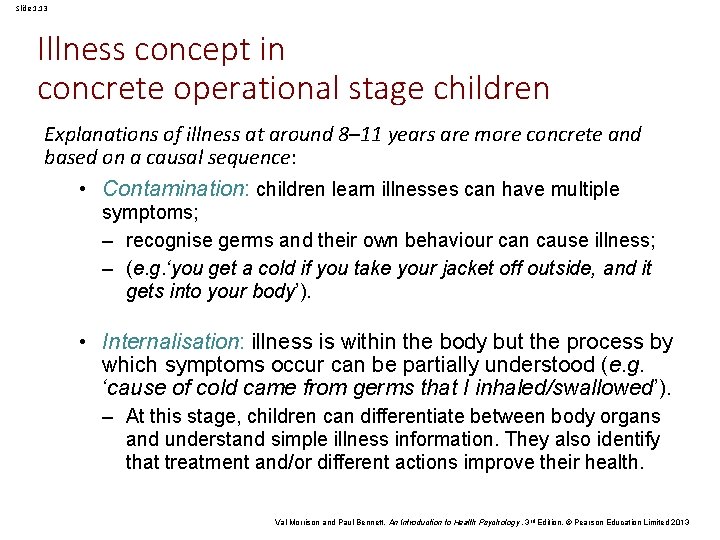
Slide 1. 13 Illness concept in concrete operational stage children Explanations of illness at around 8– 11 years are more concrete and based on a causal sequence: • Contamination: children learn illnesses can have multiple symptoms; – recognise germs and their own behaviour can cause illness; – (e. g. ‘you get a cold if you take your jacket off outside, and it gets into your body’). • Internalisation: illness is within the body but the process by which symptoms occur can be partially understood (e. g. ‘cause of cold came from germs that I inhaled/swallowed’). – At this stage, children can differentiate between body organs and understand simple illness information. They also identify that treatment and/or different actions improve their health. Val Morrison and Paul Bennett, An Introduction to Health Psychology , 3 rd Edition, © Pearson Education Limited 2013
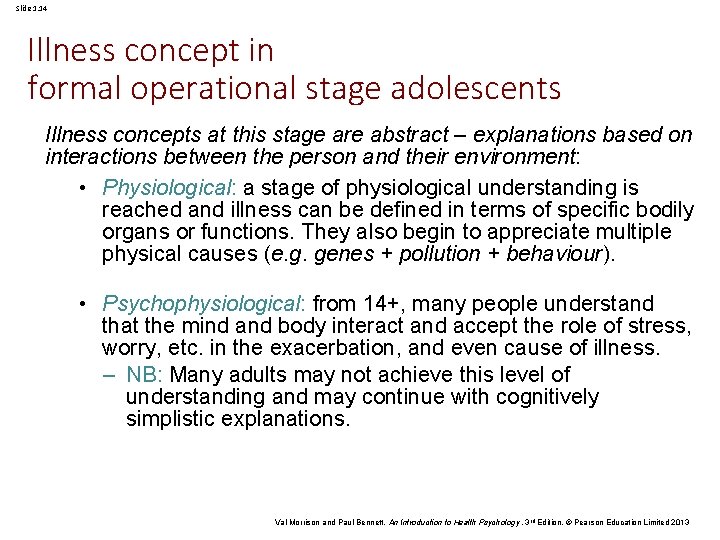
Slide 1. 14 Illness concept in formal operational stage adolescents Illness concepts at this stage are abstract – explanations based on interactions between the person and their environment: • Physiological: a stage of physiological understanding is reached and illness can be defined in terms of specific bodily organs or functions. They also begin to appreciate multiple physical causes (e. g. genes + pollution + behaviour). • Psychophysiological: from 14+, many people understand that the mind and body interact and accept the role of stress, worry, etc. in the exacerbation, and even cause of illness. – NB: Many adults may not achieve this level of understanding and may continue with cognitively simplistic explanations. Val Morrison and Paul Bennett, An Introduction to Health Psychology , 3 rd Edition, © Pearson Education Limited 2013
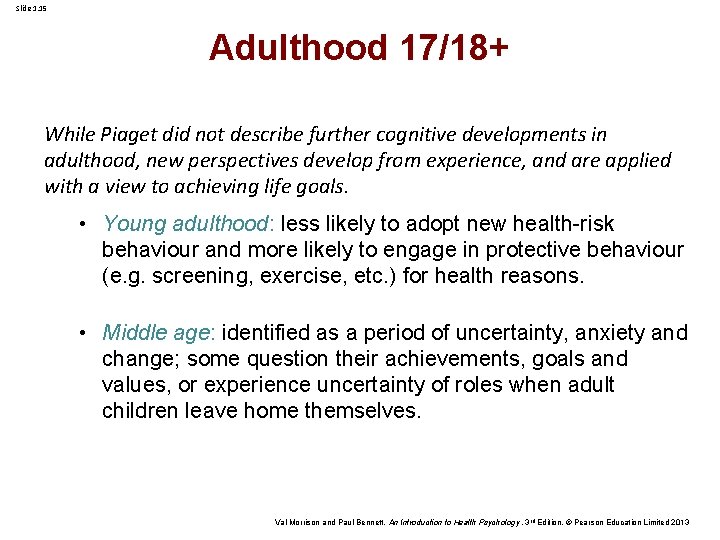
Slide 1. 15 Adulthood 17/18+ While Piaget did not describe further cognitive developments in adulthood, new perspectives develop from experience, and are applied with a view to achieving life goals. • Young adulthood: less likely to adopt new health-risk behaviour and more likely to engage in protective behaviour (e. g. screening, exercise, etc. ) for health reasons. • Middle age: identified as a period of uncertainty, anxiety and change; some question their achievements, goals and values, or experience uncertainty of roles when adult children leave home themselves. Val Morrison and Paul Bennett, An Introduction to Health Psychology , 3 rd Edition, © Pearson Education Limited 2013
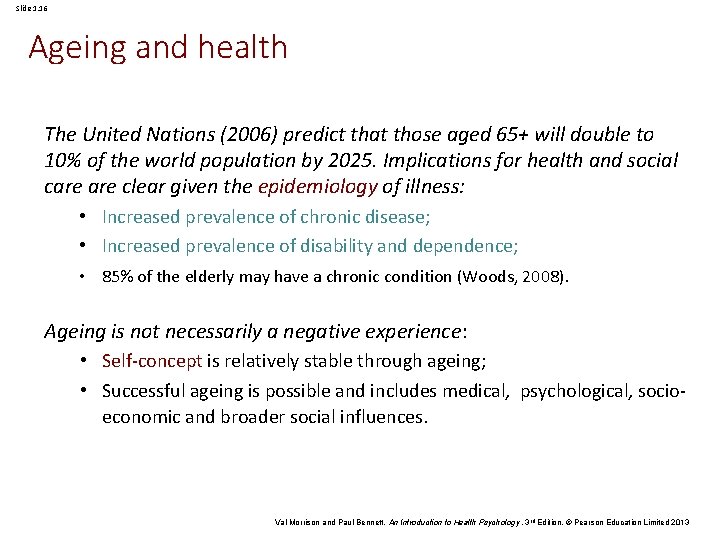
Slide 1. 16 Ageing and health The United Nations (2006) predict that those aged 65+ will double to 10% of the world population by 2025. Implications for health and social care clear given the epidemiology of illness: • Increased prevalence of chronic disease; • Increased prevalence of disability and dependence; • 85% of the elderly may have a chronic condition (Woods, 2008). Ageing is not necessarily a negative experience: • Self-concept is relatively stable through ageing; • Successful ageing is possible and includes medical, psychological, socioeconomic and broader social influences. Val Morrison and Paul Bennett, An Introduction to Health Psychology , 3 rd Edition, © Pearson Education Limited 2013
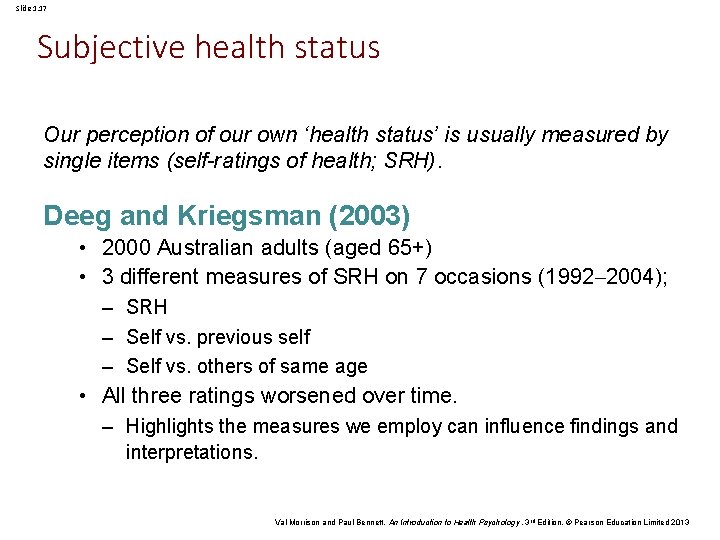
Slide 1. 17 Subjective health status Our perception of our own ‘health status’ is usually measured by single items (self-ratings of health; SRH). Deeg and Kriegsman (2003) • 2000 Australian adults (aged 65+) • 3 different measures of SRH on 7 occasions (1992– 2004); – SRH – Self vs. previous self – Self vs. others of same age • All three ratings worsened over time. – Highlights the measures we employ can influence findings and interpretations. Val Morrison and Paul Bennett, An Introduction to Health Psychology , 3 rd Edition, © Pearson Education Limited 2013
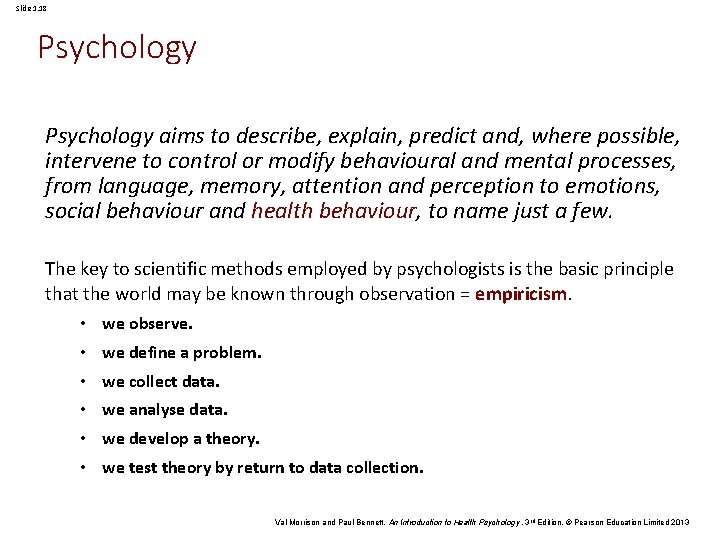
Slide 1. 18 Psychology aims to describe, explain, predict and, where possible, intervene to control or modify behavioural and mental processes, from language, memory, attention and perception to emotions, social behaviour and health behaviour, to name just a few. The key to scientific methods employed by psychologists is the basic principle that the world may be known through observation = empiricism. • we observe. • we define a problem. • we collect data. • we analyse data. • we develop a theory. • we test theory by return to data collection. Val Morrison and Paul Bennett, An Introduction to Health Psychology , 3 rd Edition, © Pearson Education Limited 2013
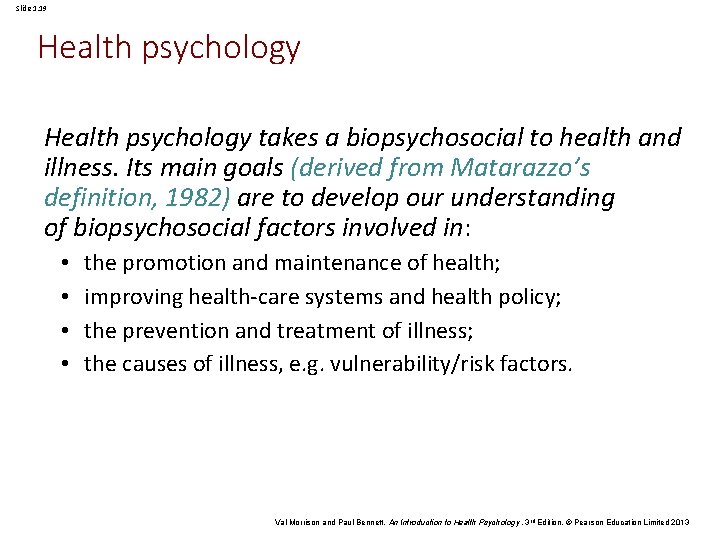
Slide 1. 19 Health psychology takes a biopsychosocial to health and illness. Its main goals (derived from Matarazzo’s definition, 1982) are to develop our understanding of biopsychosocial factors involved in: • • the promotion and maintenance of health; improving health-care systems and health policy; the prevention and treatment of illness; the causes of illness, e. g. vulnerability/risk factors. Val Morrison and Paul Bennett, An Introduction to Health Psychology , 3 rd Edition, © Pearson Education Limited 2013
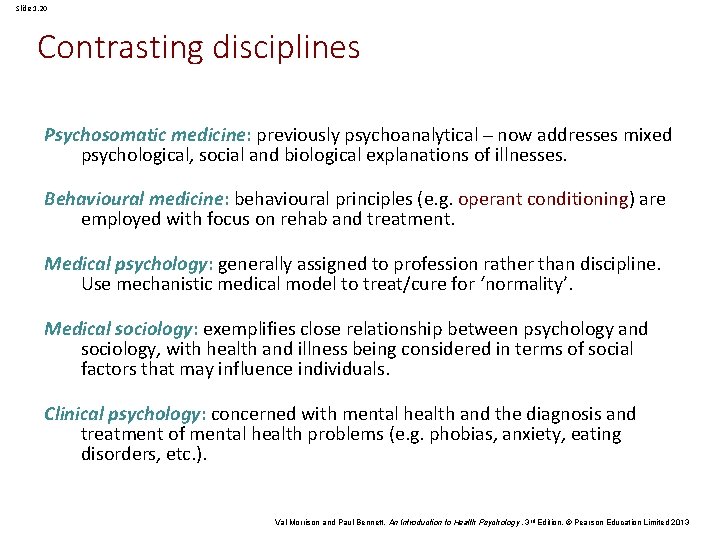
Slide 1. 20 Contrasting disciplines Psychosomatic medicine: previously psychoanalytical – now addresses mixed psychological, social and biological explanations of illnesses. Behavioural medicine: behavioural principles (e. g. operant conditioning) are employed with focus on rehab and treatment. Medical psychology: generally assigned to profession rather than discipline. Use mechanistic medical model to treat/cure for ‘normality’. Medical sociology: exemplifies close relationship between psychology and sociology, with health and illness being considered in terms of social factors that may influence individuals. Clinical psychology: concerned with mental health and the diagnosis and treatment of mental health problems (e. g. phobias, anxiety, eating disorders, etc. ). Val Morrison and Paul Bennett, An Introduction to Health Psychology , 3 rd Edition, © Pearson Education Limited 2013
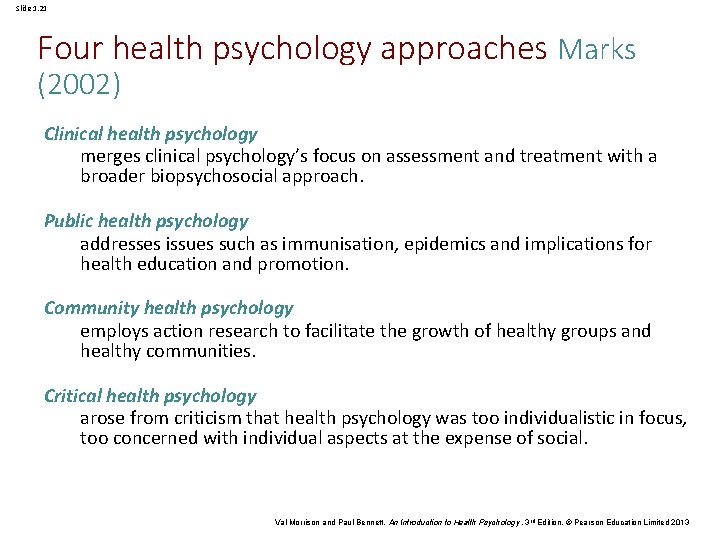
Slide 1. 21 Four health psychology approaches Marks (2002) Clinical health psychology merges clinical psychology’s focus on assessment and treatment with a broader biopsychosocial approach. Public health psychology addresses issues such as immunisation, epidemics and implications for health education and promotion. Community health psychology employs action research to facilitate the growth of healthy groups and healthy communities. Critical health psychology arose from criticism that health psychology was too individualistic in focus, too concerned with individual aspects at the expense of social. Val Morrison and Paul Bennett, An Introduction to Health Psychology , 3 rd Edition, © Pearson Education Limited 2013