
Slide 1 1 Part 1 Introduction Chapter 1


- Slides: 67
Slide 1. 1 Part 1 Introduction Chapter 1 Introduction to digital business and e‑commerce Chaffey, Digital Business and E-commerce Management Powerpoints on the Web, 6 th edition © Marketing Insights Limited 2015
Slide 1. 2 Learning outcomes Define the meaning and scope of digital business and e-commerce and their different elements • Summarise the main reasons for adoption of digital business and barriers that may restrict adoption • Outline the ongoing business challenges of managing digital business in an organisation, paticularly online start-up businesses • Chaffey, Digital Business and E-commerce Management Powerpoints on the Web, 6 th edition © Marketing Insights Limited 2015
Slide 1. 3 Management issues How do we explain the scope and implications of digital business to staff? • What is the full range of benefits of introducing digital business and what are the risks? • How do we evaluate our current digital business capabilities? • Chaffey, Digital Business and E-commerce Management Powerpoints on the Web, 6 th edition © Marketing Insights Limited 2015
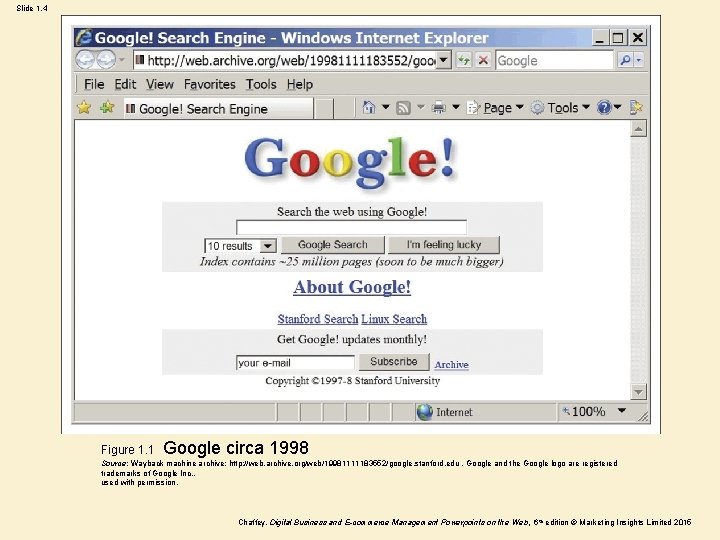
Slide 1. 4 Figure 1. 1 Google circa 1998 Source: Wayback machine archive: http: //web. archive. org/web/19981111183552/google. stanford. edu. Google and the Google logo are registered trademarks of Google Inc. , used with permission. Chaffey, Digital Business and E-commerce Management Powerpoints on the Web, 6 th edition © Marketing Insights Limited 2015
Slide 1. 5 Digital business innovation and opportunity Since Google was launched in 1998 which online start-ups have transformed the way we work, live and play? • How has Google innovated in search and its business model? • See Table 1. 1 for some of the major innovators. • Chaffey, Digital Business and E-commerce Management Powerpoints on the Web, 6 th edition © Marketing Insights Limited 2015
Slide 1. 6 Chaffey, Digital Business and E-commerce Management Powerpoints on the Web, 6 th edition © Marketing Insights Limited 2015
Slide 1. 7 Activity List the most important requirements to establish a new e-business. • Pay attention to costs! • Try to be precise as much as possible. • Chaffey, Digital Business and E-commerce Management Powerpoints on the Web, 6 th edition © Marketing Insights Limited 2015
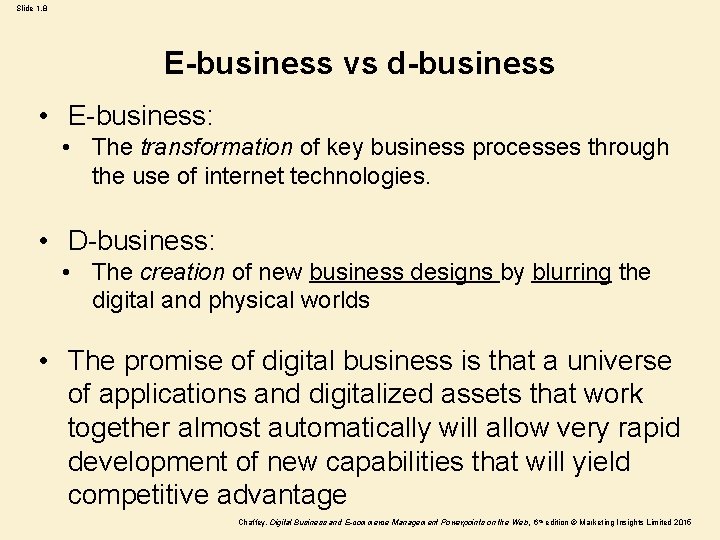
Slide 1. 8 E-business vs d-business • E-business: • The transformation of key business processes through the use of internet technologies. • D-business: • The creation of new business designs by blurring the digital and physical worlds • The promise of digital business is that a universe of applications and digitalized assets that work together almost automatically will allow very rapid development of new capabilities that will yield competitive advantage Chaffey, Digital Business and E-commerce Management Powerpoints on the Web, 6 th edition © Marketing Insights Limited 2015
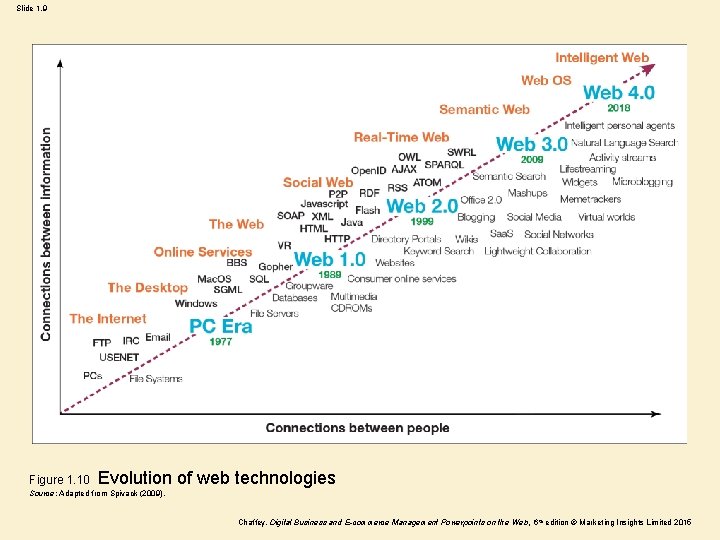
Slide 1. 9 Figure 1. 10 Evolution of web technologies Source: Adapted from Spivack (2009). Chaffey, Digital Business and E-commerce Management Powerpoints on the Web, 6 th edition © Marketing Insights Limited 2015
Slide 1. 10 E-commerce? • E-commerce: • All electronically mediated information exchanges between an organization and its external stakeholders. Chaffey, Digital Business and E-commerce Management Powerpoints on the Web, 6 th edition © Marketing Insights Limited 2015
Slide 1. 11 Perspectives of e-commerce • A communicative perspective: • the delivery of information, products or services or payment by electronic means. • Business process perspective: • the application of technology towards the automation of business transactions and workflows. • A service perspective: • enabling cost cutting at the same time as increasing the speed and quality of service delivery. • An online perspective: • the buying and selling of products and information online Chaffey, Digital Business and E-commerce Management Powerpoints on the Web, 6 th edition © Marketing Insights Limited 2015
Slide 1. 12 What is the impact of electronic communication on traditional businesses? • Digital business transformation: these are the significant changes to organizational processes, structure, and system implemented to improve organizational performance through increasing the use of digital media and technology platforms, and they include: • • • Inbound marketing Social media marketing Mobile commerce Chaffey, Digital Business and E-commerce Management Powerpoints on the Web, 6 th edition © Marketing Insights Limited 2015
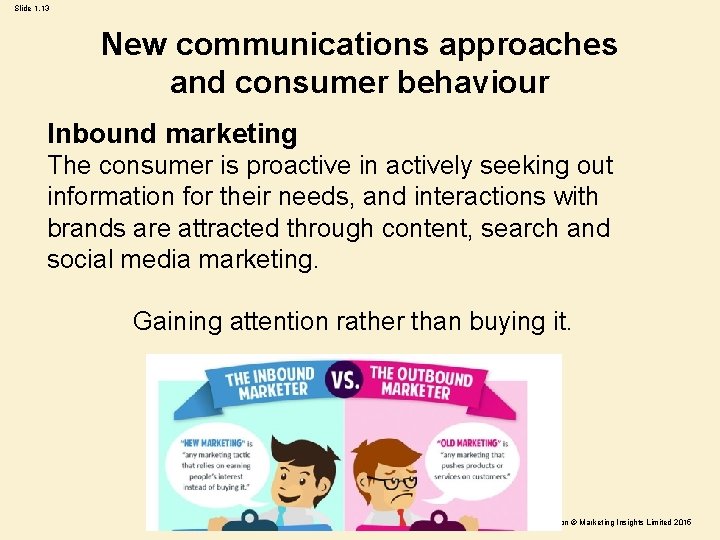
Slide 1. 13 New communications approaches and consumer behaviour Inbound marketing The consumer is proactive in actively seeking out information for their needs, and interactions with brands are attracted through content, search and social media marketing. Gaining attention rather than buying it. Chaffey, Digital Business and E-commerce Management Powerpoints on the Web, 6 th edition © Marketing Insights Limited 2015
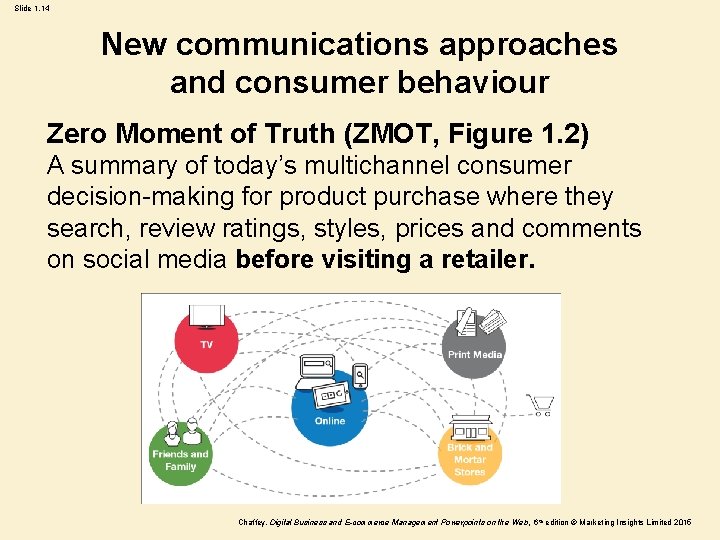
Slide 1. 14 New communications approaches and consumer behaviour Zero Moment of Truth (ZMOT, Figure 1. 2) A summary of today’s multichannel consumer decision-making for product purchase where they search, review ratings, styles, prices and comments on social media before visiting a retailer. Chaffey, Digital Business and E-commerce Management Powerpoints on the Web, 6 th edition © Marketing Insights Limited 2015
Slide 1. 15 Moment of truth (MOT) in marketing, is the moment when a customer/user interacts with a brand, product or service to form or change an impression about that particular brand, product or service. Chaffey, Digital Business and E-commerce Management Powerpoints on the Web, 6 th edition © Marketing Insights Limited 2015
Slide 1. 16 Moment of truth First moment of truth (FMOT): When a customer is confronted with the product in-store or in real life. Second moment of truth (SMOT): When a customer purchases a product and experiences its quality as per the promise of the brand. Third moment of truth (TMOT): Consumers feedback or reaction towards a brand, product or service. Actual moment of truth to describe the new postpurchase experience gap created by the advent of online shopping, after a consumer has made a purchase but before they've received the product. Chaffey, Digital Business and E-commerce Management Powerpoints on the Web, 6 th edition © Marketing Insights Limited 2015
Slide 1. 17 Inbound marketing • Inbound marketing is powerful since advertising wastage is reduced. • Search marketing (SEM), • content marketing and • social media marketing can be used to target prospect with a defined need. • Could be a weakness; marketers have less control than in traditional communication where the message is pushed! Chaffey, Digital Business and E-commerce Management Powerpoints on the Web, 6 th edition © Marketing Insights Limited 2015
Slide 1. 18 New communications approaches and consumer behaviour (Continued) Content marketing The management of text, rich media, audio and video content aimed at engaging customers and prospects to meet business goals, published through print and digital media including web and mobile platforms, which is repurposed and syndicated to different forms of web presence such as publisher sites, blogs, social media and comparison sites. - Can it help in triggering demand? Chaffey, Digital Business and E-commerce Management Powerpoints on the Web, 6 th edition © Marketing Insights Limited 2015
Slide 1. 19 Social media marketing Social media: A category of media focusing on participation and peer‑to‑peer communication between individuals, with sites providing the capability to develop user-generated content (UGC) and to exchange messages and comments between different users. Social media marketing: Monitoring and facilitating customer–customer interaction and participation throughout the web to encourage positive engagement with a company and its brands. Interactions may occur on a company site, social networks and other third-party sites Chaffey, Digital Business and E-commerce Management Powerpoints on the Web, 6 th edition © Marketing Insights Limited 2015
Slide 1. 20 Social media It includes: Social networking sites (SNS) (see figure next slide) RSS feeds Virtual worlds Blogs Video blogs Chaffey, Digital Business and E-commerce Management Powerpoints on the Web, 6 th edition © Marketing Insights Limited 2015
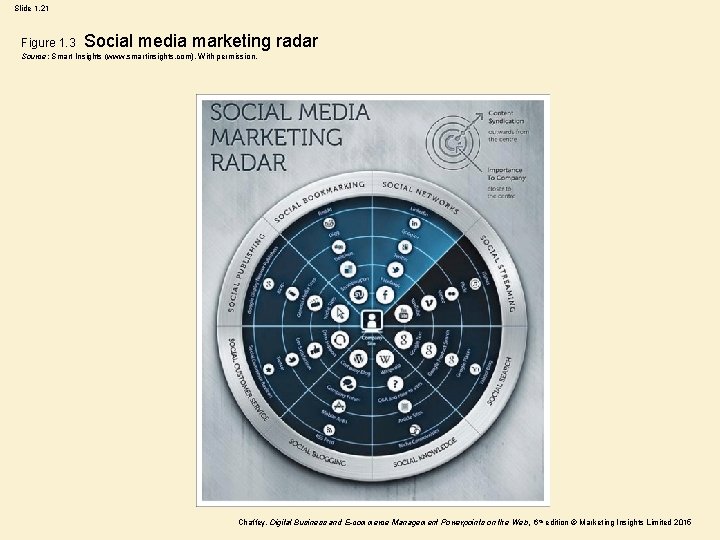
Slide 1. 21 Figure 1. 3 Social media marketing radar Source: Smart Insights (www. smartinsights. com). With permission. Chaffey, Digital Business and E-commerce Management Powerpoints on the Web, 6 th edition © Marketing Insights Limited 2015
Slide 1. 22 Social media categories 1 Social networking. 2 Social knowledge. 3 Social sharing. 4 Social news. 5 Social streaming. 6 Company user-generated content and community Chaffey, Digital Business and E-commerce Management Powerpoints on the Web, 6 th edition © Marketing Insights Limited 2015
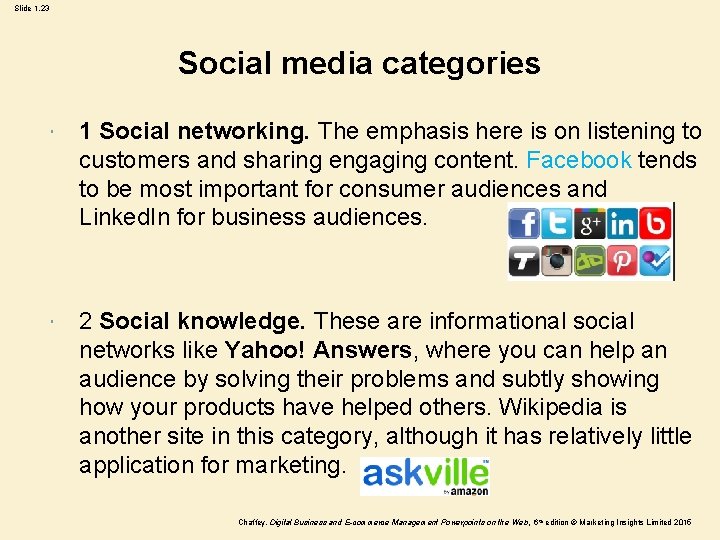
Slide 1. 23 Social media categories 1 Social networking. The emphasis here is on listening to customers and sharing engaging content. Facebook tends to be most important for consumer audiences and Linked. In for business audiences. 2 Social knowledge. These are informational social networks like Yahoo! Answers, where you can help an audience by solving their problems and subtly showing how your products have helped others. Wikipedia is another site in this category, although it has relatively little application for marketing. Chaffey, Digital Business and E-commerce Management Powerpoints on the Web, 6 th edition © Marketing Insights Limited 2015
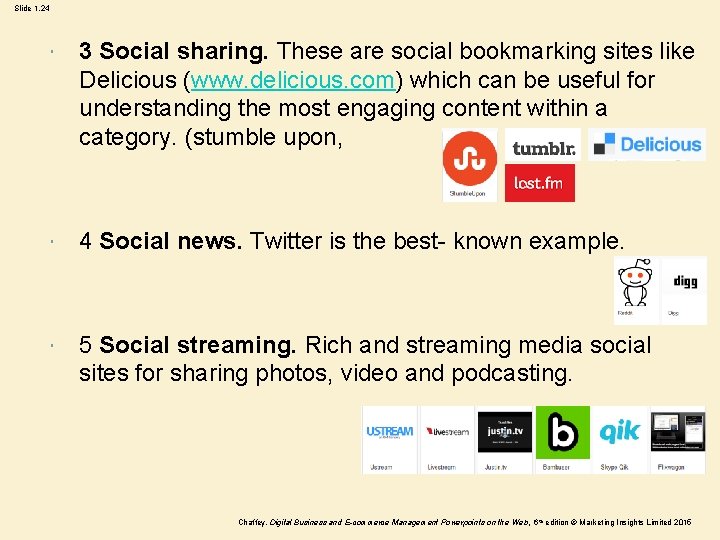
Slide 1. 24 3 Social sharing. These are social bookmarking sites like Delicious (www. delicious. com) which can be useful for understanding the most engaging content within a category. (stumble upon, 4 Social news. Twitter is the best- known example. 5 Social streaming. Rich and streaming media social sites for sharing photos, video and podcasting. Chaffey, Digital Business and E-commerce Management Powerpoints on the Web, 6 th edition © Marketing Insights Limited 2015
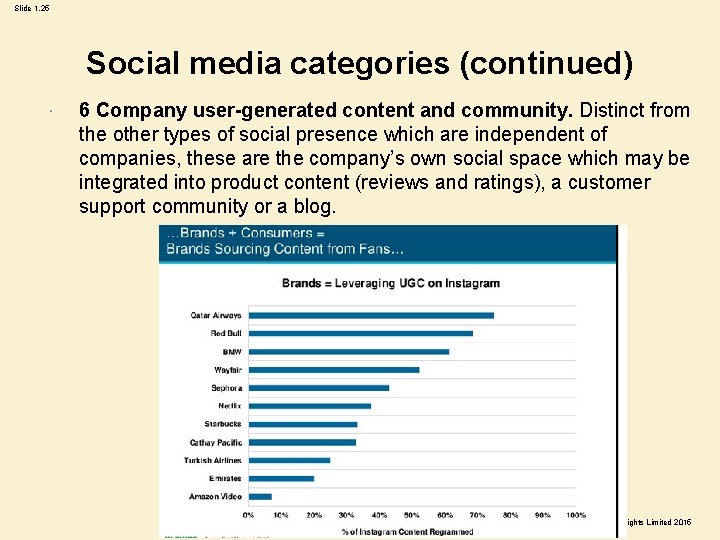
Slide 1. 25 Social media categories (continued) 6 Company user-generated content and community. Distinct from the other types of social presence which are independent of companies, these are the company’s own social space which may be integrated into product content (reviews and ratings), a customer support community or a blog. Chaffey, Digital Business and E-commerce Management Powerpoints on the Web, 6 th edition © Marketing Insights Limited 2015
Slide 1. 26 M-commerce • M-commerce: • Electronic transactions and communications conducted using mobile devices such as smartphones and tablets, and typically with a wireless connection. • 80% of mobile time was in apps rather than the browser. You do have to be careful in interpreting this, though, since Facebook, games and utility apps will naturally have the greatest time spent and browser use is still significant. • Location-based use of mobile devices is another significant trend as users may use apps or browsers while shopping, for example. Related to this activity is location. Based tracking of goods and inventory as they are manufactured and transported Chaffey, Digital Business and E-commerce Management Powerpoints on the Web, 6 th edition © Marketing Insights Limited 2015
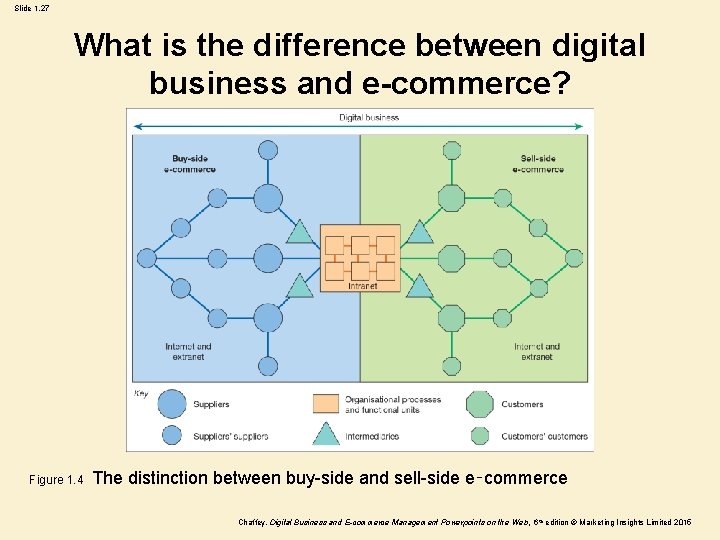
Slide 1. 27 What is the difference between digital business and e-commerce? Figure 1. 4 The distinction between buy-side and sell-side e‑commerce Chaffey, Digital Business and E-commerce Management Powerpoints on the Web, 6 th edition © Marketing Insights Limited 2015
Slide 1. 28 Definitions • Electronic commerce All electronically mediated information exchanges between an organisation and its external stakeholders. • Digital business How businesses apply digital technology and media to improve the competitiveness of their organisation through optimising internal processes with online and traditional channels to market and supply. Chaffey, Digital Business and E-commerce Management Powerpoints on the Web, 6 th edition © Marketing Insights Limited 2015
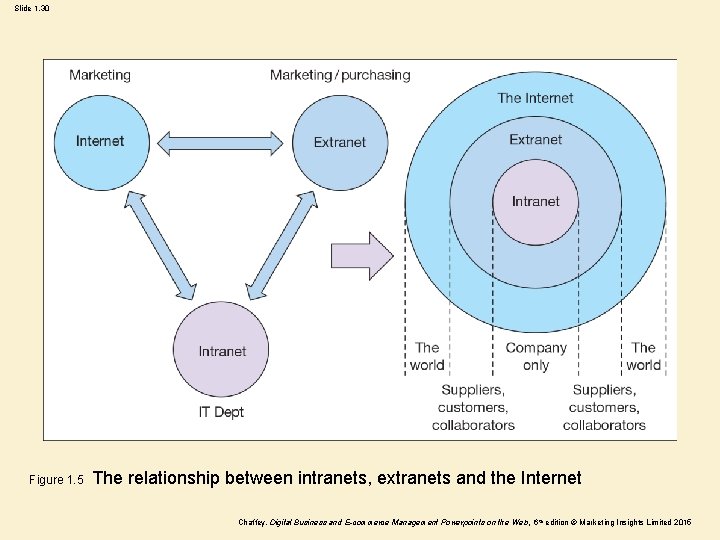
Slide 1. 29 Intranets and extranets many digital business applications that access sensitive company information require access to be limited to qualified individuals or partners If information is restricted to employees inside an organisation, this is an intranet If access to an organisation’s web services is extended to some others, but not everyone beyond the organisation, this is an extranet Chaffey, Digital Business and E-commerce Management Powerpoints on the Web, 6 th edition © Marketing Insights Limited 2015
Slide 1. 30 Figure 1. 5 The relationship between intranets, extranets and the Internet Chaffey, Digital Business and E-commerce Management Powerpoints on the Web, 6 th edition © Marketing Insights Limited 2015
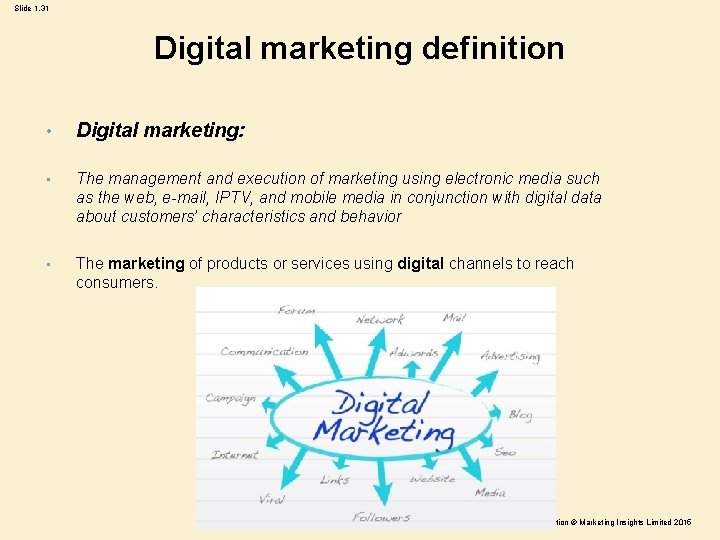
Slide 1. 31 Digital marketing definition • Digital marketing: • The management and execution of marketing using electronic media such as the web, e-mail, IPTV, and mobile media in conjunction with digital data about customers’ characteristics and behavior • The marketing of products or services using digital channels to reach consumers. Chaffey, Digital Business and E-commerce Management Powerpoints on the Web, 6 th edition © Marketing Insights Limited 2015
Slide 1. 32 Digital marketing definition • Digital marketing involves: • • • To achieve these objectives: • • Applying these technologies which form online channels to market: Web, email, databases, plus mobile/wireless and digital TV. Support marketing activities aimed at achieving profitable acquisition and retention of customers. . . within a multichannel buying process and customer lifecycle. Through using these marketing tactics: • Recognising the strategic importance of digital technologies and developing a planned approach to reach and migrate customers to online services through e-communications and traditional communications. Retention is achieved through improving our customer knowledge (of their profiles, behaviour, value and loyalty drivers), then delivering integrated, targeted communications and online services that match their individual needs. Chaffey, Digital Business and E-commerce Management Powerpoints on the Web, 6 th edition © Marketing Insights Limited 2015
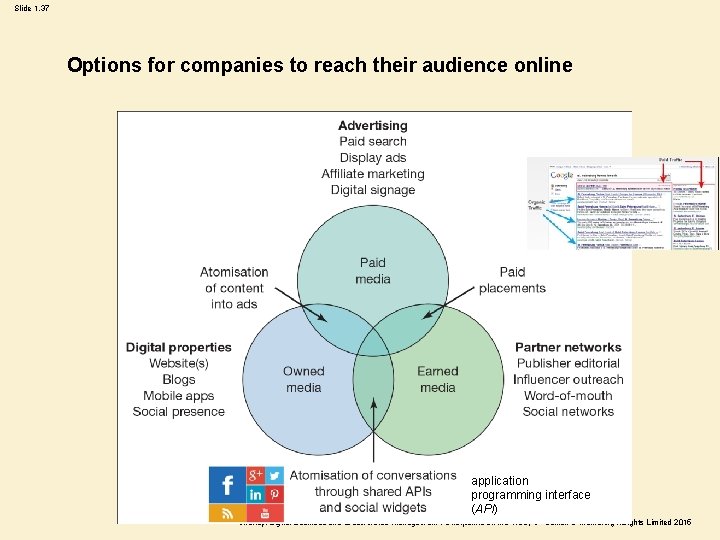
Slide 1. 33 Options to reach audience online Paid media Earned media Owned media Chaffey, Digital Business and E-commerce Management Powerpoints on the Web, 6 th edition © Marketing Insights Limited 2015
Slide 1. 34 Paid media. These are bought media where there is investment to pay for visitors, reach or conversions through search, display advertising networks or affiliate marketing. Offline, traditional media like print and TV advertising and direct mail remain important, accounting for the majority of paid-media spend. Chaffey, Digital Business and E-commerce Management Powerpoints on the Web, 6 th edition © Marketing Insights Limited 2015
Slide 1. 35 Earned media. Traditionally, earned media has been the name given to publicity generated through PR invested in targeting influencers to increase awareness about a brand. Now earned media also includes word‑of‑mouth that can be stimulated through viral and social media marketing and includes conversations in social networks, blogs and other communities. It’s useful to think of earned media as developed through different types of partners such as publishers, bloggers and other influencers, including customer advocates. Another way of thinking about earned media is as different forms of conversations between consumers and businesses occurring both online and offline. Chaffey, Digital Business and E-commerce Management Powerpoints on the Web, 6 th edition © Marketing Insights Limited 2015
Slide 1. 36 Owned media. This is media owned by the brand. Online, this includes a company’s own websites, blogs, email list, mobile apps or their social presence on Facebook, Linked. In or Twitter. Offline, owned media may include brochures or retail stores. It’s useful to think of a company’s own presence as media in the sense that they are an alternative investment to other media and they offer opportunities to promote products using similar ad or editorial formats to other media. It emphasises the need for all organisations to become multichannel publishers. Chaffey, Digital Business and E-commerce Management Powerpoints on the Web, 6 th edition © Marketing Insights Limited 2015
Slide 1. 37 Options for companies to reach their audience online application programming interface (API) Chaffey, Digital Business and E-commerce Management Powerpoints on the Web, 6 th edition © Marketing Insights Limited 2015
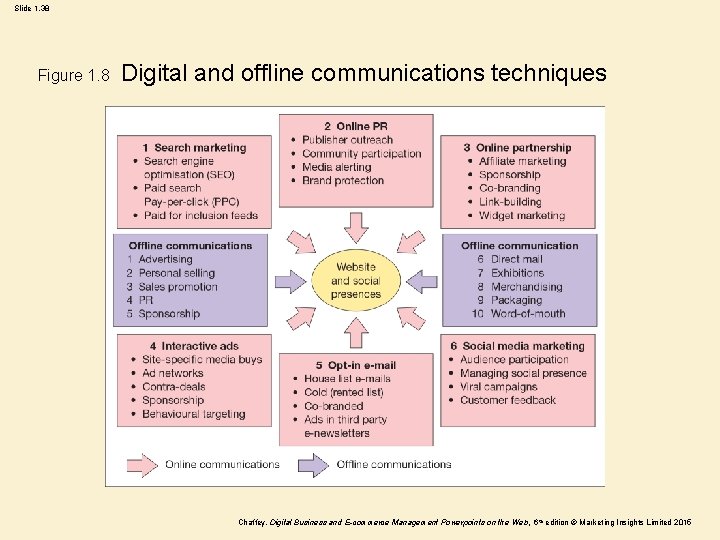
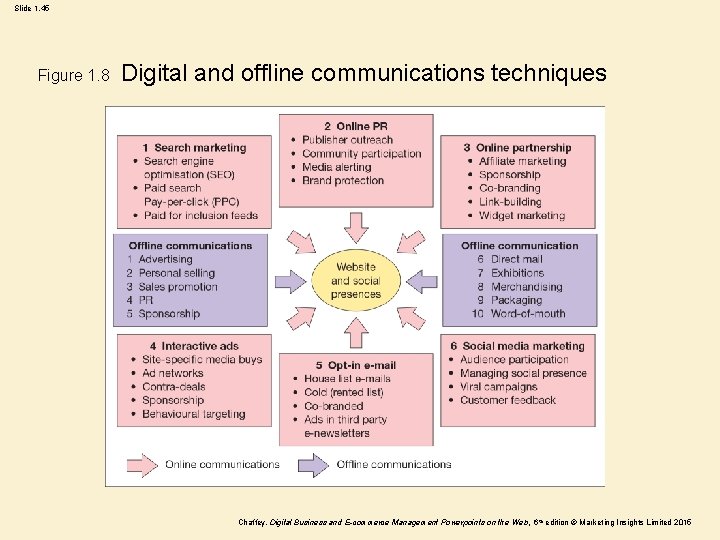
Slide 1. 38 Figure 1. 8 Digital and offline communications techniques Chaffey, Digital Business and E-commerce Management Powerpoints on the Web, 6 th edition © Marketing Insights Limited 2015
Slide 1. 39 Six types of digital media channels 1 Search engine marketing. Placing messages on a search engine to encourage clickthrough to a website when the user types a specific keyword phrase. Two key search marketing techniques are: paid placements or sponsored links using pay-per-click, and placements in the natural or organic listings using search engine optimisation (SEO). Chaffey, Digital Business and E-commerce Management Powerpoints on the Web, 6 th edition © Marketing Insights Limited 2015
Slide 1. 40 Six types of digital media channels 2 Online PR. Maximising favourable mentions and interactions with a company’s brands, products or websites using third-party sites such as social networks or blogs that are likely to be visited by your target audience. It also includes responding to negative mentions and conducting public relations via a site through a press centre or blog. It is closely related to social media marketing. How should we deal with negative mentions? What are the disadvantages and advantages of negative PR? Chaffey, Digital Business and E-commerce Management Powerpoints on the Web, 6 th edition © Marketing Insights Limited 2015
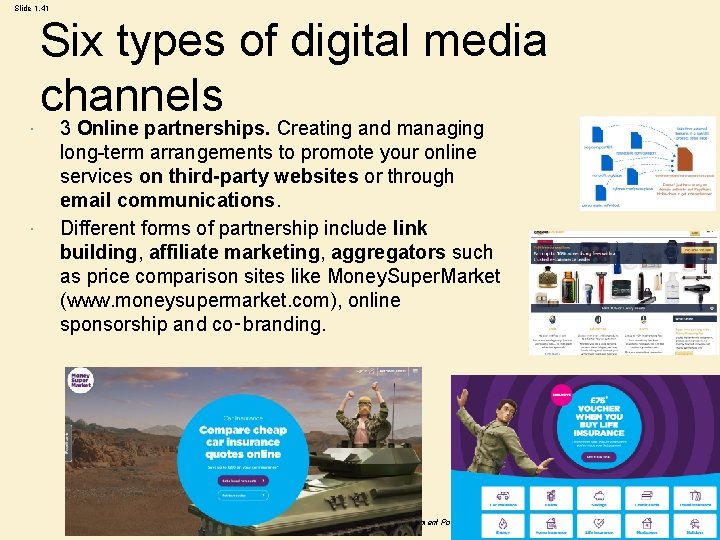
Slide 1. 41 Six types of digital media channels 3 Online partnerships. Creating and managing long-term arrangements to promote your online services on third-party websites or through email communications. Different forms of partnership include link building, affiliate marketing, aggregators such as price comparison sites like Money. Super. Market (www. moneysupermarket. com), online sponsorship and co‑branding. Chaffey, Digital Business and E-commerce Management Powerpoints on the Web, 6 th edition © Marketing Insights Limited 2015
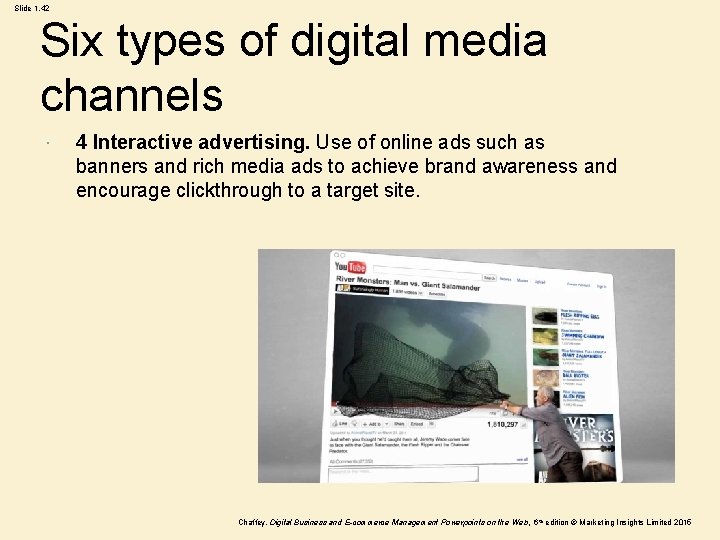
Slide 1. 42 Six types of digital media channels 4 Interactive advertising. Use of online ads such as banners and rich media ads to achieve brand awareness and encourage clickthrough to a target site. Chaffey, Digital Business and E-commerce Management Powerpoints on the Web, 6 th edition © Marketing Insights Limited 2015
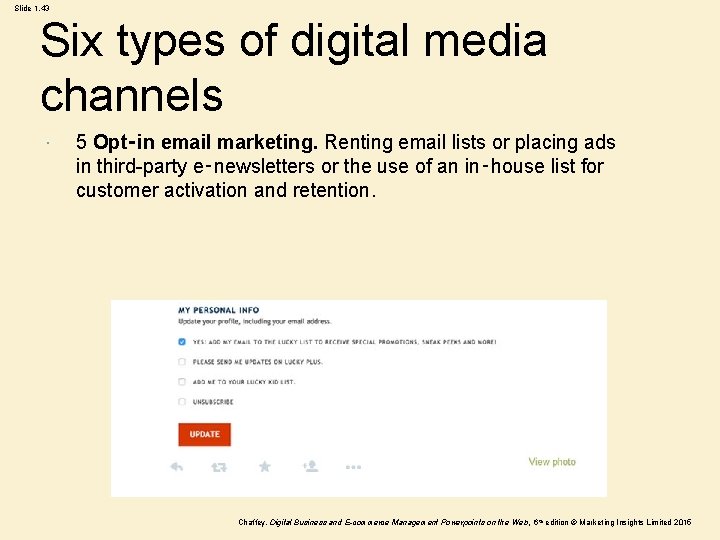
Slide 1. 43 Six types of digital media channels 5 Opt‑in email marketing. Renting email lists or placing ads in third-party e‑newsletters or the use of an in‑house list for customer activation and retention. Chaffey, Digital Business and E-commerce Management Powerpoints on the Web, 6 th edition © Marketing Insights Limited 2015
Slide 1. 44 Six types of digital media channels 6 Social media marketing is an important category of digital marketing which involves encouraging customer communications on a company’s own site, or a social presence such as Facebook or Twitter, or in specialist publisher sites, blogs and forums. It can be applied as a traditional broadcast medium, for example companies can use Facebook or Twitter to send messages to customers or partners who have opted in. However, to take advantage of the benefits of social media it is important to participate in customer conversations. These can be related to products, promotions or customer service and are aimed at learning more about customers and providing support, so improving the way a company is perceived. (In Chapter 9 we identify six main applications of social media. ) Chaffey, Digital Business and E-commerce Management Powerpoints on the Web, 6 th edition © Marketing Insights Limited 2015
Slide 1. 45 Figure 1. 8 Digital and offline communications techniques Chaffey, Digital Business and E-commerce Management Powerpoints on the Web, 6 th edition © Marketing Insights Limited 2015
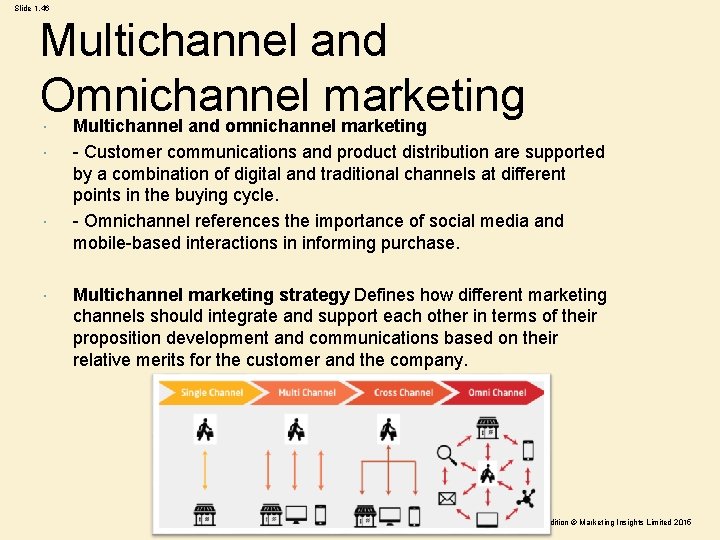
Slide 1. 46 Multichannel and Omnichannel marketing Multichannel and omnichannel marketing - Customer communications and product distribution are supported by a combination of digital and traditional channels at different points in the buying cycle. - Omnichannel references the importance of social media and mobile-based interactions in informing purchase. Multichannel marketing strategy Defines how different marketing channels should integrate and support each other in terms of their proposition development and communications based on their relative merits for the customer and the company. Chaffey, Digital Business and E-commerce Management Powerpoints on the Web, 6 th edition © Marketing Insights Limited 2015
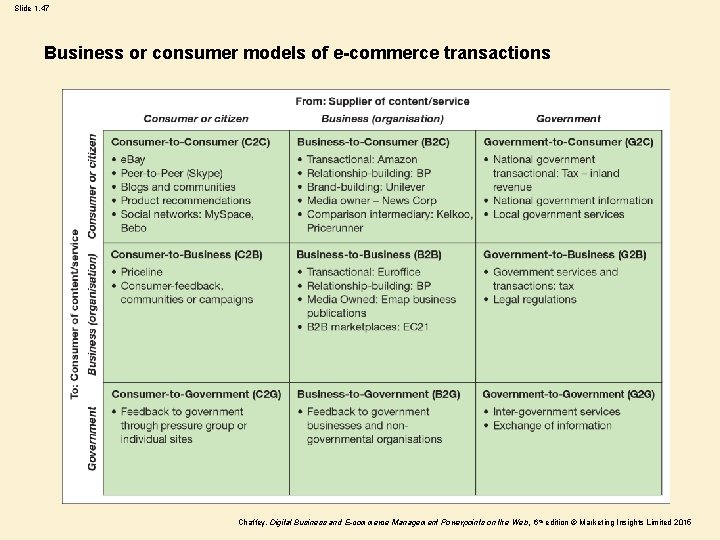
Slide 1. 47 Business or consumer models of e-commerce transactions Chaffey, Digital Business and E-commerce Management Powerpoints on the Web, 6 th edition © Marketing Insights Limited 2015
Slide 1. 48 E-government • E‑government: The application of e‑commerce technologies to government and public services for citizens and businesses. Customers – citizens • Suppliers – government • Internal communications: collection and dissemination. • Chaffey, Digital Business and E-commerce Management Powerpoints on the Web, 6 th edition © Marketing Insights Limited 2015
Slide 1. 49 Digital business opportunities • What oppurtunities has digital business introduced? Reach Richness Affiliation Chaffey, Digital Business and E-commerce Management Powerpoints on the Web, 6 th edition © Marketing Insights Limited 2015
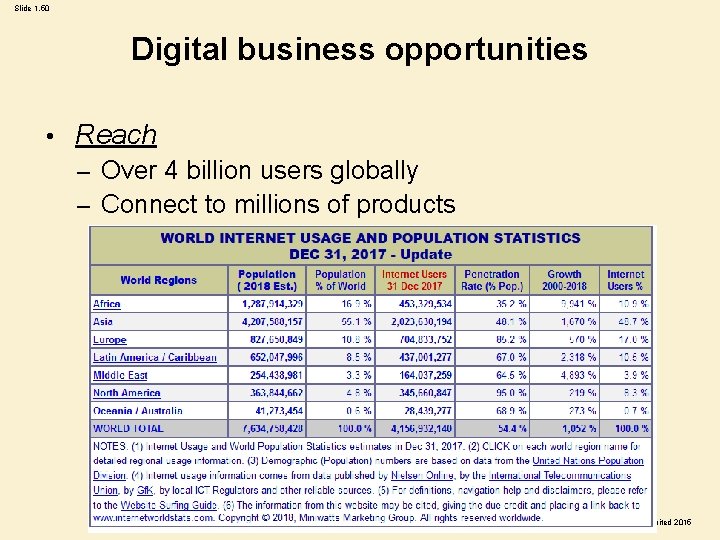
Slide 1. 50 Digital business opportunities • Reach – Over 4 billion users globally – Connect to millions of products Chaffey, Digital Business and E-commerce Management Powerpoints on the Web, 6 th edition © Marketing Insights Limited 2015
Slide 1. 51 Digital business opportunities • Reach – Over 4 billion users globally – Connect to millions of products • Richness – Detailed product information on 20 billion+ pages indexed by Google. Blogs, videos, feeds… – Personalised messages for users • Affiliation – Partnerships are key in the networked economy. – “soft lock-in” Chaffey, Digital Business and E-commerce Management Powerpoints on the Web, 6 th edition © Marketing Insights Limited 2015
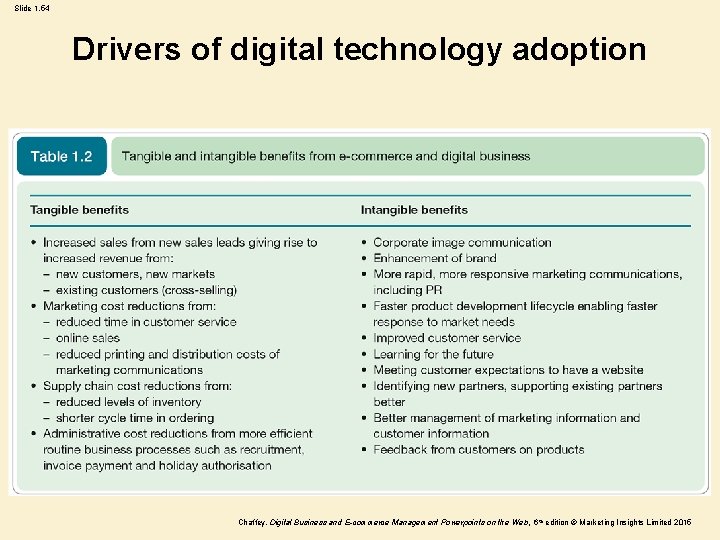
Slide 1. 52 Drivers of digital technology adoption Business adoption of e‑commerce and digital business is driven by benefits This can be achieved in two ways: ● Potential for increased revenue arising from increased reach to a larger customer base and encouraging loyalty and repeat purchases amongst existing customers. ● Cost reduction achieved through delivering services electronically. Reductions include staff costs, transport costs and costs of materials such as paper. Chaffey, Digital Business and E-commerce Management Powerpoints on the Web, 6 th edition © Marketing Insights Limited 2015
Slide 1. 53 Cost/efficiency and competitiveness drivers • Cost/efficiency drivers – – • Increasing speed with which supplies can be obtained Increasing speed with which goods can be dispatched Reduced sales and purchasing costs Reduced operating costs. Competitiveness drivers – Customer demand – Improving the range and quality of services offered – Avoid losing market share to businesses already using e-commerce. Chaffey, Digital Business and E-commerce Management Powerpoints on the Web, 6 th edition © Marketing Insights Limited 2015
Slide 1. 54 Drivers of digital technology adoption Chaffey, Digital Business and E-commerce Management Powerpoints on the Web, 6 th edition © Marketing Insights Limited 2015
Slide 1. 55 Additional activity – drivers and barriers to adoption • You are in a team of advisers at a local business, list: – Drivers to adoption of sell-side e-commerce by business and how you can reinforce these by marketing benefits – Barriers to adoption of sell-side e-commerce by business and how you can reinforce these by stressing benefits. Chaffey, Digital Business and E-commerce Management Powerpoints on the Web, 6 th edition © Marketing Insights Limited 2015
Slide 1. 56 Drivers of consumer adoption Driver? Marketing approach 1 2 3 4 5 6 Chaffey, Digital Business and E-commerce Management Powerpoints on the Web, 6 th edition © Marketing Insights Limited 2015
Slide 1. 57 Barriers to consumer adoption Barrier? Marketing approach 1 2 3 4 5 6 Chaffey, Digital Business and E-commerce Management Powerpoints on the Web, 6 th edition © Marketing Insights Limited 2015
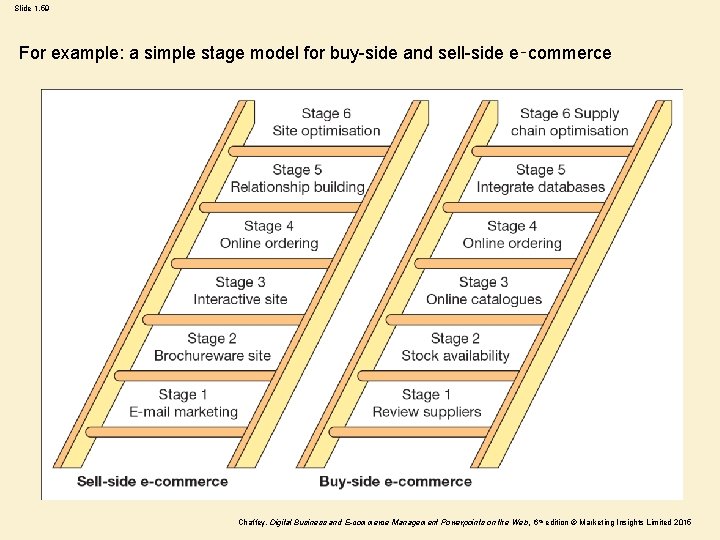
Slide 1. 58 Evaluating organization’s digital business capabilities • Evaluation is a starting point for future development • Stage models: • Used to review how advanced a company is in its use of information and communications technology (ICT) to support different processes. (more in chapter 5) Chaffey, Digital Business and E-commerce Management Powerpoints on the Web, 6 th edition © Marketing Insights Limited 2015
Slide 1. 59 For example: a simple stage model for buy-side and sell-side e‑commerce Chaffey, Digital Business and E-commerce Management Powerpoints on the Web, 6 th edition © Marketing Insights Limited 2015
Slide 1. 60 Online value proposition (OVP) • More important than ICT stage is the question: • Do we have a clear OVP? • OVP: A statement of the benefits of online services reinforces the core proposition and differentiates from an organisation’s offline offering and those of competitors. • Benefits of online services can be summarized in the 6 C’s: Content Customisation Community Convenience Choice Cost reduction Chaffey, Digital Business and E-commerce Management Powerpoints on the Web, 6 th edition © Marketing Insights Limited 2015
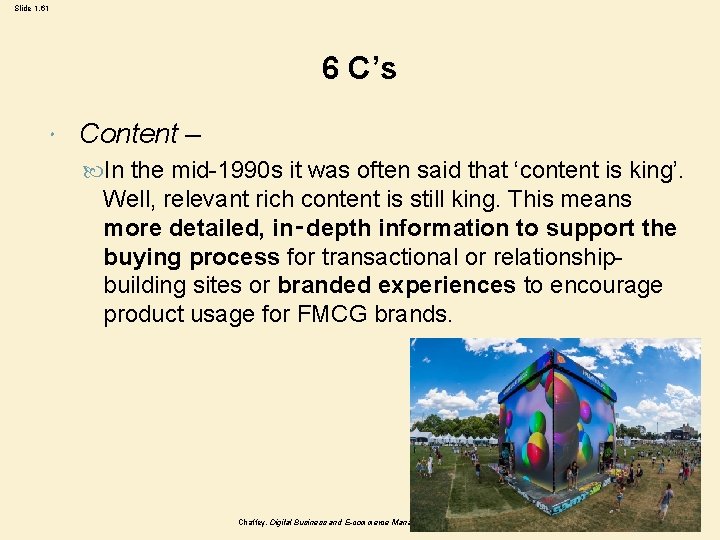
Slide 1. 61 6 C’s Content – In the mid-1990 s it was often said that ‘content is king’. Well, relevant rich content is still king. This means more detailed, in‑depth information to support the buying process for transactional or relationshipbuilding sites or branded experiences to encourage product usage for FMCG brands. Chaffey, Digital Business and E-commerce Management Powerpoints on the Web, 6 th edition © Marketing Insights Limited 2015
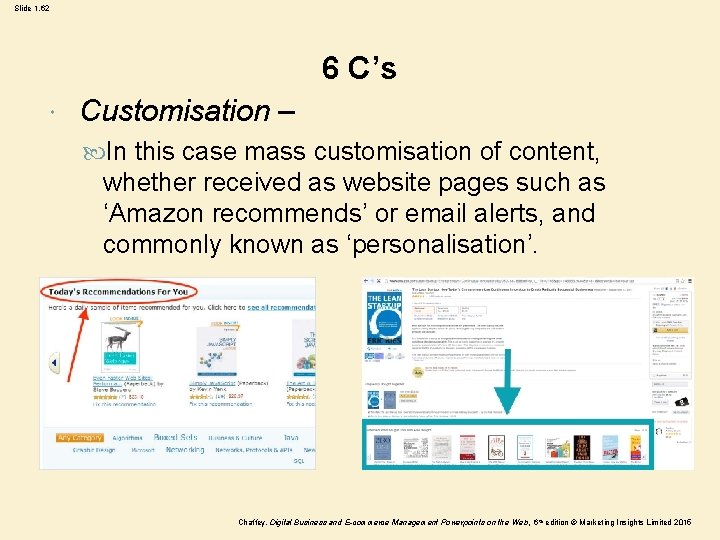
Slide 1. 62 6 C’s Customisation – In this case mass customisation of content, whether received as website pages such as ‘Amazon recommends’ or email alerts, and commonly known as ‘personalisation’. Chaffey, Digital Business and E-commerce Management Powerpoints on the Web, 6 th edition © Marketing Insights Limited 2015
Slide 1. 63 6 C’s Community – The Internet liberates consumers to discuss anything they wish through forums, chat-rooms and blog comments. Chaffey, Digital Business and E-commerce Management Powerpoints on the Web, 6 th edition © Marketing Insights Limited 2015
Slide 1. 64 6 C’s Convenience – This is the ability to select, purchase and in some cases use products from your desktop at any time: the classic 24 × 7 × 365 availability of a service. Online usage of products is, of course, restricted to digital products such as music or other data services. Amazon has advertised offline using creative ads showing a Christmas shopper battling against a gale-swept street clutching several bags to reinforce the convenience message. Chaffey, Digital Business and E-commerce Management Powerpoints on the Web, 6 th edition © Marketing Insights Limited 2015
Slide 1. 65 6 C’s Choice – The web gives a wider choice of products and suppliers than via conventional distribution channels. The success of online intermediaries such as Kelkoo (www. kelkoo. com) and Reevoo (www. reevoo. com) is evidence of this. Similarly, Tesco. com provides Tesco with a platform to give consumers a wider choice of products (financial, travel, white goods) with more detailed information than are physically available in‑store. Chaffey, Digital Business and E-commerce Management Powerpoints on the Web, 6 th edition © Marketing Insights Limited 2015
Slide 1. 66 6 C’s Cost reduction – The Internet is widely perceived as a relatively low -cost place of purchase. Often customers expect to get a good deal online as they realise that online traders have a lower cost base. A simple price differential is a key approach to encouraging usage of online services. Chaffey, Digital Business and E-commerce Management Powerpoints on the Web, 6 th edition © Marketing Insights Limited 2015
Slide 1. 67 The end of chapter 1 Chaffey, Digital Business and E-commerce Management Powerpoints on the Web, 6 th edition © Marketing Insights Limited 2015