
Slick SQL Interaction in Scala Jan Christopher Vogt
 { def id =](https://slidetodoc.com/presentation_image_h/1b1c6673cb638d3d3eb0fc80751132ea/image-13.jpg "Table description class Devices(tag: Tag) extends Table[(Long, Double, Date)](tag, \"DEVICE\") { def id =")
 { def id =](https://slidetodoc.com/presentation_image_h/1b1c6673cb638d3d3eb0fc80751132ea/image-18.jpg "Table description class Devices(tag: Tag) extends Table[(Long, Double, Date)](tag, \"DEVICE\") { def id =")

- Slides: 36
Slick SQL Interaction in Scala Jan Christopher Vogt, EPFL Slick Team
(vs. ORM) • • • Functional-Relational Mapper natural fit (no impedance mismatch) declarative embraces relational stateless Slick is to ORM what Scala is to Java
8 Reasons for using Slick
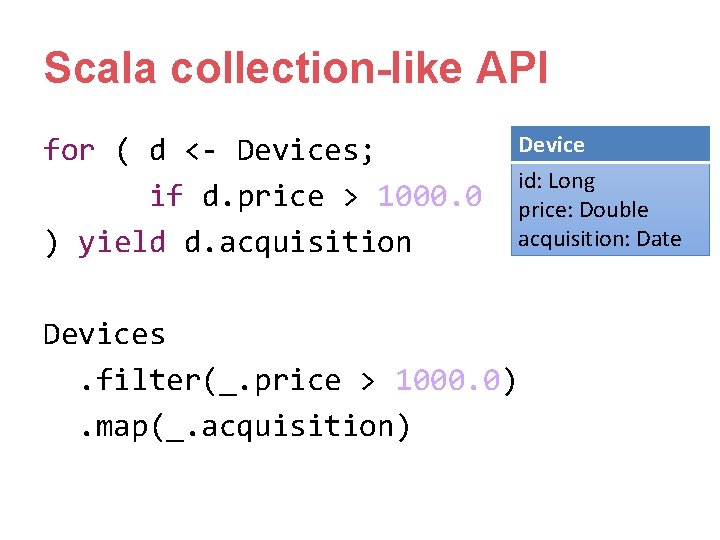
1 Scala collection-like API
Scala collection-like API for ( d <- Devices; if d. price > 1000. 0 ) yield d. acquisition Devices. filter(_. price > 1000. 0). map(_. acquisition) Device id: Long price: Double acquisition: Date
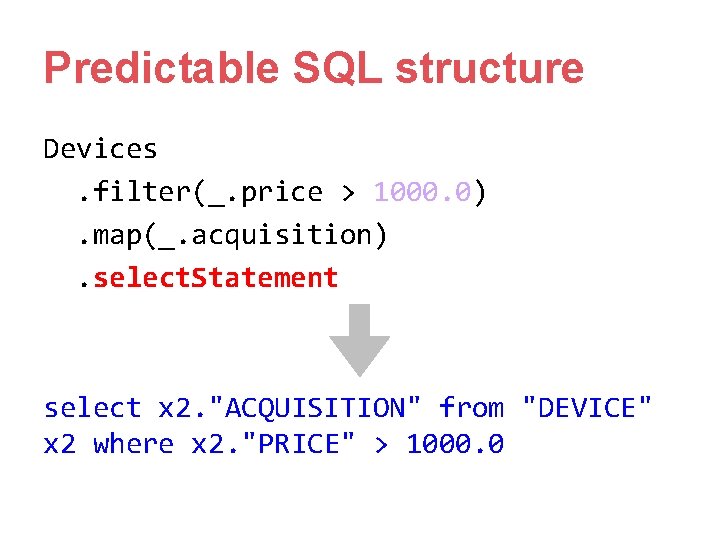
2 Predictable SQL structure
Predictable SQL structure Devices. filter(_. price > 1000. 0). map(_. acquisition). select. Statement select x 2. "ACQUISITION" from "DEVICE" x 2 where x 2. "PRICE" > 1000. 0
3 Type-safety
Compile-Time Safety • Spelling mistake in column name? • Wrong column type? • Query doesn’t match the result type? scalac sees it all!
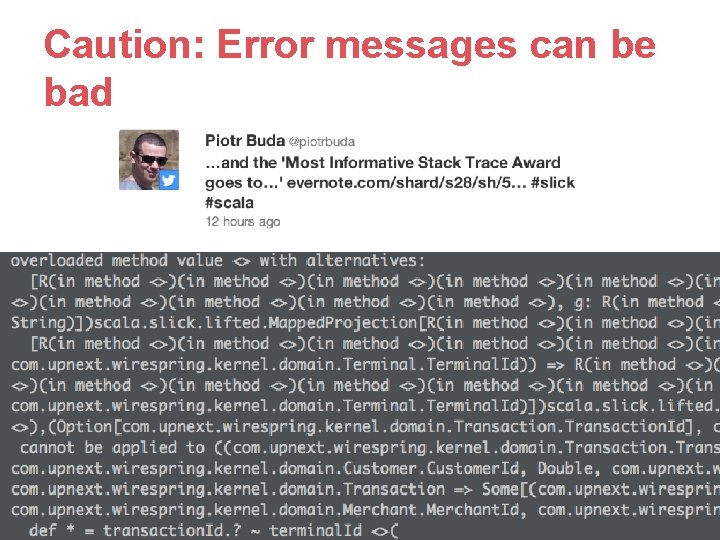
Caution: Error messages can be bad • Error messages can destroy the illusion
Enforce schema consistency • Generate DDL from table classes • Slick 2. 0: Generate table classes and mapped classes from database
4 Small configuration using Scala code
Table description class Devices(tag: Tag) extends Table[(Long, Double, Date)](tag, "DEVICE") { def id = column[Long] ("ID", O. Primary. Key) def price = column[Double]("PRICE") def acquisition = column[Date] ("ACQUISITION") def * = (id, price, acquisition) } def Devices = Table. Query[Devices] can be auto-generated in Slick 2. 0
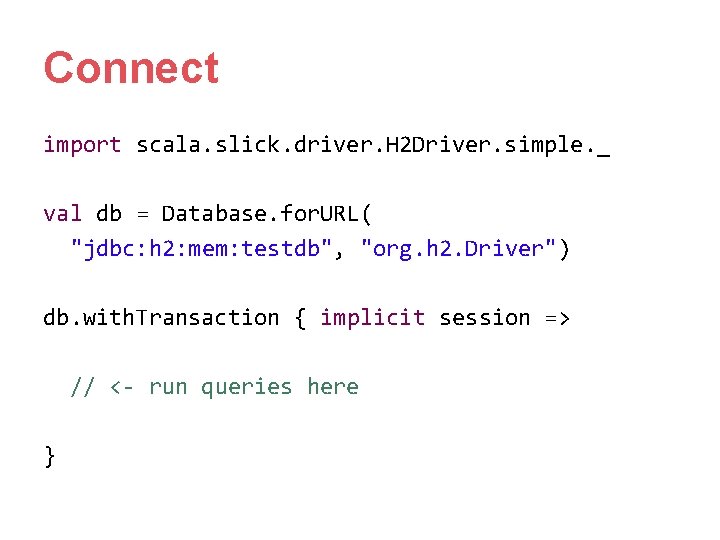
Connect import scala. slick. driver. H 2 Driver. simple. _ val db = Database. for. URL( "jdbc: h 2: mem: testdb", "org. h 2. Driver") db. with. Transaction { implicit session => // <- run queries here }
5 Explicit control over execution and transfer
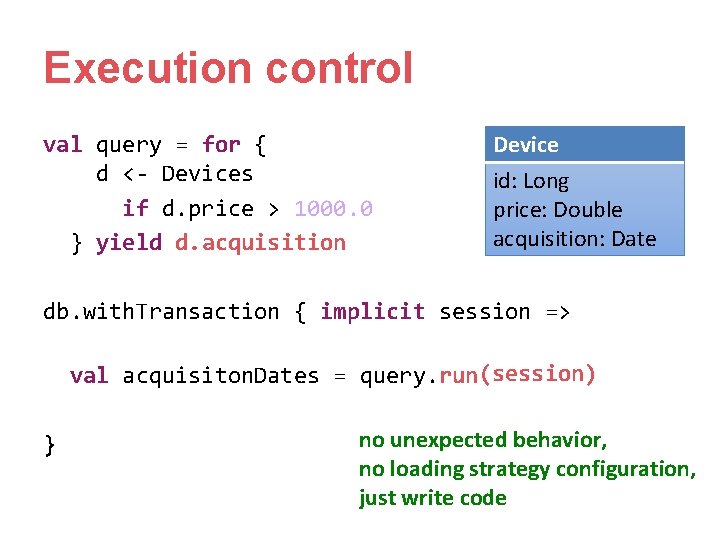
Execution control val query = for { d <- Devices if d. price > 1000. 0 } yield d. acquisition Device id: Long price: Double acquisition: Date db. with. Transaction { implicit session => val acquisiton. Dates = query. run(session) } no unexpected behavior, no loading strategy configuration, just write code
6 Loosely-coupled, flexible mapping
Table description class Devices(tag: Tag) extends Table[(Long, Double, Date)](tag, "DEVICE") { def id = column[Long] ("ID", O. Primary. Key) def price = column[Double]("PRICE") def acquisition = column[Date] ("ACQUISITION") def * = (id, price, acquisition) } val Devices = Table. Query[Devices]
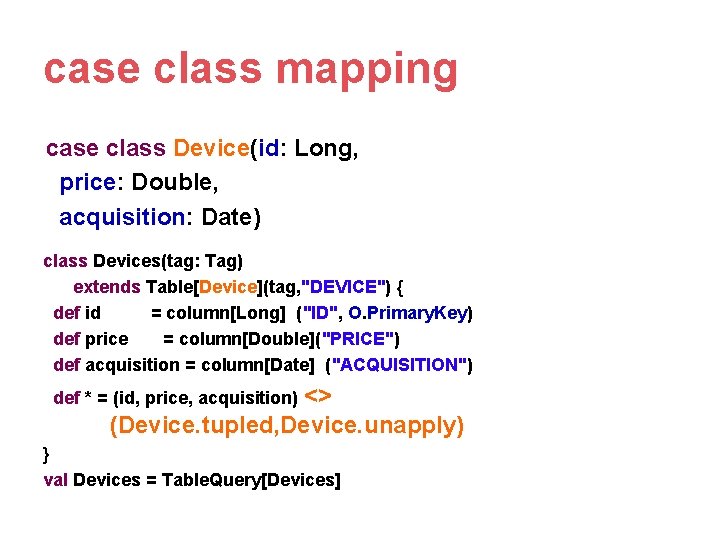
case class mapping case class Device(id: Long, price: Double, acquisition: Date) class Devices(tag: Tag) extends Table[Device](tag, "DEVICE") { def id = column[Long] ("ID", O. Primary. Key) def price = column[Double]("PRICE") def acquisition = column[Date] ("ACQUISITION") def * = (id, price, acquisition) <> (Device. tupled, Device. unapply) } val Devices = Table. Query[Devices]
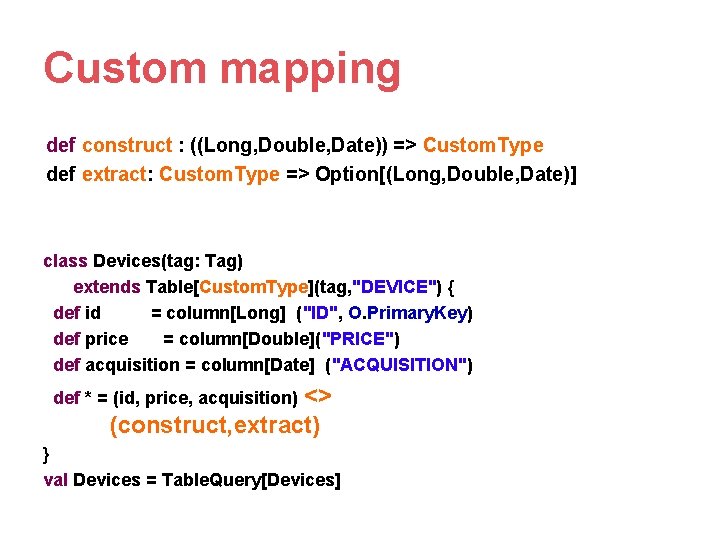
Custom mapping def construct : ((Long, Double, Date)) => Custom. Type def extract: Custom. Type => Option[(Long, Double, Date)] class Devices(tag: Tag) extends Table[Custom. Type](tag, "DEVICE") { def id = column[Long] ("ID", O. Primary. Key) def price = column[Double]("PRICE") def acquisition = column[Date] ("ACQUISITION") def * = (id, price, acquisition) <> (construct, extract) } val Devices = Table. Query[Devices]
7 Plain SQL support
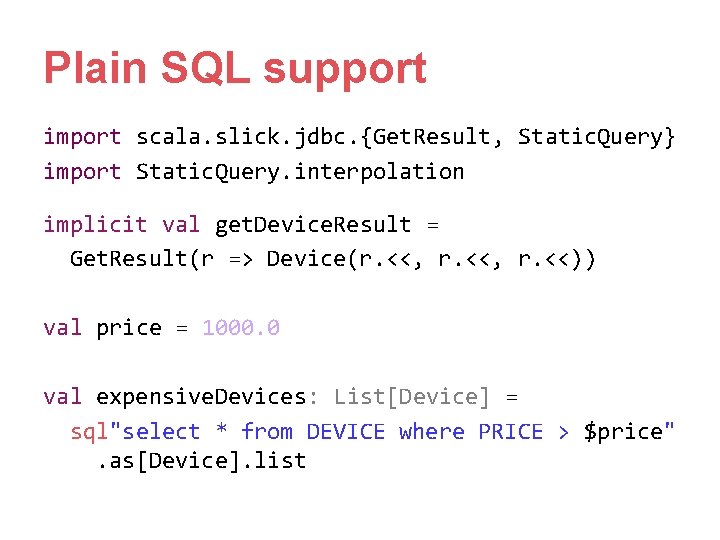
Plain SQL support import scala. slick. jdbc. {Get. Result, Static. Query} import Static. Query. interpolation implicit val get. Device. Result = Get. Result(r => Device(r. <<, r. <<)) val price = 1000. 0 val expensive. Devices: List[Device] = sql"select * from DEVICE where PRICE > $price". as[Device]. list
8 composable / re-usable queries
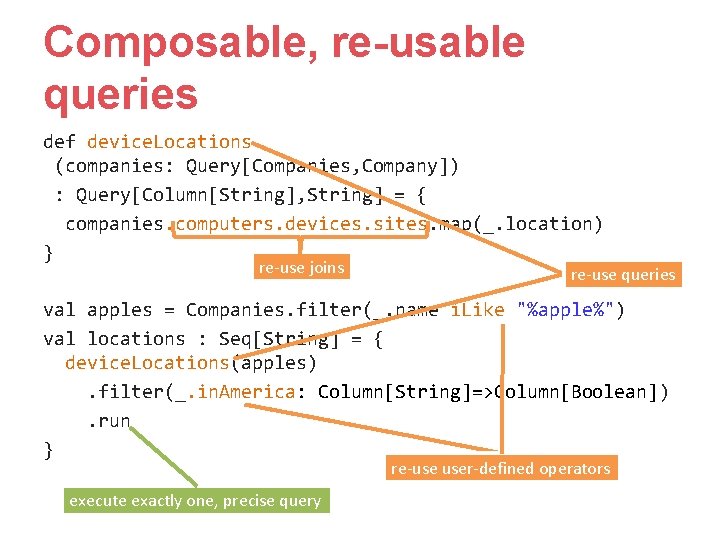
Composable, re-usable queries def device. Locations (companies: Query[Companies, Company]) : Query[Column[String], String] = { companies. computers. devices. sites. map(_. location) } re-use joins re-use queries val apples = Companies. filter(_. name i. Like "%apple%") val locations : Seq[String] = { device. Locations(apples). filter(_. in. America: Column[String]=>Column[Boolean]). run } re-use user-defined operators execute exactly one, precise query
Live Demo
Slick app design
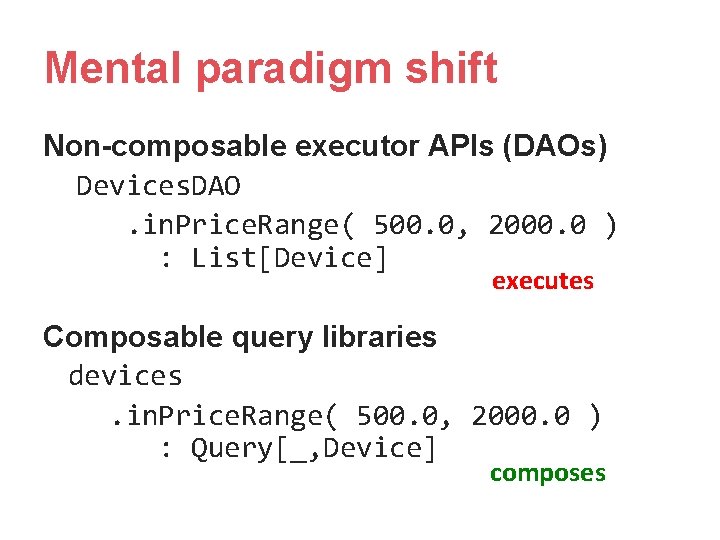
Mental paradigm shift Non-composable executor APIs (DAOs) Devices. DAO. in. Price. Range( 500. 0, 2000. 0 ) : List[Device] executes Composable query libraries devices. in. Price. Range( 500. 0, 2000. 0 ) : Query[_, Device] composes
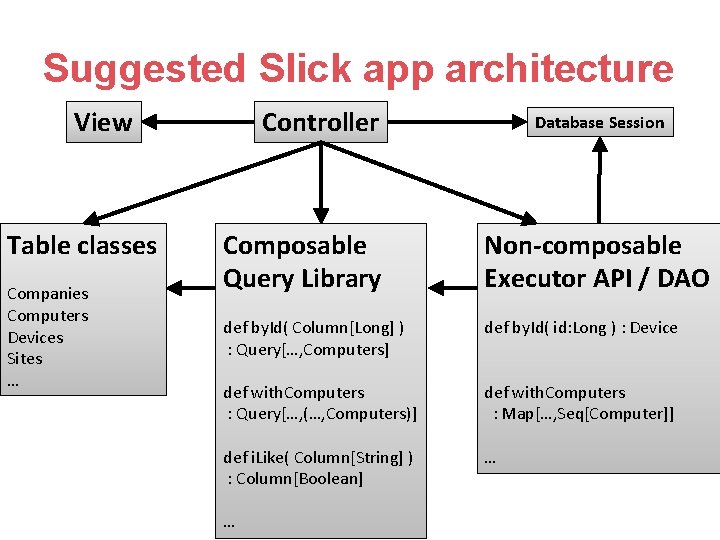
Suggested Slick app architecture View Table classes Companies Computers Devices Sites … Controller Database Session Composable Query Library Non-composable Executor API / DAO def by. Id( Column[Long] ) : Query[…, Computers] def by. Id( id: Long ) : Device def with. Computers : Query[…, (…, Computers)] def with. Computers : Map[…, Seq[Computer]] def i. Like( Column[String] ) : Column[Boolean] … …
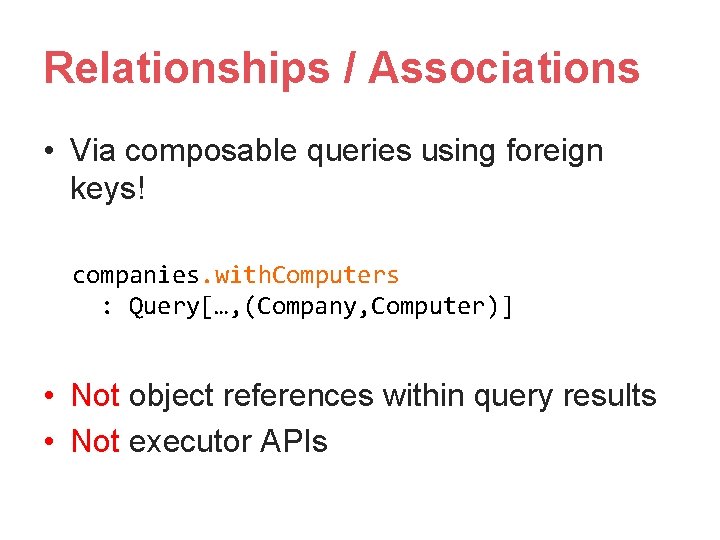
Relationships / Associations • Via composable queries using foreign keys! companies. with. Computers : Query[…, (Company, Computer)] • Not object references within query results • Not executor APIs
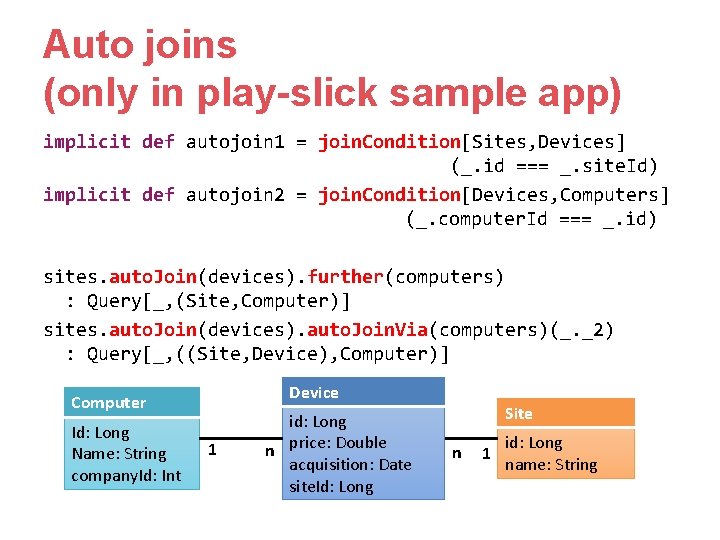
Auto joins (only in play-slick sample app) implicit def autojoin 1 = join. Condition[Sites, Devices] (_. id === _. site. Id) implicit def autojoin 2 = join. Condition[Devices, Computers] (_. computer. Id === _. id) sites. auto. Join(devices). further(computers) : Query[_, (Site, Computer)] sites. auto. Join(devices). auto. Join. Via(computers)(_. _2) : Query[_, ((Site, Device), Computer)] Device Computer Id: Long Name: String company. Id: Int 1 id: Long n price: Double acquisition: Date site. Id: Long Site n 1 id: Long name: String
Other features
Other features • inserts += ++=, updates query. update(…) • user defined column types, e. g. type-safe ids • user defined database functions • …
Outlook
2. 0 is around the corner • code-generation based type providers • hlists and custom shapes (no 22 -col limit, easy integration with shapeless, etc. ) • distributed queries (over multiple dbs) • improved pre-compiled queries
Current experiments • • • improved macro-based api (simpler types) macro-based type providers schema manipulation api migration/version management tool extended for-comprehensions (order, group) Thanks to @amirsh @clhodapp @nafg
Thank you slick. typesafe. com @cvogt @Stefan. Zeiger http: //slick. typesafe. com/talks/ https: //github. com/cvogt/play-slick/