
Slicer AutoSharding for Datacenter Applications Atul Adya Daniel
- Slides: 21
Slicer: Auto-Sharding for Datacenter Applications Atul Adya, Daniel Myers, Jon Howell, Jeremy Elson, Colin Meek, Vishesh Khemani, Stefan Fulger, Pan Gu, Lakshminath Bhuvanagiri, Jason Hunter, Roberto Peon, Larry Kai, Alexander Shraer, Arif Merchant, Kfir Lev-Ari (Technion – Israel) 1
Local Memory Considered Helpful • Server machines have a lot of memory • Applications should take advantage of it, e. g. , caching • Datacenter applications often don’t cache data • Too hard to implement • Slicer makes it easy to build services that use local memory 2
Talk Outline • Why stateful servers are difficult • Slicer model and architecture • Evaluation 3
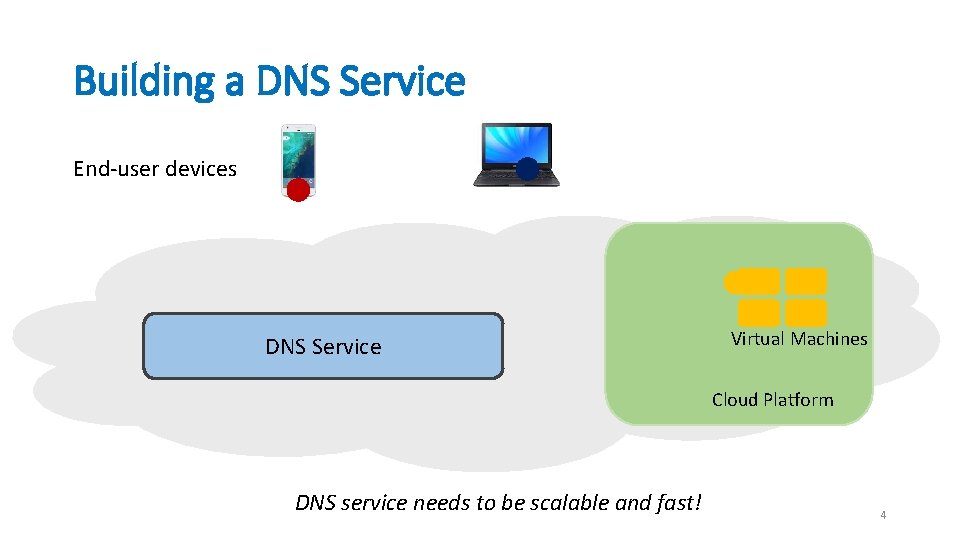
Building a DNS Service End-user devices DNS Service Virtual Machines Cloud Platform DNS service needs to be scalable and fast! 4
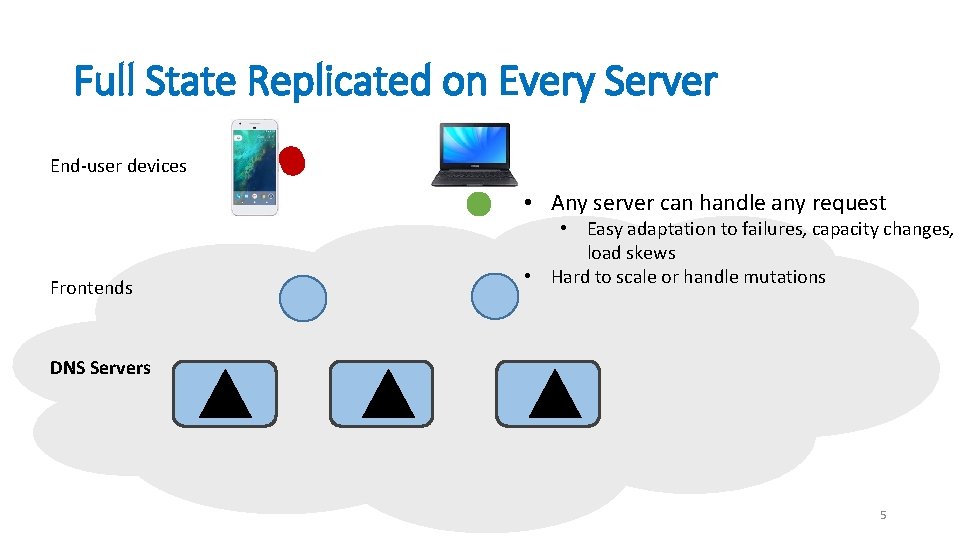
Full State Replicated on Every Server End-user devices • Any server can handle any request Frontends • Easy adaptation to failures, capacity changes, load skews • Hard to scale or handle mutations DNS Servers 5
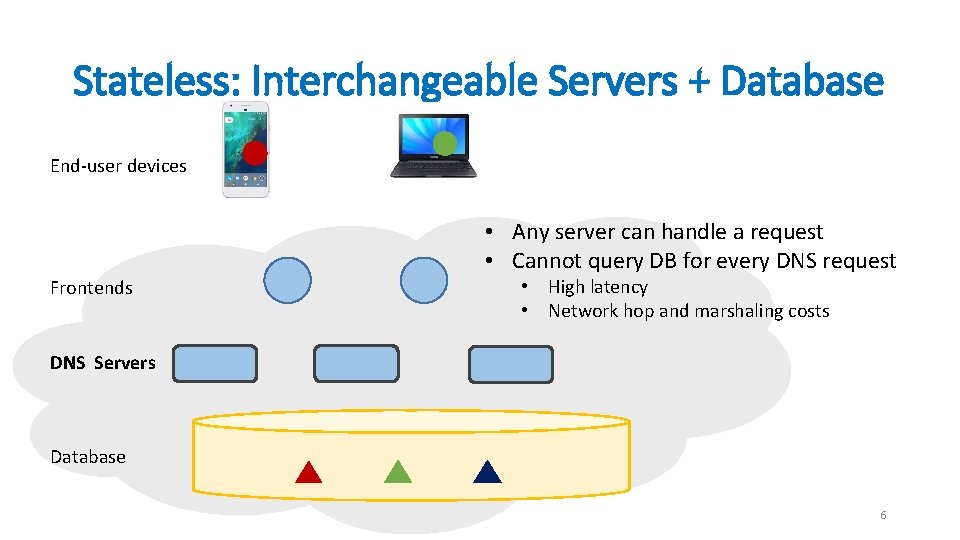
Stateless: Interchangeable Servers + Database End-user devices • Any server can handle a request • Cannot query DB for every DNS request Frontends • High latency • Network hop and marshaling costs DNS Servers Database 6
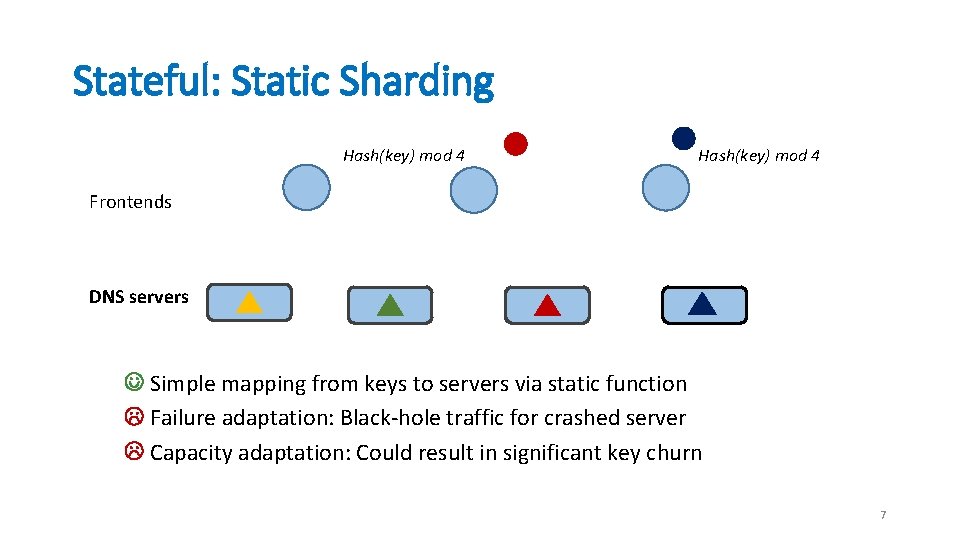
Stateful: Static Sharding Hash(key) mod 4 Frontends DNS servers Simple mapping from keys to servers via static function Failure adaptation: Black-hole traffic for crashed server Capacity adaptation: Could result in significant key churn 7
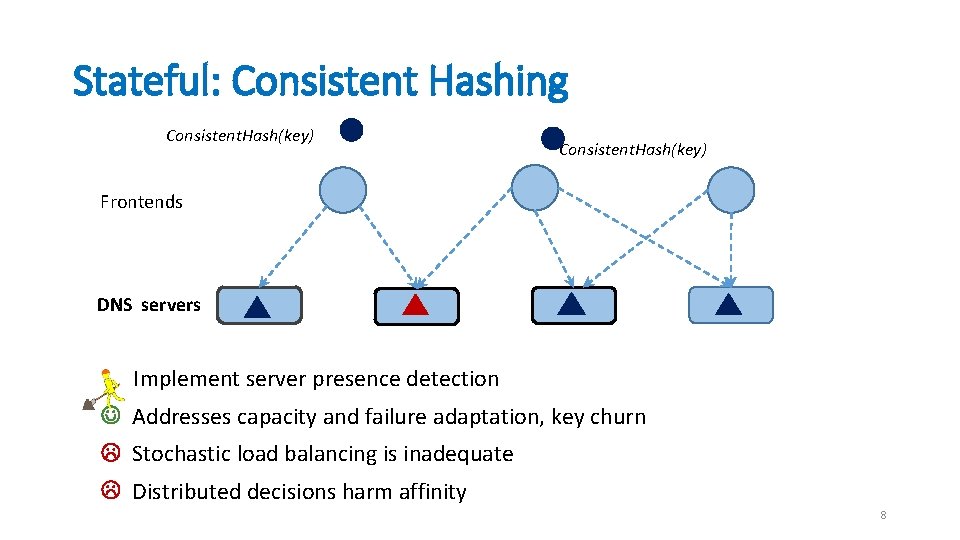
Stateful: Consistent Hashing Consistent. Hash(key) Frontends DNS servers Implement server presence detection Addresses capacity and failure adaptation, key churn Stochastic load balancing is inadequate Distributed decisions harm affinity 8
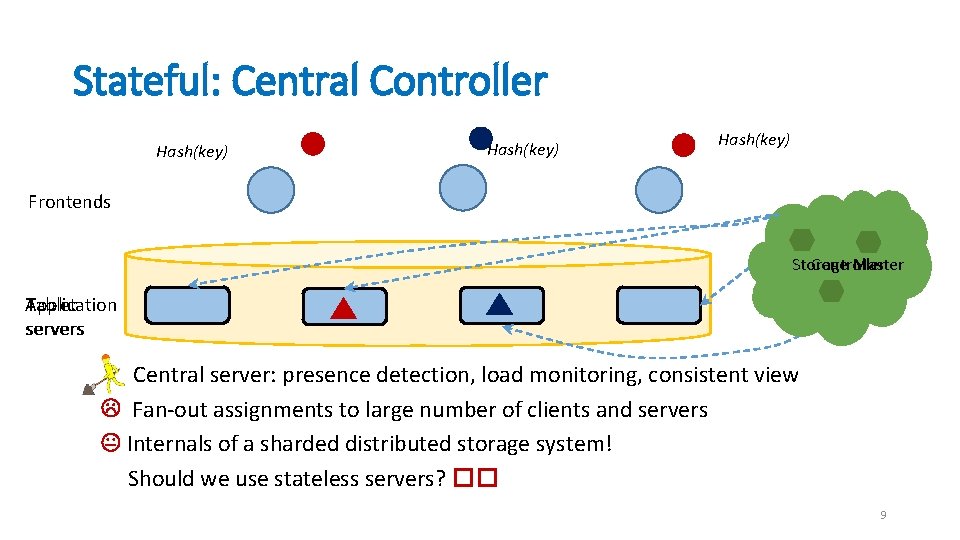
Stateful: Central Controller Hash(key) Frontends Storage Controller Master Application Tablet servers Central server: presence detection, load monitoring, consistent view Fan-out assignments to large number of clients and servers Internals of a sharded distributed storage system! Should we use stateless servers? �� 9
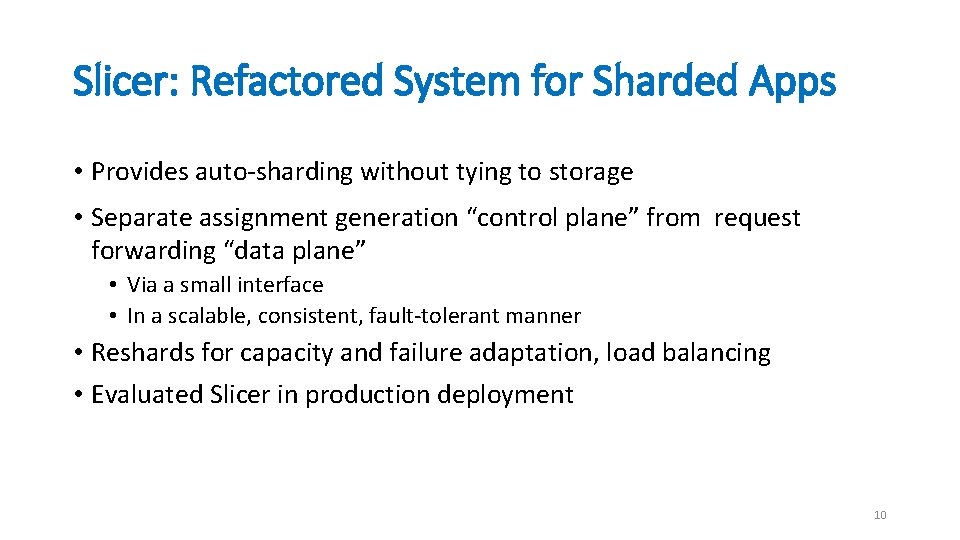
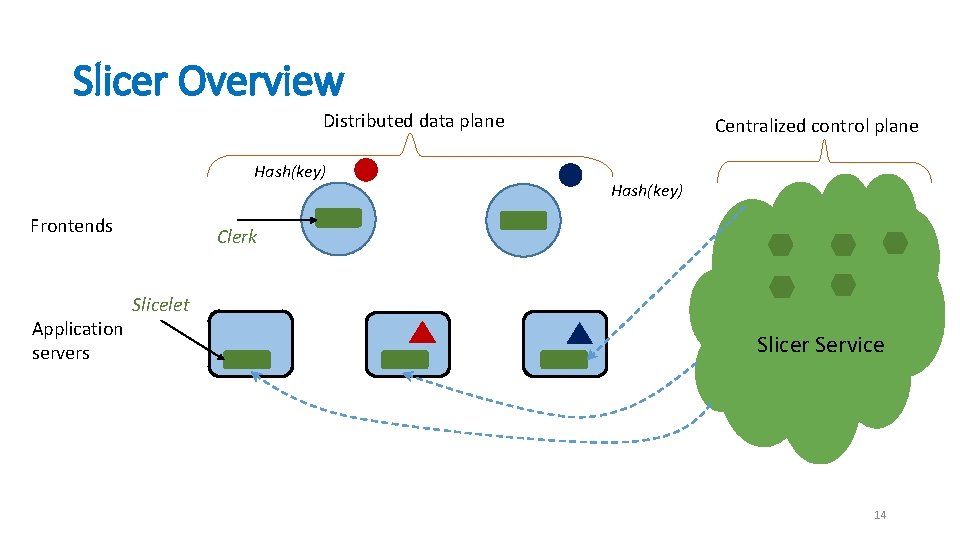
Slicer: Refactored System for Sharded Apps • Provides auto-sharding without tying to storage • Separate assignment generation “control plane” from request forwarding “data plane” • Via a small interface • In a scalable, consistent, fault-tolerant manner • Reshards for capacity and failure adaptation, load balancing • Evaluated Slicer in production deployment 10
Benefits of Sharding/Affinity • Any type of serving from memory / caching • E. g. , Cloud DNS • Even stateless services use stateful components • E. g. External caches such as Memcache • Affinity helps aggregating writes to storage • E. g. , Thialfi [SOSP ’ 11] batches notification messages to storage 11
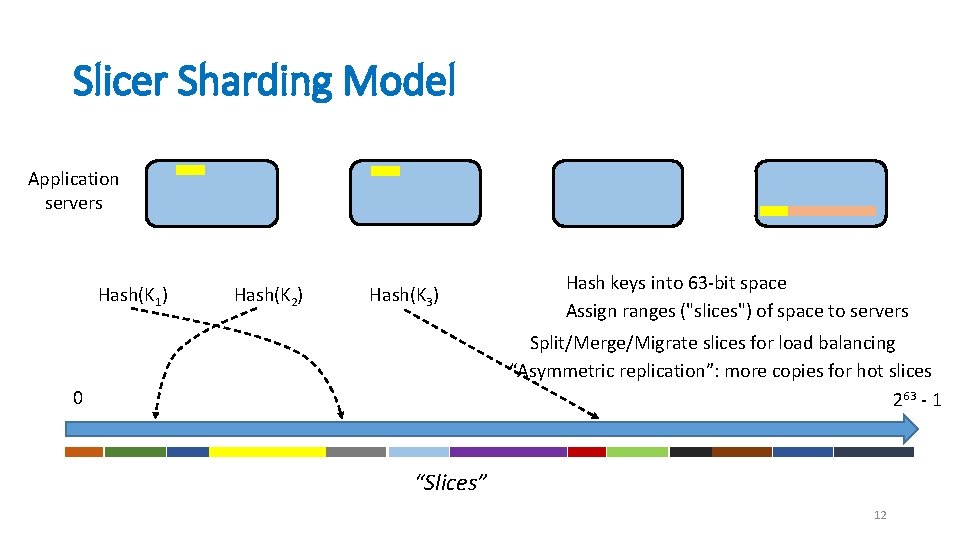
Slicer Sharding Model Application servers Hash(K 1) Hash(K 2) Hash(K 3) Hash keys into 63 -bit space Assign ranges ("slices") of space to servers Split/Merge/Migrate slices for load balancing “Asymmetric replication”: more copies for hot slices 263 - 1 0 “Slices” 12
Slicer Architecture: Goals • High-quality sharding and consistency of a centralized system • Low latency and high availability of local decisions 13
Slicer Overview Distributed data plane Hash(key) Frontends Application servers Centralized control plane Hash(key) Clerk Slicelet Slicer Service 14
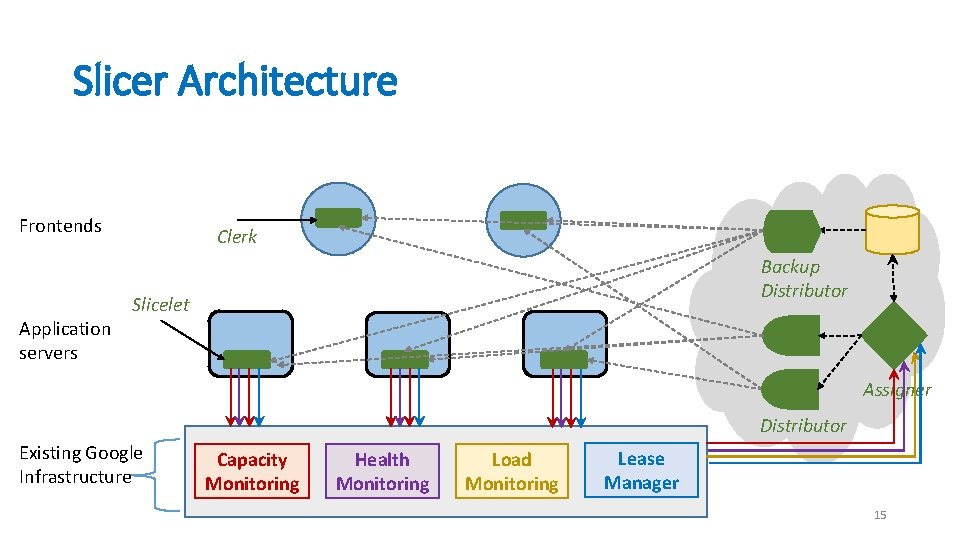
Slicer Architecture Frontends Application servers Clerk Backup Distributor Slicelet Assigner Distributor Existing Google Infrastructure Capacity Monitoring Health Monitoring Load Monitoring Lease Manager 15
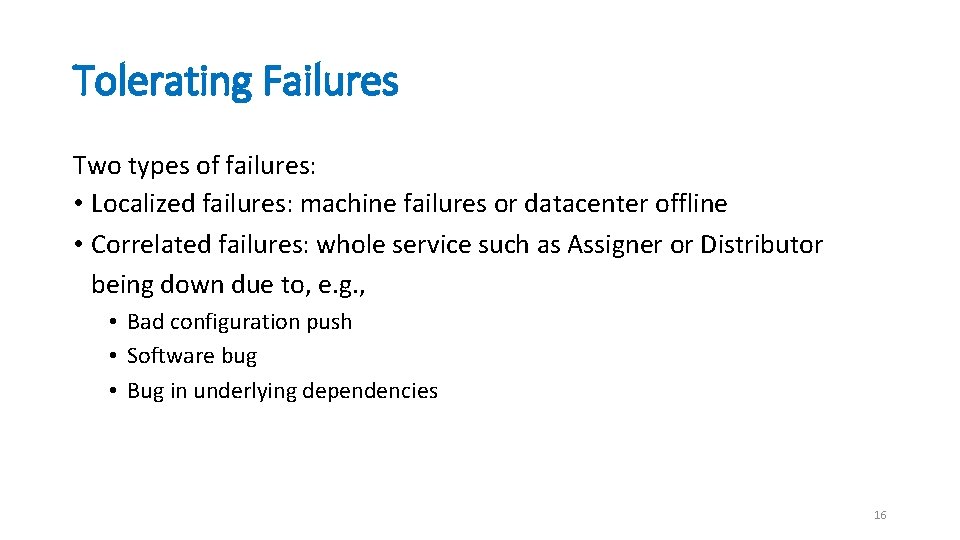
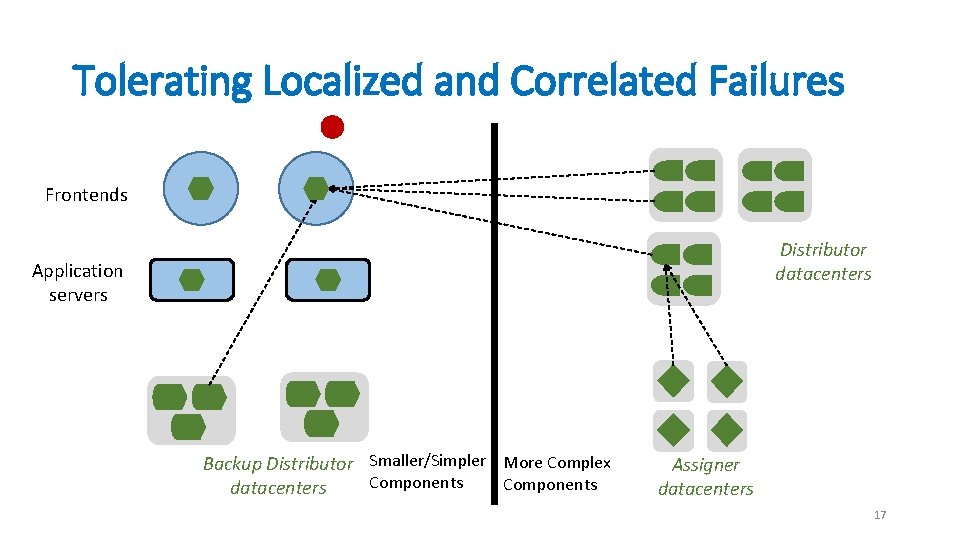
Tolerating Failures Two types of failures: • Localized failures: machine failures or datacenter offline • Correlated failures: whole service such as Assigner or Distributor being down due to, e. g. , • Bad configuration push • Software bug • Bug in underlying dependencies 16
Tolerating Localized and Correlated Failures Frontends Distributor datacenters Application servers Backup Distributor Smaller/Simpler More Complex Components datacenters Assigner datacenters 17
Slicer Features and Evaluation • Load balancing algorithm • Assignments with strong consistency guarantees • Production Measurements Brief scale, load balancing, availability, assignment latencies • Detailed • Comparison with consistent hashing • Experiments • Comparing load balancing strategies • Load reaction time • Assigner recovery time 18
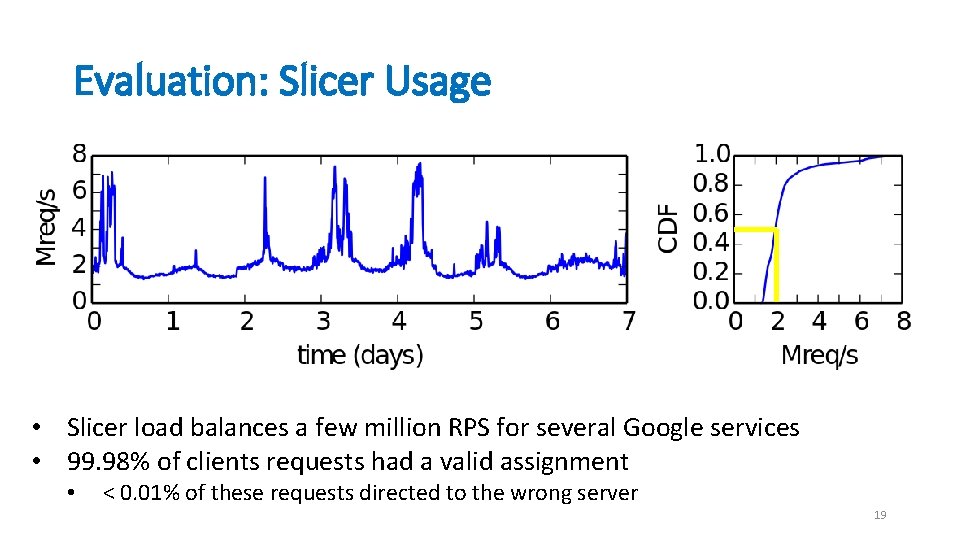
Evaluation: Slicer Usage • Slicer load balances a few million RPS for several Google services • 99. 98% of clients requests had a valid assignment • < 0. 01% of these requests directed to the wrong server 19
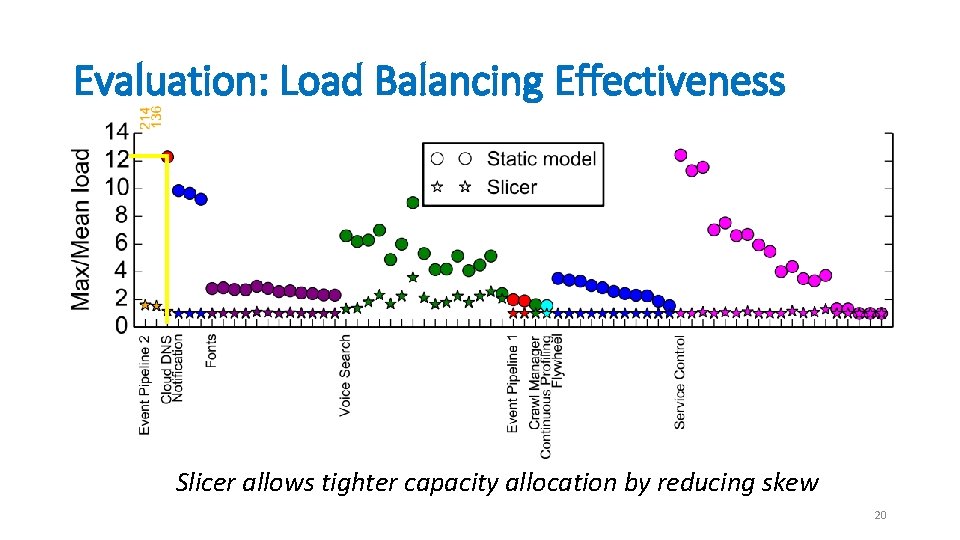
Evaluation: Load Balancing Effectiveness Slicer allows tighter capacity allocation by reducing skew 20
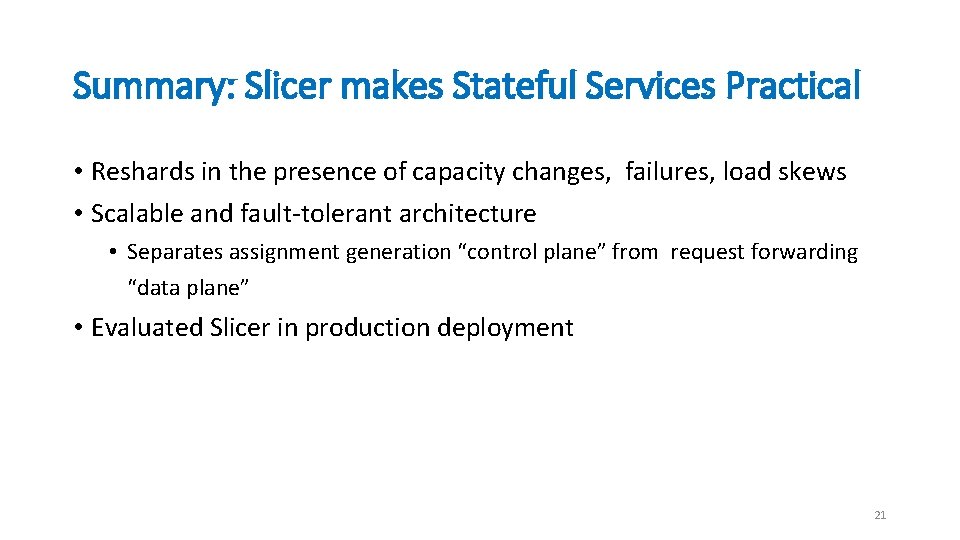
Summary: Slicer makes Stateful Services Practical • Reshards in the presence of capacity changes, failures, load skews • Scalable and fault-tolerant architecture • Separates assignment generation “control plane” from request forwarding “data plane” • Evaluated Slicer in production deployment 21