
SLES What is SLES An employment skillsfocussed NDIS
- Slides: 22
SLES
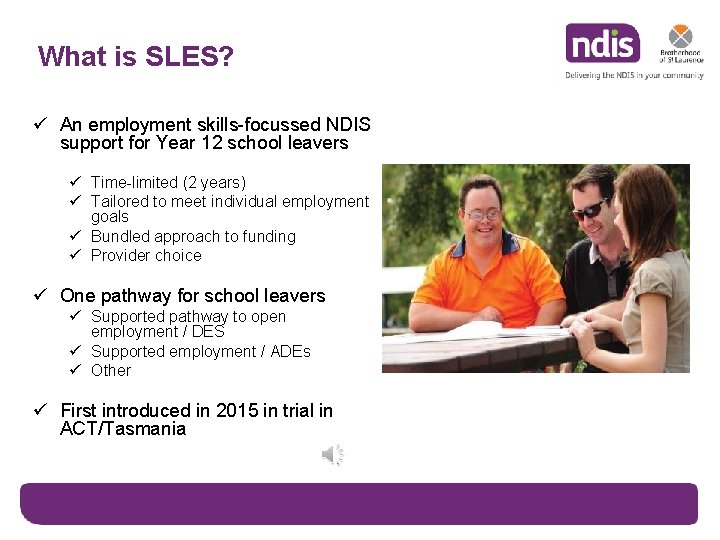
What is SLES? ü An employment skills-focussed NDIS support for Year 12 school leavers ü Time-limited (2 years) ü Tailored to meet individual employment goals ü Bundled approach to funding ü Provider choice ü One pathway for school leavers ü Supported pathway to open employment / DES ü Supported employment / ADEs ü Other ü First introduced in 2015 in trial in ACT/Tasmania
How does SLES connect with NDIS? • SLES stands for School Leaver Employment Supports. • There are various initiatives under the NDIS. SLES is one example of a reasonable and necessary support. • SLES is focused on improving employment opportunities for Year 12 school leavers. • To be approved for SLES applicants must also be eligible for NDIS.
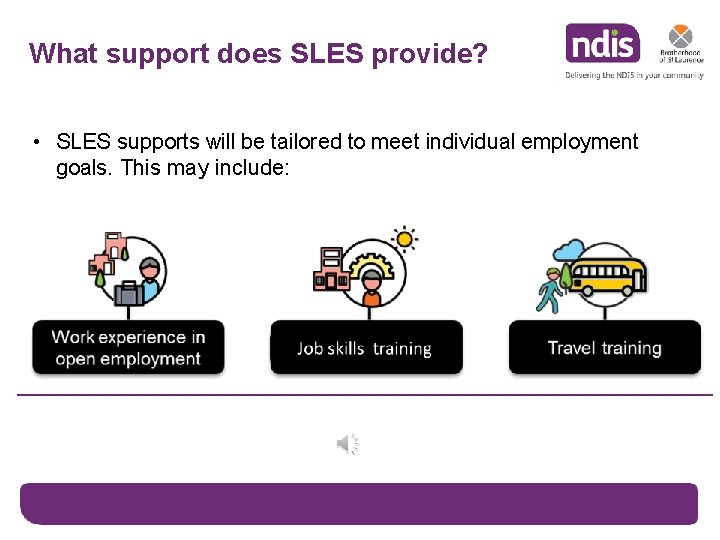
What support does SLES provide? • SLES supports will be tailored to meet individual employment goals. This may include:
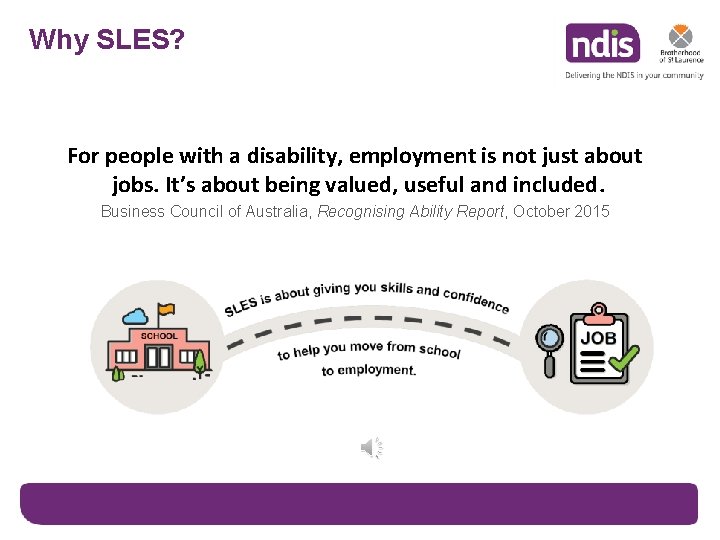
Why SLES? For people with a disability, employment is not just about jobs. It’s about being valued, useful and included. Business Council of Australia, Recognising Ability Report, October 2015
Why SLES? “Before I came I was sceptical and negative. I thought there was no hope of my son being able to get into employment – I’ve changed my mind”. Quote from carer, SLES Participant Workshop, February 2016
Why SLES? • Overcomes low expectations – person, family, community • Increases number of young people willing to give employment a go. • Engages education sector • Provides a bridge to DES – ongoing supports
How did we design SLES? • Looked at the research, evidence and outcomes – Transition To Work (TTW) in NSW • Continuing what works – not reinventing the wheel • Co-design – trial sites, providers, people with disability • Planning between participant and provider, bundled approach, focus on outcomes not outputs • It’s not a ‘program’
What will SLES achieve? An increase in the number of NDIS participants: • Aspiring for employment • Employment goals as part of their Plan • Ready to work in the open labour market
How will success be measured? • Participant and carer surveys • Provider reporting tool • Published information about provider performance to drive informed choice
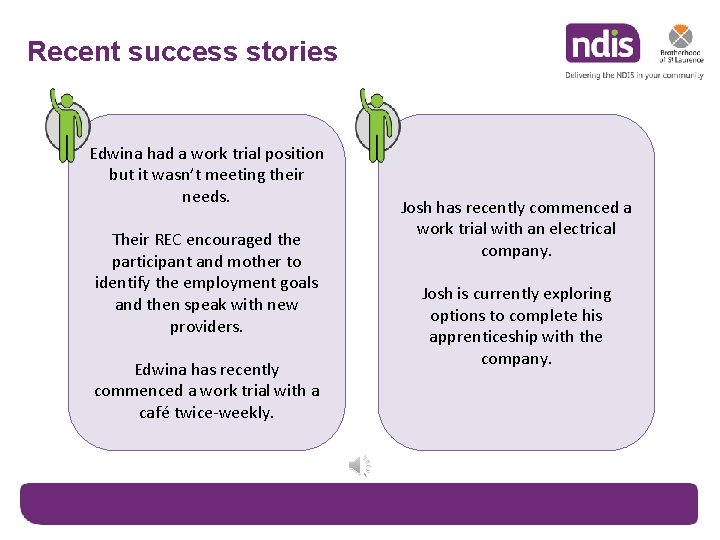
Recent success stories Edwina had a work trial position but it wasn’t meeting their needs. Their REC encouraged the participant and mother to identify the employment goals and then speak with new providers. Edwina has recently commenced a work trial with a café twice-weekly. Josh has recently commenced a work trial with an electrical company. Josh is currently exploring options to complete his apprenticeship with the company.
SLES preliminary results 2015 trial in ACT & Tasmania: • Up to 100 young people with SLES in their Plan • Importance of participant workshops to drive informed choice • A ripple effect – “everyone’s talking about employment” (Planners) • Increased market capacity (30%) • Partnership with education critical to success
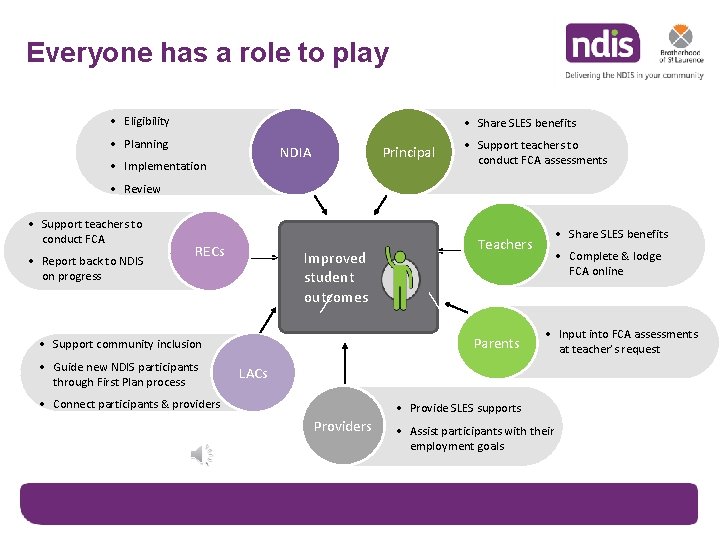
Everyone has a role to play • Eligibility • Share SLES benefits • Planning Principal NDIA • Implementation • Support teachers to conduct FCA assessments • Review • Support teachers to conduct FCA • Report back to NDIS on progress RECs Improved student outcomes Parents • Support community inclusion • Guide new NDIS participants through First Plan process • Share SLES benefits Teachers • Complete & lodge FCA online • Input into FCA assessments at teacher’s request LACs • Connect participants & providers • Provide SLES supports Providers • Assist participants with their employment goals
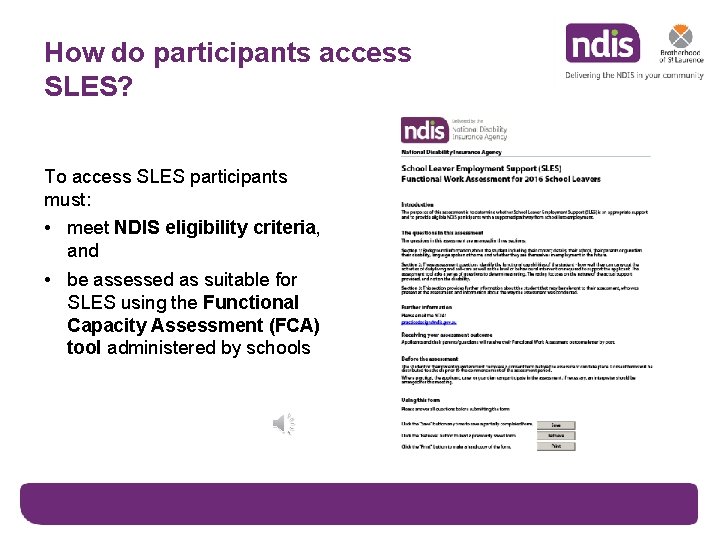
How do participants access SLES? To access SLES participants must: • meet NDIS eligibility criteria, and • be assessed as suitable for SLES using the Functional Capacity Assessment (FCA) tool administered by schools
The Functional Capacity Assessment
Functional Capacity Assessment tool and NDIS eligibility • The SLES Functional Capacity Assessment (FCA) is an assessment which NDIA uses to find out if a student with disability is likely to benefit from SLES. • The FCA does not have any impact or correlation with the students' eligibility for the NDIS. • Eligibility for the NDIS has a range of factors and anyone can test their eligibility for the Scheme at any time.
What does the Functional Capacity Assessment involve? • The FCA is administered by teachers • The FCA is a short and simple nine item tool to measure current & future work capacity • Developed, trialled, tested, validated (Prof Kathy Eagar, Uni of Wollongong) • Focuses on the student’s functional capacity in domains of living - what the student ‘can do’ • FCA input is provided by students, parents and guardians.
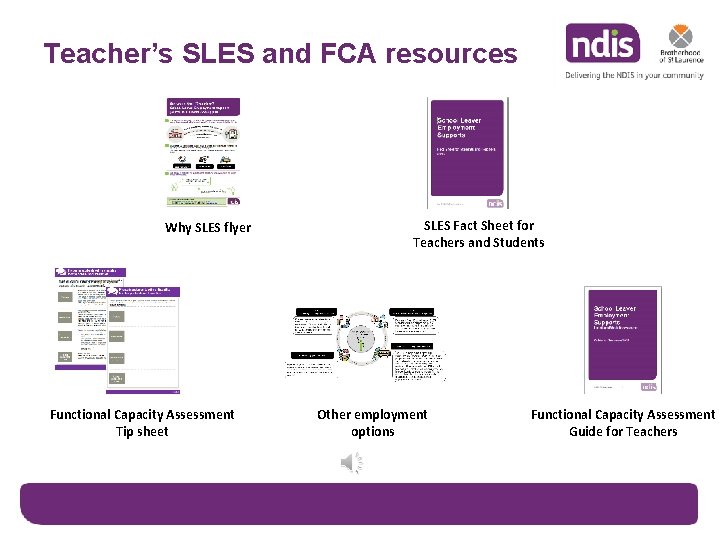
Teacher’s SLES and FCA resources Why SLES flyer Functional Capacity Assessment Tip sheet SLES Fact Sheet for Teachers and Students Other employment options Functional Capacity Assessment Guide for Teachers
Next steps
Next Steps –schools 17 th July – 22 nd August 2017: Teachers conduct the FCA November/ December 2017: NDIS pre-planning and hosts participant workshops to support informed choice.
SLES 2017 next steps • Conduct the assessments: 17 th July – 22 nd August • Access the package of resources: – – – – Why SLES – information flyer Fact sheet for teachers and students – general info FCA guide for teachers – about the Tool Information and Recording consent form – consent The NDIA Functional Capacity Assessment tool – the Tool FCA tip sheet – guide to use the Tool Other employment options – guidance https: //www. ndis. gov. au/people-disability/sles practicedesign@ndis. gov. au
Questions?