
Sleepless Nights Growing Waistbands Circadian Rhythm Metabolic Health
Sleepless Nights, Growing Waistbands: Circadian Rhythm & Metabolic Health Laura Andromalos, MS, RD, CDE Nutrition Program Manager Northwest Weight & Wellness Center Bilingual CDE Coach Cecelia Health MINNESOTA ACADEMY OF NUTRITION & DIETETICS 2019 ANNUAL MEETING APRIL 24 – 26, 2019

Disclosures Consultant: LEVL
Objectives At the conclusion of this session, participants will be able to: • Assess sleep patterns and promote improved sleep hygiene • Assist clients in reversing distorted meal timing patterns • Provide clients with diet modifications to minimize negative impacts of a shift work schedule
Agenda Sleep • Sleep cycle & circadian rhythm • Sleep adequacy • Effects of sleep deprivation • Promoting improved sleep health Meal Timing • Effects on health • Realistic modifications for traditional and non-traditional schedules

SLEEP 101
Sleep • Sleep is a state of unconsciousness when the brain is more responsive to internal than external stimuli • We (should) spend 25 -30% of our lives sleeping! Stevens 2015
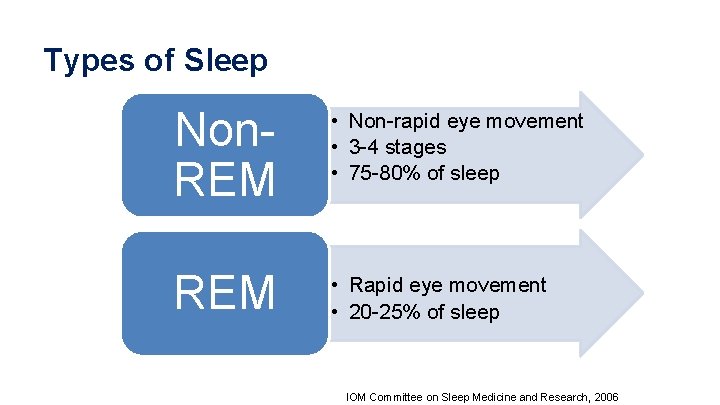
Types of Sleep Non. REM • Non-rapid eye movement • 3 -4 stages • 75 -80% of sleep REM • Rapid eye movement • 20 -25% of sleep IOM Committee on Sleep Medicine and Research, 2006
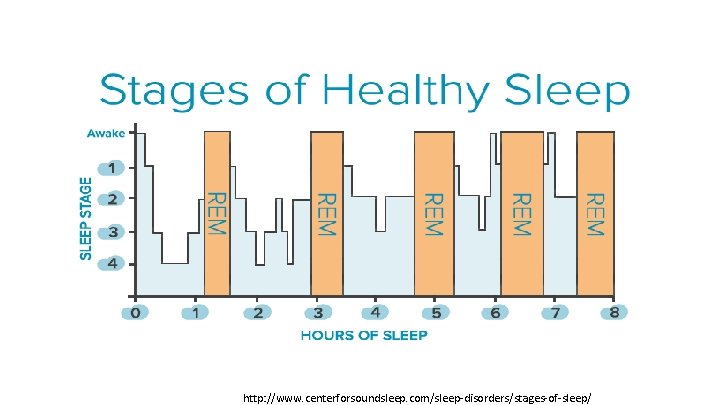
http: //www. centerforsoundsleep. com/sleep-disorders/stages-of-sleep/
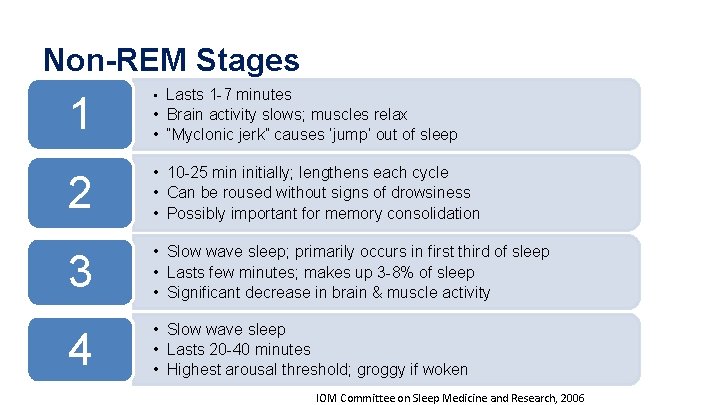
Non-REM Stages 1 • Lasts 1 -7 minutes 2 • 10 -25 min initially; lengthens each cycle • Can be roused without signs of drowsiness • Possibly important for memory consolidation 3 • Slow wave sleep; primarily occurs in first third of sleep • Lasts few minutes; makes up 3 -8% of sleep • Significant decrease in brain & muscle activity 4 • Slow wave sleep • Lasts 20 -40 minutes • Highest arousal threshold; groggy if woken • Brain activity slows; muscles relax • “Myclonic jerk” causes ‘jump’ out of sleep IOM Committee on Sleep Medicine and Research, 2006
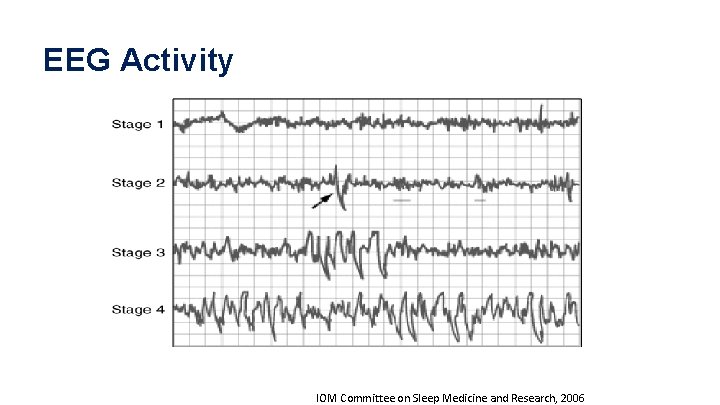
EEG Activity IOM Committee on Sleep Medicine and Research, 2006
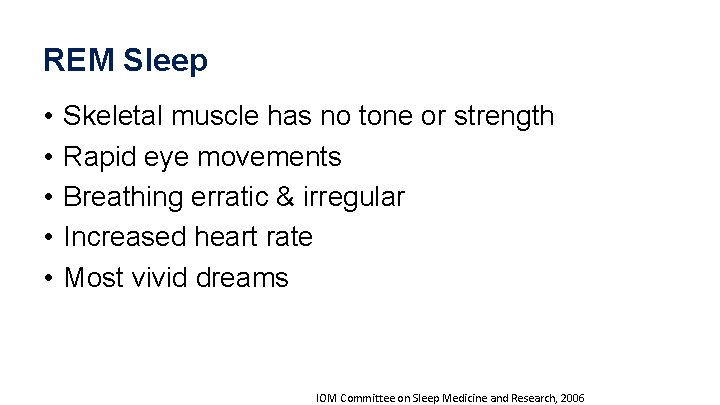
REM Sleep • • • Skeletal muscle has no tone or strength Rapid eye movements Breathing erratic & irregular Increased heart rate Most vivid dreams IOM Committee on Sleep Medicine and Research, 2006
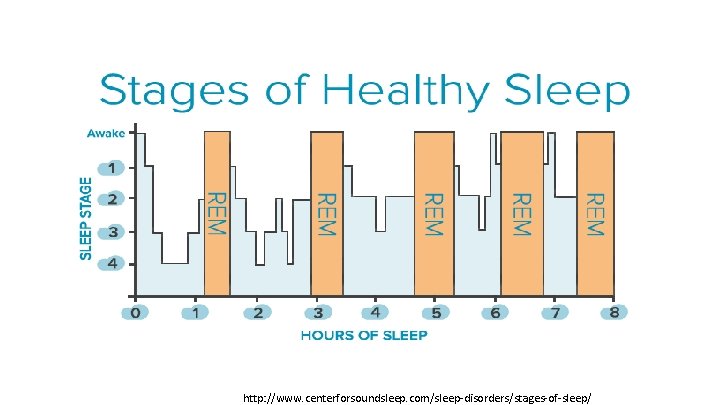
http: //www. centerforsoundsleep. com/sleep-disorders/stages-of-sleep/
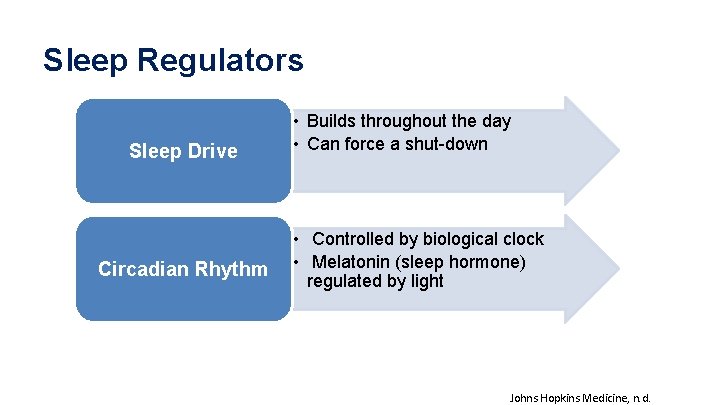
Sleep Regulators Sleep Drive Circadian Rhythm • Builds throughout the day • Can force a shut-down • Controlled by biological clock • Melatonin (sleep hormone) regulated by light Johns Hopkins Medicine, n. d.
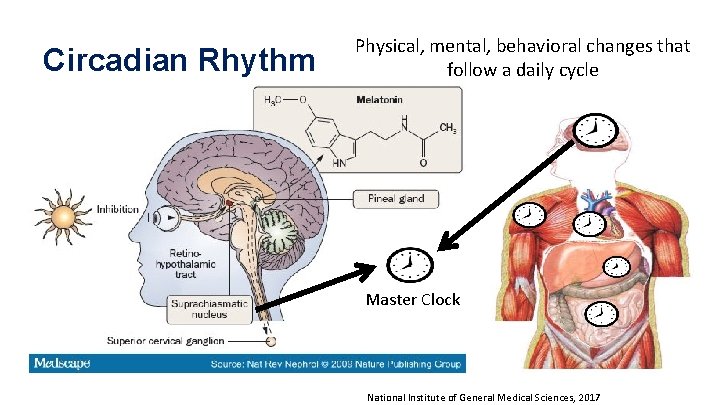
Circadian Rhythm Physical, mental, behavioral changes that follow a daily cycle Master Clock National Institute of General Medical Sciences, 2017

SLEEP ADEQUACY
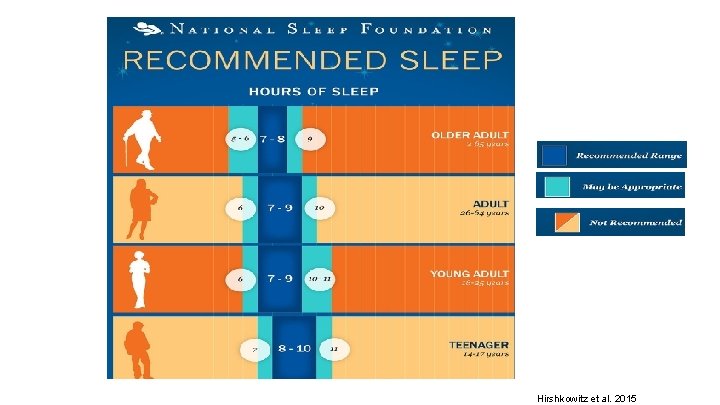
Hirshkowitz et al. 2015
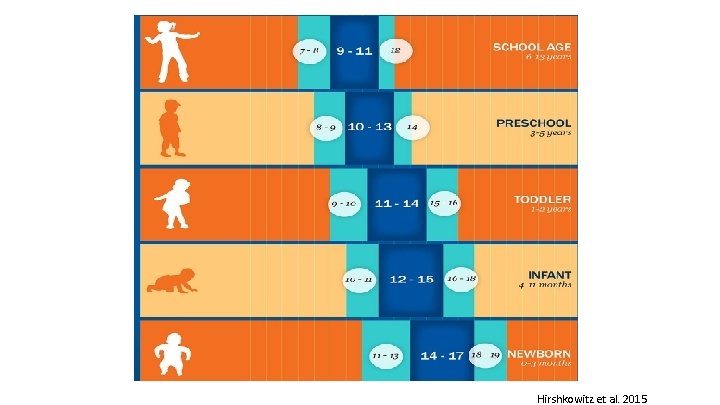
Hirshkowitz et al. 2015
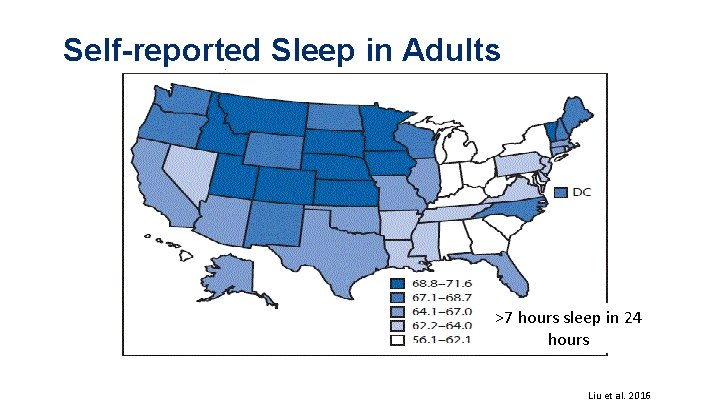
Self-reported Sleep in Adults >7 hours sleep in 24 hours Liu et al. 2016
Effects of Sleep Deprivation • • Physical health Mental health Quality of life Safety Sleep deprivation is a relative concept and often unrecognized by the individual experiencing sleep loss Stevens 2015
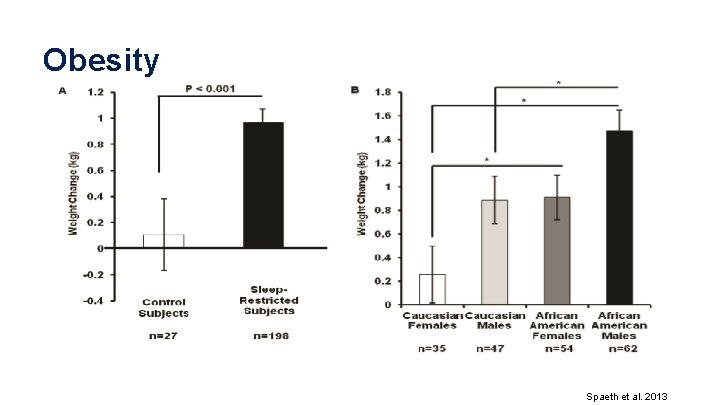
Obesity Spaeth et al. 2013
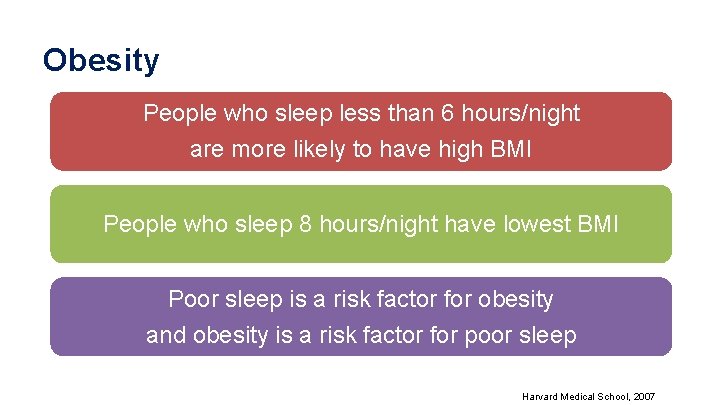
Obesity People who sleep less than 6 hours/night are more likely to have high BMI People who sleep 8 hours/night have lowest BMI Poor sleep is a risk factor for obesity and obesity is a risk factor for poor sleep Harvard Medical School, 2007
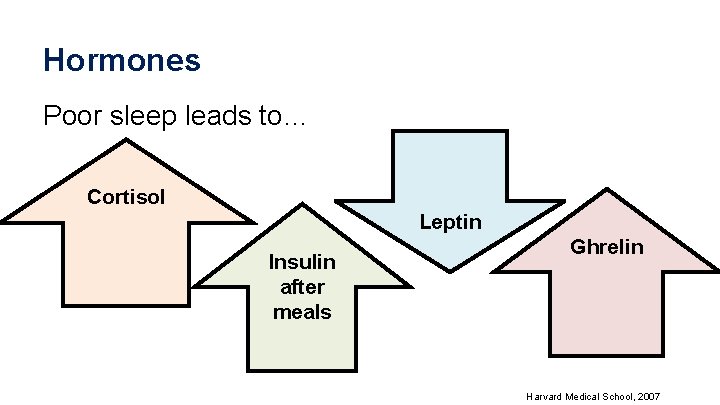
Hormones Poor sleep leads to… Cortisol Leptin Insulin after meals Ghrelin Harvard Medical School, 2007
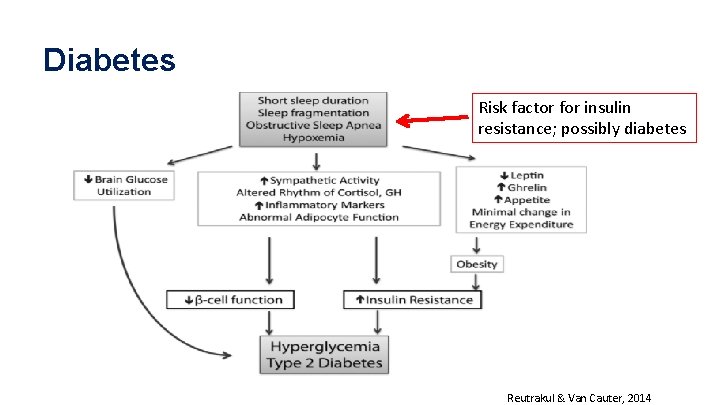
Diabetes Risk factor for insulin resistance; possibly diabetes Reutrakul & Van Cauter, 2014
Mental Health 50 to 80 percent of people living with typical psychiatric illnesses also report chronic sleep problems Which comes first? Chronotherapy is a possible treatment for mental health disorders. • Changing the time you go to sleep and wake up by a small amount of time each day • Studies have shown success in improving bipolar disorder Harvard Medical School, 2007; Wu et al. 2009
Safety Participants who slept for less than 6 hours/night for several weeks became slower at identifying visual information… but reported feeling little difference in sleepiness Sleep deficiency is associated with higher rates of musculoskeletal pain and functional limitations among health care workers 20% of pilots and train operators and 15% of truck drivers said lack of sleep had directly caused at least one serious incident or near miss in their careers Bukowski 2014
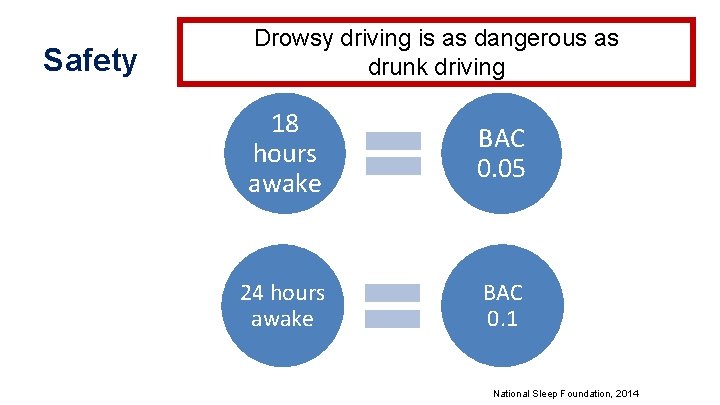
Safety Drowsy driving is as dangerous as drunk driving 18 hours awake BAC 0. 05 24 hours awake BAC 0. 1 National Sleep Foundation, 2014
Ask Your Patients… Do you feel sleepy when driving or in meetings? Are you experiencing sleep problems? Do you notice changes in your productivity, health, and happiness based on the number of hours you sleep? Do you depend on caffeine to get you through the day? National Sleep Foundation, 2018
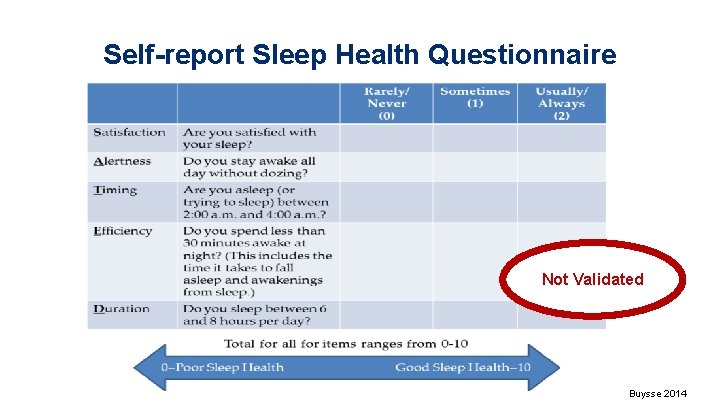
Self-report Sleep Health Questionnaire Not Validated Buysse 2014
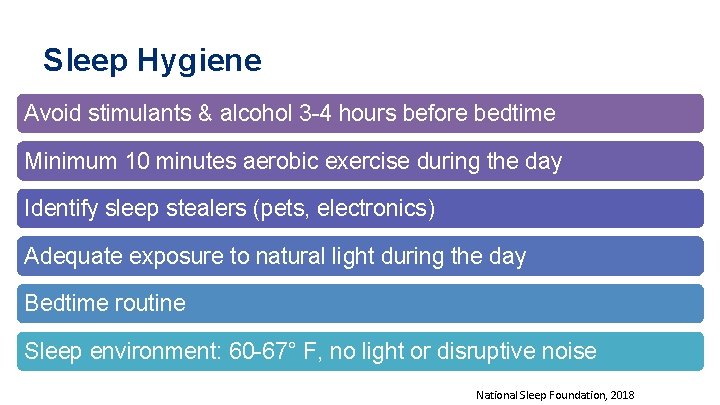
Sleep Hygiene Avoid stimulants & alcohol 3 -4 hours before bedtime Minimum 10 minutes aerobic exercise during the day Identify sleep stealers (pets, electronics) Adequate exposure to natural light during the day Bedtime routine Sleep environment: 60 -67° F, no light or disruptive noise National Sleep Foundation, 2018
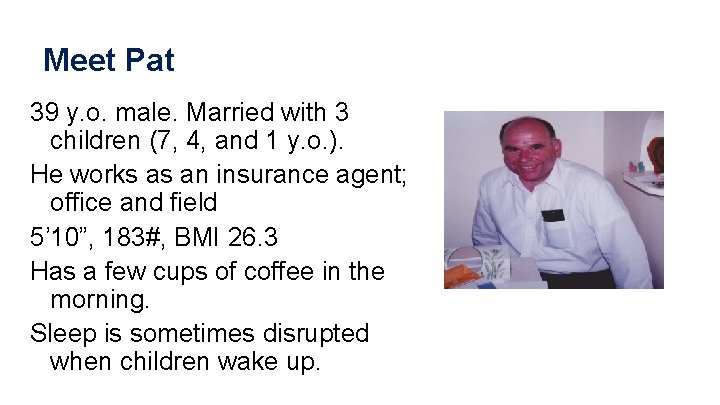
Meet Pat 39 y. o. male. Married with 3 children (7, 4, and 1 y. o. ). He works as an insurance agent; office and field 5’ 10”, 183#, BMI 26. 3 Has a few cups of coffee in the morning. Sleep is sometimes disrupted when children wake up.

Pat’s Room
When to Refer • Sleep apnea – STOP Bang • Insomnia – Unable to fall asleep or stay asleep • Acute: days or weeks; often from stress or traumatic event • Chronic: month or more • Restless leg syndrome – Irresistible urge to move – May be described as aching, throbbing, itching, crawling
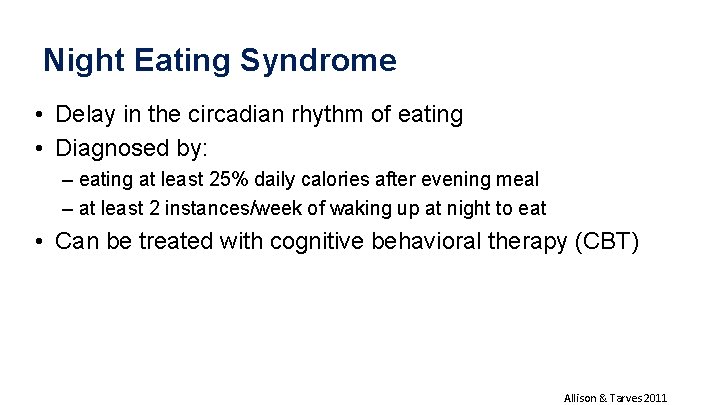
Night Eating Syndrome • Delay in the circadian rhythm of eating • Diagnosed by: – eating at least 25% daily calories after evening meal – at least 2 instances/week of waking up at night to eat • Can be treated with cognitive behavioral therapy (CBT) Allison & Tarves 2011
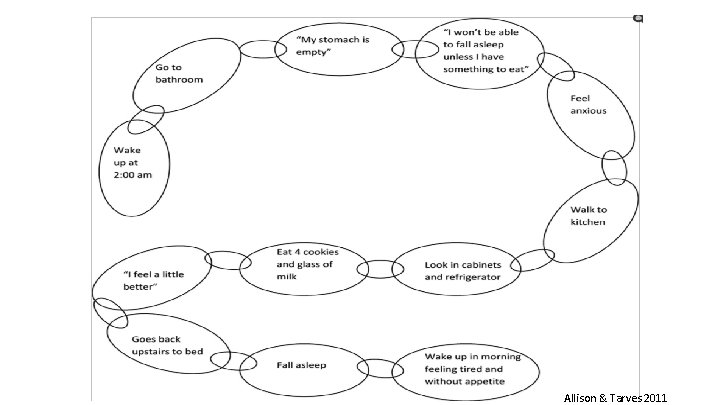
Allison & Tarves 2011

MEAL TIMING
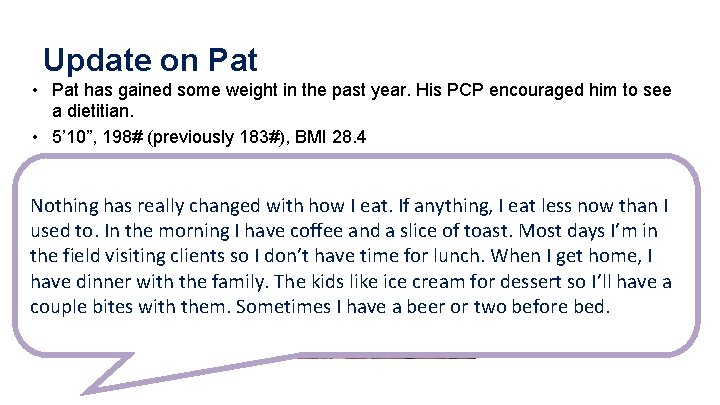
Update on Pat • Pat has gained some weight in the past year. His PCP encouraged him to see a dietitian. • 5’ 10”, 198# (previously 183#), BMI 28. 4 Nothing has really changed with how I eat. If anything, I eat less now than I used to. In the morning I have coffee and a slice of toast. Most days I’m in the field visiting clients so I don’t have time for lunch. When I get home, I have dinner with the family. The kids like ice cream for dessert so I’ll have a couple bites with them. Sometimes I have a beer or two before bed.
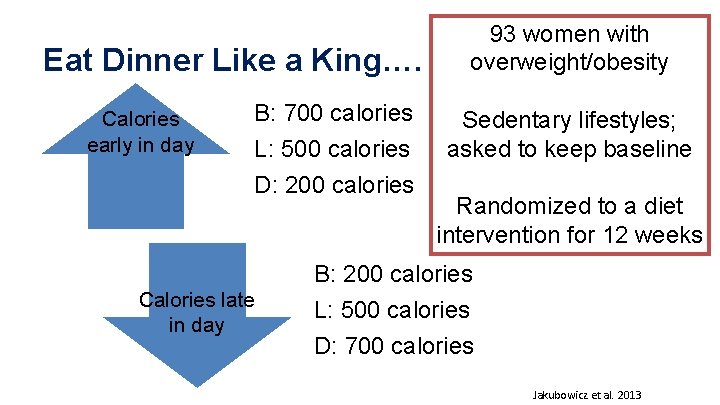
Eat Dinner Like a King…. Calories early in day B: 700 calories L: 500 calories D: 200 calories Calories late in day 93 women with overweight/obesity Sedentary lifestyles; asked to keep baseline Randomized to a diet intervention for 12 weeks B: 200 calories L: 500 calories D: 700 calories Jakubowicz et al. 2013
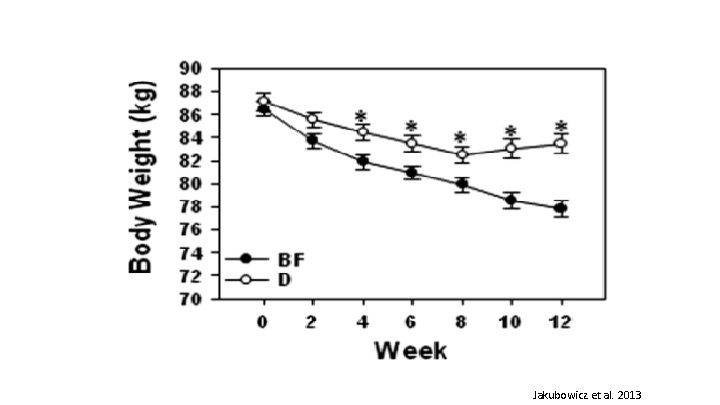
Jakubowicz et al. 2013
Intermittent Fasting • Alternate-day fasting alternates days of zero calories with days of unrestricted calories • Modified fasting allows 20 -25% of estimated caloric needs on fasting days and unrestricted intake on non-fasting days (5: 2 diet) • Time-restricting feeding requires a prolonged nighttime fast
IF versus Continuous Restriction 88 women randomized to 1 of 4 arms for 8 weeks: • IF 70, an IF diet at 70% energy needs (weekly) • IF 100, an IF diet at 100% energy needs (weekly) • DR 70, a continuous restriction at 70% energy needs (daily) • Control, 100% energy needs daily IF groups fasted for 24 hours after breakfast on 3 nonconsecutive days/week Hutchison et al 2018
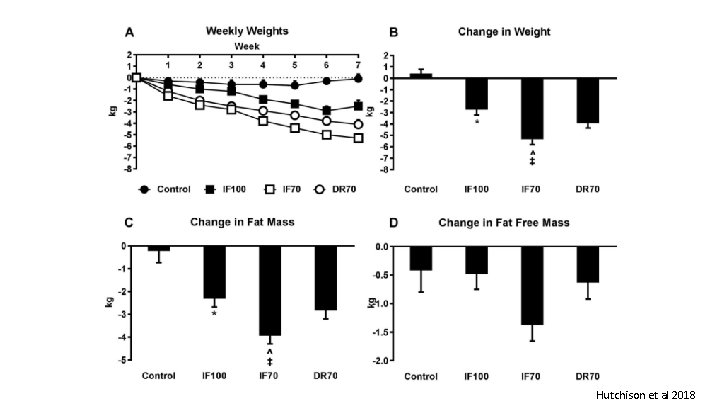
Hutchison et al 2018
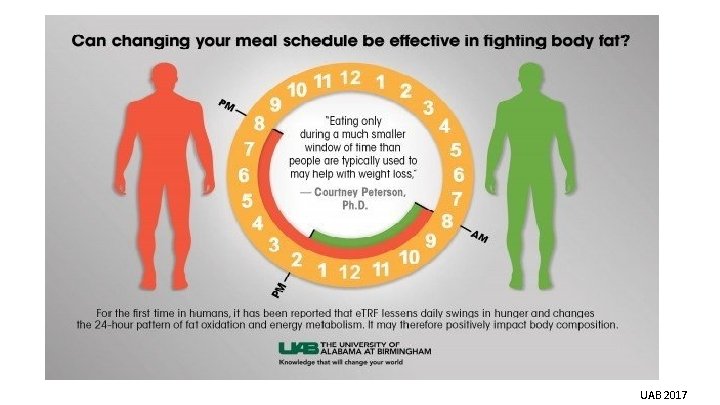
UAB 2017
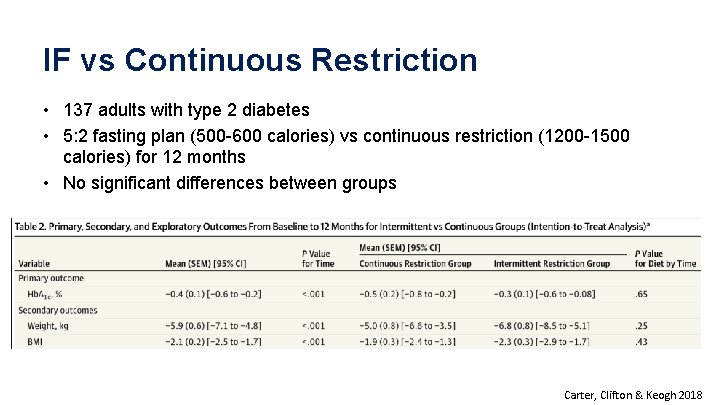
IF vs Continuous Restriction • 137 adults with type 2 diabetes • 5: 2 fasting plan (500 -600 calories) vs continuous restriction (1200 -1500 calories) for 12 months • No significant differences between groups Carter, Clifton & Keogh 2018
AHA Statement February 2017 Circulation St. -Onge et al. 2017
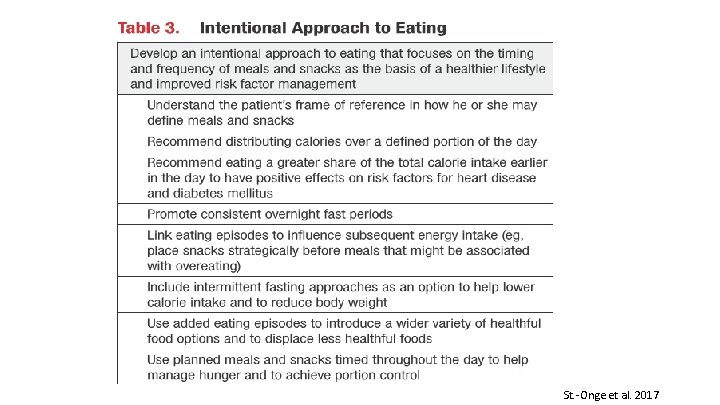
St. -Onge et al. 2017
Applying the Research While intermittent fasting is certainly a strategy that works for some, as with any diet, the question a person need ask to determine if it's right for them is, "could I enjoy living this way forever, " and if the answer's "no, " then intermittent fasting isn't going to be their panacea. Yoni Freedhoff, MD Bachert A, 2018

What Should We Tell Pat?
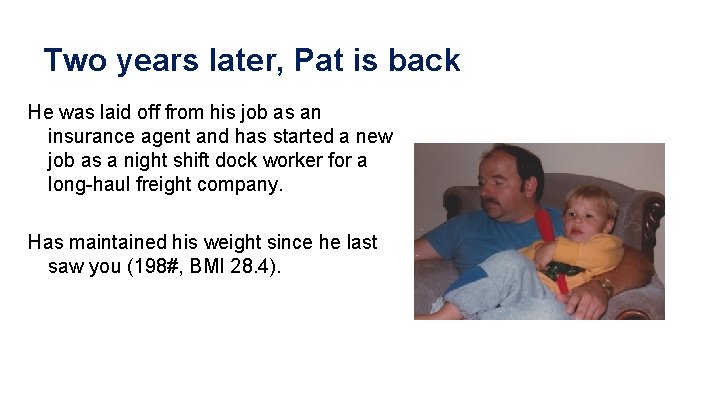
Two years later, Pat is back He was laid off from his job as an insurance agent and has started a new job as a night shift dock worker for a long-haul freight company. Has maintained his weight since he last saw you (198#, BMI 28. 4).

SHIFT WORK
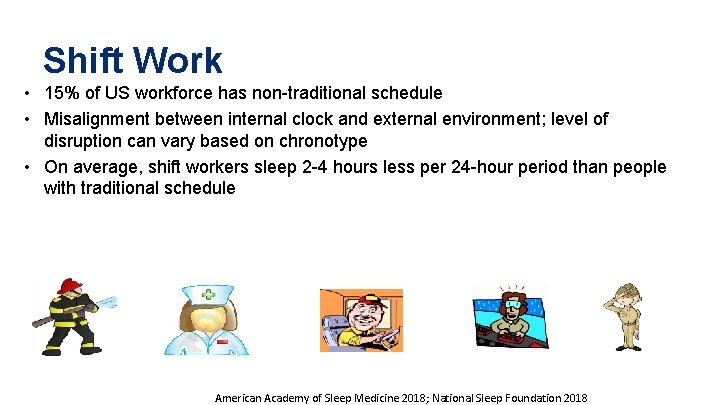
Shift Work • 15% of US workforce has non-traditional schedule • Misalignment between internal clock and external environment; level of disruption can vary based on chronotype • On average, shift workers sleep 2 -4 hours less per 24 -hour period than people with traditional schedule American Academy of Sleep Medicine 2018; National Sleep Foundation 2018
Shift Work Disorder 10% of shift workers have shift work disorder Symptoms: • Excessive sleepiness • Difficulty falling asleep or staying asleep • Lack of energy • Difficulty concentrating • Headaches • Poor mood & irritability Assessment Questions: • Have you had this workrelated sleep problem for at least one month? • Does this problem hurt your social, family or work life? American Academy of Sleep Medicine 2018; National Sleep Foundation 2018
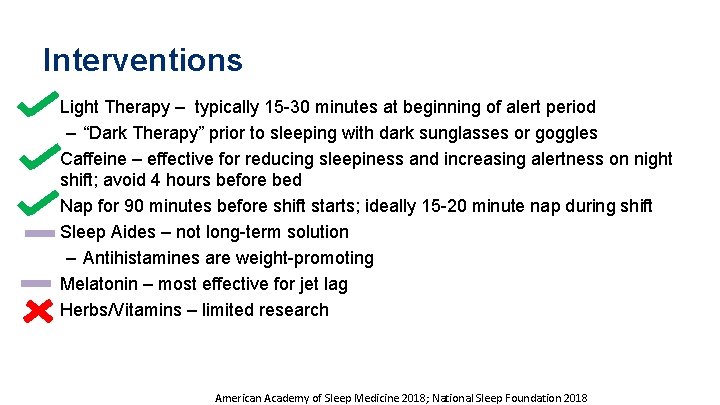
Interventions • Light Therapy – typically 15 -30 minutes at beginning of alert period – “Dark Therapy” prior to sleeping with dark sunglasses or goggles • Caffeine – effective for reducing sleepiness and increasing alertness on night shift; avoid 4 hours before bed • Nap for 90 minutes before shift starts; ideally 15 -20 minute nap during shift • Sleep Aides – not long-term solution – Antihistamines are weight-promoting • Melatonin – most effective for jet lag • Herbs/Vitamins – limited research American Academy of Sleep Medicine 2018; National Sleep Foundation 2018
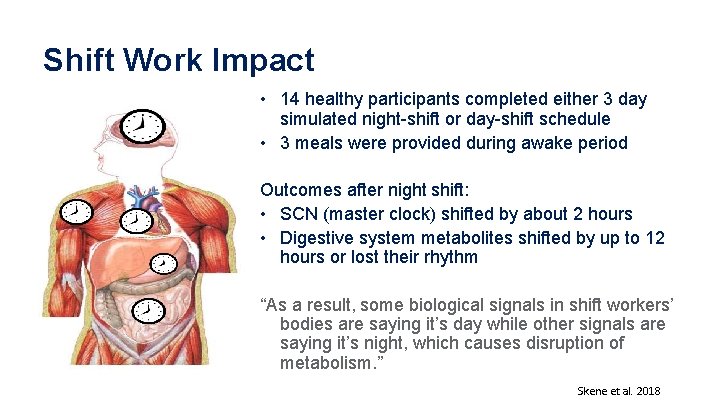
Shift Work Impact • 14 healthy participants completed either 3 day simulated night-shift or day-shift schedule • 3 meals were provided during awake period Outcomes after night shift: • SCN (master clock) shifted by about 2 hours • Digestive system metabolites shifted by up to 12 hours or lost their rhythm “As a result, some biological signals in shift workers’ bodies are saying it’s day while other signals are saying it’s night, which causes disruption of metabolism. ” Skene et al. 2018
Diet Interventions • Avoid largest meal within 3 hours of bedtime; ideally eat it before starting shift • Small, frequent meals vs 3 main meals? • Avoid refined sugar / quick carbs • Limit total caffeine to 400 mg • Meal prep is key! Digestive troubles reported in 20 -75% of shift workers versus 10 -25% of day workers Grant et al. 2017; American Academy of Sleep Medicine 2018; National Sleep Foundation 2018; Dietitians of Canada 2017
Let’s Help Pat 10: 20 pm – leaves for work 11 pm – work shift starts 2: 30 am - break 7: 30 am – work shift ends; drives home 8: 30 am – sleeps 1 pm – wakes up 3: 30 pm – kids get home 6 pm – family eats dinner
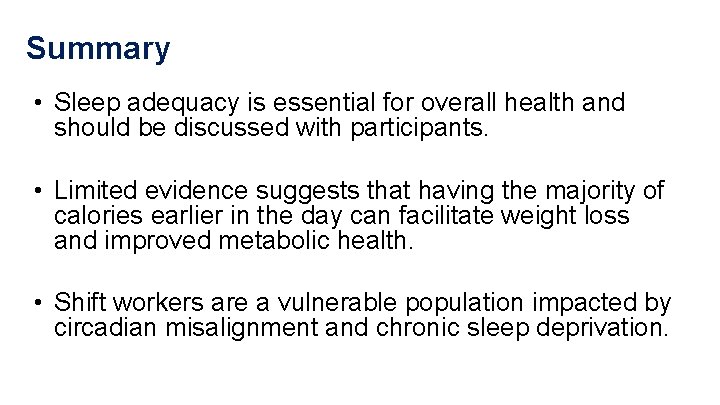
Summary • Sleep adequacy is essential for overall health and should be discussed with participants. • Limited evidence suggests that having the majority of calories earlier in the day can facilitate weight loss and improved metabolic health. • Shift workers are a vulnerable population impacted by circadian misalignment and chronic sleep deprivation.

Laura. Andromalos@gmail. com @Landromalos www. Laura. Andromalos. com
References • Allison KC and Tarves E. (2011). Treatment of Night Eating Syndrome. Psychiatr Clin North Am, 34(4): 785 -796. • American Academy of Sleep Medicine. Shift Work. 2018. Retrieved from http: //www. sleepeducation. org/essentials-in-sleep/shift-work • American Academy of Sleep Medicine. Social jet lag is associated with worse mood, poorer health and heart disease: Delaying your sleep schedule on weekends has health consequences. Science. Daily. 5 June 2017. Retrieved from www. sciencedaily. com/releases/2017/06/170605085326. htm • Bukowski TJ (2014). Sleepy and unsafe. Safety + Health. Retrieved from http: //www. safetyandhealthmagazine. com/articles/10412 -sleepy-and-unsafe-worker-fatigue • Bixler EO, Vgontzas AN, Lin HM, Calhoun SL, Vela-Bueno A, & Kales A. (2005). Excessive Daytime Sleepiness in a General Population Sample: The Role of Sleep Apnea, Age, Obesity, Diabetes, and Depression. The Journal of Clinical Endocrinology & Metabolism, 90(8): 4510– 4515 • Buysse DJ. Sleep Health: Can We Define It? Does It Matter? Sleep. 2014; 37(1): 9– 17.
References • Carter S, Clifton PM, and Keogh JB. Effect of Intermittent Compared With Continuous Energy Restricted Diet on Glycemic Control in Patients With Type 2 Diabetes A Randomized Noninferiority Trial. JAMA Netw Open. 2018; 1(3): e 180756. doi: 10. 1001/jamanetworkopen. 2018. 0756 • Dietitians of Canada. 10 Nutrition tips for shift workers. 2017, March 6. Retrieved from https: //www. dietitians. ca/Your-Health/Nutrition-A-Z/Healthy-Eating/10 -Nutrition-Tips-for -Shift-Workers. aspx • Division of Sleep Medicine at Harvard Medical School. (2007). Sleep and Disease Risk. Retrieved from http: //healthysleep. med. harvard. edu/healthy/matters/consequences/sleep-and-disease -risk • Drager LF, Togeiro SM, Polotsky VY, & Lorenzi-Filho G. (2013). Obstructive Sleep Apnea: A Cardiometabolic Risk in Obesity and the Metabolic Syndrome. J Am Coll Cardiol, 62(7): 569 -76.
References • Hutchison AT, Liu B, Wood RE, Vincent AD, Thompson CH, O’Callaghan NJ, Wittert G & Heilbronn LK. Effects of Intermittent Versus Continuous Energy Intakes on Insulin Sensitivity and Metabolic Risk in Women with Overweight. Obesity. 2018; 27(1). https: //doi. org/10. 1002/oby. 22345 • Institute of Medicine (US) Committee on Sleep Medicine and Research (2006). Sleep Physiology. In H. R. Colten & B. M. Altevogt (Eds), Sleep Disorders and Sleep Deprivation: An Unmet Public Health Problem. Washington (DC): National Academies Press (US). Available from: https: //www. ncbi. nlm. nih. gov/books/NBK 19956/ • Jakubowicz D, Barnea M, Wainstein J, and Froy O. (2013). High caloric intake at breakfast vs. dinner differentially influences weight loss of overweight and obese women. Obesity, 21(12): 2504 -2512 • Johns Hopkins Medicine. The science of sleep: Understanding what happens when you sleep (n. d. ). Healthy Sleep. Retrieved from https: //www. hopkinsmedicine. org/healthy-sleep/sleep-science/the-science-of-sleepunderstanding-what-happens-when-you-sleep
References • Liu Y, Wheaton AG, Chapman DP, Cunningham TJ, Lu H, Croft JB. Prevalence of Healthy Sleep Duration among Adults — United States, 2014. MMWR Morb Mortal Wkly Rep 2016; 65: 137– 141. DOI: http: //dx. doi. org/10. 15585/mmwr. mm 6506 a 1 • National Institute of General Medical Sciences. (2017). Circadian rhythms. Retrieved from https: //www. nigms. nih. gov/education/pages/Factsheet_Circadian. Rhythms. aspx • National Sleep Foundation. (2018). Drowsy driving vs. drunk driving: how similar are they? Retrieved from https: //sleepfoundation. org/sleep-topics/drowsy-driving-vs-drunkdriving-how-similar-are-they • National Sleep Foundation. (2018). How much sleep do we really need? Retrieved from https: //sleepfoundation. org/how-sleep-works/how-much-sleep-do-we-reallyneed/page/0/1 • National Sleep Foundation (2018). Sleep Hygiene. Retrieved from https: //sleepfoundation. org/sleep-topics/sleep-hygiene/page/0/1 • National Sleep Foundation (2018). What is shift work? Retrieved from https: //sleepfoundation. org/shift-work/content/what-shift-work
References • Reutrakul S and Van Cauter, E. (2014). Interactions between sleep, circadian function, and glucose metabolism: implications for risk and severity of diabetes. The Year in Diabetes and Obesity, 1311: 151 -173. • Romero-Corral A, Caples SM, Lopez-Jimenez F, and Somers VK. (2010) Interactions between obesity and obstructive sleep apnea: Implications for treatment. Chest, 137(3): 711719 • Spaeth AM, Dinges DF, and Goel N. (2013). Effects of experimental sleep restriction on weight gain, caloric intake, and meal timing in healthy adults. SLEEP, 36(7): 981 -990. • Stevens MS (2015) Normal sleep, sleep physiology, and sleep deprivation. Medscape. Retrieved 19 January, 2018 from https: //emedicine. medscape. com/article/1188226 overview#a 2 • Stoner L, Castro N, Signal L, Skidmore P, Faulkner J, Lark S, Williams MA, Muller D, and Harrex H. Childhood Obesity. January 2018, ahead of print. https: //doi. org/10. 1089/chi. 2017. 0272
References • St-Onge MP, Ard J, Baskin ML, Chiuve SE, Johnson HM, Kris-Etherton P, & Varady K. (2017). Meal Timing and Frequency: Implications for Cardiovascular Disease Prevention A Scientific Statement From the American Heart Association. Circulation, 135: e 96–e 121 • University of Alabama at Birmingham. (2017). Time-restricted feeding study shows promise in helping people shed body fat. Science. Daily. Retrieved from www. sciencedaily. com/releases/2017/01/170106113820. htm • Versteeg RI, Ackermans MT, Nederveen AJ, Fliers E, Serlie MJ & la Fleur SE. (2017). Meal timing effects on insulin sensitivity and intrahepatic triglycerides during weight loss. International Journal of Obesity. doi: 10. 1038/ijo. 2017. 199 • Wu JC, Kelsoe JR, Schachat C, Bunney BG, De. Modena A, Golshan S, Gillin JC, Potkin SG, and Bunney WE. (2009). Rapid and Sustained Antidepressant Response with Sleep Deprivation and Chronotherapy in Bipolar Disorder, Biological Psychology, 66(3): 298 -301
- Slides: 63