
Sleep Deprivation Has No Effect on Dynamic Visual
- Slides: 7
Sleep Deprivation Has No Effect on Dynamic Visual Acuity in Military Service Members Who Are Healthy by Matthew R. Scherer, Pedro J. Claro, and Kristin J. Heaton ptjournal Volume 93(9): 1185 -1196 August 29, 2013 © 2013 American Physical Therapy Association
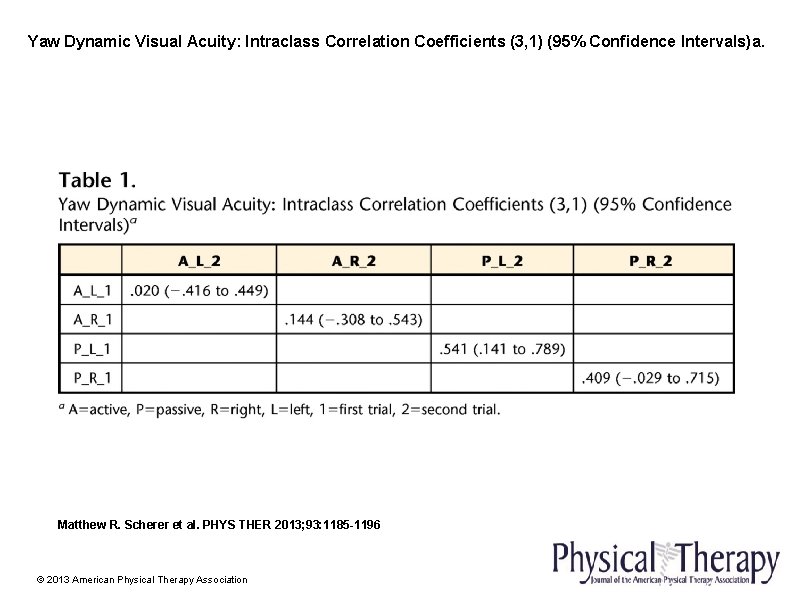
Yaw Dynamic Visual Acuity: Intraclass Correlation Coefficients (3, 1) (95% Confidence Intervals)a. Matthew R. Scherer et al. PHYS THER 2013; 93: 1185 -1196 © 2013 American Physical Therapy Association
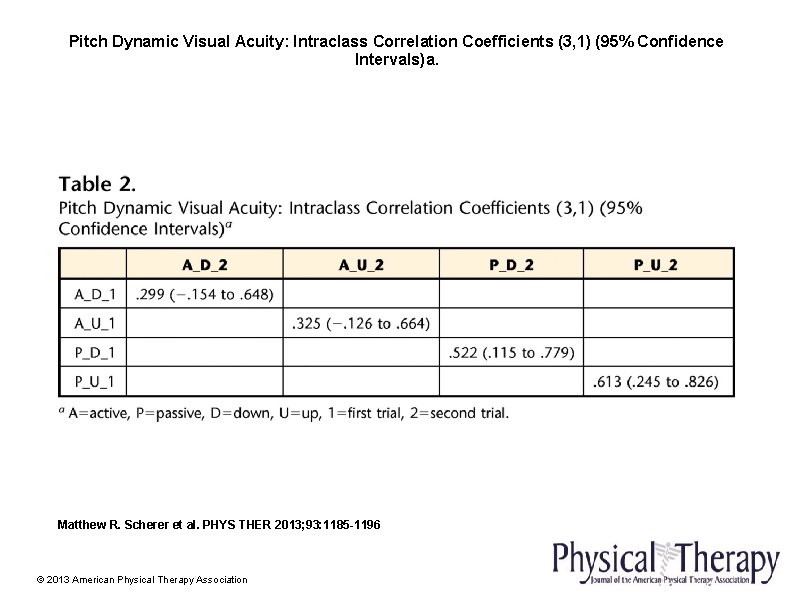
Pitch Dynamic Visual Acuity: Intraclass Correlation Coefficients (3, 1) (95% Confidence Intervals)a. Matthew R. Scherer et al. PHYS THER 2013; 93: 1185 -1196 © 2013 American Physical Therapy Association
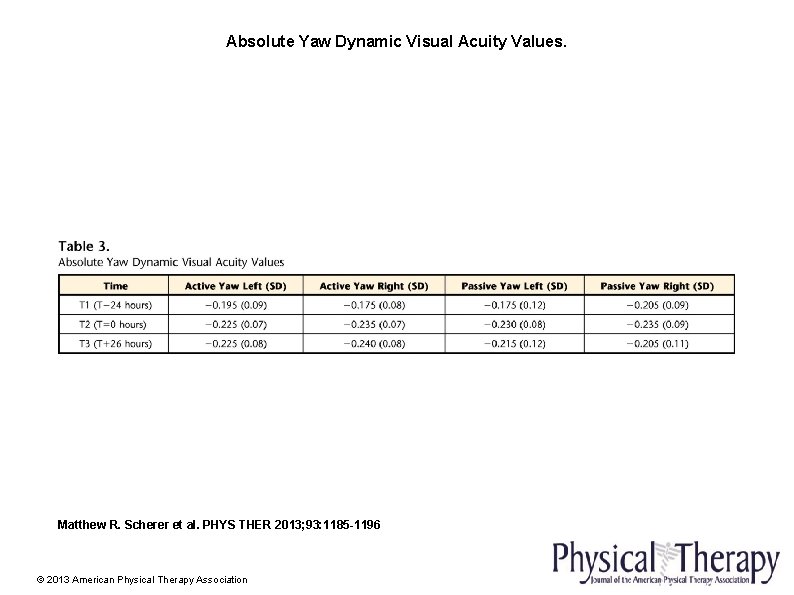
Absolute Yaw Dynamic Visual Acuity Values. Matthew R. Scherer et al. PHYS THER 2013; 93: 1185 -1196 © 2013 American Physical Therapy Association
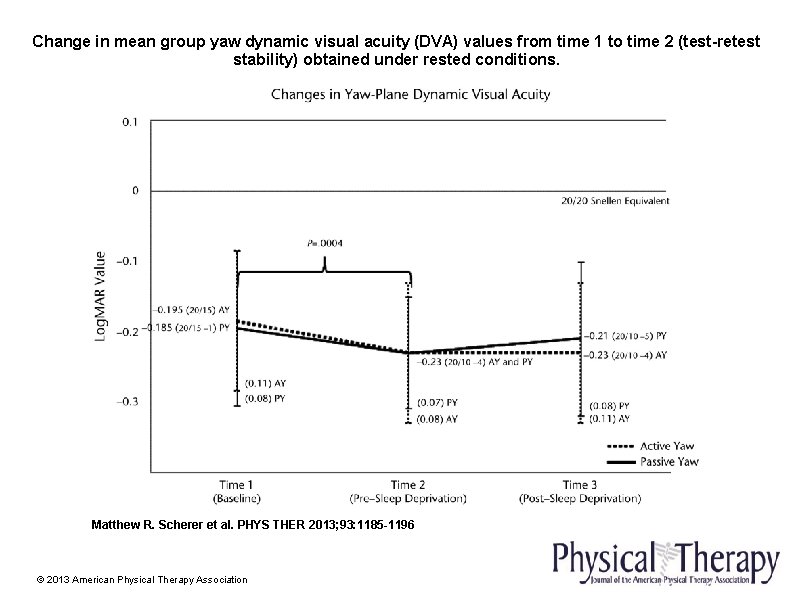
Change in mean group yaw dynamic visual acuity (DVA) values from time 1 to time 2 (test-retest stability) obtained under rested conditions. Matthew R. Scherer et al. PHYS THER 2013; 93: 1185 -1196 © 2013 American Physical Therapy Association
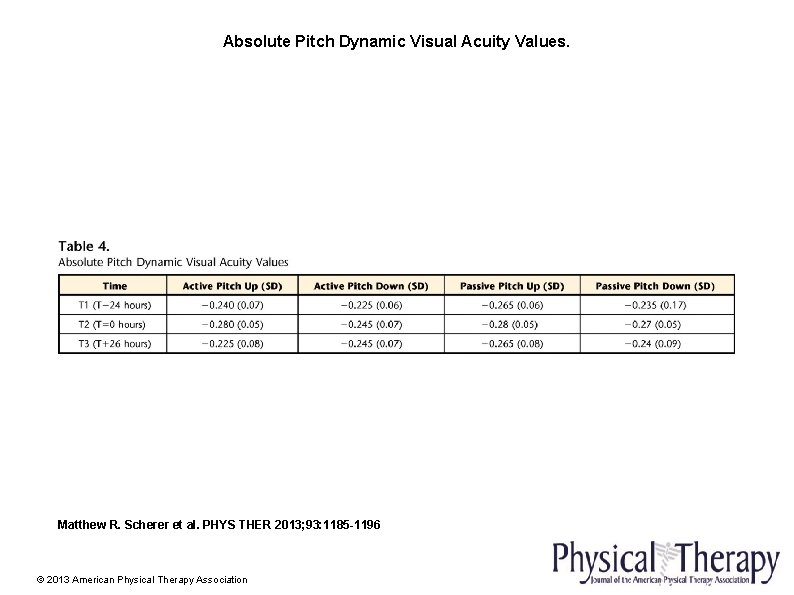
Absolute Pitch Dynamic Visual Acuity Values. Matthew R. Scherer et al. PHYS THER 2013; 93: 1185 -1196 © 2013 American Physical Therapy Association
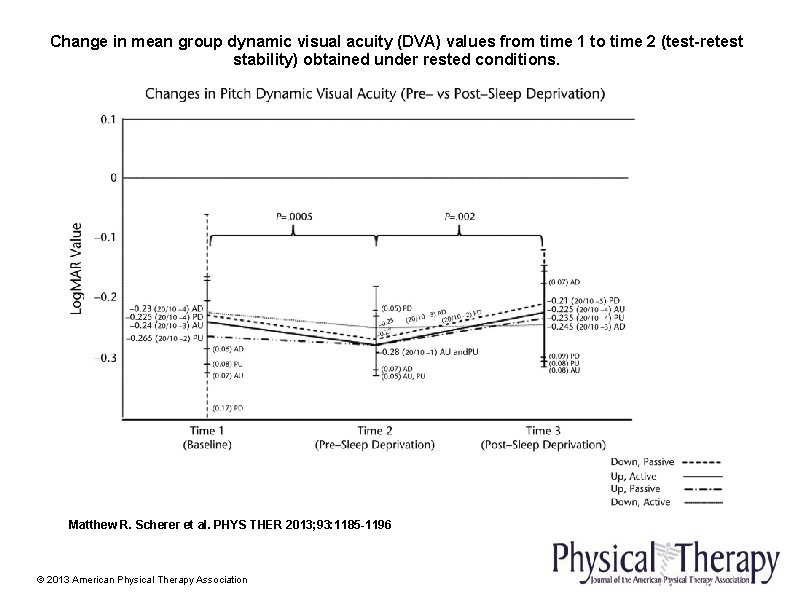
Change in mean group dynamic visual acuity (DVA) values from time 1 to time 2 (test-retest stability) obtained under rested conditions. Matthew R. Scherer et al. PHYS THER 2013; 93: 1185 -1196 © 2013 American Physical Therapy Association