
Sleep Deprivation Effects on Reaction Time By Phillip
Sleep Deprivation Effects on Reaction Time By: Phillip De. Renzo Grade 11 Pittsburgh Central Catholic High School
Introduction �Over 20% of adults suffer from some form of sleep deprivation. �Sleep deprivation and reaction time go hand in hand. �So, what effects does sleep deprivation have on reaction time of human senses? �Three senses were tested in this experiment: �Sight �Hearing �Touch
Sleep Deprivation • A shortage of the essential amount of sleep. • A situation where somebody does not get the required amount of sleep and it effects aspects of their life. • May result in blurred vision, drowsiness, dizziness, fainting, and slow reaction time.
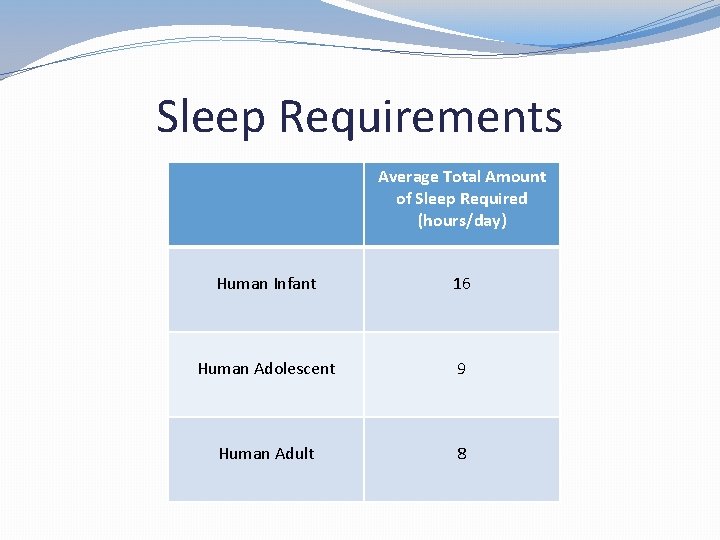
Sleep Requirements Average Total Amount of Sleep Required (hours/day) Human Infant 16 Human Adolescent 9 Human Adult 8

Background of Sleep Deprivation vs. Reaction Time �Studies show that those who lack enough sleep will see a significant effect on their physical and mental abilities. �Through studies, scientists have found that the reactions of someone who is significantly deprived of sleep are similar to the reactions of those who have consumed a considerable amount of alcohol.

Sleep Deprivation and the Brain �The thalamus (in the brain) is more highly activated when an individual is sleep deprive, but the thalamus is more highly activated during problematic tasks when in a state of rested wakefulness and not when deprived of sleep. �When the thalamus is highly activated, there’s a decrease in parietal, prefrontal, and cingulate cortex activation, which weakens visual awareness and performance. �Sleep deprivation causes lowered perceptual attentiveness, resulting in a lessening of auditory attention.
Purpose • To take scientific studies one step further and determine how sleep deprivation affects the individual reaction times of three senses: • Sight • Hearing • Touch • Also, at what point is one deprived enough of sleep to see an effect on the reaction time of their senses?
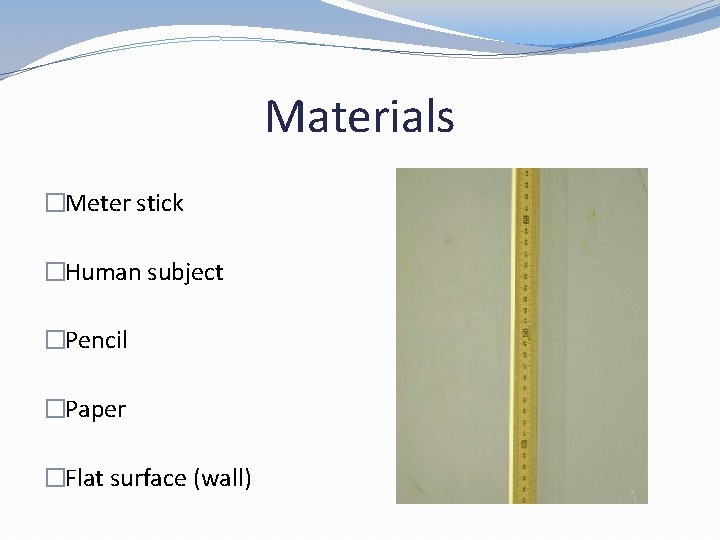
Materials �Meter stick �Human subject �Pencil �Paper �Flat surface (wall)
Hypotheses �Null Hypothesis : Sleep deprivation will not affect the reaction times of sight, hearing, or touch. �Alternate Hypothesis : Sleep deprivation will cause a decrease in the reaction times of sight, hearing, and touch.
Procedure 1. A meter stick was held against a wall. 2. The subject placed the bottom of his hand approximately 1 centimeter away from the meter stick directly at the 0 centimeter mark. 3. First, the subject’s reflex time for sight was tested. The meter stick was dropped while the subject’s eyes were open and he was to catch the falling meter stick as quickly as possible. 4. His reaction time was measured by the cm. mark where the bottom of his hand was located when he caught the stick. 5. Steps 1 – 4 were repeated 6 times.
Procedure (Continued) 6. Second, the subject’s reaction time for touch was tested. Steps 1 – 5 were repeated; however the meter stick was dropped while the subject had his eyes closed. At the exact time that the meter stick was dropped, the subject was touched on the shoulder, informing him that the stick was dropped. 7. Third, the subject’s reaction time for hearing was tested. Steps 1 – 5 were repeated; however the meter stick was dropped while the subject had his eyes closed. At the exact time that the meter stick was dropped, “NOW!” was yelled, informing the subject that the stick was dropped. 8. The results were written down and the data was analyzed for conclusions to be made.
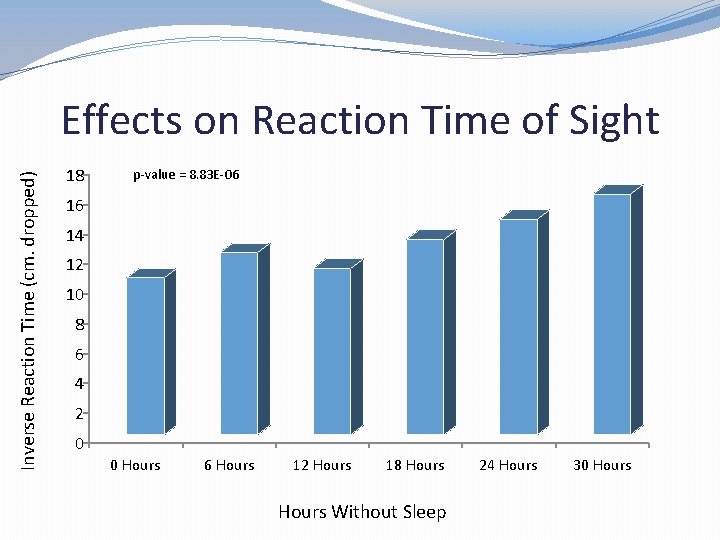
Inverse Reaction Time (cm. dropped) Effects on Reaction Time of Sight 18 p-value = 8. 83 E-06 16 14 12 10 8 6 4 2 0 0 Hours 6 Hours 12 Hours 18 Hours Without Sleep 24 Hours 30 Hours
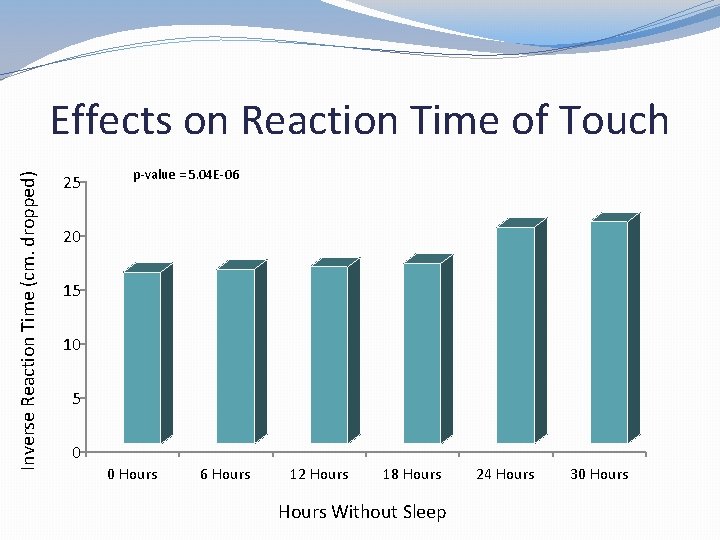
Inverse Reaction Time (cm. dropped) Effects on Reaction Time of Touch 25 p-value = 5. 04 E-06 20 15 10 5 0 0 Hours 6 Hours 12 Hours 18 Hours Without Sleep 24 Hours 30 Hours
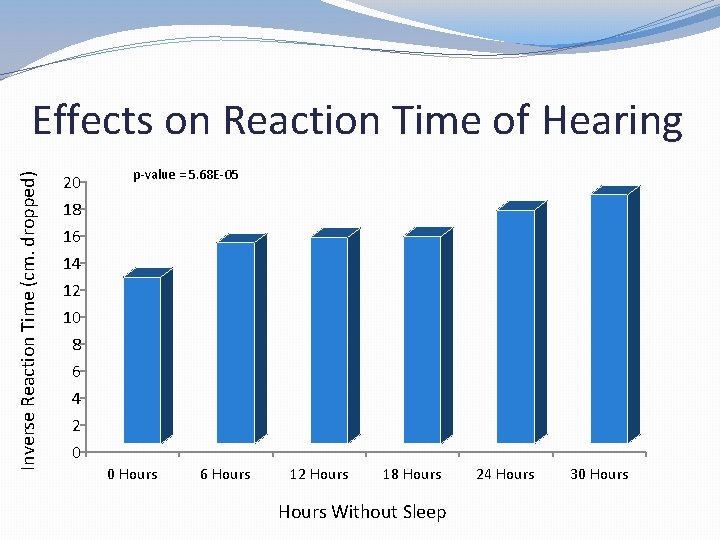
Inverse Reaction Time (cm. dropped) Effects on Reaction Time of Hearing 20 18 16 14 12 10 8 6 4 2 0 p-value = 5. 68 E-05 0 Hours 6 Hours 12 Hours 18 Hours Without Sleep 24 Hours 30 Hours
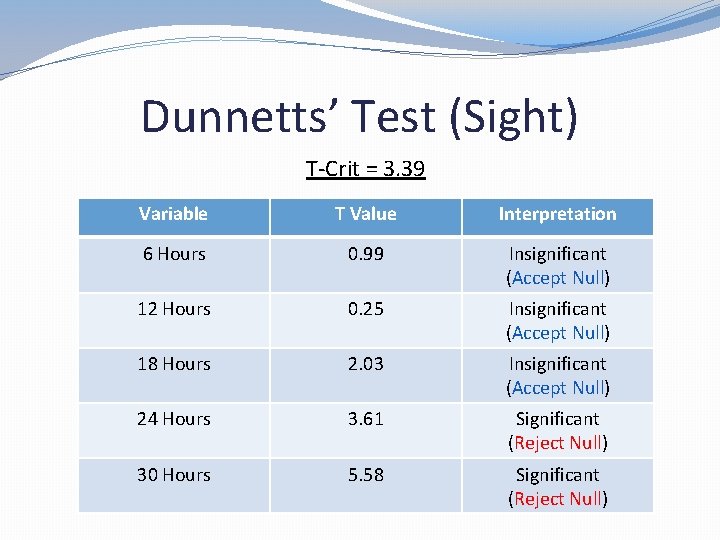
Dunnetts’ Test (Sight) T-Crit = 3. 39 Variable T Value Interpretation 6 Hours 0. 99 Insignificant (Accept Null) 12 Hours 0. 25 Insignificant (Accept Null) 18 Hours 2. 03 Insignificant (Accept Null) 24 Hours 3. 61 Significant (Reject Null) 30 Hours 5. 58 Significant (Reject Null)
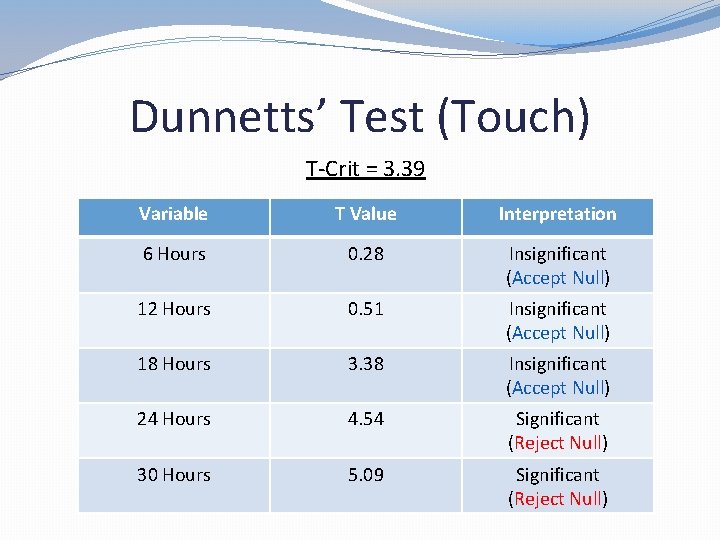
Dunnetts’ Test (Touch) T-Crit = 3. 39 Variable T Value Interpretation 6 Hours 0. 28 Insignificant (Accept Null) 12 Hours 0. 51 Insignificant (Accept Null) 18 Hours 3. 38 Insignificant (Accept Null) 24 Hours 4. 54 Significant (Reject Null) 30 Hours 5. 09 Significant (Reject Null)
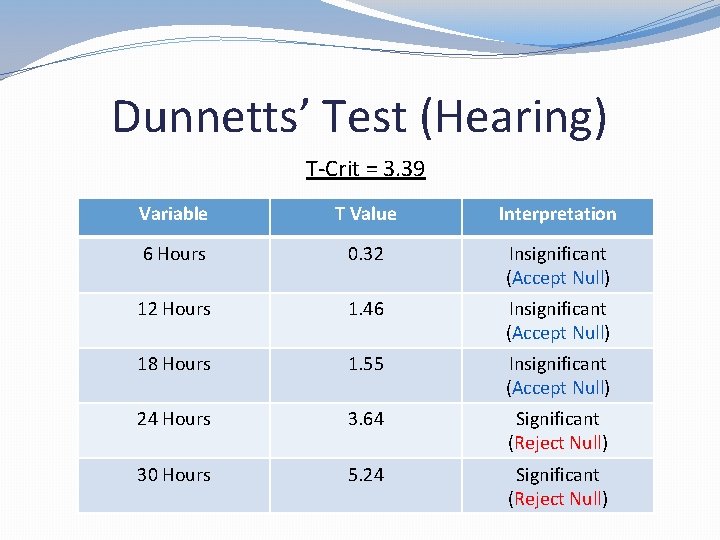
Dunnetts’ Test (Hearing) T-Crit = 3. 39 Variable T Value Interpretation 6 Hours 0. 32 Insignificant (Accept Null) 12 Hours 1. 46 Insignificant (Accept Null) 18 Hours 1. 55 Insignificant (Accept Null) 24 Hours 3. 64 Significant (Reject Null) 30 Hours 5. 24 Significant (Reject Null)
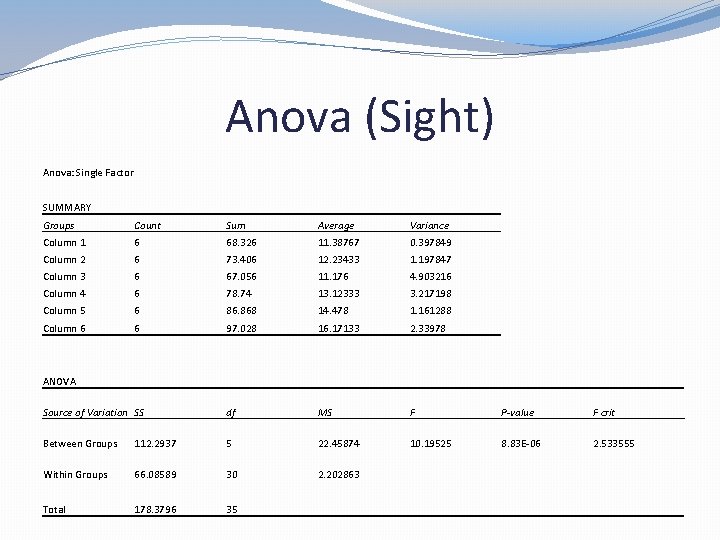
Anova (Sight) Anova: Single Factor SUMMARY Groups Count Sum Average Variance Column 1 6 68. 326 11. 38767 0. 397849 Column 2 6 73. 406 12. 23433 1. 197847 Column 3 6 67. 056 11. 176 4. 903216 Column 4 6 78. 74 13. 12333 3. 217198 Column 5 6 86. 868 14. 478 1. 161288 Column 6 6 97. 028 16. 17133 2. 33978 Source of Variation SS df MS F P-value F crit Between Groups 112. 2937 5 22. 45874 10. 19525 8. 83 E-06 2. 533555 Within Groups 66. 08589 30 2. 202863 Total 178. 3796 35 ANOVA
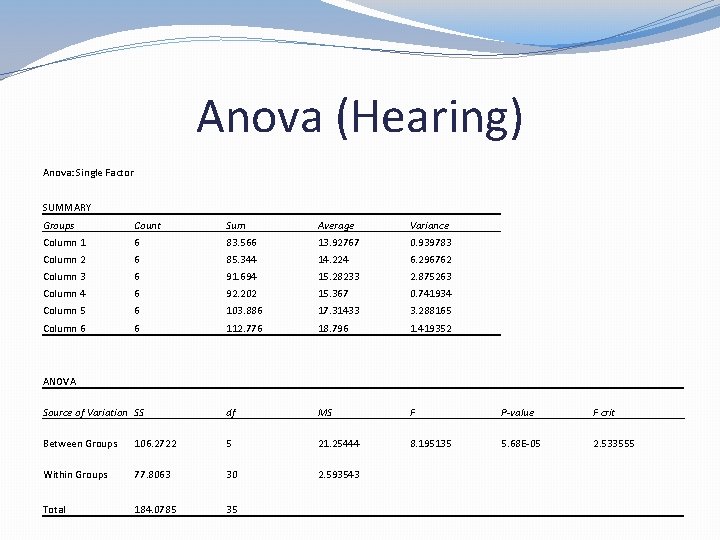
Anova (Hearing) Anova: Single Factor SUMMARY Groups Count Sum Average Variance Column 1 6 83. 566 13. 92767 0. 939783 Column 2 6 85. 344 14. 224 6. 296762 Column 3 6 91. 694 15. 28233 2. 875263 Column 4 6 92. 202 15. 367 0. 741934 Column 5 6 103. 886 17. 31433 3. 288165 Column 6 6 112. 776 18. 796 1. 419352 Source of Variation SS df MS F P-value F crit Between Groups 106. 2722 5 21. 25444 8. 195135 5. 68 E-05 2. 533555 Within Groups 77. 8063 30 2. 593543 Total 184. 0785 35 ANOVA
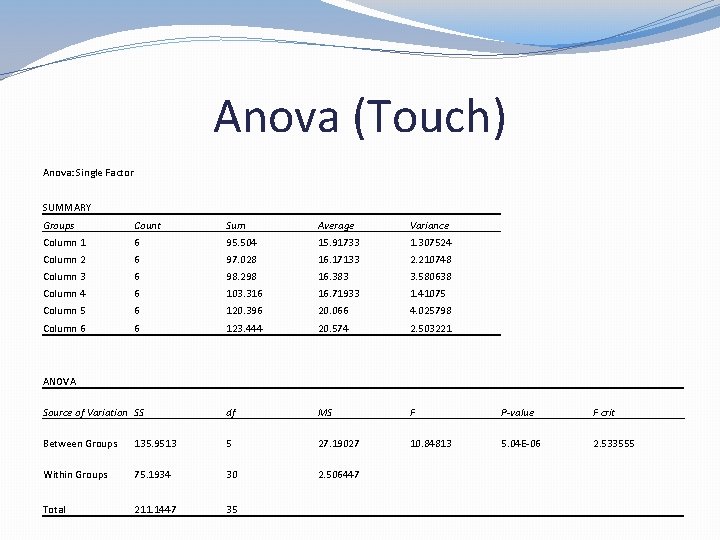
Anova (Touch) Anova: Single Factor SUMMARY Groups Count Sum Average Variance Column 1 6 95. 504 15. 91733 1. 307524 Column 2 6 97. 028 16. 17133 2. 210748 Column 3 6 98. 298 16. 383 3. 580638 Column 4 6 103. 316 16. 71933 1. 41075 Column 5 6 120. 396 20. 066 4. 025798 Column 6 6 123. 444 20. 574 2. 503221 Source of Variation SS df MS F P-value F crit Between Groups 135. 9513 5 27. 19027 10. 84813 5. 04 E-06 2. 533555 Within Groups 75. 1934 30 2. 506447 Total 211. 1447 35 ANOVA
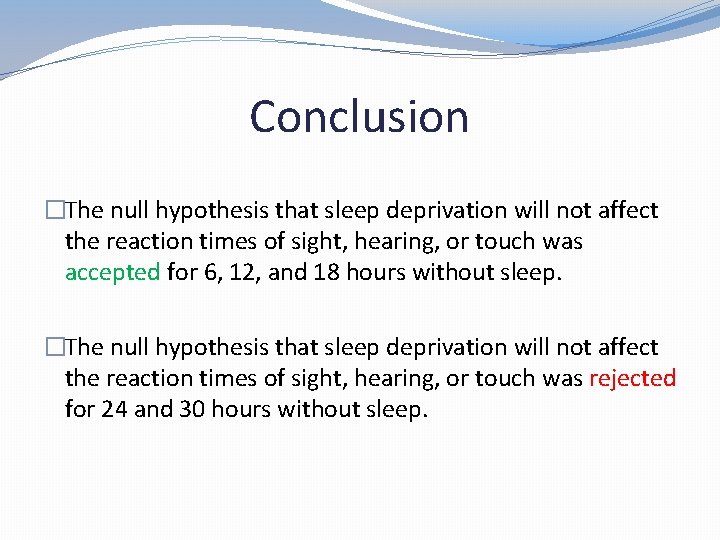
Conclusion �The null hypothesis that sleep deprivation will not affect the reaction times of sight, hearing, or touch was accepted for 6, 12, and 18 hours without sleep. �The null hypothesis that sleep deprivation will not affect the reaction times of sight, hearing, or touch was rejected for 24 and 30 hours without sleep.
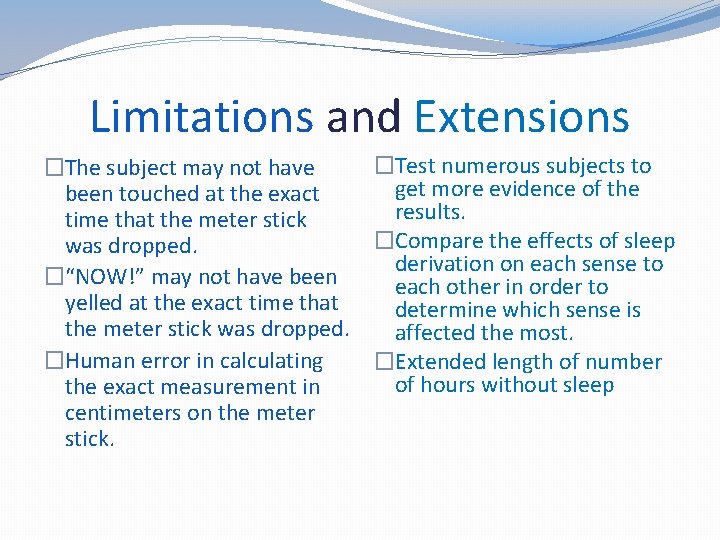
Limitations and Extensions �Test numerous subjects to �The subject may not have get more evidence of the been touched at the exact results. time that the meter stick �Compare the effects of sleep was dropped. derivation on each sense to �“NOW!” may not have been each other in order to yelled at the exact time that determine which sense is the meter stick was dropped. affected the most. �Human error in calculating �Extended length of number of hours without sleep the exact measurement in centimeters on the meter stick.
Sources �http: //www. squidoo. com/sleep-deprivation-and-reaction-time �http: //www. end-your-sleep-deprivation. com/effects-of-sleepdeprivation. html �http: //www. dana. org/news/brainhealth/detail. aspx? id=10064 �http: //naturalmoisturizers. org/articledirectory/? does-sleepdeprivation-effect-reaction-19 �http: //science. education. nih. gov/supplements/nih 3/sleep/guide/inf o-sleep. htm
- Slides: 23