
Sleep and Arousal Prof K Sivapalan Electroencephalogram It
- Slides: 14
Sleep and Arousal Prof. K. Sivapalan
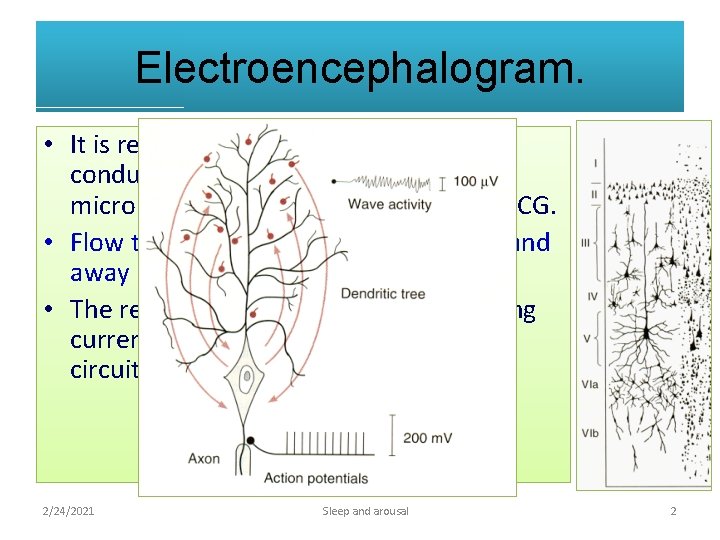
Electroencephalogram. • It is record of potentials in volume conductor as ECG. The changes are in micro volts as opposed to millivolts in ECG. • Flow towards the electrode is positive and away is negative. • The recorded waves represent oscillating currents within cortex and feed back circuits between thalamus and cortex. 2/24/2021 Sleep and arousal 2
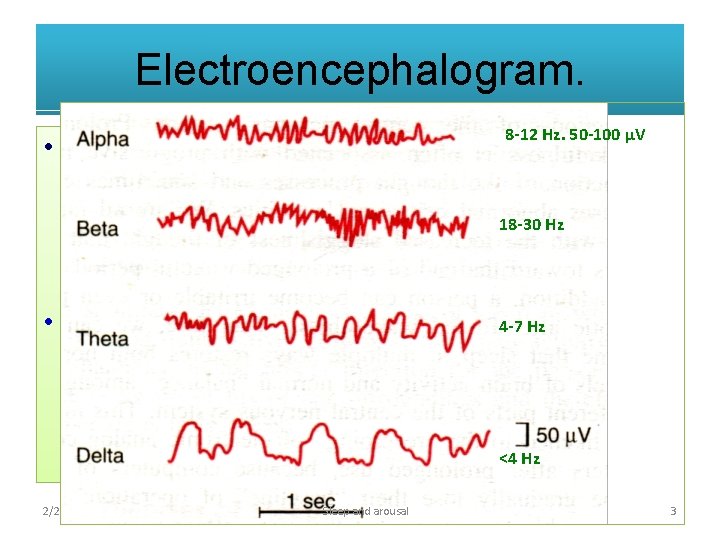
Electroencephalogram. • Record of variations in the brain potentials recorded with electrodes on the surface of the scalp. • Electrocorticogramelectrodes on the pial surface. 8 -12 Hz. 50 -100 μV 18 -30 Hz 4 -7 Hz <4 Hz 2/24/2021 Sleep and arousal 3
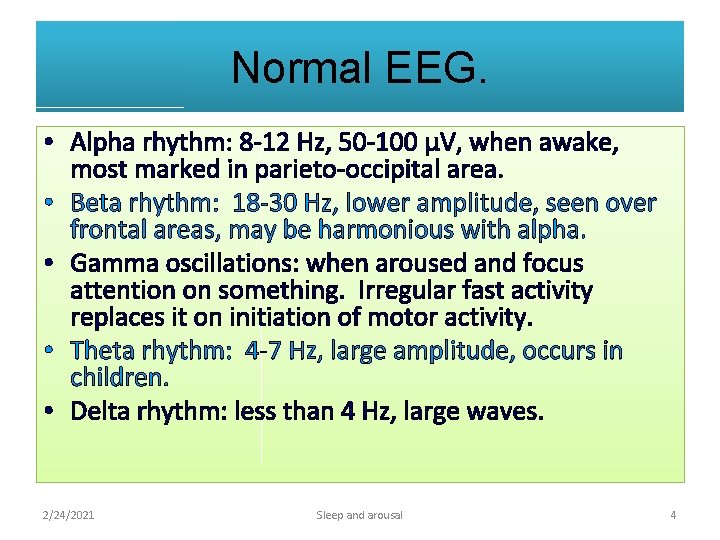
Normal EEG. • Alpha rhythm: 8 -12 Hz, 50 -100 μV, when awake, most marked in parieto-occipital area. • Beta rhythm: 18 -30 Hz, lower amplitude, seen over frontal areas, may be harmonious with alpha. • Gamma oscillations: when aroused and focus attention on something. Irregular fast activity replaces it on initiation of motor activity. • Theta rhythm: 4 -7 Hz, large amplitude, occurs in children. • Delta rhythm: less than 4 Hz, large waves. 2/24/2021 Sleep and arousal 4
Variations in EEG. • Age- – Beta like activity is seen in infants but the occipital rhythm is 0. 5 -2 Hz. – This speeds up in childhood to typical theta rhythm. – The adult alpha pattern appears gradually in adolescence. • Frequency of alpha rhythm is decreased by: ↓ blood glucose , ↓ body temperature, ↑ arterial PCO 2, ↓glucocorticoids. • Alpha block- [arousal] focusing the attention causes replacement of alpha waves by irregular low voltage waves. • Atypical pattern can be seen in epilepsy. 2/24/2021 Sleep and arousal 5
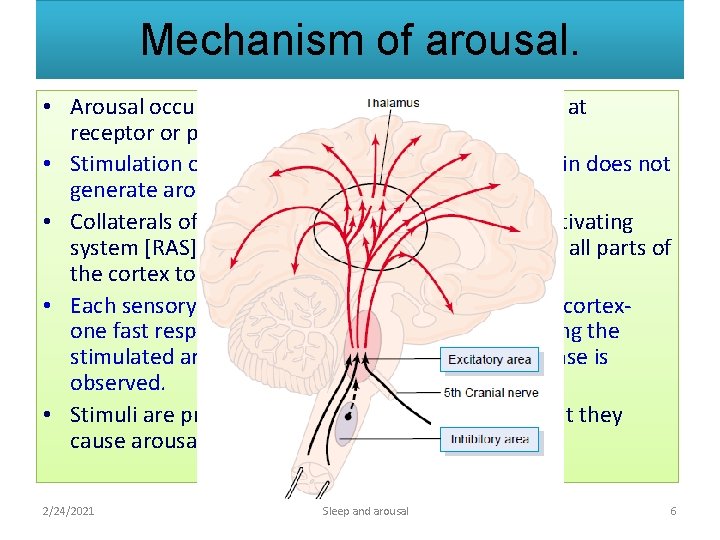
Mechanism of arousal. • Arousal occurs on stimulation of any sensory input at receptor or pathway up to midbrain. • Stimulation of the specific pathways above midbrain does not generate arousal. • Collaterals of all sensory input activate reticular activating system [RAS] in brain stem which sends impulse to all parts of the cortex to generate arousal. • Each sensory input produces two responses in the cortexone fast response in the sensory cortex representing the stimulated area only. Then a second diffuse response is observed. • Stimuli are processed in the cortex when awake but they cause arousal when in sleep. 2/24/2021 Sleep and arousal 6
Sleep. • Sleep is an active process controlled by certain centers in the brain. • Sleep has been investigated by EEG and other observations. • Dreams are associated with rapid eye movements and EEG changes. • Sleep is divided into REM and NREM sleep depending on the eye movements. 2/24/2021 Sleep and arousal 7
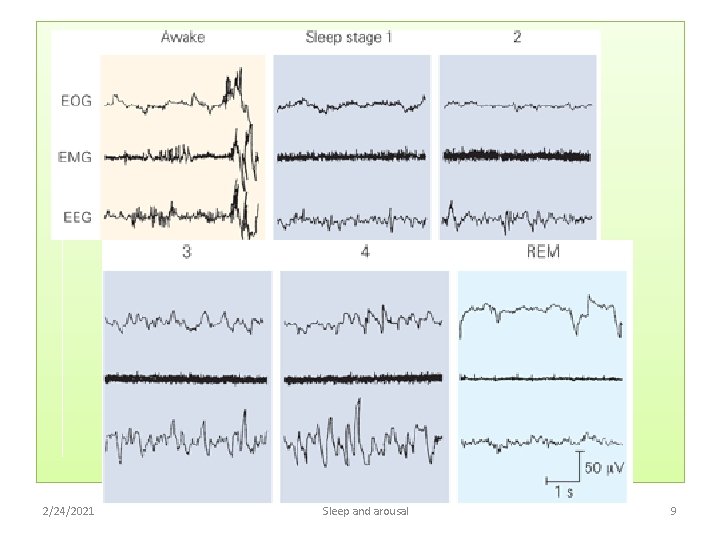
Sleep Paterns. • NREM [non rapid eye movement sleep] is divided into 4 stages. • Stage 1 - low amplitudehigh frwquency activity in EEG. • Stage 2 - appearance of ‘sleep spindles’ which are 10 -14 Hz, 50μV waves. [alpha like] • Stage 3 - lower frequency and increased amplitude. • Stage 4 - maximum slowing with large waves. • REM sleep [paradoxical sleep] - rapid low voltage activity resembling stage 1 but threshold for arousal is increased. • Marked reduction of tone of neck muscles and relative paralysis of skeletal muscles during REM sleep. • Locus cerulus [in the floor of the fourth ventricle] seems to be responsible for this paralysis. 2/24/2021 Sleep and arousal 8
2/24/2021 Sleep and arousal 9
Slow wave sleep. • The diencephalic sleep zone in posterior hypothalamus and related structures generate sleep if stimulated at 8 Hz. Faster stimuli produce arousal. • Medullary synchronizing zone in the reticular formation of medulla also same. • Basal forebrain sleep zone in preoptic area and diagonal band of Borca produces sleep by slow or high frequency stimuli. • Stimulation of mechano receptors at 10 Hz in animals and regularly repeated monotonous stimuli in humans produce sleep. • Suprachaiasmatic nuclei of hypothalamus regulate circadian sleep pattern. • Reduction in vascular tone, blood pressure, respiratory rate and metabolic rate. 2/24/2021 Sleep and arousal 10
REM Sleep. • Associated with dreaming. • There is catching up after deprivation. • Activity is increased in pontine area, amygdala, anterior cingulate gyrus and visual association areas. • Activity is decreased in prefrontal, parietal, and primary visual cortices • The mechanism that triggers REM sleep is in the pontine reticular formation. • Reduced muscle tone, irregular heart beat and respiration. 2/24/2021 Sleep and arousal 11
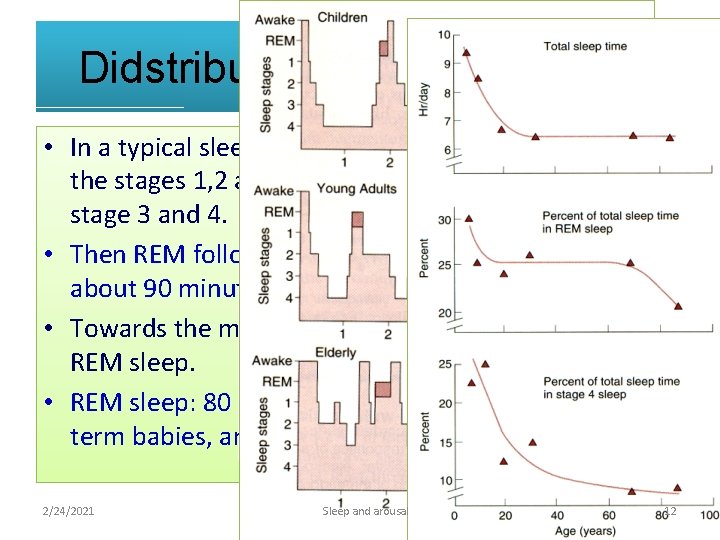
Didstribution of sleep stages. • In a typical sleep, the person passes through the stages 1, 2 and spends about 100 minutes in stage 3 and 4. • Then REM follows and the cycle is repeated in about 90 minute intervals. • Towards the morning, less stage 3, 4 and more REM sleep. • REM sleep: 80 % for preterm babies, 50 % for term babies, and 25 % in old age. 2/24/2021 Sleep and arousal 12
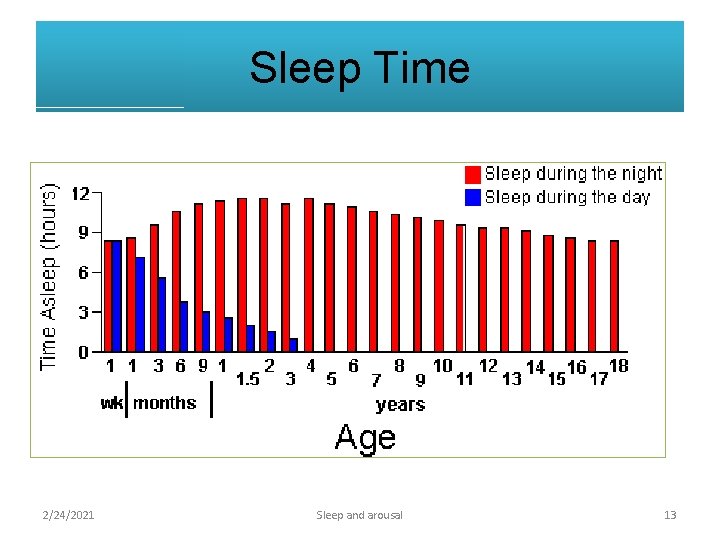
Sleep Time 2/24/2021 Sleep and arousal 13
Sleep disorders. • Insomnia- mental and medical conditions can cause this. • Somnambulism- sleep walking-occurs during awaking from stage 4. common in children, males. • Sleep apnoea- obstruction of airway in inspiration due to relaxation of muscles • Narcolepsy- sleep attack during day- REM while awake- last several seconds to 30 minutes 2/24/2021 Sleep and arousal 14