
SLC Promoting Positive Relationships and Understanding Distressed Behaviour
SLC Promoting Positive Relationships and Understanding Distressed Behaviour (PPRUDB) in our schools. For Parent Councils

SLC Ethos in schools • Inclusion means we have much more complex pupils in our classes and we must try to understand, accept and meet needs. • We are a council that promotes diversity and our vision is to have all pupils, parents, staff and partners aiming to understand that some pupils communicate through distressed behaviour. • We should see behaviour as communication that we should seek to understand the reasons for. • Behaviour Management is built on good relationships.

Overarching messages: Distress- not a challenge!. . . • The guidelines for PPRUDB promote an ethos of understanding and meeting needs. • If we see behaviour as a pupil in distress, we try to understand what they are communicating and try to help. • We want to move away from the perceptions the distressed pupil is ‘a challenge’.

Behaviour Management in the classroom is about the relationship… • • Make sure you are aware of the needs of the child. Understand what they really mean when they act a certain way and why. Don’t allow others to resolve a crisis you are a part of- if you resolve it, try to understand find a resolution- a relationship from mutual respect will form. Do not hand your respect over to another adult. Find out what they value, what they are good at and what they are interested in and use this to enhance your relationship. Equality is key- it is not a power struggle, it is about finding a way forward together. Kids are people too!! Catch them being good and build confidence, even if something very small. Allow them to be safe and be true to your word-always. Understand that we are leading by example by showing our pupils that there all different types of people, with different needs who have equal rights but need more help and understanding than others to manage.

There is no such thing as a bad child!! Understanding the reasons: Why might I behave this way? What am I communicating? • • • Trauma or Insecure Attachment effects- affects brain development and neural pathwaysbehaviour may not be a choice. If a person cannot decipher their own emotions or is too anxious to think rationally, they may need to feel in control and become distressed. Learning Needs/Interrupted Learning- If a child has learning needs they may try to avoid embarrassment and frustration by displaying distressed behaviour to communicate this to you. ASD- Social communication needs- may communicate easier through behaviour- may not recognise facial expressions, tones and cannot articulate needs verbally- will communicate this distress through behaviour. ADHD- child may be struggling with an incapacity to self regulate impulsivity- will communicate this through distressed behaviour. ASD with Extreme Demand Avoidance or Demand Avoidant behaviours: High anxiety, need for control and limited or no capacity to behave another way. Can manifest itself in distressed behaviour and will be communicated this way. Emotional and Social Needs: High anxiety, need for control and limited understanding of self for any of the reasons above can manifest itself in distressed behaviour and will be communicated this way.
Duty of Care in SLC… Council position: It is only acceptable to physically intervene with a child or young person where the member of staff reasonably believes in all the circumstances that if he/she does not physically intervene with the child/young person, the child/young person’s actions are likely to cause physical damage or harm to that child or young person or another person.
Support for Schools • All ASN Staff from bases and standalone schools will be trained in de-escalation through MAPA/Pivotal. • All mainstream schools can apply to have this training as part of their training for the year. • Inclusive Education Service will support day to day.
Recording Physical Interventions and Seclusion • The Scottish Government have advised we record all instances of Physical Interventionwhen exercising your duty of care to keep folk safe. • All instances of Seclusion must be recorded. • All instances of PI and Seclusion must be fed back to parent.
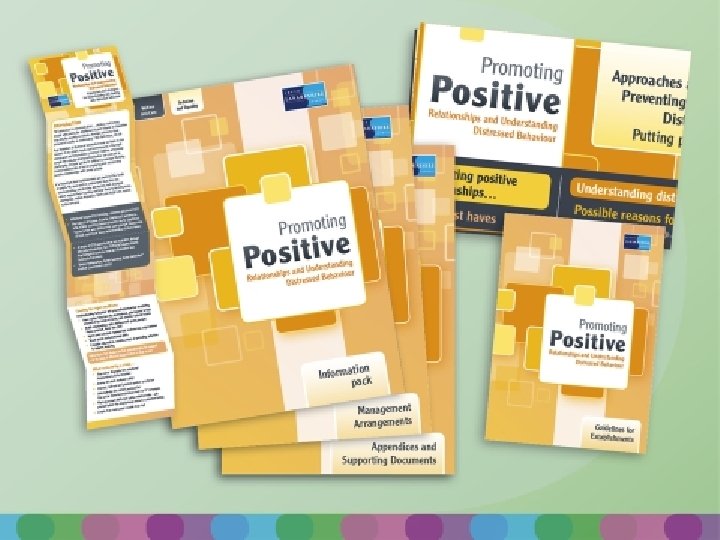

What is in this PPRUDB Pack to support in managing behaviour? • It is a guide all establishments in managing relationships and understanding distressed behaviour through: • A Management Arrangements Booklet • An Establishment Guide • Appendices that will help promote safety • Concertina for all • Poster for all establishments • EPs will promote as will Social Work
- Slides: 10