
Slavery in the Americas Honors World History Dubbs
Slavery in the Americas Honors World History Dubbs
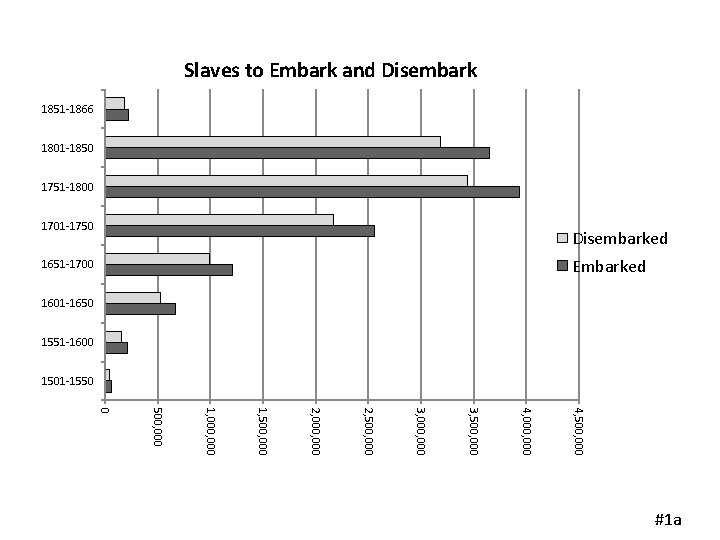
Slaves to Embark and Disembark 1851 -1866 1801 -1850 1751 -1800 1701 -1750 Disembarked Embarked 1651 -1700 1601 -1650 1551 -1600 1501 -1550 4, 500, 000 4, 000 3, 500, 000 3, 000 2, 500, 000 2, 000 1, 500, 000 1, 000 500, 000 0 #1 a
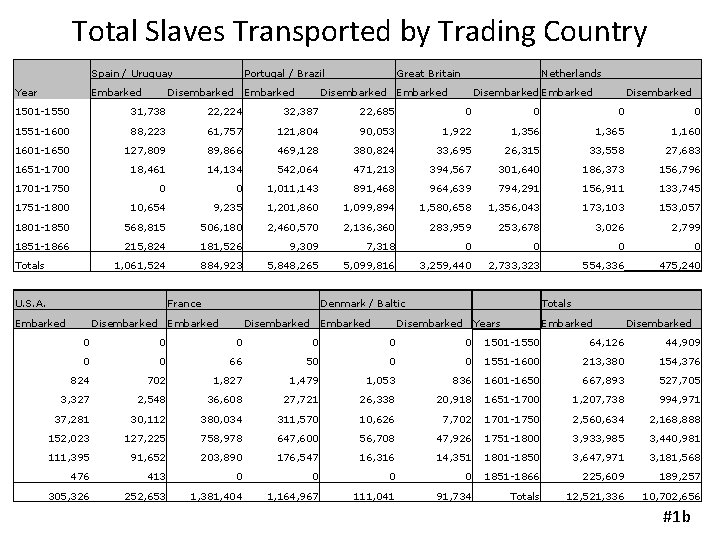
Total Slaves Transported by Trading Country Year Spain / Uruguay Portugal / Brazil Great Britain Embarked Disembarked Netherlands Disembarked Embarked Disembarked 1501 -1550 31, 738 22, 224 32, 387 22, 685 0 0 1551 -1600 88, 223 61, 757 121, 804 90, 053 1, 922 1, 356 1, 365 1, 1601 -1650 127, 809 89, 866 469, 128 380, 824 33, 695 26, 315 33, 558 27, 683 1651 -1700 18, 461 14, 134 542, 064 471, 213 394, 567 301, 640 186, 373 156, 796 1701 -1750 0 0 1, 011, 143 891, 468 964, 639 794, 291 156, 911 133, 745 1751 -1800 10, 654 9, 235 1, 201, 860 1, 099, 894 1, 580, 658 1, 356, 043 173, 103 153, 057 1801 -1850 568, 815 506, 180 2, 460, 570 2, 136, 360 283, 959 253, 678 3, 026 2, 799 1851 -1866 215, 824 181, 526 9, 309 7, 318 0 0 1, 061, 524 884, 923 5, 848, 265 5, 099, 816 3, 259, 440 2, 733, 323 554, 336 475, 240 Totals U. S. A. France Embarked Disembarked Denmark / Baltic Embarked Disembarked Embarked Totals Disembarked Years Embarked Disembarked 0 0 0 1501 -1550 64, 126 44, 909 0 0 66 50 0 0 1551 -1600 213, 380 154, 376 824 702 1, 827 1, 479 1, 053 836 1601 -1650 667, 893 527, 705 3, 327 2, 548 36, 608 27, 721 26, 338 20, 918 1651 -1700 1, 207, 738 994, 971 37, 281 30, 112 380, 034 311, 570 10, 626 7, 702 1701 -1750 2, 560, 634 2, 168, 888 152, 023 127, 225 758, 978 647, 600 56, 708 47, 926 1751 -1800 3, 933, 985 3, 440, 981 111, 395 91, 652 203, 890 176, 547 16, 316 14, 351 1801 -1850 3, 647, 971 3, 181, 568 476 413 0 0 1851 -1866 225, 609 189, 257 305, 326 252, 653 1, 381, 404 1, 164, 967 111, 041 91, 734 Totals 12, 521, 336 10, 702, 656 #1 b
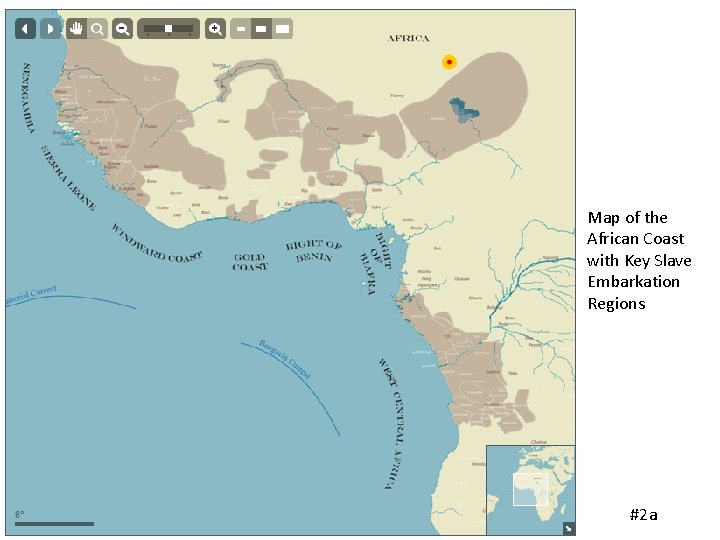
Map of the African Coast with Key Slave Embarkation Regions #2 a
Number of Slave Embarkations by Region #2 b
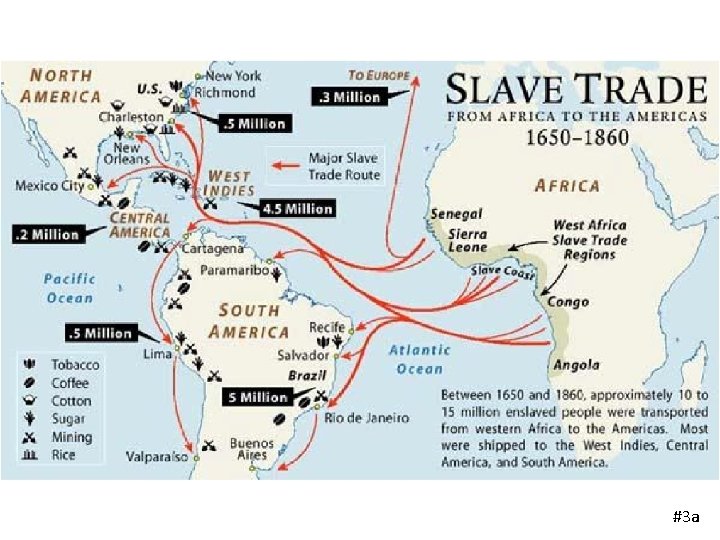
#3 a
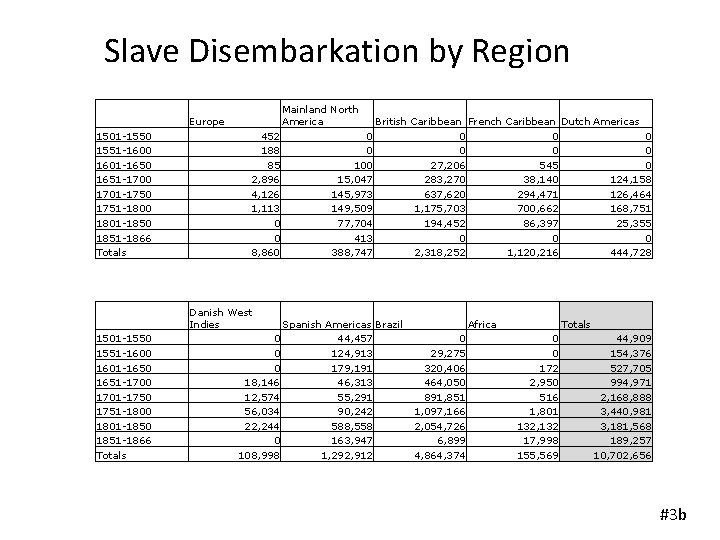
Slave Disembarkation by Region Mainland North America Europe 1501 -1550 1551 -1600 1601 -1650 1651 -1700 1701 -1750 1751 -1800 1801 -1850 1851 -1866 Totals 452 188 85 2, 896 4, 126 1, 113 0 0 8, 860 0 0 100 15, 047 145, 973 149, 509 77, 704 413 388, 747 British Caribbean French Caribbean Dutch Americas 0 0 0 27, 206 545 0 283, 270 38, 140 124, 158 637, 620 294, 471 126, 464 1, 175, 703 700, 662 168, 751 194, 452 86, 397 25, 355 0 0 0 2, 318, 252 1, 120, 216 444, 728 Danish West Indies 1501 -1550 1551 -1600 1601 -1650 1651 -1700 1701 -1750 1751 -1800 1801 -1850 1851 -1866 Totals Spanish Americas Brazil 0 44, 457 0 124, 913 0 179, 191 18, 146 46, 313 12, 574 55, 291 56, 034 90, 242 22, 244 588, 558 0 163, 947 108, 998 1, 292, 912 Africa 0 29, 275 320, 406 464, 050 891, 851 1, 097, 166 2, 054, 726 6, 899 4, 864, 374 Totals 0 0 172 2, 950 516 1, 801 132, 132 17, 998 155, 569 44, 909 154, 376 527, 705 994, 971 2, 168, 888 3, 440, 981 3, 181, 568 189, 257 10, 702, 656 #3 b
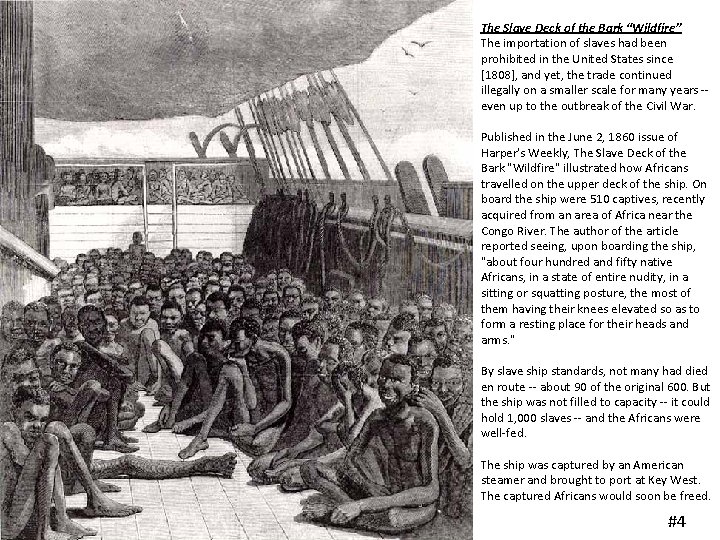
The Slave Deck of the Bark “Wildfire” The importation of slaves had been prohibited in the United States since [1808], and yet, the trade continued illegally on a smaller scale for many years -even up to the outbreak of the Civil War. Published in the June 2, 1860 issue of Harper's Weekly, The Slave Deck of the Bark "Wildfire" illustrated how Africans travelled on the upper deck of the ship. On board the ship were 510 captives, recently acquired from an area of Africa near the Congo River. The author of the article reported seeing, upon boarding the ship, "about four hundred and fifty native Africans, in a state of entire nudity, in a sitting or squatting posture, the most of them having their knees elevated so as to form a resting place for their heads and arms. " By slave ship standards, not many had died en route -- about 90 of the original 600. But the ship was not filled to capacity -- it could hold 1, 000 slaves -- and the Africans were well-fed. The ship was captured by an American steamer and brought to port at Key West. The captured Africans would soon be freed. #4
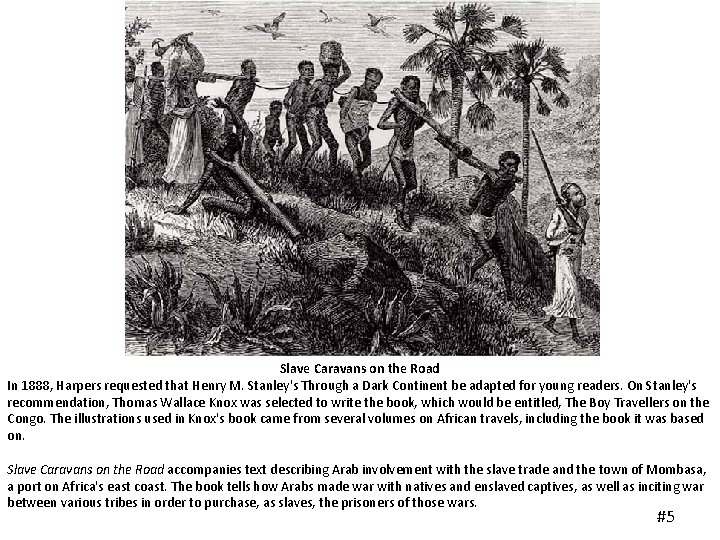
Slave Caravans on the Road In 1888, Harpers requested that Henry M. Stanley's Through a Dark Continent be adapted for young readers. On Stanley's recommendation, Thomas Wallace Knox was selected to write the book, which would be entitled, The Boy Travellers on the Congo. The illustrations used in Knox's book came from several volumes on African travels, including the book it was based on. Slave Caravans on the Road accompanies text describing Arab involvement with the slave trade and the town of Mombasa, a port on Africa's east coast. The book tells how Arabs made war with natives and enslaved captives, as well as inciting war between various tribes in order to purchase, as slaves, the prisoners of those wars. #5
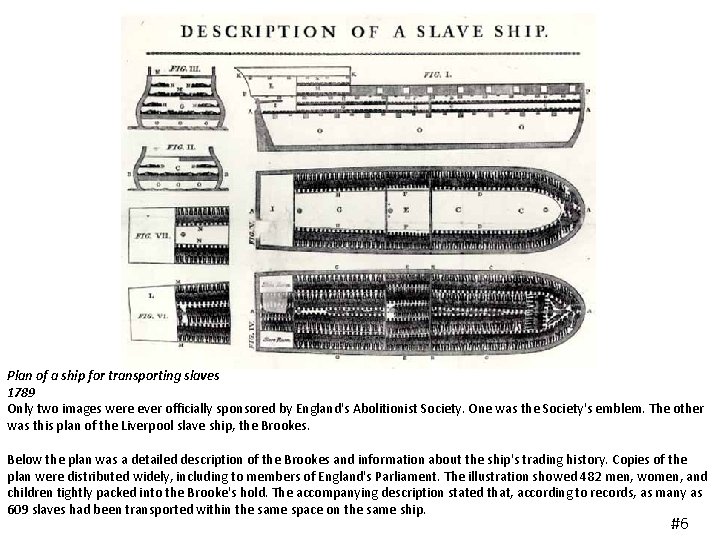
Plan of a ship for transporting slaves 1789 Only two images were ever officially sponsored by England's Abolitionist Society. One was the Society's emblem. The other was this plan of the Liverpool slave ship, the Brookes. Below the plan was a detailed description of the Brookes and information about the ship's trading history. Copies of the plan were distributed widely, including to members of England's Parliament. The illustration showed 482 men, women, and children tightly packed into the Brooke's hold. The accompanying description stated that, according to records, as many as 609 slaves had been transported within the same space on the same ship. #6
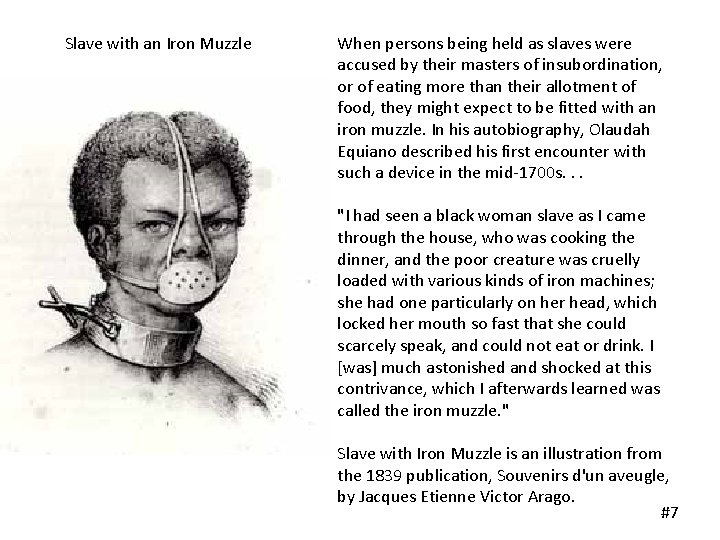
Slave with an Iron Muzzle When persons being held as slaves were accused by their masters of insubordination, or of eating more than their allotment of food, they might expect to be fitted with an iron muzzle. In his autobiography, Olaudah Equiano described his first encounter with such a device in the mid-1700 s. . . "I had seen a black woman slave as I came through the house, who was cooking the dinner, and the poor creature was cruelly loaded with various kinds of iron machines; she had one particularly on her head, which locked her mouth so fast that she could scarcely speak, and could not eat or drink. I [was] much astonished and shocked at this contrivance, which I afterwards learned was called the iron muzzle. " Slave with Iron Muzzle is an illustration from the 1839 publication, Souvenirs d'un aveugle, by Jacques Etienne Victor Arago. #7
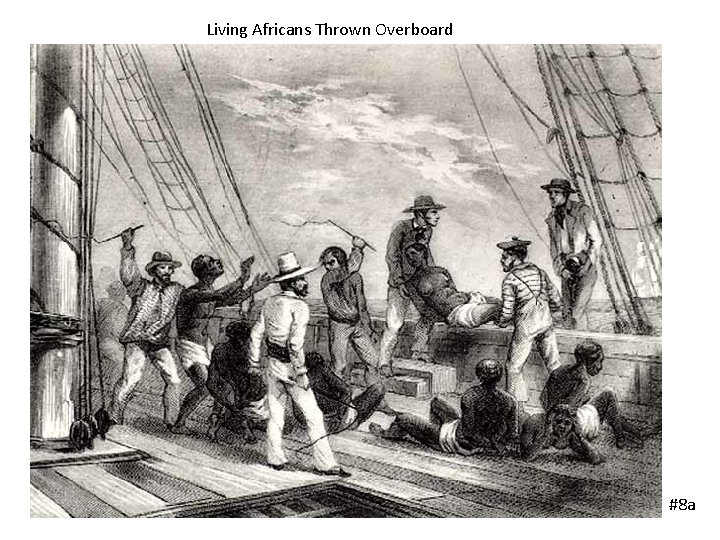
Living Africans Thrown Overboard #8 a
Heading for Jamaica in 1781, the ship Zong was nearing the end of its voyage. It had been twelve weeks since it had sailed from the west African coast with its cargo of 417 slaves. Water was running out. Then, compounding the problem, there was an outbreak of disease. The ship's captain, reasoning that the slaves were going to die anyway, made a decision. In order to reduce the owner's losses he would throw overboard the slaves thought to be too sick to recover. The voyage was insured, but the insurance would not pay for sick slaves or even those killed by illness. However, it would cover slaves lost through drowning. The captain gave the order; 54 Africans were chained together, then thrown overboard. Another 78 were drowned over the next two days. By the time the ship had reached the Caribbean, 132 persons had been murdered. When the ship returned to England the owners made their claim -- they wished to be compensated the full value for each slave lost. The claim might have been honored had if it had not been former slave Equiano, then living in England, who learned of the tragedy and alerted an abolitionist friend of his. The case went to court. At first the jury ruled in favor of the ship's owners. Since it was permissible to kill animals for the safety of the ship, they decided, it was permissible to kill slaves for the same reason. The insurance company appealed, and the case was retried. This time the court decided that the Africans on board the ship were people. It was a landmark decision. On another voyage, on another ship, a similar incident occurred. On La Rodeur in 1812, there was an outbreak of ophthalmia, a disease that causes temporary blindness. Both slaves and crew were afflicted. The captain, fearing that the blindness was permanent and knowing that blind slaves would be difficult if not impossible to sell, sent 39 slaves over the rails to their watery death. As with the captain of the Zong, he hoped that the insurance would cover the loss. #8 b
- Slides: 13