
Slaughterhouses Waste Management Waste generated in slaughterhouse Slaughter
- Slides: 19
Slaughterhouses Waste Management
Waste generated in slaughterhouse Slaughter house is a place where animals are killed for their meat Slaughterhouse waste generated includes intestinal contents, Hair & horns, hooves, gallbladders, trimmings, internal organs, condemned carcasses or body parts, carton, and plastics etc. ,
Slaughterhouse waste continued Waste materials produced in these establishments are of three types: solid, liquid, and gas. Solid wastes from slaughterhouses are varied depending on the kind and scale of operations. Liquid wastes of slaughterhouses come from urine, blood, and wastewater from the slaughter processes Odours and emissions are also produced in the operations.
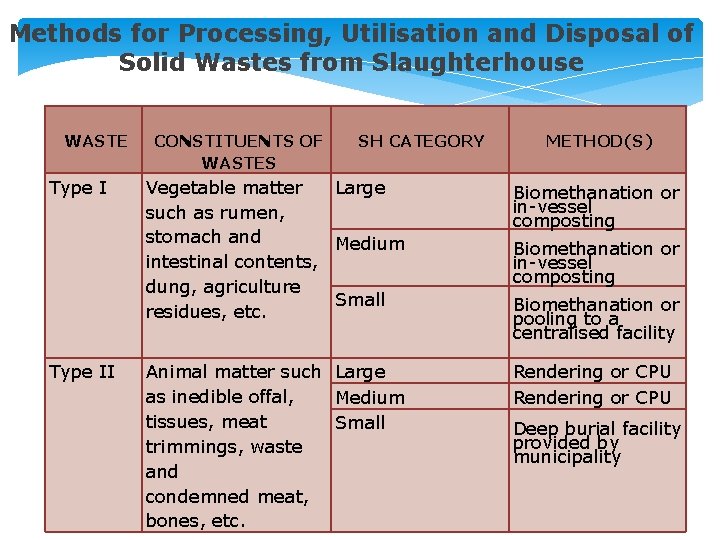
SLAUGHTERHOUSE WASTE Cont. . • Slaughterhouses waste can be broadly classified into two categories: (i) Vegetative matter (type I) such as rumen, stomach and intestine contents, dung, agriculture residues, etc. , and (i) Animal matter (type II) like inedible offals, tissues, meat trimmings, waste and condemned meat, bones, etc. • These waste streams can be segregated and treated separately.
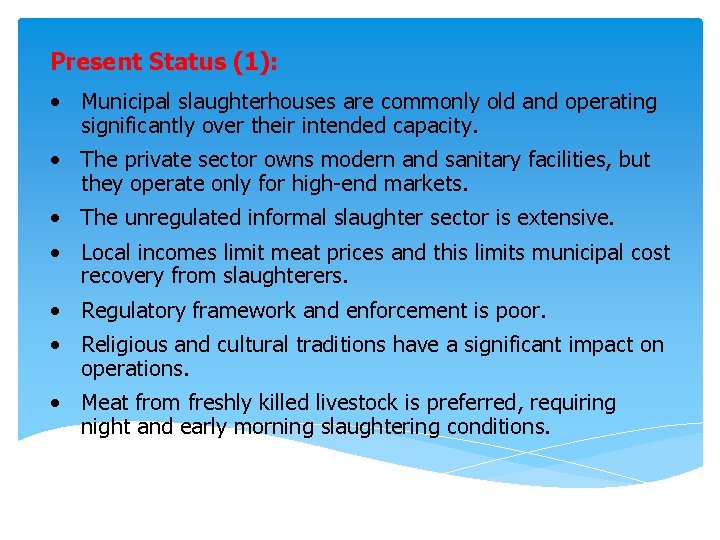
Present Status (1): • Municipal slaughterhouses are commonly old and operating significantly over their intended capacity. • The private sector owns modern and sanitary facilities, but they operate only for high-end markets. • The unregulated informal slaughter sector is extensive. • Local incomes limit meat prices and this limits municipal cost recovery from slaughterers. • Regulatory framework and enforcement is poor. • Religious and cultural traditions have a significant impact on operations. • Meat from freshly killed livestock is preferred, requiring night and early morning slaughtering conditions.
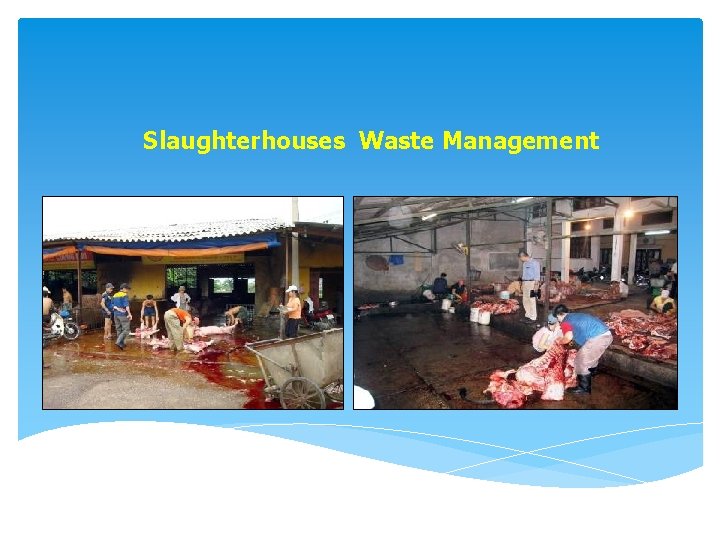
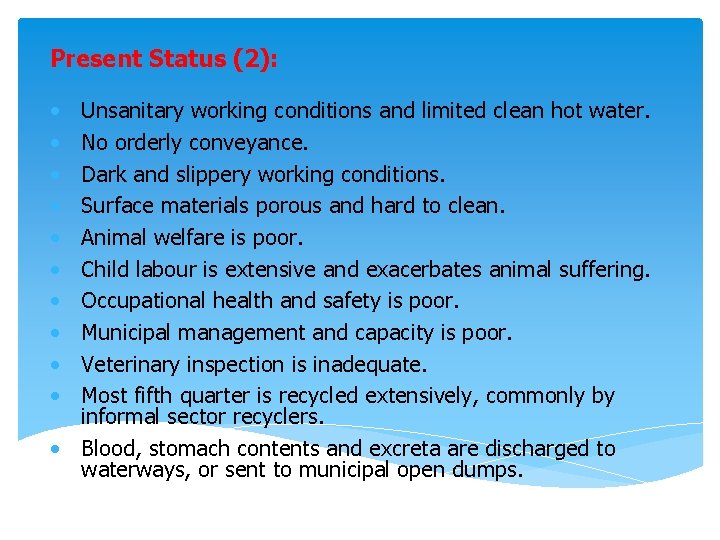
Present Status (2): • • • Unsanitary working conditions and limited clean hot water. No orderly conveyance. Dark and slippery working conditions. Surface materials porous and hard to clean. Animal welfare is poor. Child labour is extensive and exacerbates animal suffering. Occupational health and safety is poor. Municipal management and capacity is poor. Veterinary inspection is inadequate. Most fifth quarter is recycled extensively, commonly by informal sector recyclers. • Blood, stomach contents and excreta are discharged to waterways, or sent to municipal open dumps.
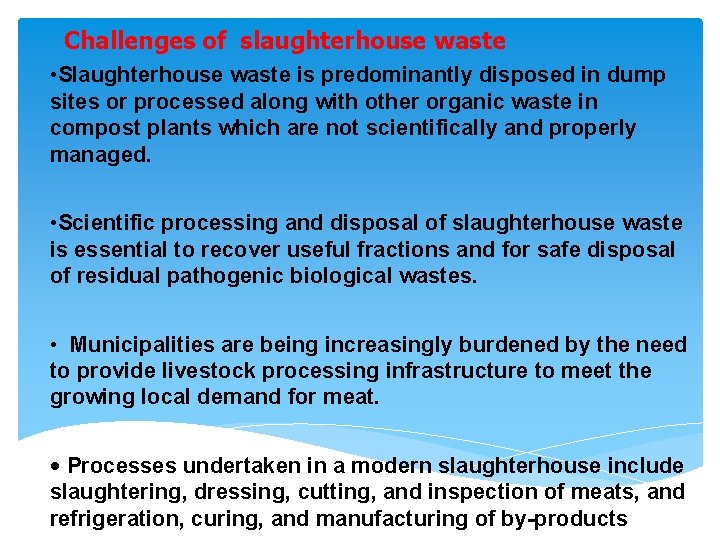
Challenges of slaughterhouse waste • Slaughterhouse waste is predominantly disposed in dump sites or processed along with other organic waste in compost plants which are not scientifically and properly managed. • Scientific processing and disposal of slaughterhouse waste is essential to recover useful fractions and for safe disposal of residual pathogenic biological wastes. • Municipalities are being increasingly burdened by the need to provide livestock processing infrastructure to meet the growing local demand for meat. • Processes undertaken in a modern slaughterhouse include slaughtering, dressing, cutting, and inspection of meats, and refrigeration, curing, and manufacturing of by-products
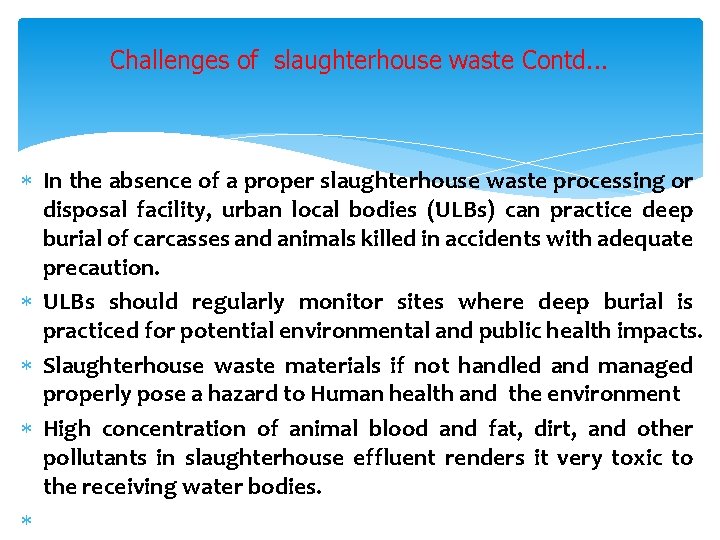
Challenges of slaughterhouse waste Contd. . . In the absence of a proper slaughterhouse waste processing or disposal facility, urban local bodies (ULBs) can practice deep burial of carcasses and animals killed in accidents with adequate precaution. ULBs should regularly monitor sites where deep burial is practiced for potential environmental and public health impacts. Slaughterhouse waste materials if not handled and managed properly pose a hazard to Human health and the environment High concentration of animal blood and fat, dirt, and other pollutants in slaughterhouse effluent renders it very toxic to the receiving water bodies.
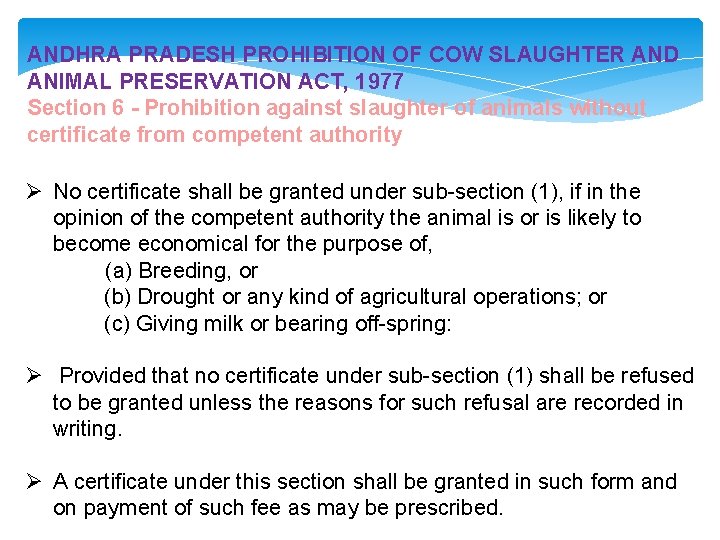
ANDHRA PRADESH PROHIBITION OF COW SLAUGHTER AND ANIMAL PRESERVATION ACT, 1977 Section 6 - Prohibition against slaughter of animals without certificate from competent authority Ø No certificate shall be granted under sub-section (1), if in the opinion of the competent authority the animal is or is likely to become economical for the purpose of, (a) Breeding, or (b) Drought or any kind of agricultural operations; or (c) Giving milk or bearing off-spring: Ø Provided that no certificate under sub-section (1) shall be refused to be granted unless the reasons for such refusal are recorded in writing. Ø A certificate under this section shall be granted in such form and on payment of such fee as may be prescribed.
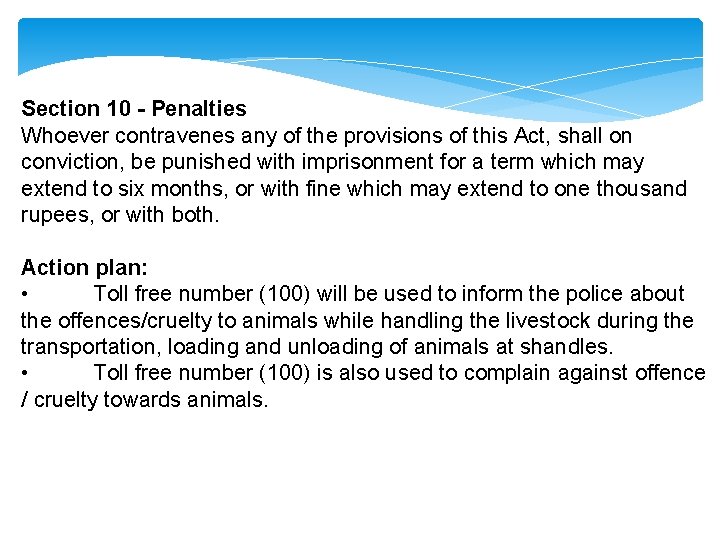
Section 10 - Penalties Whoever contravenes any of the provisions of this Act, shall on conviction, be punished with imprisonment for a term which may extend to six months, or with fine which may extend to one thousand rupees, or with both. Action plan: • Toll free number (100) will be used to inform the police about the offences/cruelty to animals while handling the livestock during the transportation, loading and unloading of animals at shandles. • Toll free number (100) is also used to complain against offence / cruelty towards animals.
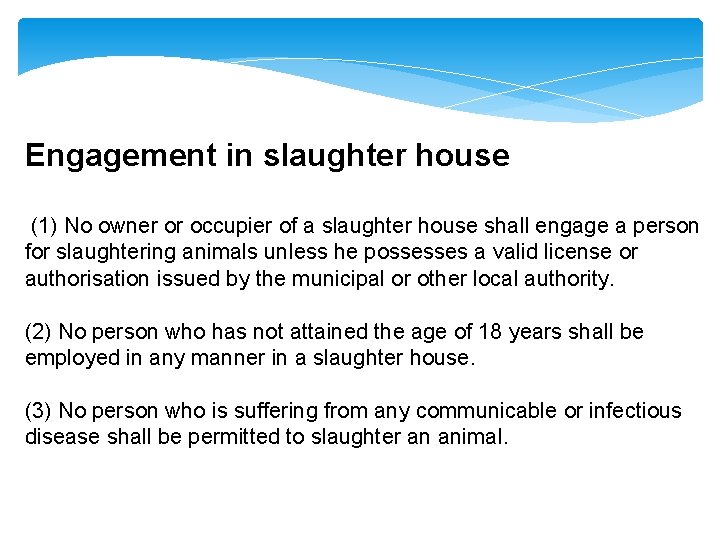
Engagement in slaughter house (1) No owner or occupier of a slaughter house shall engage a person for slaughtering animals unless he possesses a valid license or authorisation issued by the municipal or other local authority. (2) No person who has not attained the age of 18 years shall be employed in any manner in a slaughter house. (3) No person who is suffering from any communicable or infectious disease shall be permitted to slaughter an animal.
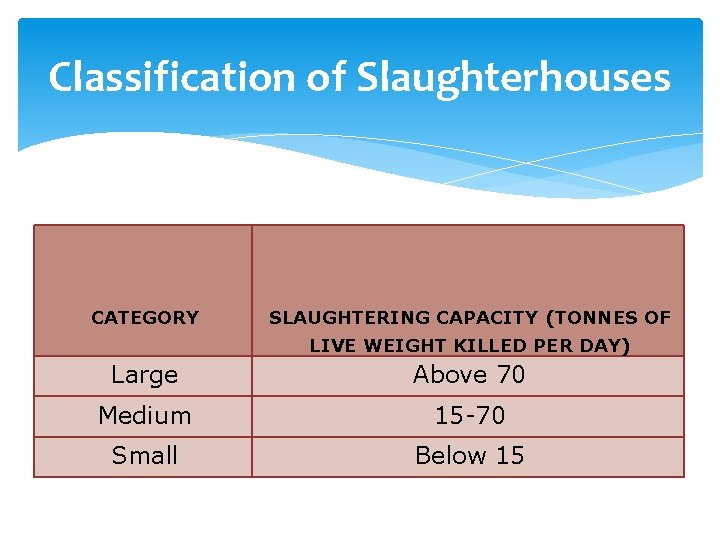
Classification of Slaughterhouses CATEGORY SLAUGHTERING CAPACITY (TONNES OF LIVE WEIGHT KILLED PER DAY) Large Above 70 Medium 15 -70 Small Below 15
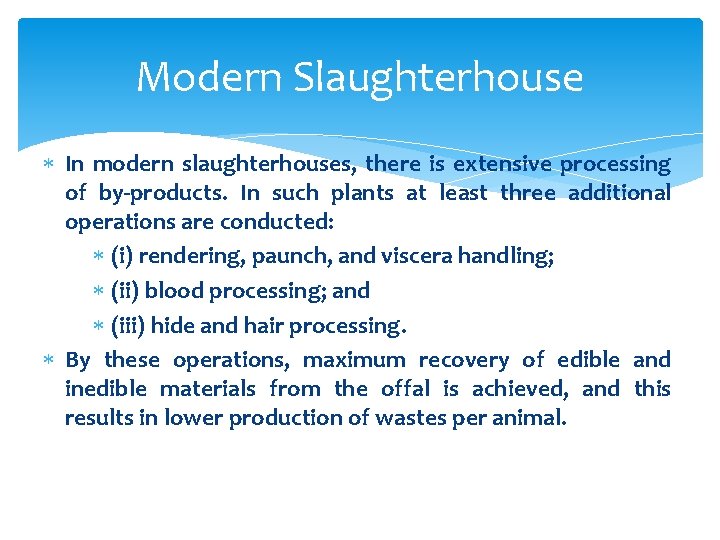
Modern Slaughterhouse In modern slaughterhouses, there is extensive processing of by-products. In such plants at least three additional operations are conducted: (i) rendering, paunch, and viscera handling; (ii) blood processing; and (iii) hide and hair processing. By these operations, maximum recovery of edible and inedible materials from the offal is achieved, and this results in lower production of wastes per animal.
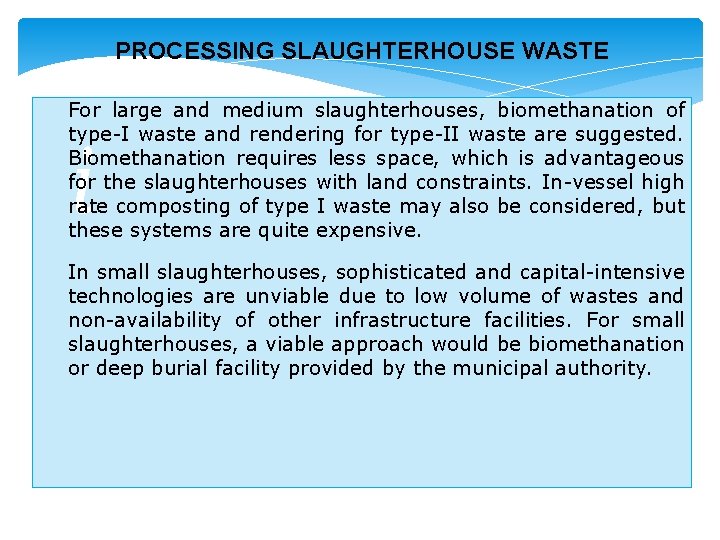
PROCESSING SLAUGHTERHOUSE WASTE For large and medium slaughterhouses, biomethanation of type-I waste and rendering for type-II waste are suggested. Biomethanation requires less space, which is advantageous for the slaughterhouses with land constraints. In-vessel high rate composting of type I waste may also be considered, but these systems are quite expensive. In small slaughterhouses, sophisticated and capital-intensive technologies are unviable due to low volume of wastes and non-availability of other infrastructure facilities. For small slaughterhouses, a viable approach would be biomethanation or deep burial facility provided by the municipal authority.
Methods for Processing, Utilisation and Disposal of Solid Wastes from Slaughterhouse WASTE Type II CONSTITUENTS OF WASTES SH CATEGORY METHOD(S) Vegetable matter Large such as rumen, stomach and Medium intestinal contents, dung, agriculture Small residues, etc. Biomethanation or in-vessel composting Animal matter such Large as inedible offal, Medium tissues, meat Small trimmings, waste and condemned meat, bones, etc. Rendering or CPU Biomethanation or in-vessel composting Biomethanation or pooling to a centralised facility Deep burial facility provided by municipality
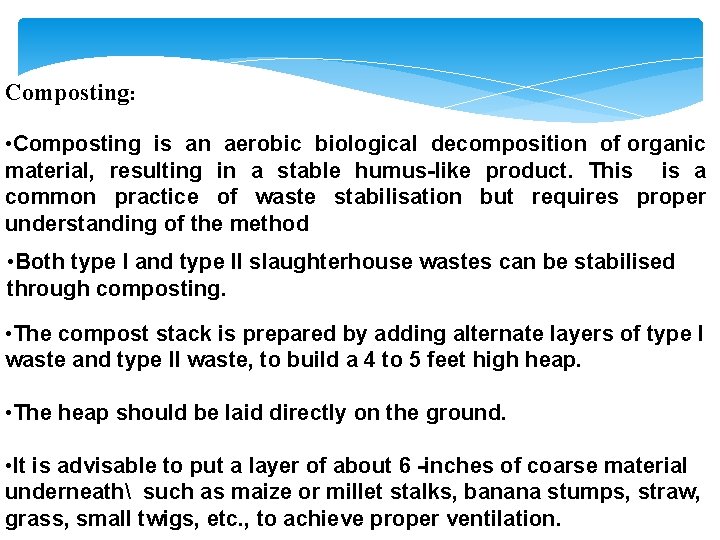
Composting: • Composting is an aerobic biological decomposition of organic material, resulting in a stable humus-like product. This is a common practice of waste stabilisation but requires proper understanding of the method • Both type I and type II slaughterhouse wastes can be stabilised through composting. • The compost stack is prepared by adding alternate layers of type I waste and type II waste, to build a 4 to 5 feet high heap. • The heap should be laid directly on the ground. • It is advisable to put a layer of about 6 -inches of coarse material underneath such as maize or millet stalks, banana stumps, straw, grass, small twigs, etc. , to achieve proper ventilation.
Composting: Large- sized matter (organs such as kidneys and lungs, or other similar wastes) in type II wastes should be minced to 2 to 3 -inch pieces before composting. For better results, it is advised to mix these pieces with earth and evenly spread out in the centre of the heap where the temperature is high. The ruminal and intestinal contents provide sufficient moisture for initiating and sustaining bacterial activity. As such, under normal circumstances, no additional water is required.
Biomethanation: Slaughterhouse waste is anaerobically stabilised in biomethanation. The success of the process, especially the effective removal of biochemical oxygen demand (BOD), has led to the acceptance of biogas slaughterhouse wastes. plants for processing
Thank you