
Slant TEC data ingestion in the Modified Ne
- Slides: 18
Slant TEC data ingestion in the Modified Ne. Quick ionosphere electron density model B. Nava, S. M. Radicella, R. Leitinger and P. Coïsson The Abdus Salam ICTP, Trieste, Italy IGAM, Graz, Austria XXVIII General Assembly of International Union of Radio Science New Delhi, India October 23 -29, 2005
Outline • Introduction • • Slant TEC data ingestion • • Electron density reconstruction technique (concepts) The Modified Ne. Quick performance • • Ne. Quick model and Modified Ne. Quick model description Evaluation criteria Data used Data analysis Conclusions The abdus salam international centre for theoretical physics
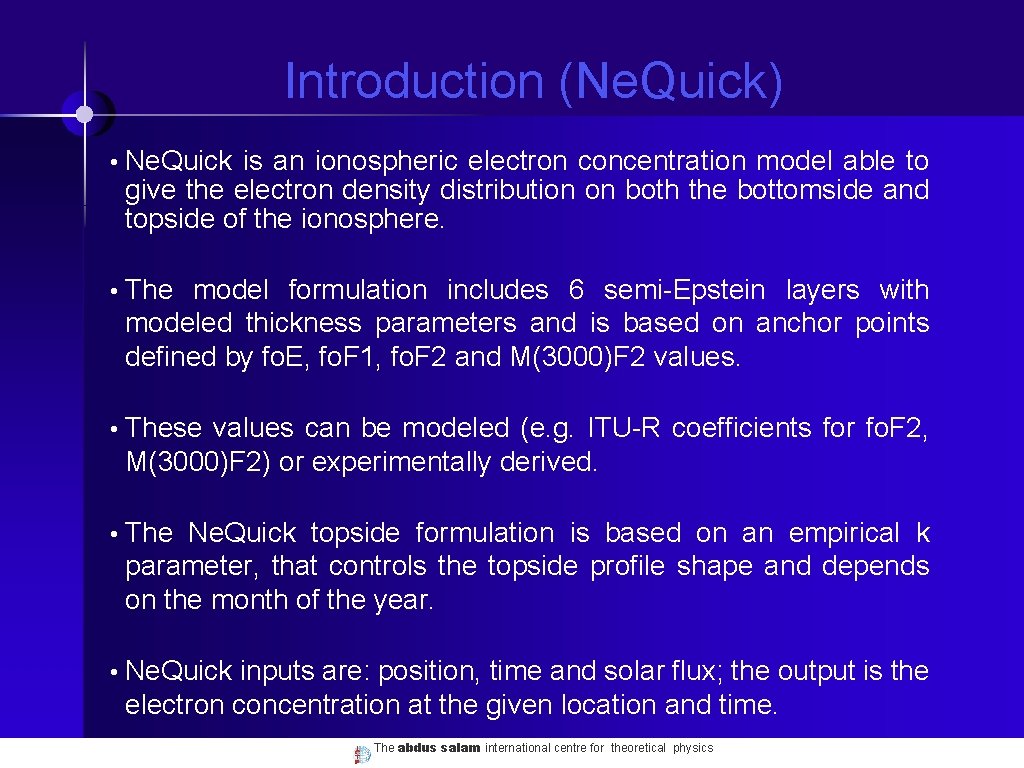
Introduction (Ne. Quick) • Ne. Quick is an ionospheric electron concentration model able to give the electron density distribution on both the bottomside and topside of the ionosphere. • The model formulation includes 6 semi-Epstein layers with modeled thickness parameters and is based on anchor points defined by fo. E, fo. F 1, fo. F 2 and M(3000)F 2 values. • These values can be modeled (e. g. ITU-R coefficients for fo. F 2, M(3000)F 2) or experimentally derived. • The Ne. Quick topside formulation is based on an empirical k parameter, that controls the topside profile shape and depends on the month of the year. • Ne. Quick inputs are: position, time and solar flux; the output is the electron concentration at the given location and time. The abdus salam international centre for theoretical physics
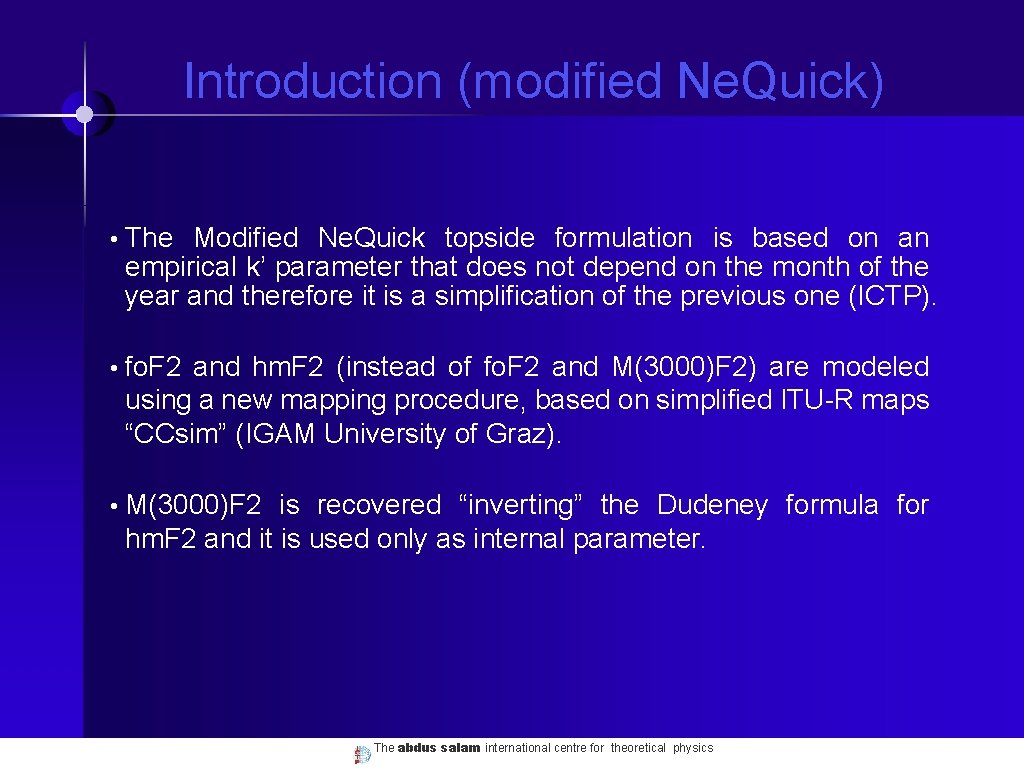
Introduction (modified Ne. Quick) • The Modified Ne. Quick topside formulation is based on an empirical k’ parameter that does not depend on the month of the year and therefore it is a simplification of the previous one (ICTP). • fo. F 2 and hm. F 2 (instead of fo. F 2 and M(3000)F 2) are modeled using a new mapping procedure, based on simplified ITU-R maps “CCsim” (IGAM University of Graz). • M(3000)F 2 is recovered “inverting” the Dudeney formula for hm. F 2 and it is used only as internal parameter. The abdus salam international centre for theoretical physics
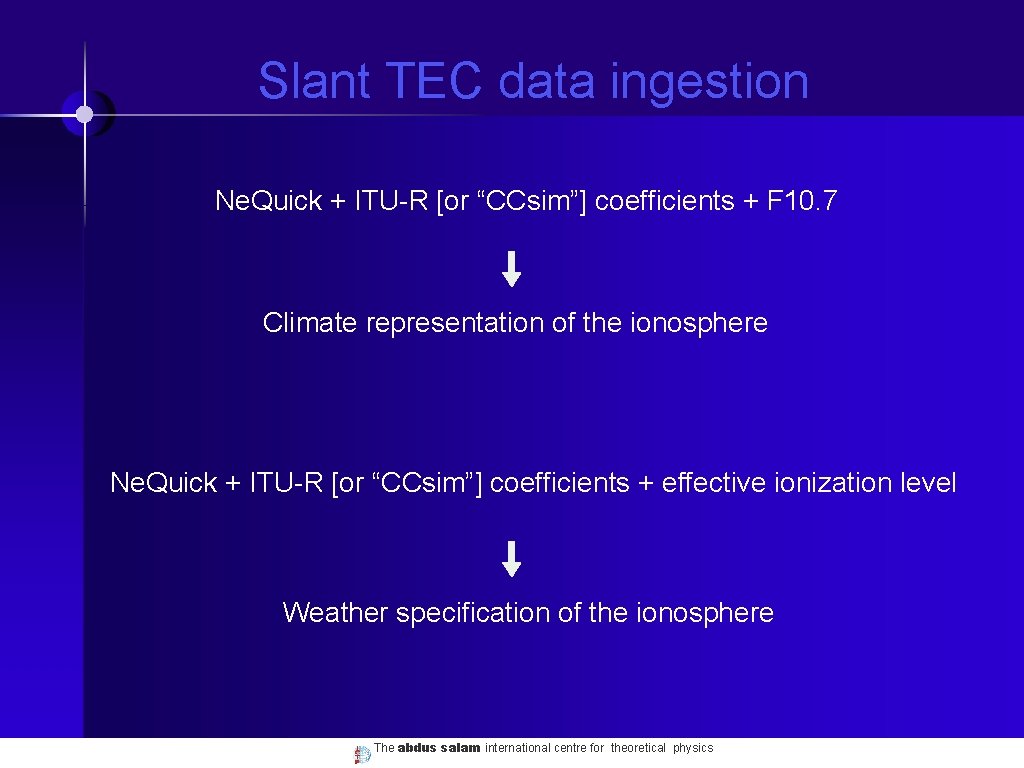
Slant TEC data ingestion Ne. Quick + ITU-R [or “CCsim”] coefficients + F 10. 7 Climate representation of the ionosphere Ne. Quick + ITU-R [or “CCsim”] coefficients + effective ionization level Weather specification of the ionosphere The abdus salam international centre for theoretical physics
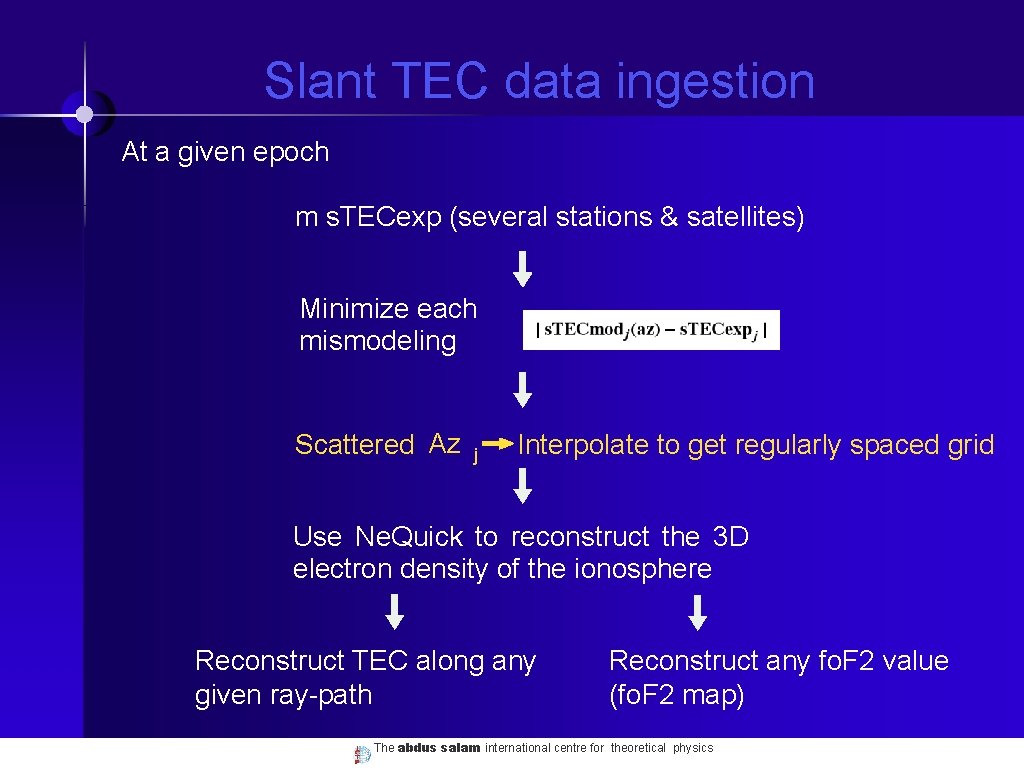
Slant TEC data ingestion At a given epoch m s. TECexp (several stations & satellites) Minimize each mismodeling Scattered Az j Interpolate to get regularly spaced grid Use Ne. Quick to reconstruct the 3 D electron density of the ionosphere Reconstruct TEC along any given ray-path Reconstruct any fo. F 2 value (fo. F 2 map) The abdus salam international centre for theoretical physics
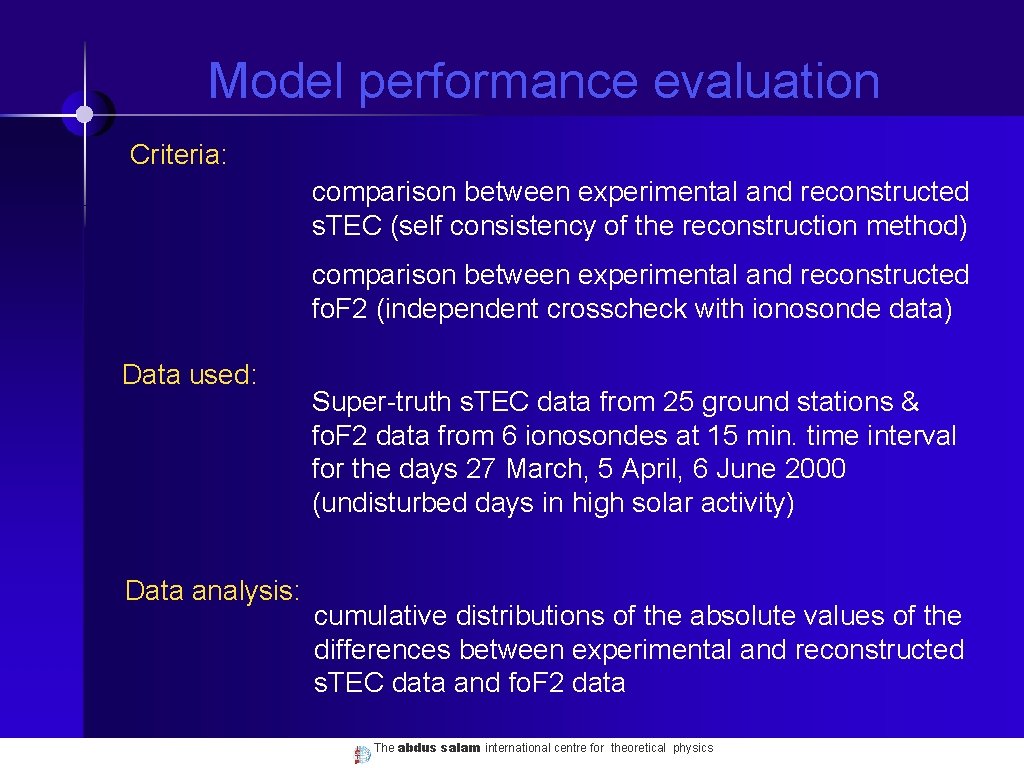
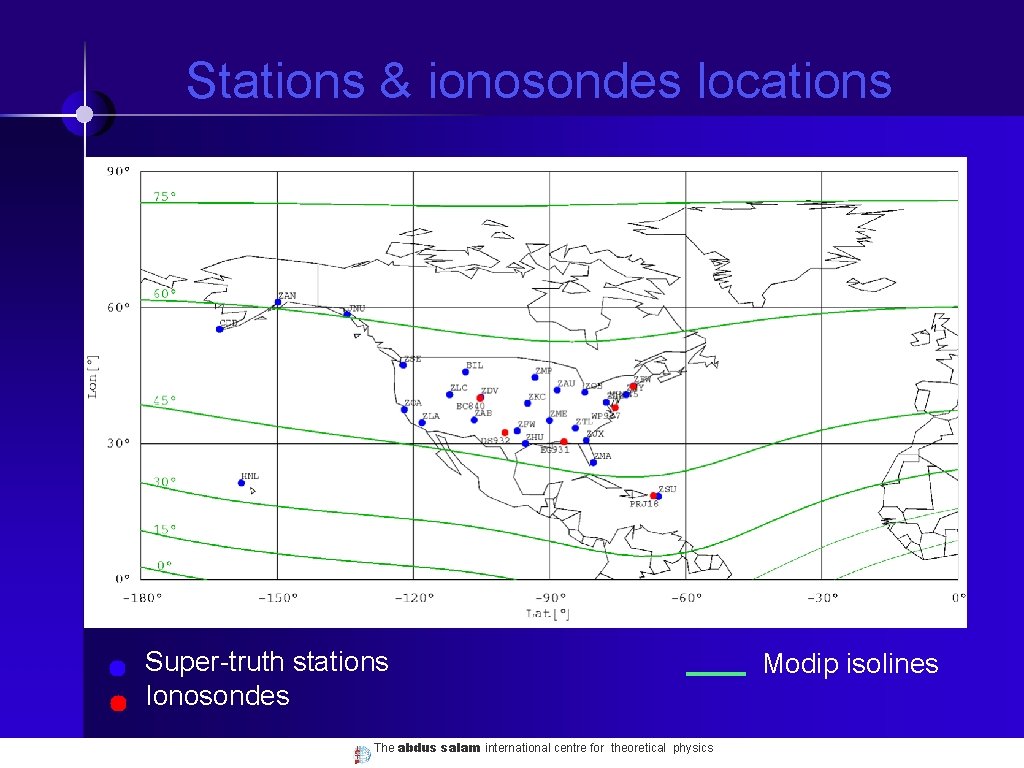
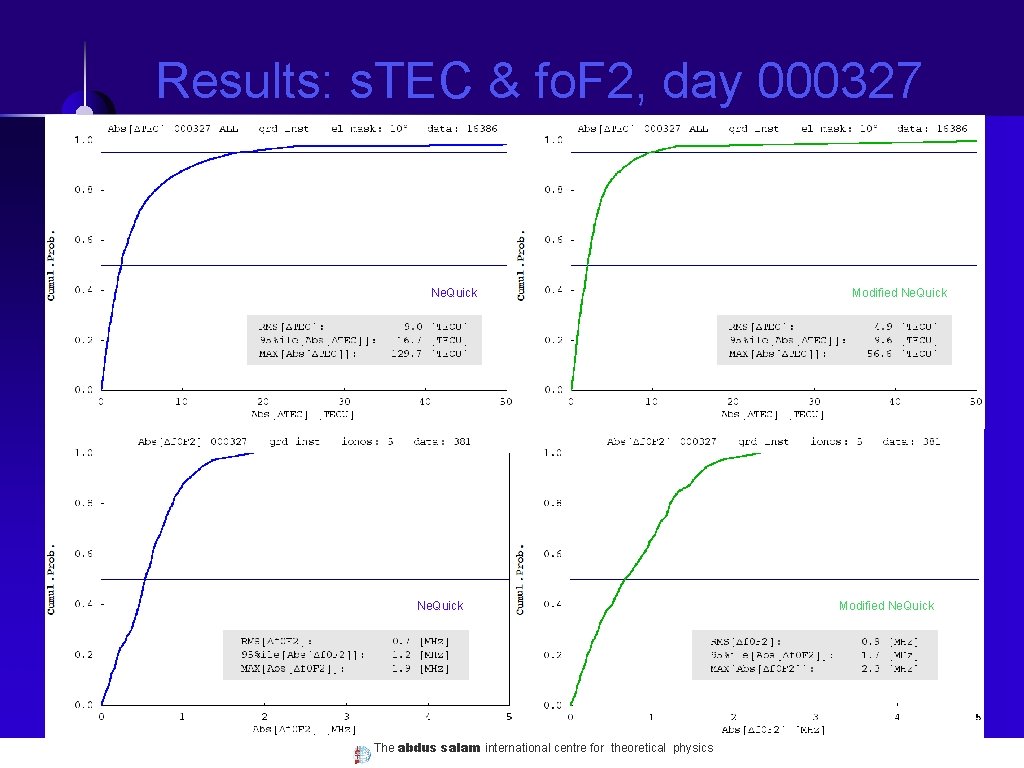
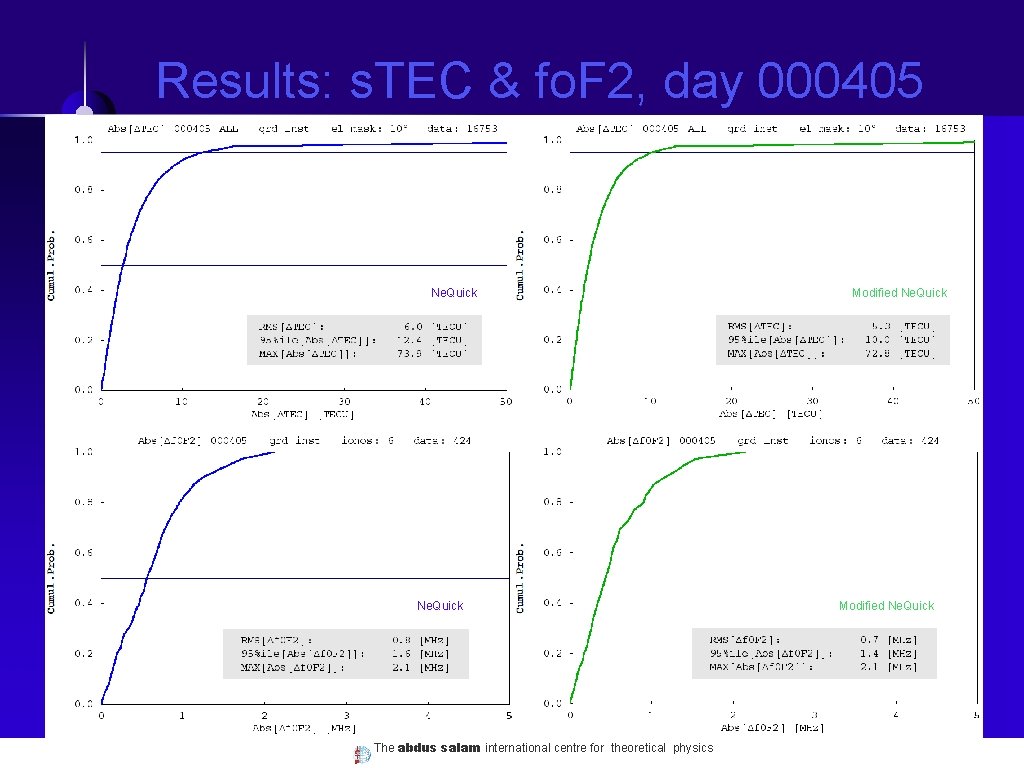
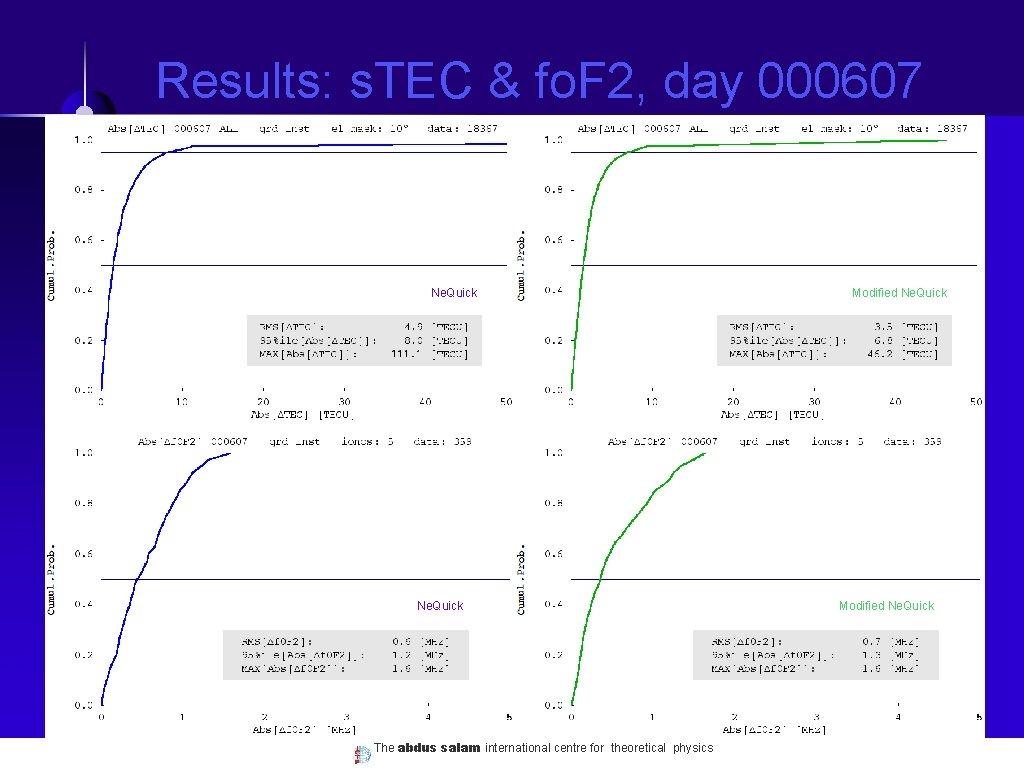
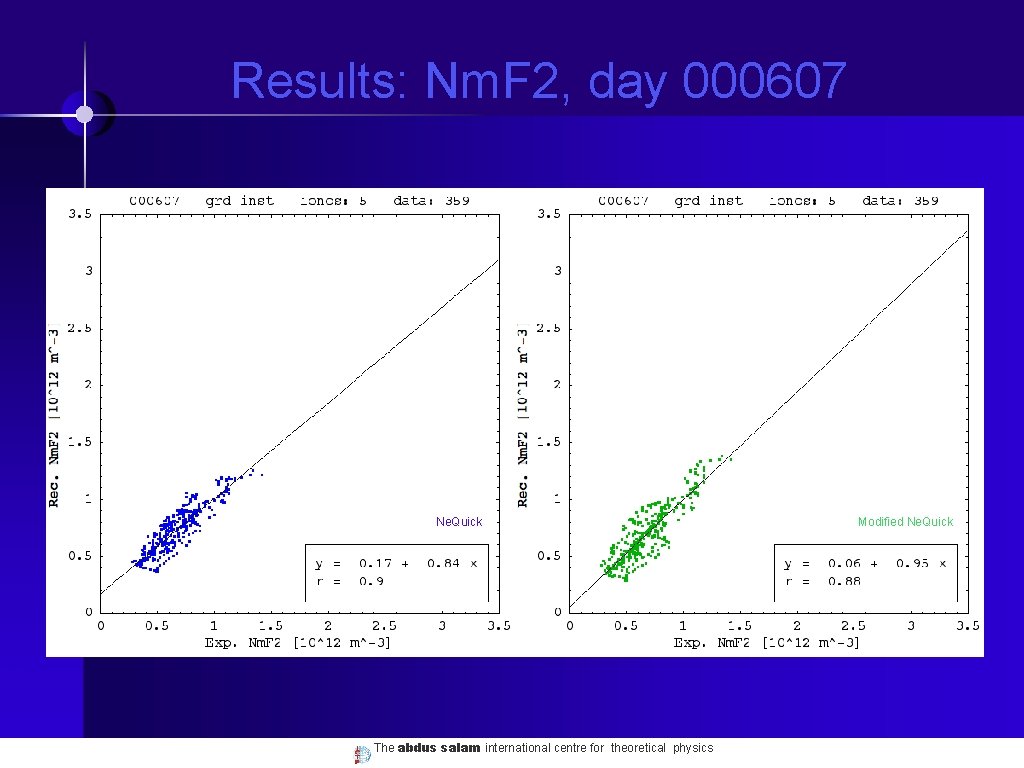
Model performance evaluation Criteria: comparison between experimental and reconstructed s. TEC (self consistency of the reconstruction method) comparison between experimental and reconstructed fo. F 2 (independent crosscheck with ionosonde data) Data used: Data analysis: Super-truth s. TEC data from 25 ground stations & fo. F 2 data from 6 ionosondes at 15 min. time interval for the days 27 March, 5 April, 6 June 2000 (undisturbed days in high solar activity) cumulative distributions of the absolute values of the differences between experimental and reconstructed s. TEC data and fo. F 2 data The abdus salam international centre for theoretical physics
Stations & ionosondes locations Super-truth stations Ionosondes The abdus salam international centre for theoretical physics Modip isolines
Results: s. TEC & fo. F 2, day 000327 Ne. Quick The abdus salam international centre for theoretical physics Modified Ne. Quick
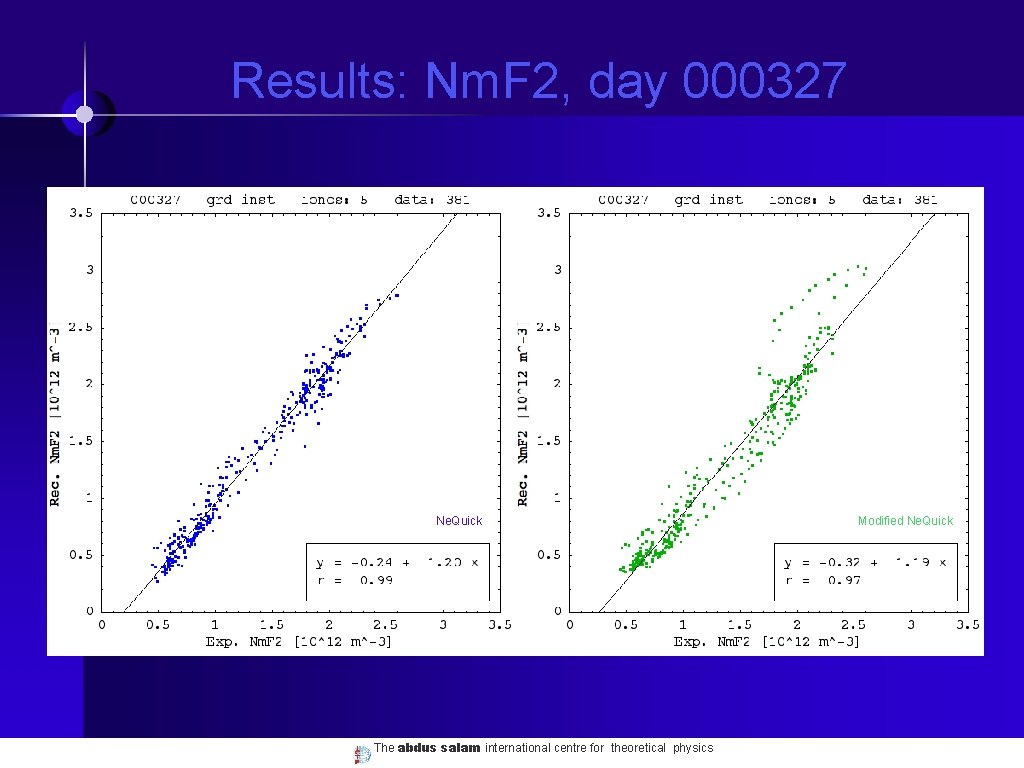
Results: Nm. F 2, day 000327 Ne. Quick The abdus salam international centre for theoretical physics Modified Ne. Quick
Results: s. TEC & fo. F 2, day 000405 Ne. Quick The abdus salam international centre for theoretical physics Modified Ne. Quick
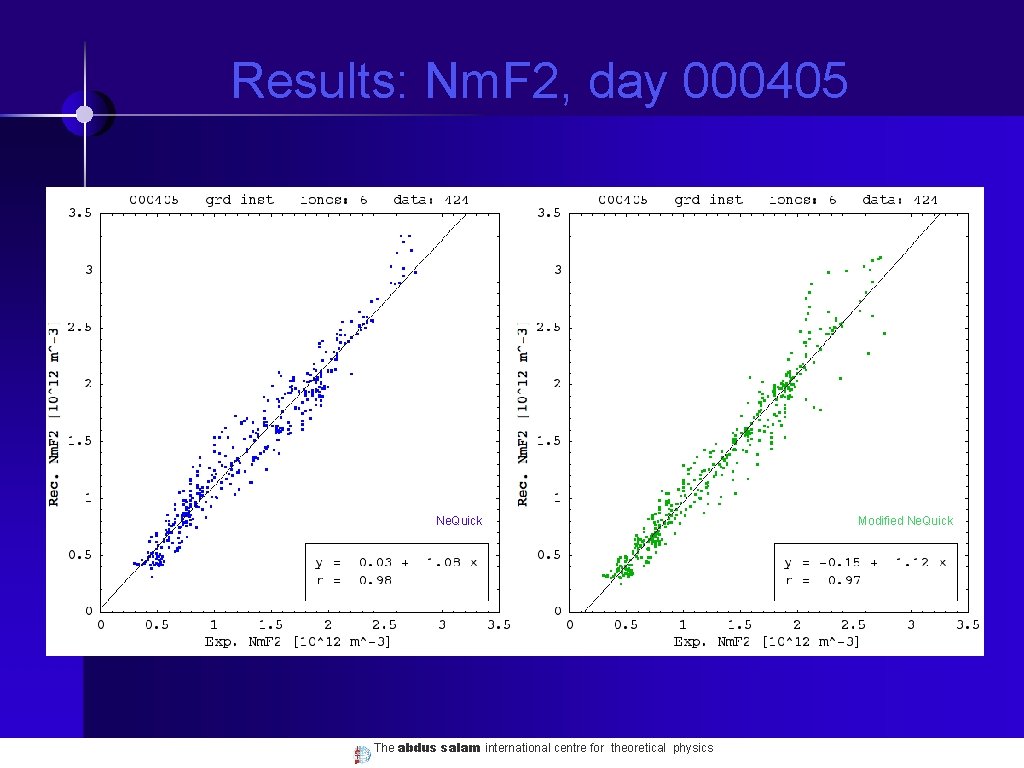
Results: Nm. F 2, day 000405 Ne. Quick The abdus salam international centre for theoretical physics Modified Ne. Quick
Results: s. TEC & fo. F 2, day 000607 Ne. Quick The abdus salam international centre for theoretical physics Modified Ne. Quick
Results: Nm. F 2, day 000607 Ne. Quick The abdus salam international centre for theoretical physics Modified Ne. Quick
Conclusions • Ne. Quick model has been modified. The impact of the changes has been tested using an electron density reconstruction technique previously developed by the authors. This technique, based on slant TEC data ingestion, has been applied to Ne. Quick and Modified Ne. Quick models. • The results obtained show that the Modified Ne. Quick model allows a better reconstruction of the ionosphere in terms of TEC, if compared with Ne. Quick model. Not substantial changes are observed in terms of fo. F 2. • Since Ne. Quick has been developed to be used in single frequency positioning applications, where TEC is the most important parameter to be modeled, the Modified Ne. Quick model can be considered an improvement with respect to Nequick. The abdus salam international centre for theoretical physics
Acknowledgments The authors are grateful to the WAAS community from whom they received the “Supertruth” data used for the present study and to the Center for Atmospheric Research of the University of Massachusetts at Lowell, for providing access to the digital ionogram data base (DIDBase). The abdus salam international centre for theoretical physics
Thank you for your attention The abdus salam international centre for theoretical physics
The abdus salam international centre for theoretical physics