
SLAC Status in Accelerator Structures Production and Analysis




- Slides: 28
SLAC Status in Accelerator Structures Production and Analysis of Structure Changes after High Power Tests Juwen Wang 4 th X-Band Structure Collaboration Meeting March 5, 2010
Outline 1. Work Status • • • Past Ongoing Future 2. Measurement and Analysis of Structure Changes after High Power Tests • • • Three Structures: T 18_VG 2. 4_DISC SLAC-1 T 18_VG 2. 4_DISC KEK-1 TD 18_VG 2. 4_DISC SLAC-1 Comparison with NLC/GLC structures Discussion
1. Work Status
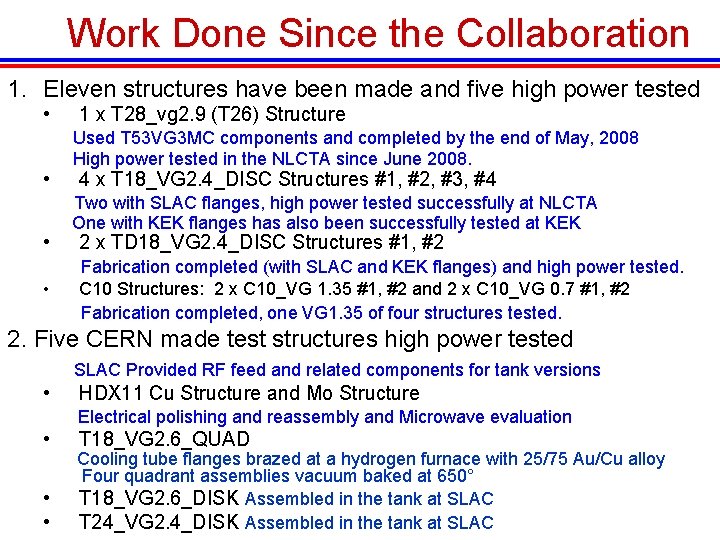
Work Done Since the Collaboration 1. Eleven structures have been made and five high power tested • • 1 x T 28_vg 2. 9 (T 26) Structure Used T 53 VG 3 MC components and completed by the end of May, 2008 High power tested in the NLCTA since June 2008. 4 x T 18_VG 2. 4_DISC Structures #1, #2, #3, #4 Two with SLAC flanges, high power tested successfully at NLCTA One with KEK flanges has also been successfully tested at KEK 2 x TD 18_VG 2. 4_DISC Structures #1, #2 Fabrication completed (with SLAC and KEK flanges) and high power tested. C 10 Structures: 2 x C 10_VG 1. 35 #1, #2 and 2 x C 10_VG 0. 7 #1, #2 Fabrication completed, one VG 1. 35 of four structures tested. 2. Five CERN made test structures high power tested SLAC Provided RF feed and related components for tank versions • HDX 11 Cu Structure and Mo Structure Electrical polishing and reassembly and Microwave evaluation • • • T 18_VG 2. 6_QUAD Cooling tube flanges brazed at a hydrogen furnace with 25/75 Au/Cu alloy Four quadrant assemblies vacuum baked at 650° T 18_VG 2. 6_DISK Assembled in the tank at SLAC T 24_VG 2. 4_DISK Assembled in the tank at SLAC
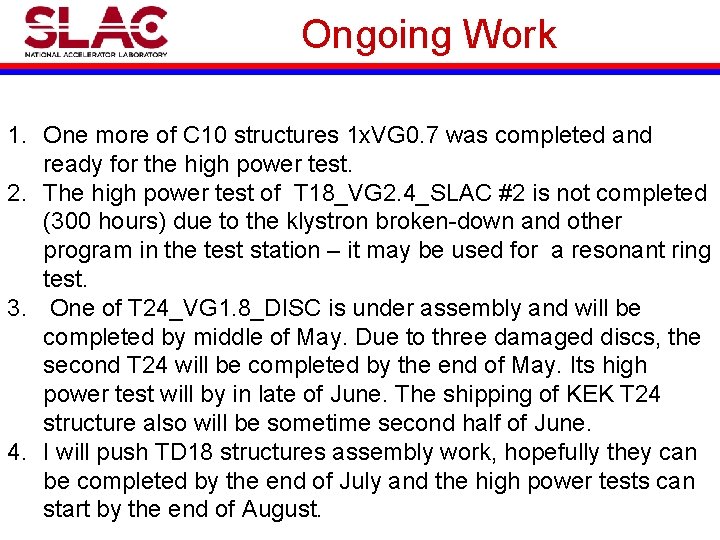
Ongoing Work 1. One more of C 10 structures 1 x. VG 0. 7 was completed and ready for the high power test. 2. The high power test of T 18_VG 2. 4_SLAC #2 is not completed (300 hours) due to the klystron broken-down and other program in the test station – it may be used for a resonant ring test. 3. One of T 24_VG 1. 8_DISC is under assembly and will be completed by middle of May. Due to three damaged discs, the second T 24 will be completed by the end of May. Its high power test will by in late of June. The shipping of KEK T 24 structure also will be sometime second half of June. 4. I will push TD 18 structures assembly work, hopefully they can be completed by the end of July and the high power tests can start by the end of August.
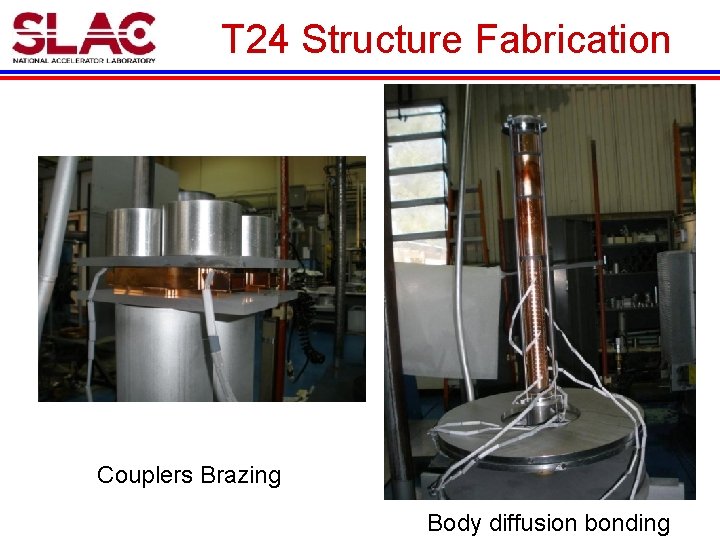
T 24 Structure Fabrication Couplers Brazing Body diffusion bonding
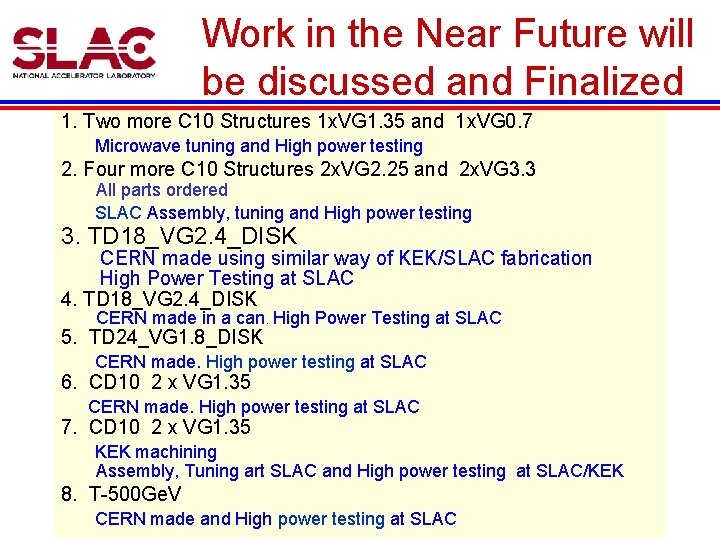
Work in the Near Future will be discussed and Finalized 1. Two more C 10 Structures 1 x. VG 1. 35 and 1 x. VG 0. 7 Microwave tuning and High power testing 2. Four more C 10 Structures 2 x. VG 2. 25 and 2 x. VG 3. 3 All parts ordered SLAC Assembly, tuning and High power testing 3. TD 18_VG 2. 4_DISK CERN made using similar way of KEK/SLAC fabrication High Power Testing at SLAC 4. TD 18_VG 2. 4_DISK CERN made in a can. High Power Testing at SLAC 5. TD 24_VG 1. 8_DISK CERN made. High power testing at SLAC 6. CD 10 2 x VG 1. 35 CERN made. High power testing at SLAC 7. CD 10 2 x VG 1. 35 KEK machining Assembly, Tuning art SLAC and High power testing at SLAC/KEK 8. T-500 Ge. V CERN made and High power testing at SLAC
2. Measurement and Analysis of Structure Changes after High Power Tests
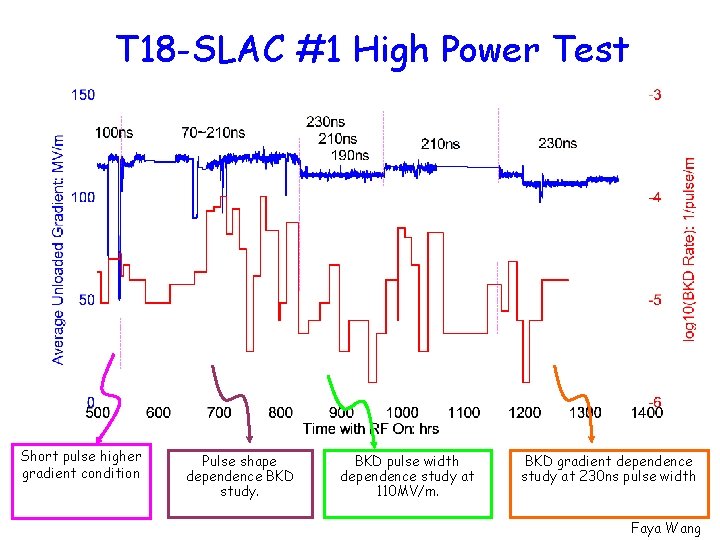
T 18 -SLAC #1 High Power Test Short pulse higher gradient condition Pulse shape dependence BKD study. BKD pulse width dependence study at 110 MV/m. BKD gradient dependence study at 230 ns pulse width Faya Wang
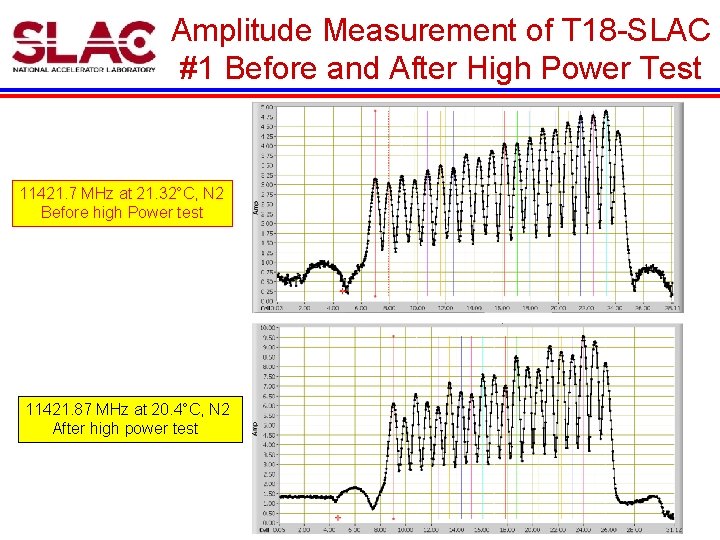
Amplitude Measurement of T 18 -SLAC #1 Before and After High Power Test 11421. 7 MHz at 21. 32°C, N 2 Before high Power test 11421. 87 MHz at 20. 4°C, N 2 After high power test
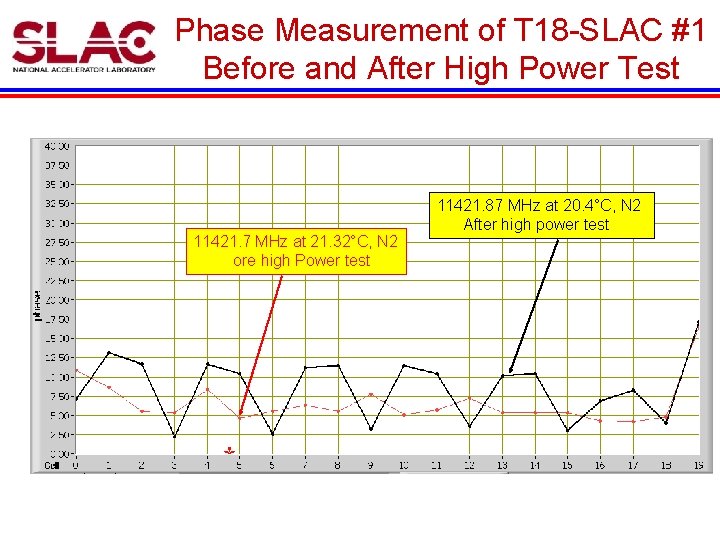
Phase Measurement of T 18 -SLAC #1 Before and After High Power Test 11421. 7 MHz at 21. 32°C, N 2 ore high Power test 11421. 87 MHz at 20. 4°C, N 2 After high power test
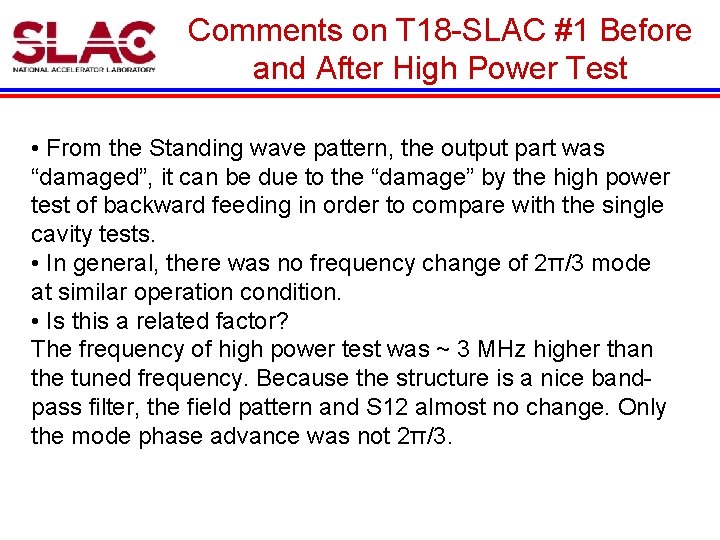
Comments on T 18 -SLAC #1 Before and After High Power Test • From the Standing wave pattern, the output part was “damaged”, it can be due to the “damage” by the high power test of backward feeding in order to compare with the single cavity tests. • In general, there was no frequency change of 2π/3 mode at similar operation condition. • Is this a related factor? The frequency of high power test was ~ 3 MHz higher than the tuned frequency. Because the structure is a nice bandpass filter, the field pattern and S 12 almost no change. Only the mode phase advance was not 2π/3.
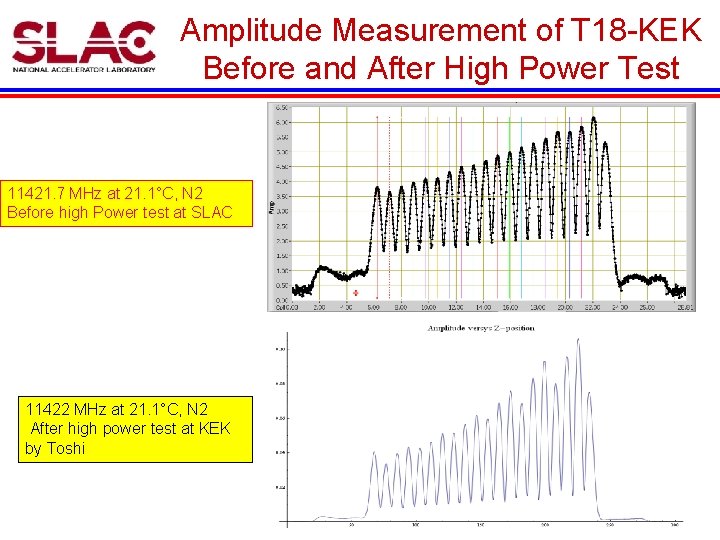
Amplitude Measurement of T 18 -KEK Before and After High Power Test 11421. 7 MHz at 21. 1°C, N 2 Before high Power test at SLAC 11422 MHz at 21. 1°C, N 2 After high power test at KEK by Toshi
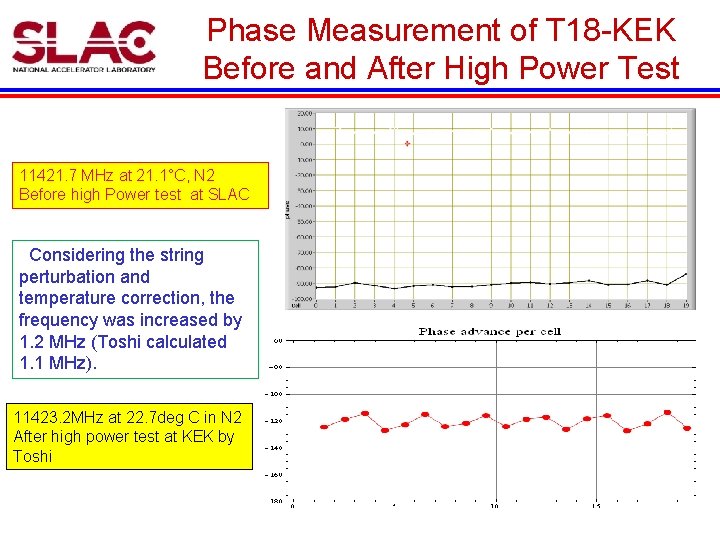
Phase Measurement of T 18 -KEK Before and After High Power Test 11421. 7 MHz at 21. 1°C, N 2 Before high Power test at SLAC Considering the string perturbation and temperature correction, the frequency was increased by 1. 2 MHz (Toshi calculated 1. 1 MHz). 11423. 2 MHz at 22. 7 deg C in N 2 After high power test at KEK by Toshi
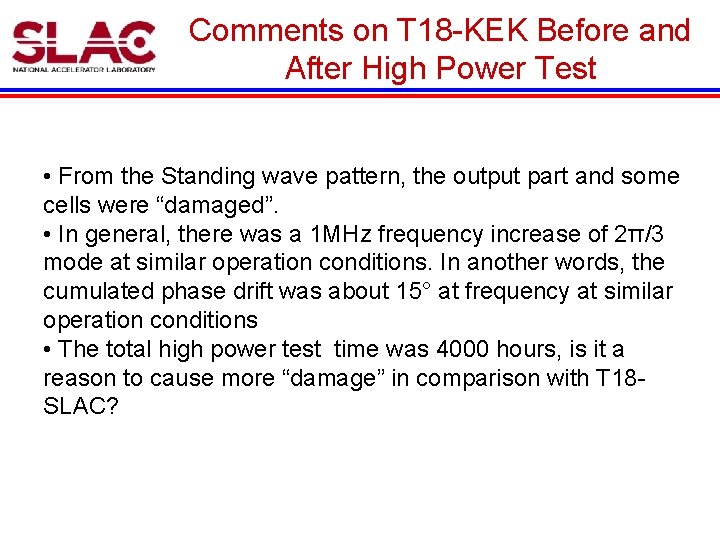
Comments on T 18 -KEK Before and After High Power Test • From the Standing wave pattern, the output part and some cells were “damaged”. • In general, there was a 1 MHz frequency increase of 2π/3 mode at similar operation conditions. In another words, the cumulated phase drift was about 15° at frequency at similar operation conditions • The total high power test time was 4000 hours, is it a reason to cause more “damage” in comparison with T 18 SLAC?
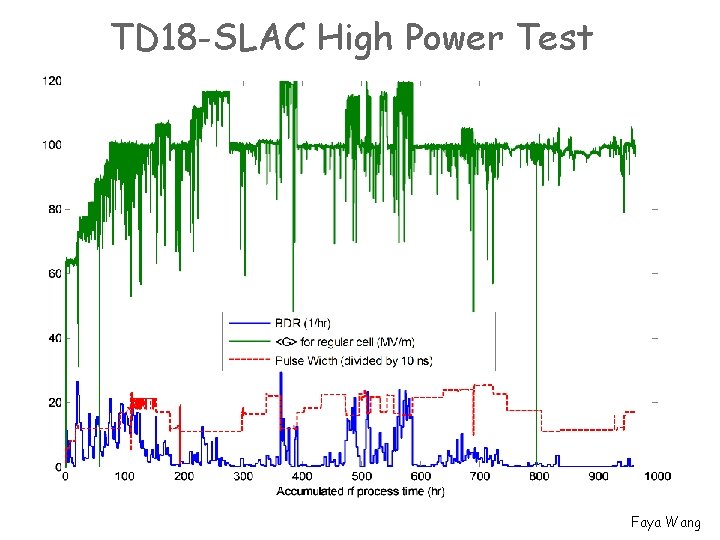
TD 18 -SLAC High Power Test Faya Wang
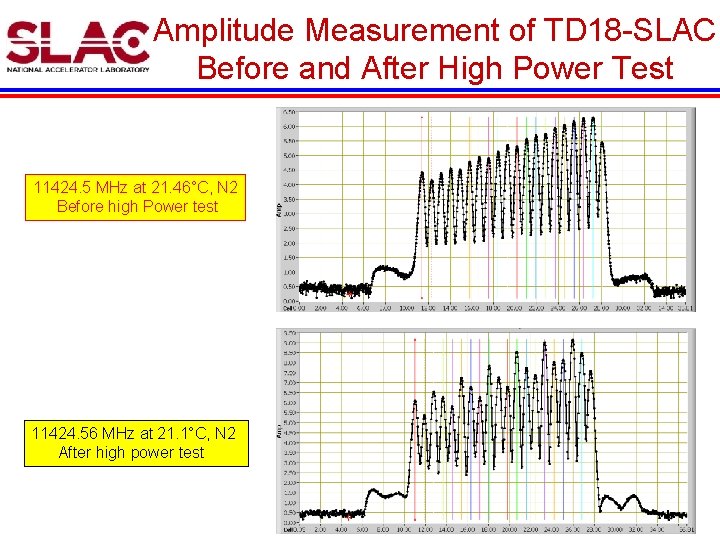
Amplitude Measurement of TD 18 -SLAC Before and After High Power Test 11424. 5 MHz at 21. 46°C, N 2 Before high Power test 11424. 56 MHz at 21. 1°C, N 2 After high power test
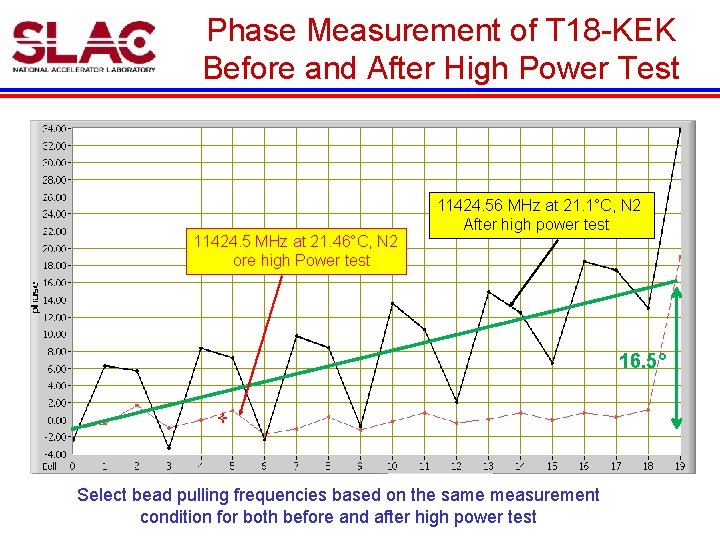
Phase Measurement of T 18 -KEK Before and After High Power Test 11424. 5 MHz at 21. 46°C, N 2 ore high Power test 11424. 56 MHz at 21. 1°C, N 2 After high power test 16. 5° Select bead pulling frequencies based on the same measurement condition for both before and after high power test
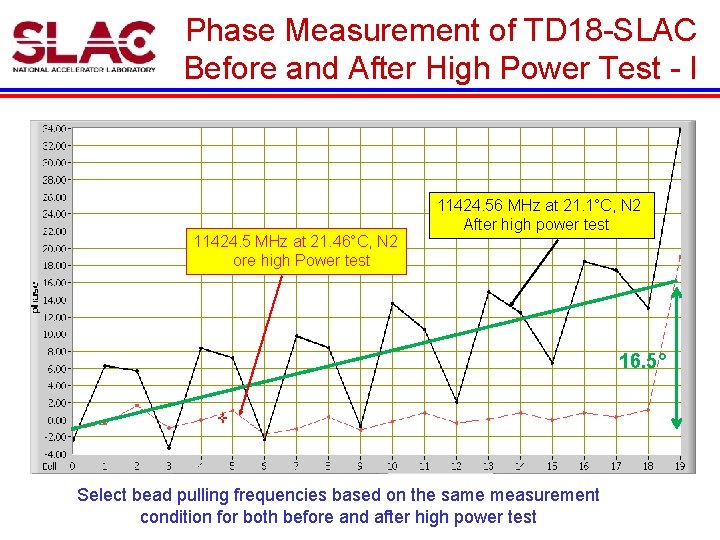
Phase Measurement of TD 18 -SLAC Before and After High Power Test - I 11424. 5 MHz at 21. 46°C, N 2 ore high Power test 11424. 56 MHz at 21. 1°C, N 2 After high power test 16. 5° Select bead pulling frequencies based on the same measurement condition for both before and after high power test
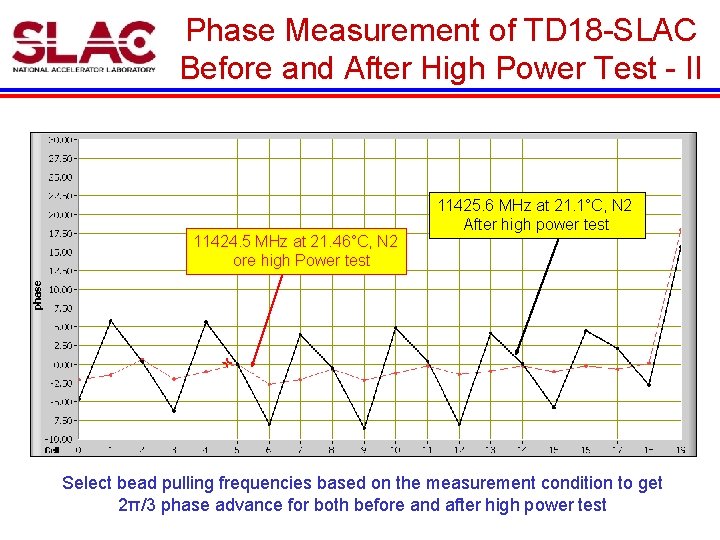
Phase Measurement of TD 18 -SLAC Before and After High Power Test - II 11424. 5 MHz at 21. 46°C, N 2 ore high Power test 11425. 6 MHz at 21. 1°C, N 2 After high power test Select bead pulling frequencies based on the measurement condition to get 2π/3 phase advance for both before and after high power test
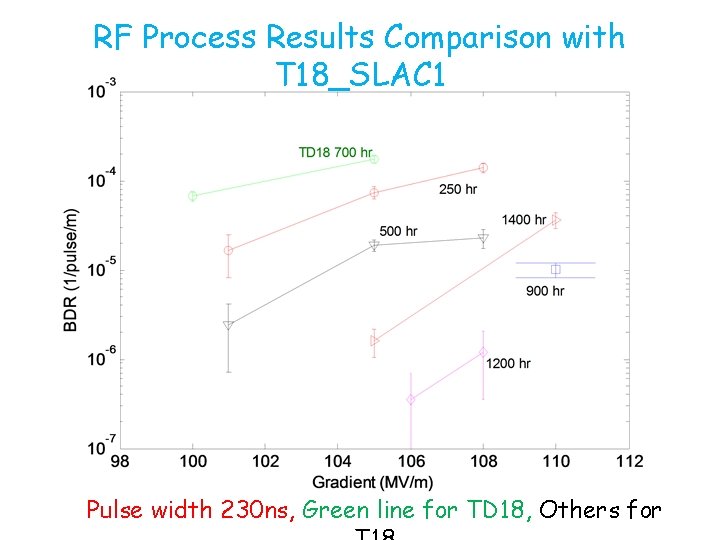
RF Process Results Comparison with T 18_SLAC 1 Pulse width 230 ns, Green line for TD 18, Others for
Comments on TD 18 -SLAC Before and After High Power Test • From the standing wave pattern, the output part and some cells were “damaged”. • In general, there was a 1 MHz frequency increase of 2π/3 mode at similar operation conditions. In another words, the cumulated phase drift was about 16° at frequency at similar operation conditions • The pulse heating for TD 18 structure is higher, but it is believed that the “damages” were still on the disc irises. • The total breakdown event recorded was more than 4000 – only twice higher than T 18 SLAC #1, but the TD 18 breakdown rate measured after 700 hours was higher than T 18 SLAC #1 by factor of 100. The “damage” can be caused at higher power and full pulse width in stead of the process beginning with lower power and short pulse width?
Recall of NLC/GLC structures
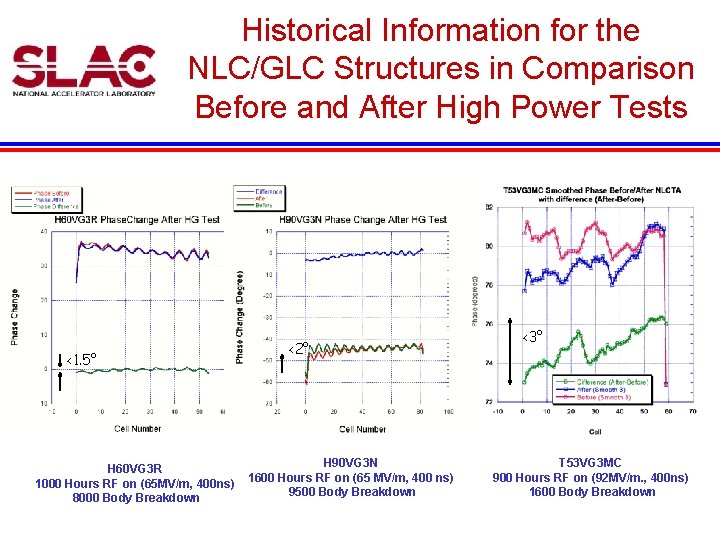
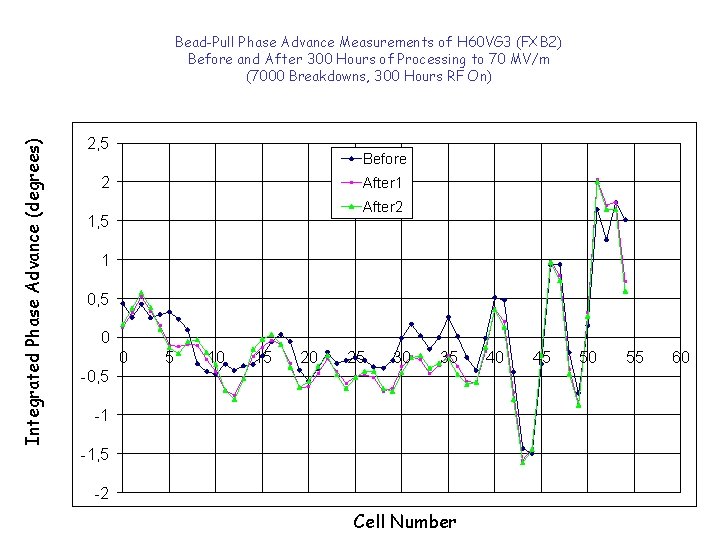
Historical Information for the NLC/GLC Structures in Comparison Before and After High Power Tests <1. 5° H 60 VG 3 R 1000 Hours RF on (65 MV/m, 400 ns) 8000 Body Breakdown <2° H 90 VG 3 N 1600 Hours RF on (65 MV/m, 400 ns) 9500 Body Breakdown <3° T 53 VG 3 MC 900 Hours RF on (92 MV/m. , 400 ns) 1600 Body Breakdown
Integrated Phase Advance (degrees) Bead-Pull Phase Advance Measurements of H 60 VG 3 (FXB 2) Before and After 300 Hours of Processing to 70 MV/m (7000 Breakdowns, 300 Hours RF On) 2, 5 Before 2 After 1 After 2 1, 5 1 0, 5 0 0 5 10 15 20 25 30 35 -0, 5 -1 -1, 5 -2 Cell Number 40 45 50 55 60
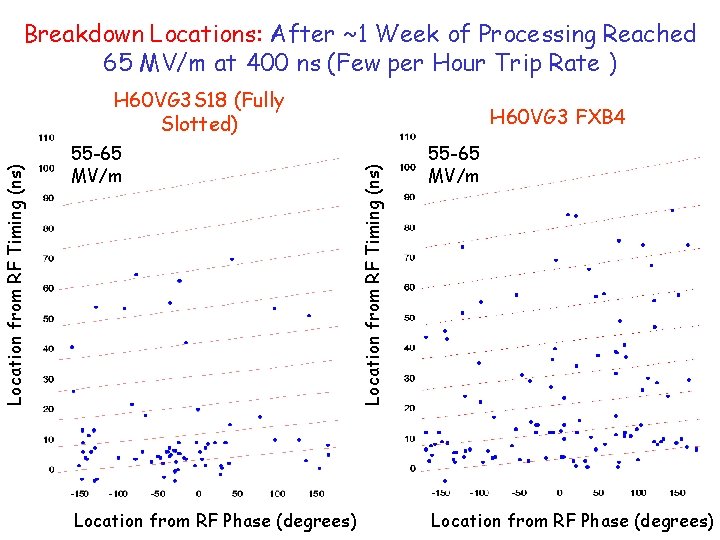
Breakdown Locations: After ~1 Week of Processing Reached 65 MV/m at 400 ns (Few per Hour Trip Rate ) 55 -65 MV/m Location from RF Phase (degrees) H 60 VG 3 FXB 4 Location from RF Timing (ns) H 60 VG 3 S 18 (Fully Slotted) 55 -65 MV/m Location from RF Phase (degrees)
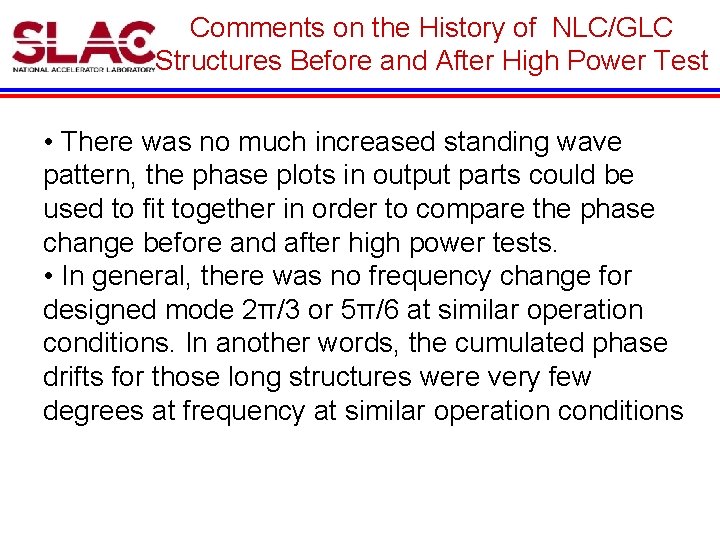
Comments on the History of NLC/GLC Structures Before and After High Power Test • There was no much increased standing wave pattern, the phase plots in output parts could be used to fit together in order to compare the phase change before and after high power tests. • In general, there was no frequency change for designed mode 2π/3 or 5π/6 at similar operation conditions. In another words, the cumulated phase drifts for those long structures were very few degrees at frequency at similar operation conditions
Conclusion We need pay close attention on the measurement (surface and microwave) and analysis of the structure status before and after high gradient operation. It always is a critical issue for the life time and stabilization of the high gradient accelerating structures.