
SLAC Electron Beam Test Facilities 5 Me V
SLAC Electron Beam Test Facilities 5 Me. V to 20 Ge. V FACET ● ESTB ● NLCTA ● ASTA Carsten Hast, SLAC Si. D Workshop, Oct. 15 th, SLAC 2013
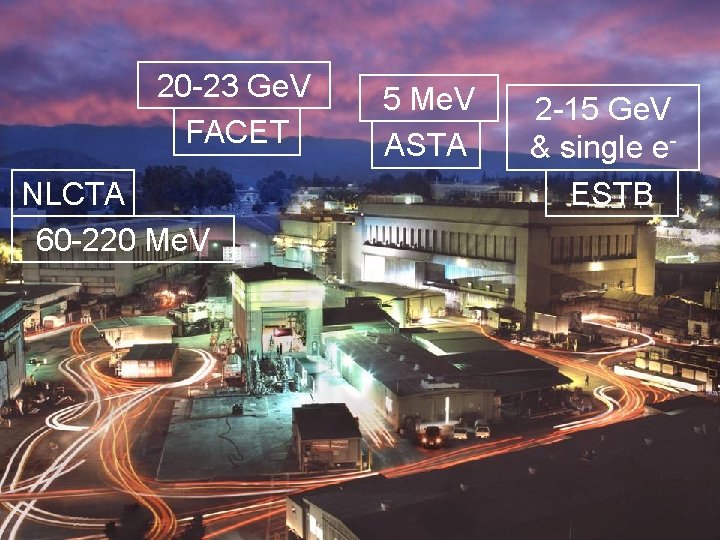
20 -23 Ge. V FACET NLCTA 60 -220 Me. V 5 Me. V ASTA 2 -15 Ge. V & single e. ESTB
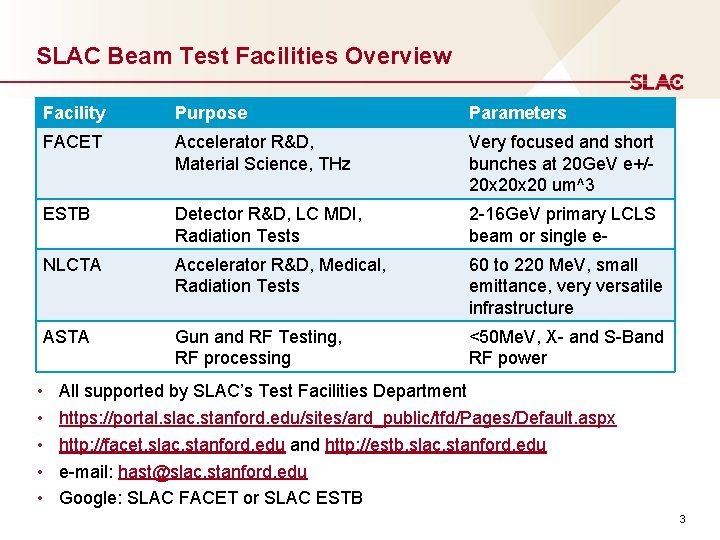
SLAC Beam Test Facilities Overview • • • Facility Purpose Parameters FACET Accelerator R&D, Material Science, THz Very focused and short bunches at 20 Ge. V e+/20 x 20 um^3 ESTB Detector R&D, LC MDI, Radiation Tests 2 -16 Ge. V primary LCLS beam or single e- NLCTA Accelerator R&D, Medical, Radiation Tests 60 to 220 Me. V, small emittance, very versatile infrastructure ASTA Gun and RF Testing, RF processing <50 Me. V, X- and S-Band RF power All supported by SLAC’s Test Facilities Department https: //portal. slac. stanford. edu/sites/ard_public/tfd/Pages/Default. aspx http: //facet. slac. stanford. edu and http: //estb. slac. stanford. edu e-mail: hast@slac. stanford. edu Google: SLAC FACET or SLAC ESTB 3
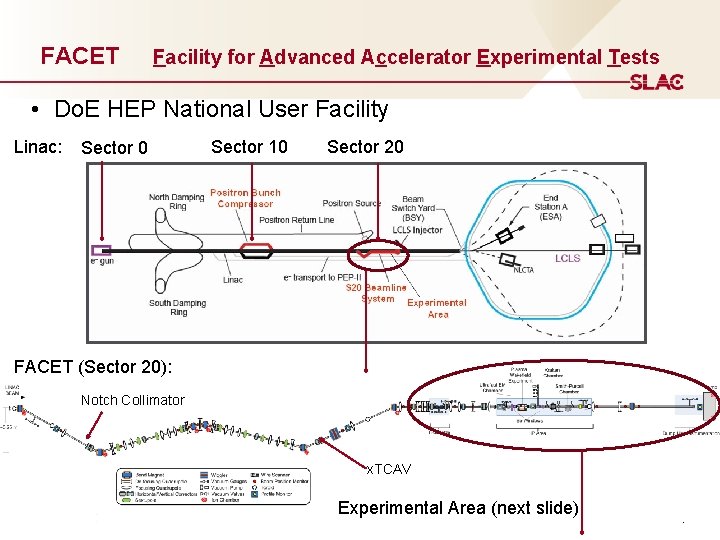
FACET Facility for Advanced Accelerator Experimental Tests • Do. E HEP National User Facility Linac: Sector 0 Sector 10 Sector 20 FACET (Sector 20): Notch Collimator x. TCAV Experimental Area (next slide) 4
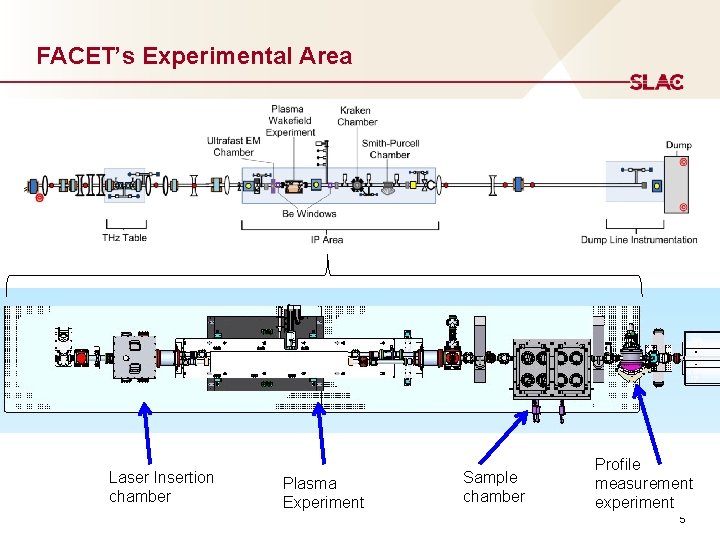
FACET’s Experimental Area Laser Insertion chamber Plasma Experiment Sample chamber Profile measurement experiment 5
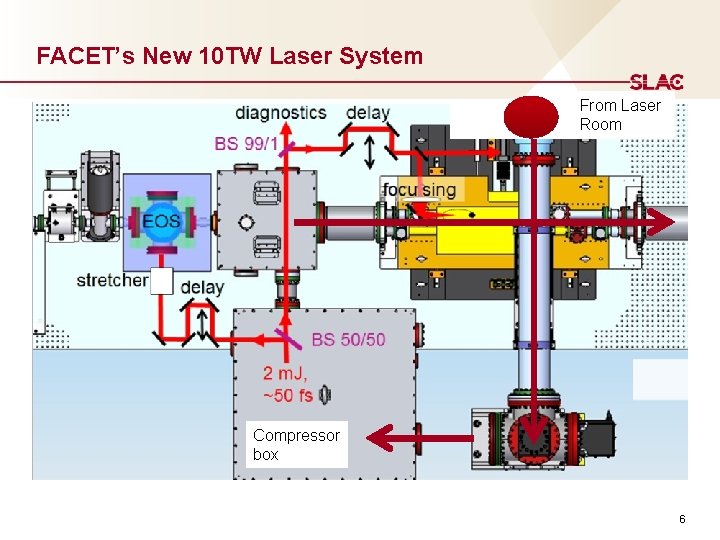
FACET’s New 10 TW Laser System From Laser Room Compressor box 6
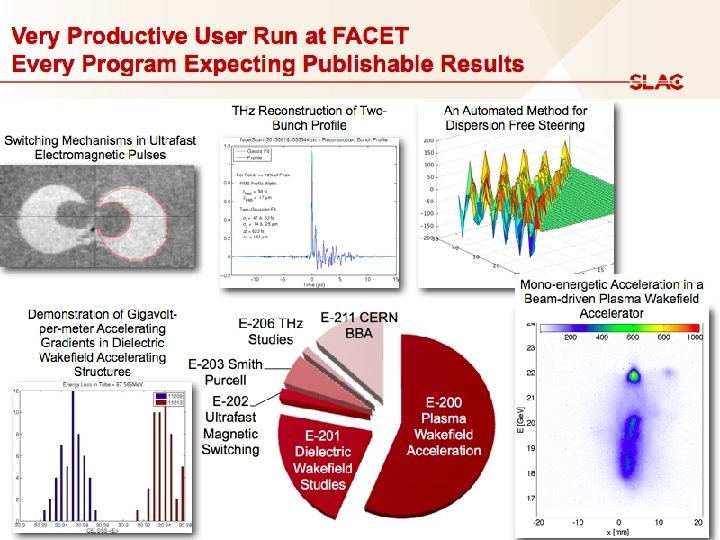
Bunch Length Measurements and Notch Collimator • The time profile of the bunch is important to know at FACET longitudinal bunch profile: Blue curve- fully compressed Green curve uncompressed • Notch Collimator provides drive and witness bunches for wakefield acceleration experiments 7
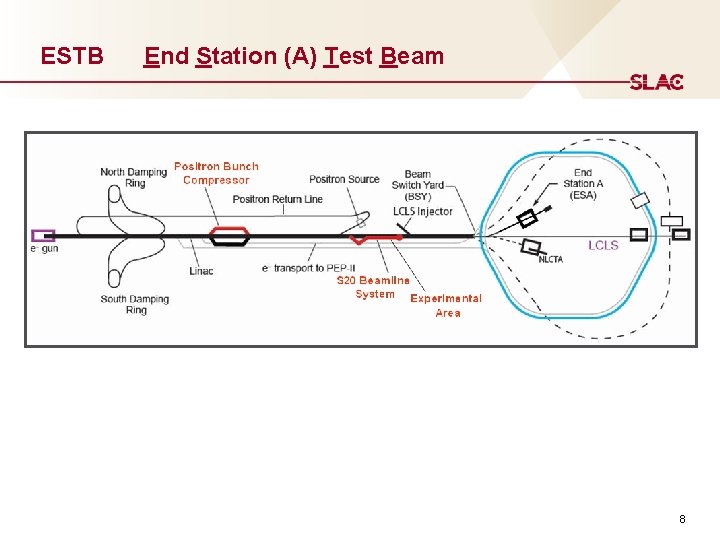
ESTB End Station (A) Test Beam 8
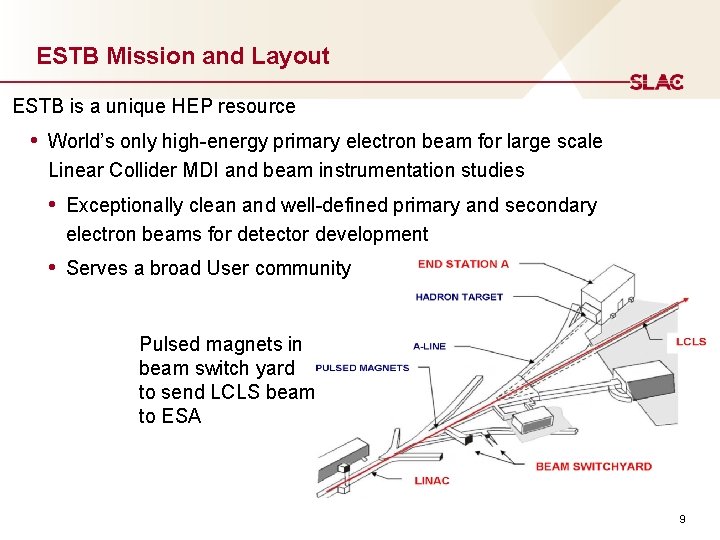
ESTB Mission and Layout ESTB is a unique HEP resource • World’s only high-energy primary electron beam for large scale Linear Collider MDI and beam instrumentation studies • Exceptionally clean and well-defined primary and secondary electron beams for detector development • Serves a broad User community Pulsed magnets in beam switch yard to send LCLS beam to ESA 9
LCLS and ESTB Beams LCLS beam • • Energy: 2. 2 – 16. 0 Ge. V Repetition rate: 120 Hz Beam charge: 20 to 250 p. C (150 p. C typically) Beam availability > 95%! ESTB beam • Kick the LCLS beam into ESA @ 5 Hz - Potential for higher rates when LCLS doesn’t need full rate • Primary beam 2. 2 -16. 0 Ge. V - Determined by LCLS - <1 x 10⁹ e-/pulse (150 p. C) • Clean secondary electrons - 2 Ge. V to 15 Ge. V, 1 e-/pulse to 109 e-/pulse - Momentum resolution way better than 1% 10
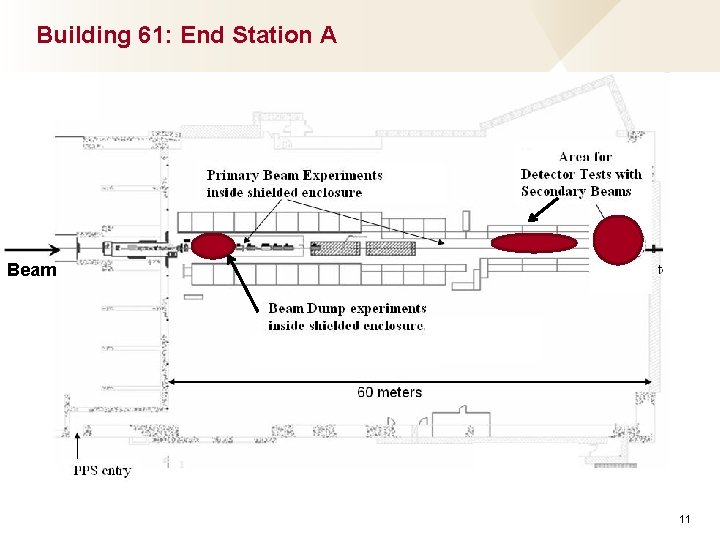
Building 61: End Station A Beam 11
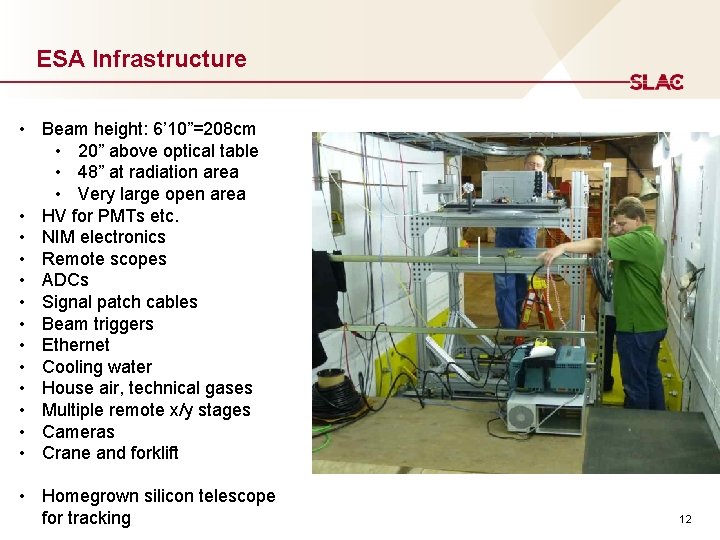
ESA Infrastructure • Beam height: 6’ 10”=208 cm • 20” above optical table • 48” at radiation area • Very large open area • HV for PMTs etc. • NIM electronics • Remote scopes • ADCs • Signal patch cables • Beam triggers • Ethernet • Cooling water • House air, technical gases • Multiple remote x/y stages • Cameras • Crane and forklift • Homegrown silicon telescope for tracking 12
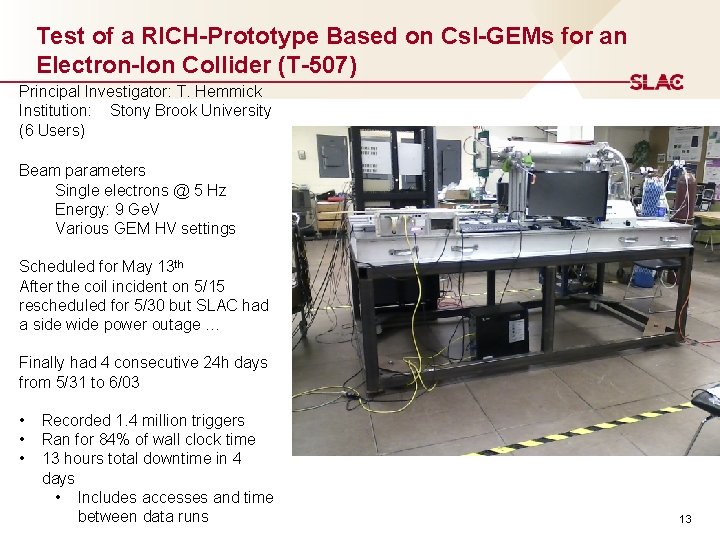
Test of a RICH-Prototype Based on Cs. I-GEMs for an Electron-Ion Collider (T-507) Principal Investigator: T. Hemmick Institution: Stony Brook University (6 Users) Beam parameters Single electrons @ 5 Hz Energy: 9 Ge. V Various GEM HV settings Scheduled for May 13 th After the coil incident on 5/15 rescheduled for 5/30 but SLAC had a side wide power outage … Finally had 4 consecutive 24 h days from 5/31 to 6/03 • • • Recorded 1. 4 million triggers Ran for 84% of wall clock time 13 hours total downtime in 4 days • Includes accesses and time between data runs 13
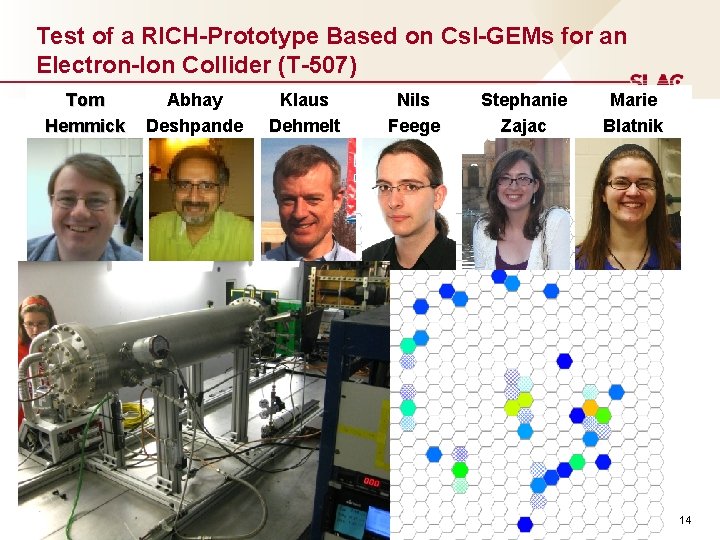
Test of a RICH-Prototype Based on Cs. I-GEMs for an Electron-Ion Collider (T-507) Tom Hemmick Abhay Deshpande Klaus Dehmelt Nils Feege Stephanie Zajac Marie Blatnik 14 14
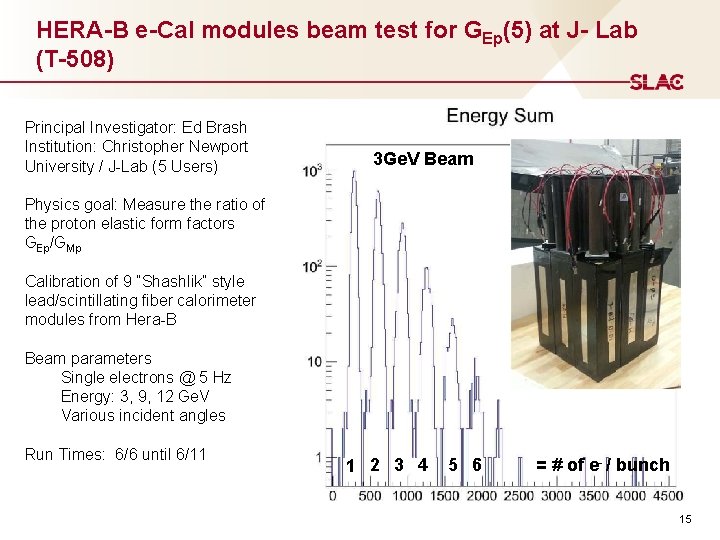
HERA-B e-Cal modules beam test for GEp(5) at J- Lab (T-508) Principal Investigator: Ed Brash Institution: Christopher Newport University / J-Lab (5 Users) 3 Ge. V Beam Physics goal: Measure the ratio of the proton elastic form factors GEp/GMp Calibration of 9 “Shashlik” style lead/scintillating fiber calorimeter modules from Hera-B Beam parameters Single electrons @ 5 Hz Energy: 3, 9, 12 Ge. V Various incident angles Run Times: 6/6 until 6/11 1 2 3 4 5 6 = # of e- / bunch 15
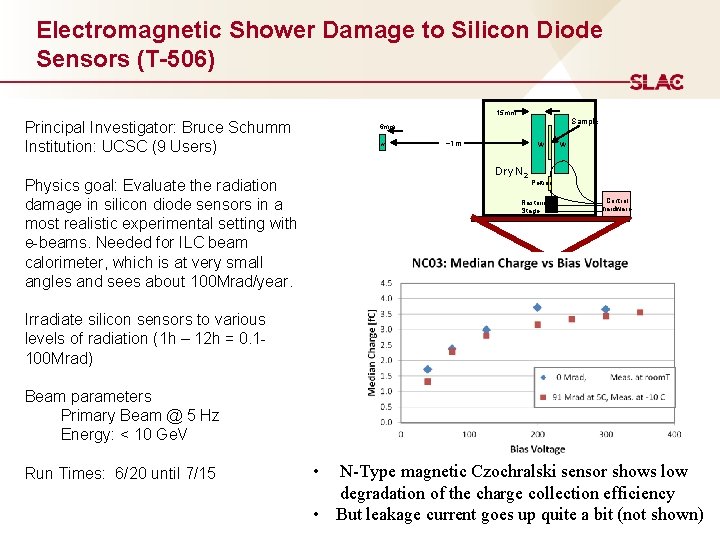
Electromagnetic Shower Damage to Silicon Diode Sensors (T-506) 15 mm Principal Investigator: Bruce Schumm Institution: UCSC (9 Users) Sample 6 mm W ~1 m W Dry N 2 Physics goal: Evaluate the radiation damage in silicon diode sensors in a most realistic experimental setting with e-beams. Needed for ILC beam calorimeter, which is at very small angles and sees about 100 Mrad/year. W Peltier Rastoring Stage Control hardware Irradiate silicon sensors to various levels of radiation (1 h – 12 h = 0. 1100 Mrad) Beam parameters Primary Beam @ 5 Hz Energy: < 10 Ge. V Run Times: 6/20 until 7/15 • N-Type magnetic Czochralski sensor shows low degradation of the charge collection efficiency • But leakage current goes up quite a bit (not shown)
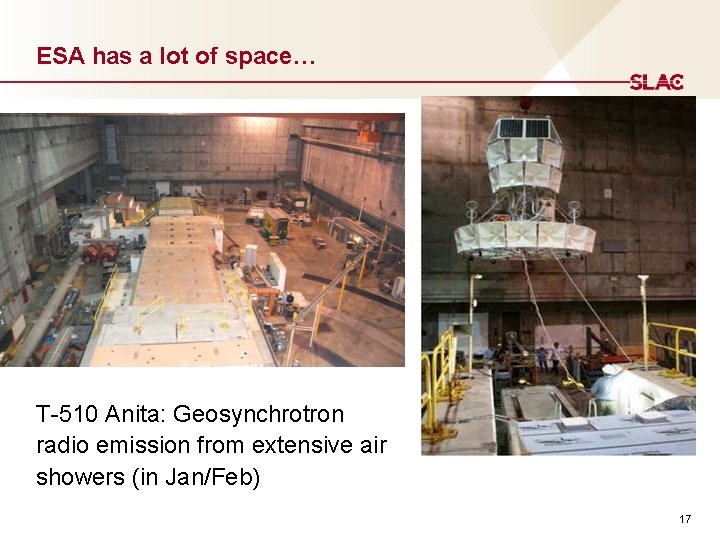
ESA has a lot of space… T-510 Anita: Geosynchrotron radio emission from extensive air showers (in Jan/Feb) 17
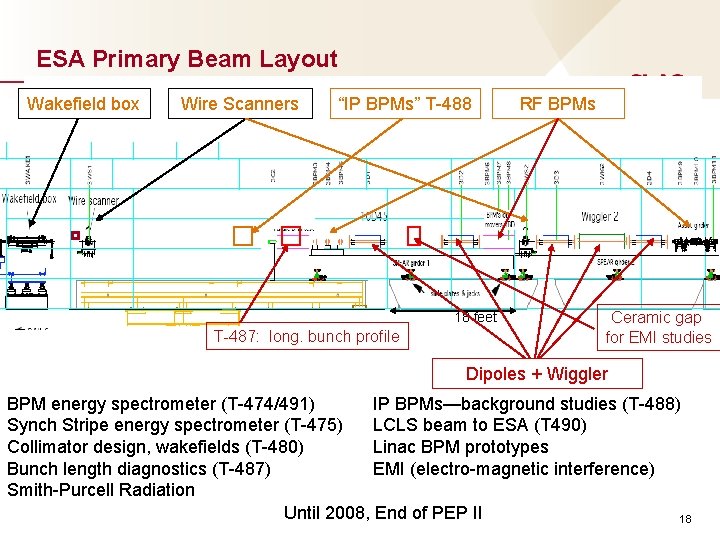
ESA Primary Beam Layout Wakefield box Wire Scanners “IP BPMs” T-488 18 feet T-487: long. bunch profile RF BPMs Ceramic gap for EMI studies Dipoles + Wiggler BPM energy spectrometer (T-474/491) IP BPMs—background studies (T-488) Synch Stripe energy spectrometer (T-475) LCLS beam to ESA (T 490) Collimator design, wakefields (T-480) Linac BPM prototypes Bunch length diagnostics (T-487) EMI (electro-magnetic interference) Smith-Purcell Radiation Until 2008, End of PEP II 18
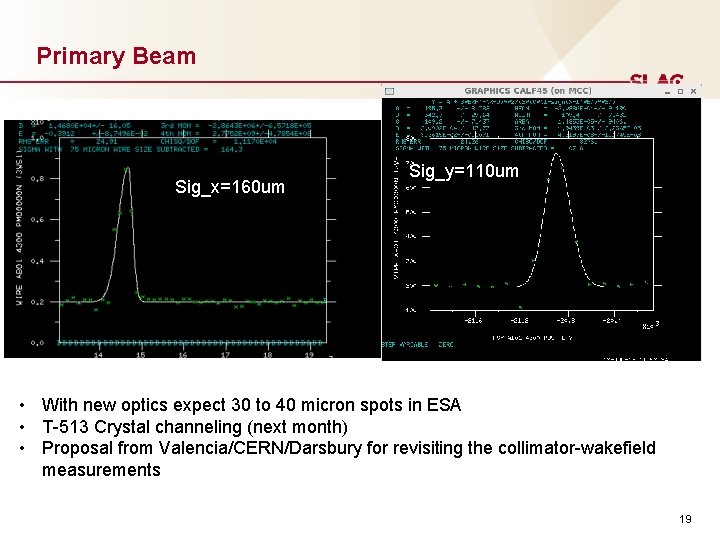
Primary Beam Sig_x=160 um Sig_y=110 um • With new optics expect 30 to 40 micron spots in ESA • T-513 Crystal channeling (next month) • Proposal from Valencia/CERN/Darsbury for revisiting the collimator-wakefield measurements 19
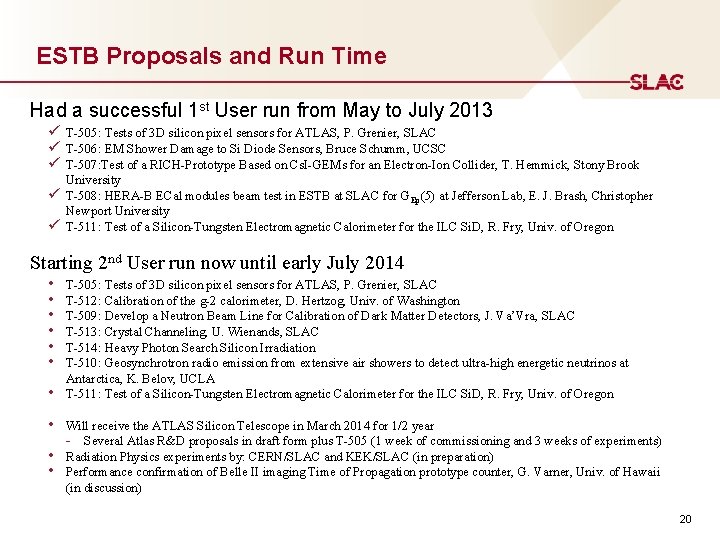
ESTB Proposals and Run Time Had a successful 1 st User run from May to July 2013 ü T-505: Tests of 3 D silicon pixel sensors for ATLAS, P. Grenier, SLAC ü T-506: EM Shower Damage to Si Diode Sensors, Bruce Schumm, UCSC ü T-507: Test of a RICH-Prototype Based on Cs. I-GEMs for an Electron-Ion Collider, T. Hemmick, Stony Brook University ü T-508: HERA-B ECal modules beam test in ESTB at SLAC for G Ep(5) at Jefferson Lab, E. J. Brash, Christopher ü Newport University T-511: Test of a Silicon-Tungsten Electromagnetic Calorimeter for the ILC Si. D, R. Fry, Univ. of Oregon Starting 2 nd User run now until early July 2014 • • T-505: Tests of 3 D silicon pixel sensors for ATLAS, P. Grenier, SLAC T-512: Calibration of the g-2 calorimeter, D. Hertzog, Univ. of Washington T-509: Develop a Neutron Beam Line for Calibration of Dark Matter Detectors, J. Va’Vra, SLAC T-513: Crystal Channeling, U. Wienands, SLAC T-514: Heavy Photon Search Silicon Irradiation T-510: Geosynchrotron radio emission from extensive air showers to detect ultra-high energetic neutrinos at Antarctica, K. Belov, UCLA T-511: Test of a Silicon-Tungsten Electromagnetic Calorimeter for the ILC Si. D, R. Fry, Univ. of Oregon • Will receive the ATLAS Silicon Telescope in March 2014 for 1/2 year - Several Atlas R&D proposals in draft form plus T-505 (1 week of commissioning and 3 weeks of experiments) • Radiation Physics experiments by: CERN/SLAC and KEK/SLAC (in preparation) • Performance confirmation of Belle II imaging Time of Propagation prototype counter, G. Varner, Univ. of Hawaii (in discussion) 20
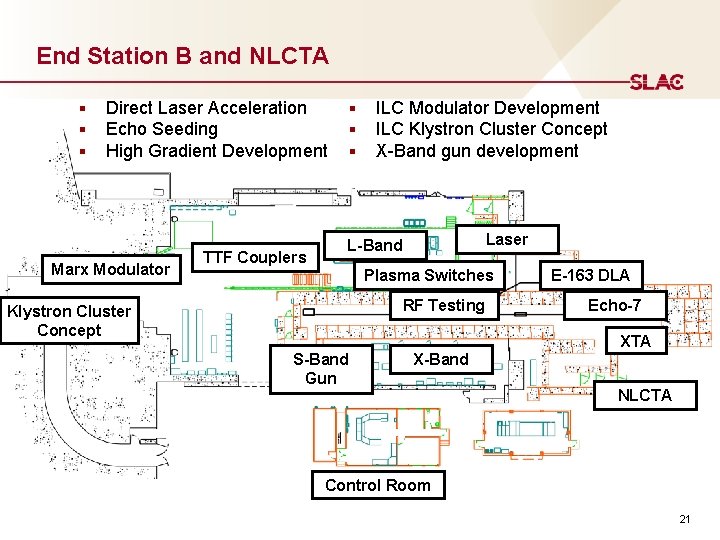
End Station B and NLCTA § § § Direct Laser Acceleration Echo Seeding High Gradient Development Marx Modulator TTF Couplers § § § ILC Modulator Development ILC Klystron Cluster Concept X-Band gun development Laser L-Band Plasma Switches RF Testing Klystron Cluster Concept E-163 DLA Echo-7 XTA S-Band Gun X-Band NLCTA Control Room 21
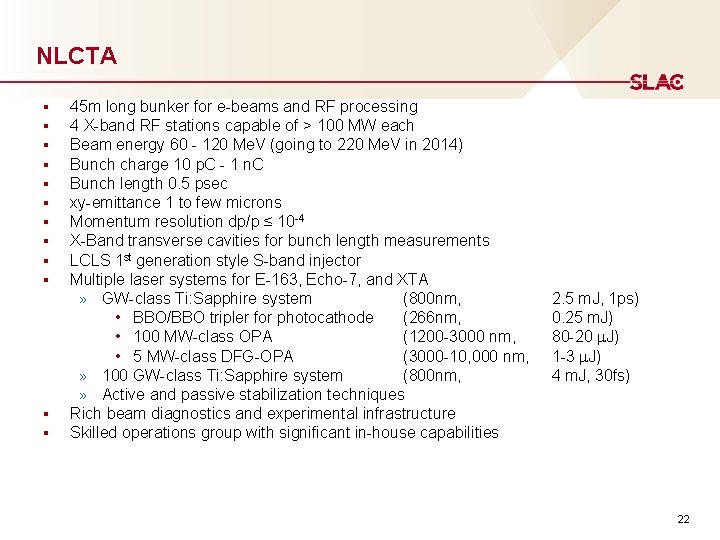
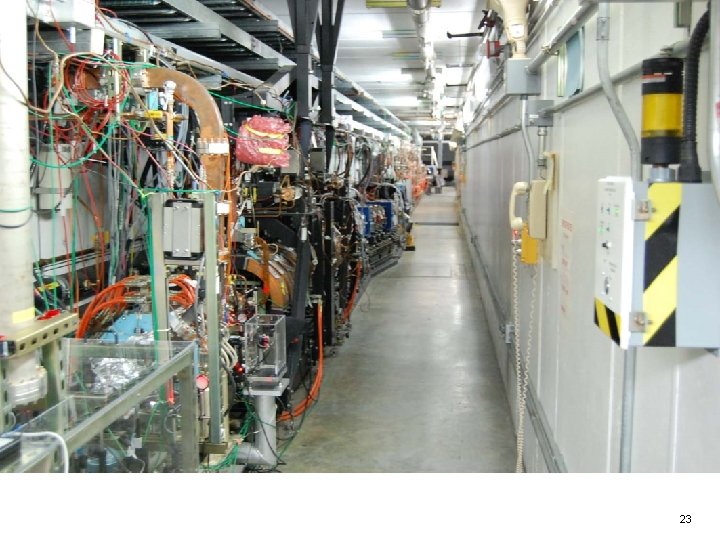
NLCTA § § § 45 m long bunker for e-beams and RF processing 4 X-band RF stations capable of > 100 MW each Beam energy 60 - 120 Me. V (going to 220 Me. V in 2014) Bunch charge 10 p. C - 1 n. C Bunch length 0. 5 psec xy-emittance 1 to few microns Momentum resolution dp/p ≤ 10 -4 X-Band transverse cavities for bunch length measurements LCLS 1 st generation style S-band injector Multiple laser systems for E-163, Echo-7, and XTA » GW-class Ti: Sapphire system (800 nm, • BBO/BBO tripler for photocathode (266 nm, • 100 MW-class OPA (1200 -3000 nm, • 5 MW-class DFG-OPA (3000 -10, 000 nm, » 100 GW-class Ti: Sapphire system (800 nm, » Active and passive stabilization techniques Rich beam diagnostics and experimental infrastructure Skilled operations group with significant in-house capabilities 2. 5 m. J, 1 ps) 0. 25 m. J) 80 -20 m. J) 1 -3 m. J) 4 m. J, 30 fs) 22
23
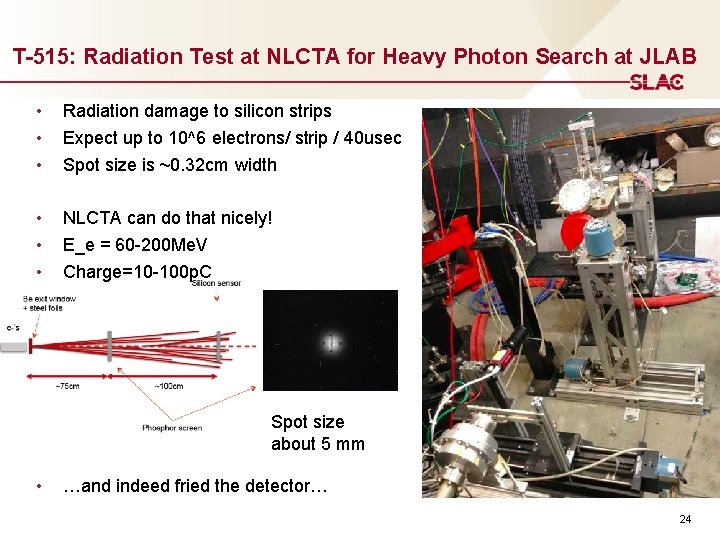
T-515: Radiation Test at NLCTA for Heavy Photon Search at JLAB • • • Radiation damage to silicon strips Expect up to 10^6 electrons/ strip / 40 usec Spot size is ~0. 32 cm width • • • NLCTA can do that nicely! E_e = 60 -200 Me. V Charge=10 -100 p. C Spot size about 5 mm • …and indeed fried the detector… 24
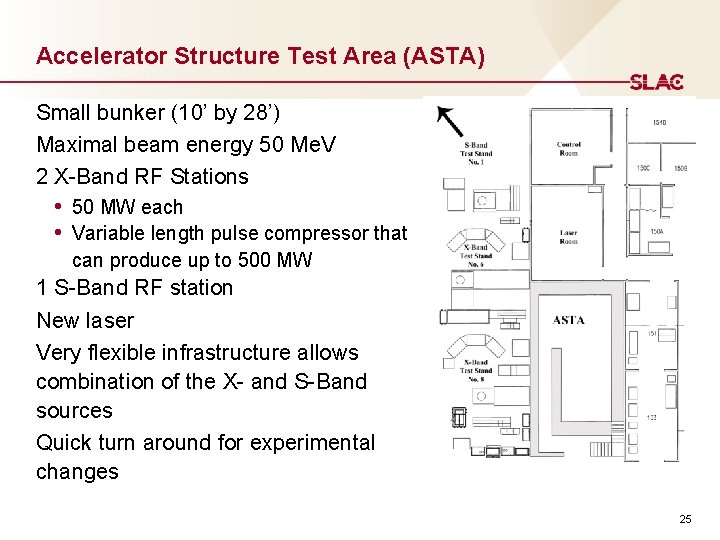
Accelerator Structure Test Area (ASTA) Small bunker (10’ by 28’) Maximal beam energy 50 Me. V 2 X-Band RF Stations • 50 MW each • Variable length pulse compressor that can produce up to 500 MW 1 S-Band RF station New laser Very flexible infrastructure allows combination of the X- and S-Band sources Quick turn around for experimental changes 25
ASTA High Gradient RF Developments - Geometrical Studies • Standing wave accelerator structures • Photonic band gap Structures - Material Studies • • Pulsed heating effects Hard materials Mixed materials Low temperature accelerators - Full Length Accelerator Structures Gun Test Lab • Cathode and gun development with focus on LCLS - In situ cathode QE and e-beam emittance measurements - Cathode performance studies with different laser conditions - Develop laser cleaning methodologies - Load lock system development and hot spare for LCLS Start soon CLIC acceleration structure testing 26
Summary • ASTA-NLCTA-ESTB-FACET span a broad spectrum - e- energy between a few Me. V to 20 Ge. V, and positrons at FACET • Together they cover broad research themes - Novel and better acceleration techniques • RF, X-Band, WFA, DLA, GTL, Seeding - BDL/MDI for Linear Colliders - Detector R&D • User and technical support is via Test Facilities Department • Formal proposal review processes in place for all facilities • Please submit your proposals Need Electrons? Come to SLAC ! 27
- Slides: 27