
Slab deformation and seismicity Thorsten W Becker Lisa
Slab deformation and seismicity Thorsten W. Becker Lisa A. Alpert Iain W. Bailey Melanie Gerault Meghan S. Miller University of Southern California Los Angeles EGU meeting, Vienna April 26, 2012
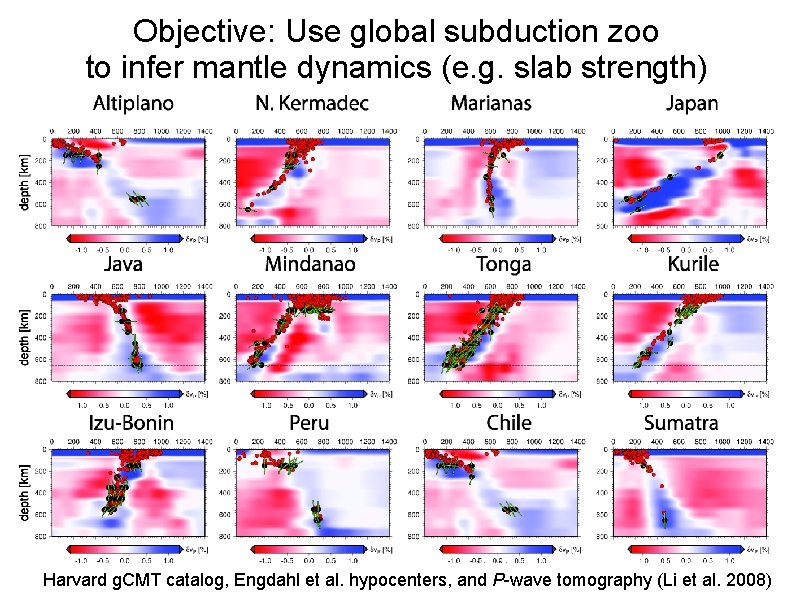
Objective: Use global subduction zoo to infer mantle dynamics (e. g. slab strength) Harvard g. CMT catalog, Engdahl et al. hypocenters, and P-wave tomography (Li et al. 2008)
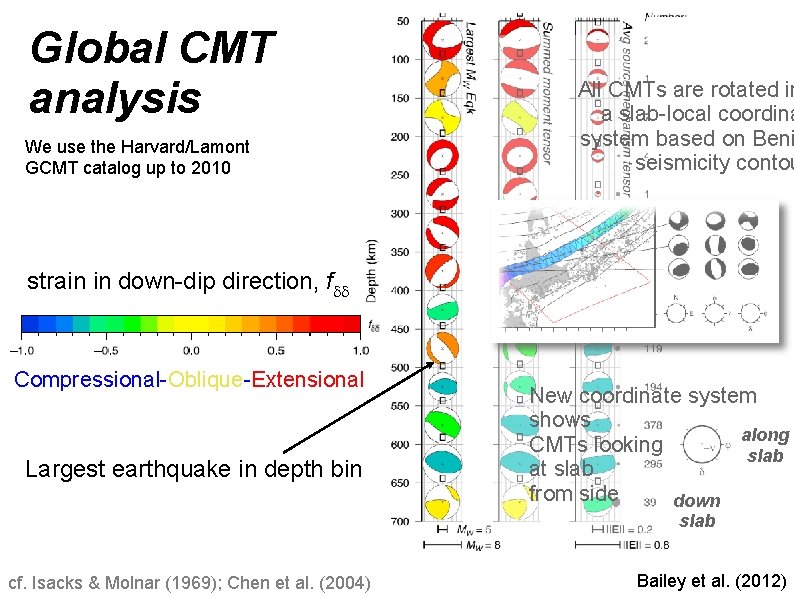
Global CMT analysis All CMTs are rotated in a slab-local coordina system based on Beni seismicity contou We use the Harvard/Lamont GCMT catalog up to 2010 strain in down-dip direction, fdd depth Compressional-Oblique-Extensional Largest earthquake in depth bin New coordinate system shows along CMTs looking slab at slab from side down slab cf. Isacks & Molnar (1969); Chen et al. (2004) Bailey et al. (2012)
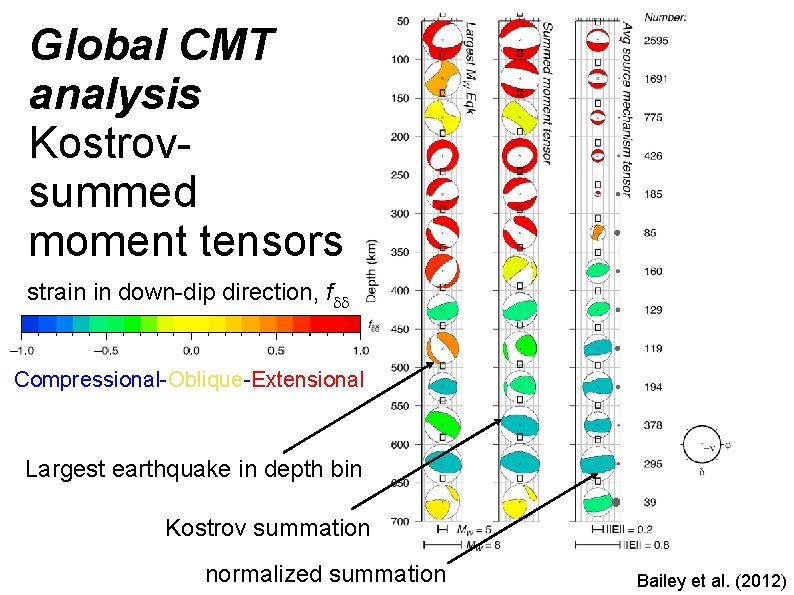
Global CMT analysis Kostrovsummed moment tensors strain in down-dip direction, fdd Compressional-Oblique-Extensional Largest earthquake in depth bin Kostrov summation normalized summation Bailey et al. (2012)
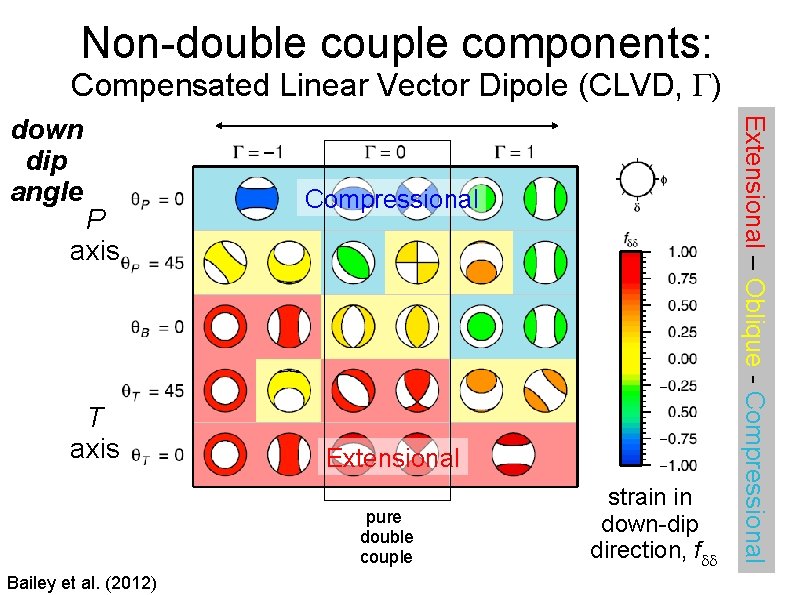
Non-double couple components: Compensated Linear Vector Dipole (CLVD, G) P axis T axis Compressional Extensional pure double couple Bailey et al. (2012) strain in down-dip direction, fdd Extensional – Oblique - Compressional down dip angle
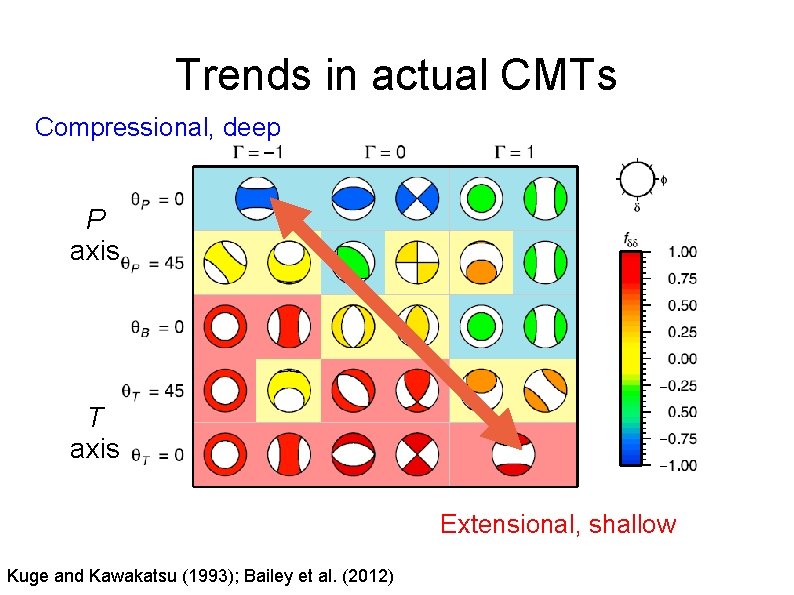
Trends in actual CMTs Compressional, deep P axis T axis Extensional, shallow Kuge and Kawakatsu (1993); Bailey et al. (2012)
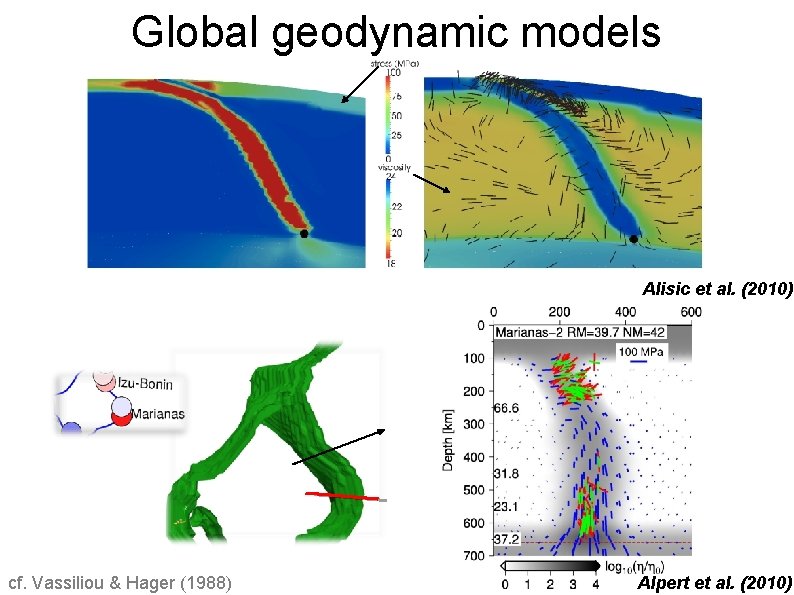
Global geodynamic models Alisic et al. (2010) cf. Vassiliou & Hager (1988) Alpert et al. (2010)
Circulation modeling Incompressible, laminar (Stokes) flow Boundary conditions: weak zones with plate motions driven by density anomalies, or prescribed plate motions Layered viscosity structure, with lateral viscosity variations, Newtonian Density anomalies assigned to Wadati-Benioff zones for slabs Solve with MILAMIN (Dabrowski et al. , 2008) or Citcom. S (Zhong et al. , 2000), with modifications as in Becker & Faccenna (2011) and Gerault et al. (2012) Resolution ~5 – 20 km (global 3 D), 1 km (cylindrical) (Alpert et al. , 2010; Gerault et al. , 2012) 8
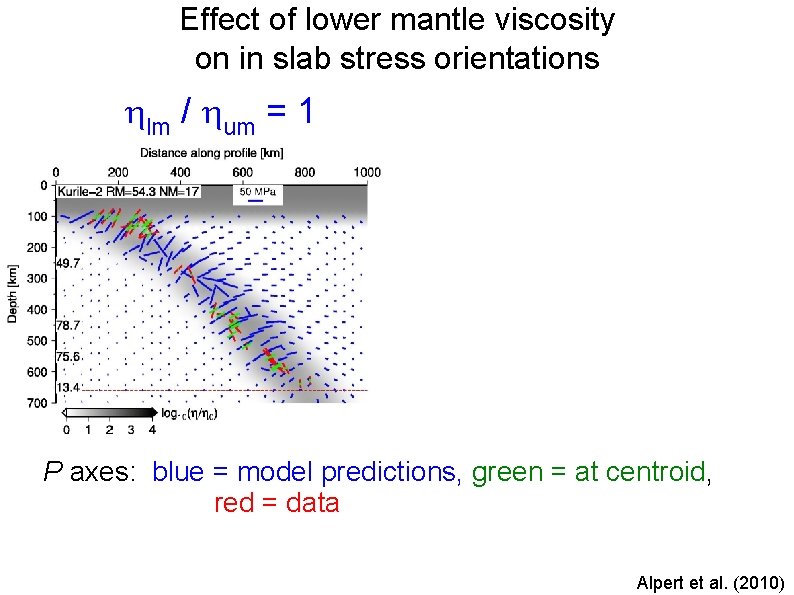
Effect of lower mantle viscosity on in slab stress orientations hlm / hum = 1 ηslab/ηmantle = 100 P axes: blue = model predictions, green = at centroid, red = data Alpert et al. (2010)
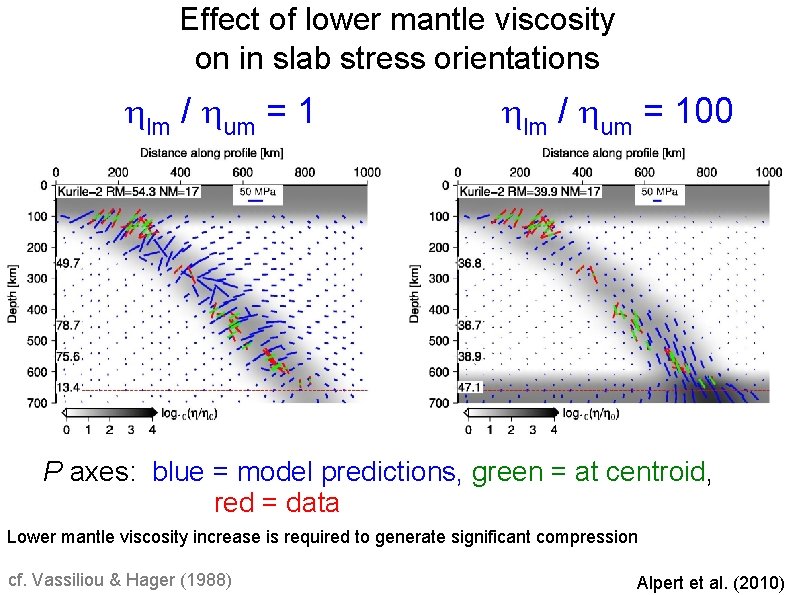
Effect of lower mantle viscosity on in slab stress orientations hlm / hum = 100 ηslab/ηmantle = 100 P axes: blue = model predictions, green = at centroid, red = data Lower mantle viscosity increase is required to generate significant compression cf. Vassiliou & Hager (1988) Alpert et al. (2010)
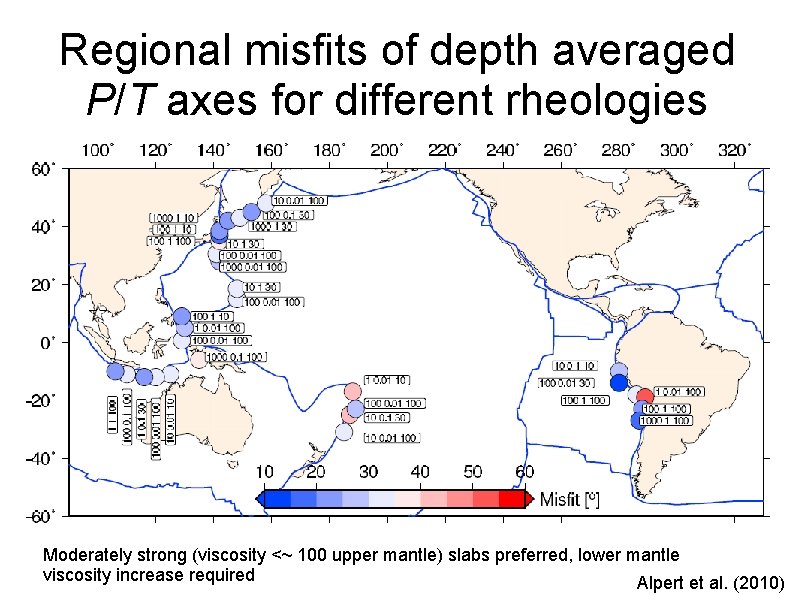
Regional misfits of depth averaged P/T axes for different rheologies Moderately strong (viscosity <~ 100 upper mantle) slabs preferred, lower mantle viscosity increase required Alpert et al. (2010)
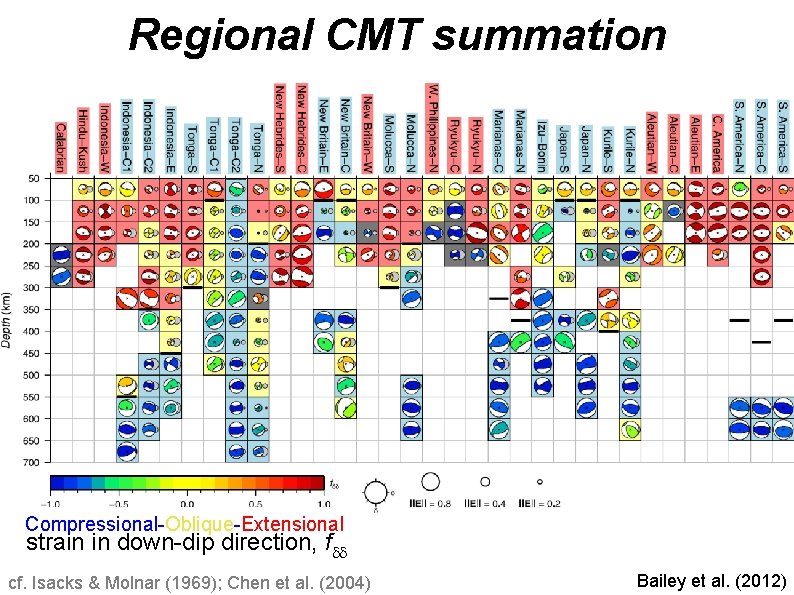
Regional CMT summation Compressional-Oblique-Extensional strain in down-dip direction, fdd cf. Isacks & Molnar (1969); Chen et al. (2004) Bailey et al. (2012)
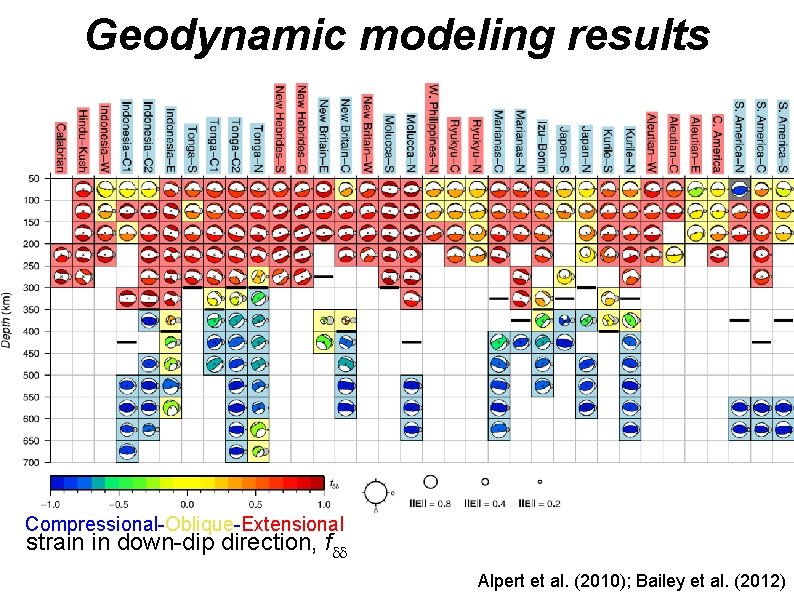
Geodynamic modeling results Compressional-Oblique-Extensional strain in down-dip direction, fdd Alpert et al. (2010); Bailey et al. (2012)
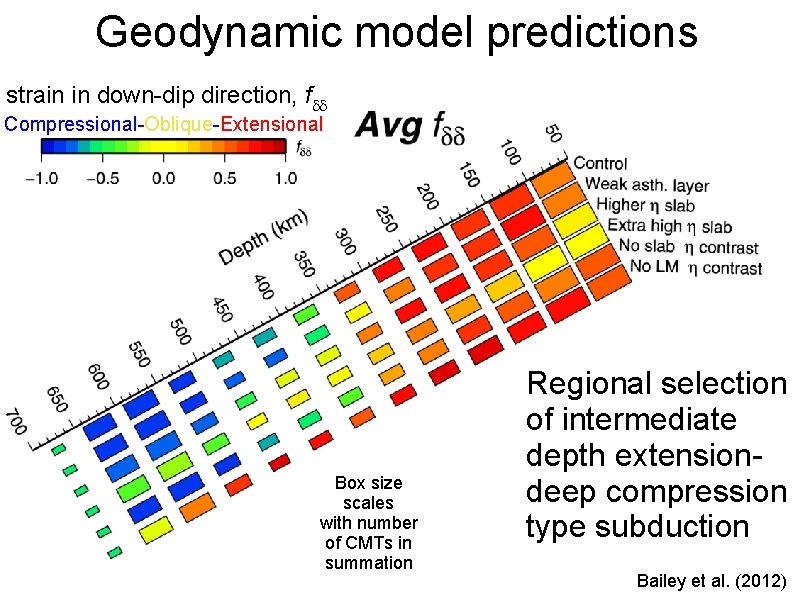
Geodynamic model predictions strain in down-dip direction, fdd Compressional-Oblique-Extensional Box size scales with number of CMTs in summation Regional selection of intermediate depth extensiondeep compression type subduction Bailey et al. (2012)
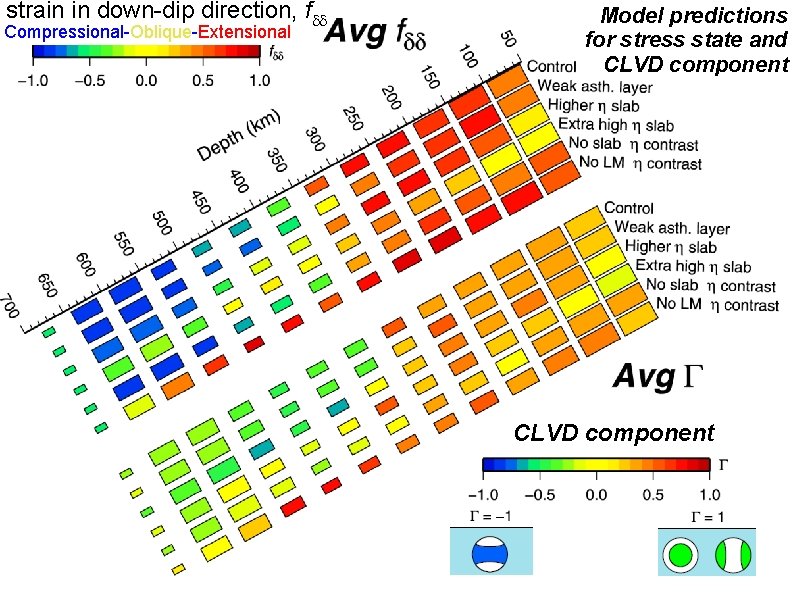
strain in down-dip direction, fdd Compressional-Oblique-Extensional Model predictions for stress state and CLVD component
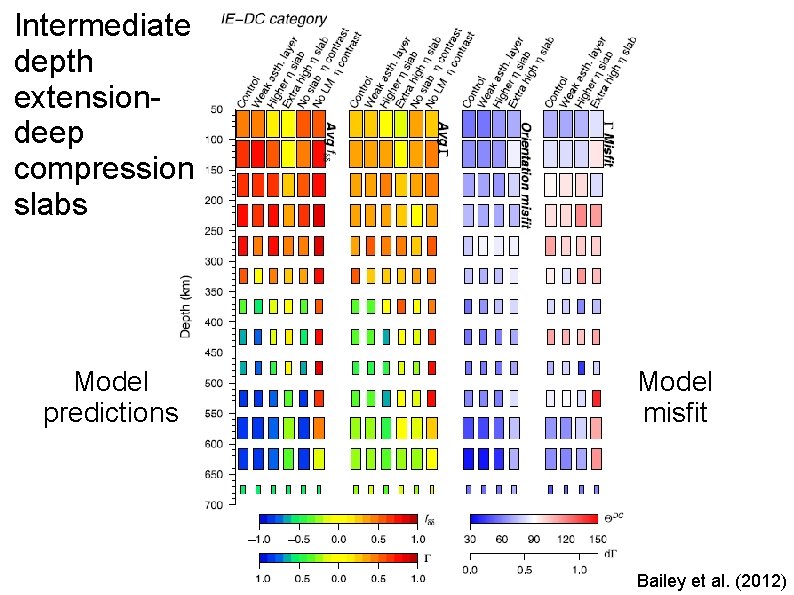
Intermediate depth extensiondeep compression slabs Model predictions Model misfit Bailey et al. (2012)
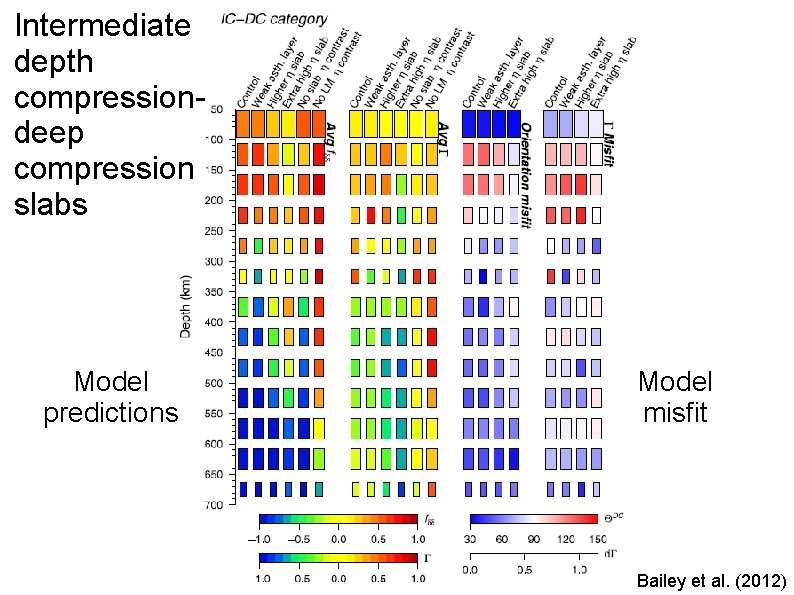
Intermediate depth compressiondeep compression slabs Model predictions Model misfit Bailey et al. (2012)
Conclusions Global circulation models provide good (“reference”? ) fit to deep, co-seismic slab deformation style world wide (Newtonian, isotropic flow works) Moderately strong slabs (viscosity ~100 upper mantle) and ~50 viscosity increase in lower mantle preferred Non double couple (CLVD) components of CMTs, and dependency of CLVD style on major stress axis, are newly predicted by fluid models
- Slides: 18