
Skull cranial bones extra handout By Dr Mohsen
Skull & cranial bones extra handout By Dr. Mohsen Dashti Imaging Procedures 362 March 15 & 18, 2009 Mosby items and derived items © 2007, 2003, 1999 by Mosby, Inc. , an affiliate of Elsevier Inc.
Anatomy Review Skull Mosby items and derived items © 2007, 2003, 1999 by Mosby, Inc. , an affiliate of Elsevier Inc. Slide 2
Skull Anatomy Comprised of 22 separate bones divided into two groups: Cranial bones – 8 Ø Facial bones – 14 Ø Cranial bones further subdivided into Calvaria Ø Floor Ø Mosby items and derived items © 2007, 2003, 1999 by Mosby, Inc. , an affiliate of Elsevier Inc. Slide 3
Skull Anatomy Diploë = inner layer of spongy bone separating two outer plates of compact tissue Ø Composition of calvarium bones Mosby items and derived items © 2007, 2003, 1999 by Mosby, Inc. , an affiliate of Elsevier Inc. Slide 4
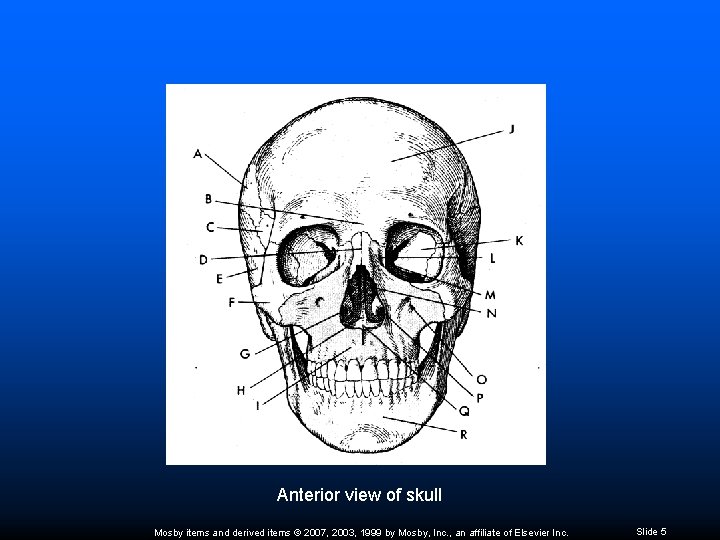
Anterior view of skull Mosby items and derived items © 2007, 2003, 1999 by Mosby, Inc. , an affiliate of Elsevier Inc. Slide 5
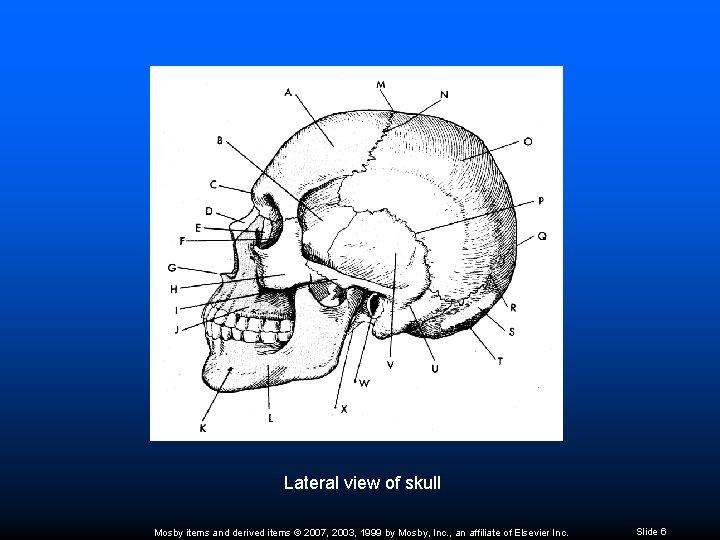
Lateral view of skull Mosby items and derived items © 2007, 2003, 1999 by Mosby, Inc. , an affiliate of Elsevier Inc. Slide 6
Cranial Bones Calvaria Frontal Ø Occipital Ø R. parietal Ø L. parietal Ø Floor Ethmoid Ø Sphenoid Ø R. temporal Ø L. temporal Ø Mosby items and derived items © 2007, 2003, 1999 by Mosby, Inc. , an affiliate of Elsevier Inc. Slide 7
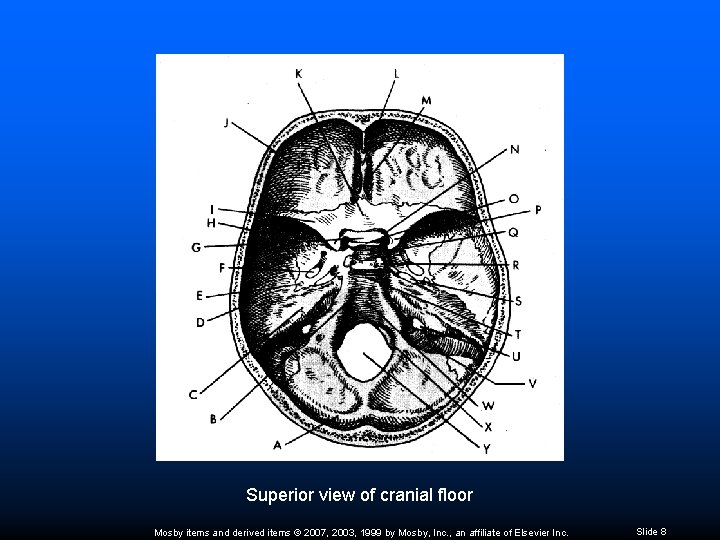
Superior view of cranial floor Mosby items and derived items © 2007, 2003, 1999 by Mosby, Inc. , an affiliate of Elsevier Inc. Slide 8
Skull Anatomy Sutures = fibrous joints that connect the bones of the skull Coronal = between frontal and parietal bones Ø Sagittal = on top of head between two parietal bones Ø Squamosal = between temporal bone and the parietal bones Ø Lambdoidal = between occipital and the parietal bones Ø Mosby items and derived items © 2007, 2003, 1999 by Mosby, Inc. , an affiliate of Elsevier Inc. Slide 9

Skull Anatomy Bregma = junction of coronal and sagittal sutures Lambda = junction of sagittal and lambdoidal suture Fontanels = areas of incomplete ossification in Infant skulls, i. e. , “soft spots” Adult cranial size usually achieved by age 12 Mosby items and derived items © 2007, 2003, 1999 by Mosby, Inc. , an affiliate of Elsevier Inc. Slide 10
Cranial Floor Internally, divided into three regions Anterior cranial fossa – houses frontal lobes of cerebrum; extends from anterior frontal bone to lesser wings of sphenoid Ø Middle cranial fossa – houses temporal lobes; extends from lesser wings of sphenoid to apices of petrous ridges Ø Posterior cranial fossa – deep depression posterior to petrous ridges; protects cerebellum, pons, and medulla oblongata Ø Mosby items and derived items © 2007, 2003, 1999 by Mosby, Inc. , an affiliate of Elsevier Inc. Slide 11
Skull Morphology Typical skull = mesocephalic Ø Petrous pyramids project anteriorly and medially at angle of 47 degrees from MSP Brachycephalic skull Petrous pyramids project anteriorly and medially at angle of 54 degrees from MSP Ø Short from front to back, broad from side to side, and shallow from vertex to base Ø Mosby items and derived items © 2007, 2003, 1999 by Mosby, Inc. , an affiliate of Elsevier Inc. Slide 12
Skull Morphology Dolichocephalic skull Petrous pyramids project anteriorly and medially at angle of 40 degrees from MSP Ø Long from front to back, narrow from side to side, and deep from vertex to base Ø Asymmetry of outer features should be noted while positioning; for example, the nose may not always be in the midline Mosby items and derived items © 2007, 2003, 1999 by Mosby, Inc. , an affiliate of Elsevier Inc. Slide 13
Frontal Bone Has vertical portion (frontal squama) and horizontal portions Frontal squama forms forehead anterior part of cranial vault Horizontal portions form orbital plates, part of roof of nasal cavity, and greater part of anterior cranial fossa Mosby items and derived items © 2007, 2003, 1999 by Mosby, Inc. , an affiliate of Elsevier Inc. Slide 14
Frontal Bone Landmarks to note Frontal eminences Ø Supraorbital margins Ø Supraciliary arches Ø Supraorbital foramina Ø Glabella Ø Mosby items and derived items © 2007, 2003, 1999 by Mosby, Inc. , an affiliate of Elsevier Inc. Slide 15
Frontal Bone Frontal sinuses contained between the two tables of squama on each side of MSP Articulates with R and L parietals, sphenoid, and ethmoid, nasal bones, and zygoma Mosby items and derived items © 2007, 2003, 1999 by Mosby, Inc. , an affiliate of Elsevier Inc. Slide 16
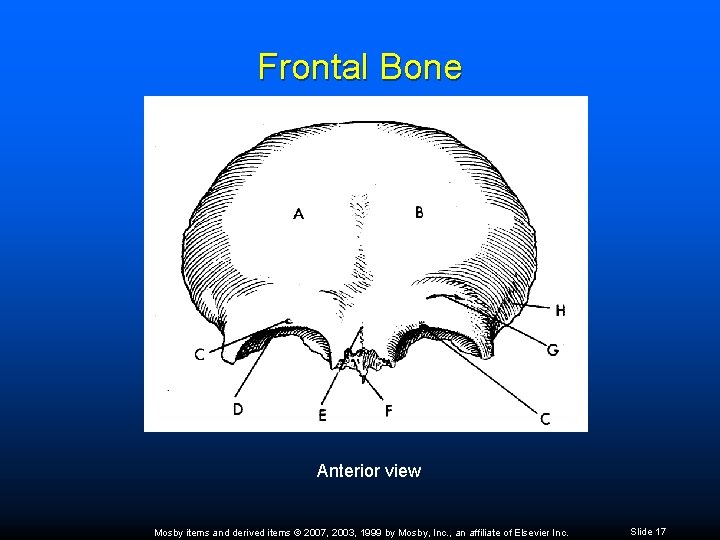
Frontal Bone Anterior view Mosby items and derived items © 2007, 2003, 1999 by Mosby, Inc. , an affiliate of Elsevier Inc. Slide 17
Ethmoid Bone Consists of Horizontal plate Ø Vertical plate Ø Two light, spongy masses = labyrinths Ø Mosby items and derived items © 2007, 2003, 1999 by Mosby, Inc. , an affiliate of Elsevier Inc. Slide 18
Ethmoid Bone Located between the orbits and forms part of anterior cranial fossa, nasal cavity, orbital walls, and bony nasal septum Horizontal portion is called cribriform plate Mosby items and derived items © 2007, 2003, 1999 by Mosby, Inc. , an affiliate of Elsevier Inc. Slide 19
Ethmoid Bone Cribriform plate contains numerous foramina for transmission of olfactory nerves Crista galli = conical projection at anterior midline of cribriform plate Perpendicular plate = vertical portion; forms superior portion of bony nasal septum Mosby items and derived items © 2007, 2003, 1999 by Mosby, Inc. , an affiliate of Elsevier Inc. Slide 20
Ethmoid Bone Labyrinths Contain ethmoid sinuses or air cells Ø Walls form part of medial walls of orbits and lateral walls of nasal cavity Ø Have two thin, scroll-shaped projections = superior and middle nasal conchae Ø Articulates with frontal, sphenoid, lacrimal, maxilla, and vomer Mosby items and derived items © 2007, 2003, 1999 by Mosby, Inc. , an affiliate of Elsevier Inc. Slide 21
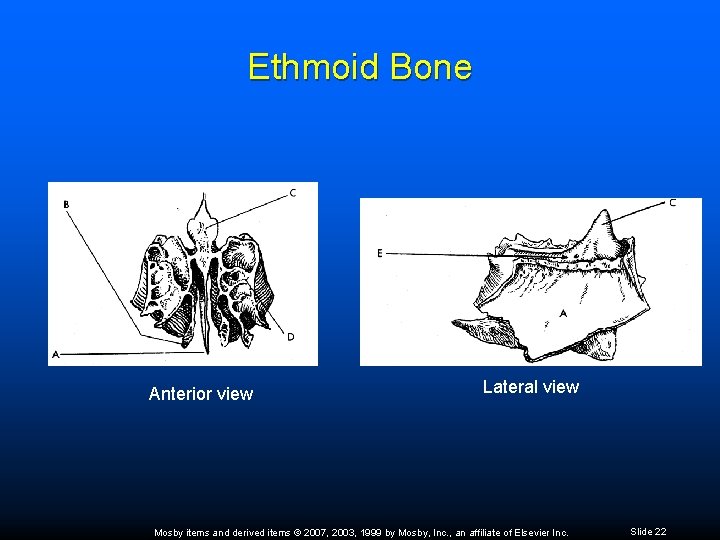
Ethmoid Bone Anterior view Lateral view Mosby items and derived items © 2007, 2003, 1999 by Mosby, Inc. , an affiliate of Elsevier Inc. Slide 22
Parietal Bones Somewhat square-shaped Have a convex external surface and concave internal surface Parietal eminence = prominent bulge near center of external surface of each bone Ø This is the point where the width of the skull should be measured to set technique Mosby items and derived items © 2007, 2003, 1999 by Mosby, Inc. , an affiliate of Elsevier Inc. Slide 23
Parietal Bones Articulate with each other at the sagittal suture in MSP, the frontal, temporal, occipital, and sphenoid bones Mosby items and derived items © 2007, 2003, 1999 by Mosby, Inc. , an affiliate of Elsevier Inc. Slide 24
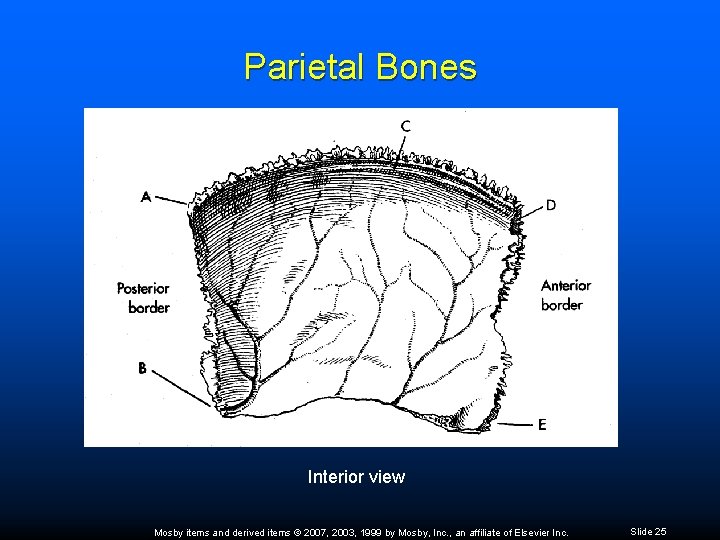
Parietal Bones Interior view Mosby items and derived items © 2007, 2003, 1999 by Mosby, Inc. , an affiliate of Elsevier Inc. Slide 25
Sphenoid Bone Irregular, wedge-shaped bone that resembles a bat (somewhat) Located in base of cranium anterior to temporal bones and basilar portion of occipital Mosby items and derived items © 2007, 2003, 1999 by Mosby, Inc. , an affiliate of Elsevier Inc. Slide 26
Sphenoid Bone Consists of Body Ø Two lesser wings Ø Two greater wings Ø Two pterygoid processes Ø Mosby items and derived items © 2007, 2003, 1999 by Mosby, Inc. , an affiliate of Elsevier Inc. Slide 27
Sphenoid Bone Body contains two sphenoid sinuses and forms posterior bony wall of nasal cavity Sella turcica = deep depression on superior surface of body Houses pituitary gland Ø Located in MSP of cranium ¾ anterior and superior to EAM Ø Mosby items and derived items © 2007, 2003, 1999 by Mosby, Inc. , an affiliate of Elsevier Inc. Slide 28
Sphenoid Bone Tuberculum sellae = anterior border of sella Dorsum sellae = posterior border of sella Posterior clinoid processes = top borders of dorsum Mosby items and derived items © 2007, 2003, 1999 by Mosby, Inc. , an affiliate of Elsevier Inc. Slide 29
Sphenoid Bone Clivus = slanted area of bone posterior and inferior to dorsum Continuous with basilar area of occipital Ø Supports pons of the brain Ø Optic groove extends across anterior portion of tuberculum sellae Ø Groove ends on each side at the optic canal Mosby items and derived items © 2007, 2003, 1999 by Mosby, Inc. , an affiliate of Elsevier Inc. Slide 30
Sphenoid Bone Optic canal = opening into the apex of orbit for transmission of optic nerve and ophthalmic artery Ø Actual opening is termed optic foramen Mosby items and derived items © 2007, 2003, 1999 by Mosby, Inc. , an affiliate of Elsevier Inc. Slide 31
Sphenoid Bone Lesser wings arise from anterior and superior portion of body and lie horizontally on each side Form posteromedial portion of orbital roofs, the posterior portion of anterior cranial fossa, upper margin of superior orbital fissure, and optic canals Ø Medial ends form the anterior clinoid processes Ø Mosby items and derived items © 2007, 2003, 1999 by Mosby, Inc. , an affiliate of Elsevier Inc. Slide 32
Sphenoid Bone Greater wings arise from sides of body and curve laterally, posteriorly, and superiorly Ø Form part of middle cranial fossa and posterolateral walls of orbit Mosby items and derived items © 2007, 2003, 1999 by Mosby, Inc. , an affiliate of Elsevier Inc. Slide 33
Sphenoid Bone Three paired foramina situated on greater wings Rotundum Ø Ovale Ø Spinosum Ø Pterygoid processes arise from lateral portions of inferior surface of body and medial portions of inferior surfaces of greater wings Mosby items and derived items © 2007, 2003, 1999 by Mosby, Inc. , an affiliate of Elsevier Inc. Slide 34
Sphenoid Bone Pterygoids articulate with Palantine bones anteriorly Ø Vomer as part of the nasal cavity Ø Sphenoid articulates with each of the other seven bones of the cranium and the zygoma Mosby items and derived items © 2007, 2003, 1999 by Mosby, Inc. , an affiliate of Elsevier Inc. Slide 35
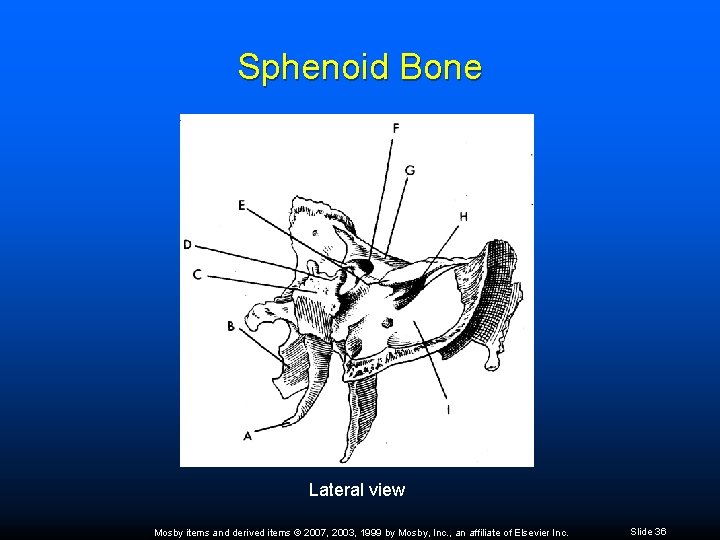
Sphenoid Bone Lateral view Mosby items and derived items © 2007, 2003, 1999 by Mosby, Inc. , an affiliate of Elsevier Inc. Slide 36
Occipital Bone Situated at posteroinferior part of cranium Forms posterior half of cranial base and greater portion of posterior cranial fossa Has four parts Squama Ø Two occipital condyles Ø Basilar portion Ø Mosby items and derived items © 2007, 2003, 1999 by Mosby, Inc. , an affiliate of Elsevier Inc. Slide 37
Occipital Bone Foramen magnum = large opening through which the medulla oblongata passes as it exits cranium External occipital protuberance = prominent process on squama Also called inion Ø Corresponds to internal occipital protuberance Ø Mosby items and derived items © 2007, 2003, 1999 by Mosby, Inc. , an affiliate of Elsevier Inc. Slide 38
Occipital Bone Occipital condyles = project anteriorly from each side of squama Fuse at basilar portion to complete foramen magnum Ø Articulates with the two parietals, the two temporals, the sphenoid, and the atlas (C 1) Ø Mosby items and derived items © 2007, 2003, 1999 by Mosby, Inc. , an affiliate of Elsevier Inc. Slide 39
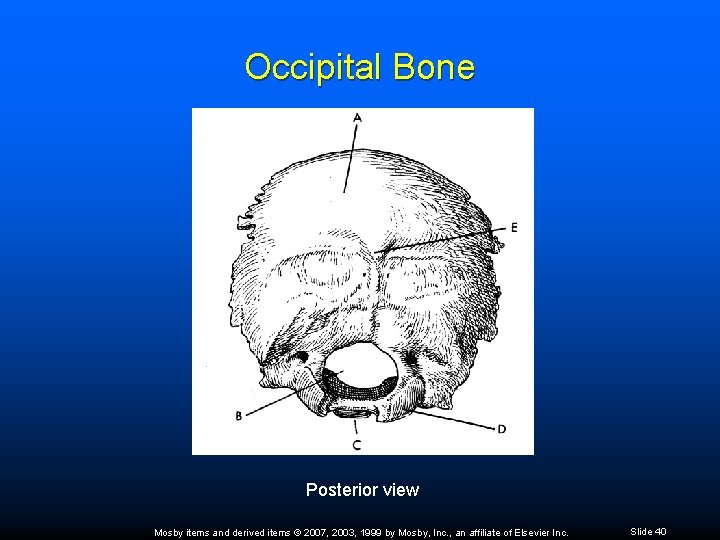
Occipital Bone Posterior view Mosby items and derived items © 2007, 2003, 1999 by Mosby, Inc. , an affiliate of Elsevier Inc. Slide 40
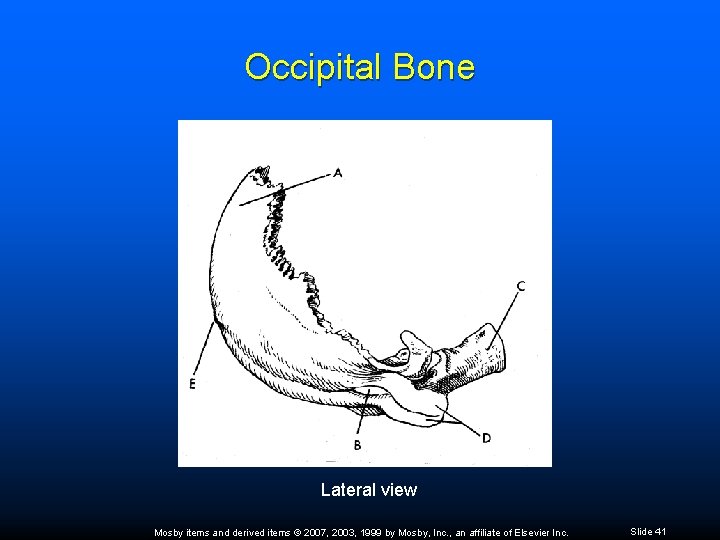
Occipital Bone Lateral view Mosby items and derived items © 2007, 2003, 1999 by Mosby, Inc. , an affiliate of Elsevier Inc. Slide 41
Temporal Bones Situated on each side of cranial base between greater wings of sphenoid and occipital bone Form large part of middle cranial fossa and a small part of posterior cranial fossa Mosby items and derived items © 2007, 2003, 1999 by Mosby, Inc. , an affiliate of Elsevier Inc. Slide 42
Temporal Bones Consist of Squamous portion Ø Tympanic portion Ø Styloid process Ø Zygomatic process Ø Petromastoid portion which contain the organs for hearing and equilibrium Ø Mosby items and derived items © 2007, 2003, 1999 by Mosby, Inc. , an affiliate of Elsevier Inc. Slide 43
Temporal Bones Squamous portion = thin, upper portion of temporal bone Ø Forms part of side wall of cranium Zygomatic process = prominent arched process that projects anteriorly to articulate with zygoma and complete the zygomatic arch Mosby items and derived items © 2007, 2003, 1999 by Mosby, Inc. , an affiliate of Elsevier Inc. Slide 44
Temporal Bones Articular tubercle = located on inferior border of zygomatic process Ø Forms anterior boundary of mandibular fossa Mandibular fossa = receives condyle of mandible to form temporomandibular joint (TMJ) Mosby items and derived items © 2007, 2003, 1999 by Mosby, Inc. , an affiliate of Elsevier Inc. Slide 45
Temporal Bones Tympanic portion = located below squama and in front of petromastoid portion Ø Forms anterior wall, inferior wall and part of posterior walls of the EAM Styloid process = slender, pointed bone projecting inferiorly, anteriorly, and slightly medially from inferior surface of tympanic portion Mosby items and derived items © 2007, 2003, 1999 by Mosby, Inc. , an affiliate of Elsevier Inc. Slide 46
Temporal Bones Petromastoid portion combines petrous and mastoid portions Forms the inferior, posterior part of the temporal bone Ø Articulates with parietal bone at its superior border and with occipital bone at its posterior border Ø Usually contains air cells, which vary greatly in size, number, and pneumatization Ø Mosby items and derived items © 2007, 2003, 1999 by Mosby, Inc. , an affiliate of Elsevier Inc. Slide 47
Temporal Bones Mastoid process = conical process projecting from mastoid portion Petrous portion projects medially and anteriorly between greater wing of sphenoid and occipital bone Also called petrous pyramid Ø Conical or pyramidal in shape Ø Thickest and densest portion of cranium Ø Contains the organs of hearing and balance Ø Mosby items and derived items © 2007, 2003, 1999 by Mosby, Inc. , an affiliate of Elsevier Inc. Slide 48
Temporal Bones Auditory ossicles = bones of middle ear Malleus Ø Incus Ø Stapes Ø Temporal bone articulates with the parietal, occipital, sphenoid, zygoma, and mandible Mosby items and derived items © 2007, 2003, 1999 by Mosby, Inc. , an affiliate of Elsevier Inc. Slide 49
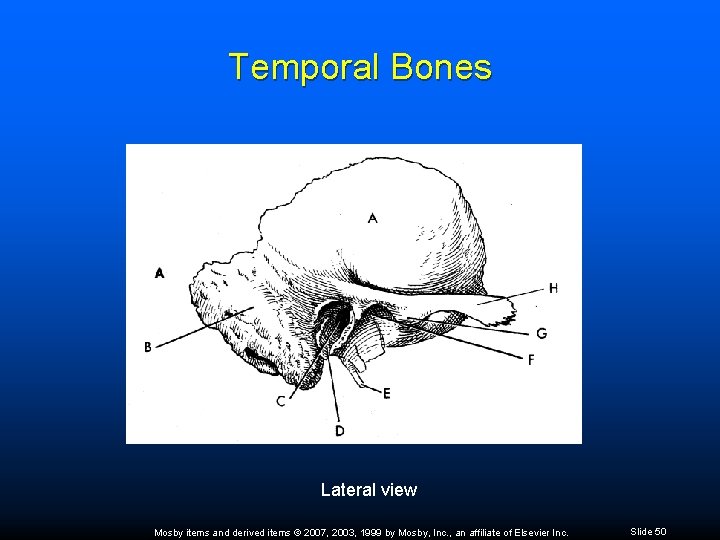
Temporal Bones Lateral view Mosby items and derived items © 2007, 2003, 1999 by Mosby, Inc. , an affiliate of Elsevier Inc. Slide 50
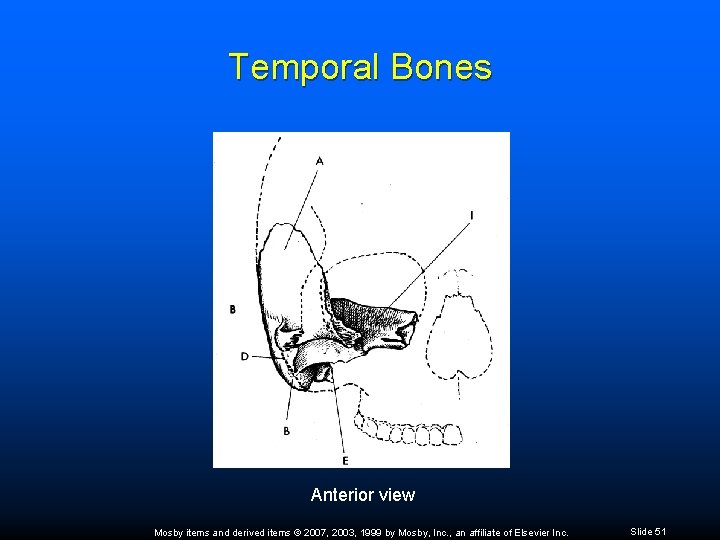
Temporal Bones Anterior view Mosby items and derived items © 2007, 2003, 1999 by Mosby, Inc. , an affiliate of Elsevier Inc. Slide 51
Procedural Considerations Skull topography Skull morphology General body position Cleanliness Radiation protection Mosby items and derived items © 2007, 2003, 1999 by Mosby, Inc. , an affiliate of Elsevier Inc. Slide 52
Skull Topography Be able to locate the following landmarks: Glabella Inner canthus Outer canthus Nasion Infraorbital margin Acanthion Gonion Mental point External auditory meatus (EAM) Auricular point Top of ear attachment (TEA) Mosby items and derived items © 2007, 2003, 1999 by Mosby, Inc. , an affiliate of Elsevier Inc. Slide 53
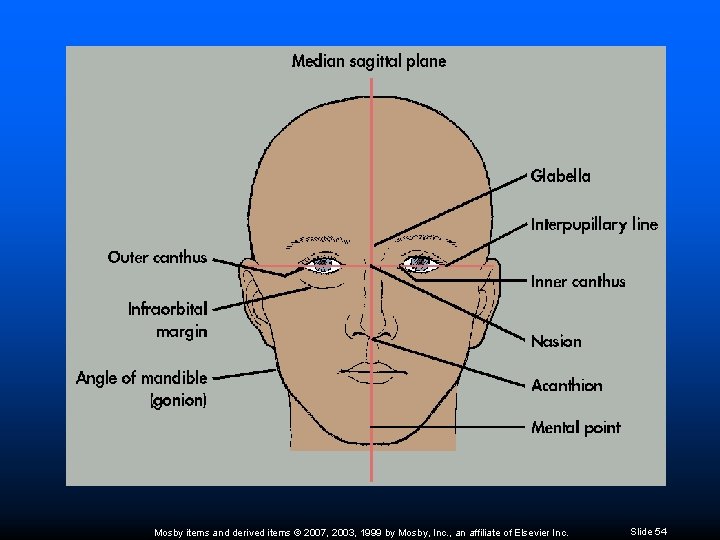
Mosby items and derived items © 2007, 2003, 1999 by Mosby, Inc. , an affiliate of Elsevier Inc. Slide 54
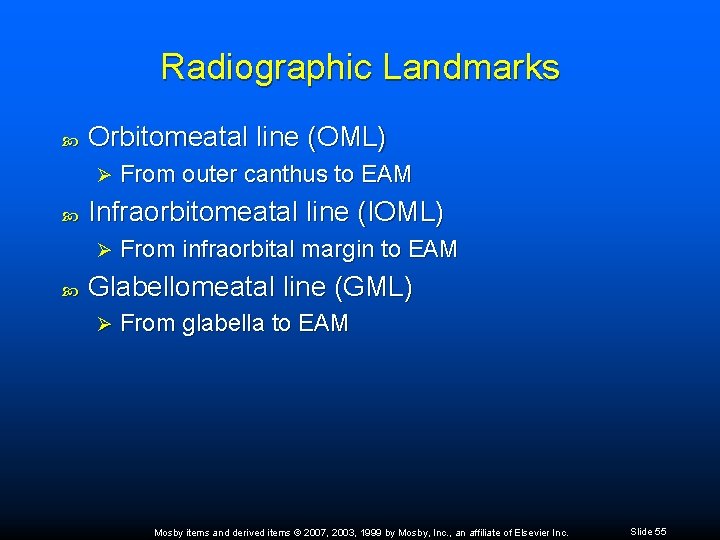
Radiographic Landmarks Orbitomeatal line (OML) Ø Infraorbitomeatal line (IOML) Ø From outer canthus to EAM From infraorbital margin to EAM Glabellomeatal line (GML) Ø From glabella to EAM Mosby items and derived items © 2007, 2003, 1999 by Mosby, Inc. , an affiliate of Elsevier Inc. Slide 55
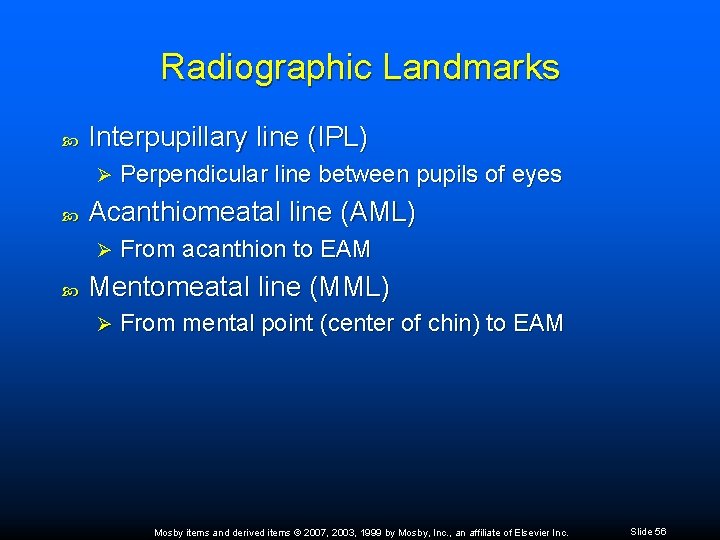
Radiographic Landmarks Interpupillary line (IPL) Ø Acanthiomeatal line (AML) Ø Perpendicular line between pupils of eyes From acanthion to EAM Mentomeatal line (MML) Ø From mental point (center of chin) to EAM Mosby items and derived items © 2007, 2003, 1999 by Mosby, Inc. , an affiliate of Elsevier Inc. Slide 56
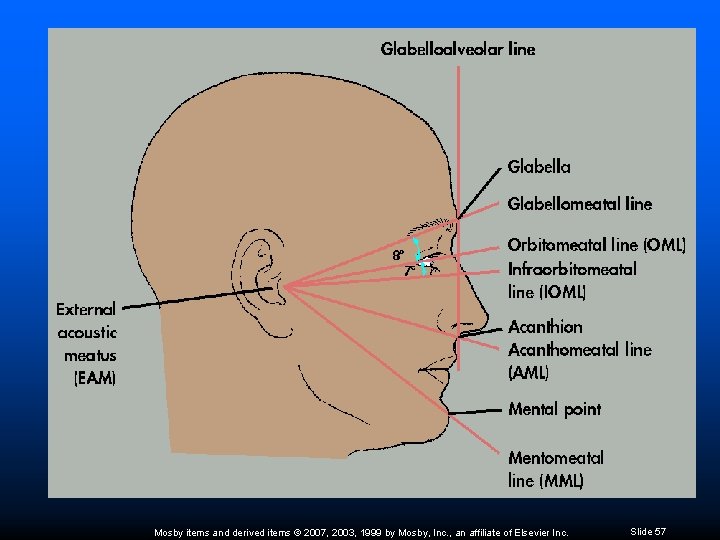
Mosby items and derived items © 2007, 2003, 1999 by Mosby, Inc. , an affiliate of Elsevier Inc. Slide 57
Skull Morphology Radiographic positioning guidelines are based on mesocephalic skull size and shape Adjustments to centering and CR and/or part angulation may be required when working with patients with atypical skull shapes Mosby items and derived items © 2007, 2003, 1999 by Mosby, Inc. , an affiliate of Elsevier Inc. Slide 58
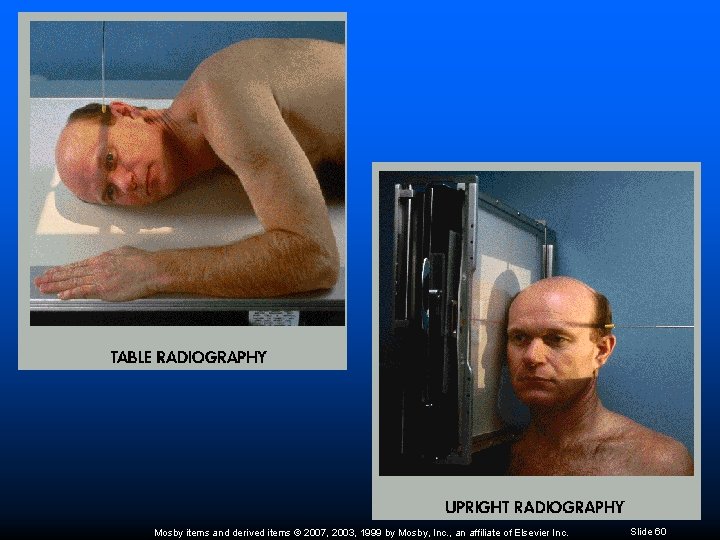
General Body Position Patient may be examined in upright or recumbent positions General body position is especially important in hyposthenic, and hypersthenic body types Mosby items and derived items © 2007, 2003, 1999 by Mosby, Inc. , an affiliate of Elsevier Inc. Slide 59
Mosby items and derived items © 2007, 2003, 1999 by Mosby, Inc. , an affiliate of Elsevier Inc. Slide 60
General Body Position Hyposthenic/asthenic patients usually need support at chest to elevate C-spine Ø Helps prevent downward tilt of MSP Hypersthenic patients require radiolucent support at head Ø Helps prevent upward tilt of MSP Mosby items and derived items © 2007, 2003, 1999 by Mosby, Inc. , an affiliate of Elsevier Inc. Slide 61
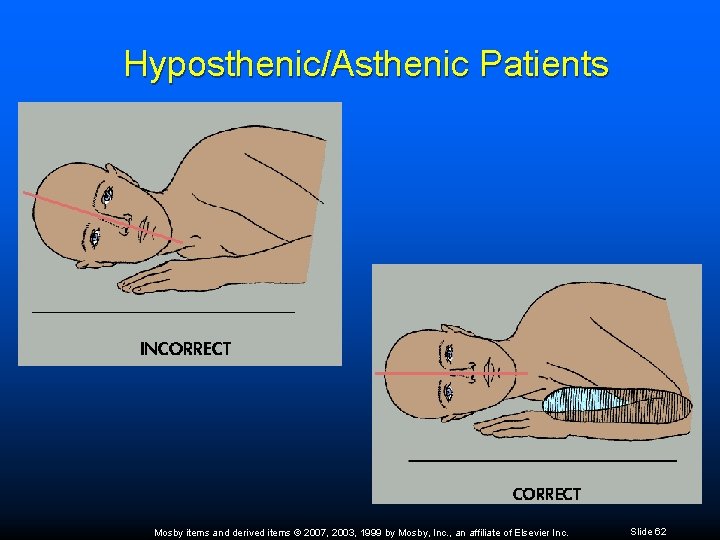
Hyposthenic/Asthenic Patients Mosby items and derived items © 2007, 2003, 1999 by Mosby, Inc. , an affiliate of Elsevier Inc. Slide 62
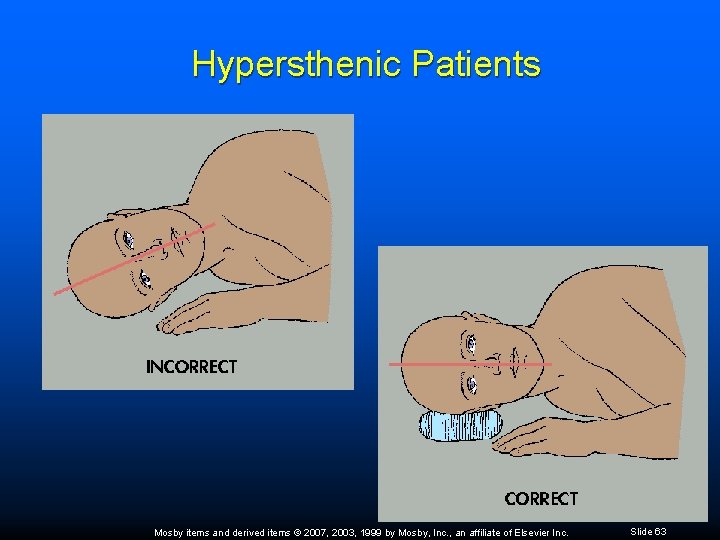
Hypersthenic Patients Mosby items and derived items © 2007, 2003, 1999 by Mosby, Inc. , an affiliate of Elsevier Inc. Slide 63
Cleanliness Hair and skin of face are naturally oily; illness often increases oiliness Cranial procedures require direct contact of patient’s face with VBS Clean device after each patient Wash your hands!!! Mosby items and derived items © 2007, 2003, 1999 by Mosby, Inc. , an affiliate of Elsevier Inc. Slide 64
Radiation Protection Collimate to anatomy of interest Shield gonads/abdomen of pediatric patients and those of reproductive age Shield thyroid and thymus of pediatric patient when doing so will not interfere with demonstration of anatomy of interest Good communication and positioning skills reduce chance of need for repeat radiographs Mosby items and derived items © 2007, 2003, 1999 by Mosby, Inc. , an affiliate of Elsevier Inc. Slide 65
Patient Preparation Remove all radiopaque artifacts Eyeglasses Ø Dentures and partial plates Ø Hearing aids Ø Jewelry Ø Wigs/hairpieces Ø Hairpins, barrettes, and pony tail holders Ø False eyes Ø Mosby items and derived items © 2007, 2003, 1999 by Mosby, Inc. , an affiliate of Elsevier Inc. Slide 66
Essential Projections: Cranium Lateral Right and left lateral positions Ø Dorsal decubitus position Ø PA PA axial (Caldwell method) AP AP axial (Towne method) Mosby items and derived items © 2007, 2003, 1999 by Mosby, Inc. , an affiliate of Elsevier Inc. Slide 67
Essential Projections: Cranium PA axial (Haas method) Submentovertical (SMV) Ø For cranial base Mosby items and derived items © 2007, 2003, 1999 by Mosby, Inc. , an affiliate of Elsevier Inc. Slide 68
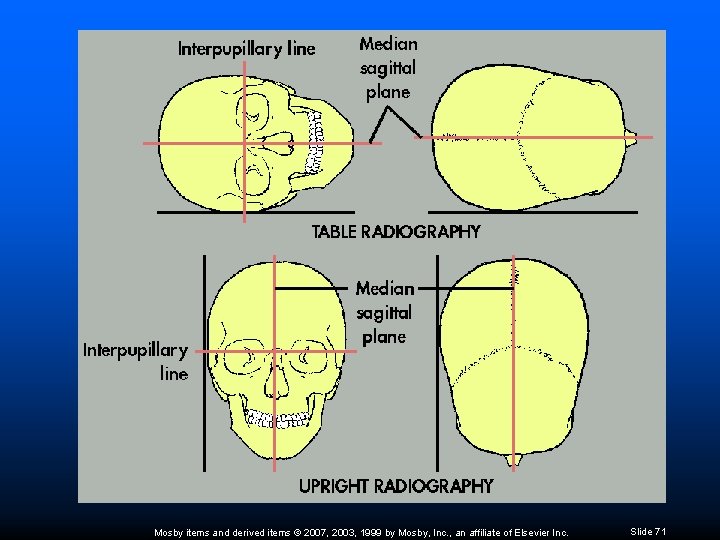
Lateral Projection Patient position Ø Seated upright or semiprone Part position MSP of head parallel to IR Ø IPL perpendicular Ø IOML parallel to transverse axis of cassette Ø Mosby items and derived items © 2007, 2003, 1999 by Mosby, Inc. , an affiliate of Elsevier Inc. Slide 69
Lateral Projection CR Perpendicular to center of IR Ø Enters 2 superior to EAM Ø Mosby items and derived items © 2007, 2003, 1999 by Mosby, Inc. , an affiliate of Elsevier Inc. Slide 70
Mosby items and derived items © 2007, 2003, 1999 by Mosby, Inc. , an affiliate of Elsevier Inc. Slide 71
Lateral Projection Patient position Ø Dorsal decubitus Part position Elevate head on radiolucent support to center to vertical IR Ø MSP of head vertical Ø IPL perpendicular to IR Ø IOML parallel to transverse axis of cassette Ø Mosby items and derived items © 2007, 2003, 1999 by Mosby, Inc. , an affiliate of Elsevier Inc. Slide 72
Lateral Projection CR Horizontal and perpendicular to center of IR Ø Enters 2 superior to EAM Ø Mosby items and derived items © 2007, 2003, 1999 by Mosby, Inc. , an affiliate of Elsevier Inc. Slide 73
Lateral Projection Patient position Ø Supine or semisupine Part position Elevate head on radiolucent support to place MSP parallel and IPL perpendicular Ø Turn head toward side of interest Ø Mosby items and derived items © 2007, 2003, 1999 by Mosby, Inc. , an affiliate of Elsevier Inc. Slide 74
Lateral Projection CR Perpendicular to center of IR Ø Enters 2 superior to EAM Ø Mosby items and derived items © 2007, 2003, 1999 by Mosby, Inc. , an affiliate of Elsevier Inc. Slide 75
PA/PA Axial (Caldwell) Patient position Seated erect or prone Ø MSP centered to midline Ø Forehead and nose resting on table or upright Bucky Ø Part position OML perpendicular to IR plane Ø MSP perpendicular to IR Ø IR centered to nasion Ø Mosby items and derived items © 2007, 2003, 1999 by Mosby, Inc. , an affiliate of Elsevier Inc. Slide 76
PA/PA Axial (Caldwell) CR for PA projection Perpendicular Ø Exits nasion Ø CR for PA axial (Caldwell) Angled 15 degrees caudad Ø Exits nasion Ø Mosby items and derived items © 2007, 2003, 1999 by Mosby, Inc. , an affiliate of Elsevier Inc. Slide 77
AP/AP Axial Projection Note: Provides similar but magnified image when patient cannot be positioned for PA axial projection. Patient and part position Supine Ø MSP centered to midline Ø MSP and OML perpendicular to IR Ø Mosby items and derived items © 2007, 2003, 1999 by Mosby, Inc. , an affiliate of Elsevier Inc. Slide 78
AP/AP Axial Projection CR Perpendicular or 15 degrees cephalad for AP axial projection Ø Enters nasion Ø Mosby items and derived items © 2007, 2003, 1999 by Mosby, Inc. , an affiliate of Elsevier Inc. Slide 79
AP Axial (Towne Method) Patient and part position Supine or seated erect Ø MSP centered to midline Ø MSP perpendicular Ø OML or IOML perpendicular Ø IR top border level with skull vertex IR center at or near foramen magnum Mosby items and derived items © 2007, 2003, 1999 by Mosby, Inc. , an affiliate of Elsevier Inc. Slide 80
AP Axial (Towne Method) CR Ø Directed through foramen magnum Ø OML – 30 degrees caudal Ø IOML – 37 degrees caudal Mosby items and derived items © 2007, 2003, 1999 by Mosby, Inc. , an affiliate of Elsevier Inc. Slide 81
PA Axial (Haas) Patient position Prone or seated upright Ø MSP centered to midline Ø Shoulders in same horizontal plane Ø Part position Forehead and nose on table Ø MSP perpendicular Ø OML perpendicular to IR Ø Mosby items and derived items © 2007, 2003, 1999 by Mosby, Inc. , an affiliate of Elsevier Inc. Slide 82
PA Axial (Haas) CR Directed cephalad at angle of 25 degrees to OML Ø Enters at a point 1. 5 (3. 8 cm) below external occipital protuberance Ø Exits 1. 5 (3. 8 cm) superior to nasion Ø Mosby items and derived items © 2007, 2003, 1999 by Mosby, Inc. , an affiliate of Elsevier Inc. Slide 83
SMV Projection (Schüller) Patient position Seated upright or supine Ø Torso elevated if supine Ø Part position MSP centered to midline Ø IOML parallel with IR Ø MSP perpendicular to IR Ø Mosby items and derived items © 2007, 2003, 1999 by Mosby, Inc. , an affiliate of Elsevier Inc. Slide 84
SMV Projection (Schüller) CR Through sella turcica perpendicular to IOML Ø Enters MSP of throat between angles of mandible Ø Passes through a point ¾ (1. 9 cm) anterior to level of EAM Ø Center IR to CR Ø Mosby items and derived items © 2007, 2003, 1999 by Mosby, Inc. , an affiliate of Elsevier Inc. Slide 85
Essential Projections: Temporal Bone Axiolateral oblique (modified Law) Axiolateral oblique (Stenvers) Axiolateral oblique (Arcelin) Mosby items and derived items © 2007, 2003, 1999 by Mosby, Inc. , an affiliate of Elsevier Inc. Slide 86
Axiolateral Oblique (Modified Law) Patient position Prone or seated upright Ø Tape auricle forward Ø Part position Place head in true lateral position with affected side closer to IR Ø IOML parallel with IR Ø IPL perpendicular to IR Ø MSP angled 15 degrees toward IR Ø Mosby items and derived items © 2007, 2003, 1999 by Mosby, Inc. , an affiliate of Elsevier Inc. Slide 87
Axiolateral Oblique (Modified Law) CR Angled 15 degrees caudad to midpoint of IR Ø Exits mastoid tip closer to IR about 1 (2. 5 cm) posterior to EAM Ø Enters 2 (5 cm) posterior to and superior to upper EAM Ø Mosby items and derived items © 2007, 2003, 1999 by Mosby, Inc. , an affiliate of Elsevier Inc. Slide 88
Axiolateral Oblique (Stenvers) Patient position Ø Prone or seated upright Part position Rest head on forehead, nose, and cheek with side of interest on IR Ø IOML parallel with transverse axis of IR Ø MSP at 45 -degree angle from IR Ø Mosby items and derived items © 2007, 2003, 1999 by Mosby, Inc. , an affiliate of Elsevier Inc. Slide 89
Axiolateral Oblique (Stenvers) CR Angled 12 degrees cephalad Ø Enters about 3 to 4 (7. 6 to 10 cm) posterior and ½ (1. 3 cm) inferior to upside EAM Ø Exits 1 (2. 5 cm) anterior to downside EAM Ø IR and CR centered Ø Mosby items and derived items © 2007, 2003, 1999 by Mosby, Inc. , an affiliate of Elsevier Inc. Slide 90
Axiolateral Oblique Temporal Bone (Arcelin) Patient position Supine Ø MSP centered to midline Ø Part position Rotate face away from side of interest to place MSP at 45 -degree angle with plane of IR Ø IOML perpendicular to IR Ø Mosby items and derived items © 2007, 2003, 1999 by Mosby, Inc. , an affiliate of Elsevier Inc. Slide 91
Axiolateral Oblique Temporal Bone (Arcelin) CR Angled 10 degrees caudad Ø Enters temporal area at 1 (2. 5 cm) anterior to EAM and ¾ (1. 9) cm above it Ø Center IR and CR Ø Mosby items and derived items © 2007, 2003, 1999 by Mosby, Inc. , an affiliate of Elsevier Inc. Slide 92
Essential Projections: Optic Canal and Foramen Parietoorbital oblique (Rhese method) Mosby items and derived items © 2007, 2003, 1999 by Mosby, Inc. , an affiliate of Elsevier Inc. Slide 93
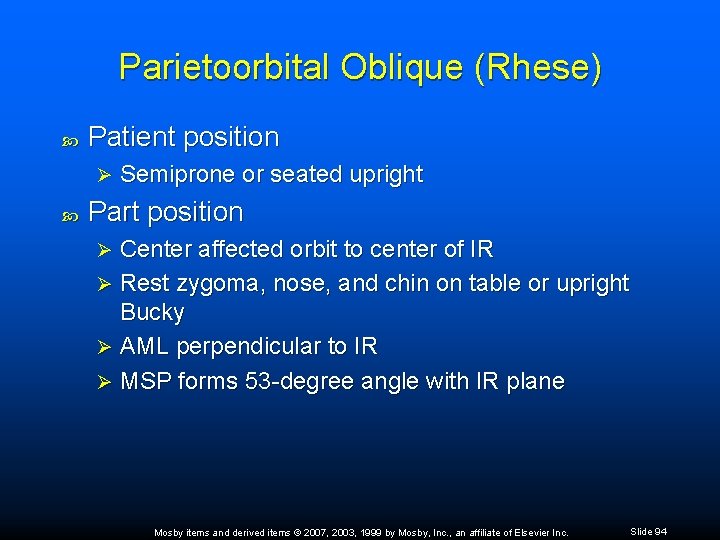
Parietoorbital Oblique (Rhese) Patient position Ø Semiprone or seated upright Part position Center affected orbit to center of IR Ø Rest zygoma, nose, and chin on table or upright Bucky Ø AML perpendicular to IR Ø MSP forms 53 -degree angle with IR plane Ø Mosby items and derived items © 2007, 2003, 1999 by Mosby, Inc. , an affiliate of Elsevier Inc. Slide 94
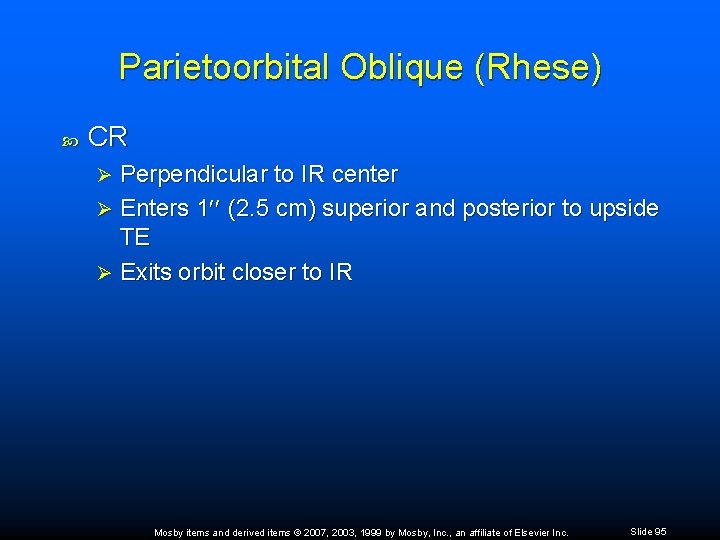
Parietoorbital Oblique (Rhese) CR Perpendicular to IR center Ø Enters 1 (2. 5 cm) superior and posterior to upside TE Ø Exits orbit closer to IR Ø Mosby items and derived items © 2007, 2003, 1999 by Mosby, Inc. , an affiliate of Elsevier Inc. Slide 95
Lesson 2 Image Critique Mosby items and derived items © 2007, 2003, 1999 by Mosby, Inc. , an affiliate of Elsevier Inc. Slide 96
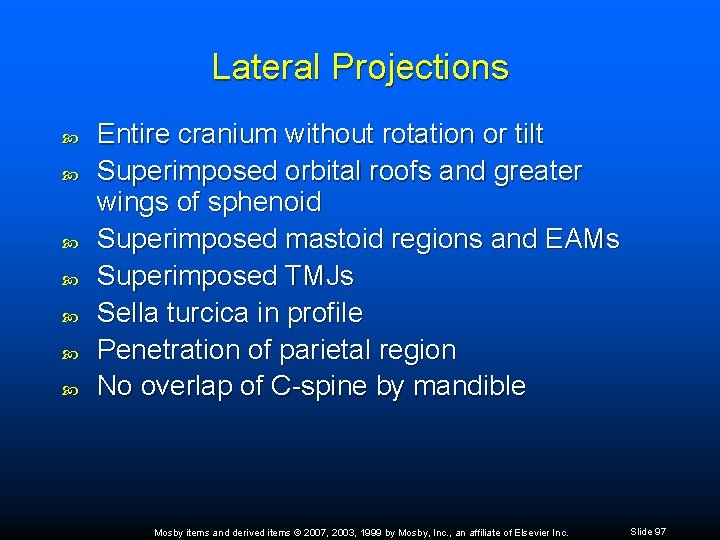
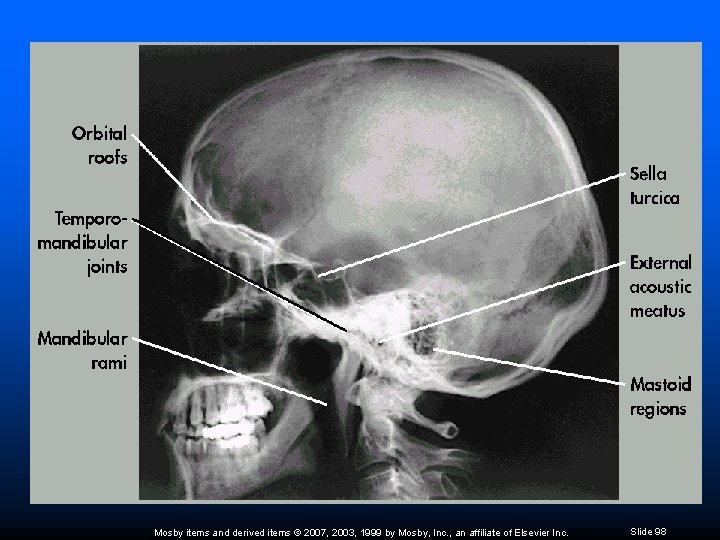
Lateral Projections Entire cranium without rotation or tilt Superimposed orbital roofs and greater wings of sphenoid Superimposed mastoid regions and EAMs Superimposed TMJs Sella turcica in profile Penetration of parietal region No overlap of C-spine by mandible Mosby items and derived items © 2007, 2003, 1999 by Mosby, Inc. , an affiliate of Elsevier Inc. Slide 97
Mosby items and derived items © 2007, 2003, 1999 by Mosby, Inc. , an affiliate of Elsevier Inc. Slide 98
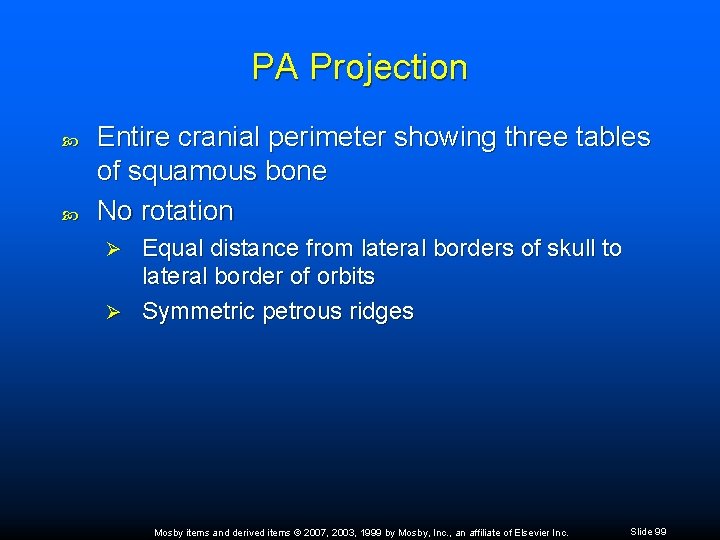
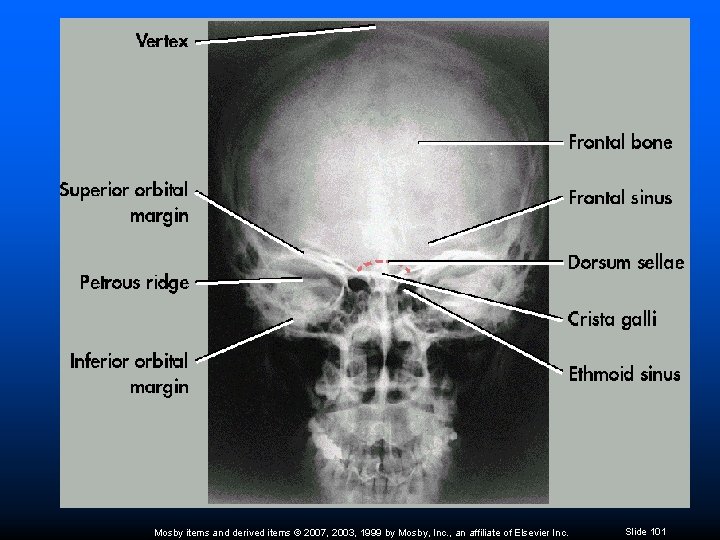
PA Projection Entire cranial perimeter showing three tables of squamous bone No rotation Equal distance from lateral borders of skull to lateral border of orbits Ø Symmetric petrous ridges Ø Mosby items and derived items © 2007, 2003, 1999 by Mosby, Inc. , an affiliate of Elsevier Inc. Slide 99
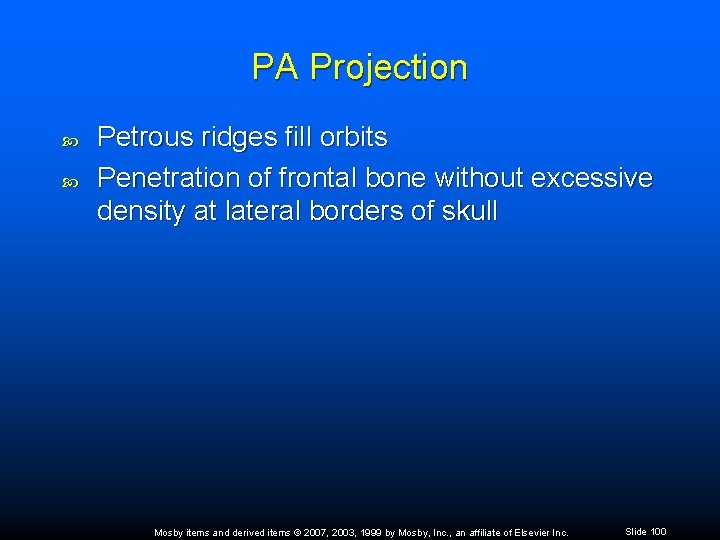
PA Projection Petrous ridges fill orbits Penetration of frontal bone without excessive density at lateral borders of skull Mosby items and derived items © 2007, 2003, 1999 by Mosby, Inc. , an affiliate of Elsevier Inc. Slide 100
Mosby items and derived items © 2007, 2003, 1999 by Mosby, Inc. , an affiliate of Elsevier Inc. Slide 101
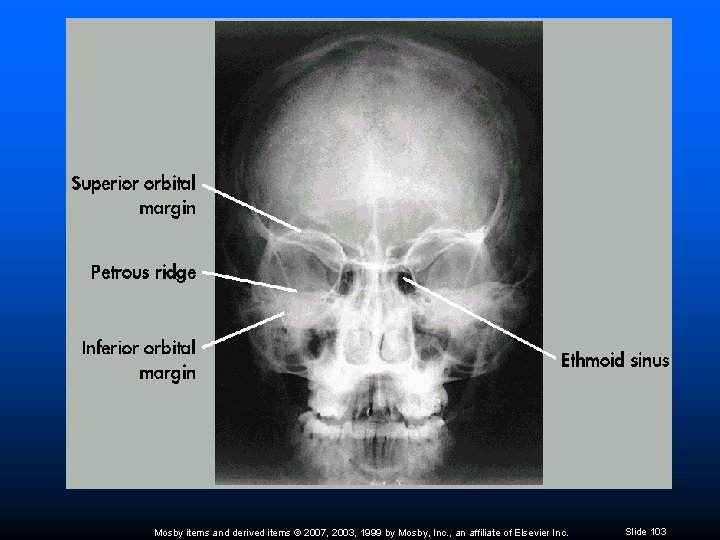
PA Axial (Caldwell Method) Same as for PA projection, except Ø Petrous ridges demonstrated in lower one third of orbit Mosby items and derived items © 2007, 2003, 1999 by Mosby, Inc. , an affiliate of Elsevier Inc. Slide 102
Mosby items and derived items © 2007, 2003, 1999 by Mosby, Inc. , an affiliate of Elsevier Inc. Slide 103

AP/AP Axial Projection Same as PA and PA axial projections Anatomy more magnified in AP and AP axial projections Mosby items and derived items © 2007, 2003, 1999 by Mosby, Inc. , an affiliate of Elsevier Inc. Slide 104
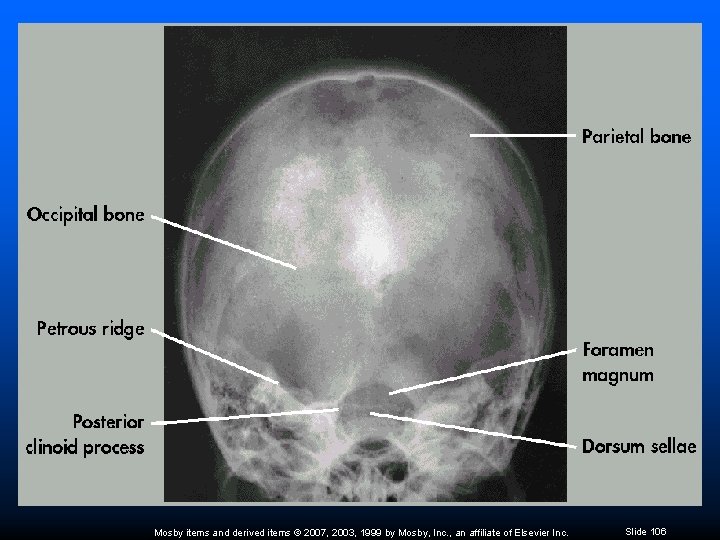
AP Axial (Towne Method) No rotation Equal distance from lateral border of skull to lateral margin or foramen magnum Ø Symmetric petrous ridges Ø Dorsum sellae and posterior clinoid processes visible within foramen magnum Penetration of occipital bone without excessive density at parietals Mosby items and derived items © 2007, 2003, 1999 by Mosby, Inc. , an affiliate of Elsevier Inc. Slide 105
Mosby items and derived items © 2007, 2003, 1999 by Mosby, Inc. , an affiliate of Elsevier Inc. Slide 106
PA Axial (Haas) Projection of dorsum sellae and posterior clinoid processes within foramen magnum Equal distance from lateral border of skull to lateral margin of foramen magnum Symmetric petrous pyramids Entire cranium Mosby items and derived items © 2007, 2003, 1999 by Mosby, Inc. , an affiliate of Elsevier Inc. Slide 107
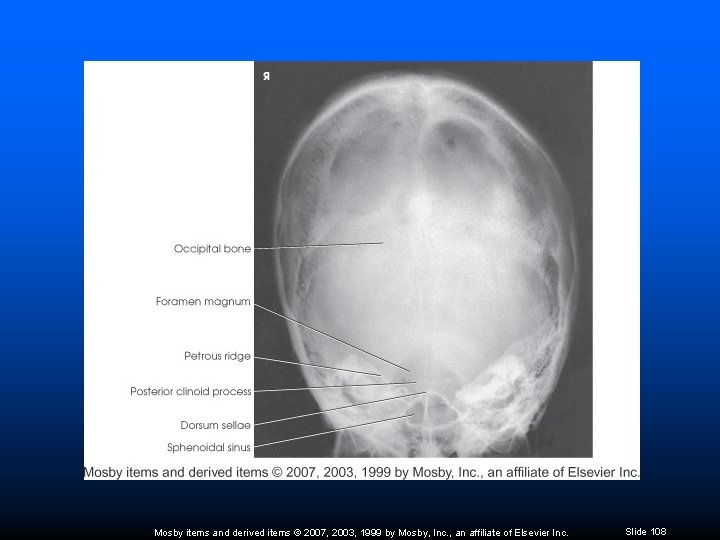
Mosby items and derived items © 2007, 2003, 1999 by Mosby, Inc. , an affiliate of Elsevier Inc. Slide 108
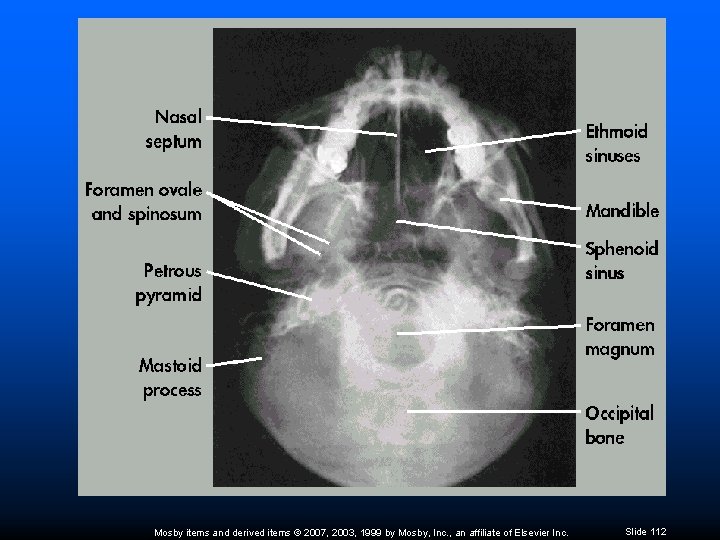
SMV Projection (Schüller) No rotation or tilt Equal distance from lateral border of skull to mandibular condyles Ø Symmetric petrous pyramids Ø Penetration sufficient to demonstrate structures of cranial base Mosby items and derived items © 2007, 2003, 1999 by Mosby, Inc. , an affiliate of Elsevier Inc. Slide 109
SMV Projection (Schüller) Superimposition of mental protuberance over anterior frontal bone, indicating full neck extension Mandibular condyles anterior to petrous pyramids Mosby items and derived items © 2007, 2003, 1999 by Mosby, Inc. , an affiliate of Elsevier Inc. Slide 110
SMV Projection (Schüller) Superimposition of mental protuberance over frontal bone – indicates full neck extension Condyles of mandible anterior to petrous pyramids Mosby items and derived items © 2007, 2003, 1999 by Mosby, Inc. , an affiliate of Elsevier Inc. Slide 111
Mosby items and derived items © 2007, 2003, 1999 by Mosby, Inc. , an affiliate of Elsevier Inc. Slide 112
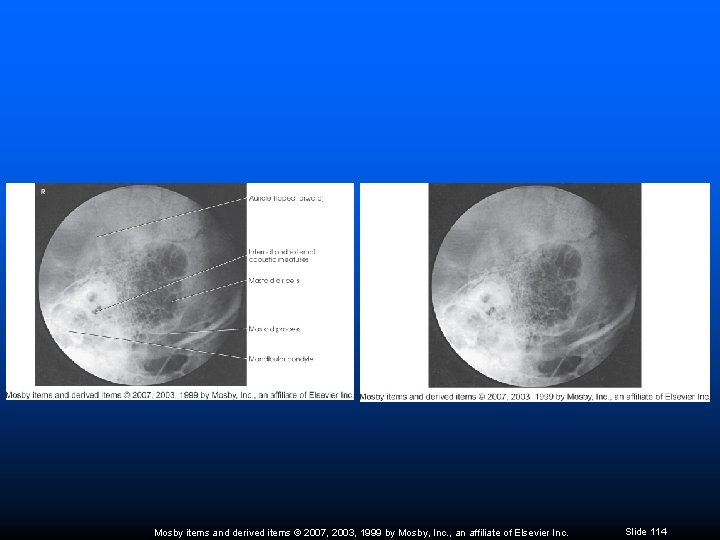
Axiolateral Oblique Temporal Bone (Modified Law) Mastoid process closer to IR Air cells centered to IR Opposite mastoid process inferior and anterior mastoid of interest Auricle of ear not superimposing mastoid Superimposition of IAM and EAM TMJ visible anterior to mastoid process Close beam restriction Mosby items and derived items © 2007, 2003, 1999 by Mosby, Inc. , an affiliate of Elsevier Inc. Slide 113
Mosby items and derived items © 2007, 2003, 1999 by Mosby, Inc. , an affiliate of Elsevier Inc. Slide 114
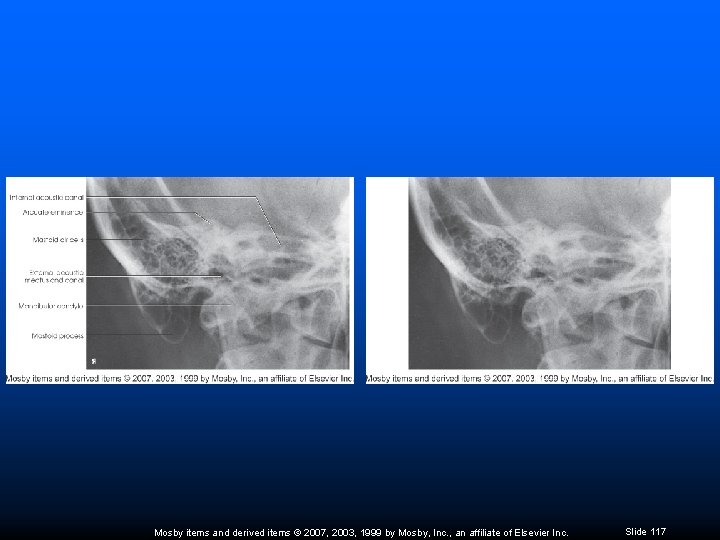
Axiolateral Oblique Temporal Bone (Stenvers) Petromastoid portion in profile Lateral border of skull to lateral border of orbit Petrous ridge extended to a point about two thirds up lateral border of orbit Mosby items and derived items © 2007, 2003, 1999 by Mosby, Inc. , an affiliate of Elsevier Inc. Slide 115
Axiolateral Oblique Temporal Bone (Stenvers) Mastoid process in profile below cranium Posterior margin of mandibular ramus superimposing lateral border of C-spine Mandibular condyle projecting over atlas near petrosa Close beam restriction Mosby items and derived items © 2007, 2003, 1999 by Mosby, Inc. , an affiliate of Elsevier Inc. Slide 116
Mosby items and derived items © 2007, 2003, 1999 by Mosby, Inc. , an affiliate of Elsevier Inc. Slide 117
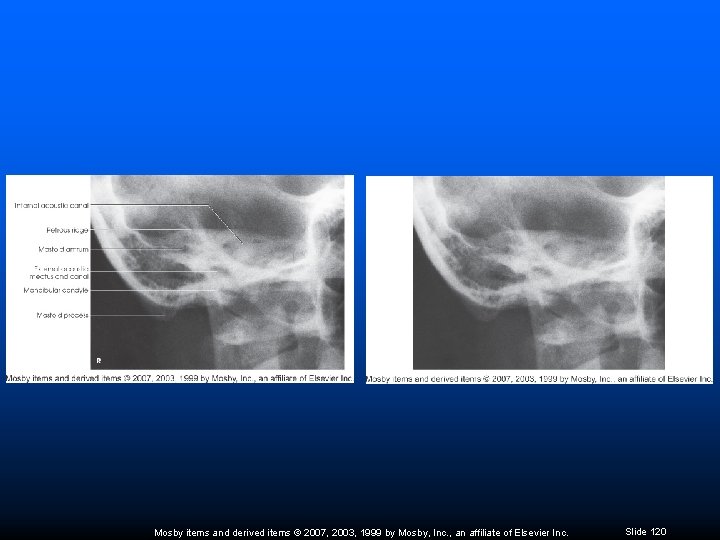
Axiolateral Oblique Temporal Bone (Arcelin) Petromastoid portion in profile Lateral border of skull to lateral border of orbit Petrous ridge lying horizontal about two thirds up lateral border of orbit Mosby items and derived items © 2007, 2003, 1999 by Mosby, Inc. , an affiliate of Elsevier Inc. Slide 118
Axiolateral Oblique Temporal Bone (Arcelin) Mastoid process in profile below cranium Posterior margin of mandibular ramus superimposing lateral border of C-spine Mandibular condyle projecting over atlas near petrosa Close beam restriction Mosby items and derived items © 2007, 2003, 1999 by Mosby, Inc. , an affiliate of Elsevier Inc. Slide 119
Mosby items and derived items © 2007, 2003, 1999 by Mosby, Inc. , an affiliate of Elsevier Inc. Slide 120
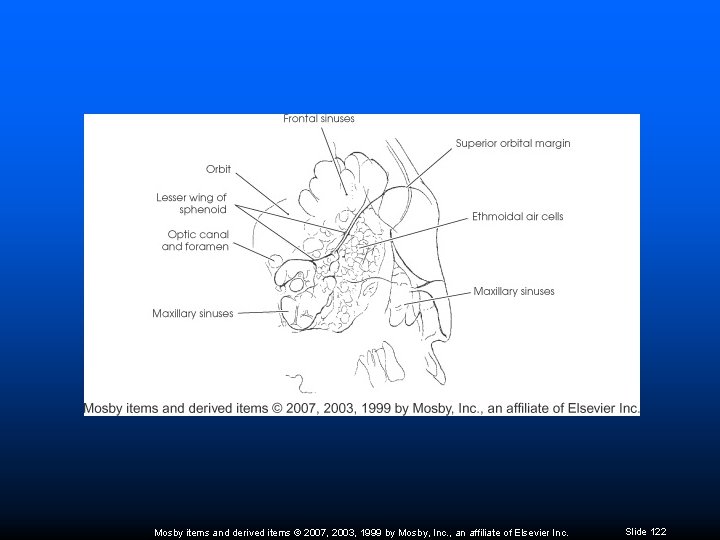
Parietoorbital Oblique (Rhese) Optic canal and foramen visible at end of sphenoid ridge in inferior and lateral quadrant of orbit Entire orbital rim Supraorbital margins lying in same horizontal line Close beam restriction to orbit Mosby items and derived items © 2007, 2003, 1999 by Mosby, Inc. , an affiliate of Elsevier Inc. Slide 121
Mosby items and derived items © 2007, 2003, 1999 by Mosby, Inc. , an affiliate of Elsevier Inc. Slide 122
- Slides: 122