
SKULL BASE INSTITUTE The Evolution of Pituitary Surgery
SKULL BASE INSTITUTE The Evolution of Pituitary Surgery: From an Open Transcranial to a Minimally Invasive Endoscopic Approach. Hrayr K. Shahinian M. D.
Objectives • Describe pituitary anatomy and the various presentations of pituitary adenomas • Discuss the three standard surgical approaches to pituitary adenomas - Transcranial - Microscopic Transseptal-transsphenoidal - Endoscopic Transnasal-transsphenoidal
Objectives • Discuss results from our latest research comparing outcomes for patients undergoing Microscopic vs. Endoscopic Transsphenoidal Pituitary Adenoma Resection
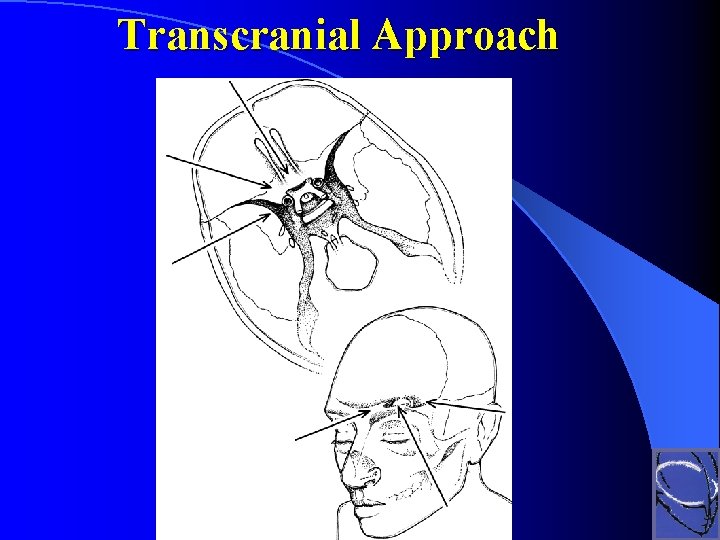
Transcranial Approach
Transcranial Approach • Requires craniotomy and retraction of the frontal lobes of the brain. • Sub-optimal exposure of inferior and posterior aspects of tumor. • Difficult to distinguish normal gland from tumor from distal perspective.
Transcranial Approach • Forces surgeon to operate between CN I or over orbit risking injury to vision or sense of smell. • Used for large invasive tumors or tumors with significant suprasellar extension. • Often used as a combined second stage approach following a transsphenoidal resection.
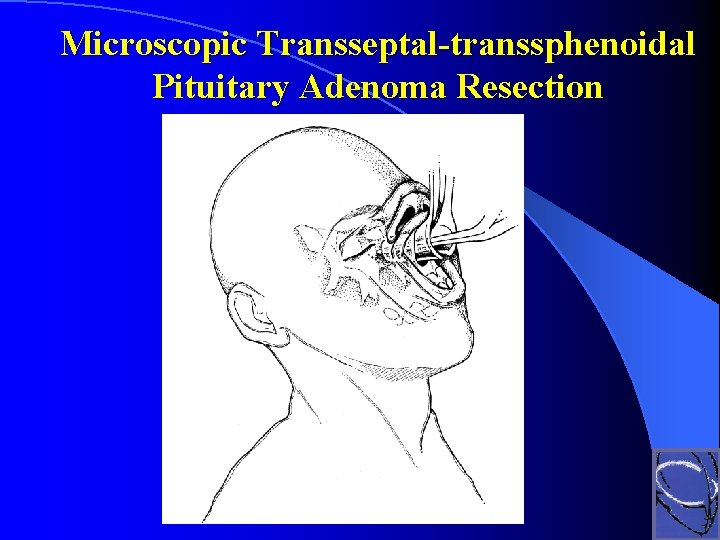
Microscopic Transseptal-transsphenoidal Pituitary Adenoma Resection
Microscopic Transseptal-transsphenoidal Approach • Current standard operation for most pituitary adenomas • Has demonstrated equal outcomes for cure compared to open transcranial approach with less morbidity and mortality. • Allows for more rapid recovery
Endoscopic Transnasal-Transsphenoidal Pituitary Adenoma Resection Made possible by advances in endoscopic technology • • • Endoscopes – Varying widths and angles of view Cameras – Three chip, Digital, Three dimensional Light Sources – Halogen, Metal Halide, Xenon Recorders/Processors – Digital, Real Time Irrigation Sheaths Holding Arms
Endoscopic Procedures Developed Using Animal Models Animal models developed at SBI have demonstrated the safety and revealed the advantages of the endoscopic approach. • Endoscope allows for clear visualization of pituitary gland, hypophyseal stalk, cavernous sinuses, and optic nerves. • Angled endoscopes enable visualization of lateral recesses and suprasellar areas. •
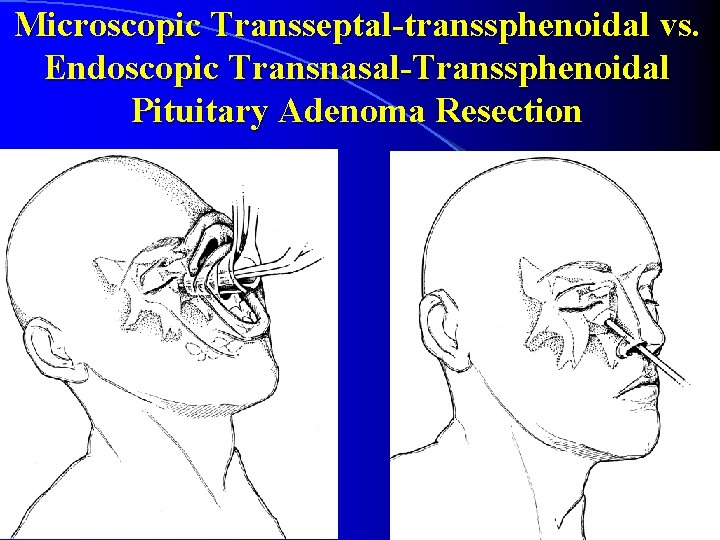
Microscopic Transseptal-transsphenoidal vs. Endoscopic Transnasal-Transsphenoidal Pituitary Adenoma Resection
Combined Micro-endoscopic Approach • SBI began with combined approach in 1996 • Early combined micro-endoscopic series, including one performed at SBI have demonstrated a 33 - 49% incidence of residual tumor, recognized only with the additional visualization provided by the endoscope.
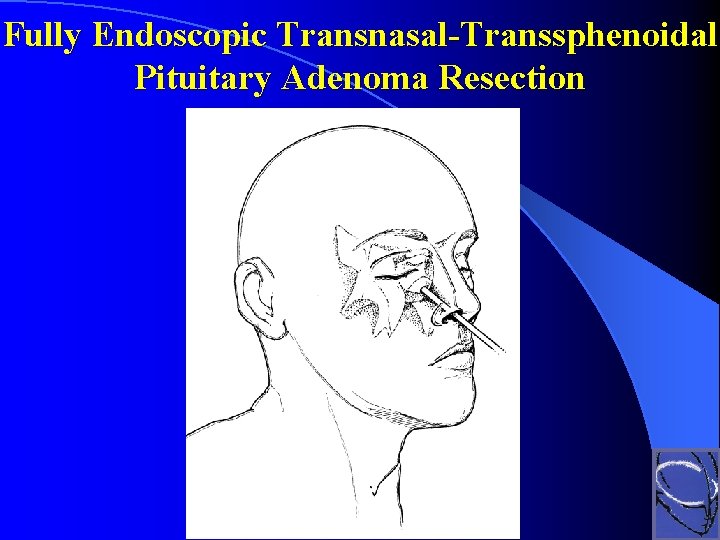
Fully Endoscopic Transnasal-Transsphenoidal Pituitary Adenoma Resection
Fully Endoscopic Transnasal-Transsphenoidal Transnasal-Transsphenoida Pituitary Adenoma Resection • In 1998 SBI converted to a fully endoscopic technique. • Since then we have compiled results for all patients undergoing fully endoscopic pituitary adenoma resection. • Submitted these endoscopic results for publication, comparing early outcomes and complication rates to published results using the standard microscopic transsphenoidal operation.
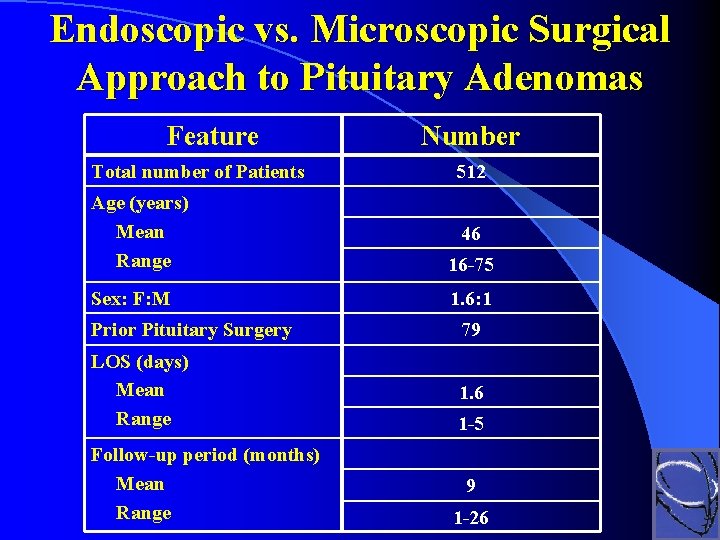
Endoscopic vs. Microscopic Surgical Approach to Pituitary Adenomas Feature Number Total number of Patients 512 Age (years) Mean Range 46 16 -75 Sex: F: M 1. 6: 1 Prior Pituitary Surgery 79 LOS (days) Mean Range 1. 6 Follow-up period (months) Mean Range 1 -5 9 1 -26
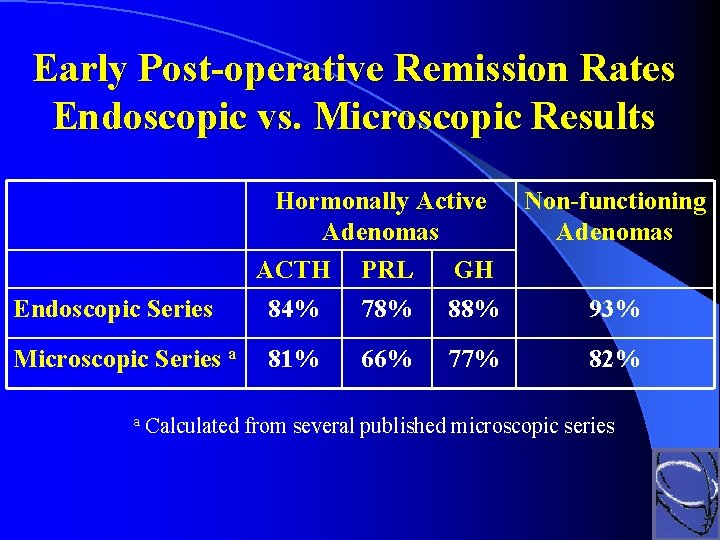
Early Post-operative Remission Rates Endoscopic vs. Microscopic Results Endoscopic Series Microscopic Series a a Hormonally Active Non-functioning Adenomas ACTH PRL GH 84% 78% 88% 93% 81% 66% 77% 82% Calculated from several published microscopic series
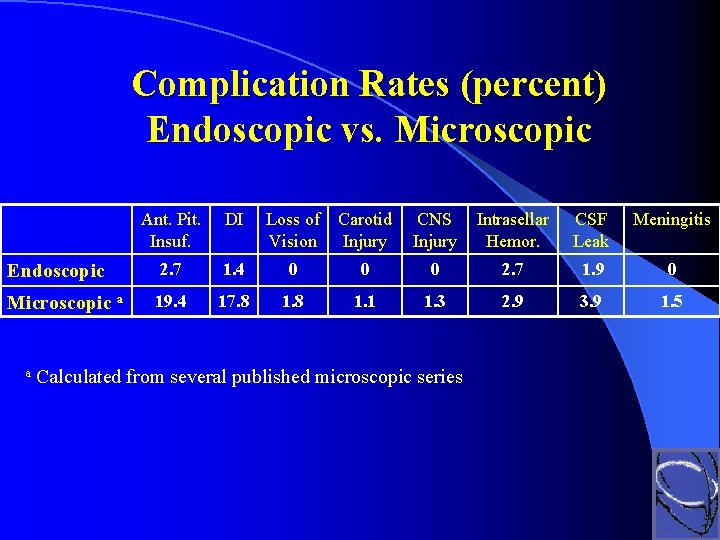
Complication Rates (percent) Endoscopic vs. Microscopic Ant. Pit. Insuf. DI Loss of Vision Carotid Injury CNS Injury Intrasellar Hemor. CSF Leak Meningitis Endoscopic 2. 7 1. 4 0 0 0 2. 7 1. 9 0 Microscopic a 19. 4 17. 8 1. 1 1. 3 2. 9 3. 9 1. 5 a Calculated from several published microscopic series
Fully Endoscopic Transnasal-Transsphenoidal Pituitary Adenoma Resection • A safer operation: Improved visualization of surrounding optic bulbs, brainstem, and carotid prominences. Improved ability to differentiate tumor from normal pituitary tissue Completely transnasal approach avoids the risk of naso -oral fistulae, and lip numbness seen with the transseptal approach.
Fully Endoscopic Transnasal-Transsphenoidal Pituitary Adenoma Resection • A more complete operation: Improved visualization sellar and parasellar tumor extension, should result in a lower recurrence rate, as demonstrated by our early results.
Fully Endoscopic Transnasal-Transsphenoidal Pituitary Adenoma Resection • Minimally invasive approach allows for a more rapid recovery with less post-operative discomfort: Most patients discharged within 48 hours. Completely endonasal approach avoids the need for post -operative nasal packing.
The Evolution of Pituitary Surgery: From an Open Transcranial to a Minimally Invasive Endoscopic Approach. Continued research into improved medical and surgical treatment of pituitary adenomas: • New 3 -dimensional endoscopes • Animal models using fetal pituitary cell transplantation
- Slides: 21