
Skreppa The Modular Shoe By Nick Amato Mickey
Skreppa - The Modular Shoe By Nick Amato, Mickey Evans, Haley Gallagher, Lydia Yeckley 1
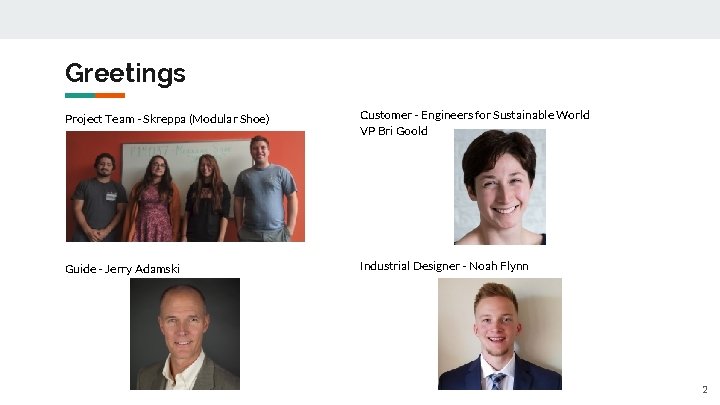
Greetings Project Team - Skreppa (Modular Shoe) Customer - Engineers for Sustainable World VP Bri Goold Guide - Jerry Adamski Industrial Designer - Noah Flynn 2
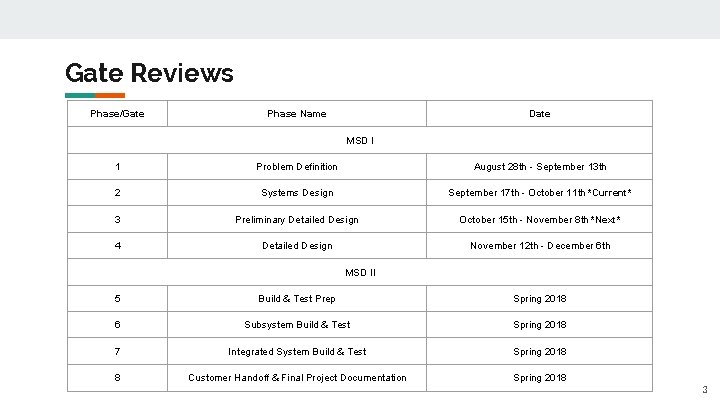
Gate Reviews Phase/Gate Phase Name Date MSD I 1 Problem Definition August 28 th - September 13 th 2 Systems Design September 17 th - October 11 th *Current* 3 Preliminary Detailed Design October 15 th - November 8 th *Next* 4 Detailed Design November 12 th - December 6 th MSD II 5 Build & Test Prep Spring 2018 6 Subsystem Build & Test Spring 2018 7 Integrated System Build & Test Spring 2018 8 Customer Handoff & Final Project Documentation Spring 2018 3
Agenda 1. 2. 3. 4. 5. 6. 7. 8. 9. 10. 11. 12. Systems Design Plan Team Definitions for Shoe Elements Project Scope and Market Analysis Problem Statement Refinement Functional Decomposition Tree Benchmarking Concept Generation & Morph Chart Concept Refinement Concept Selection & Visualizations Risk Assessment High Level Budget Next Steps 4
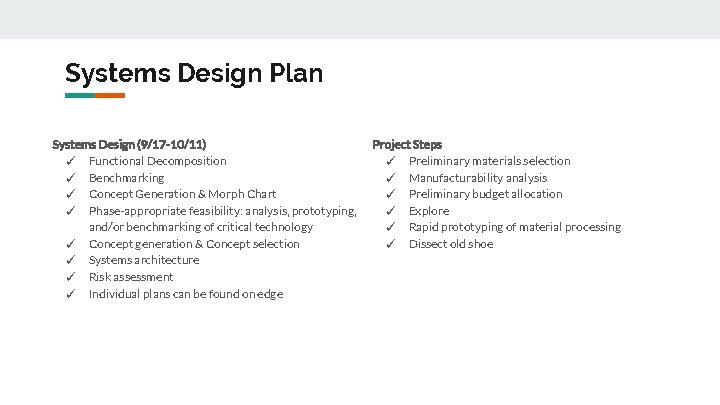
Systems Design Plan Systems Design (9/17 -10/11) ✓ Functional Decomposition ✓ Benchmarking ✓ Concept Generation & Morph Chart ✓ Phase-appropriate feasibility: analysis, prototyping, and/or benchmarking of critical technology ✓ Concept generation & Concept selection ✓ Systems architecture ✓ Risk assessment ✓ Individual plans can be found on edge Project Steps ✓ Preliminary materials selection ✓ Manufacturability analysis ✓ Preliminary budget allocation ✓ Explore ✓ Rapid prototyping of material processing ✓ Dissect old shoe
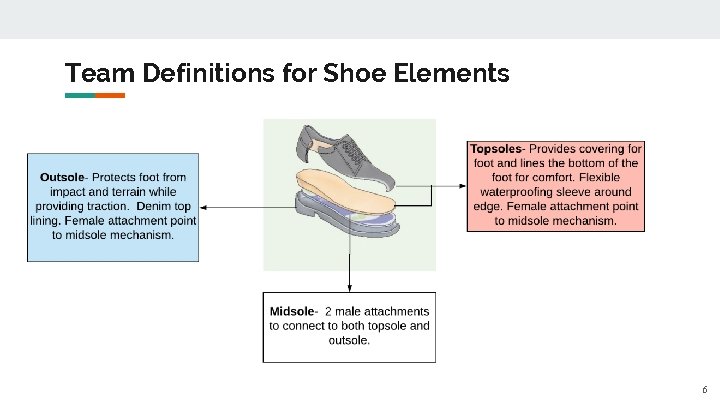
Team Definitions for Shoe Elements 6
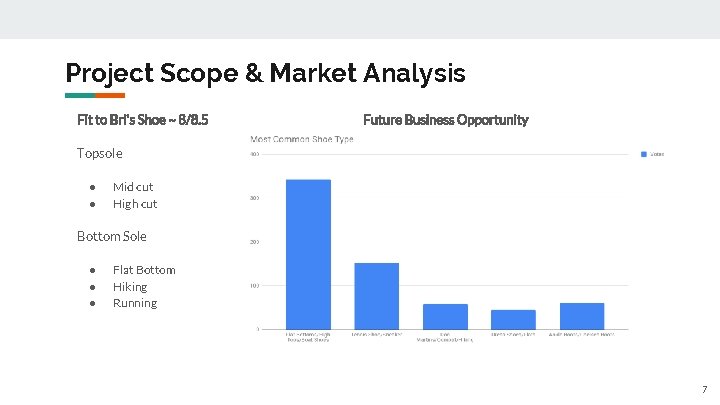
Project Scope & Market Analysis Fit to Bri’s Shoe ~ 8/8. 5 Future Business Opportunity Topsole ● ● Mid cut High cut Bottom Sole ● ● ● Flat Bottom Hiking Running 7
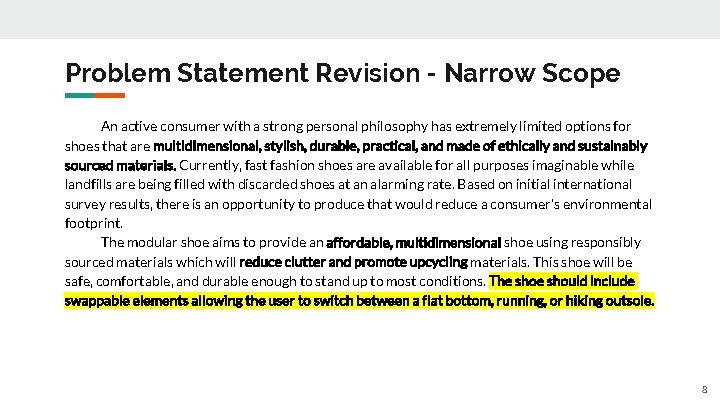
Problem Statement Revision - Narrow Scope An active consumer with a strong personal philosophy has extremely limited options for shoes that are multidimensional, stylish, durable, practical, and made of ethically and sustainably sourced materials. Currently, fast fashion shoes are available for all purposes imaginable while landfills are being filled with discarded shoes at an alarming rate. Based on initial international survey results, there is an opportunity to produce that would reduce a consumer's environmental footprint. The modular shoe aims to provide an affordable, multidimensional shoe using responsibly sourced materials which will reduce clutter and promote upcycling materials. This shoe will be safe, comfortable, and durable enough to stand up to most conditions. The should include swappable elements allowing the user to switch between a flat bottom, running, or hiking outsole. 8
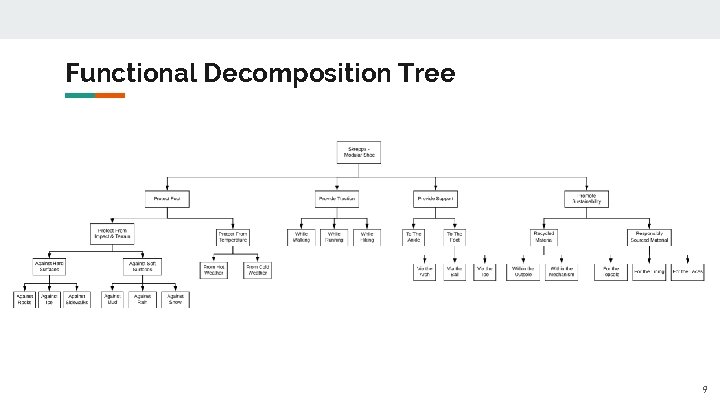
Functional Decomposition Tree 9
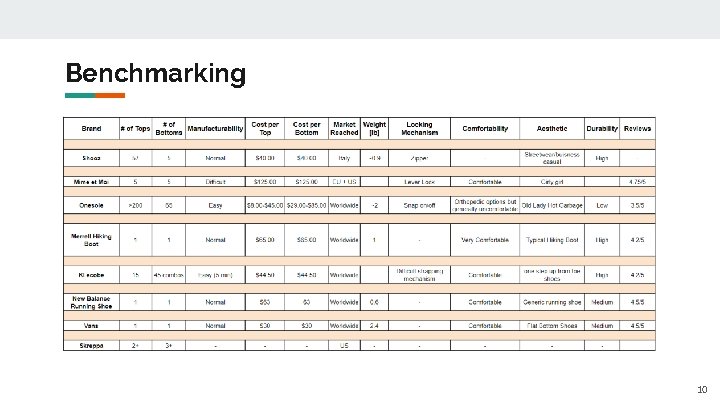
Benchmarking 10
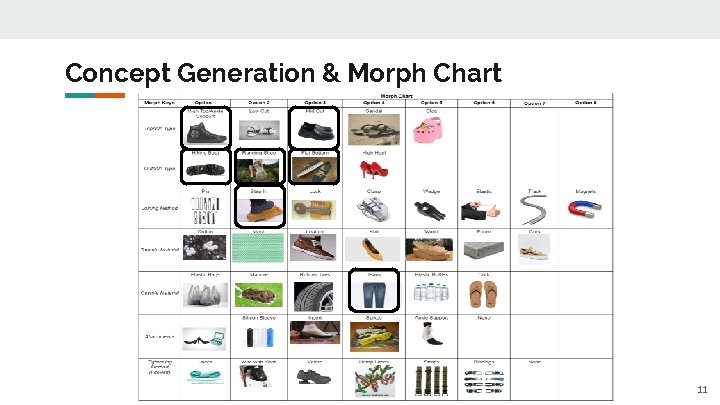
Concept Generation & Morph Chart 11
Major Breakthroughs - Through Morph ● ● Tightening methods are an important function when building the shoe. Flexible track and wedge was the most practical joining method. ○ ● ● Might need active and passive mechanisms to join top and bottom Aesthetics must be kept in mind. Must consider flexibility of shoe when developing joining method concepts. 12
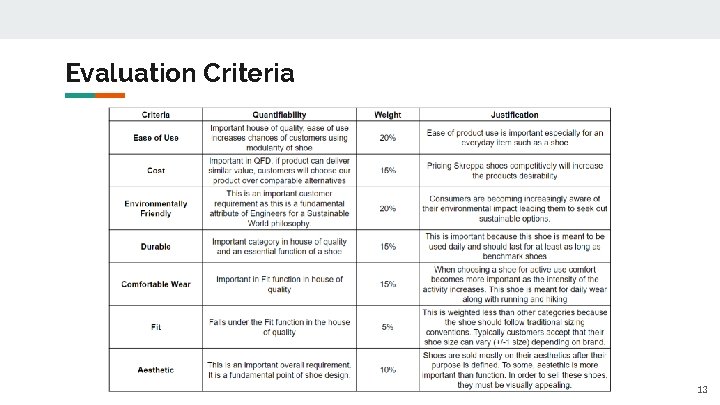
Evaluation Criteria 13
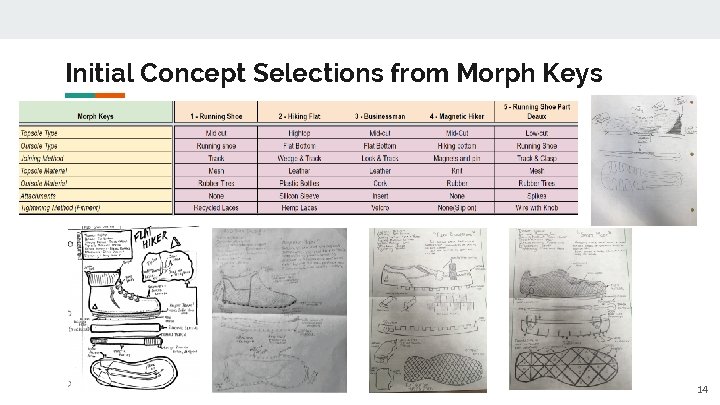
Initial Concept Selections from Morph Keys 14
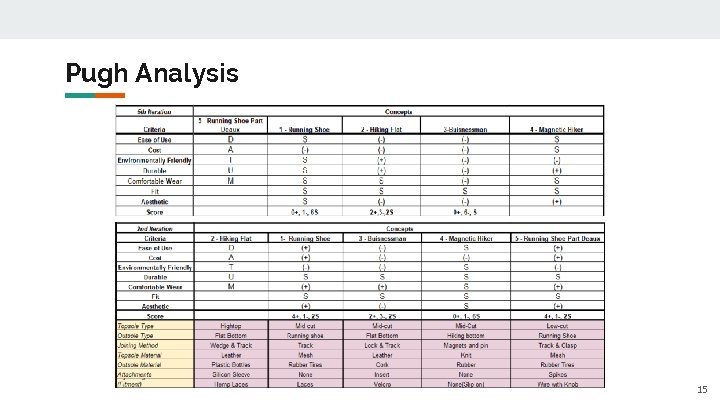
Pugh Analysis 15
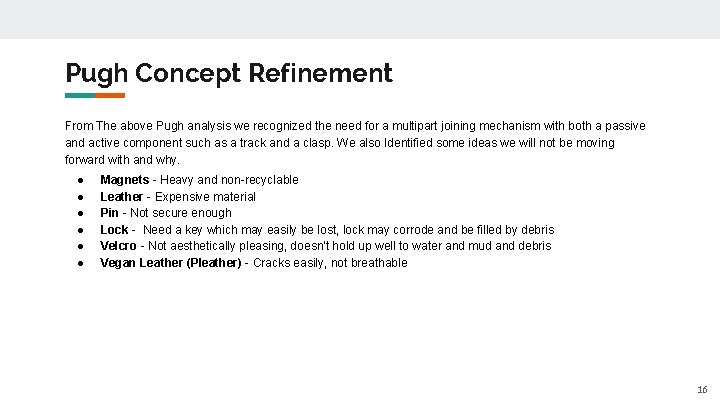
Pugh Concept Refinement From The above Pugh analysis we recognized the need for a multipart joining mechanism with both a passive and active component such as a track and a clasp. We also Identified some ideas we will not be moving forward with and why. ● ● ● Magnets - Heavy and non-recyclable Leather - Expensive material Pin - Not secure enough Lock - Need a key which may easily be lost, lock may corrode and be filled by debris Velcro - Not aesthetically pleasing, doesn’t hold up well to water and mud and debris Vegan Leather (Pleather) - Cracks easily, not breathable 16
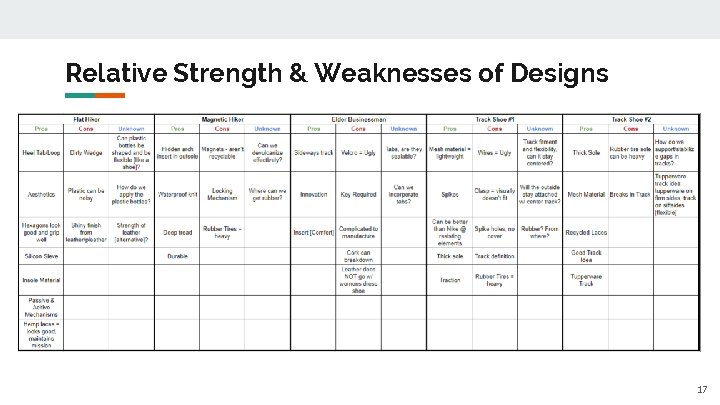
Relative Strength & Weaknesses of Designs 17
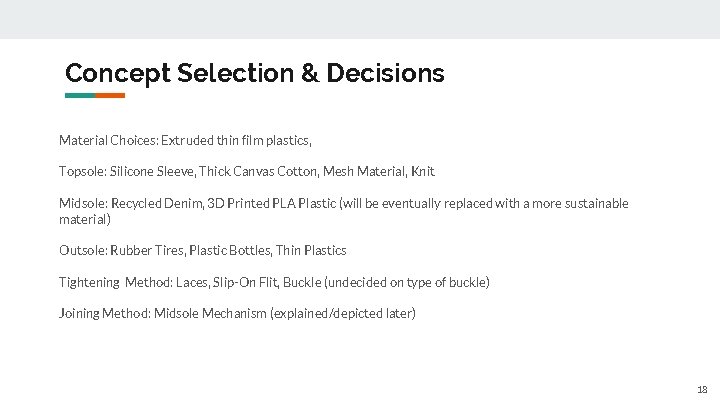
Concept Selection & Decisions Material Choices: Extruded thin film plastics, Topsole: Silicone Sleeve, Thick Canvas Cotton, Mesh Material, Knit Midsole: Recycled Denim, 3 D Printed PLA Plastic (will be eventually replaced with a more sustainable material) Outsole: Rubber Tires, Plastic Bottles, Thin Plastics Tightening Method: Laces, Slip-On Flit, Buckle (undecided on type of buckle) Joining Method: Midsole Mechanism (explained/depicted later) 18
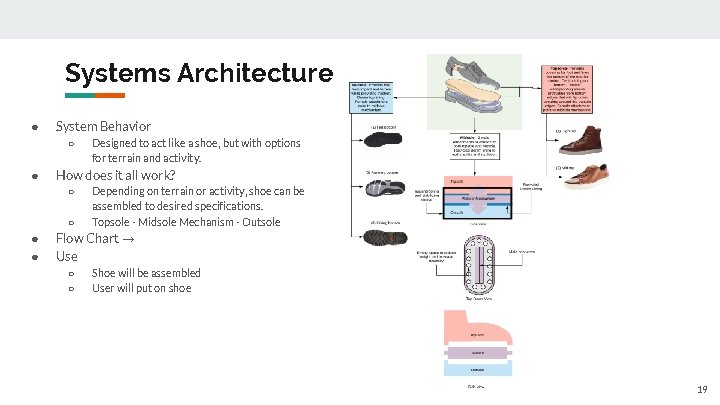
Systems Architecture ● System Behavior ○ ● How does it all work? ○ ○ ● ● Designed to act like a shoe, but with options for terrain and activity. Depending on terrain or activity, shoe can be assembled to desired specifications. Topsole - Midsole Mechanism - Outsole Flow Chart → Use ○ ○ Shoe will be assembled User will put on shoe 19
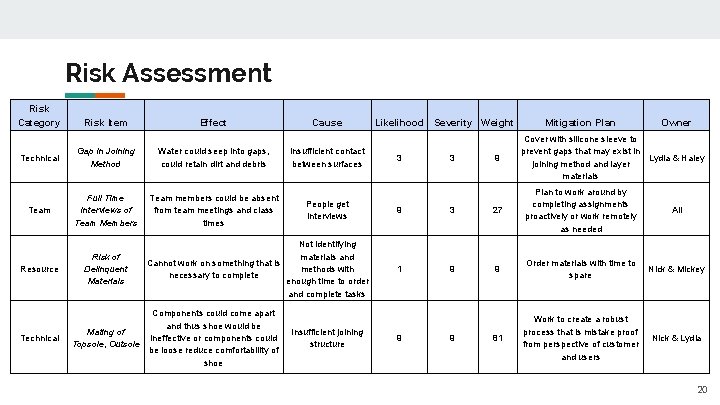
Risk Assessment Risk Category Risk Item Effect Cause Technical Gap in Joining Method Water could seep into gaps, could retain dirt and debris Insufficient contact between surfaces Team Full Time Interviews of Team Members Team members could be absent from team meetings and class times People get interviews Resource Risk of Delinquent Materials Technical Mating of Topsole, Outsole Not identifying materials and Cannot work on something that is methods with necessary to complete enough time to order and complete tasks Components could come apart and thus shoe would be ineffective or components could be loose reduce comfortability of shoe Insufficient joining structure Likelihood Severity Weight 3 3 9 Mitigation Plan Owner Cover with silicone sleeve to prevent gaps that may exist in Lydia & Haley joining method and layer materials 9 3 27 Plan to work around by completing assignments proactively or work remotely as needed 1 9 9 Order materials with time to spare Nick & Mickey 81 Work to create a robust process that is mistake proof from perspective of customer and users Nick & Lydia 9 9 All 20
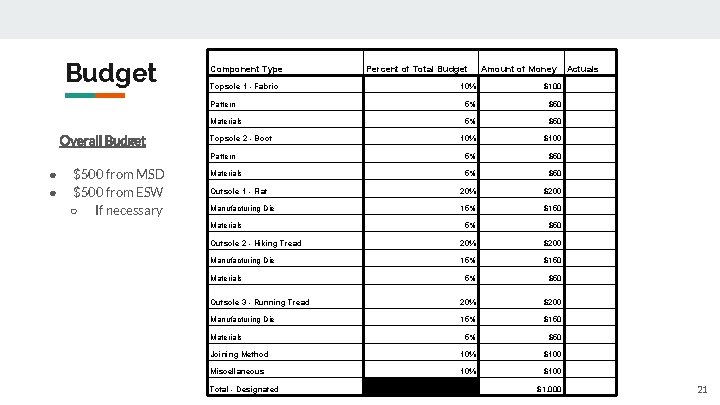
Budget Overall Budget ● ● $500 from MSD $500 from ESW ○ If necessary Component Type Topsole 1 - Fabric Percent of Total Budget Amount of Money 10% $100 Pattern 5% $50 Materials 5% $50 Outsole 1 - Flat 20% $200 Manufacturing Die 15% $150 5% $50 Outsole 2 - Hiking Tread 20% $200 Manufacturing Die 15% $150 5% $50 Outsole 3 - Running Tread 20% $200 Manufacturing Die 15% $150 5% $50 Joining Method 10% $100 Miscellaneous 10% $100 Topsole 2 - Boot Materials Total - Designated $1, 000 Actuals 21
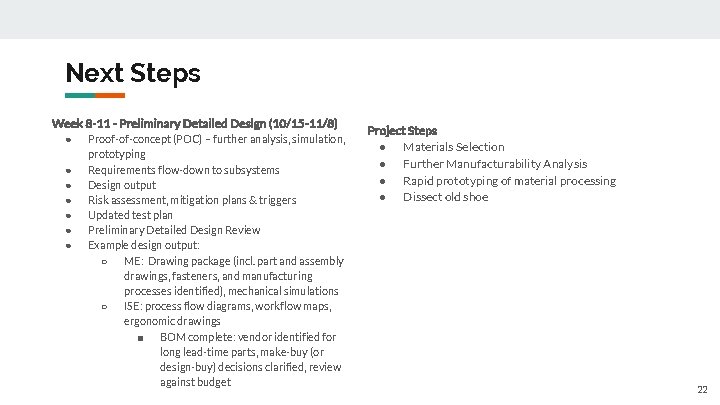
Next Steps Week 8 -11 - Preliminary Detailed Design (10/15 -11/8) ● ● ● ● Proof-of-concept (POC) – further analysis, simulation, prototyping Requirements flow-down to subsystems Design output Risk assessment, mitigation plans & triggers Updated test plan Preliminary Detailed Design Review Example design output: ○ ME: Drawing package (incl. part and assembly drawings, fasteners, and manufacturing processes identified), mechanical simulations ○ ISE: process flow diagrams, workflow maps, ergonomic drawings ■ BOM complete: vendor identified for long lead-time parts, make-buy (or design-buy) decisions clarified, review against budget Project Steps ● Materials Selection ● Further Manufacturability Analysis ● Rapid prototyping of material processing ● Dissect old shoe 22

Questions? 23
- Slides: 23