
Skin Pigmentation Natural Selection slide version 1 0
- Slides: 30
Skin Pigmentation: Natural Selection slide version 1. 0 www. evo-ed. org
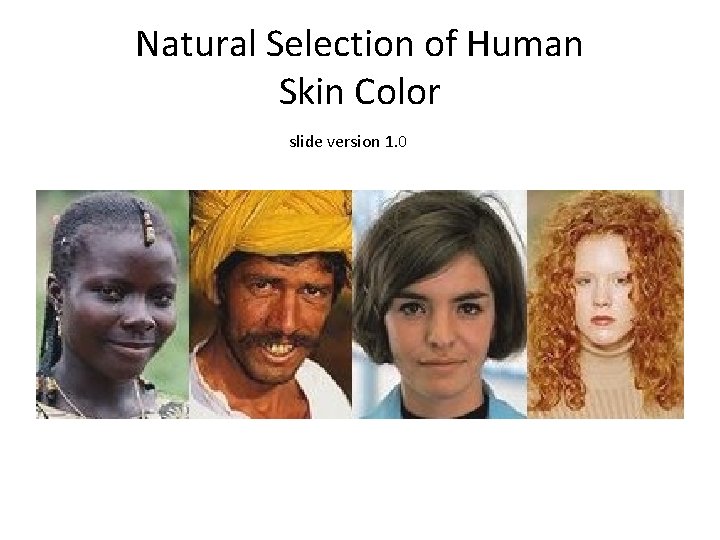
Natural Selection of Human Skin Color slide version 1. 0
Skin Pigmentation Natural Selection Learners will be able to discuss the ancestral distribution of human skin color by: • Correlating skin color of indigenous peoples to latitude and ultraviolet light levels. • Explaining three hypotheses for positive selection of darker skin near the equator in terms of cell biology. • Explaining the primary hypothesis for positive selection of lighter skin at higher northern latitudes in terms of cell biology.
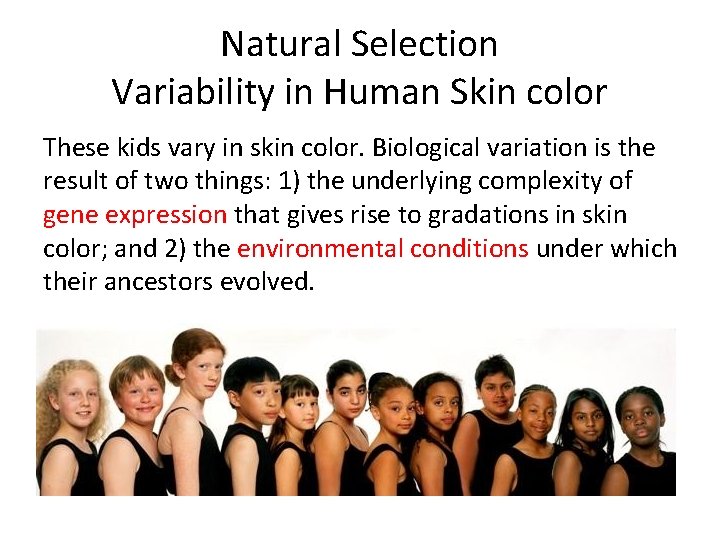
Natural Selection Variability in Human Skin color These kids vary in skin color. Biological variation is the result of two things: 1) the underlying complexity of gene expression that gives rise to gradations in skin color; and 2) the environmental conditions under which their ancestors evolved.
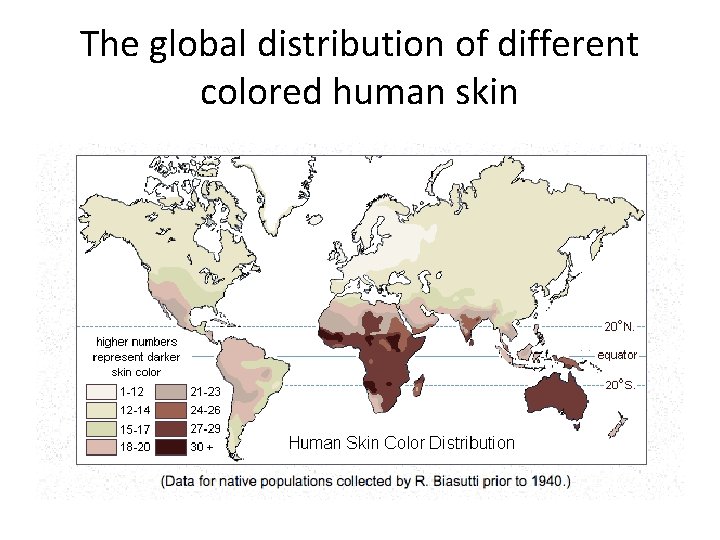
The global distribution of different colored human skin
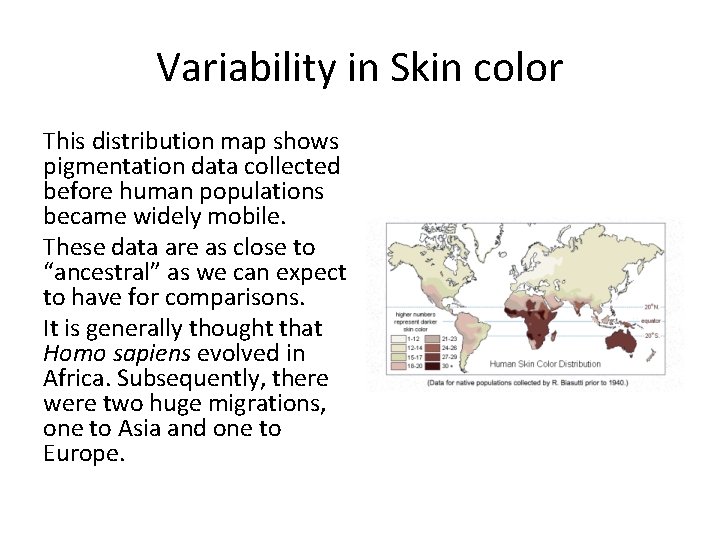
Variability in Skin color This distribution map shows pigmentation data collected before human populations became widely mobile. These data are as close to “ancestral” as we can expect to have for comparisons. It is generally thought that Homo sapiens evolved in Africa. Subsequently, there were two huge migrations, one to Asia and one to Europe.
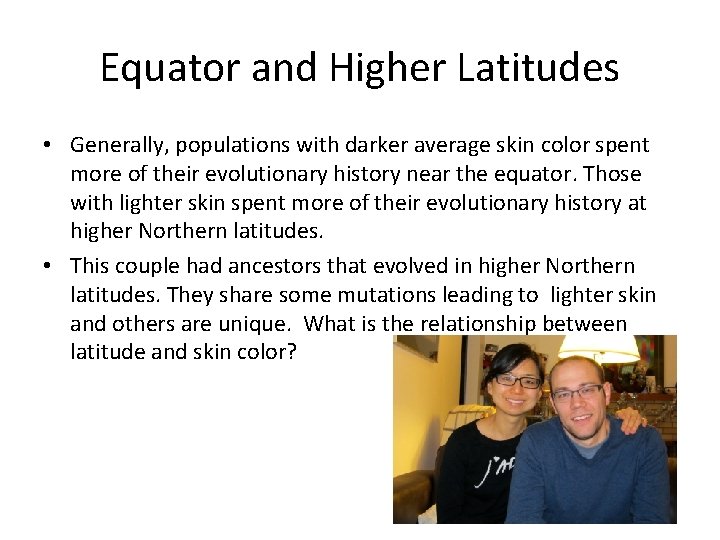
Equator and Higher Latitudes • Generally, populations with darker average skin color spent more of their evolutionary history near the equator. Those with lighter skin spent more of their evolutionary history at higher Northern latitudes. • This couple had ancestors that evolved in higher Northern latitudes. They share some mutations leading to lighter skin and others are unique. What is the relationship between latitude and skin color?
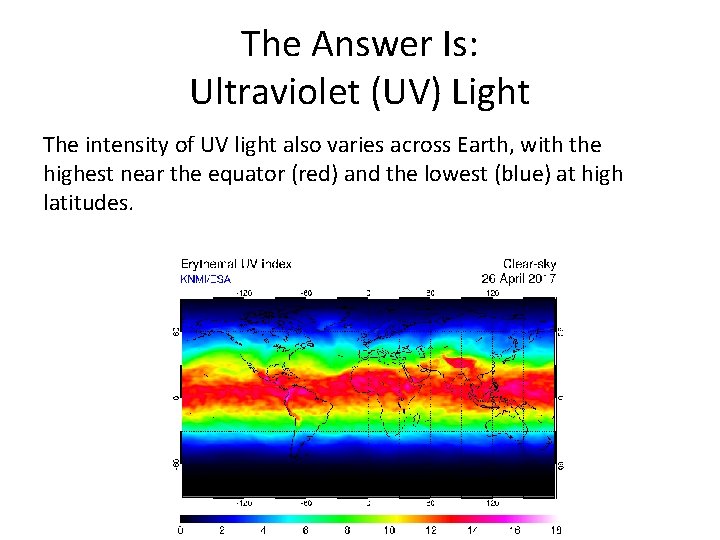
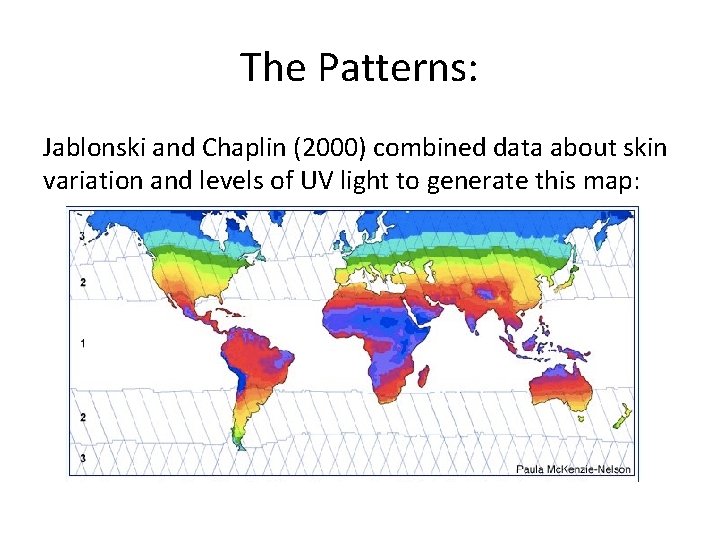
The Answer Is: Ultraviolet (UV) Light The intensity of UV light also varies across Earth, with the highest near the equator (red) and the lowest (blue) at high latitudes.
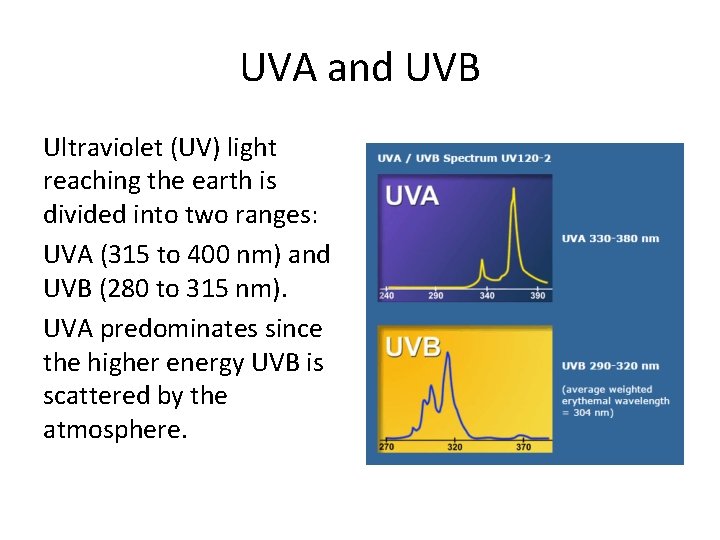
UVA and UVB Ultraviolet (UV) light reaching the earth is divided into two ranges: UVA (315 to 400 nm) and UVB (280 to 315 nm). UVA predominates since the higher energy UVB is scattered by the atmosphere.
The Patterns: Jablonski and Chaplin (2000) combined data about skin variation and levels of UV light to generate this map:
The Patterns: Key to the map: Variations in UV light are indicated by color and correspond primarily to latitude and somewhat to altitude. The highest degree of UV radiation is shown in red. UV radiation becomes less towards the poles. Zone 1 – dark pigmentation not much tanning Zone 2 – in between, “seasonal variation” = tanning Zone 3 – light pigmentation not much tanning; burning is a problem
Our Ancient Ancestors • Based on information about our Homo sapiens ancestors, their skin was thought to be light. The hair of our ancestors protected the skin from ultraviolet radiation. As our ancestors evolved in the savannahs of Africa, they lost hair. • Subsequently, hairless humans evolved dark skin, which requires the synthesis of the pigment eumelanin. This pigment also colors hair. The basic cellular mechanism for making and moving color shifted from hair to skin.
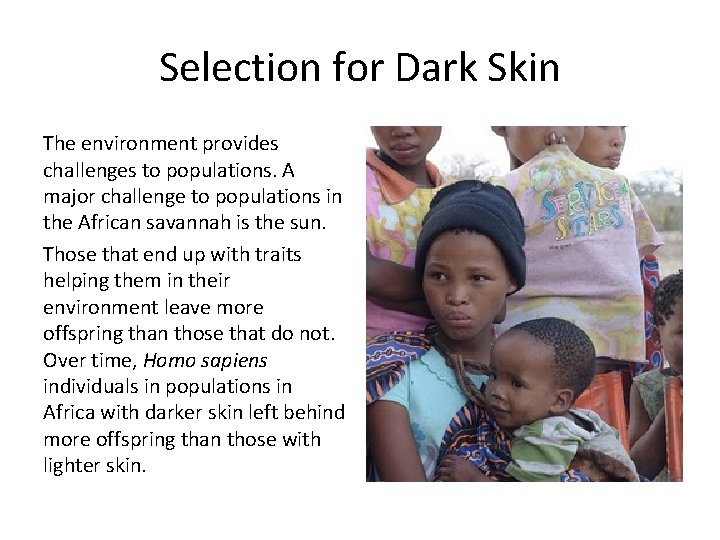
Selection for Dark Skin The environment provides challenges to populations. A major challenge to populations in the African savannah is the sun. Those that end up with traits helping them in their environment leave more offspring than those that do not. Over time, Homo sapiens individuals in populations in Africa with darker skin left behind more offspring than those with lighter skin.
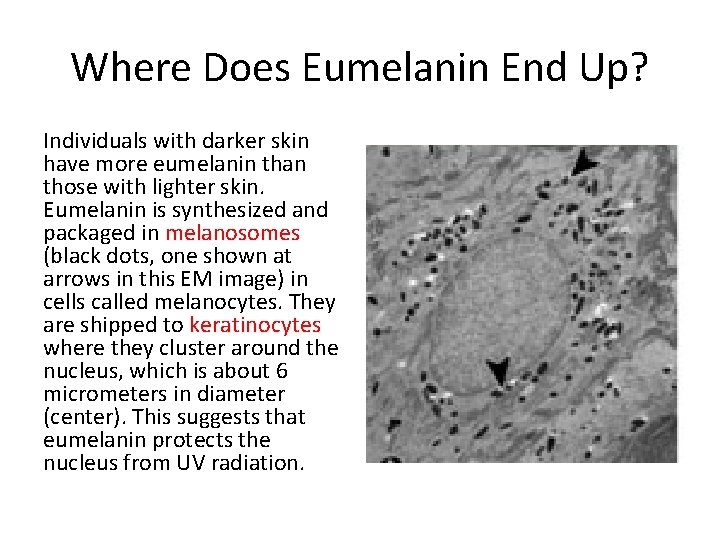
Where Does Eumelanin End Up? Individuals with darker skin have more eumelanin than those with lighter skin. Eumelanin is synthesized and packaged in melanosomes (black dots, one shown at arrows in this EM image) in cells called melanocytes. They are shipped to keratinocytes where they cluster around the nucleus, which is about 6 micrometers in diameter (center). This suggests that eumelanin protects the nucleus from UV radiation.
Positive Selection for Dark Skin Many hypotheses have been suggested for the evolution of dark skin in the ancestral populations in the African savannah. Some of these are that dark skin: • Prevented skin and sweat glands and blood vessels under the skin from being damaged. • Kept microorganisms at bay (dark skin is a better barrier than light skin). • Provided camouflage. • Mitigated high environmental temperatures. • Protected the skin from developing cancer. • Prevented photolysis of folate.
Three Primary Hypotheses The evolution of dark skin is complex; these hypotheses are not mutually exclusive. We’ll focus on three that are the most likely: 1. Protection from skin cancer 2. Prevention of folate photolysis 3. Protection of sweat glands, skin and blood vessels
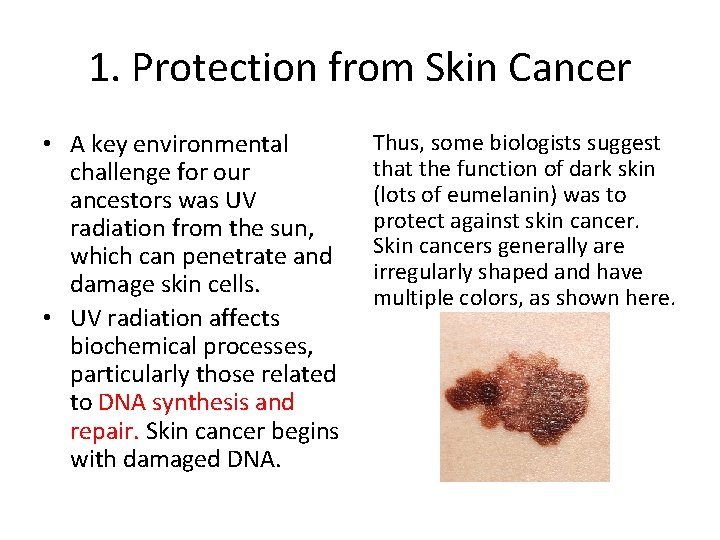
1. Protection from Skin Cancer • A key environmental challenge for our ancestors was UV radiation from the sun, which can penetrate and damage skin cells. • UV radiation affects biochemical processes, particularly those related to DNA synthesis and repair. Skin cancer begins with damaged DNA. Thus, some biologists suggest that the function of dark skin (lots of eumelanin) was to protect against skin cancer. Skin cancers generally are irregularly shaped and have multiple colors, as shown here.
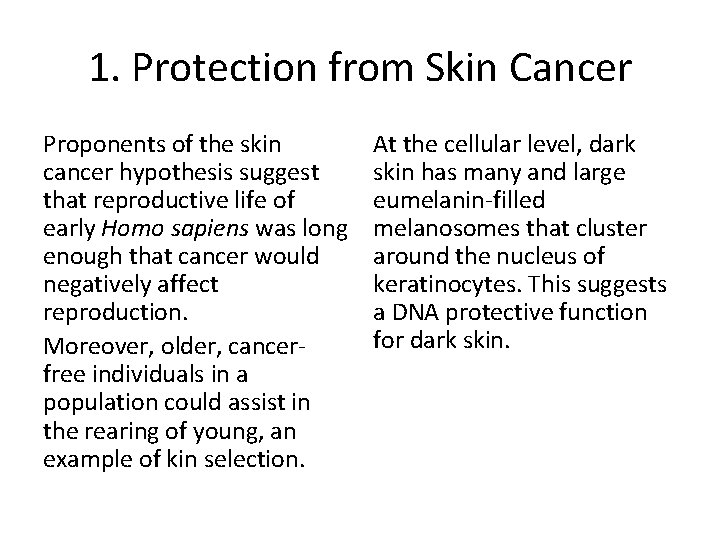
1. Protection from Skin Cancer Proponents of the skin cancer hypothesis suggest that reproductive life of early Homo sapiens was long enough that cancer would negatively affect reproduction. Moreover, older, cancerfree individuals in a population could assist in the rearing of young, an example of kin selection. At the cellular level, dark skin has many and large eumelanin-filled melanosomes that cluster around the nucleus of keratinocytes. This suggests a DNA protective function for dark skin.
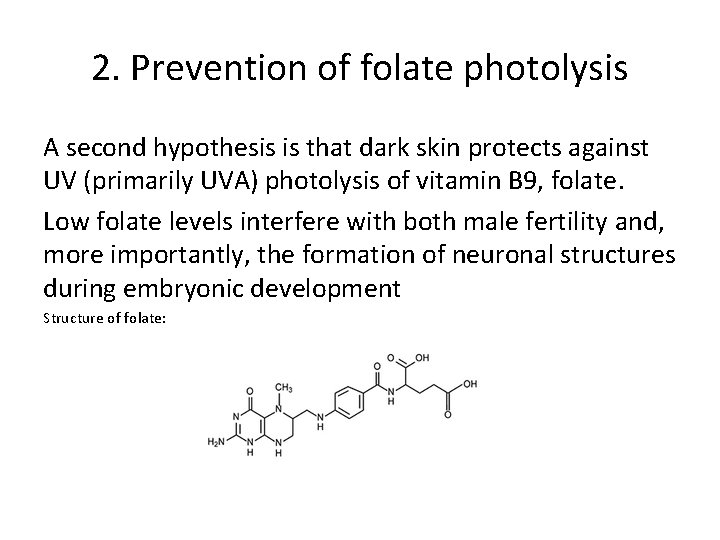
2. Prevention of folate photolysis A second hypothesis is that dark skin protects against UV (primarily UVA) photolysis of vitamin B 9, folate. Low folate levels interfere with both male fertility and, more importantly, the formation of neuronal structures during embryonic development Structure of folate:
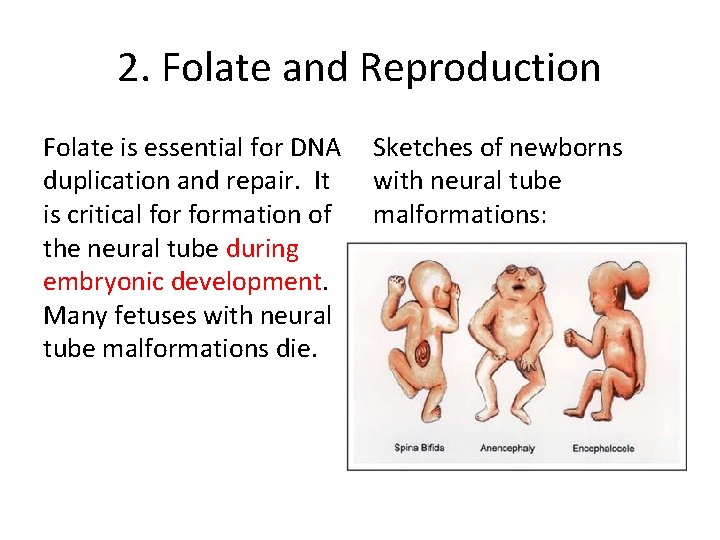
2. Folate and Reproduction Folate is essential for DNA duplication and repair. It is critical formation of the neural tube during embryonic development. Many fetuses with neural tube malformations die. Sketches of newborns with neural tube malformations:
2. Folate and Reproduction There is some experimental evidence that UV light degrades folate in laboratory conditions. Other evidence also suggests that UV degradation of folate occurs in older people. It is reasonable to suggest that individuals having more eumelanin (more capable of absorbing UV light) had greater protection from folate degradation and were more likely to be reproductively successful.
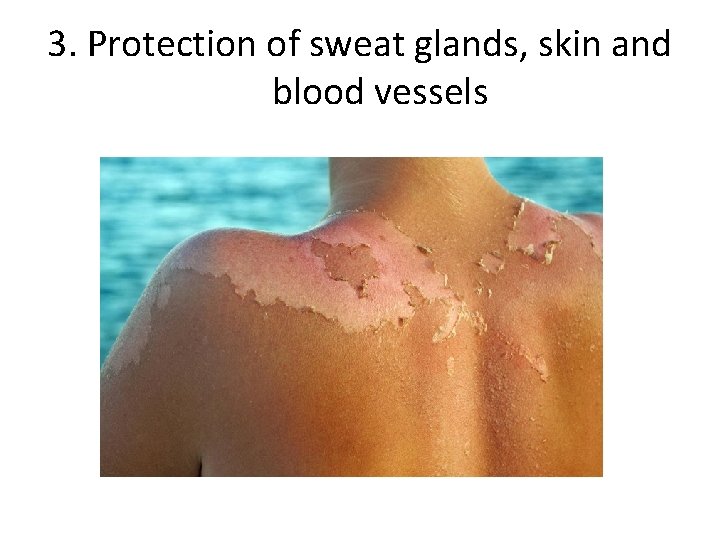
3. Protection of sweat glands, skin and blood vessels
Positive selection for Dark Skin 3. Protection of Sweat Glands and Blood Vessels • In addition to burning skin, strong equatorial sun (lots of UV) can wreak havoc on blood vessels and sweat glands. A sunburn also can lead to breaks in the skin and the possibility of infection. Untreated infection is a strong selective agent! • More pigment results in the absorption of more radiation in the keratinocytes, the surface of the skin. This absorption prevents damage to underlying structures.
Bottom Line: Summary of Positive Selection for Dark Skin • What is clear across all three hypotheses is that dark skin protects individuals from UV damage to cellular processes. • This protection was multifactorial, preserving DNA repair and synthesis, and vitamins such as folate. • Additionally, the skin as an organ was safeguarded, preventing breaks and desiccation of structures within that organ.
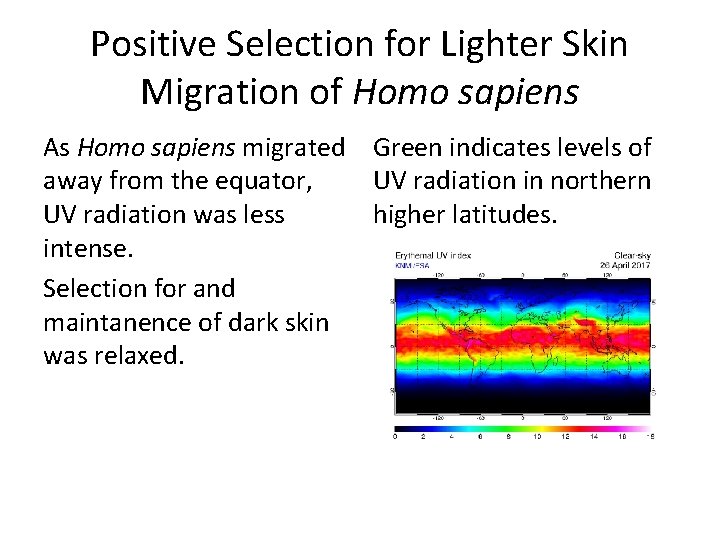
Positive Selection for Lighter Skin Migration of Homo sapiens As Homo sapiens migrated Green indicates levels of away from the equator, UV radiation in northern UV radiation was less higher latitudes. intense. Selection for and maintanence of dark skin was relaxed.
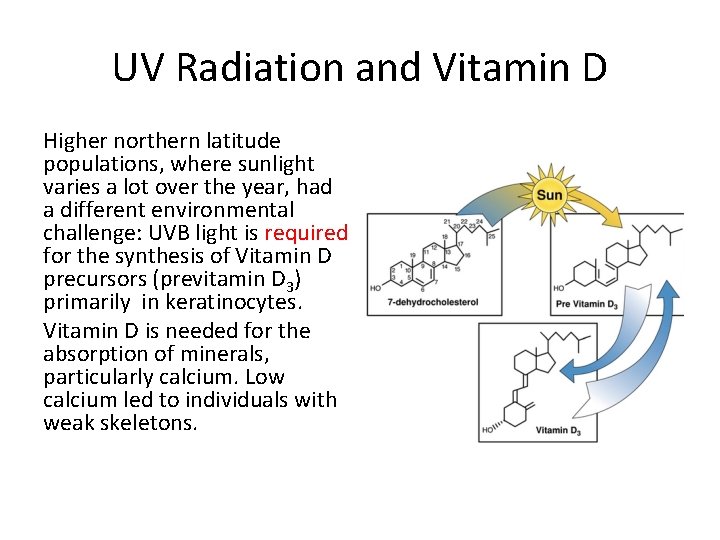
UV Radiation and Vitamin D Higher northern latitude populations, where sunlight varies a lot over the year, had a different environmental challenge: UVB light is required for the synthesis of Vitamin D precursors (previtamin D 3) primarily in keratinocytes. Vitamin D is needed for the absorption of minerals, particularly calcium. Low calcium led to individuals with weak skeletons.
The “Sunshine” Vitamin As selection for protection against UV radiation relaxed, selective advantage came to populations that could more effectively synthesize vitamin D precursors – those with less eumelanin and subsequently lighter skin that absorbed UV light.
Less Eumelanin And Maybe Pheomelanin • Changes in several genes, primarily in those that change and regulate melanin synthesis, produced individuals with lighter skin. Generally, they made less eumelanin and/or produced an alternative pigment, pheomelanin that is produced in some Northern latitude populations. • These individuals could synthesize vitamin D in reduced overall levels of UV radiation. Their children were stronger than those that could not synthesize vitamin D.
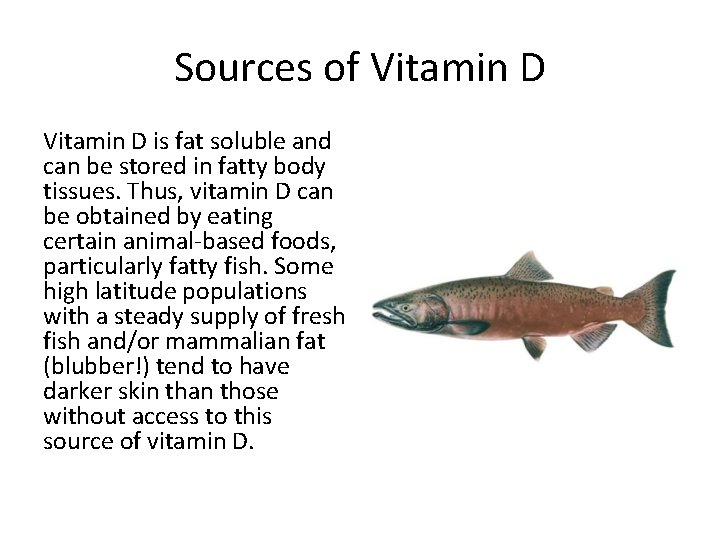
Sources of Vitamin D is fat soluble and can be stored in fatty body tissues. Thus, vitamin D can be obtained by eating certain animal-based foods, particularly fatty fish. Some high latitude populations with a steady supply of fresh fish and/or mammalian fat (blubber!) tend to have darker skin than those without access to this source of vitamin D.
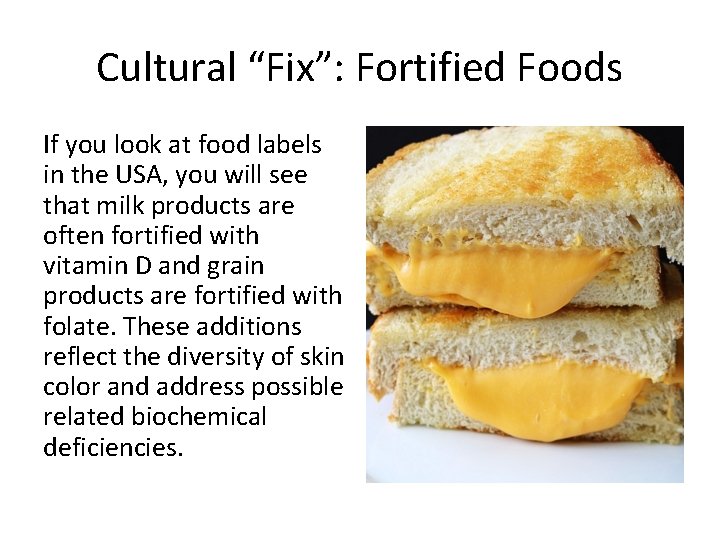
Cultural “Fix”: Fortified Foods If you look at food labels in the USA, you will see that milk products are often fortified with vitamin D and grain products are fortified with folate. These additions reflect the diversity of skin color and address possible related biochemical deficiencies.