
Skin Manifestations of Tuberous Sclerosis Complex Julie Prendiville

Skin Manifestations of Tuberous Sclerosis Complex Julie Prendiville BC Children’s Hospital
Skin Manifestations of TSC • • • Hypomelanotic macules Angiofibromas Fibrous cephalic plaques Ungual fibromas Collagenomas (shagreen patch)

Skin Manifestations of TSC • Minor diagnostic criteria – Confetti skin lesions – Oral/dental • Dental pits • Gingival and other oral fibromas • Other
Hypomelanotic Macules Sometimes referred to as “ash-leaf” spots Classic lesion has similar “lanceovate” shape to mountain ash tree leaf Mountain Ash (Rowan) tree
Other Skin Findings Nuchal Skin Tags Neonatal White Plaques Associated with cardiac rhabdomyomas
Differential Diagnosis • Vitiligo – Acquired autoimmune condition – Loss of melanocytes • Piebaldism – Present at birth • “Nevus depigmentosus” – Isolated white macules seen in general population – May be small macules or large segmental areas
Mosaicism/Segmental Hypopigmentation Mosaicism in a child with TSC

Mosaicism Unilateral facial angiofibromas with no other evidence of TSC
Differential Diagnosis • Facial angiofibromas may occur in other genetic conditions – Multiple endocrine neoplasia type 1 – Birt-Hogg-Dube syndrome • Facial angiofibromas may be mistaken for acne
Treatment of Skin Manifestations • Facial Angiofibromas – Facial disfigurement – May affect self-esteem – May result in feelings of social isolation • Ungual fibromas – May cause discomfort – Cosmetic issue
Treatment of Facial Angiofibromas • Surgical • Medical
Treatment of Facial Angiofibromas • Surgical – Pulsed dye laser • For red vascular angiofibromas – CO 2 laser • For fibrous angiofibromas – Excision • For larger or bleeding angiofibromas Angiofibromas tend to recur regardless of surgical modality
Treatment of Facial Angiofibromas • Medical therapy – Inhibitors of m. TOR • Rapamycin (sirolimus) • Everolimus
Treatment of Facial Angiofibromas with MTOR Inhibitors • 2008: report of improvement in child with TSC receiving sirolimus (rapamycin) following kidney transplant • 2010: case report of improvement with topical application of rapamycin • 2010 -2016: multiple case reports, a few case series, and one controlled trial
Topical Rapamycin • All published reports describe improvement • Large angiofibromas may respond poorly
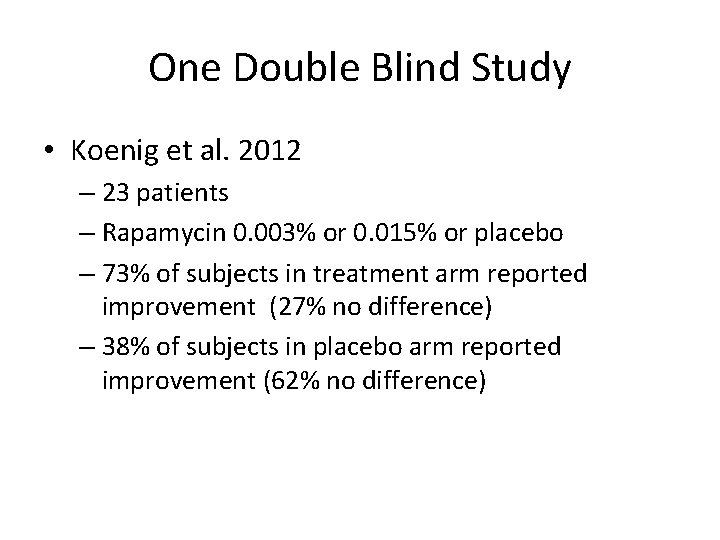
One Double Blind Study • Koenig et al. 2012 – 23 patients – Rapamycin 0. 003% or 0. 015% or placebo – 73% of subjects in treatment arm reported improvement (27% no difference) – 38% of subjects in placebo arm reported improvement (62% no difference)
How to Objectively Assess Improvement • • Before and after photographs Left /right comparison studies Double-blinded randomized controlled studies Standardized measurement tool – Facial angiofibroma severity index (FASI)
Topical Rapamycin • What is the optimal concentration? – 0. 0035% to 1% reported in the literature – 0. 1% and 0. 2% most commonly prescribed • What is the best vehicle? – Ointment – Cream – Gel – Solution – frequently causes skin irritation
Topical Rapamycin • Safety – Systemic absorption appears to be minimal • Skin irritation is the most common adverse effect – May be treated with topical steroids
Obstacles to Treatment • Cost – 30 grams of rapamycin 0. 2% cream costs ~ CAD$500 • Compounding – sirolimus (rapamycin) pills need to be crushed and compounded into cream or ointment • Special Authority requests – BC Pharmacare and many insurance companies require special authority approval
What about Everolimus • Two placebo controlled studies of oral everolimus (for renal tumors) reported a significant improvement in skin lesions • One study of topical everolimus showed benefit
Conclusions • Oral rapamycin and everolimus appear to improve facial angiofibromas • Topical formulations have shown benefit – Double-blind randomized controlled studies using objective measurement tools are lacking • Large angiofibromas do not appear to respond so well and may do better with laser/surgery • Combination of surgical and medical treatments can be considered
- Slides: 22