
Skin Integument Cutaneous Membrane 7 Functions Protective covering
Skin = Integument = Cutaneous Membrane • 7 Functions: – – – – Protective covering Regulates body temperature Manufactures Vitamin D Sensory function Temporary storage of fat, glucose, water and salts Screens out harmful ultraviolet radiation Absorbs certain drugs
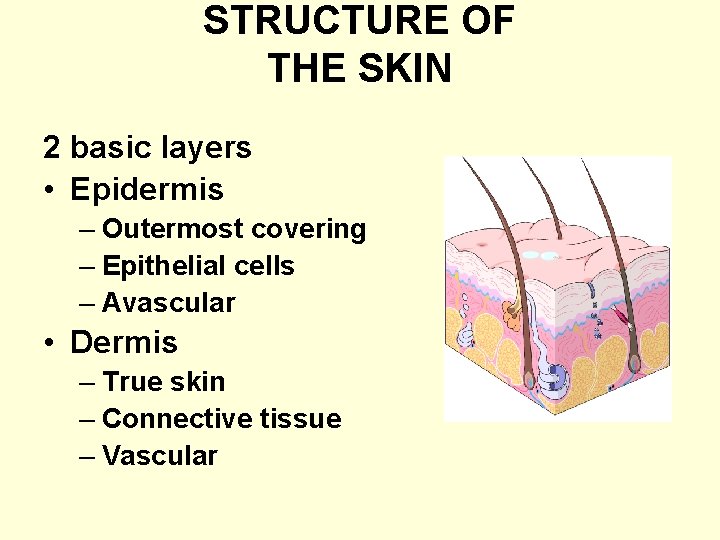
STRUCTURE OF THE SKIN 2 basic layers • Epidermis – Outermost covering – Epithelial cells – Avascular • Dermis – True skin – Connective tissue – Vascular
EPIDERMIS 2 (of 3) epidermal layers are: • Stratum corneum • Stratum germinativum
STRATUM CORNEUM (Epidermis) Outermost layer • In cells, cytoplasm replaced by KERATIN – making them waterproof. • Flat and scale-like cells that flake off • First line of defense against surface bacteria • Thickest on palms of hands, soles of feet
STRATUM GERMINATIVUM (Epidermis) • Innermost epidermal layer • Reproductive layer – cells form and push their way up, become keratinized, and replace the top layer • Contains MELANOCYTES – cells that contain a pigment = MELANIN
Melanin • Black, brown, or has a yellow tint – depending on racial origin • The more melanin, the darker the skin • Caucasians don’t have much melanin in their melanocytes. • Freckles = patches of melanin • Albinism = no melanin
Tanning (Epidermis) • Sunlight stimulates melanocytes to make more melanin • Tanning produced by UV rays. • Prolonged exposure may lead to skin cancer!
PAPILLAE (Epidermis) • Ridges in stratum germinativum that arise from dermis • Create permanent ridges in fingers, palms and soles of feet • These “friction ridges” help with grip • Cause “fingerprints”
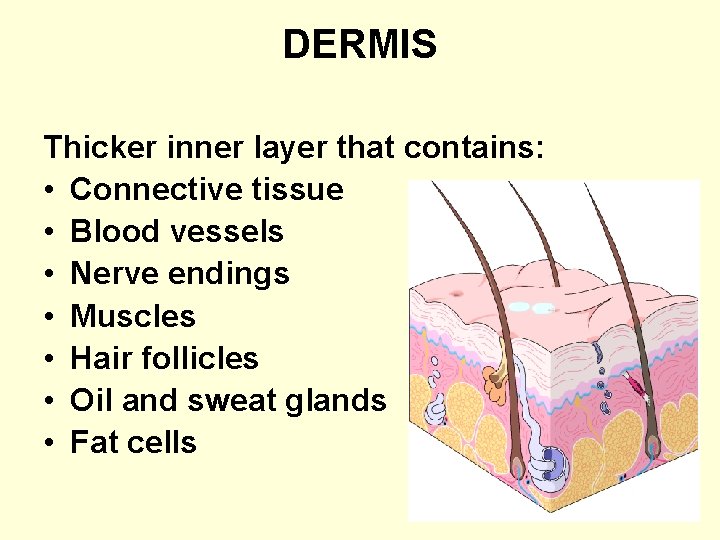
DERMIS Thicker inner layer that contains: • Connective tissue • Blood vessels • Nerve endings • Muscles • Hair follicles • Oil and sweat glands • Fat cells
Nerve Receptors in Dermis • Sensory nerves – heat, cold, touch, pain and pressure • Touch receptors close to the surface • Pressure receptors are deeper
Subcutaneous Layer • Lies under the dermis (not really part of integumentary system) • Made up of loose connective tissue • Contains half of the body’s stored fat
Appendages of the Skin HAIR (Overhead) • Almost everywhere on the body • Length, thickness, type and color varies • Outer layer = CORTEX • Inner layer = MEDULLA • Part under the skin = ROOT • Part outside the skin = SHAFT • FOLLICLE = pocket in epidermis, hair inside • PAPILLA = tuft of tissue in root, contains capillaries • ARRECTOR PILI MUSCLE = smooth muscle attached to follicle. How does this muscle cause goose bumps?
Appendages of the Skin SWEAT GLANDS • Perspiration is 99% water • SUDORIFEROUS GLANDS • Distributed over the entire skin surface • Large numbers under the arms, palms of hands, soles of feet and forehead • Duct extends to form a pore in the skin, perspiration excreted through the pores • May be activated by heat, pain, fever and nervousness • Average fluid loss is 500 ml per day
Appendages of the Skin SEBACEOUS GLANDS • Secret oil (SEBUM) that protects and lubricates the skin NAILS • Nail is formed in the nail bed or MATRIX • Epidermal cells fused together and fill with keratin
Skin and Microorganisms • Intact skin = best protection against pathogens, toxins and water loss • Skin generally too dry for microbial growth – they do grow in moist areas • Most skin bacteria associated with hair follicles or sweat glands • Underarm perspiration odor caused by bacteria and perspiration The best way to prevent the spread of disease is by hand washing.
ACNE • Common and chronic disorder of sebaceous glands • Sebum plugs pores area fills with leukocytes • Also – blackheads, cysts, pimples and scarring ATHLETE’S FOOT • Contagious fungal infection • Usually contracted in public baths and showers • Rx – antifungal agents
DERMATITIS • Non-specific inflammation of skin • Can be rash – reaction to soap, plants, etc. • Can be emotional – stress can cause skin blotches
GENITAL HERPES • Viral • Blister in genital area • Spread through sexual contact • Periods of remission and exacerbation • Rx – Acyclovir • Can be passed to newborn during vaginal delivery
MALIGNANT MELANOMA • Occurs in melanocytes • Metastasizes to other areas quickly • Appears as brown or black irregular patch that occurs suddenly • A change in an existing wart or mole may indicate melanoma • Rx – surgical removal of melanoma and surrounding area and chemotherapy
SKIN CANCER • Associated with exposure to sun (UV rays) • Most common type of cancer in people ALBINISM – absence of melanin ALOPECIA – baldness
BURNS • Caused by radiation, sun, boiling water, chemicals, fire or electricity • RULE OF NINES – Measures percent of body burned. Body divided into 11 area, each is 9% of body surface.
BURNS FIRST DEGREE • Superficial • Skin red and dry • Involves only epidermis • Rx – cold water • Healing within one week
BURNS SECOND DEGREE • Epidermis and dermis • Pain, swelling, redness and blistering • Skin may be exposed to infection • Rx – pain medication, dry sterile dressing • Healing within 2 weeks
BURNS THIRD DEGREE • Epidermis, dermis and subcutaneous layers • Symptoms – loss of skin, blackened skin • May be life threatening
- Slides: 24