
Skin Integrity and Wound Care Dr Mohammed Hassan

- Slides: 16
Skin Integrity and Wound Care Dr. Mohammed Hassan RN, Ph. D
LEARNING OUTCOMES After completing this lecture, you will be able to: 1. Describe factors affecting skin integrity. 2. Differentiate primary and secondary wound healing. 3. Describe three phases of wound healing. 4. Identify three major types of wound exudate. 5. Identify the main complications of and factors that affect wound healing. 6. Identify assessment data pertinent to skin integrity, pressure sites, and wounds.
Types of wounds The wounds can be classified according to: 1 - Etiology and causes. 2 - Degree of wound contamination. 3 - Depth of wound.
Types of Wounds
Wound healing Healing is a quality of living tissue; it is also referred to as regeneration (renewal) of tissues.
Types of Wound Healing The types of healing are influenced by the amount of tissue loss; classify in to 3: 1. Primary intention. 2. secondary intention healing. 3. tertiary intention.
Phases of Wound Healing Wound healing can be broken down into three phases: 1. Inflammatory. 2. Proliferative. 3. Maturation or remodeling.
Inflammatory phase The inflammatory phase begins immediately after injury and lasts 3 to 6 days. Two major processes occur during this phase: hemostasis and phagocytosis.
Proliferative phase The proliferative phase, the second phase in healing, extends from day 3 or 4 to about day 21 post injury. Fibroblasts (connective tissue cells), which migrate into the wound starting about 24 hours after injury, begin to synthesize collagen.
Maturation phase The maturation phase begins on about day 21 and can extend 1 or 2 years after the injury. Fibroblasts continue to synthesize collagen.
Types of Wound Exudate is material, such as fluid and cells, that has escaped from blood vessels during the inflammatory process and is deposited in tissue or on tissue surfaces. The three major types: 1. A serous exudate. 2. A purulent exudate. 3. A sanguineous exudate.
Complications of Wound Healing Several untoward events can interfere with the healing of a wound. These include: 1. Hemorrhage. 2. Infection. 3. Dehiscence. 4. Evisceration.
Factors Affecting Wound Healing Characteristics of the individual such as: 1. Age. 2. Nutritional status. 3. Lifestyle. 4. Medications.
Nursing management Assessing Assessment of Skin Integrity The nurse conducts an examination of the integument as part of a routine assessment and during regular care.
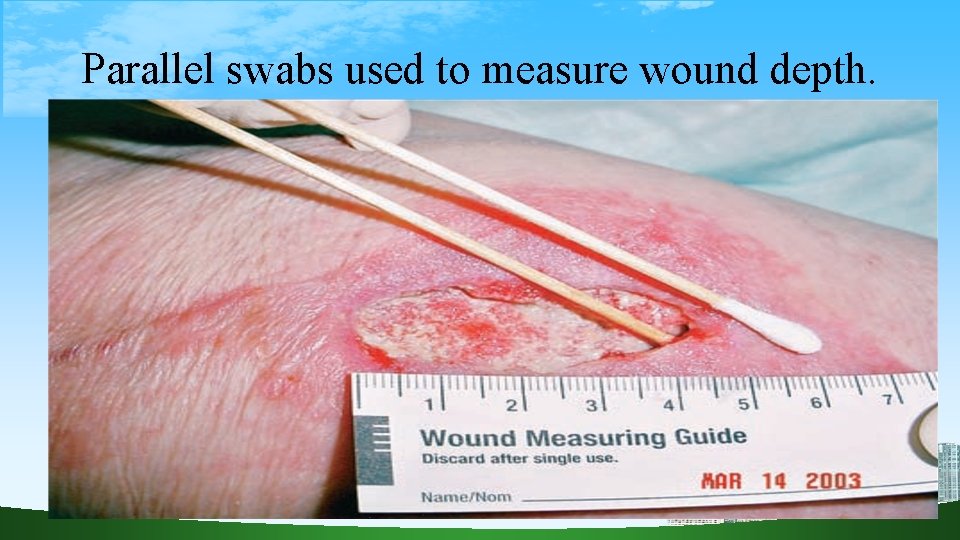
Parallel swabs used to measure wound depth.