
Skin color representation in peerreviewed dermatology publications JAAD
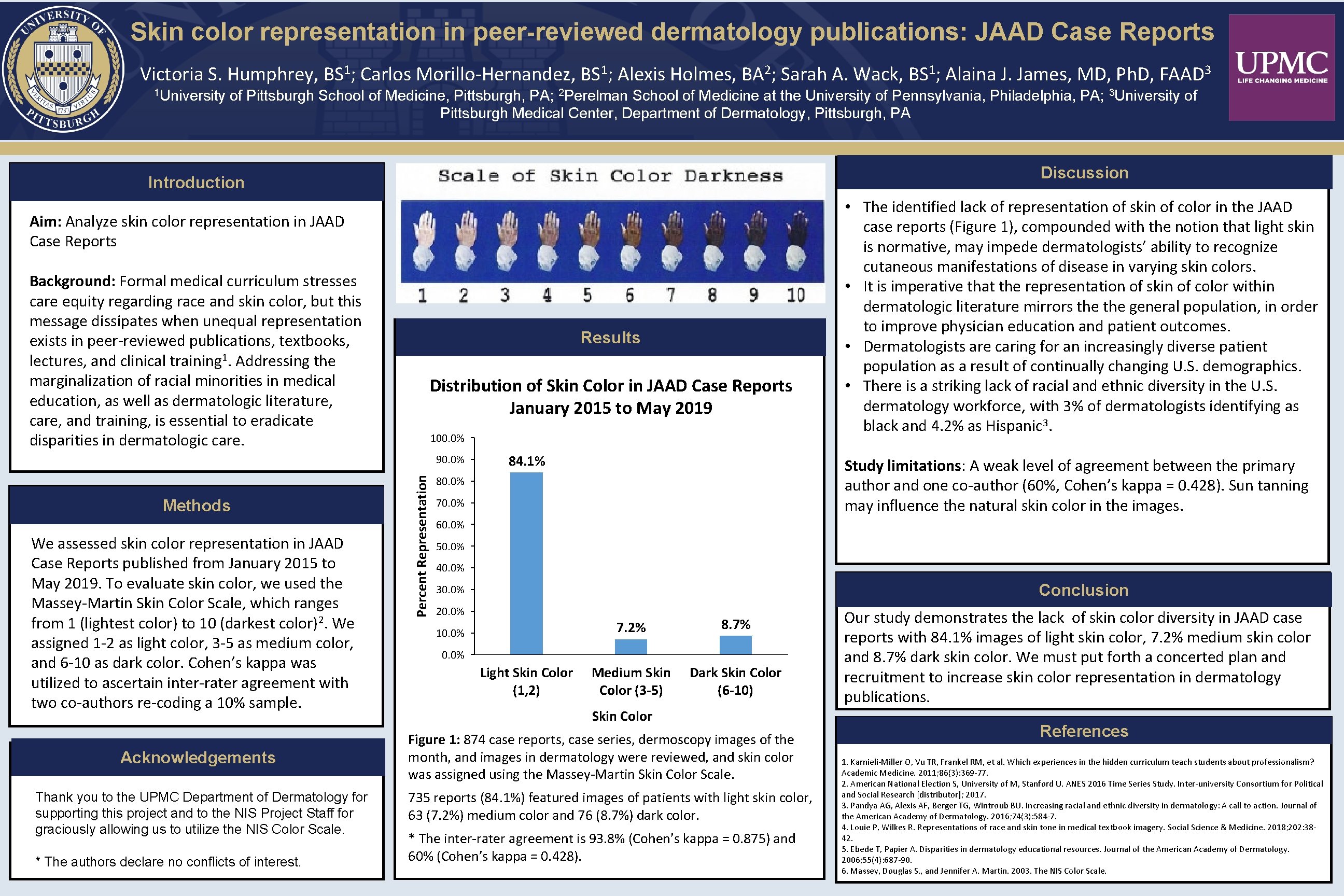
Skin color representation in peer-reviewed dermatology publications: JAAD Case Reports Victoria S. Humphrey, BS 1; Carlos Morillo-Hernandez, BS 1; Alexis Holmes, BA 2; Sarah A. Wack, BS 1; Alaina J. James, MD, Ph. D, FAAD 3 1 University of Pittsburgh School of Medicine, Pittsburgh, PA; 2 Perelman School of Medicine at the University of Pennsylvania, Philadelphia, PA; 3 University of Pittsburgh Medical Center, Department of Dermatology, Pittsburgh, PA Discussion Introduction Aim: Analyze skin color representation in JAAD Case Reports Background: Formal medical curriculum stresses care equity regarding race and skin color, but this message dissipates when unequal representation exists in peer-reviewed publications, textbooks, lectures, and clinical training 1. Addressing the marginalization of racial minorities in medical education, as well as dermatologic literature, care, and training, is essential to eradicate disparities in dermatologic care. Results Distribution of Skin Color in JAAD Case Reports January 2015 to May 2019 100. 0% Methods We assessed skin color representation in JAAD Case Reports published from January 2015 to May 2019. To evaluate skin color, we used the Massey-Martin Skin Color Scale, which ranges from 1 (lightest color) to 10 (darkest color)2. We assigned 1 -2 as light color, 3 -5 as medium color, and 6 -10 as dark color. Cohen’s kappa was utilized to ascertain inter-rater agreement with two co-authors re-coding a 10% sample. Acknowledgements Thank you to the UPMC Department of Dermatology for supporting this project and to the NIS Project Staff for graciously allowing us to utilize the NIS Color Scale. * The authors declare no conflicts of interest. Percent Representation 90. 0% 84. 1% • The identified lack of representation of skin of color in the JAAD case reports (Figure 1), compounded with the notion that light skin is normative, may impede dermatologists’ ability to recognize cutaneous manifestations of disease in varying skin colors. • It is imperative that the representation of skin of color within dermatologic literature mirrors the general population, in order to improve physician education and patient outcomes. • Dermatologists are caring for an increasingly diverse patient population as a result of continually changing U. S. demographics. • There is a striking lack of racial and ethnic diversity in the U. S. dermatology workforce, with 3% of dermatologists identifying as black and 4. 2% as Hispanic 3. Study limitations: A weak level of agreement between the primary author and one co-author (60%, Cohen’s kappa = 0. 428). Sun tanning may influence the natural skin color in the images. 80. 0% 70. 0% 60. 0% 50. 0% 40. 0% Conclusion 30. 0% 20. 0% 10. 0% 7. 2% 8. 7% Medium Skin Color (3 -5) Dark Skin Color (6 -10) 0. 0% Light Skin Color (1, 2) Skin Color Figure 1: 874 case reports, case series, dermoscopy images of the month, and images in dermatology were reviewed, and skin color was assigned using the Massey-Martin Skin Color Scale. 735 reports (84. 1%) featured images of patients with light skin color, 63 (7. 2%) medium color and 76 (8. 7%) dark color. * The inter-rater agreement is 93. 8% (Cohen’s kappa = 0. 875) and 60% (Cohen’s kappa = 0. 428). Our study demonstrates the lack of skin color diversity in JAAD case reports with 84. 1% images of light skin color, 7. 2% medium skin color and 8. 7% dark skin color. We must put forth a concerted plan and recruitment to increase skin color representation in dermatology publications. References 1. Karnieli-Miller O, Vu TR, Frankel RM, et al. Which experiences in the hidden curriculum teach students about professionalism? Academic Medicine. 2011; 86(3): 369 -77. 2. American National Election S, University of M, Stanford U. ANES 2016 Time Series Study. Inter-university Consortium for Political and Social Research [distributor]; 2017. 3. Pandya AG, Alexis AF, Berger TG, Wintroub BU. Increasing racial and ethnic diversity in dermatology: A call to action. Journal of the American Academy of Dermatology. 2016; 74(3): 584 -7. 4. Louie P, Wilkes R. Representations of race and skin tone in medical textbook imagery. Social Science & Medicine. 2018; 202: 3842. 5. Ebede T, Papier A. Disparities in dermatology educational resources. Journal of the American Academy of Dermatology. 2006; 55(4): 687 -90. 6. Massey, Douglas S. , and Jennifer A. Martin. 2003. The NIS Color Scale.
- Slides: 1