
SKIN CANCER SKIN CANCER Objectives Students will be
SKIN CANCER
SKIN CANCER Objectives Students will be able to: Describe 2 differences between UVA and UVB rays List the three types of skin cancer and identify which is potentially the most serious Identify at least 4 risk factors for skin cancer Recognize from a photo whether a mole is abnormal Identify the A, B, C, D, Es and , E, F, G’s for evaluating moles Describe how to perform a skin check List 3 ways to protect yourself from the sun
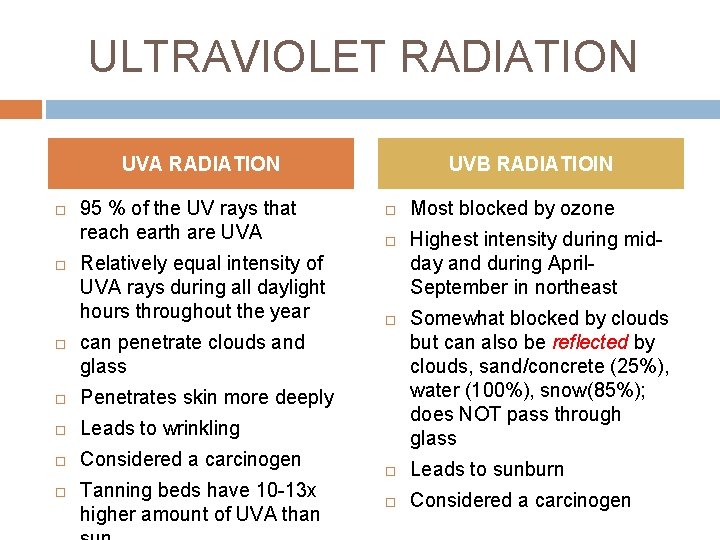
ULTRAVIOLET RADIATION UVA RADIATION 95 % of the UV rays that reach earth are UVA Relatively equal intensity of UVA rays during all daylight hours throughout the year can penetrate clouds and glass Penetrates skin more deeply Leads to wrinkling Considered a carcinogen UVB RADIATIOIN Tanning beds have 10 -13 x higher amount of UVA than Most blocked by ozone Highest intensity during midday and during April. September in northeast Somewhat blocked by clouds but can also be reflected by clouds, sand/concrete (25%), water (100%), snow(85%); does NOT pass through glass Leads to sunburn Considered a carcinogen
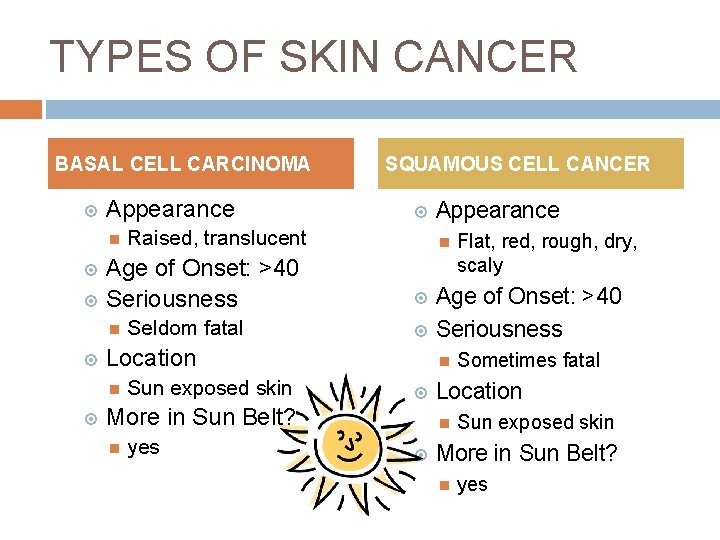
TYPES OF SKIN CANCER BASAL CELL CARCINOMA Appearance SQUAMOUS CELL CANCER Raised, translucent Age of Onset: >40 Seriousness Appearance Age of Onset: >40 Seriousness Location Seldom fatal Sun exposed skin More in Sun Belt? yes Flat, red, rough, dry, scaly Location Sometimes fatal Sun exposed skin More in Sun Belt? yes
MALIGNANT MELANOMA APPEARANCE Change in size, color, shape, surface or thickness of a mole, freckle, birthmark, blemish or other pigmented lesion AGE OF ONSET: any age over 10 SERIOUSNESS: can be FATAL if not found in time LOCATION: anywhere on the skin MORE IN SUN BELT? No GOOD NEWS: EASIEST OF CANCERS TO SELF DETECT GUARANTEED CURABLE IF FOUND EARLY! REMOVAL PAINLESS, QUICK, IN DOCTOR’S OFFICE NO CHEMO OR RADIATION IF FOUND EARLY
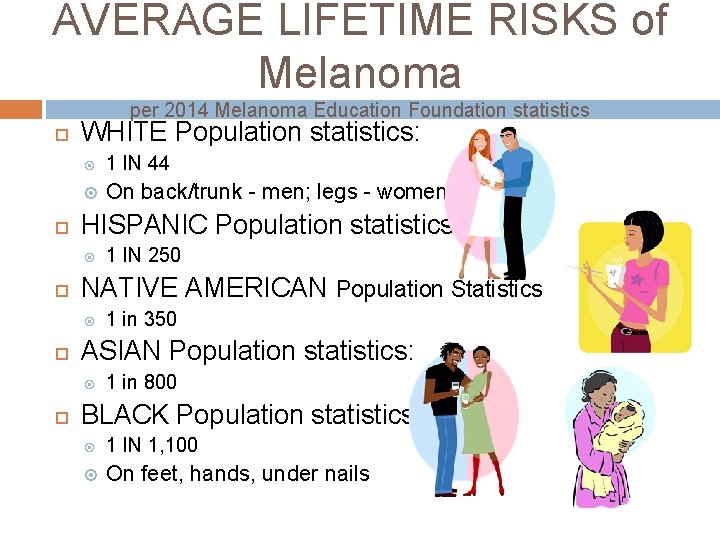
AVERAGE LIFETIME RISKS of Melanoma per 2014 Melanoma Education Foundation statistics WHITE Population statistics: 1 IN 44 On back/trunk - men; legs - women HISPANIC Population statistics: NATIVE AMERICAN Population Statistics 1 in 350 ASIAN Population statistics: 1 IN 250 1 in 800 BLACK Population statistics: 1 IN 1, 100 On feet, hands, under nails
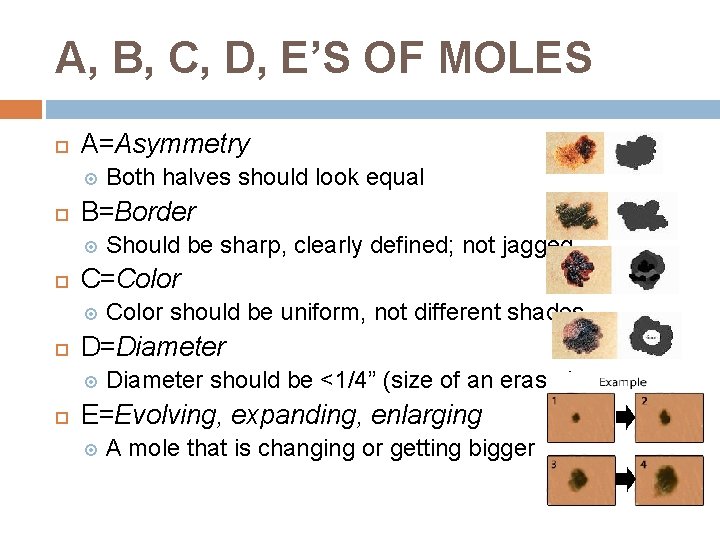
A, B, C, D, E’S OF MOLES A=Asymmetry B=Border Color should be uniform, not different shades D=Diameter Should be sharp, clearly defined; not jagged C=Color Both halves should look equal Diameter should be <1/4” (size of an eraser) E=Evolving, expanding, enlarging A mole that is changing or getting bigger
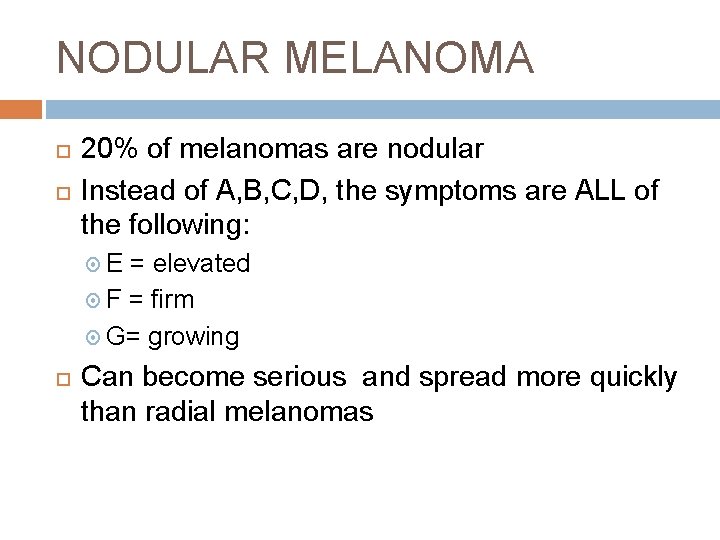
NODULAR MELANOMA 20% of melanomas are nodular Instead of A, B, C, D, the symptoms are ALL of the following: E = elevated F = firm G= growing Can become serious and spread more quickly than radial melanomas
MELANOMA SYMPTOMS It is important to realize that a mole may have some of the characteristics described on the previous slide and NOT be a melanoma. A biopsy is often the only way to distinguish an atypical mole from a melanoma. OTHER WARNING SIGNS OF MELANOMA INCLUDE: Change in the appearance of a mole, such as the spreading of the pigment from the border of the mole into the surrounding skin A mole that looks scaly, oozes, or bleeds Itching, tenderness, or pain in a mole or lesion Brown or black streak that appears underneath a nail or around the nail Bruise on the foot that does not heal
Let’s Review! Turn to a partner and write down the answer to the following: Describe 2 differences between UVA and UVB rays List the three types of skin cancer and identify which is potentially the most serious Identify the A, B, C, D, Es and E, F, G’s for evaluating moles
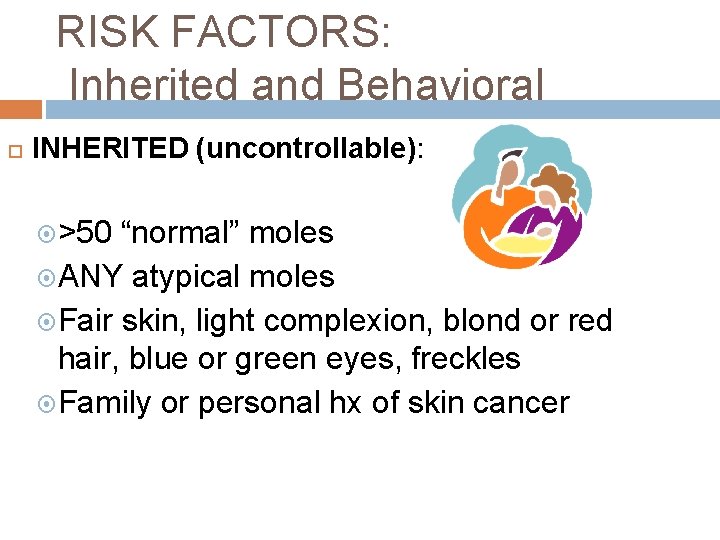
RISK FACTORS: Inherited and Behavioral INHERITED (uncontrollable): >50 “normal” moles ANY atypical moles Fair skin, light complexion, blond or red hair, blue or green eyes, freckles Family or personal hx of skin cancer
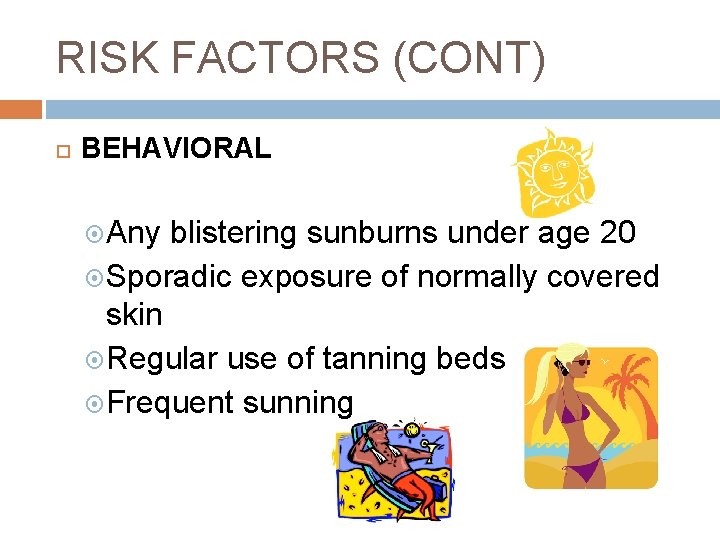
RISK FACTORS (CONT) BEHAVIORAL Any blistering sunburns under age 20 Sporadic exposure of normally covered skin Regular use of tanning beds Frequent sunning

SUN PROTECTION Protective clothing – light colors do not block rays as well as darker colors Find shaded areas – beach umbrellas only provide ~50% protection
WHEN TO APPLY SUNSCREEN Every day, 30 minutes before sun exposure REAPPLY after swimming, exercising, or every 2 hours NO SUCH THING AS AN ALL-DAY SUNSCREEN! Wear hats and protective clothing in addition to reapplying sunscreen often
HOW TO APPLY SUNSCREEN SHAKE WELL if a lotion Try SPRAY-ON OR STICK types of sunscreen if lotion unappealing to you Use 1 ounce (~2 TBSP or one handful) for complete coverage in a bathing suit Don’t forget to apply to EARS, BACK, SHOULDERS, BACK OF KNEES, TOP OF FEET, LEGS & SCALP Careful application around eyes
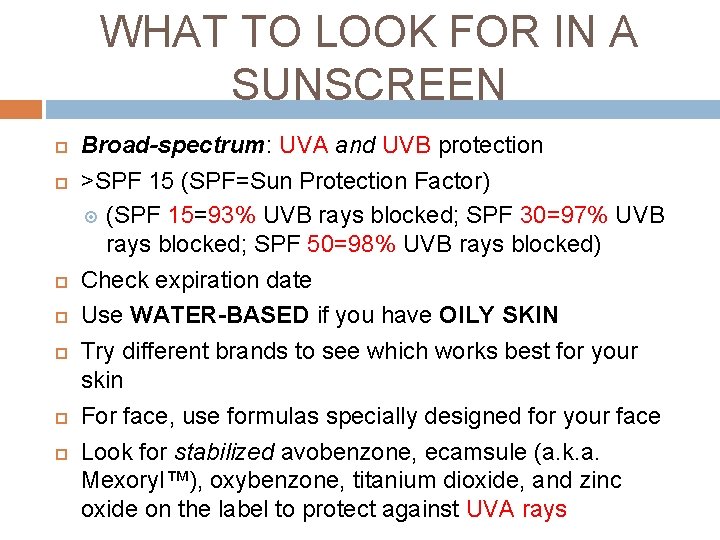
WHAT TO LOOK FOR IN A SUNSCREEN Broad-spectrum: UVA and UVB protection >SPF 15 (SPF=Sun Protection Factor) (SPF 15=93% UVB rays blocked; SPF 30=97% UVB rays blocked; SPF 50=98% UVB rays blocked) Check expiration date Use WATER-BASED if you have OILY SKIN Try different brands to see which works best for your skin For face, use formulas specially designed for your face Look for stabilized avobenzone, ecamsule (a. k. a. Mexoryl™), oxybenzone, titanium dioxide, and zinc oxide on the label to protect against UVA rays
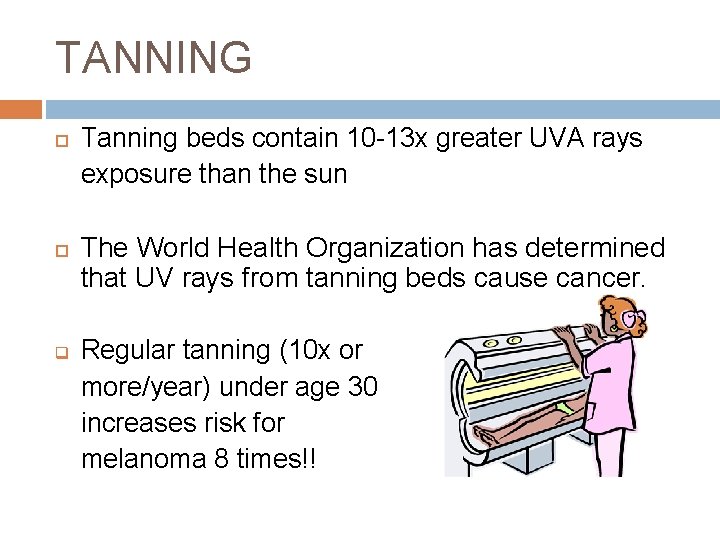
TANNING q Tanning beds contain 10 -13 x greater UVA rays exposure than the sun The World Health Organization has determined that UV rays from tanning beds cause cancer. Regular tanning (10 x or more/year) under age 30 increases risk for melanoma 8 times!!
TANNING BEDS (cont) Melanoma isn't the only problem: people who use tanning beds are 2. 5 times more likely to develop squamous cell carcinoma 1. 5 times more likely to develop basal cell carcinoma. Using a tanning bed for 20 minutes is the same as spending 1 -3 hours a day at the beach with no sun protection at all. According to recent research, first exposure to tanning beds in youth increases melanoma risk by 75 percent!
UV Skin damage video https: //www. youtube. com/watch? v=o 9 Bqr. SAH b. Tc
Let’s Review Again: Turn to a partner and write down the answer to the following: Identify at least 4 risk factors for skin cancer Describe how to perform a skin check List 3 ways to protect yourself from the sun List at least 2 things to look for in a sunscreen product Describe how and when to apply sunscreen
Sources for Powerpoint Massachusetts Melanoma Education Foundation, www. skincheck. org Canadian Centre for Occupational Health and Safety, http: //www. ccohs. ca/oshanswers/phys_agents/ultravio letradiation. html http: //www. skincarephysicians. com/skincancernet/mel anoma. html http: //www. skincancer. org/understanding-uva-and -uvb. html. http: //www. cancer. gov/cancertopics/types/melanoma. http: //www. mfne. org/ysii/materials/2013_HS_Multi_Sig nature. pdf
- Slides: 21