
Skin cancer classification using artificial neural network NORHAMIRA
- Slides: 17
Skin cancer classification using artificial neural network NORHAMIRA BINTI MOHAMAD (2017412226) SUPERVISOR NAME : Ts. DR RAJESWARI RAJU
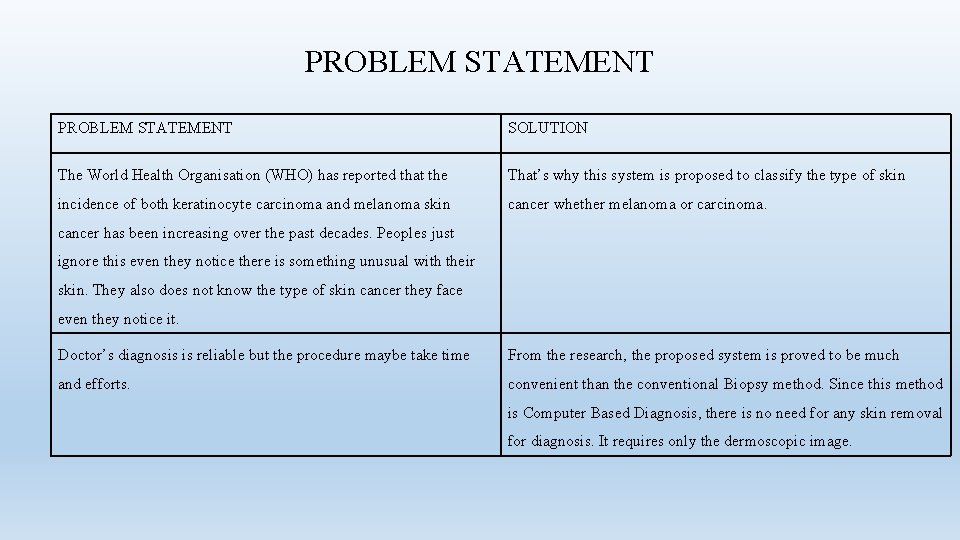
PROBLEM STATEMENT SOLUTION The World Health Organisation (WHO) has reported that the That’s why this system is proposed to classify the type of skin incidence of both keratinocyte carcinoma and melanoma skin cancer whether melanoma or carcinoma. cancer has been increasing over the past decades. Peoples just ignore this even they notice there is something unusual with their skin. They also does not know the type of skin cancer they face even they notice it. Doctor’s diagnosis is reliable but the procedure maybe take time From the research, the proposed system is proved to be much and efforts. convenient than the conventional Biopsy method. Since this method is Computer Based Diagnosis, there is no need for any skin removal for diagnosis. It requires only the dermoscopic image.
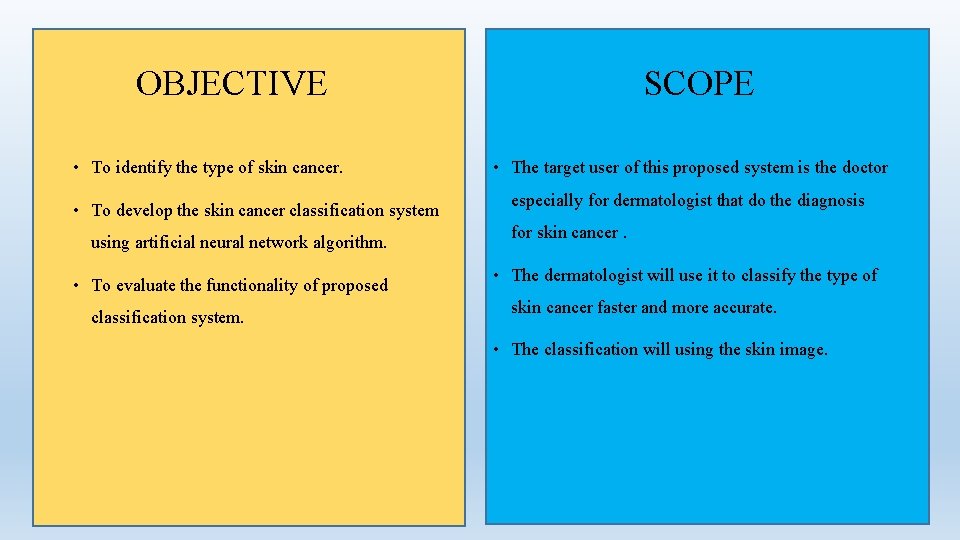
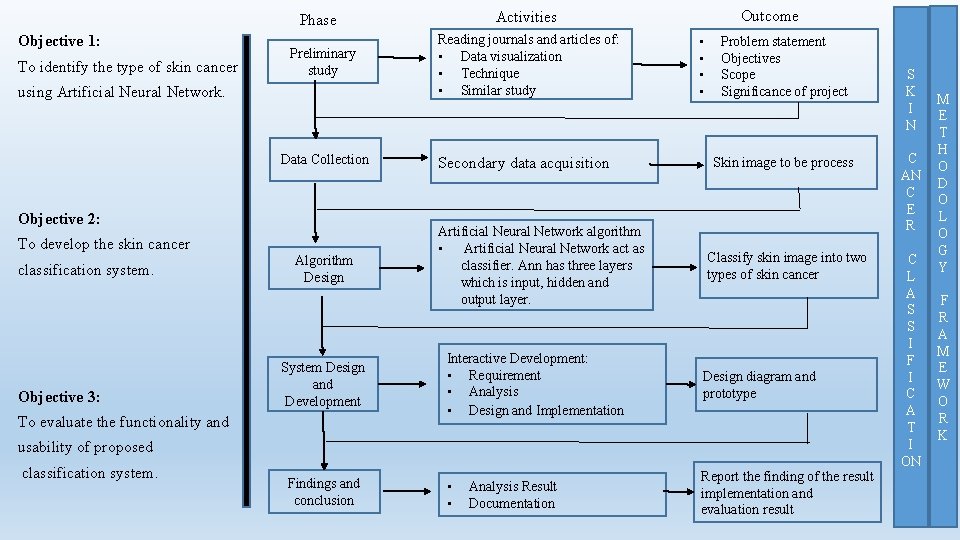
OBJECTIVE • To identify the type of skin cancer. • To develop the skin cancer classification system using artificial neural network algorithm. • To evaluate the functionality of proposed classification system. SCOPE • The target user of this proposed system is the doctor especially for dermatologist that do the diagnosis for skin cancer. • The dermatologist will use it to classify the type of skin cancer faster and more accurate. • The classification will using the skin image.
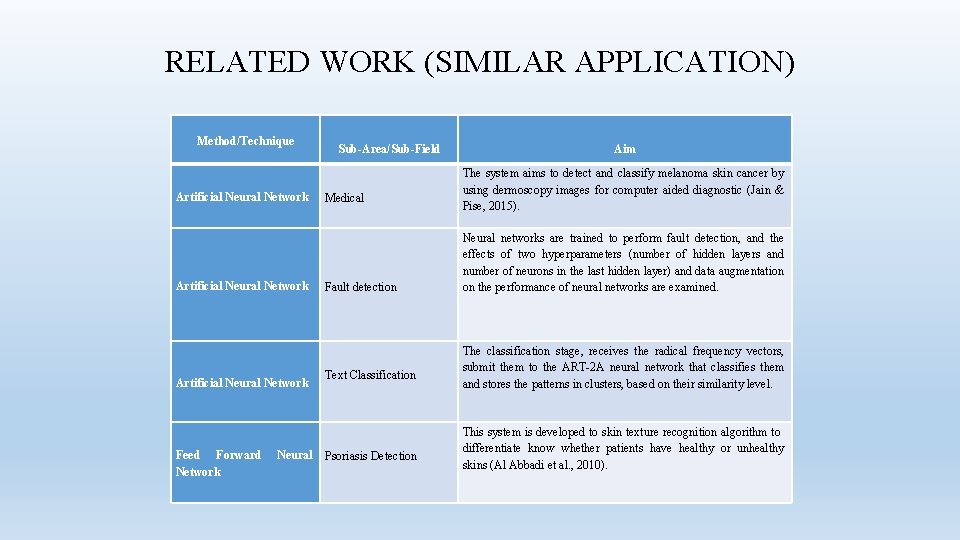
RELATED WORK (SIMILAR APPLICATION) Method/Technique Artificial Neural Network Feed Forward Network Neural Sub-Area/Sub-Field Medical Fault detection Text Classification Psoriasis Detection Aim The system aims to detect and classify melanoma skin cancer by using dermoscopy images for computer aided diagnostic (Jain & Pise, 2015). Neural networks are trained to perform fault detection, and the effects of two hyperparameters (number of hidden layers and number of neurons in the last hidden layer) and data augmentation on the performance of neural networks are examined. The classification stage, receives the radical frequency vectors, submit them to the ART-2 A neural network that classifies them and stores the patterns in clusters, based on their similarity level. This system is developed to skin texture recognition algorithm to differentiate know whether patients have healthy or unhealthy skins (Al Abbadi et al. , 2010).
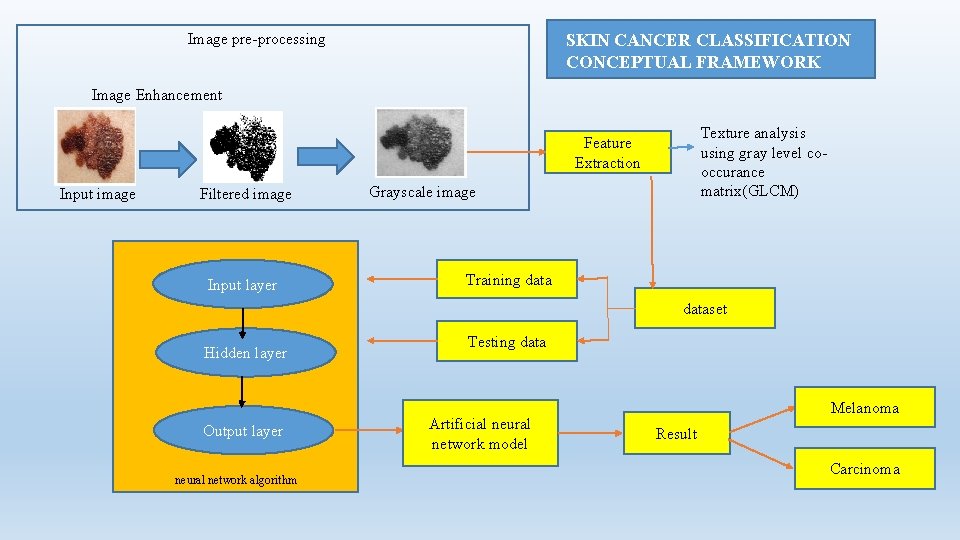
Image pre-processing SKIN CANCER CLASSIFICATION CONCEPTUAL FRAMEWORK Image Enhancement Texture analysis using gray level cooccurance matrix(GLCM) Feature Extraction Input image Filtered image Input layer Grayscale image Training dataset Hidden layer Output layer neural network algorithm Testing data Artificial neural network model Melanoma Result Carcinoma
Objective 1: To identify the type of skin cancer Preliminary study using Artificial Neural Network. Data Collection Objective 2: To develop the skin cancer classification system. Objective 3: Algorithm Design System Design and Development To evaluate the functionality and Outcome Activities Phase Reading journals and articles of: • Data visualization • Technique • Similar study Secondary data acquisition Artificial Neural Network algorithm • Artificial Neural Network act as classifier. Ann has three layers which is input, hidden and output layer. • • Problem statement Objectives Scope Significance of project Skin image to be process Classify skin image into two types of skin cancer Interactive Development: • Requirement • Analysis • Design and Implementation Design diagram and prototype • • Report the finding of the result implementation and evaluation result usability of proposed classification system. Findings and conclusion Analysis Result Documentation S K I N C AN C E R C L A S S I F I C A T I ON M E T H O D O L O G Y F R A M E W O R K
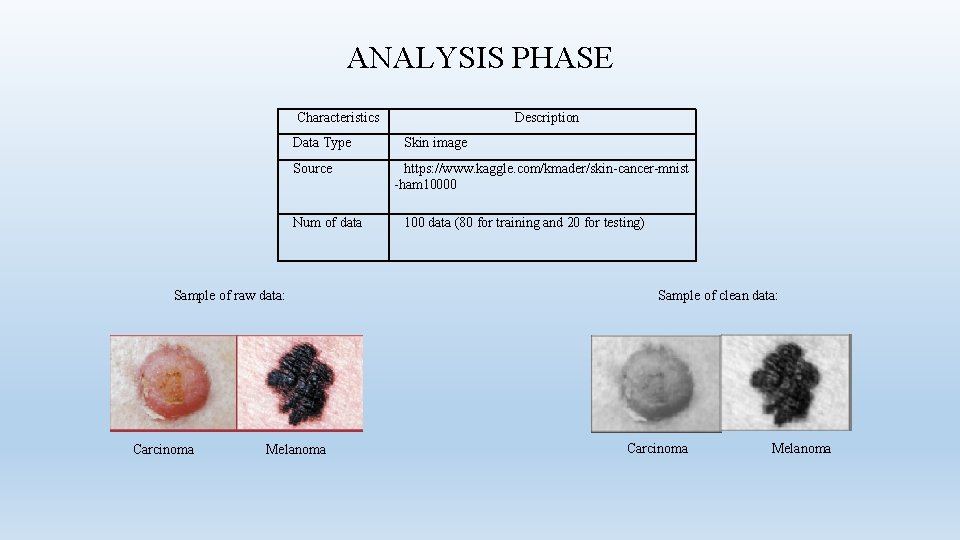
ANALYSIS PHASE Characteristics Data Type Source Num of data Sample of raw data: Carcinoma Melanoma Description Skin image https: //www. kaggle. com/kmader/skin-cancer-mnist -ham 10000 100 data (80 for training and 20 for testing) Sample of clean data: Carcinoma Melanoma
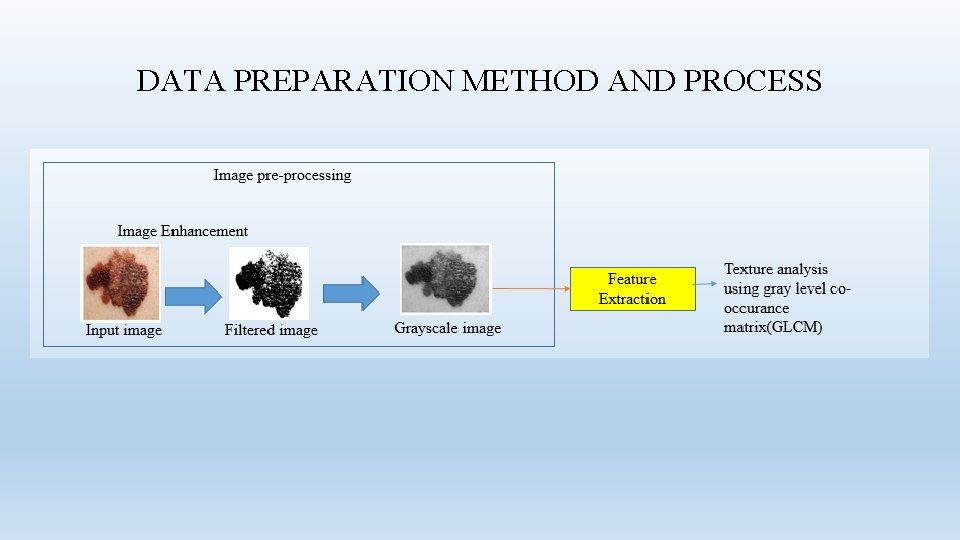
DATA PREPARATION METHOD AND PROCESS
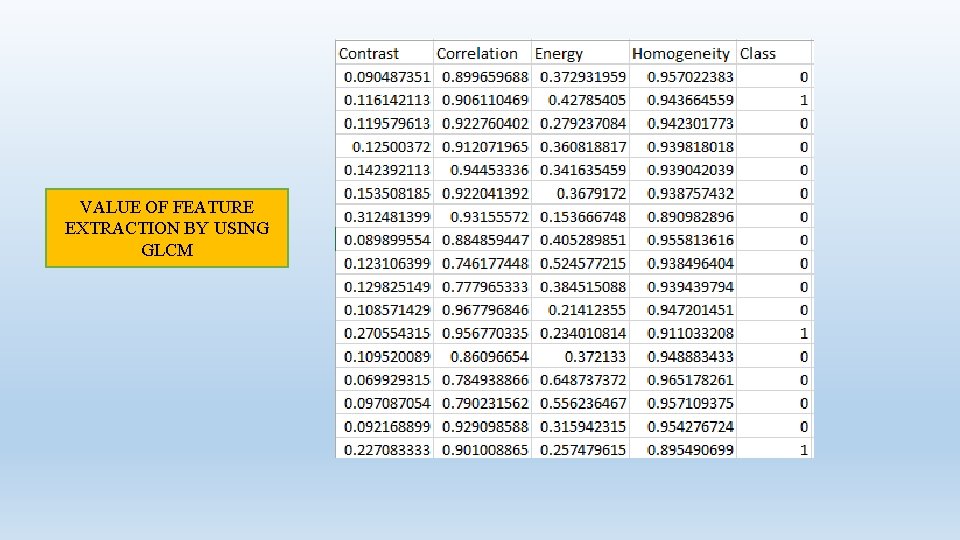
VALUE OF FEATURE EXTRACTION BY USING GLCM
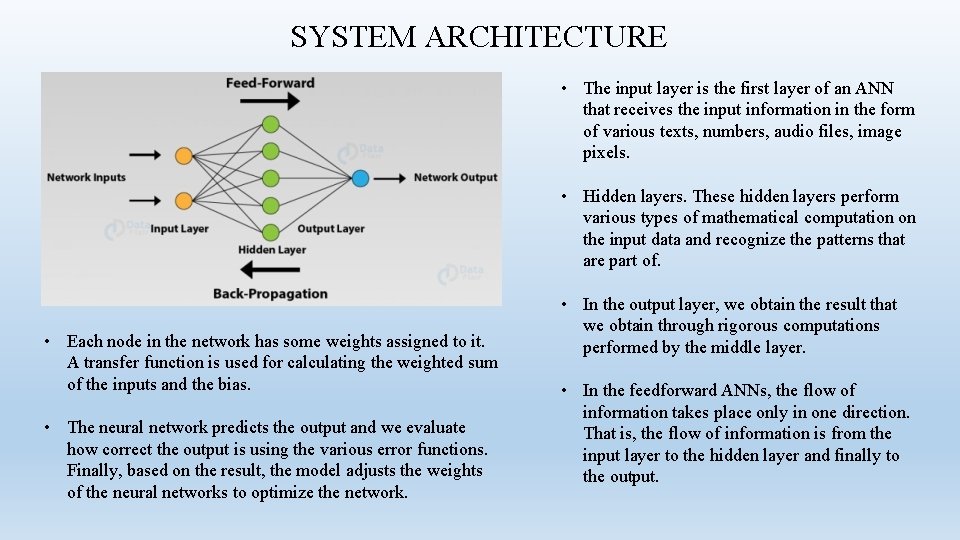
SYSTEM ARCHITECTURE • The input layer is the first layer of an ANN that receives the input information in the form of various texts, numbers, audio files, image pixels. • Hidden layers. These hidden layers perform various types of mathematical computation on the input data and recognize the patterns that are part of. • Each node in the network has some weights assigned to it. A transfer function is used for calculating the weighted sum of the inputs and the bias. • The neural network predicts the output and we evaluate how correct the output is using the various error functions. Finally, based on the result, the model adjusts the weights of the neural networks to optimize the network. • In the output layer, we obtain the result that we obtain through rigorous computations performed by the middle layer. • In the feedforward ANNs, the flow of information takes place only in one direction. That is, the flow of information is from the input layer to the hidden layer and finally to the output.
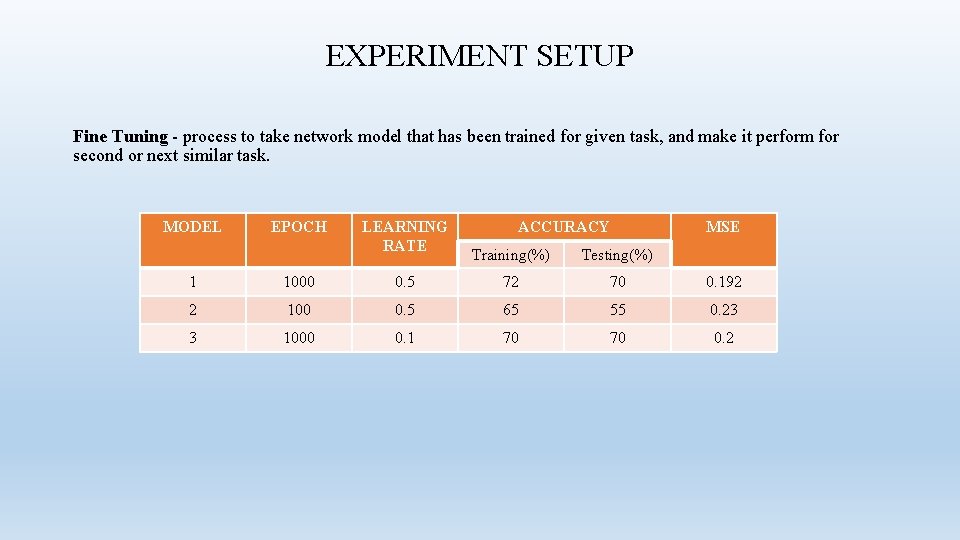
EXPERIMENT SETUP Fine Tuning - process to take network model that has been trained for given task, and make it perform for second or next similar task. MODEL EPOCH LEARNING RATE ACCURACY Training(%) Testing(%) MSE 1 1000 0. 5 72 70 0. 192 2 100 0. 5 65 55 0. 23 3 1000 0. 1 70 70 0. 2
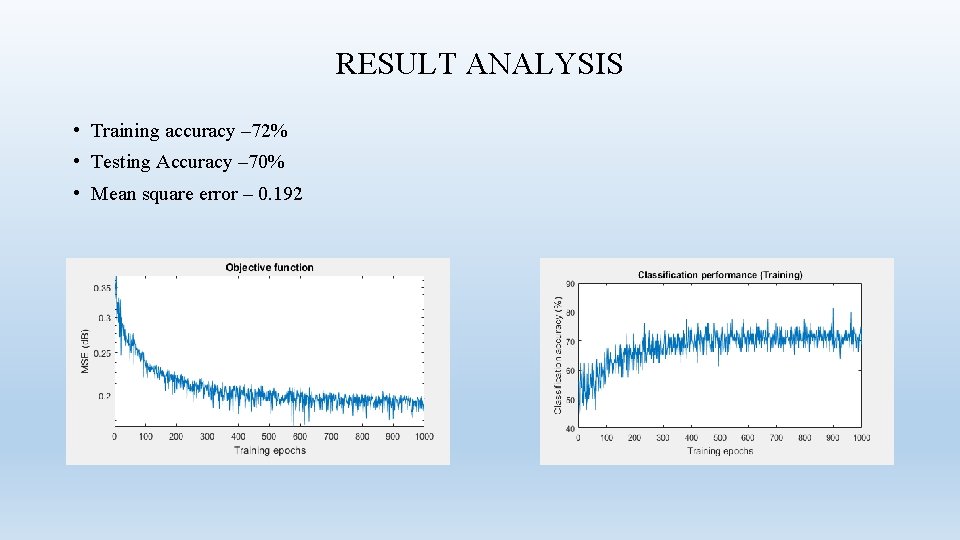
RESULT ANALYSIS • Training accuracy – 72% • Testing Accuracy – 70% • Mean square error – 0. 192
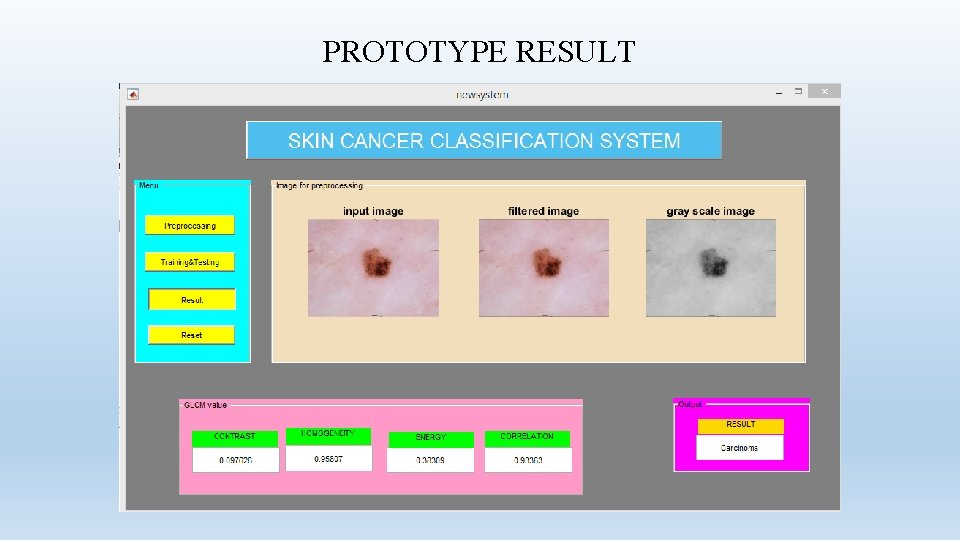
PROTOTYPE RESULT
PROJECT TESTING & EVALUATION Functionality test • All button is successfully function. • The system can classify the type of skin cancer. • The image can be upload. • Easy to use.
CONCLUSION • The objective of the system has been achieved which is the symptom of skin cancer has been identified. • Next, the skin cancer classification system using Artificial Neural Network has been develop successfully. • The functionality of classification system also has been evaluated, but still, it still has to do an enhancement and improvement of this system for future work.
REFERENCES Al Abbadi, N. K. , Dahir, N. S. , AL-Dhalimi, M. A. , & Restom, H. (2010). Psoriasis detection using skin color and texture features. Journal of Computer Science, 6(6), 648– 652. https: //doi. org/10. 3844/jcssp. 2010. 648. 652 Alom, Z. , Yakopcic, C. , Taha, T. M. , & Asari, V. K. (n. d. ). Breast Cancer Classification from Histopathological Images with Inception Recurrent Residual Convolutional Neural Network. Antony, A. , Ramesh, A. , Sojan, A. , Mathews, B. , & Varghese, T. A. (2016). Skin Cancer Detection Using Artificial Neural Networking. 4(4), 305– 308. https: //doi. org/10. 17148/IJIREEICE. 2016. 4476 Azura, A. (n. d. ). Is skin cancer common in Malr. Retrieved from https: //www. thestar. com. my/lifestyle/health/2015/02/08/isskin-cancer-common-in-malaysia/ Cell, S. , Cancer, S. , Cell, S. , & Cancers, S. (n. d. ). Basal and Squamous Cell Skin Cancer Early Detection , Diagnosis , and Staging Can Basal and Squamous Cell Skin Cancers Be Found Early 1– 14. Clinical, N. , Guidelines, P. , & Guidelines, N. (2013). Squamous cell skin cancer. NCCN Guidelines. Retrieved from https: //www. nlm. nih. gov/medlineplus/ency/article/000829. htm Devi, M. S. , Sruthi, A. N. , & Balamurugan, P. (2018). Artificial neural network classification-based skin cancer detection. 7, 591– 593. Gustafson, E. , Pacheco, J. , Wehbe, F. , Silverberg, J. , & Thompson, W. (2017). A Machine Learning Algorithm for Identifying Atopic Dermatitis in Adults from Electronic Health Records. Proceedings - 2017 IEEE International Conference on Healthcare Informatics, ICHI 2017, 83– 90. https: //doi. org/10. 1109/ICHI. 2017. 31 Ishwarya, M. , Sudha, J. , & Ph, D. (2019). �Prediction of Skin Cancer Using Morphological Neural Network Analysis. 842– 854. https: //doi. org/10. 15680/IJIRSET. 2019. 0802032
Jain, S. , & Pise, N. (2015). Computer aided Melanoma skin cancer detection using Image Processing. Procedia - Procedia Computer Science, 48(Iccc), 735– 740. https: //doi. org/10. 1016/j. procs. 2015. 04. 209 Masood, A. , & Al-jumaily, A. A. (2013). Computer Aided Diagnostic Support System for Skin Cancer A Review of Techniques and Algorithms. 2013. Meenakshi, M. M. , & Natarajan, S. (2019). Melanoma Skin Cancer Detection using Image Processing and Machine Learning. 7(10), 1– 5. Mehdy, M. M. , Ng, P. Y. , Shair, E. F. , Saleh, N. I. , & Gomes, C. (2017). Artificial Neural Networks in Image Processing for Early Detection of Breast Cancer. 2017. Olatunji, S. O. , & Arif, H. (2013). IDENTIFICATION OF ERYTHEMATO-SQUAMOUS SKIN DISEASES USING EXTREME LEARNING MACHINE AND ARTIFICIAL NEURAL NETWORK. 6956(October). https: //doi. org/10. 21917/ijsc. 2013. 0090 Paliwal, N. (2016). Skin Cancer Segmentation , Detection And Classification Using Hybrid Image Processing Technique. (4), 71– 73. Tests, D. , & Diabetes, F. O. R. (2015). 2. Classification and Diagnosis of Diabetes. 38(January), 8– 16. https: //doi. org/10. 2337/dc 15 -S 005 Übeylı, E. D. , & Güler, İ. (2005). Automatic detection of erythemato-squamous diseases using adaptive neuro-fuzzy inference systems. Computers in Biology and Medicine, 35(5), 421– 433. https: //doi. org/10. 1016/J. COMPBIOMED. 2004. 03. 003 Yogesh, B. (2017). EARLY DIAGNOSIS OF SKIN CANCER USING ARTIFICIAL NEURAL. 5, 1– 7. Zakareya, M. , & Alam, M. B. (2018). Classification of Cancerous Skin using Artificial Neural Network Classifier. 181(22), 21 – 25.