
Skin Cancer Assessment and Screening in Primary Care
- Slides: 1
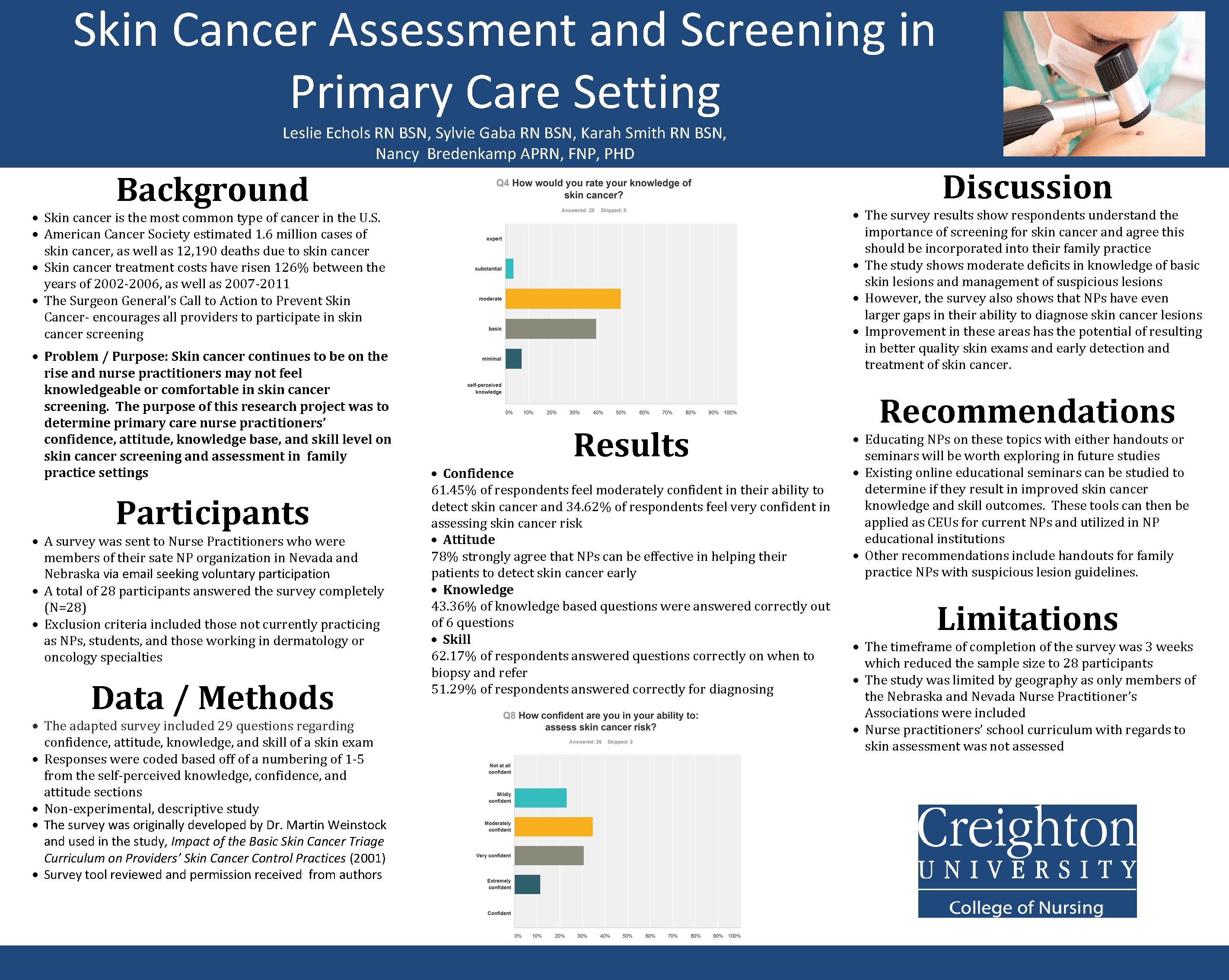
Skin Cancer Assessment and Screening in Primary Care Setting Leslie Echols RN BSN, Sylvie Gaba RN BSN, Karah Smith RN BSN, Nancy Bredenkamp APRN, FNP, PHD Discussion Background The survey results show respondents understand the importance of screening for skin cancer and agree this should be incorporated into their family practice The study shows moderate deficits in knowledge of basic skin lesions and management of suspicious lesions However, the survey also shows that NPs have even larger gaps in their ability to diagnose skin cancer lesions Improvement in these areas has the potential of resulting in better quality skin exams and early detection and treatment of skin cancer. Skin cancer is the most common type of cancer in the U. S. American Cancer Society estimated 1. 6 million cases of skin cancer, as well as 12, 190 deaths due to skin cancer Skin cancer treatment costs have risen 126% between the years of 2002 -2006, as well as 2007 -2011 The Surgeon General’s Call to Action to Prevent Skin Cancer- encourages all providers to participate in skin cancer screening Problem / Purpose: Skin cancer continues to be on the rise and nurse practitioners may not feel knowledgeable or comfortable in skin cancer screening. The purpose of this research project was to determine primary care nurse practitioners’ confidence, attitude, knowledge base, and skill level on skin cancer screening and assessment in family practice settings Participants A survey was sent to Nurse Practitioners who were members of their sate NP organization in Nevada and Nebraska via email seeking voluntary participation A total of 28 participants answered the survey completely (N=28) Exclusion criteria included those not currently practicing as NPs, students, and those working in dermatology or oncology specialties Data / Methods The adapted survey included 29 questions regarding confidence, attitude, knowledge, and skill of a skin exam Responses were coded based off of a numbering of 1 -5 from the self-perceived knowledge, confidence, and attitude sections Non-experimental, descriptive study The survey was originally developed by Dr. Martin Weinstock and used in the study, Impact of the Basic Skin Cancer Triage Curriculum on Providers’ Skin Cancer Control Practices (2001) Survey tool reviewed and permission received from authors Results Confidence 61. 45% of respondents feel moderately confident in their ability to detect skin cancer and 34. 62% of respondents feel very confident in assessing skin cancer risk Attitude 78% strongly agree that NPs can be effective in helping their patients to detect skin cancer early Knowledge 43. 36% of knowledge based questions were answered correctly out of 6 questions Skill 62. 17% of respondents answered questions correctly on when to biopsy and refer 51. 29% of respondents answered correctly for diagnosing Recommendations Educating NPs on these topics with either handouts or seminars will be worth exploring in future studies Existing online educational seminars can be studied to determine if they result in improved skin cancer knowledge and skill outcomes. These tools can then be applied as CEUs for current NPs and utilized in NP educational institutions Other recommendations include handouts for family practice NPs with suspicious lesion guidelines. Limitations The timeframe of completion of the survey was 3 weeks which reduced the sample size to 28 participants The study was limited by geography as only members of the Nebraska and Nevada Nurse Practitioner’s Associations were included Nurse practitioners’ school curriculum with regards to skin assessment was not assessed