
SKIN BREAKDOWN PREVENTION ASSESSMENT AND TREATMENT AGS Joseph
SKIN BREAKDOWN: PREVENTION, ASSESSMENT, AND TREATMENT AGS Joseph Nicholas, MD, MPH Assistant Professor of Medicine University of Rochester School of Medicine THE AMERICAN GERIATRICS SOCIETY Geriatrics Health Professionals. Leading change. Improving care for older adults.
OBJECTIVES • Understand high risk for skin breakdown in older adults and all fracture patients • Pathogenesis • Prevention • Medical implications • Cost implications Slide 2
PRESSURE ULCER • Decubitus Ø Decumbere — “to lie down” Ø Cubitum — elbow • Described by Paget in 1873 Ø “The risk of bedsores in the old with a fractured neck of femur is chiefly in the first week…” Slide 3
EPIDEMIOLOGY • Develop in 5% 15% of acute care patients • Present in 10% 35% of nursing home patients • Develop in up to 20% of geriatric fracture patients (can be as low as 5%) Slide 4
HOST FACTORS • Immobility • Incontinence • Malnutrition • Poor skin perfusion • Altered sensation (neuropathy) • Altered sensorium (dementia/delirium) Slide 5
EXTERNAL FACTORS • Pressure • Shearing • Friction/tearing • Moisture Slide 6
COMPLICATIONS • Infection • Pain • Psychosocial decline (depression, social isolation, decline in overall health status) • Cost Slide 7
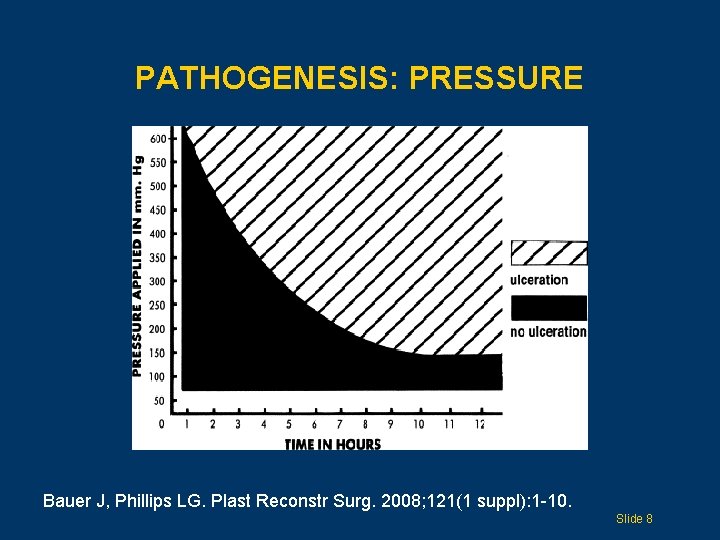
PATHOGENESIS: PRESSURE Bauer J, Phillips LG. Plast Reconstr Surg. 2008; 121(1 suppl): 1 -10. Slide 8
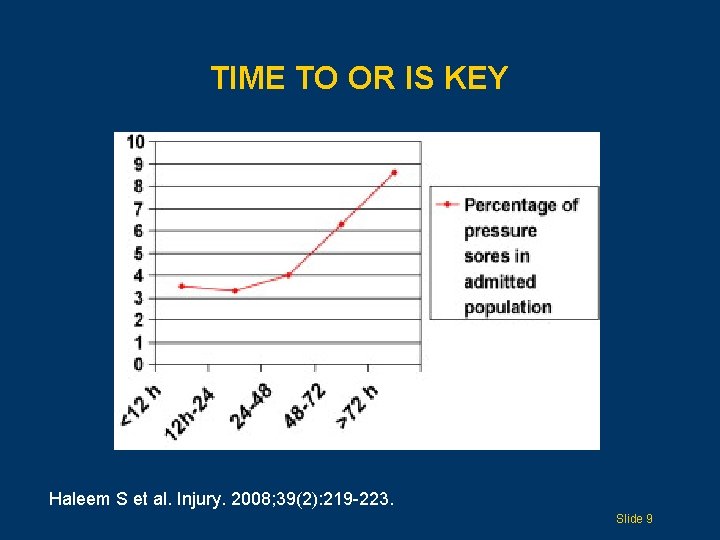
TIME TO OR IS KEY Haleem S et al. Injury. 2008; 39(2): 219 -223. Slide 9
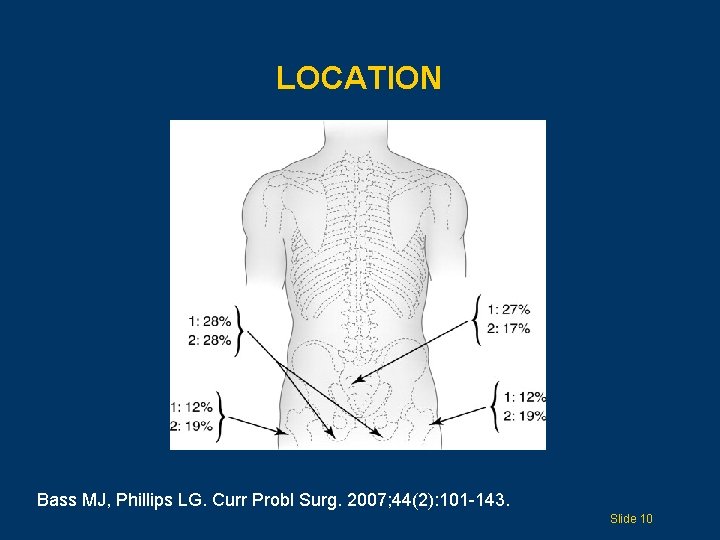
LOCATION Bass MJ, Phillips LG. Curr Probl Surg. 2007; 44(2): 101 -143. Slide 10
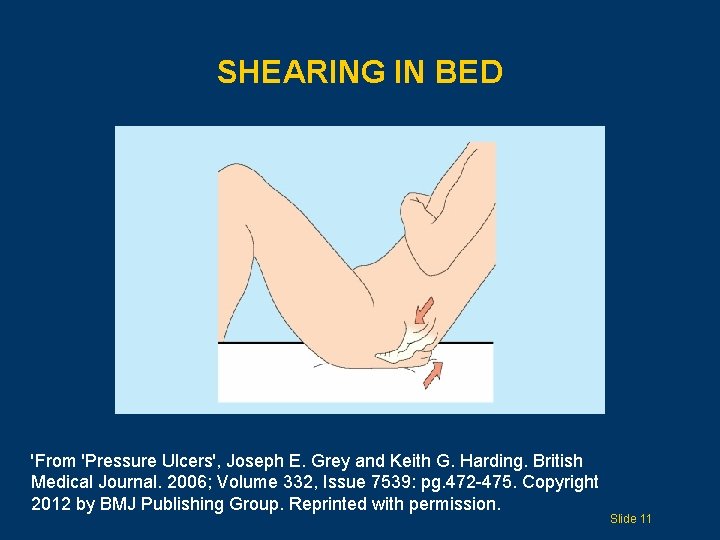
SHEARING IN BED 'From 'Pressure Ulcers', Joseph E. Grey and Keith G. Harding. British Medical Journal. 2006; Volume 332, Issue 7539: pg. 472 -475. Copyright 2012 by BMJ Publishing Group. Reprinted with permission. Slide 11
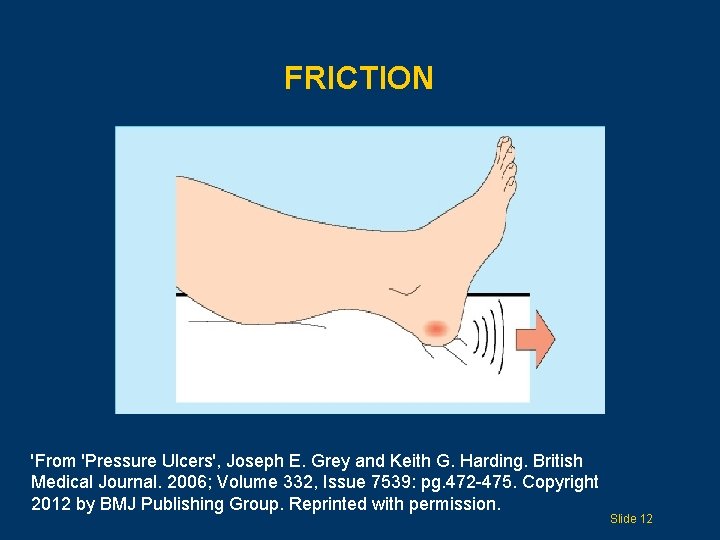
FRICTION 'From 'Pressure Ulcers', Joseph E. Grey and Keith G. Harding. British Medical Journal. 2006; Volume 332, Issue 7539: pg. 472 -475. Copyright 2012 by BMJ Publishing Group. Reprinted with permission. Slide 12
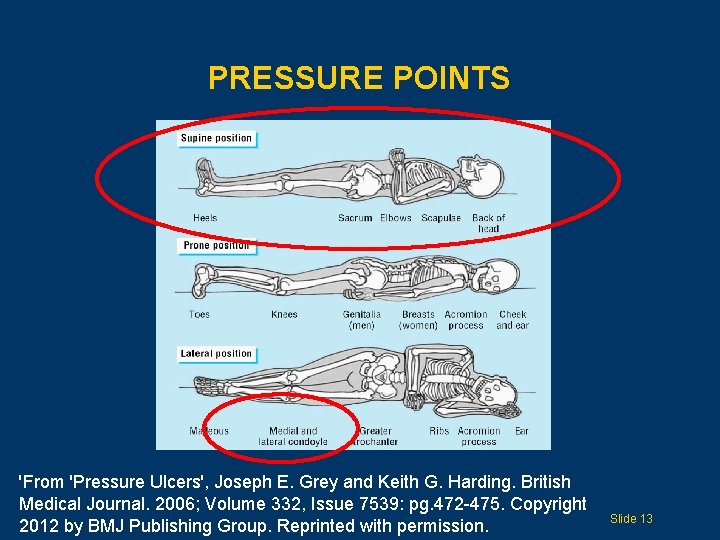
PRESSURE POINTS 'From 'Pressure Ulcers', Joseph E. Grey and Keith G. Harding. British Medical Journal. 2006; Volume 332, Issue 7539: pg. 472 -475. Copyright 2012 by BMJ Publishing Group. Reprinted with permission. Slide 13

PRESSURE ULCER STAGING
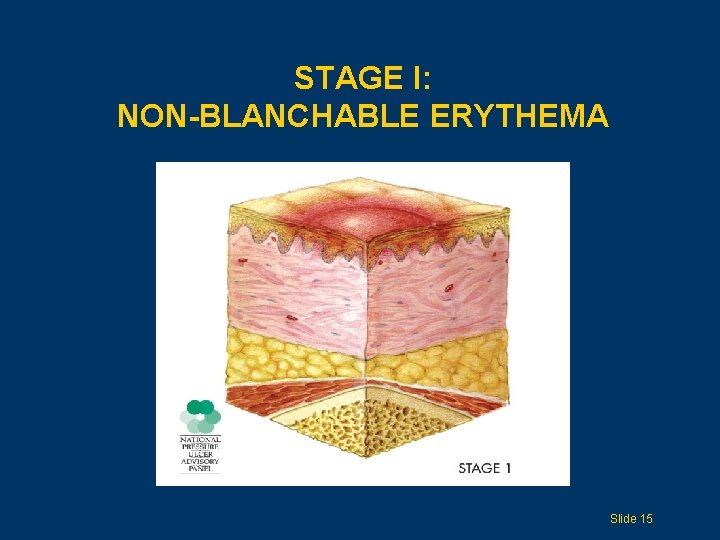
STAGE I: NON-BLANCHABLE ERYTHEMA Slide 15
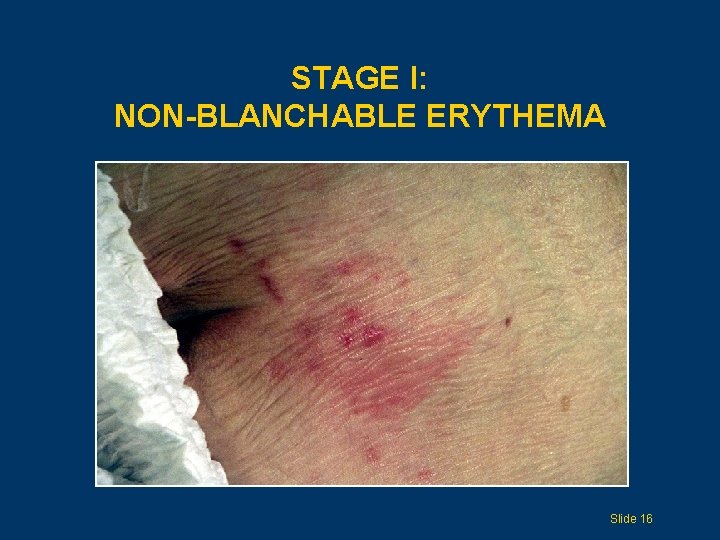
STAGE I: NON-BLANCHABLE ERYTHEMA Slide 16
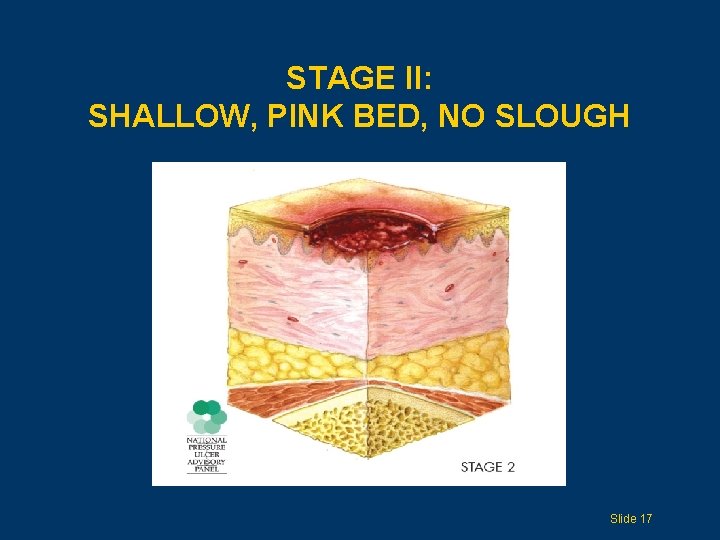
STAGE II: SHALLOW, PINK BED, NO SLOUGH Slide 17
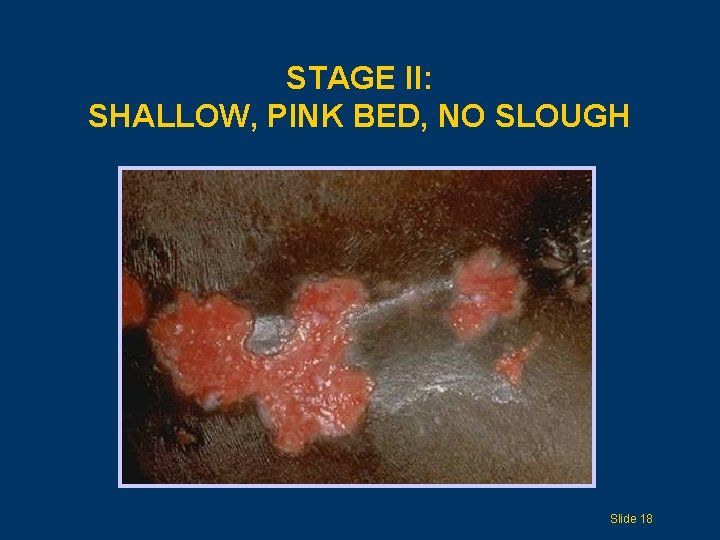
STAGE II: SHALLOW, PINK BED, NO SLOUGH Slide 18
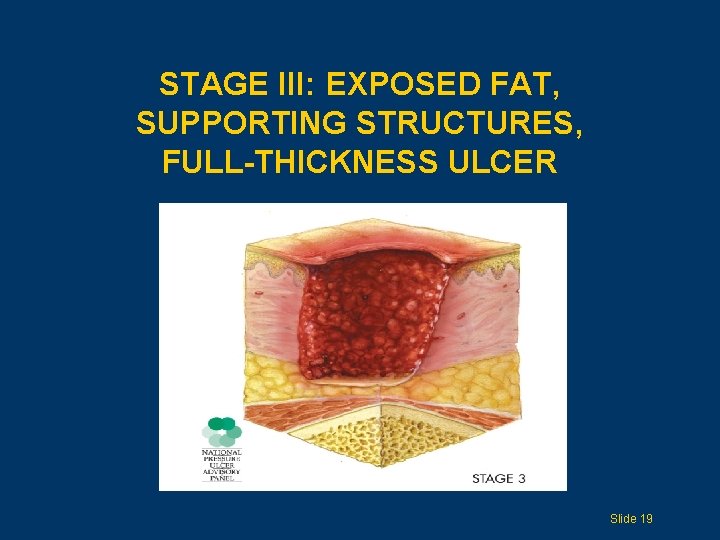
STAGE III: EXPOSED FAT, SUPPORTING STRUCTURES, FULL-THICKNESS ULCER Slide 19
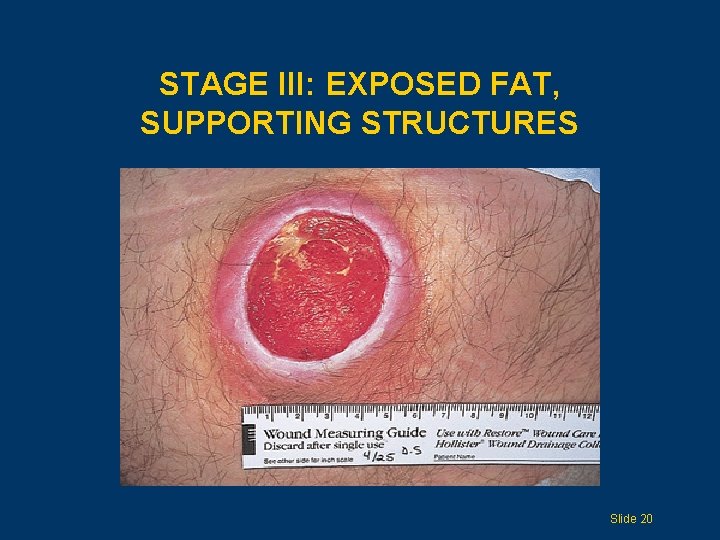
STAGE III: EXPOSED FAT, SUPPORTING STRUCTURES Slide 20
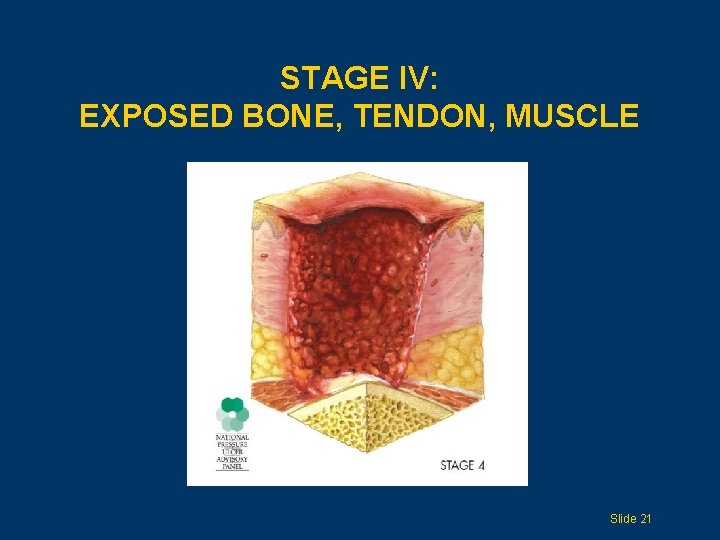
STAGE IV: EXPOSED BONE, TENDON, MUSCLE Slide 21
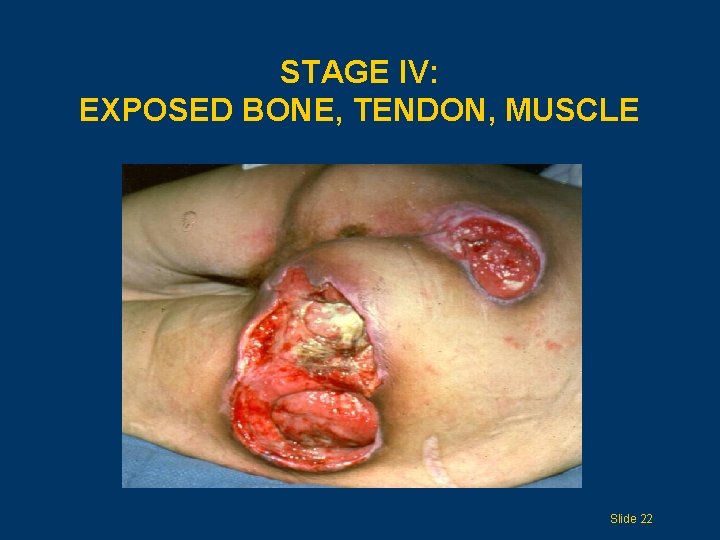
STAGE IV: EXPOSED BONE, TENDON, MUSCLE Slide 22
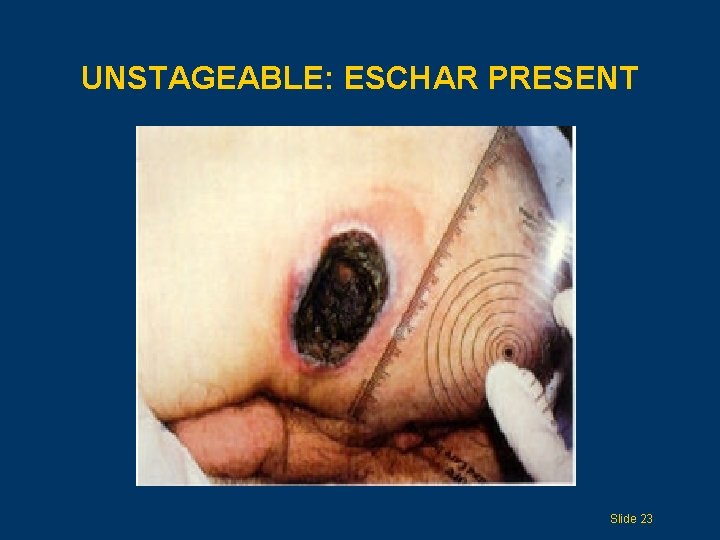
UNSTAGEABLE: ESCHAR PRESENT Slide 23
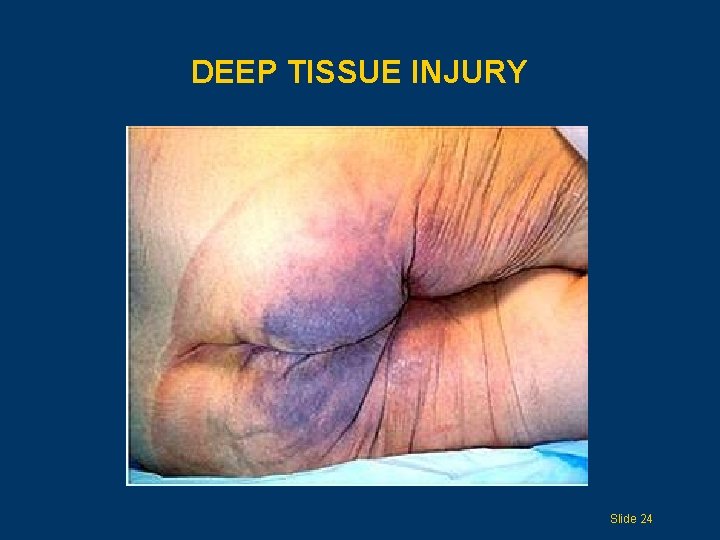
DEEP TISSUE INJURY Slide 24
PRESSURE ULCERS: APPROACH TO PREVENTION
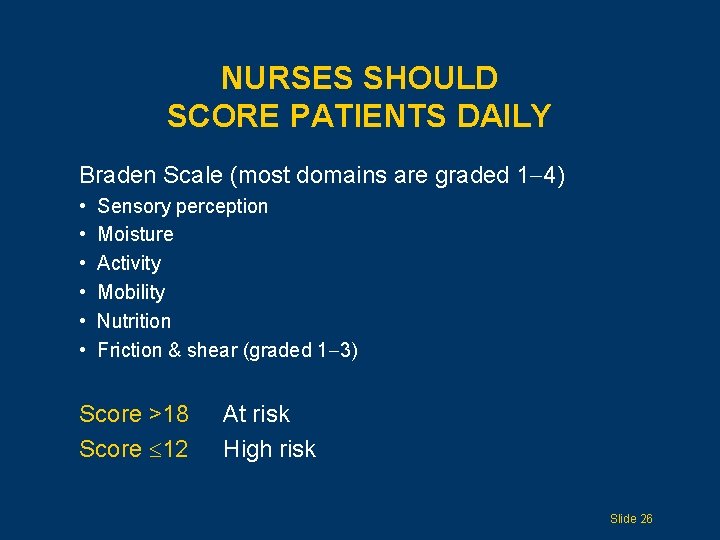
NURSES SHOULD SCORE PATIENTS DAILY Braden Scale (most domains are graded 1 4) • • • Sensory perception Moisture Activity Mobility Nutrition Friction & shear (graded 1 3) Score >18 Score 12 At risk High risk Slide 26
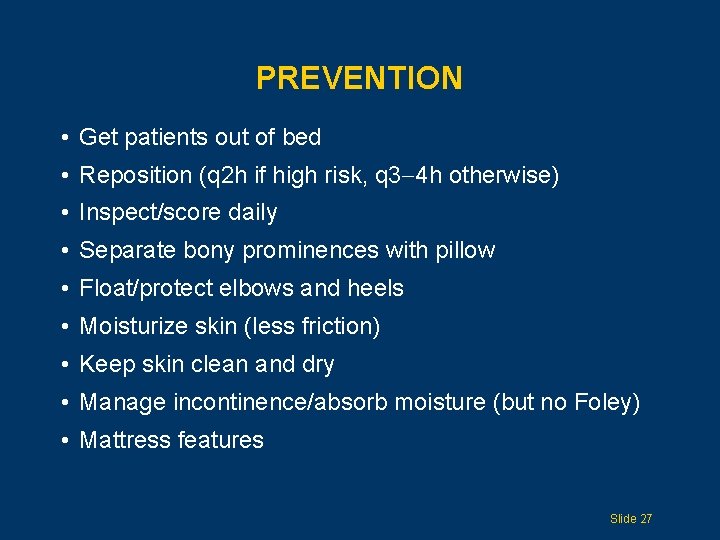
PREVENTION • Get patients out of bed • Reposition (q 2 h if high risk, q 3 4 h otherwise) • Inspect/score daily • Separate bony prominences with pillow • Float/protect elbows and heels • Moisturize skin (less friction) • Keep skin clean and dry • Manage incontinence/absorb moisture (but no Foley) • Mattress features Slide 27
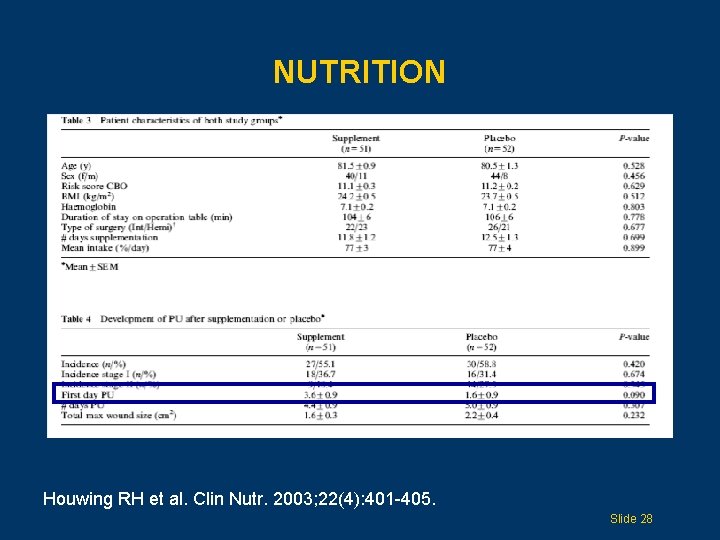
NUTRITION Houwing RH et al. Clin Nutr. 2003; 22(4): 401 -405. Slide 28
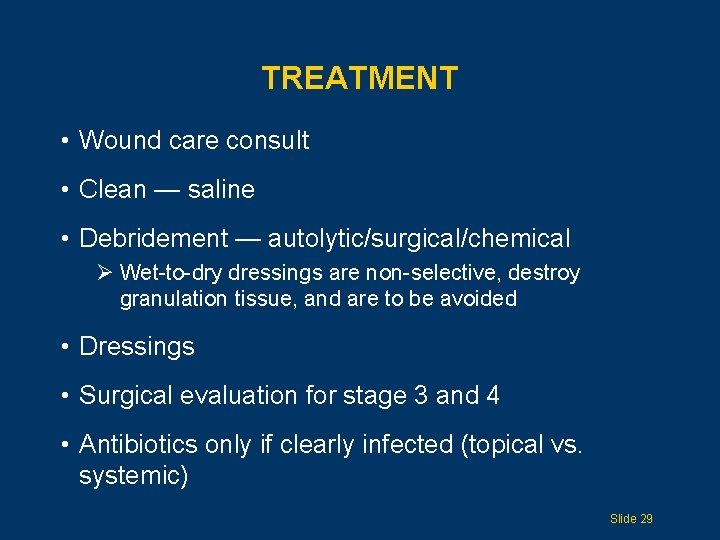
TREATMENT • Wound care consult • Clean — saline • Debridement — autolytic/surgical/chemical Ø Wet-to-dry dressings are non-selective, destroy granulation tissue, and are to be avoided • Dressings • Surgical evaluation for stage 3 and 4 • Antibiotics only if clearly infected (topical vs. systemic) Slide 29
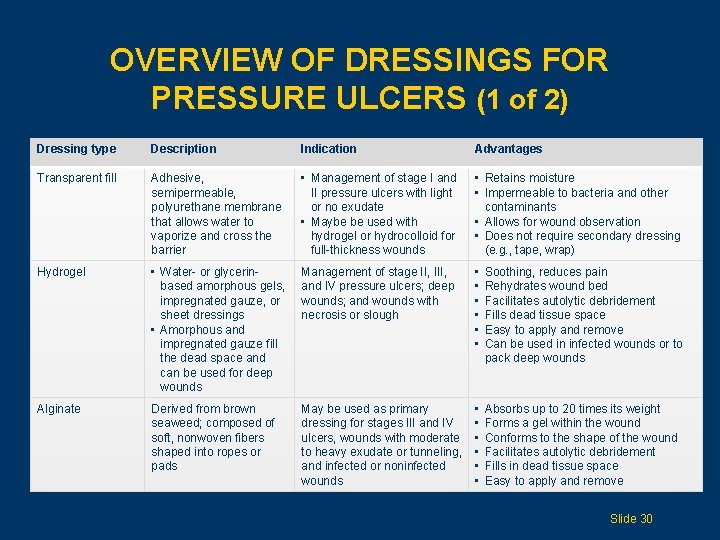
OVERVIEW OF DRESSINGS FOR PRESSURE ULCERS (1 of 2) Dressing type Description Indication Advantages Transparent fill Adhesive, semipermeable, polyurethane membrane that allows water to vaporize and cross the barrier • Management of stage I and II pressure ulcers with light or no exudate • Maybe be used with hydrogel or hydrocolloid for full-thickness wounds • Retains moisture • Impermeable to bacteria and other contaminants • Allows for wound observation • Does not require secondary dressing (e. g. , tape, wrap) Hydrogel • Water- or glycerinbased amorphous gels, impregnated gauze, or sheet dressings • Amorphous and impregnated gauze fill the dead space and can be used for deep wounds Management of stage II, III, and IV pressure ulcers; deep wounds; and wounds with necrosis or slough • • • Soothing, reduces pain Rehydrates wound bed Facilitates autolytic debridement Fills dead tissue space Easy to apply and remove Can be used in infected wounds or to pack deep wounds Alginate Derived from brown seaweed; composed of soft, nonwoven fibers shaped into ropes or pads May be used as primary dressing for stages III and IV ulcers, wounds with moderate to heavy exudate or tunneling, and infected or noninfected wounds • • • Absorbs up to 20 times its weight Forms a gel within the wound Conforms to the shape of the wound Facilitates autolytic debridement Fills in dead tissue space Easy to apply and remove Slide 30
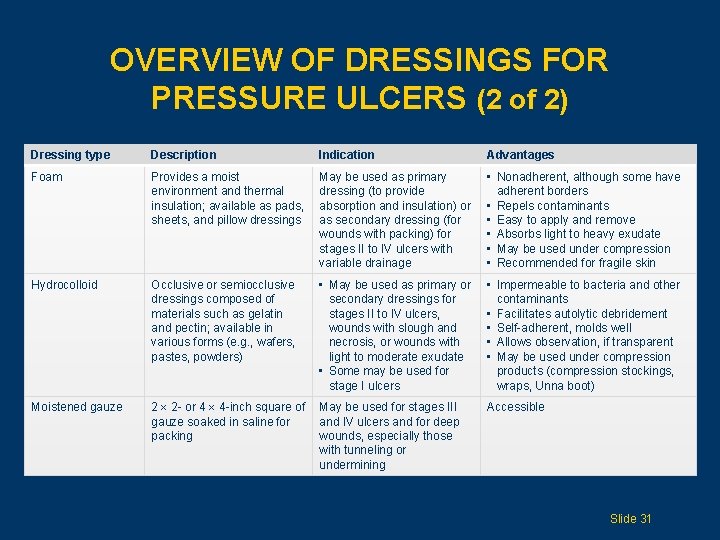
OVERVIEW OF DRESSINGS FOR PRESSURE ULCERS (2 of 2) Dressing type Description Indication Advantages Foam Provides a moist environment and thermal insulation; available as pads, sheets, and pillow dressings May be used as primary dressing (to provide absorption and insulation) or as secondary dressing (for wounds with packing) for stages II to IV ulcers with variable drainage • Nonadherent, although some have adherent borders • Repels contaminants • Easy to apply and remove • Absorbs light to heavy exudate • May be used under compression • Recommended for fragile skin Hydrocolloid Occlusive or semiocclusive dressings composed of materials such as gelatin and pectin; available in various forms (e. g. , wafers, pastes, powders) • May be used as primary or secondary dressings for stages II to IV ulcers, wounds with slough and necrosis, or wounds with light to moderate exudate • Some may be used for stage I ulcers • Impermeable to bacteria and other contaminants • Facilitates autolytic debridement • Self-adherent, molds well • Allows observation, if transparent • May be used under compression products (compression stockings, wraps, Unna boot) Moistened gauze 2 2 - or 4 4 -inch square of gauze soaked in saline for packing May be used for stages III and IV ulcers and for deep wounds, especially those with tunneling or undermining Accessible Slide 31
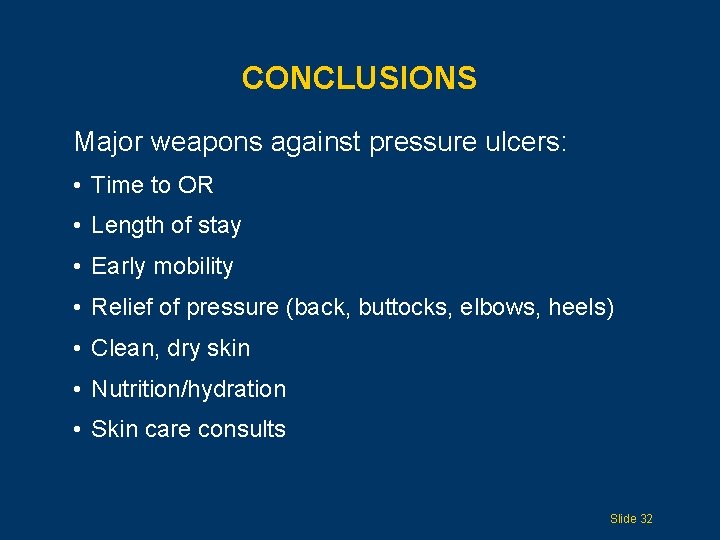
CONCLUSIONS Major weapons against pressure ulcers: • Time to OR • Length of stay • Early mobility • Relief of pressure (back, buttocks, elbows, heels) • Clean, dry skin • Nutrition/hydration • Skin care consults Slide 32

THANK YOU FOR YOUR TIME! Visit us at: www. americangeriatrics. org Facebook. com/American. Geriatrics. Society Twitter. com/Amer. Geriatrics linkedin. com/company/american-geriatricssociety Slide 33
- Slides: 33