
Skin and the Integumentary System HAP CHAPTER 6

- Slides: 18
Skin and the Integumentary System HAP CHAPTER 6
I. SKIN AND ITS TISSUES A. Functions… 1. protective covering 2. homeostasis 3. regulate body temp. 4. prevents water loss 5. sensory receptors 6. excretes wastes (sweat)
B. Layers of the Integumentary System 1. Epidermis – outer layer a. Stratified squamous epithelium 2. Dermis – inner layer a. Connective tissue b. Epithelial tissue c. Muscle tissue d. Nervous tissue e. Blood tissue *basement membrane anchors dermis and epidermis
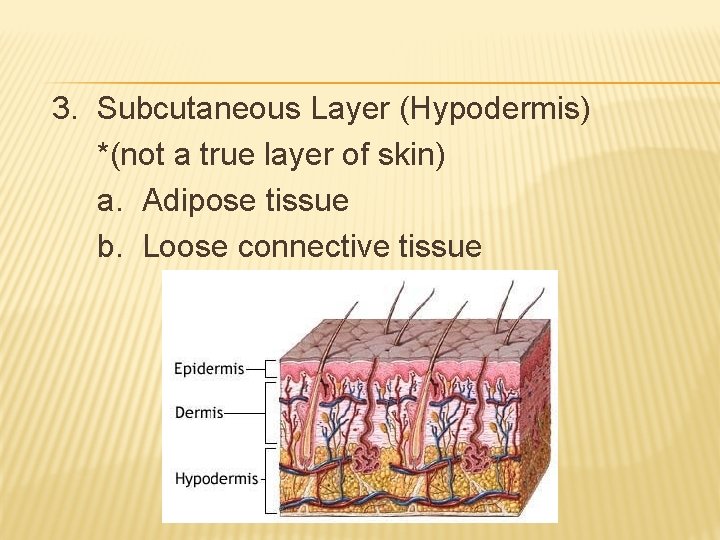
3. Subcutaneous Layer (Hypodermis) *(not a true layer of skin) a. Adipose tissue b. Loose connective tissue
II. EPIDERMIS A. Layers 1. Stratum Basale – deepest layer a. Nourished by dermal blood vessels b. Mitosis – rapid c. Push cells towards the surface d. Older cells keratinize (keratin) become tough, fibrous, waterproof 2. Stratum Corneum a. Dead cells…shed or eaten
3. Stratum Lucidum a. Thickened skin of the palms and soles b. Calluses / corns B. Functions 1. Prevents… a. Water loss b. Mechanical injury c. Harmful chemicals from entering d. Pathogens from entering
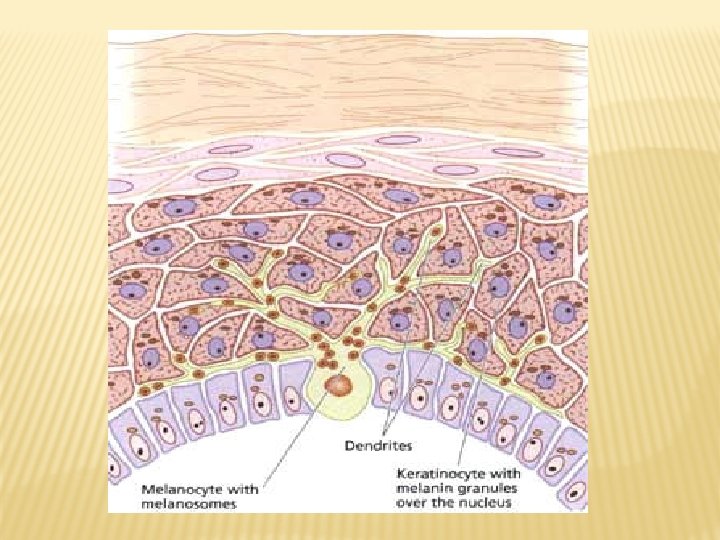
C. Special Cells 1. Melanocytes – produce melanin a. Dark pigment…absorbs UV b. Prevents DNA mutations c. Lie deep in epidermis d. Pass melanin to other cells cytocrine secretion
2. Skin Color a. Based on melanin produced… b. Genetically determined c. O 2 levels d. Diet – yellow veg. orange/yellow skin β-carotene e. Age – jaundice build up of bilirubin
III. DERMIS A. Location 1. Deep of epidermis 2. Uneven (pg. 114) dermal papillae (bumps) fingerprints B. Characteristics 1. Binds epidermis 2. Blood supply 3. Nerve cell processes 4. Hair follicles 5. Sebaceous glands 6. Sweat glands
IV. SUBCUTANEOUS (HYPODERMIS) LAYER A. Location 1. Deep of dermis 2. Level varies (no distinct boundary) B. Characteristics 1. loose and adipose connective tissue 2. major blood vessels 3. conservation of heat
V. ACCESSORY ORGANS OF SKIN A. Nails 1. components a. Nail plate – covers surface of skin b. Nail bed – specialized epithelial cells c. Lunula – white ½ moon shaped active keratinized
B. Hair Follicles 1. present almost everywhere 2. components a. Hair follicle – tubelike depression b. Hair root – extends into dermis c. Keratinized d. Arrector pili muscle – “goose bumps” 3. Hair color a. Based on melanocytes b. No melanine White…albinism c. Trichosiderin Red hair
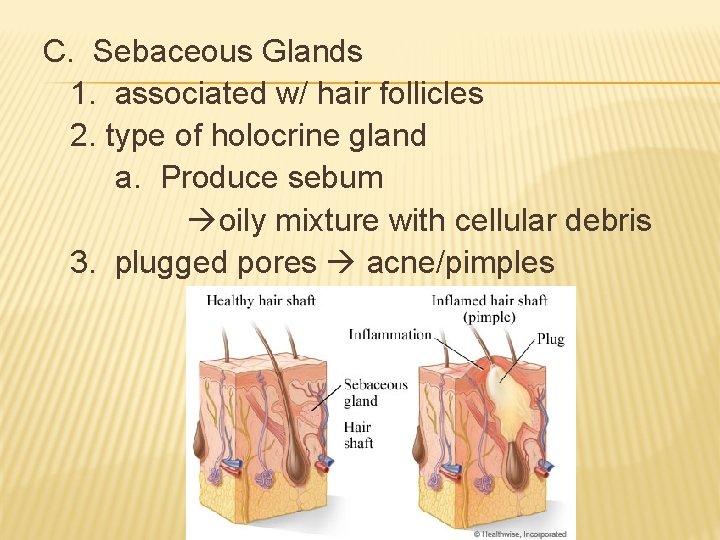
C. Sebaceous Glands 1. associated w/ hair follicles 2. type of holocrine gland a. Produce sebum oily mixture with cellular debris 3. plugged pores acne/pimples
D. Sweat Glands 1. Type of exocrine gland 2. Eccrine gland – most common type a. Forehead, neck, back 3. Sweat… a. Mostly water b. Small quantities of… -salt, wastes, and urea 4. Other sweat glands a. Apocrine glands – puberty b. Mammary gland – secrete milk
VI. BODY TEMPERATURE REGULATION A. Warm environment… 1. nerve impulses react…send message to brain 2. blood vessels vasodialate, sweat glands open 3. heat escapes B. Cold environment… 1. nerve impulses react…send message to brain 2. muscles fire; blood vessels constrict; sweat glands close 3. skeletal muscles contract…shiver
VII. WOUND HEALING A. Body’s Response 1. Swelling 2. Red 3. Warm 4. Pain B. Why? 1. Increased blood flow
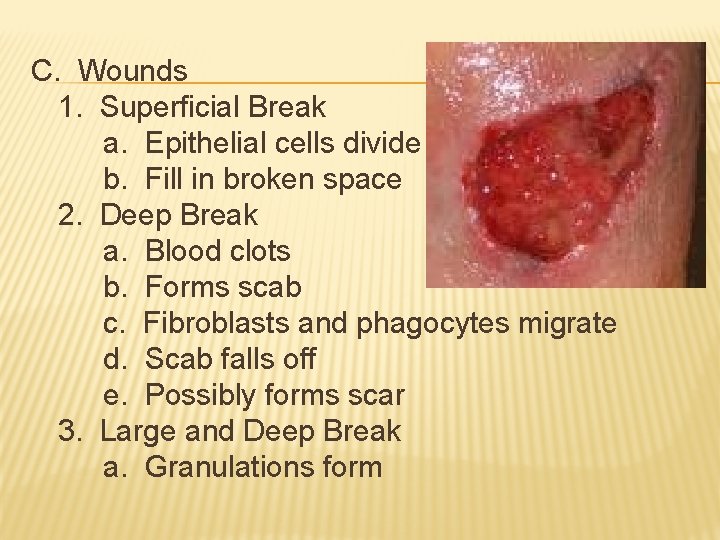
C. Wounds 1. Superficial Break a. Epithelial cells divide b. Fill in broken space 2. Deep Break a. Blood clots b. Forms scab c. Fibroblasts and phagocytes migrate d. Scab falls off e. Possibly forms scar 3. Large and Deep Break a. Granulations form