
Skin and Membranes Chapter 6 Copyright 2016 by
Skin and Membranes Chapter 6 Copyright © 2016 by Elsevier Inc. All rights reserved. 1
Learning Objectives Lesson 6. 1: Skin and Membranes 1. 2. 3. 4. Classify, compare the structure of, and give examples of each type of body membrane. Describe the structure and function of the epidermis and dermis. List and briefly describe each accessory organ of the skin. List and discuss the five primary functions of the integumentary system. Copyright © 2016 by Elsevier Inc. All rights reserved. 2
Learning Objectives Lesson 6. 1: Skin and Membranes (Cont. ) 5. 6. List and briefly describe three most common types of skin cancer. Classify burns and describe how to estimate the extent of a burn injury. Copyright © 2016 by Elsevier Inc. All rights reserved. 3

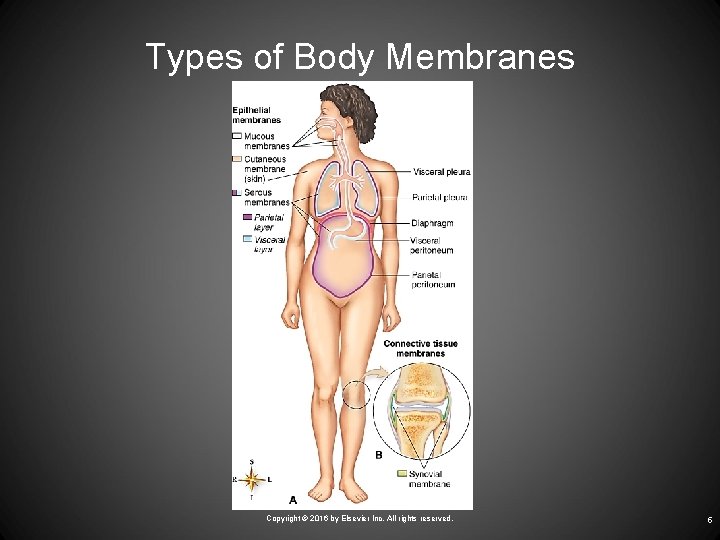
Body Membranes Classification of body membranes (Figure 6 -1) Ø Epithelial membranes • Ø Composed of epithelial tissue and an underlying layer of connective tissue Connective tissue membranes • Composed largely of various types of connective tissue Copyright © 2016 by Elsevier Inc. All rights reserved. 4
Types of Body Membranes Copyright © 2016 by Elsevier Inc. All rights reserved. 5

Body Membranes (Cont. ) Epithelial membranes Ø Ø Cutaneous membrane: Skin Serous membranes: Simple squamous epithelium on a connective tissue basement membrane • Types • Parietal layer: Line walls of body cavities Visceral layer: Cover organs found in body cavities Examples Pleura: Parietal and visceral layers line walls of thoracic cavity and cover the lungs Peritoneum: Parietal and visceral layers line walls of abdominal cavity and cover the organs in that cavity Copyright © 2016 by Elsevier Inc. All rights reserved. 6
Body Membranes (Cont. ) Epithelial membranes Ø Serous membranes • Diseases Pleurisy: Inflammation of the serous membranes that line the chest cavity and cover the lungs Peritonitis: Inflammation of the serous membranes in the abdominal cavity that line the walls and cover the abdominal organs Copyright © 2016 by Elsevier Inc. All rights reserved. 7
Body Membranes (Cont. ) Epithelial membranes Ø Mucous membranes • • Line body surfaces that open directly to the exterior Produce mucus, a thick secretion that keeps the membranes soft and moist Copyright © 2016 by Elsevier Inc. All rights reserved. 8
Body Membranes (Cont. ) Connective tissue membranes Ø Ø Ø Do not contain epithelial components Produce a lubricant called synovial fluid Examples are the synovial membranes in the spaces between joints and in the lining of bursal sacs Copyright © 2016 by Elsevier Inc. All rights reserved. 9
The Skin Structure (Figure 6 -3): Two primary layers called epidermis and dermis Ø Epidermis • • • Outermost and thinnest primary layer of skin Composed of several layers of stratified squamous epithelium Stratum germinativum: Innermost layer of cells that continually reproduce; new cells move toward the surface (Figure 6 -4) As cells approach the surface, they are filled with a tough, waterproof protein called keratin; eventually cells flake off Stratum corneum: Outermost layer of keratin-filled cells Copyright © 2016 by Elsevier Inc. All rights reserved. 10
The Skin (Cont. ) Structure Ø Skin pigment: Deepest epidermal layer is responsible for production of pigment, which gives color to the skin • • The brown pigment melanin is produced by specialized cells in this layer Blisters are caused by breakdown of union between cells or primary layers of skin Copyright © 2016 by Elsevier Inc. All rights reserved. 11
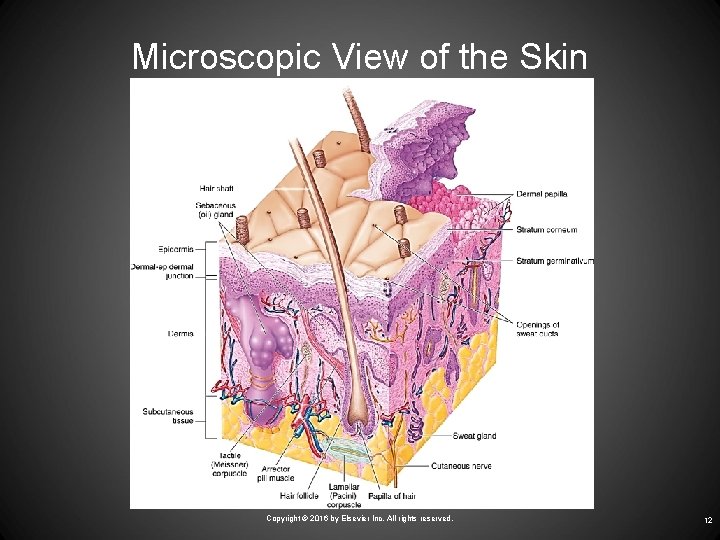
Microscopic View of the Skin Copyright © 2016 by Elsevier Inc. All rights reserved. 12
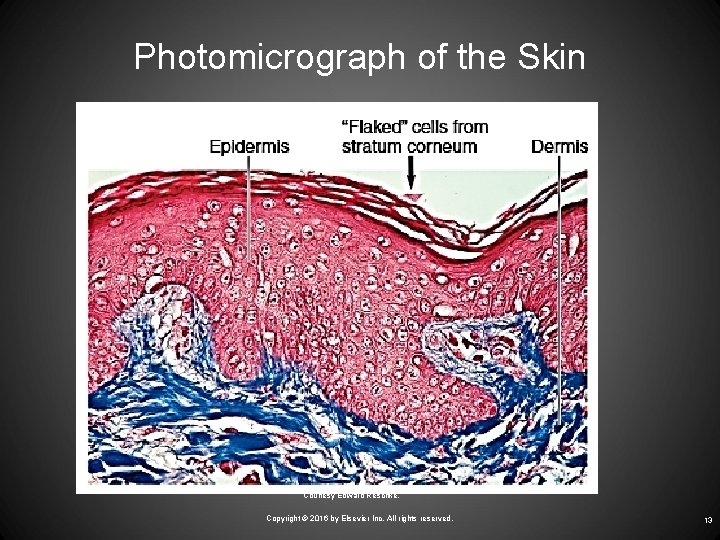
Photomicrograph of the Skin Courtesy Edward Reschke. Copyright © 2016 by Elsevier Inc. All rights reserved. 13
The Skin (Cont. ) Structure Ø Dermal-epidermal junction • Ø Specialized area between two skin layers Dermis • • • Deeper and thicker of the two primary skin layers and composed largely of connective tissue Upper papillary layer of dermis characterized by parallel rows of tiny bumps called dermal papillae Ridges and grooves in dermis form pattern unique to each individual Basis of fingerprinting Improves grip for tool use and walking Copyright © 2016 by Elsevier Inc. All rights reserved. 14
The Skin (Cont. ) Structure Ø Dermis • Deeper reticular layer of dermis filled with network of tough, interlacing, collagenous and stretchable elastic fibers Number of elastic fibers decreases with age and contributes to wrinkle formation Dermis also contains nerve endings, muscle fibers, hair follicles, sweat and sebaceous glands, and many blood vessels Copyright © 2016 by Elsevier Inc. All rights reserved. 15
Accessory Organs of The Skin Hair, nails, and skin receptors Ø Hair (Figure 6 -5) • • • Soft hair of fetus and newborn is called lanugo Hair growth requires epidermal tubelike structure called hair follicle Hair growth begins from hair papilla Hair root lies hidden in follicle and visible part of hair called shaft Arrector pili is specialized smooth muscle that produces “goose bumps” and causes hair to stand up straight Copyright © 2016 by Elsevier Inc. All rights reserved. 16
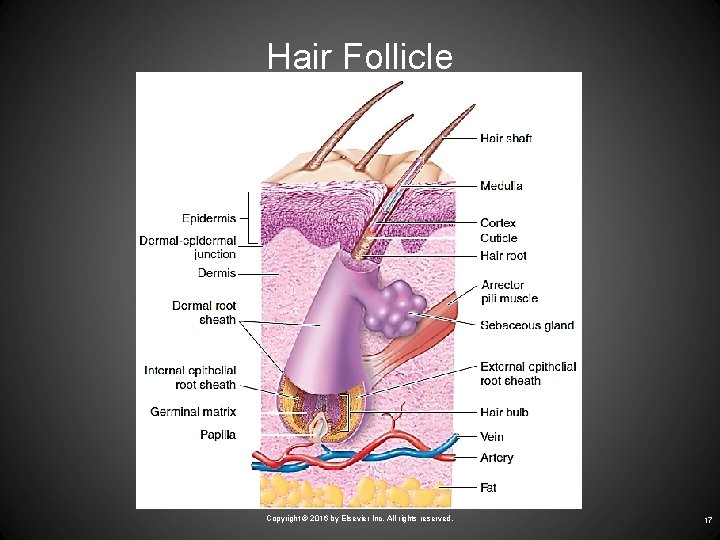
Hair Follicle Copyright © 2016 by Elsevier Inc. All rights reserved. 17
Accessory Organs of The Skin Hair, nails, and skin receptors Ø Nails (Figure 6 -7) • • • Produced by epidermal cells over terminal ends of fingers and toes Visible part is called nail body Root lies in a groove and is hidden by cuticle Crescent-shaped area nearest root is called lunula Nail bed may change color with change in blood flow Copyright © 2016 by Elsevier Inc. All rights reserved. 18
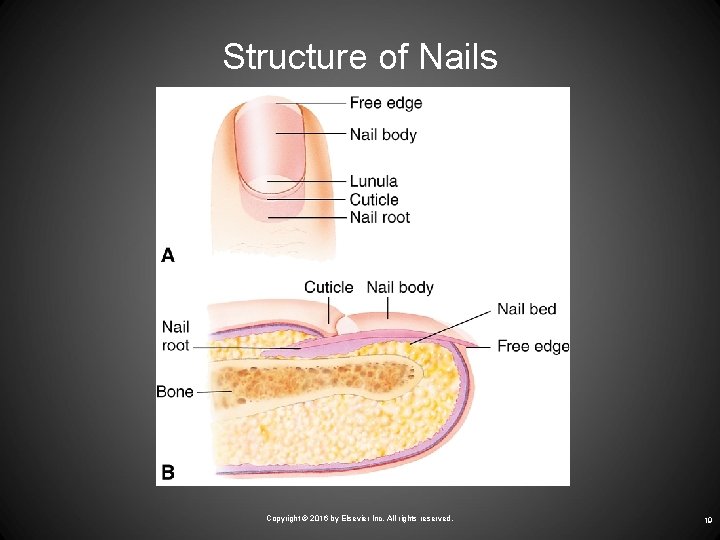
Structure of Nails Copyright © 2016 by Elsevier Inc. All rights reserved. 19
Accessory Organs of The Skin Hair, nails, and skin receptors Ø Skin receptors (Figure 6 -3) • • • Specialized nerve endings: Make it possible for skin to act as a sense organ Lamellar corpuscle (Pacini corpuscle): Capable of detecting pressure Tactile corpuscle (Meissner corpuscle): Capable of detecting light touch Copyright © 2016 by Elsevier Inc. All rights reserved. 20
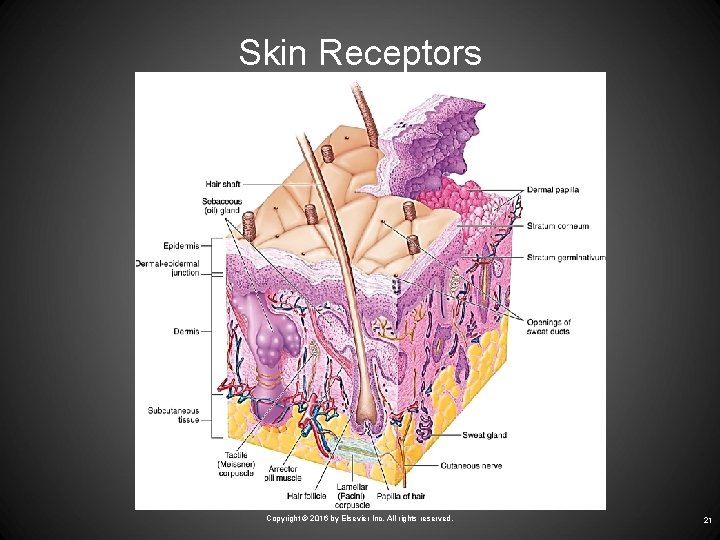
Skin Receptors Copyright © 2016 by Elsevier Inc. All rights reserved. 21
Accessory Organs of the Skin glands Ø Types • • Ø Sweat or sudoriferous Sebaceous Sweat or sudoriferous glands • Types Eccrine sweat glands • Most numerous, important, and widespread of the sweat glands • Produce perspiration or sweat, which flows out through pores on skin surface • Function throughout life and assist in body heat regulation Copyright © 2016 by Elsevier Inc. All rights reserved. 22
Accessory Organs of the Skin (Cont. ) Skin glands Ø Sweat or sudoriferous glands • Types Ø Apocrine sweat glands • Found primarily in the skin in the axilla (armpit) • Larger than eccrine glands • Thicker secretion Sebaceous glands • • Secrete oil for the hair and skin Grow where hairs grow Tiny ducts open into hair follicles Sebum secretion increases during adolescence Copyright © 2016 by Elsevier Inc. All rights reserved. 23
The Skin (Cont. ) Functions of the skin Ø Protection; first line of defense against: • • Ø Infection by microbes Ultraviolet rays from sun Harmful chemicals Cuts and tears Temperature regulation • Skin can release almost 3000 calories of body heat per day Mechanisms of temperature regulation • Regulation of sweat secretion • Regulation of flow of blood close to the body surface Copyright © 2016 by Elsevier Inc. All rights reserved. 24
The Skin (Cont. ) Functions of the skin Ø Sense organ activity • • Ø Excretion • • Ø Skin functions as an enormous sense organ Receptors serve as receivers for the body, keeping it informed of changes in its environment Body rids itself of wastes Excess vitamins, drugs, and hormones can be excreted onto the skin by sweat Synthesis of vitamin D • • Occurs when skin is exposed to ultraviolet light Vitamin D is critically important to good health Copyright © 2016 by Elsevier Inc. All rights reserved. 25
Skin Cancer Most common types (Figure 6 -8) Ø Ø Ø Causes Ø Ø Squamous cell carcinoma Basal cell carcinoma Malignant melanoma Genetic predisposition Sun's ultraviolet (UV) radiation damages skin cell deoxyribonucleic acid (DNA), causing mistakes during mitosis Kaposi sarcoma (KS) Ø First appears as purple papules Copyright © 2016 by Elsevier Inc. All rights reserved. 26
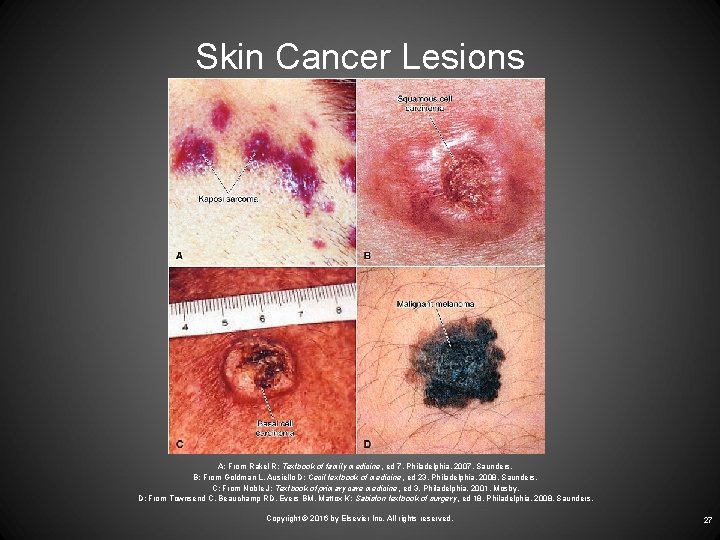
Skin Cancer Lesions A: From Rakel R: Textbook of family medicine, ed 7, Philadelphia, 2007, Saunders. B: From Goldman L, Ausiello D: Cecil textbook of medicine, ed 23, Philadelphia, 2008, Saunders. C: From Noble J: Textbook of primary care medicine, ed 3, Philadelphia, 2001, Mosby. D: From Townsend C, Beauchamp RD, Evers BM, Mattox K: Sabiston textbook of surgery, ed 18, Philadelphia, 2008, Saunders. Copyright © 2016 by Elsevier Inc. All rights reserved. 27
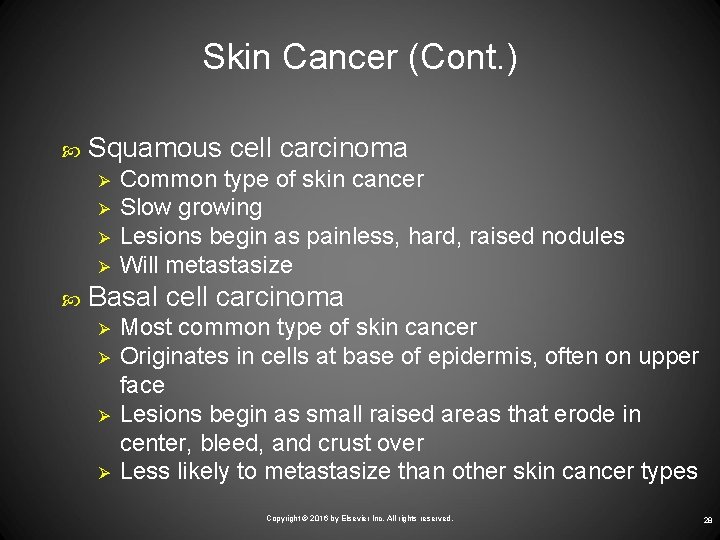
Skin Cancer (Cont. ) Squamous cell carcinoma Ø Ø Common type of skin cancer Slow growing Lesions begin as painless, hard, raised nodules Will metastasize Basal cell carcinoma Ø Ø Most common type of skin cancer Originates in cells at base of epidermis, often on upper face Lesions begin as small raised areas that erode in center, bleed, and crust over Less likely to metastasize than other skin cancer types Copyright © 2016 by Elsevier Inc. All rights reserved. 28
Skin Cancer (Cont. ) Malignant melanoma Ø Ø Most serious form of skin cancer May develop from benign, pigmented moles or excess UV radiation Incidence in the United States is increasing ABCDE rule of self-examination (Table 6 -1) Copyright © 2016 by Elsevier Inc. All rights reserved. 29
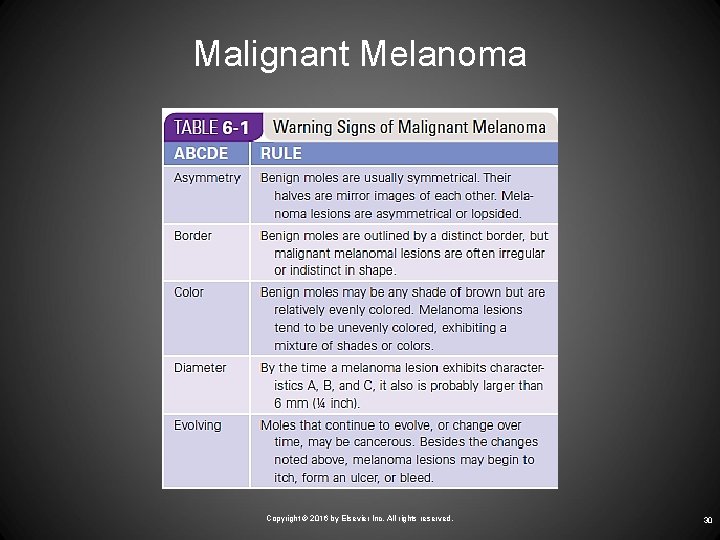
Malignant Melanoma Copyright © 2016 by Elsevier Inc. All rights reserved. 30
Burns Treatment and recovery or survival depend on total area involved and severity or depth of the burn Body surface area is estimated using the “rule of nines” (Figure 6 -9) in adults Ø Ø Body is divided into 11 areas of 9% each Additional 1% located around genitals Copyright © 2016 by Elsevier Inc. All rights reserved. 31
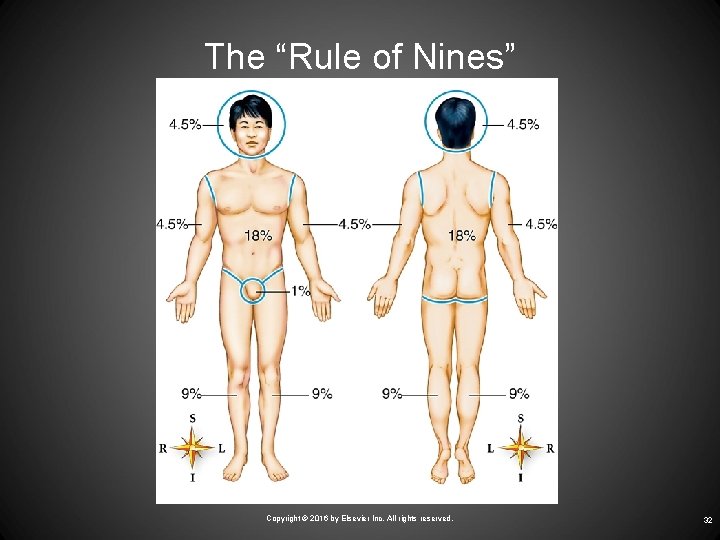
The “Rule of Nines” Courtesy Barbara Cousins. Copyright © 2016 by Elsevier Inc. All rights reserved. 32
Burns (Cont. ) Classification of burns (Figure 6 -10) Ø First-degree (partial-thickness) burns • Ø Only the surface layers of epidermis involved Second-degree (partial-thickness) burns • Involve the deep epidermal layers and always cause injury to the upper layers of the dermis Copyright © 2016 by Elsevier Inc. All rights reserved. 33
Burns (Cont. ) Classification of burns Ø Third-degree (full-thickness) burns • • • Ø Characterized by complete destruction of the epidermis and dermis May involve underlying muscle and bone Risk of infection is increased Fourth-degree (full-thickness) burns • • Extends below subcutaneous tissue and reaches muscle or bone May occur as result of high-voltage electrical burns Copyright © 2016 by Elsevier Inc. All rights reserved. 34
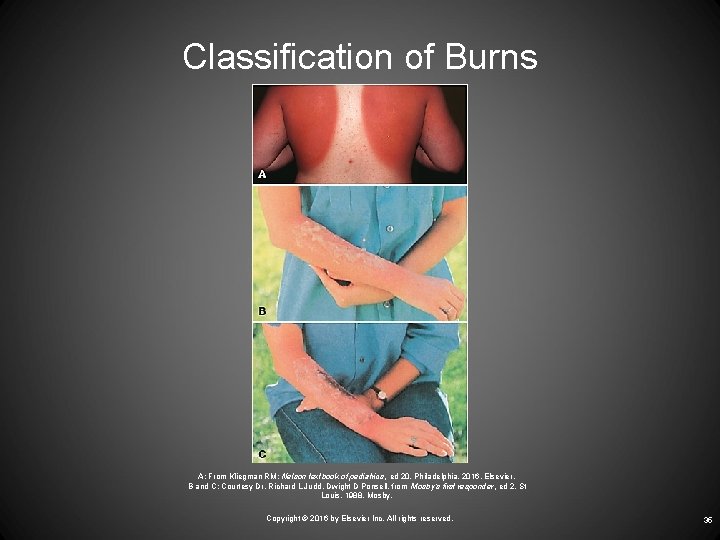
Classification of Burns A: From Kliegman RM: Nelson textbook of pediatrics, ed 20, Philadelphia, 2016, Elsevier. B and C: Courtesy Dr. Richard L Judd, Dwight D Ponsell, from Mosby’s first responder, ed 2, St Louis, 1988, Mosby. Copyright © 2016 by Elsevier Inc. All rights reserved. 35

Questions? Copyright © 2016 by Elsevier Inc. All rights reserved. 36
- Slides: 36