
SKILLS FOR THE FUTURE National Skill Standards for
- Slides: 16
SKILLS FOR THE FUTURE National Skill Standards for the Canadian Printing and Graphic Communications Industry
Presentation Outline • • Overview of the Skill Standards Initiative Who We Are Factors Driving the Industry Approach to standards – Process Areas – Types of Standards • Implementation & Next Steps
Who We Are • One of over 30 sector councils in Canada • Mandate – Identify and implement innovative approaches to skills development – Industry trends – Standards – Training • Partnership model – Government funding – Independently governed – Broad based industry involvement and buy-in
Factors Driving Industry • Changing Nature of Industry • Economic Climate • Technological Change
Changing Industry • • Expansion of Services Changing clientele New skill sets Some statistics – 25, 981 firms with 87% having fewer than 10 employees – 274, 134 employees with 64% being male – Almost half of labour force is nearing or has already passed age of early retirement – Majority of training takes place on shop floor
Economic Climate • Challenges • Window of Opportunity • Taking the long view
Technological Change • Skills and Technology Roadmap – Explores technologies that will shape the industry – Considers impact of these trends on skills development and training • Impact on skills – Need for multi-skilled and adaptable workers – Higher level technical skills
Approach to Standards • Development of skill standards – – Reflective of industry needs Responsive to technological change Adaptable to needs of small and medium enterprises Mirrors the way the industry is organized and functions • Foundation upon which a broad based human resource system is built • Process area approach reflective of manufacturing sector
Approach to Standards • Developed for each production process area – Pre-Press – Finishing/Bindery
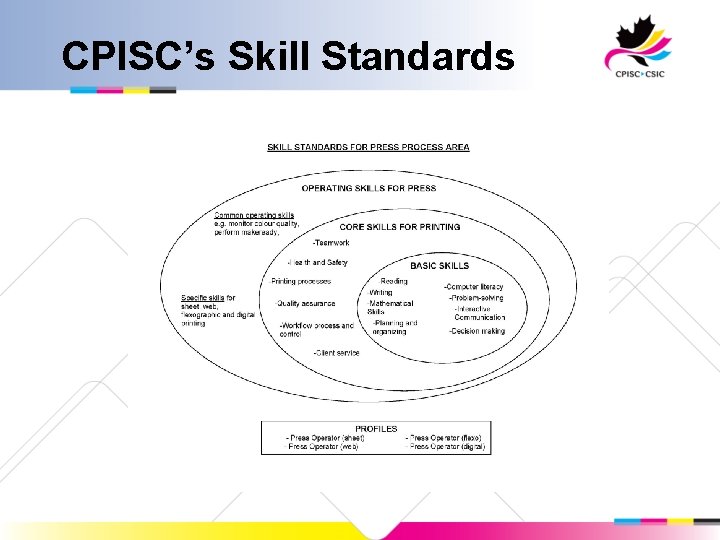
Approach to Standards • What do people need to know and be able to do in order to successfully do the job? • Three types of skill standards – Basic – Core – Operating Skills
Basic Skills • Apply to all occupations • “Enable” other skills – – – – Reading Writing Interpersonal Skills Mathematics and Calculation Problem Solving Decision Making Computer Literacy Planning and Organizing
Core Skills • Skills common to all occupations within the industry and across all process areas : prepress, finishing and bindery – – Teamwork Health and Safety Printing Process Workflow Process and Control – Quality Assurance – Client Service
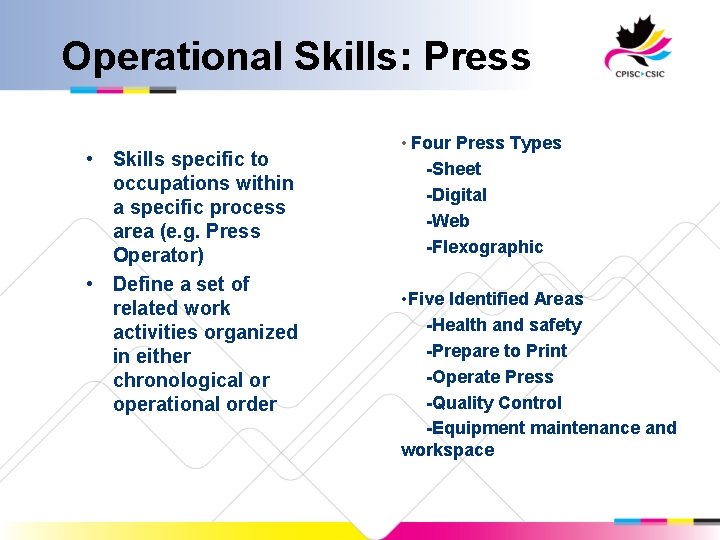
Operational Skills: Press • Skills specific to occupations within a specific process area (e. g. Press Operator) • Define a set of related work activities organized in either chronological or operational order • Four Press Types -Sheet -Digital -Web -Flexographic • Five Identified Areas -Health and safety -Prepare to Print -Operate Press -Quality Control -Equipment maintenance and workspace
CPISC’s Skill Standards
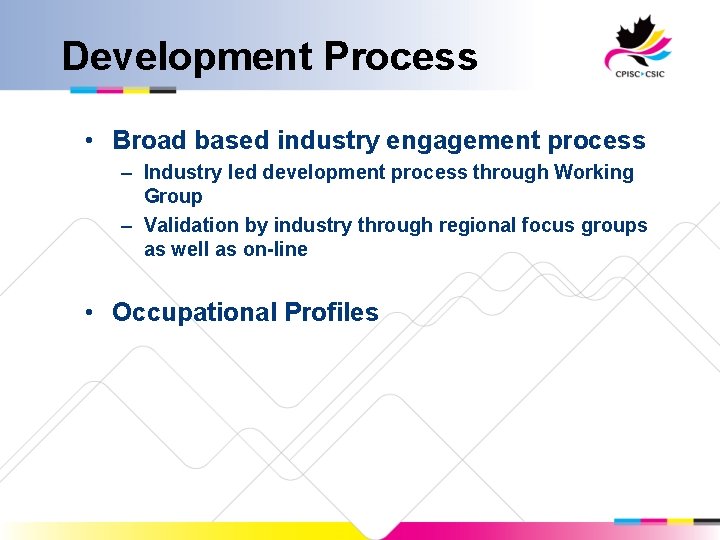
Development Process • Broad based industry engagement process – Industry led development process through Working Group – Validation by industry through regional focus groups as well as on-line • Occupational Profiles
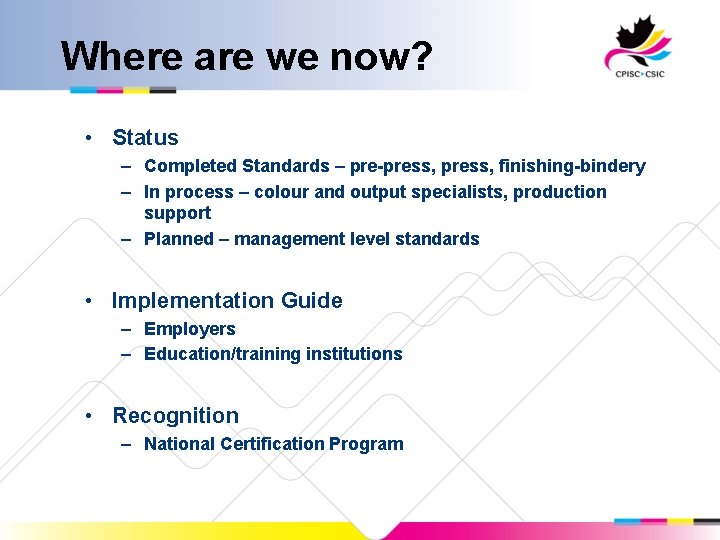
Where are we now? • Status – Completed Standards – pre-press, finishing-bindery – In process – colour and output specialists, production support – Planned – management level standards • Implementation Guide – Employers – Education/training institutions • Recognition – National Certification Program