
Skill Development at its Best Management BBA MBA
Skill Development at it’s Best Management BBA & MBA Lecture 789 Decision Making the Essence of Managerial Life Course Lecturer: Farhan Mir Copyright 2017@MIRS
Skill Development at it’s Best Learning Outcomes • • • Describe the steps in the decision-making process Identify the assumptions of the rational decision-making model Explain the limits to rationality Define certainty, risk, and uncertainty as they relate to decision making Describe the actions of the bounded-rational decision maker Copyright 2017@MIRS
Skill Development at it’s Best Learning Outcomes (…) • • • Identify the two types of decision problems and the two types of decisions that are used to solve them Define heuristics and explain how they affect the decision-making process Identify four decision-making styles Copyright 2017@MIRS
Skill Development at it’s Best Decision Making Ø Decision making. – The process of choosing a course of action for dealing with a problem or opportunity. Copyright 2017@MIRS
Skill Development at it’s Best Decision Making Lots of attempts are carried out to scientifically examine the ability of humans to make decisions. But it is still somewhat a mystery! Copyright 2017@MIRS
Skill Development at it’s Best Decision Making: our context Copyright 2017@MIRS

Skill Development at it’s Best Managers choosing among alternatives Copyright 2017@MIRS
Skill Development at it’s Best How are decisions made in organizations? • Many Methods can be adopted by various managers for making decisions, one of these is called the “Systematic Decision Making” (Also known as the “Rational Model of Decision Making”) Copyright 2017@MIRS
Skill Development at it’s Best How are decisions made in organizations? Ø Steps in systematic decision making. – Recognize and define the problem or opportunity. – Identify and analyze alternative courses of action, and estimate their effects on the problem or opportunity. – Choose a preferred course of action. – Implement the preferred course of action. – Evaluate the results and follow up as necessary. Copyright 2017@MIRS
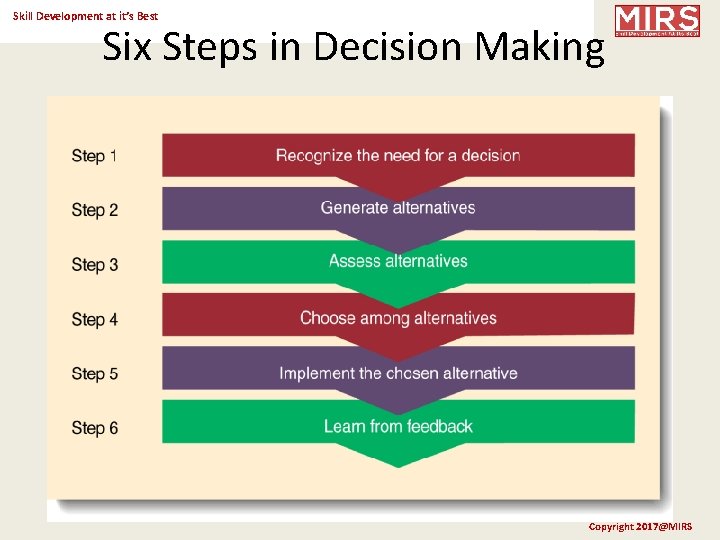
Skill Development at it’s Best Six Steps in Decision Making Figure 7. 4 Copyright 2017@MIRS
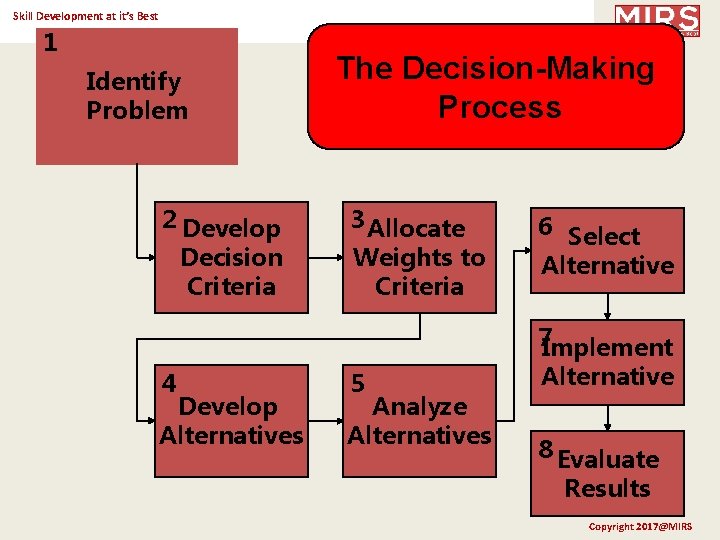
Skill Development at it’s Best 1 Identify Problem 2 Develop Decision Criteria 4 Develop Alternatives The Decision-Making Process 3 Allocate Weights to Criteria 5 Analyze Alternatives 6 Select Alternative 7 Implement Alternative 8 Evaluate Results Copyright 2017@MIRS
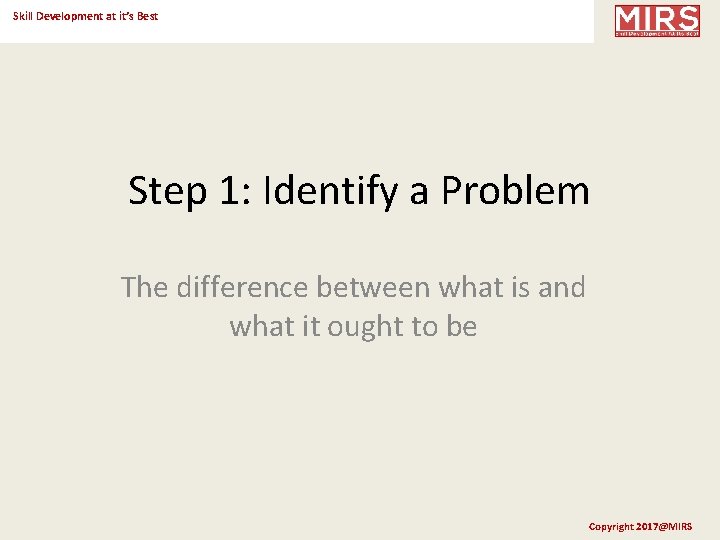
Skill Development at it’s Best Step 1: Identify a Problem The difference between what is and what it ought to be Copyright 2017@MIRS
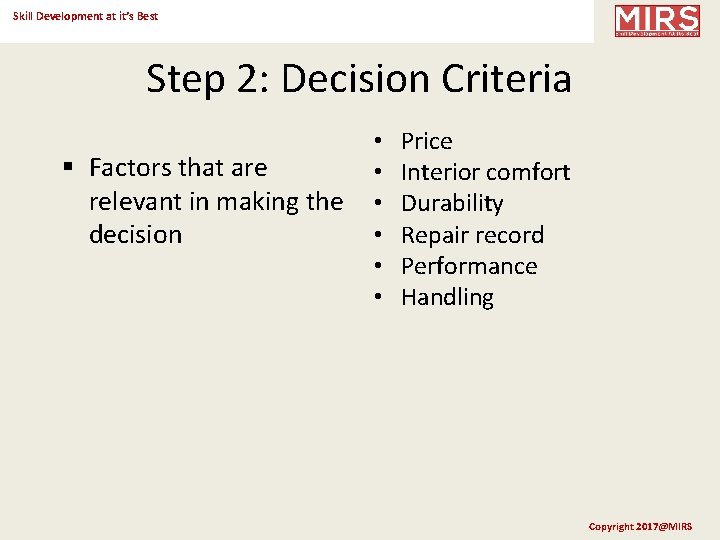
Skill Development at it’s Best Step 2: Decision Criteria § Factors that are relevant in making the decision • • • Price Interior comfort Durability Repair record Performance Handling Copyright 2017@MIRS
Skill Development at it’s Best Step 3: Allocating Weights Determining the relative priority of each of the criteria Copyright 2017@MIRS
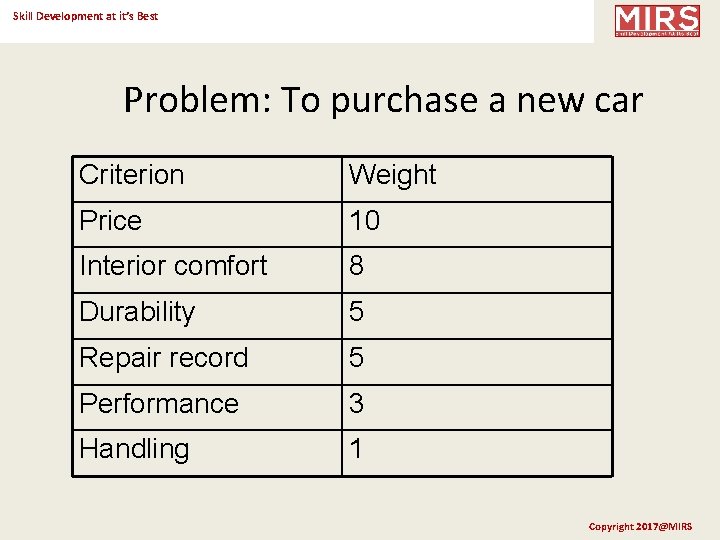
Skill Development at it’s Best Problem: To purchase a new car Criterion Weight Price 10 Interior comfort 8 Durability 5 Repair record 5 Performance 3 Handling 1 Copyright 2017@MIRS
Skill Development at it’s Best Step 4: Alternatives Generate a list of possible vehicle manufacturers Copyright 2017@MIRS
Skill Development at it’s Best Step 5: Analyzing Alternatives Assessing the value of each alternative by making a value judgment of the feature Copyright 2017@MIRS
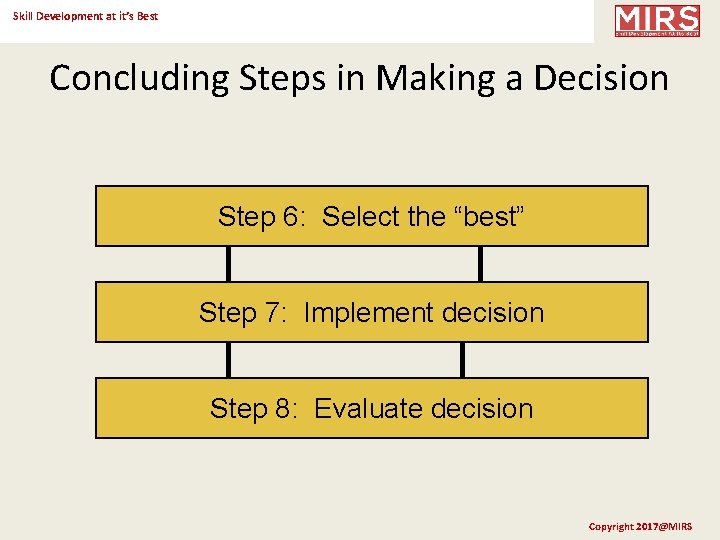
Skill Development at it’s Best Concluding Steps in Making a Decision Step 6: Select the “best” Step 7: Implement decision Step 8: Evaluate decision Copyright 2017@MIRS
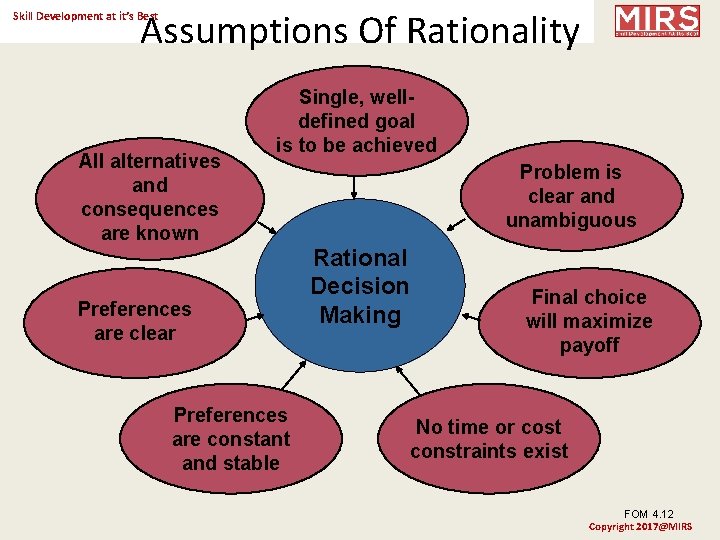
Assumptions Of Rationality Skill Development at it’s Best All alternatives and consequences are known Single, welldefined goal is to be achieved Preferences are clear Preferences are constant and stable Problem is clear and unambiguous Rational Decision Making Final choice will maximize payoff No time or cost constraints exist FOM 4. 12 Copyright 2017@MIRS

Managers have time and are usually under stress Skill. But Development at it’s don’t Best Copyright 2017@MIRS

Skill Development at it’s Best And are usually overloaded with information Copyright 2017@MIRS
Skill Development at it’s Best How are decisions made in organizations? Ø The systematic decision-making process may not be followed where substantial change occurs and many new technologies prevail. Ø New decision techniques may yield superior performance in certain situations. Copyright 2017@MIRS
Skill Development at it’s Best What are the useful decision making models? Ø Decision making realities. – Managers face complex choice processes. – Decision making information may not be available. – Bounded rationality and cognitive limitations affect the way people define problems, identify alternatives, and choose preferred solutions. Copyright 2017@MIRS
What Makes Decision Making so Difficult? Skill Development at it’s Best • • • Complexity Uncertainty Organizational & Environment Pressure Individual Decision Making Limitations Experience, Beliefs & Perceptions of the Decision Maker • Results!!!! – Satisfycing (sounds like…. guess!!!!) – Focusing on highly visible choices – So managers make decisions in Bounded Rationality • Key bounding constraints are time, uncertainty and other organizational and cultural influences Copyright 2017@MIRS
Skill Development at it’s Best How do intuition, judgment, and creativity affect decision making? Ø Intuition. – The ability to know or recognize quickly and readily the possibilities of a given situation. – A key element of decision making under risk and uncertainty. Copyright 2017@MIRS
Skill Development at it’s Best How do intuition, judgment, and creativity affect decision making? Ø Judgmental heuristics. – Simplifying strategies or “rules of thumb” used to make decisions. – Makes it easier to to deal with uncertainty and limited information. – Can lead to systematic errors that affect the quality and/or ethics of decisions. Copyright 2017@MIRS
Skill Development at it’s Best How do intuition, judgment, and creativity affect decision making? Ø Types of heuristics. – Availability heuristic — bases a decision on recent events relating to the situation at hand. – Representativeness heuristic — bases a decision on similarities between the situation at hand stereotypes of similar occurrences Copyright 2017@MIRS
Skill Development at it’s Best How do intuition, judgment, and creativity affect decision making? Ø Creativity factors. – Creativity in decision making involves the development of unique and novel responses to problems and opportunities. – Creativity is especially important in a dynamic environment full of nonroutine problems. Copyright 2017@MIRS
Skill Development at it’s Best Types of Decisions Copyright 2017@MIRS
Skill Development at it’s Best Problems Well-Structured vs. ill-Structured • Straightforward • Familiar • Easily-defined • New or unusual • Ambiguous information • Incomplete information Copyright 2017@MIRS
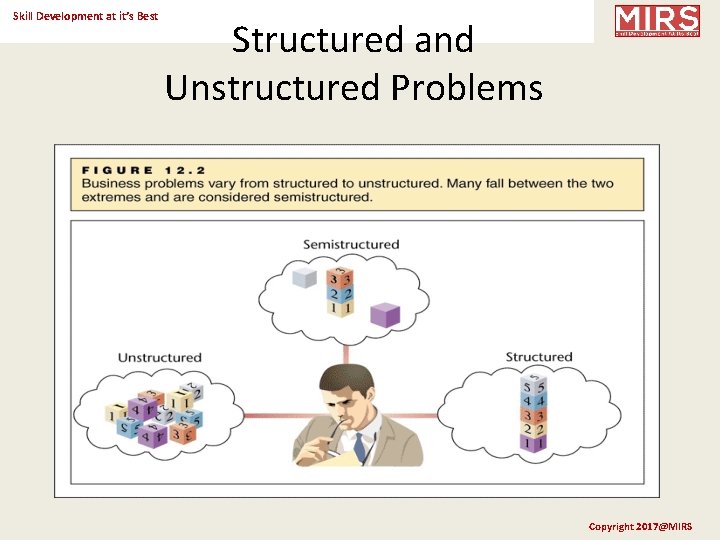
Skill Development at it’s Best Structured and Unstructured Problems Copyright 2017@MIRS
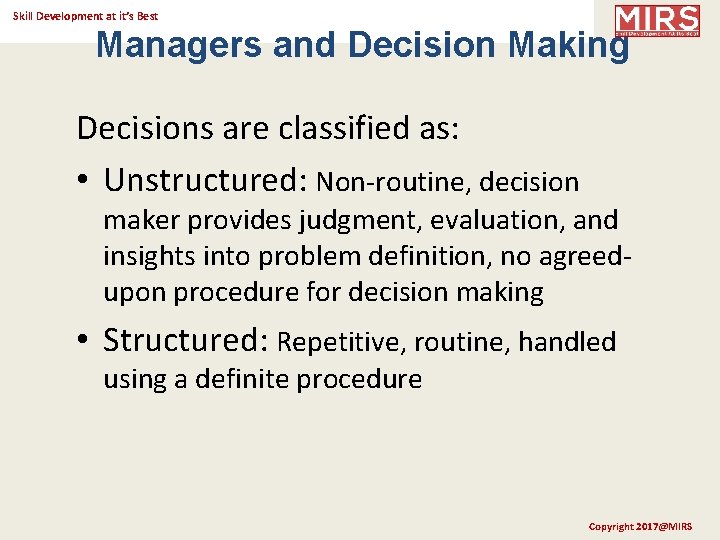
Skill Development at it’s Best Managers and Decision Making Decisions are classified as: • Unstructured: Non-routine, decision maker provides judgment, evaluation, and insights into problem definition, no agreedupon procedure for decision making • Structured: Repetitive, routine, handled using a definite procedure Copyright 2017@MIRS
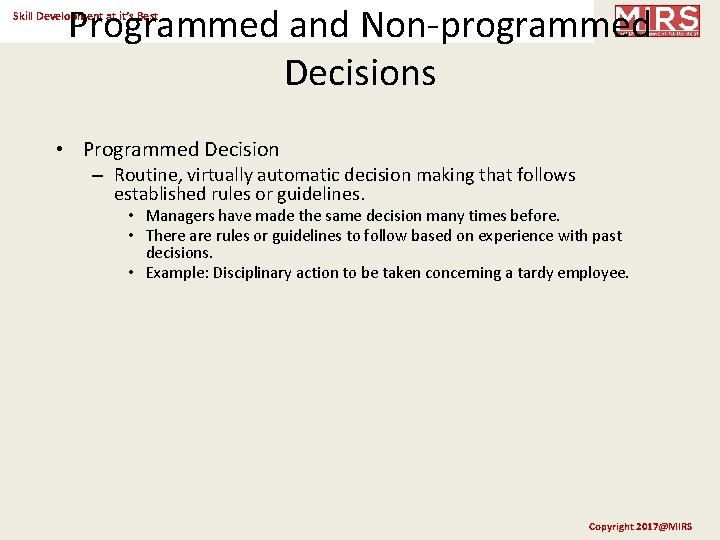
Programmed and Non-programmed Decisions Skill Development at it’s Best • Programmed Decision – Routine, virtually automatic decision making that follows established rules or guidelines. • Managers have made the same decision many times before. • There are rules or guidelines to follow based on experience with past decisions. • Example: Disciplinary action to be taken concerning a tardy employee. Copyright 2017@MIRS
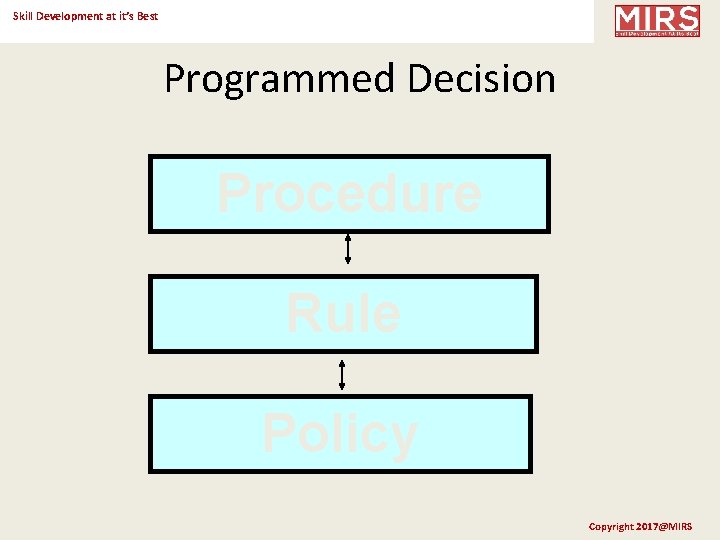
Skill Development at it’s Best Programmed Decision Procedure Rule Policy Copyright 2017@MIRS
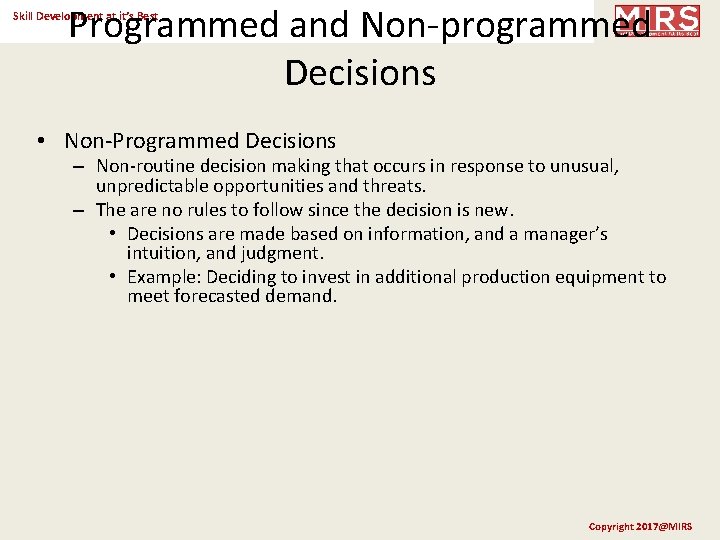
Programmed and Non-programmed Decisions Skill Development at it’s Best • Non-Programmed Decisions – Non-routine decision making that occurs in response to unusual, unpredictable opportunities and threats. – The are no rules to follow since the decision is new. • Decisions are made based on information, and a manager’s intuition, and judgment. • Example: Deciding to invest in additional production equipment to meet forecasted demand. Copyright 2017@MIRS
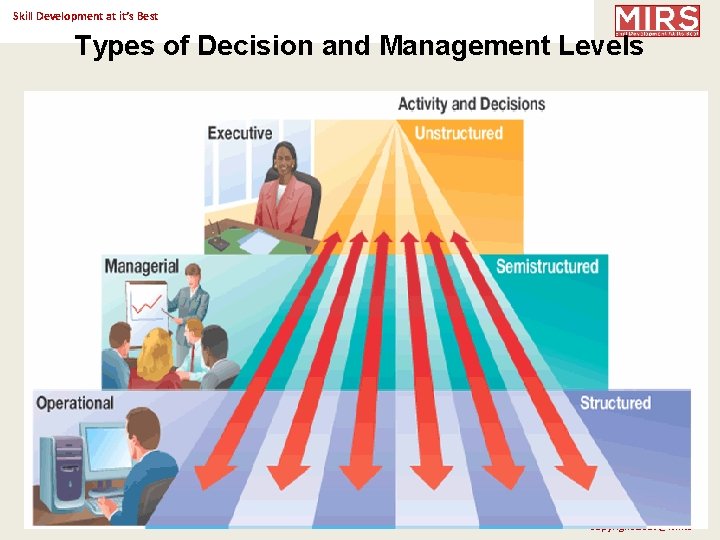
Skill Development at it’s Best Types of Decision and Management Levels Copyright 2017@MIRS
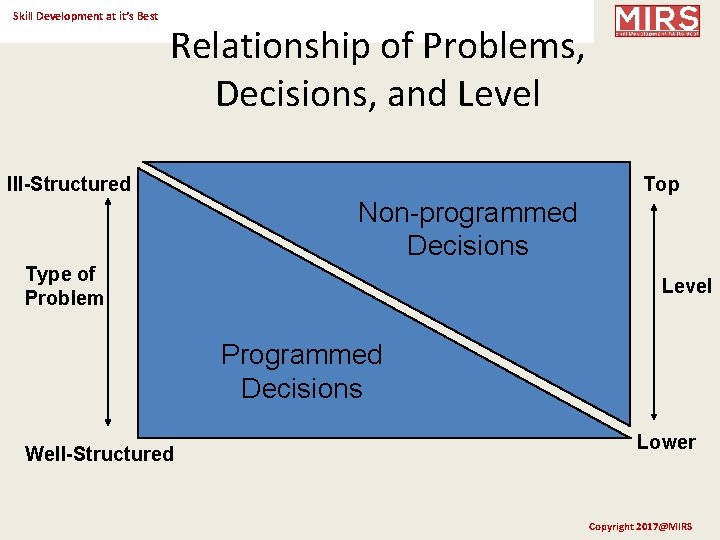
Skill Development at it’s Best Relationship of Problems, Decisions, and Level Ill-Structured Top Non-programmed Decisions Type of Problem Level Programmed Decisions Well-Structured Lower Copyright 2017@MIRS
How can the decision-making process be managed? Skill Development at it’s Best Ø Reasons for decision making failure. – Managers too often copy others’ choices and try to sell them to subordinates. – Managers tend to emphasize problems and solutions rather than successful implementation. – Managers use participation too infrequently. Copyright 2017@MIRS
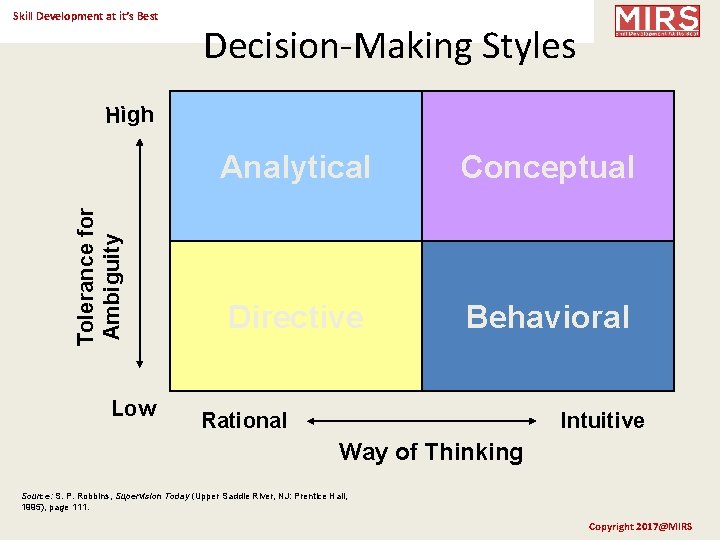
Skill Development at it’s Best Decision-Making Styles Tolerance for Ambiguity High Low Analytical Conceptual Directive Behavioral Rational Intuitive Way of Thinking Source: S. P. Robbins, Supervision Today (Upper Saddle River, NJ: Prentice Hall, 1995), page 111. Copyright 2017@MIRS
Skill Development at it’s Best Decision-Making and National Culture • Differs from one country to another • Need to recognize what is acceptable • Managers can expect high payoff if they can accommodate the diversity Copyright 2017@MIRS
- Slides: 40