
Sketching as a Tool for Numerical Linear Algebra

Sketching as a Tool for Numerical Linear Algebra David Woodruff IBM Almaden
Massive data sets Examples § Internet traffic logs § Financial data § etc. Algorithms § Want nearly linear time or less § Usually at the cost of a randomized approximation 2
Regression analysis Regression § Statistical method to study dependencies between variables in the presence of noise. 3
Regression analysis Linear Regression § Statistical method to study linear dependencies between variables in the presence of noise. 4
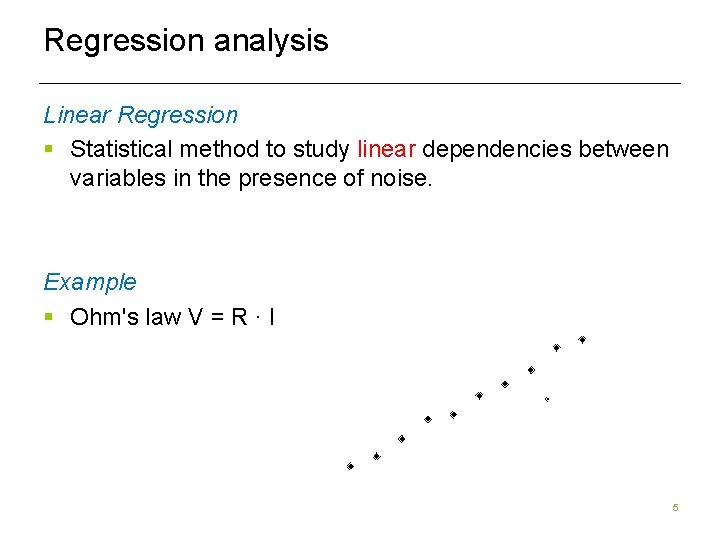
Regression analysis Linear Regression § Statistical method to study linear dependencies between variables in the presence of noise. Example § Ohm's law V = R ∙ I 250 Example Regression 200 150 Example Regression 100 50 0 0 20 40 60 80 100 120 5
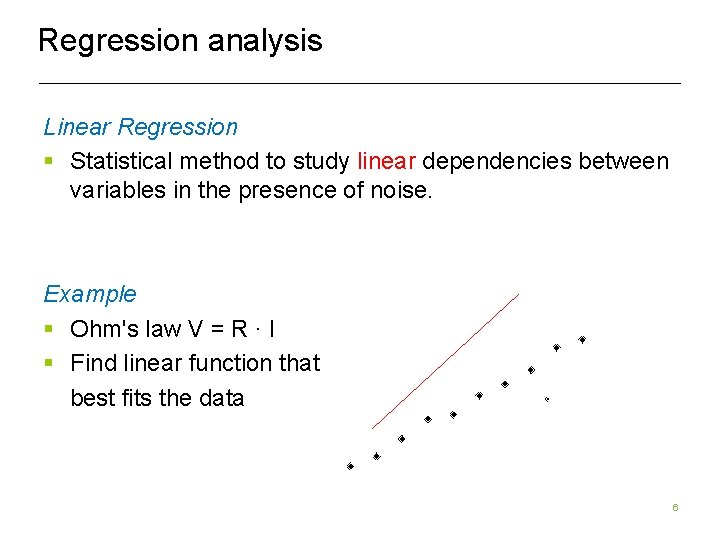
Regression analysis Linear Regression § Statistical method to study linear dependencies between variables in the presence of noise. Example 250 § Ohm's law V = R ∙ I 200 § Find linear function that 150 best fits the data 100 Example Regression 50 0 0 20 40 60 80 100 120 6
Regression analysis Linear Regression § Statistical method to study linear dependencies between variables in the presence of noise. Standard Setting § One measured variable b § A set of predictor variables a 1 , …, ad § Assumption: b = x 0 + a 1 x 1 + … + a d xd + e § e is assumed to be noise and the xi are model parameters we want to learn § Can assume x 0 = 0 § Now consider n observations of b 7
Regression analysis Matrix form Input: n d-matrix A and a vector b=(b 1, …, bn) n is the number of observations; d is the number of predictor variables Output: x* so that Ax* and b are close § Consider the over-constrained case, when n À d § Can assume that A has full column rank 8
Regression analysis Least Squares Method § Find x* that minimizes |Ax-b|22 = S (bi – <Ai*, x>)² § Ai* is i-th row of A § Certain desirable statistical properties Method of least absolute deviation (l 1 -regression) § Find x* that minimizes |Ax-b|1 = S |bi – <Ai*, x>| § Cost is less sensitive to outliers than least squares 9
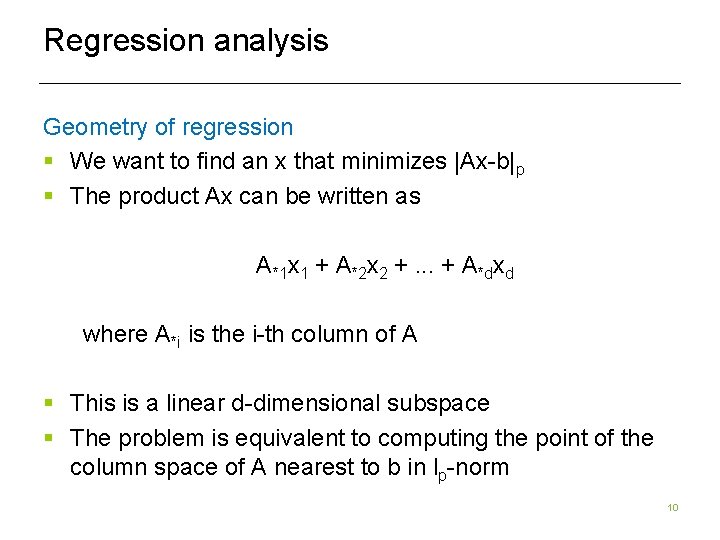
Regression analysis Geometry of regression § We want to find an x that minimizes |Ax-b|p § The product Ax can be written as A*1 x 1 + A*2 x 2 +. . . + A*dxd where A*i is the i-th column of A § This is a linear d-dimensional subspace § The problem is equivalent to computing the point of the column space of A nearest to b in lp-norm 10
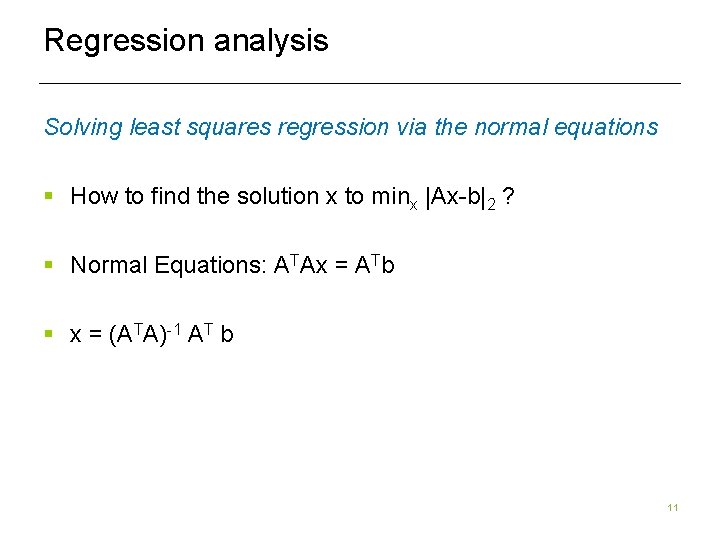
Regression analysis Solving least squares regression via the normal equations § How to find the solution x to minx |Ax-b|2 ? § Normal Equations: ATAx = ATb § x = (ATA)-1 AT b 11
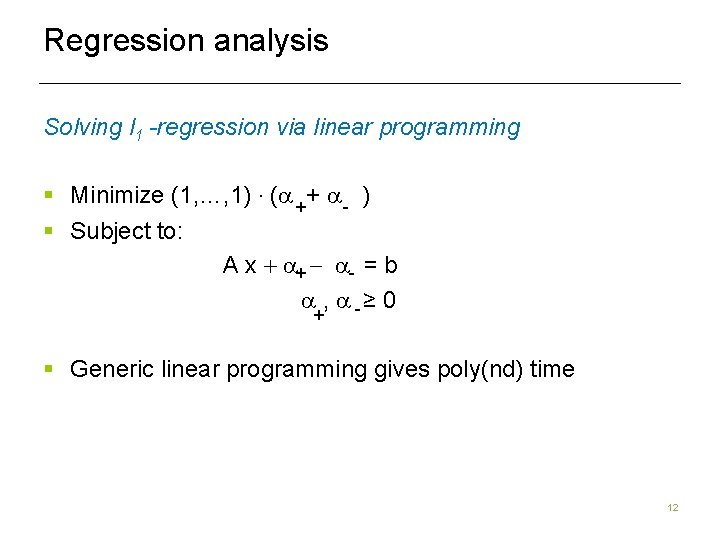
Regression analysis Solving l 1 -regression via linear programming § Minimize (1, …, 1) ∙ (a ++ a - ) § Subject to: A x + a+ - a- = b a , a -≥ 0 + § Generic linear programming gives poly(nd) time 12
Talk Outline § Sketching to speed up Least Squares Regression § Sketching to speed up Least Absolute Deviation (l 1) Regression § Sketching to speed up Low Rank Approximation 13
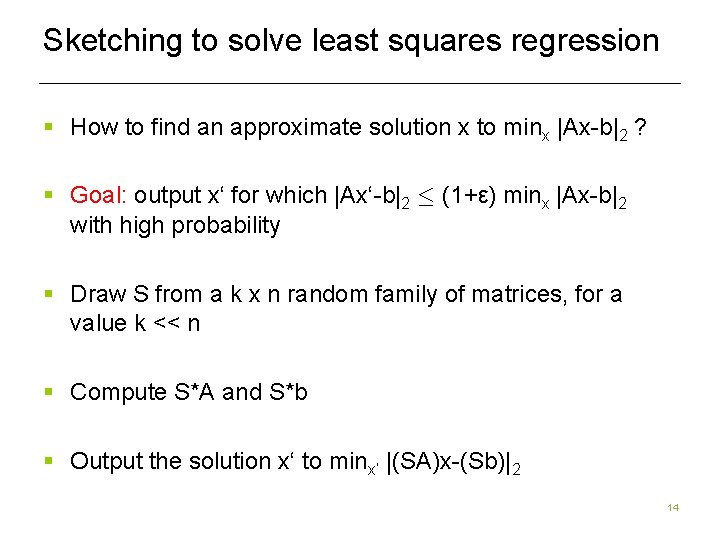
Sketching to solve least squares regression § How to find an approximate solution x to minx |Ax-b|2 ? § Goal: output x‘ for which |Ax‘-b|2 · (1+ε) minx |Ax-b|2 with high probability § Draw S from a k x n random family of matrices, for a value k << n § Compute S*A and S*b § Output the solution x‘ to minx‘ |(SA)x-(Sb)|2 14
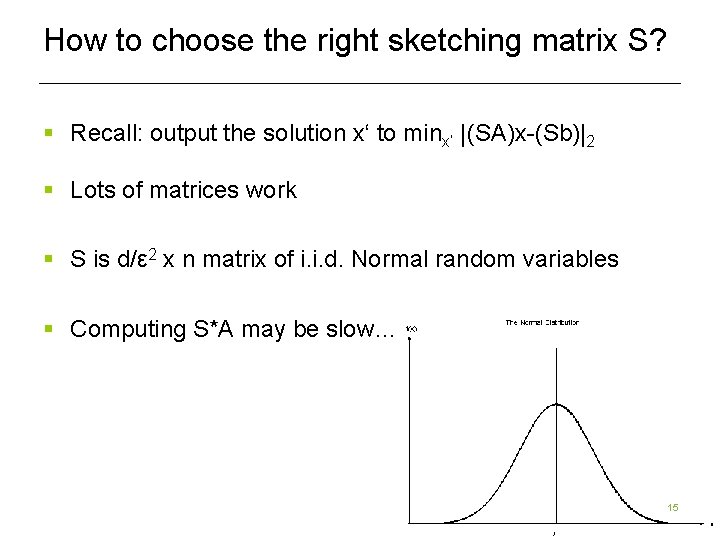
How to choose the right sketching matrix S? § Recall: output the solution x‘ to minx‘ |(SA)x-(Sb)|2 § Lots of matrices work § S is d/ε 2 x n matrix of i. i. d. Normal random variables § Computing S*A may be slow… 15
How to choose the right sketching matrix S? [S] § S is a Johnson Lindenstrauss Transform § S = P*H*D § D is a diagonal matrix with +1, -1 on diagonals § H is the Hadamard transform § P just chooses a random (small) subset of rows of H*D § S*A can be computed much faster 16
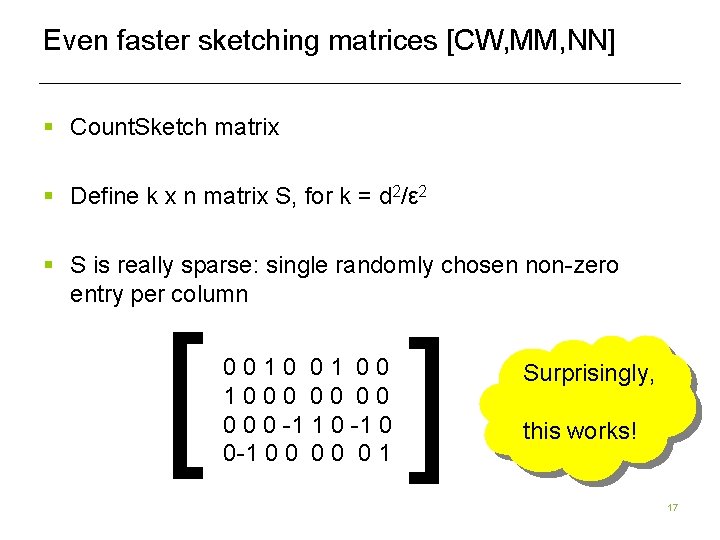
Even faster sketching matrices [CW, MM, NN] § Count. Sketch matrix § Define k x n matrix S, for k = d 2/ε 2 § S is really sparse: single randomly chosen non-zero entry per column [ [ 0010 01 00 1000 00 00 0 -1 1 0 -1 0 0 0 0 0 1 Surprisingly, this works! 17
Talk Outline § Sketching to speed up Least Squares Regression § Sketching to speed up Least Absolute Deviation (l 1) Regression § Sketching to speed up Low Rank Approximation 18
Sketching to solve l 1 -regression § How to find an approximate solution x to minx |Ax-b|1 ? § Goal: output x‘ for which |Ax‘-b|1 · (1+ε) minx |Ax-b|1 with high probability § Natural attempt: Draw S from a k x n random family of matrices, for a value k << n § Compute S*A and S*b § Output the solution x‘ to minx‘ |(SA)x-(Sb)|1 § Turns out this does not work! 19
Sketching to solve l 1 -regression [SW] § Why doesn’t outputting the solution x‘ to minx‘ |(SA)x -(Sb)|1 work? § Don‘t know of k x n matrices S with small k for which if x‘ is solution to minx |(SA)x-(Sb)|1 then |Ax‘-b|1 · (1+ε) minx |Ax-b|1 with high probability § Instead: can find an S so that |Ax‘-b|1 · (d log d) minx |Ax-b|1 § S is a matrix of i. i. d. Cauchy random variables 20
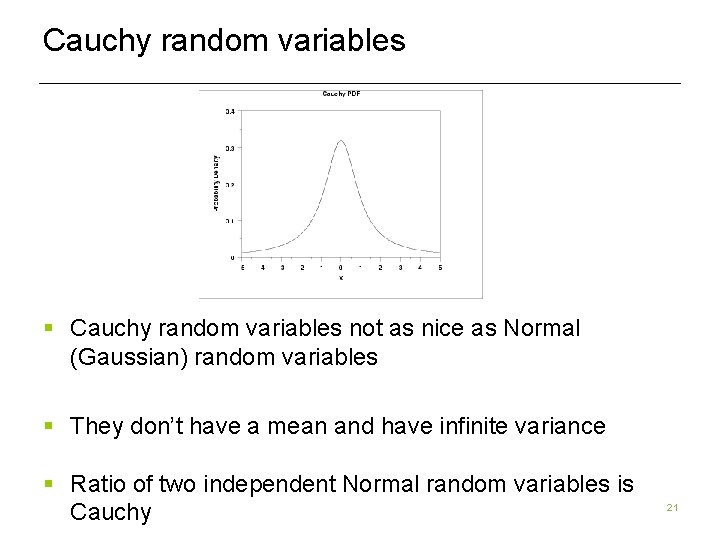
Cauchy random variables § Cauchy random variables not as nice as Normal (Gaussian) random variables § They don’t have a mean and have infinite variance § Ratio of two independent Normal random variables is Cauchy 21
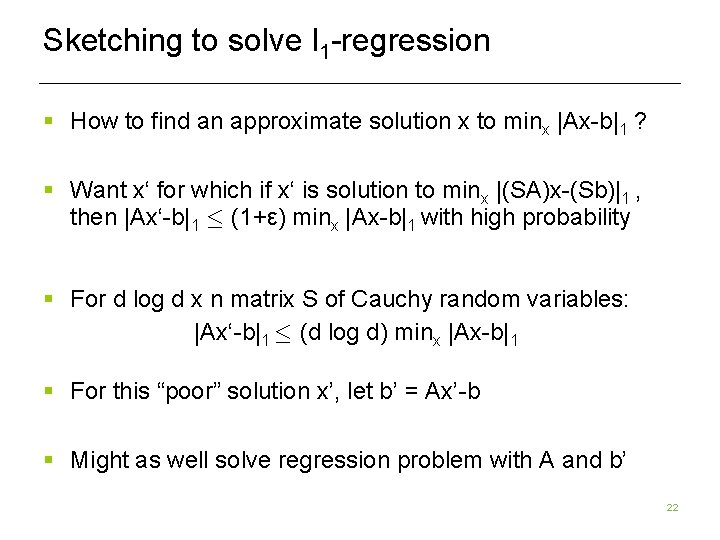
Sketching to solve l 1 -regression § How to find an approximate solution x to minx |Ax-b|1 ? § Want x‘ for which if x‘ is solution to minx |(SA)x-(Sb)|1 , then |Ax‘-b|1 · (1+ε) minx |Ax-b|1 with high probability § For d log d x n matrix S of Cauchy random variables: |Ax‘-b|1 · (d log d) minx |Ax-b|1 § For this “poor” solution x’, let b’ = Ax’-b § Might as well solve regression problem with A and b’ 22
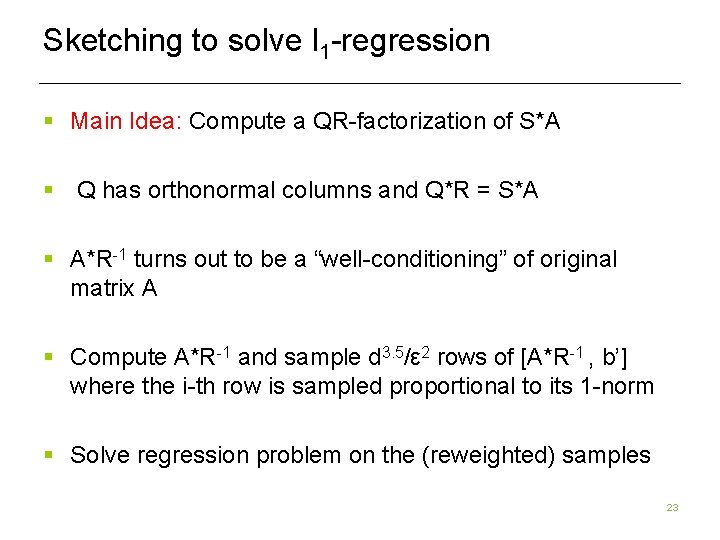
Sketching to solve l 1 -regression § Main Idea: Compute a QR-factorization of S*A § Q has orthonormal columns and Q*R = S*A § A*R-1 turns out to be a “well-conditioning” of original matrix A § Compute A*R-1 and sample d 3. 5/ε 2 rows of [A*R-1 , b’] where the i-th row is sampled proportional to its 1 -norm § Solve regression problem on the (reweighted) samples 23
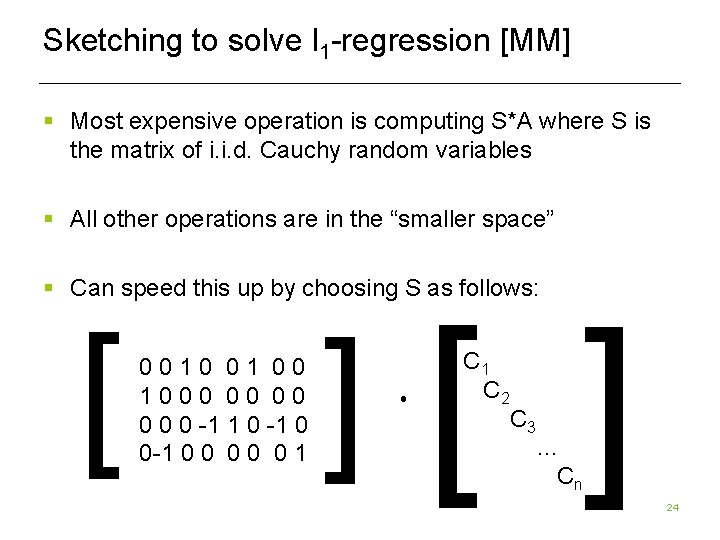
Sketching to solve l 1 -regression [MM] § Most expensive operation is computing S*A where S is the matrix of i. i. d. Cauchy random variables § All other operations are in the “smaller space” § Can speed this up by choosing S as follows: ¢ [ C 1 C 2 C 3 [ [ [ 0010 01 00 1000 00 00 0 -1 1 0 -1 0 0 0 0 0 1 … Cn 24
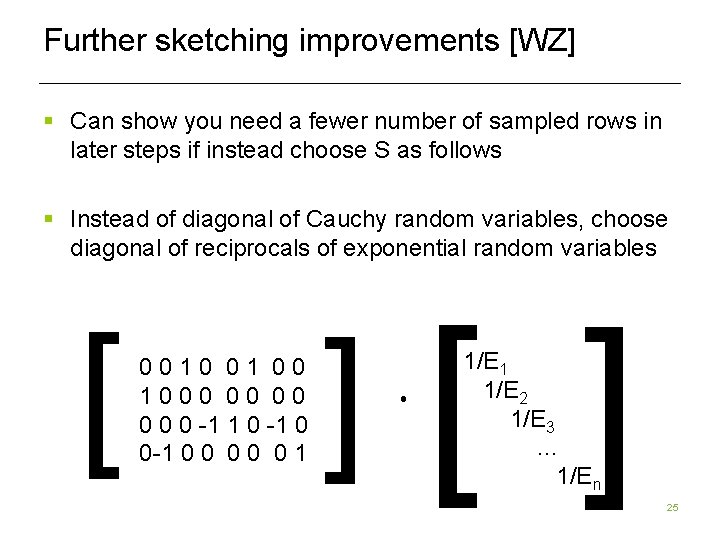
Further sketching improvements [WZ] § Can show you need a fewer number of sampled rows in later steps if instead choose S as follows § Instead of diagonal of Cauchy random variables, choose diagonal of reciprocals of exponential random variables ¢ [ [ 0010 01 00 1000 00 00 0 -1 1 0 -1 0 0 0 0 0 1 1/E 2 1/E 3 … 1/En 25
Talk Outline § Sketching to speed up Least Squares Regression § Sketching to speed up Least Absolute Deviation (l 1) Regression § Sketching to speed up Low Rank Approximation 26
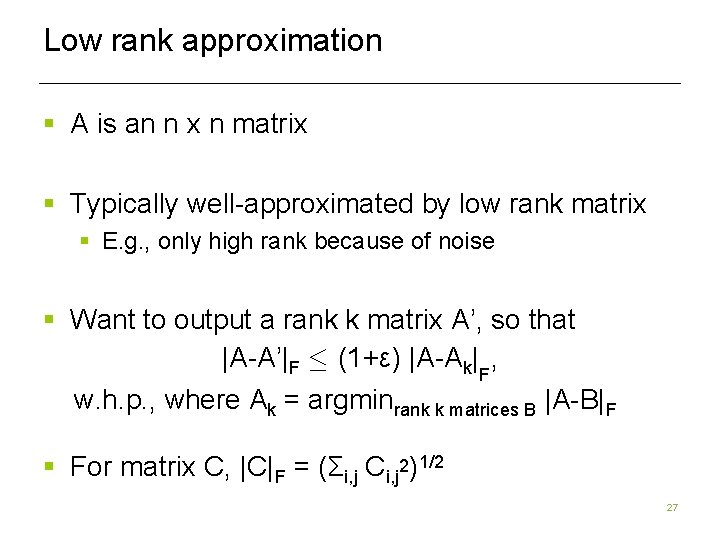
Low rank approximation § A is an n x n matrix § Typically well-approximated by low rank matrix § E. g. , only high rank because of noise § Want to output a rank k matrix A’, so that |A-A’|F · (1+ε) |A-Ak|F, w. h. p. , where Ak = argminrank k matrices B |A-B|F § For matrix C, |C|F = (Σi, j Ci, j 2)1/2 27
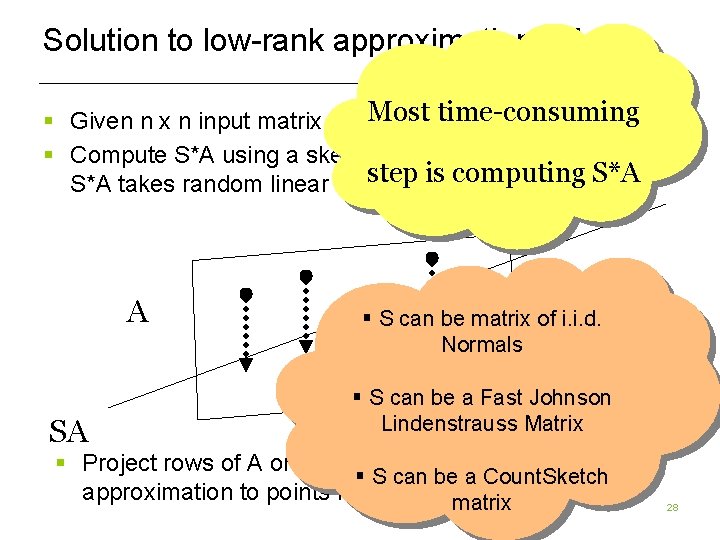
Solution to low-rank approximation [S] § Given n x n input matrix A Most time-consuming § Compute S*A using a sketching matrix S with k << n rows. step is computing S*A takes random linear combinations of rows of S*A A A SA § S can be matrix of i. i. d. Normals § S can be a Fast Johnson Lindenstrauss Matrix § Project rows of A onto SA, then find best rank-k § S can be a Count. Sketch approximation to points inside of SA. matrix 28
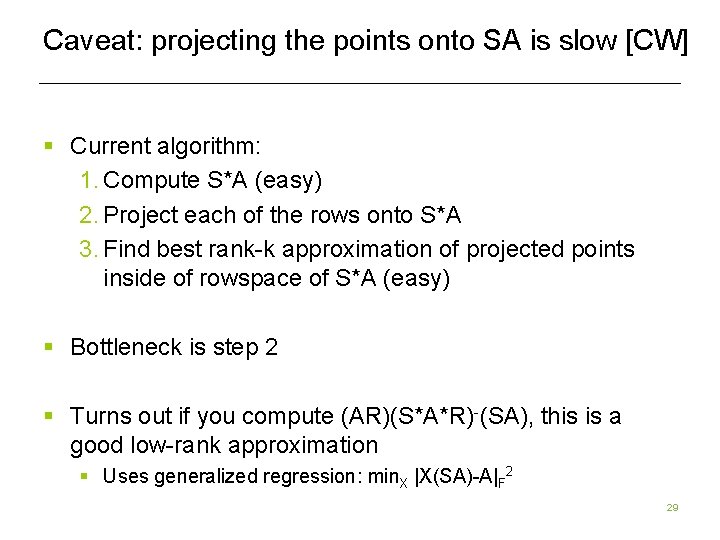
Caveat: projecting the points onto SA is slow [CW] § Current algorithm: 1. Compute S*A (easy) 2. Project each of the rows onto S*A 3. Find best rank-k approximation of projected points inside of rowspace of S*A (easy) § Bottleneck is step 2 § Turns out if you compute (AR)(S*A*R)-(SA), this is a good low-rank approximation § Uses generalized regression: min. X |X(SA)-A|F 2 29
Conclusion § Gave fast sketching-based algorithms for numerical linear algebra problems § Least Squares Regression § Least Absolute Deviation (l 1) Regression § Low Rank Approximation § Sketching also provides “dimensionality reduction” § Communication-efficient solutions for these problems 30
- Slides: 30