
SKEPPENDE KUNSTE GR 9 KWARTAAL 1 CREATIVE ARTS
- Slides: 25
SKEPPENDE KUNSTE GR 9 KWARTAAL 1
CREATIVE ARTS GR 9 TERM 1
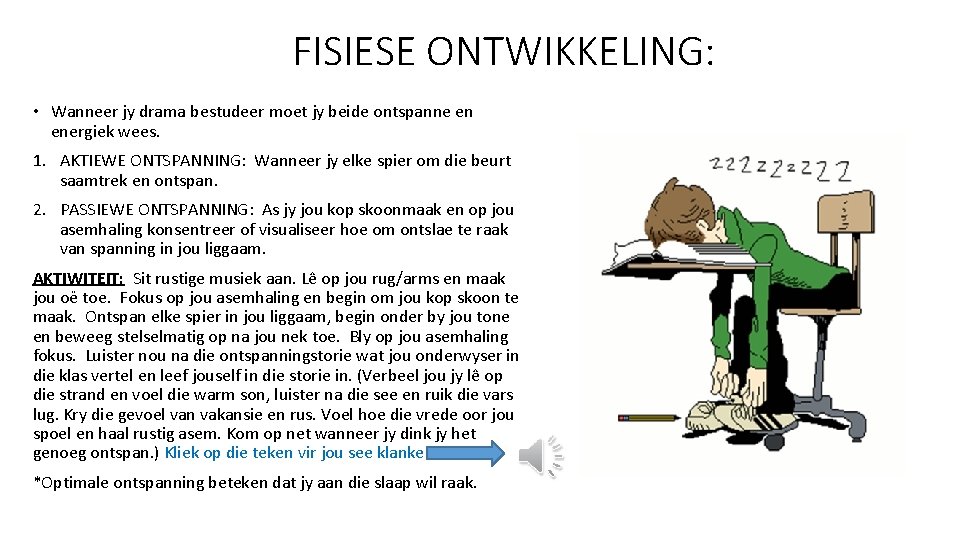
FISIESE ONTWIKKELING: • Wanneer jy drama bestudeer moet jy beide ontspanne en energiek wees. 1. AKTIEWE ONTSPANNING: Wanneer jy elke spier om die beurt saamtrek en ontspan. 2. PASSIEWE ONTSPANNING: As jy jou kop skoonmaak en op jou asemhaling konsentreer of visualiseer hoe om ontslae te raak van spanning in jou liggaam. AKTIWITEIT: Sit rustige musiek aan. Lê op jou rug/arms en maak jou oë toe. Fokus op jou asemhaling en begin om jou kop skoon te maak. Ontspan elke spier in jou liggaam, begin onder by jou tone en beweeg stelselmatig op na jou nek toe. Bly op jou asemhaling fokus. Luister nou na die ontspanningstorie wat jou onderwyser in die klas vertel en leef jouself in die storie in. (Verbeel jou jy lê op die strand en voel die warm son, luister na die see en ruik die vars lug. Kry die gevoel van vakansie en rus. Voel hoe die vrede oor jou spoel en haal rustig asem. Kom op net wanneer jy dink jy het genoeg ontspan. ) Kliek op die teken vir jou see klanke *Optimale ontspanning beteken dat jy aan die slaap wil raak.
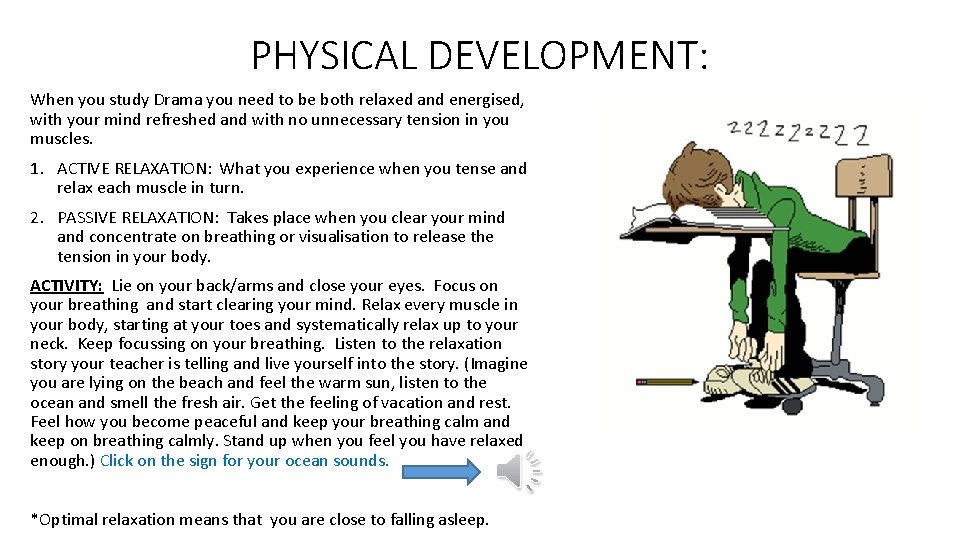
PHYSICAL DEVELOPMENT: When you study Drama you need to be both relaxed and energised, with your mind refreshed and with no unnecessary tension in you muscles. 1. ACTIVE RELAXATION: What you experience when you tense and relax each muscle in turn. 2. PASSIVE RELAXATION: Takes place when you clear your mind and concentrate on breathing or visualisation to release the tension in your body. ACTIVITY: Lie on your back/arms and close your eyes. Focus on your breathing and start clearing your mind. Relax every muscle in your body, starting at your toes and systematically relax up to your neck. Keep focussing on your breathing. Listen to the relaxation story your teacher is telling and live yourself into the story. (Imagine you are lying on the beach and feel the warm sun, listen to the ocean and smell the fresh air. Get the feeling of vacation and rest. Feel how you become peaceful and keep your breathing calm and keep on breathing calmly. Stand up when you feel you have relaxed enough. ) Click on the sign for your ocean sounds. *Optimal relaxation means that you are close to falling asleep.
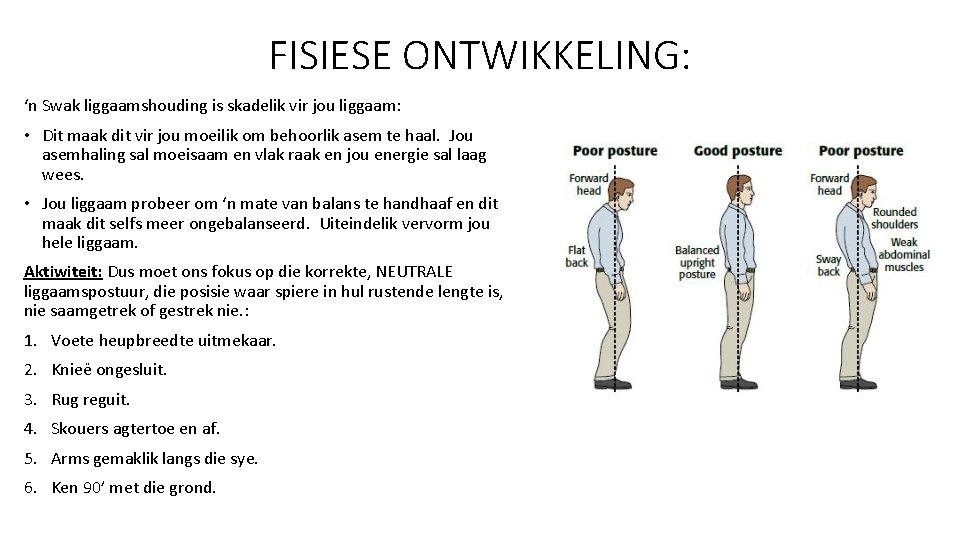
FISIESE ONTWIKKELING: ‘n Swak liggaamshouding is skadelik vir jou liggaam: • Dit maak dit vir jou moeilik om behoorlik asem te haal. Jou asemhaling sal moeisaam en vlak raak en jou energie sal laag wees. • Jou liggaam probeer om ‘n mate van balans te handhaaf en dit maak dit selfs meer ongebalanseerd. Uiteindelik vervorm jou hele liggaam. Aktiwiteit: Dus moet ons fokus op die korrekte, NEUTRALE liggaamspostuur, die posisie waar spiere in hul rustende lengte is, nie saamgetrek of gestrek nie. : 1. Voete heupbreedte uitmekaar. 2. Knieë ongesluit. 3. Rug reguit. 4. Skouers agtertoe en af. 5. Arms gemaklik langs die sye. 6. Ken 90’ met die grond.
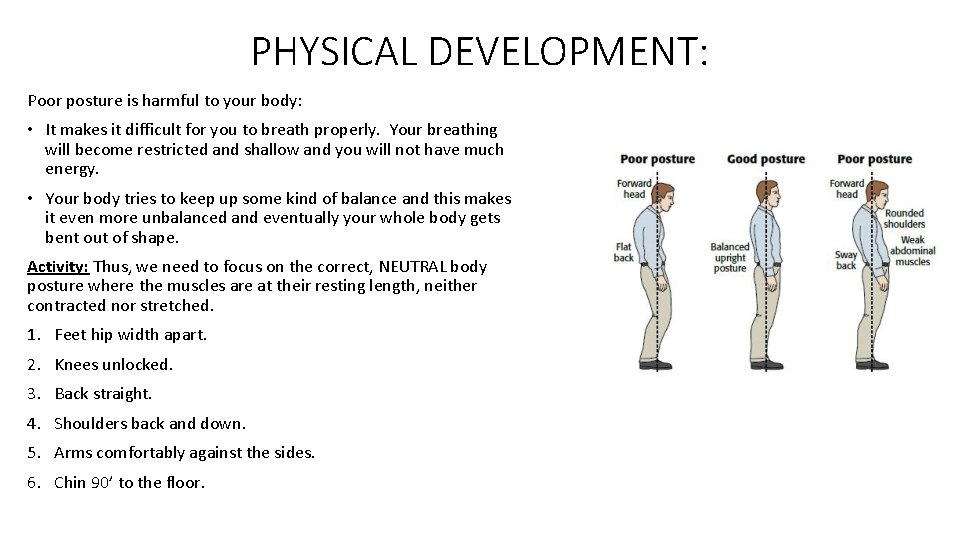
PHYSICAL DEVELOPMENT: Poor posture is harmful to your body: • It makes it difficult for you to breath properly. Your breathing will become restricted and shallow and you will not have much energy. • Your body tries to keep up some kind of balance and this makes it even more unbalanced and eventually your whole body gets bent out of shape. Activity: Thus, we need to focus on the correct, NEUTRAL body posture where the muscles are at their resting length, neither contracted nor stretched. 1. Feet hip width apart. 2. Knees unlocked. 3. Back straight. 4. Shoulders back and down. 5. Arms comfortably against the sides. 6. Chin 90’ to the floor.
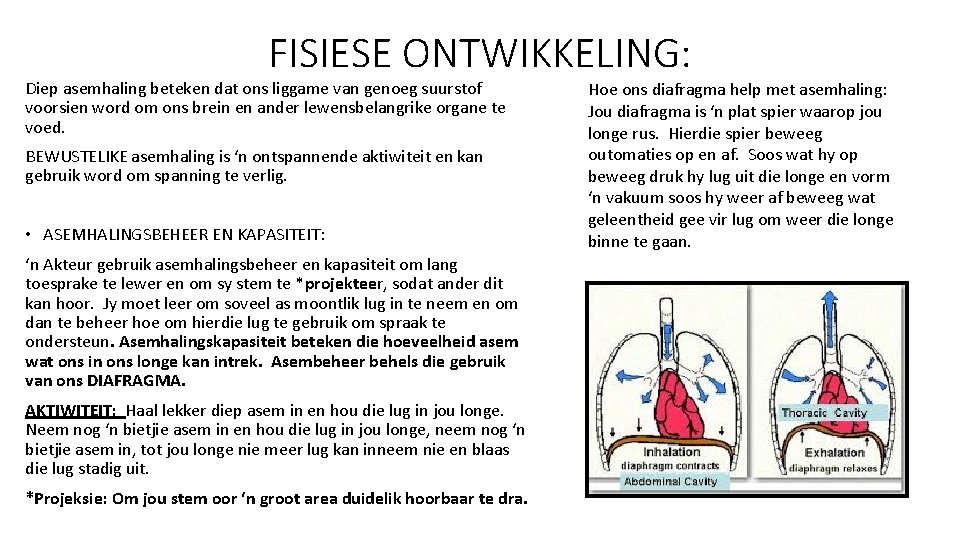
FISIESE ONTWIKKELING: Diep asemhaling beteken dat ons liggame van genoeg suurstof voorsien word om ons brein en ander lewensbelangrike organe te voed. BEWUSTELIKE asemhaling is ‘n ontspannende aktiwiteit en kan gebruik word om spanning te verlig. • ASEMHALINGSBEHEER EN KAPASITEIT: ‘n Akteur gebruik asemhalingsbeheer en kapasiteit om lang toesprake te lewer en om sy stem te *projekteer, sodat ander dit kan hoor. Jy moet leer om soveel as moontlik lug in te neem en om dan te beheer hoe om hierdie lug te gebruik om spraak te ondersteun. Asemhalingskapasiteit beteken die hoeveelheid asem wat ons in ons longe kan intrek. Asembeheer behels die gebruik van ons DIAFRAGMA. AKTIWITEIT: Haal lekker diep asem in en hou die lug in jou longe. Neem nog ‘n bietjie asem in en hou die lug in jou longe, neem nog ‘n bietjie asem in, tot jou longe nie meer lug kan inneem nie en blaas die lug stadig uit. *Projeksie: Om jou stem oor ‘n groot area duidelik hoorbaar te dra. Hoe ons diafragma help met asemhaling: Jou diafragma is ‘n plat spier waarop jou longe rus. Hierdie spier beweeg outomaties op en af. Soos wat hy op beweeg druk hy lug uit die longe en vorm ‘n vakuum soos hy weer af beweeg wat geleentheid gee vir lug om weer die longe binne te gaan.
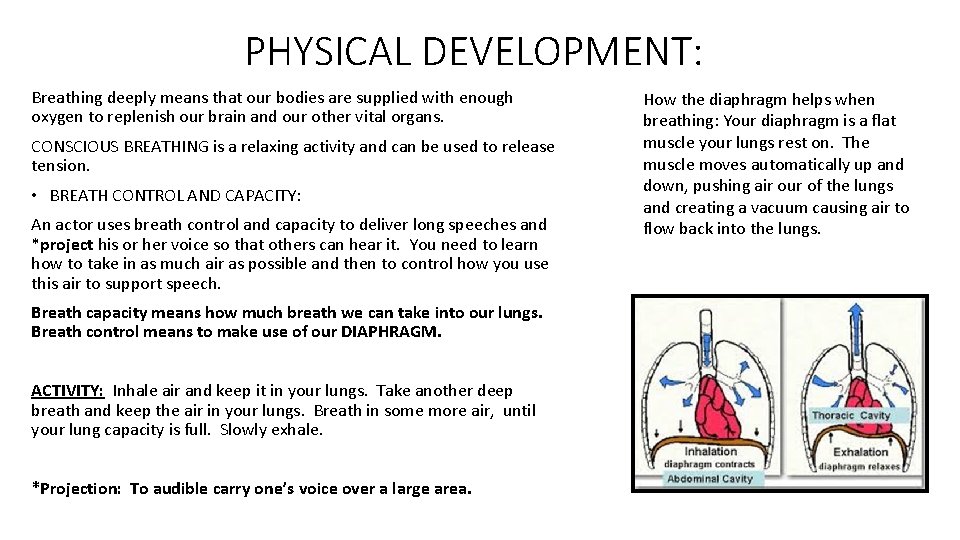
PHYSICAL DEVELOPMENT: Breathing deeply means that our bodies are supplied with enough oxygen to replenish our brain and our other vital organs. CONSCIOUS BREATHING is a relaxing activity and can be used to release tension. • BREATH CONTROL AND CAPACITY: An actor uses breath control and capacity to deliver long speeches and *project his or her voice so that others can hear it. You need to learn how to take in as much air as possible and then to control how you use this air to support speech. Breath capacity means how much breath we can take into our lungs. Breath control means to make use of our DIAPHRAGM. ACTIVITY: Inhale air and keep it in your lungs. Take another deep breath and keep the air in your lungs. Breath in some more air, until your lung capacity is full. Slowly exhale. *Projection: To audible carry one’s voice over a large area. How the diaphragm helps when breathing: Your diaphragm is a flat muscle your lungs rest on. The muscle moves automatically up and down, pushing air our of the lungs and creating a vacuum causing air to flow back into the lungs.
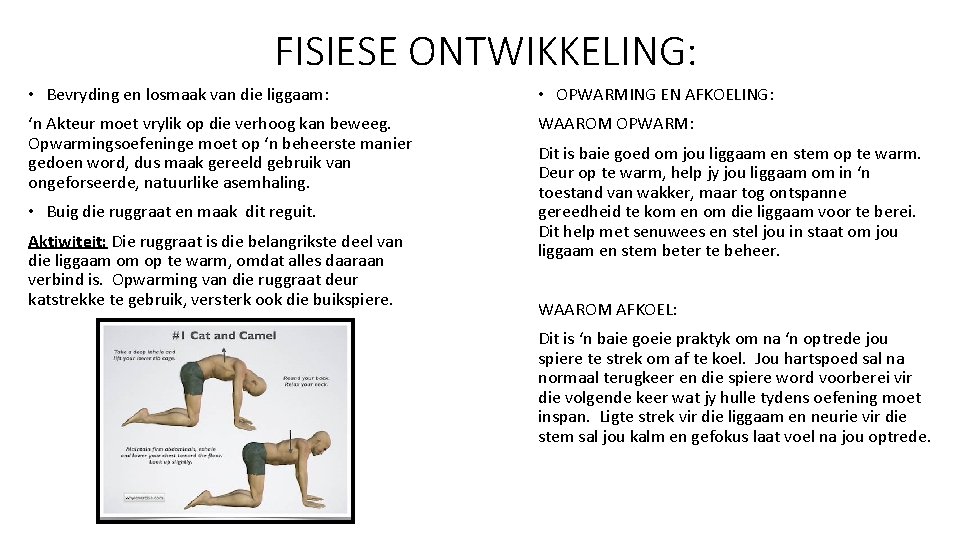
FISIESE ONTWIKKELING: • Bevryding en losmaak van die liggaam: • OPWARMING EN AFKOELING: ‘n Akteur moet vrylik op die verhoog kan beweeg. Opwarmingsoefeninge moet op ‘n beheerste manier gedoen word, dus maak gereeld gebruik van ongeforseerde, natuurlike asemhaling. WAAROM OPWARM: • Buig die ruggraat en maak dit reguit. Aktiwiteit: Die ruggraat is die belangrikste deel van die liggaam om op te warm, omdat alles daaraan verbind is. Opwarming van die ruggraat deur katstrekke te gebruik, versterk ook die buikspiere. Dit is baie goed om jou liggaam en stem op te warm. Deur op te warm, help jy jou liggaam om in ‘n toestand van wakker, maar tog ontspanne gereedheid te kom en om die liggaam voor te berei. Dit help met senuwees en stel jou in staat om jou liggaam en stem beter te beheer. WAAROM AFKOEL: Dit is ‘n baie goeie praktyk om na ‘n optrede jou spiere te strek om af te koel. Jou hartspoed sal na normaal terugkeer en die spiere word voorberei vir die volgende keer wat jy hulle tydens oefening moet inspan. Ligte strek vir die liggaam en neurie vir die stem sal jou kalm en gefokus laat voel na jou optrede.
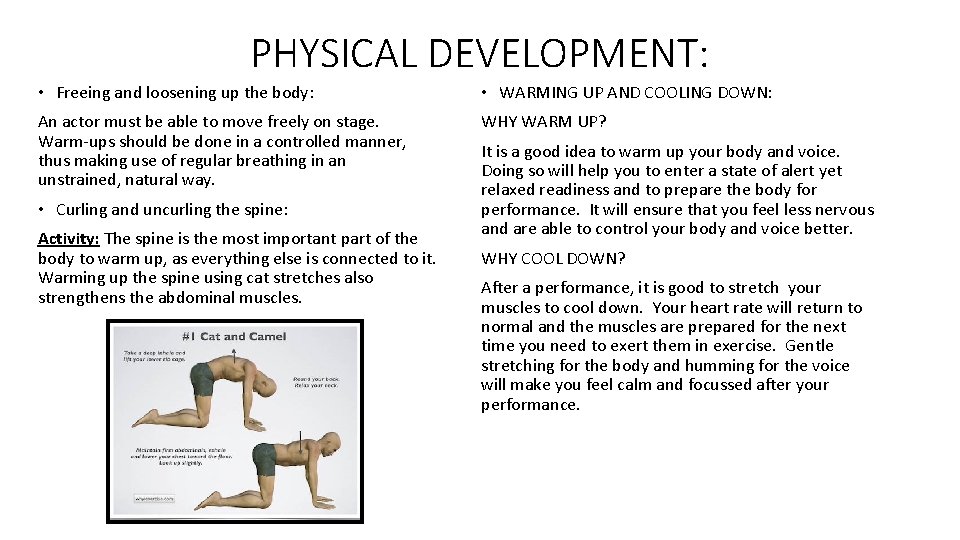
PHYSICAL DEVELOPMENT: • Freeing and loosening up the body: • WARMING UP AND COOLING DOWN: An actor must be able to move freely on stage. Warm-ups should be done in a controlled manner, thus making use of regular breathing in an unstrained, natural way. WHY WARM UP? • Curling and uncurling the spine: Activity: The spine is the most important part of the body to warm up, as everything else is connected to it. Warming up the spine using cat stretches also strengthens the abdominal muscles. It is a good idea to warm up your body and voice. Doing so will help you to enter a state of alert yet relaxed readiness and to prepare the body for performance. It will ensure that you feel less nervous and are able to control your body and voice better. WHY COOL DOWN? After a performance, it is good to stretch your muscles to cool down. Your heart rate will return to normal and the muscles are prepared for the next time you need to exert them in exercise. Gentle stretching for the body and humming for the voice will make you feel calm and focussed after your performance.
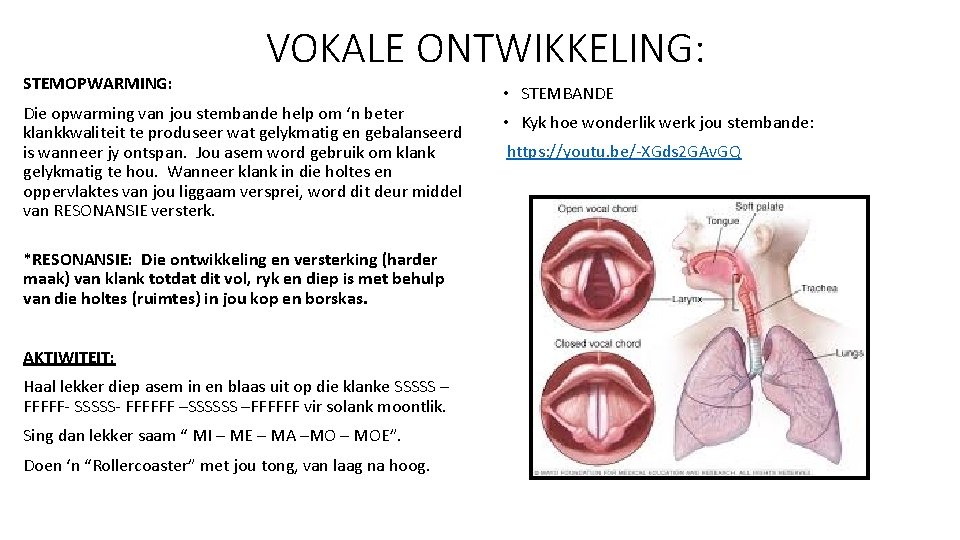
STEMOPWARMING: VOKALE ONTWIKKELING: Die opwarming van jou stembande help om ‘n beter klankkwaliteit te produseer wat gelykmatig en gebalanseerd is wanneer jy ontspan. Jou asem word gebruik om klank gelykmatig te hou. Wanneer klank in die holtes en oppervlaktes van jou liggaam versprei, word dit deur middel van RESONANSIE versterk. *RESONANSIE: Die ontwikkeling en versterking (harder maak) van klank totdat dit vol, ryk en diep is met behulp van die holtes (ruimtes) in jou kop en borskas. AKTIWITEIT: Haal lekker diep asem in en blaas uit op die klanke SSSSS – FFFFF- SSSSS- FFFFFF –SSSSSS –FFFFFF vir solank moontlik. Sing dan lekker saam “ MI – ME – MA –MO – MOE”. Doen ‘n “Rollercoaster” met jou tong, van laag na hoog. • STEMBANDE • Kyk hoe wonderlik werk jou stembande: https: //youtu. be/-XGds 2 GAv. GQ
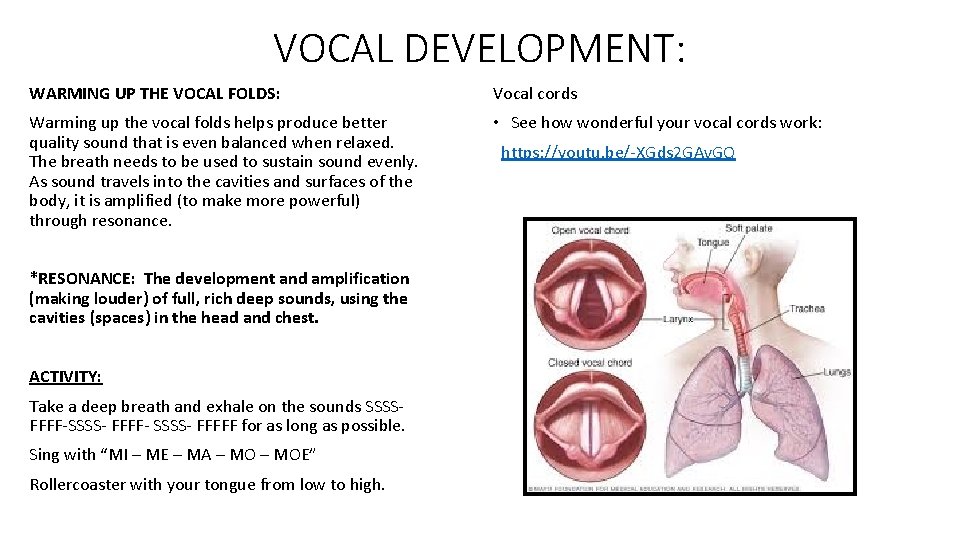
VOCAL DEVELOPMENT: WARMING UP THE VOCAL FOLDS: Vocal cords Warming up the vocal folds helps produce better quality sound that is even balanced when relaxed. The breath needs to be used to sustain sound evenly. As sound travels into the cavities and surfaces of the body, it is amplified (to make more powerful) through resonance. • See how wonderful your vocal cords work: *RESONANCE: The development and amplification (making louder) of full, rich deep sounds, using the cavities (spaces) in the head and chest. ACTIVITY: Take a deep breath and exhale on the sounds SSSSFFFF-SSSS- FFFF- SSSS- FFFFF for as long as possible. Sing with “MI – ME – MA – MOE” Rollercoaster with your tongue from low to high. https: //youtu. be/-XGds 2 GAv. GQ
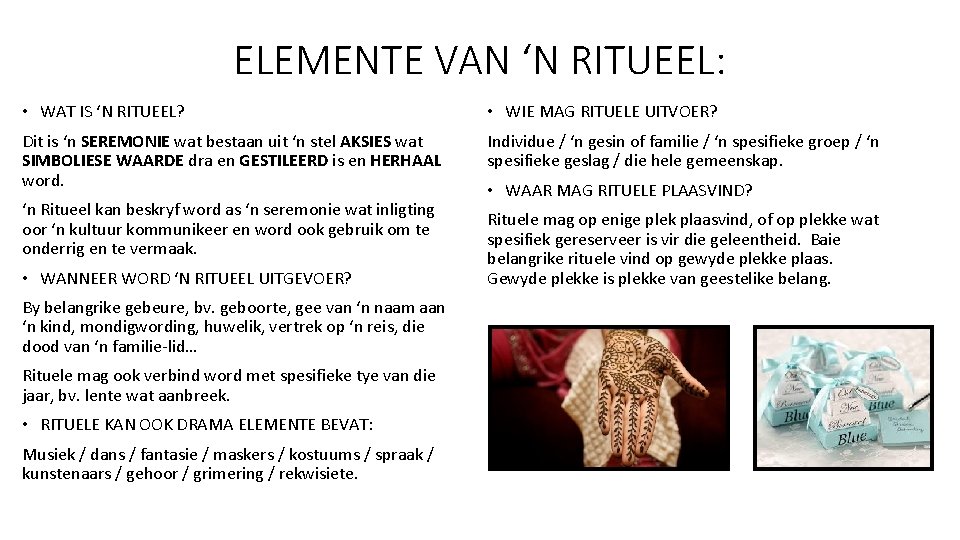
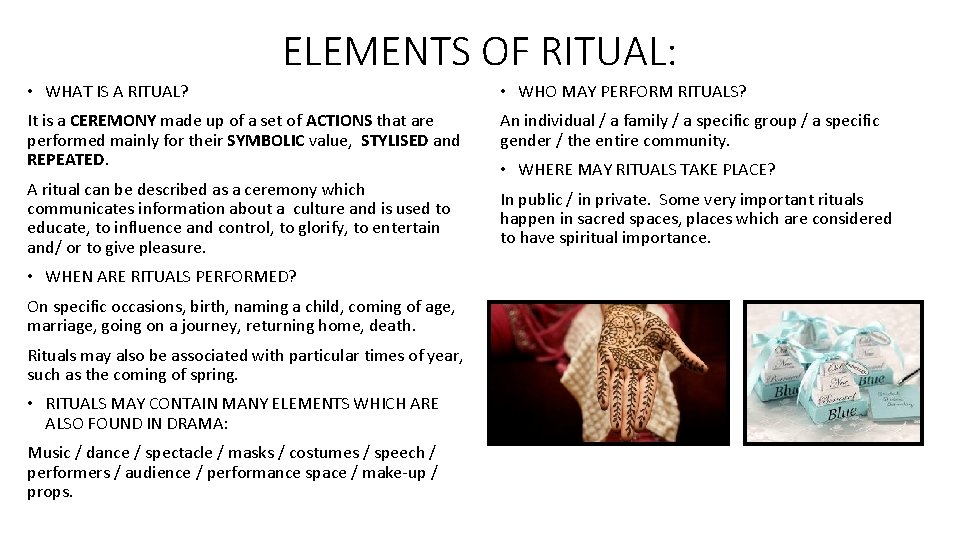
ELEMENTE VAN ‘N RITUEEL: • WAT IS ‘N RITUEEL? • WIE MAG RITUELE UITVOER? Dit is ‘n SEREMONIE wat bestaan uit ‘n stel AKSIES wat SIMBOLIESE WAARDE dra en GESTILEERD is en HERHAAL word. Individue / ‘n gesin of familie / ‘n spesifieke groep / ‘n spesifieke geslag / die hele gemeenskap. ‘n Ritueel kan beskryf word as ‘n seremonie wat inligting oor ‘n kultuur kommunikeer en word ook gebruik om te onderrig en te vermaak. • WANNEER WORD ‘N RITUEEL UITGEVOER? By belangrike gebeure, bv. geboorte, gee van ‘n naam aan ‘n kind, mondigwording, huwelik, vertrek op ‘n reis, die dood van ‘n familie-lid… Rituele mag ook verbind word met spesifieke tye van die jaar, bv. lente wat aanbreek. • RITUELE KAN OOK DRAMA ELEMENTE BEVAT: Musiek / dans / fantasie / maskers / kostuums / spraak / kunstenaars / gehoor / grimering / rekwisiete. • WAAR MAG RITUELE PLAASVIND? Rituele mag op enige plek plaasvind, of op plekke wat spesifiek gereserveer is vir die geleentheid. Baie belangrike rituele vind op gewyde plekke plaas. Gewyde plekke is plekke van geestelike belang.
ELEMENTS OF RITUAL: • WHAT IS A RITUAL? • WHO MAY PERFORM RITUALS? It is a CEREMONY made up of a set of ACTIONS that are performed mainly for their SYMBOLIC value, STYLISED and REPEATED. An individual / a family / a specific group / a specific gender / the entire community. A ritual can be described as a ceremony which communicates information about a culture and is used to educate, to influence and control, to glorify, to entertain and/ or to give pleasure. • WHEN ARE RITUALS PERFORMED? On specific occasions, birth, naming a child, coming of age, marriage, going on a journey, returning home, death. Rituals may also be associated with particular times of year, such as the coming of spring. • RITUALS MAY CONTAIN MANY ELEMENTS WHICH ARE ALSO FOUND IN DRAMA: Music / dance / spectacle / masks / costumes / speech / performers / audience / performance space / make-up / props. • WHERE MAY RITUALS TAKE PLACE? In public / in private. Some very important rituals happen in sacred spaces, places which are considered to have spiritual importance.
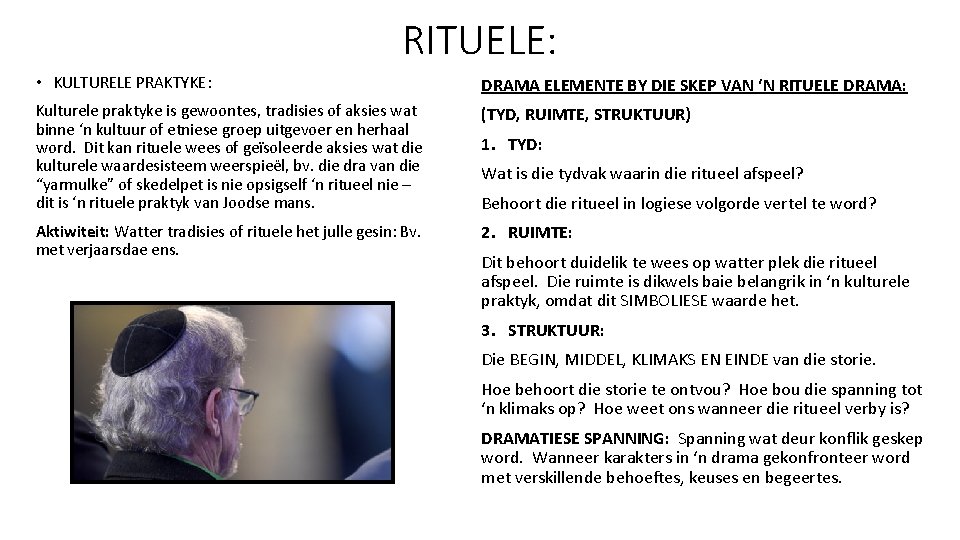
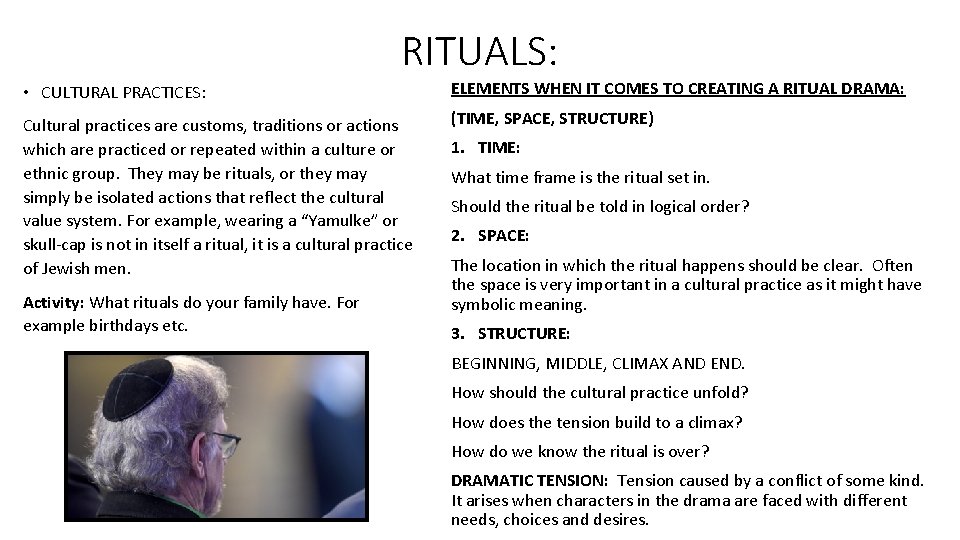
RITUELE: • KULTURELE PRAKTYKE: DRAMA ELEMENTE BY DIE SKEP VAN ‘N RITUELE DRAMA: Kulturele praktyke is gewoontes, tradisies of aksies wat binne ‘n kultuur of etniese groep uitgevoer en herhaal word. Dit kan rituele wees of geïsoleerde aksies wat die kulturele waardesisteem weerspieël, bv. die dra van die “yarmulke” of skedelpet is nie opsigself ‘n ritueel nie – dit is ‘n rituele praktyk van Joodse mans. (TYD, RUIMTE, STRUKTUUR) Aktiwiteit: Watter tradisies of rituele het julle gesin: Bv. met verjaarsdae ens. 2. RUIMTE: 1. TYD: Wat is die tydvak waarin die ritueel afspeel? Behoort die ritueel in logiese volgorde vertel te word? Dit behoort duidelik te wees op watter plek die ritueel afspeel. Die ruimte is dikwels baie belangrik in ‘n kulturele praktyk, omdat dit SIMBOLIESE waarde het. 3. STRUKTUUR: Die BEGIN, MIDDEL, KLIMAKS EN EINDE van die storie. Hoe behoort die storie te ontvou? Hoe bou die spanning tot ‘n klimaks op? Hoe weet ons wanneer die ritueel verby is? DRAMATIESE SPANNING: Spanning wat deur konflik geskep word. Wanneer karakters in ‘n drama gekonfronteer word met verskillende behoeftes, keuses en begeertes.
RITUALS: • CULTURAL PRACTICES: ELEMENTS WHEN IT COMES TO CREATING A RITUAL DRAMA: Cultural practices are customs, traditions or actions which are practiced or repeated within a culture or ethnic group. They may be rituals, or they may simply be isolated actions that reflect the cultural value system. For example, wearing a “Yamulke” or skull-cap is not in itself a ritual, it is a cultural practice of Jewish men. (TIME, SPACE, STRUCTURE) Activity: What rituals do your family have. For example birthdays etc. 1. TIME: What time frame is the ritual set in. Should the ritual be told in logical order? 2. SPACE: The location in which the ritual happens should be clear. Often the space is very important in a cultural practice as it might have symbolic meaning. 3. STRUCTURE: BEGINNING, MIDDLE, CLIMAX AND END. How should the cultural practice unfold? How does the tension build to a climax? How do we know the ritual is over? DRAMATIC TENSION: Tension caused by a conflict of some kind. It arises when characters in the drama are faced with different needs, choices and desires.
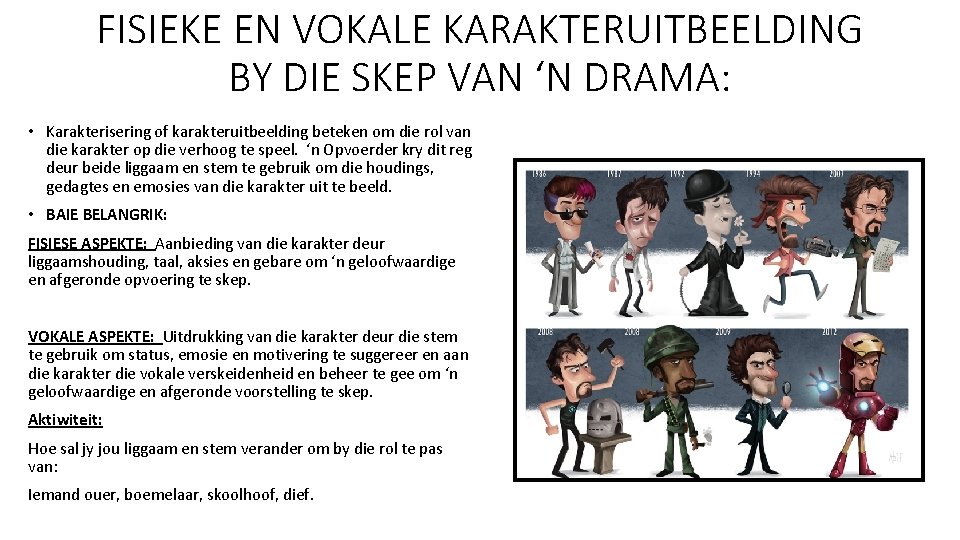
FISIEKE EN VOKALE KARAKTERUITBEELDING BY DIE SKEP VAN ‘N DRAMA: • Karakterisering of karakteruitbeelding beteken om die rol van die karakter op die verhoog te speel. ‘n Opvoerder kry dit reg deur beide liggaam en stem te gebruik om die houdings, gedagtes en emosies van die karakter uit te beeld. • BAIE BELANGRIK: FISIESE ASPEKTE: Aanbieding van die karakter deur liggaamshouding, taal, aksies en gebare om ‘n geloofwaardige en afgeronde opvoering te skep. VOKALE ASPEKTE: Uitdrukking van die karakter deur die stem te gebruik om status, emosie en motivering te suggereer en aan die karakter die vokale verskeidenheid en beheer te gee om ‘n geloofwaardige en afgeronde voorstelling te skep. Aktiwiteit: Hoe sal jy jou liggaam en stem verander om by die rol te pas van: Iemand ouer, boemelaar, skoolhoof, dief.
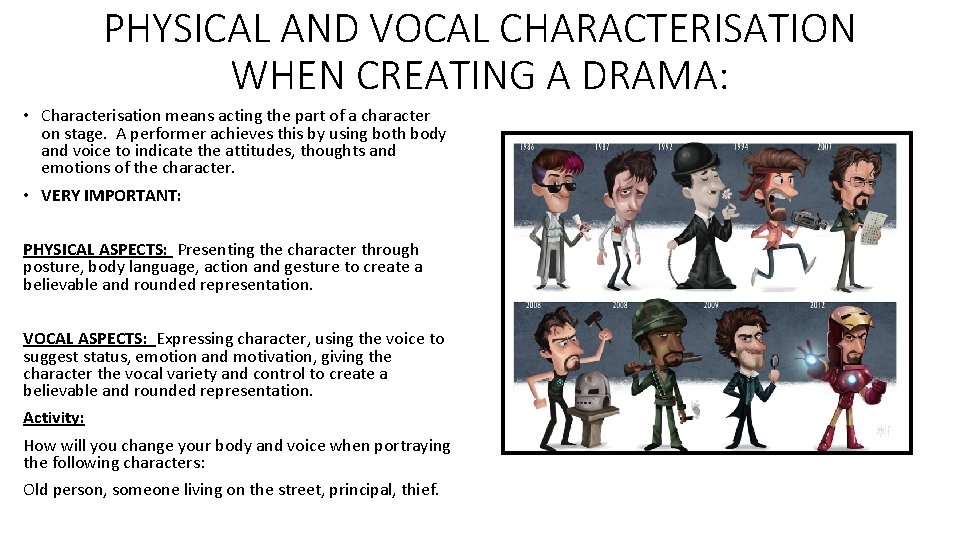
PHYSICAL AND VOCAL CHARACTERISATION WHEN CREATING A DRAMA: • Characterisation means acting the part of a character on stage. A performer achieves this by using both body and voice to indicate the attitudes, thoughts and emotions of the character. • VERY IMPORTANT: PHYSICAL ASPECTS: Presenting the character through posture, body language, action and gesture to create a believable and rounded representation. VOCAL ASPECTS: Expressing character, using the voice to suggest status, emotion and motivation, giving the character the vocal variety and control to create a believable and rounded representation. Activity: How will you change your body and voice when portraying the following characters: Old person, someone living on the street, principal, thief.
TIPES MEDIA: Ongeag watter vorm van media gebruik word, dit dra altyd ‘n boodskap van een persoon of groep oor na ‘n ander. Ons moet bewus wees wie aan ons die boodskap vertel. Elke media het beide positiewe en negatiewe invloede. Terwyl hulle gebruik word om inligting oor te dra, kan hulle ook gebruik word om die gehoor te beïnvloed of te manipuleer. 1. KOERANTE: Dit is een van die oudste vorms van media. Hulle word reeds vir eeue gebruik om te rapporteur en kommentaar op huidige sake te lewer. Hulle is die afgelope paar jaar deur die groei van die internet bedreig. Koerante is egter steeds belangrik vir diegene wat nie toegang het tot meer moderne media nie. 2. RADIO: Radio kan tot-op-die-minuut toegang tot nuus en vermaak bied. Dit kan verafgeleë plekke bereik. 3. TELEVISIE: Hierdie medium het in die laaste paar jaar baie meer geredelik beskikbaar geraak en is nou die hoofbron van nuus en vermaak. Idees kan effektief gekommunikeer word en dit bereik ‘n wye gehoor. Die wyse waarop gebeure op televisie vertoon word, beïnvloed baie mense en daarom is dit ‘n doeltreffende manier om die publiek te manipuleer. 4. DIE INTERNET: Dit is die nuutste tipe medium. Dit is besig om die manier wat ons kommunikeer wêreldwyd radikaal te verander, omdat dit verreikend en onmiddellik is. Dit kan formeel wees, bv. webtuistes wat deur nuuskanale, deur opgeleide verslaggewers beheer word, of informeel wees, bv. individue wat kommentaar lewer oor lewendige aksie wat hulle met hul fone of handtoestelle verfilm en dit dan op die publieke domein laai.
TYPES OF MEDIA: No matter which medium is used, it always carries a message from one person or group to another. We need to be aware of who is telling us the message. Each type of media has both positive and negative influence. Whilst they bring information to people, they can also be used to influence or manipulate the audience. 3. TELEVISION: This medium has become far more readily available in the last few years and is now the main source of news and entertainment. Ideas can be communicated effectively and reach a vast audience. The way events are shown on television influences many people and it is therefore an effective way to manipulate the public. 1. NEWSPAPERS: These are one of the oldest forms of media. They have been used for centuries to report and comment on current affairs. In recent years they have been threatened by the growth of the internet. However, newspapers are still important for those who do not have access to more modern media. 2. RADIO: Radio can give up-to-the-minute access to news and entertainment. It can reach remote places. 4. INTERNET: This is the newest of the media. It is radically changing the way we communicate worldwide, as it is farreaching and immediate. It can be formal, such as websites run by news stations with trained reporters, or informal, such as individuals who comment on live action, filming on their phones or mobile devices and then uploading it into the public domain.
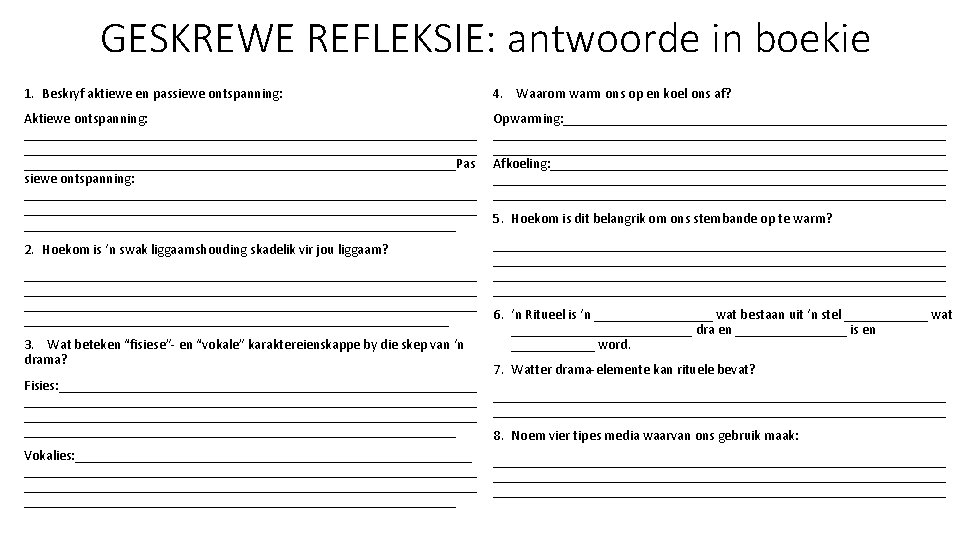
GESKREWE REFLEKSIE: antwoorde in boekie 1. Beskryf aktiewe en passiewe ontspanning: 4. Waarom warm ons op en koel ons af? Aktiewe ontspanning: _________________________________________________________________Pas siewe ontspanning: _________________________________________________________________ Opwarming: ____________________________________________________________ Afkoeling: _____________________________________________________________ 2. Hoekom is ‘n swak liggaamshouding skadelik vir jou liggaam? _________________________________________________________________ _________________________________________________________________ _______________________________ 3. Wat beteken “fisiese”- en “vokale” karaktereienskappe by die skep van ‘n drama? Fisies: _________________________________________________________________ Vokalies: _________________________________________________________________ 5. Hoekom is dit belangrik om ons stembande op te warm? 6. ‘n Ritueel is ‘n _________ wat bestaan uit ‘n stel ______ wat _____________ dra en ________ is en ______ word. 7. Watter drama-elemente kan rituele bevat? _________________________________________________________________ 8. Noem vier tipes media waarvan ons gebruik maak: _________________________________________________________________
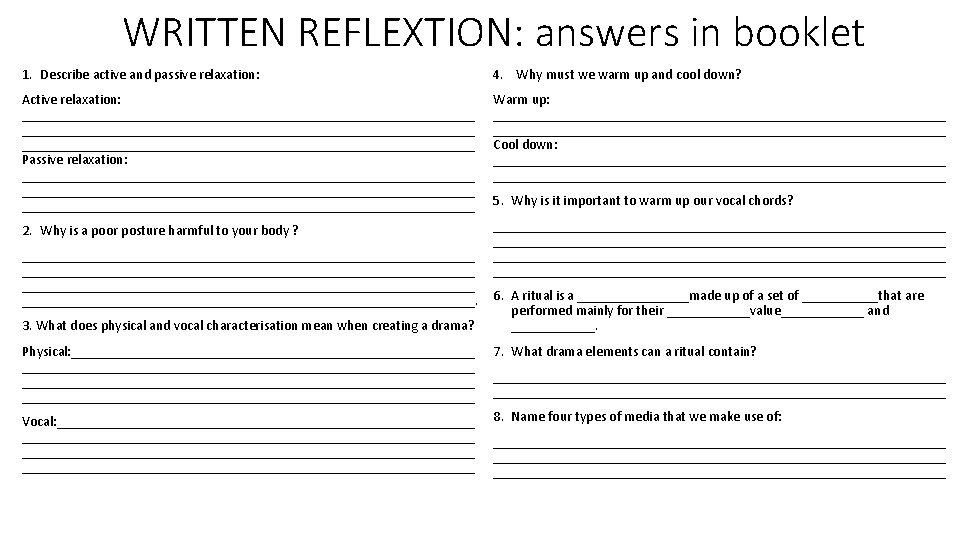
WRITTEN REFLEXTION: answers in booklet 1. Describe active and passive relaxation: 4. Why must we warm up and cool down? Active relaxation: _________________________________________________________________ Passive relaxation: _________________________________________________________________ Warm up: _________________________________________________________________ Cool down: _________________________________________________________________ 2. Why is a poor posture harmful to your body ? _________________________________________________________________ _________________________________________________________________. 3. What does physical and vocal characterisation mean when creating a drama? 5. Why is it important to warm up our vocal chords? 6. A ritual is a ________made up of a set of ______that are performed mainly for their ______value______ and ______. Physical: _________________________________________________________________ 7. What drama elements can a ritual contain? Vocal: _________________________________________________________________ 8. Name four types of media that we make use of: _________________________________________________________________ _________________________________
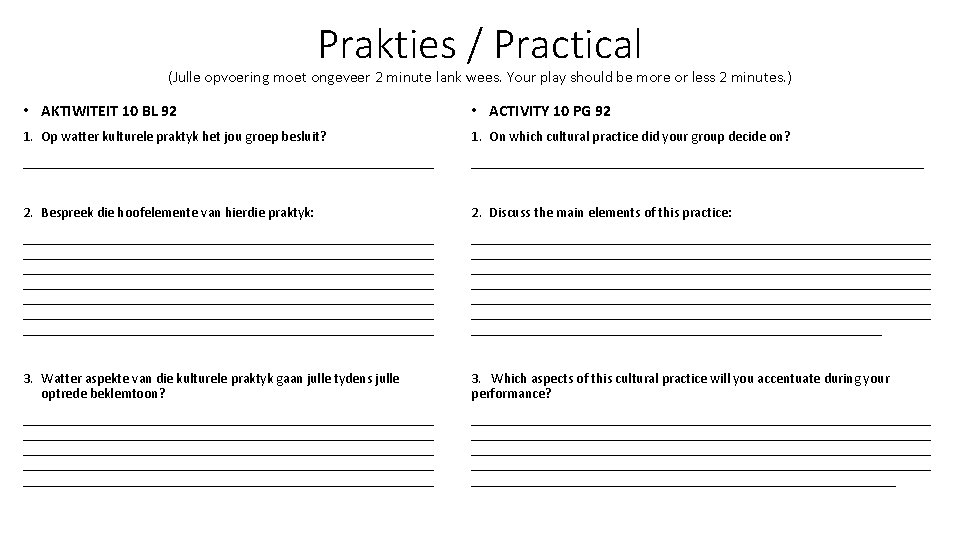
Prakties / Practical (Julle opvoering moet ongeveer 2 minute lank wees. Your play should be more or less 2 minutes. ) • AKTIWITEIT 10 BL 92 • ACTIVITY 10 PG 92 1. Op watter kulturele praktyk het jou groep besluit? 1. On which cultural practice did your group decide on? _________________________________________________________________ 2. Bespreek die hoofelemente van hierdie praktyk: 2. Discuss the main elements of this practice: ___________________________________________________________ ________________________________________________________________________________________________________________________________________________________________________________________ 3. Watter aspekte van die kulturele praktyk gaan julle tydens julle optrede beklemtoon? 3. Which aspects of this cultural practice will you accentuate during your performance? ___________________________________________________________ __________________________________________________________________ _____________________________________________________________
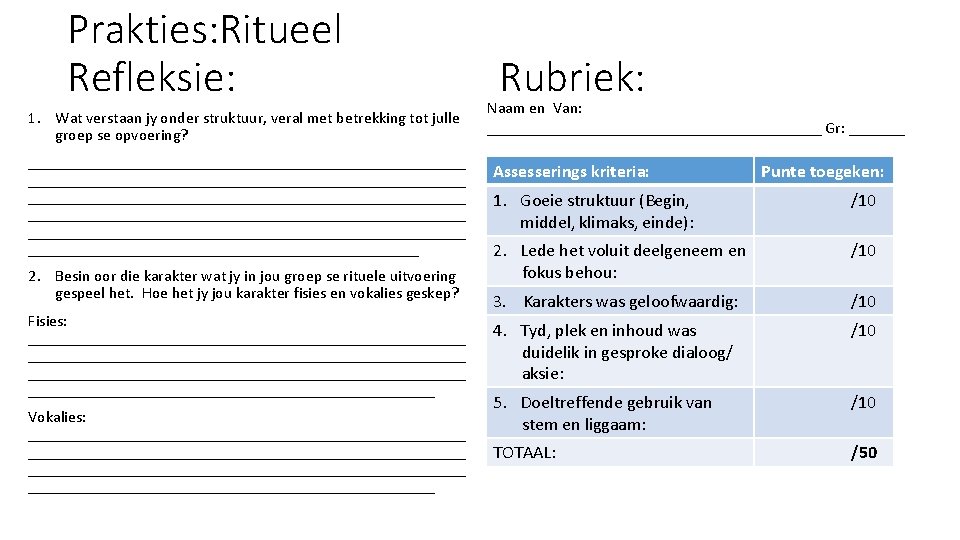
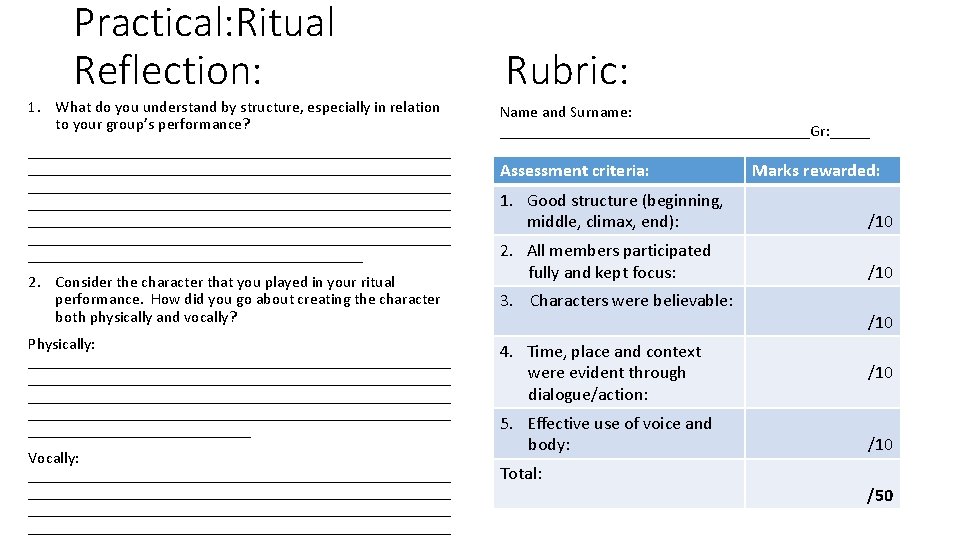
Prakties: Ritueel Refleksie: 1. Wat verstaan jy onder struktuur, veral met betrekking tot julle groep se opvoering? _______________________________________________________ ____________________________ 2. Besin oor die karakter wat jy in jou groep se rituele uitvoering gespeel het. Hoe het jy jou karakter fisies en vokalies geskep? Fisies: _______________________________________________________ __________________________ Vokalies: _______________________________________________________ __________________________ Rubriek: Naam en Van: _____________________ Gr: _______ Assesserings kriteria: Punte toegeken: 1. Goeie struktuur (Begin, middel, klimaks, einde): /10 2. Lede het voluit deelgeneem en fokus behou: /10 3. Karakters was geloofwaardig: /10 4. Tyd, plek en inhoud was duidelik in gesproke dialoog/ aksie: /10 5. Doeltreffende gebruik van stem en liggaam: /10 TOTAAL: /50
Practical: Ritual Reflection: 1. What do you understand by structure, especially in relation to your group’s performance? _____________________________________________________ _____________________________________________________ 2. Consider the character that you played in your ritual performance. How did you go about creating the character both physically and vocally? Physically: _____________________________________________________ ______________ Vocally: _____________________________________________________ Rubric: Name and Surname: ____________________Gr: _____ Assessment criteria: Marks rewarded: 1. Good structure (beginning, middle, climax, end): /10 2. All members participated fully and kept focus: /10 3. Characters were believable: 4. Time, place and context were evident through dialogue/action: 5. Effective use of voice and body: Total: /10 /10 /50