
SKELETON MOVEMENT Your skeleton Supports your body Allows
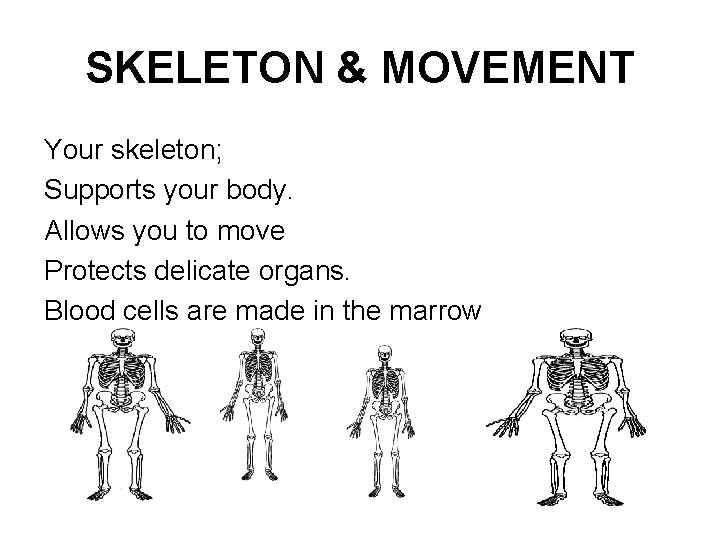
SKELETON & MOVEMENT Your skeleton; Supports your body. Allows you to move Protects delicate organs. Blood cells are made in the marrow
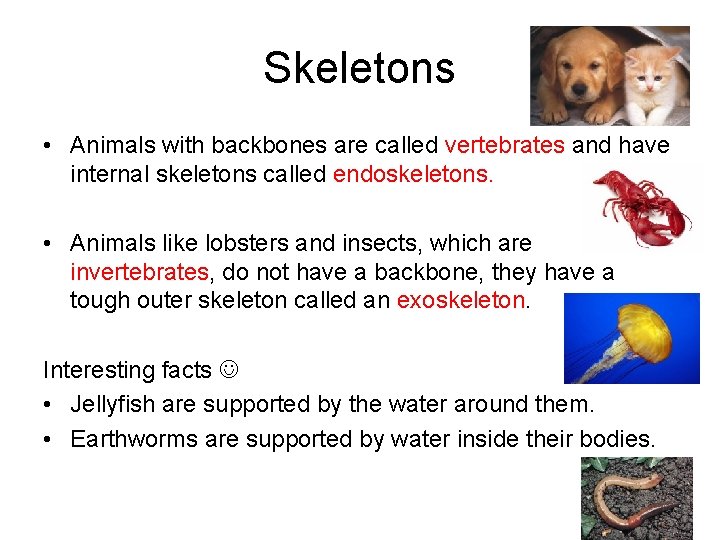
Skeletons • Animals with backbones are called vertebrates and have internal skeletons called endoskeletons. • Animals like lobsters and insects, which are invertebrates, do not have a backbone, they have a tough outer skeleton called an exoskeleton. Interesting facts • Jellyfish are supported by the water around them. • Earthworms are supported by water inside their bodies.
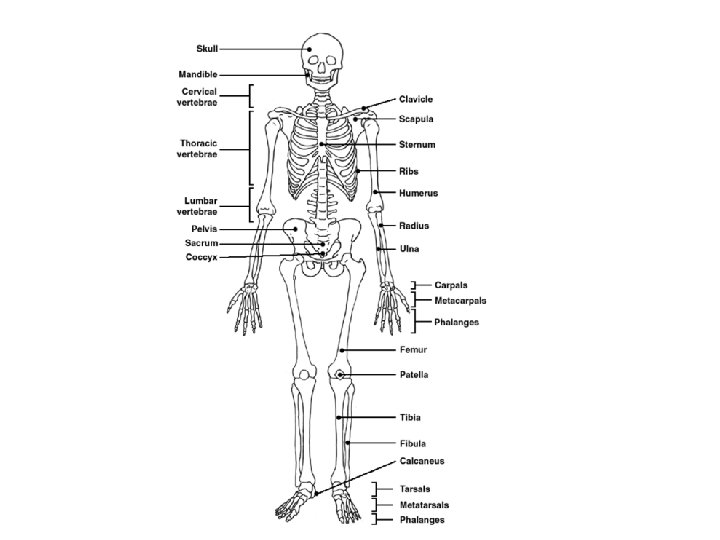
Human Skeleton • 206 bones • Some bones are hollow in the middle and contain marrow. • Adult Skeleton weighs about 9 Kg • Bone is a mixture of living material and non-living material. – Living part contains cells and collagen (allows the bones to be flexible) – Non-living part is made up of mineral salts – e. g. calcium phosphate (makes the bone hard). • Bone growth takes place in childhood and adolescence. • Growth takes place at the end of a bone.
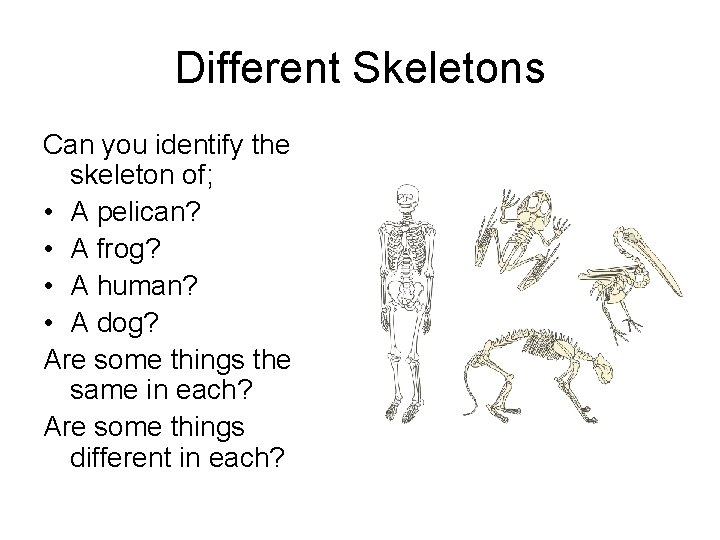
Different Skeletons Can you identify the skeleton of; • A pelican? • A frog? • A human? • A dog? Are some things the same in each? Are some things different in each?
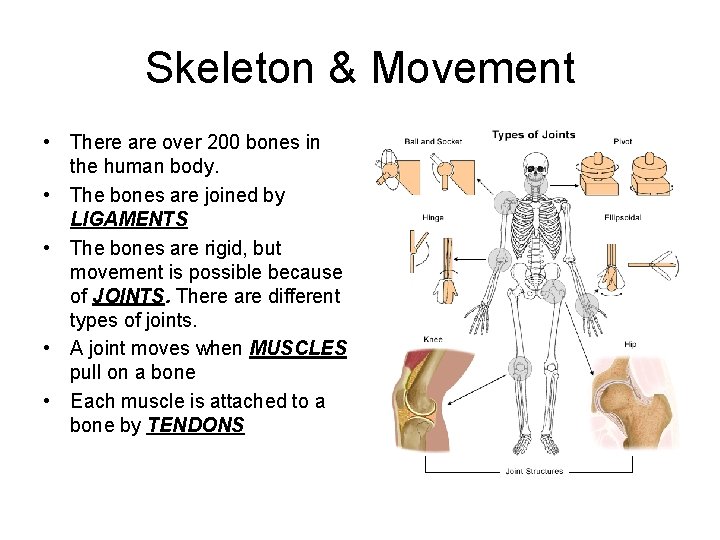
Skeleton & Movement • There are over 200 bones in the human body. • The bones are joined by LIGAMENTS • The bones are rigid, but movement is possible because of JOINTS. There are different types of joints. • A joint moves when MUSCLES pull on a bone • Each muscle is attached to a bone by TENDONS
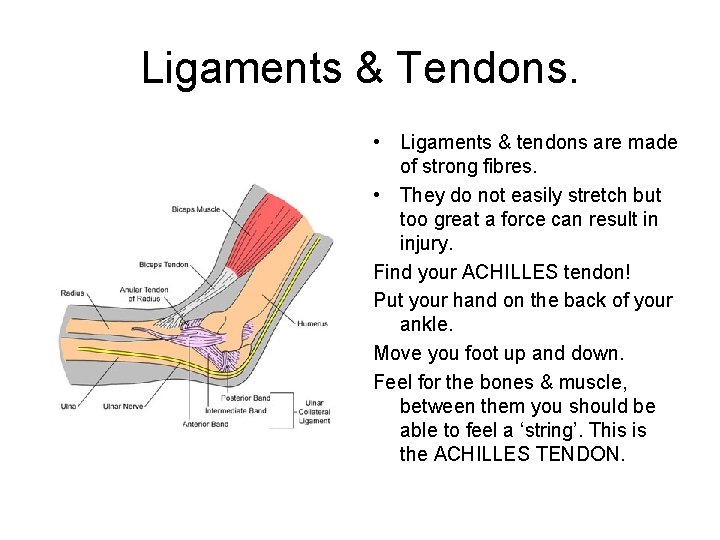
Ligaments & Tendons. • Ligaments & tendons are made of strong fibres. • They do not easily stretch but too great a force can result in injury. Find your ACHILLES tendon! Put your hand on the back of your ankle. Move you foot up and down. Feel for the bones & muscle, between them you should be able to feel a ‘string’. This is the ACHILLES TENDON.
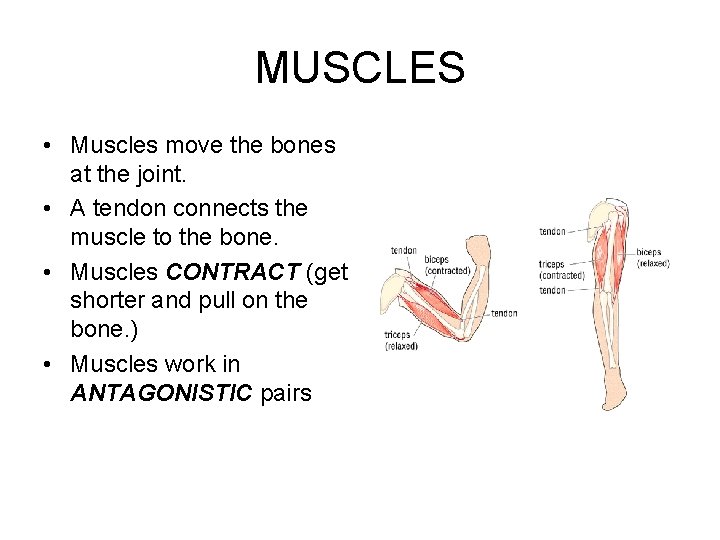
MUSCLES • Muscles move the bones at the joint. • A tendon connects the muscle to the bone. • Muscles CONTRACT (get shorter and pull on the bone. ) • Muscles work in ANTAGONISTIC pairs
- Slides: 8