
Skeletal System Structure and Function Copyright Texas Education
- Slides: 50
Skeletal System Structure and Function
Copyright © Texas Education Agency, 2017. These Materials are copyrighted © and trademarked ™ as the property of the Texas Education Agency (TEA) and may not be reproduced without the express written permission of TEA, except under the following conditions: 1) Texas public school districts, charter schools, and Education Service Centers may reproduce and use copies of the Materials and Related Materials for the districts’ and schools’ educational use without obtaining permission from TEA. 2) Residents of the state of Texas may reproduce and use copies of the Materials and Related Materials for individual personal use only, without obtaining written permission of TEA. 3) Any portion reproduced must be reproduced in its entirety and remain unedited, unaltered and unchanged in any way. 4) No monetary charge can be made for the reproduced materials or any document containing them; however, a reasonable charge to cover only the cost of reproduction and distribution may be charged. Private entities or persons located in Texas that are not Texas public school districts, Texas Education Service Centers, or Texas charter schools or any entity, whether public or private, educational or non-educational, located outside the state of Texas MUST obtain written approval from TEA and will be required to enter into a license agreement that may involve the payment of a licensing fee or a royalty. For information contact: Office of Copyrights, Trademarks, License Agreements, and Royalties, Texas Education Agency, 1701 N. Congress Ave. , Austin, TX 78701 -1494; phone 512 -463 -7004; email: copyrights@tea. state. tx. us. Copyright © Texas Education Agency, 2017. All rights reserved. 2
Functions > Support: body structure and shape > Protection: vital organs surrounded > Movement/Anchorage of Muscles > Mineral Storage: calcium & phosphorus > Blood Formation Copyright © Texas Education Agency, 2017. All rights reserved. 3
Bone Composition > Collagen: chief organic constituent (protein) > Inorganic Calcium Salts: Vitamin D essential for absorption Copyright © Texas Education Agency, 2017. All rights reserved. 4
Cells > Osteoblasts: bone building, bone repairing cells in the periosteum > Osteocytes: osteoblast embedded within the bone matrix > Osteoclasts: cells that cause absorption of bone Copyright © Texas Education Agency, 2017. All rights reserved. 5
Periosteum > Dense, fibrous membrane covering bone > Contains blood vessels > Essential for bone cell survival and bone formation Copyright © Texas Education Agency, 2017. All rights reserved. 6
Types of Bones Based on Composition: Compact Bone > Very Dense, Stress Bearing > Haversian Systems > Lamellae: concentric cylinder shaped calcified structure > Lacunae: small lakes containing tissue fluid > Osteocytes: facilitate exchange of calcium between blood and bone > Canaliculi: canals connecting the lacunae together and to the haversian canal which carries nutrients/wastes Copyright © Texas Education Agency, 2017. All rights reserved. 7
Cancellous Bone > Light, Spongy > Low Stress Areas Where Weight of Bone Would Be a Problem > Found at Ends of Long Bones, Ribs, Sternum, Hips, Vertebrae, Cranium > No Haversian Systems > Web-Like Arrangement Copyright © Texas Education Agency, 2017. All rights reserved. 8
Classification of Bones According to Shape > Long Bones > Short Bones > Flat Bones > Irregular Bones > Sesamoid Bones Copyright © Texas Education Agency, 2017. All rights reserved. 9
Long Bones > Extremities > Femur, tibia, fibula, humerus, ulna, radius, clavicle > Levers > Epiphysis: at the ends; covered with hyaline cartilage for articulating bones; cancellous bone > Diaphysis: shaft, covered with periosteum for bone growth, repair, nutrition; medullary canal with yellow and red marrow; endosteum lining; compact bone Copyright © Texas Education Agency, 2017. All rights reserved. 10
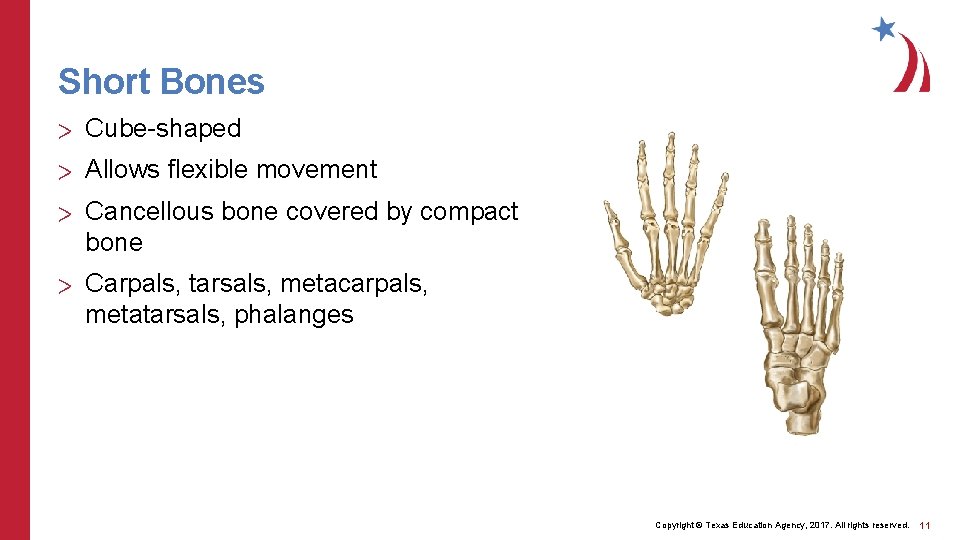
Short Bones > Cube-shaped > Allows flexible movement > Cancellous bone covered by compact bone > Carpals, tarsals, metacarpals, metatarsals, phalanges Copyright © Texas Education Agency, 2017. All rights reserved. 11
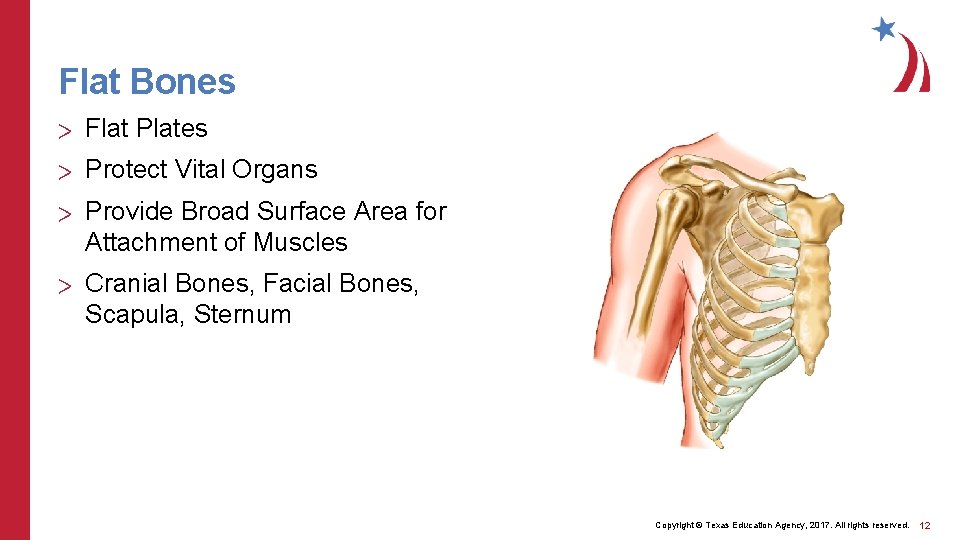
Flat Bones > Flat Plates > Protect Vital Organs > Provide Broad Surface Area for Attachment of Muscles > Cranial Bones, Facial Bones, Scapula, Sternum Copyright © Texas Education Agency, 2017. All rights reserved. 12
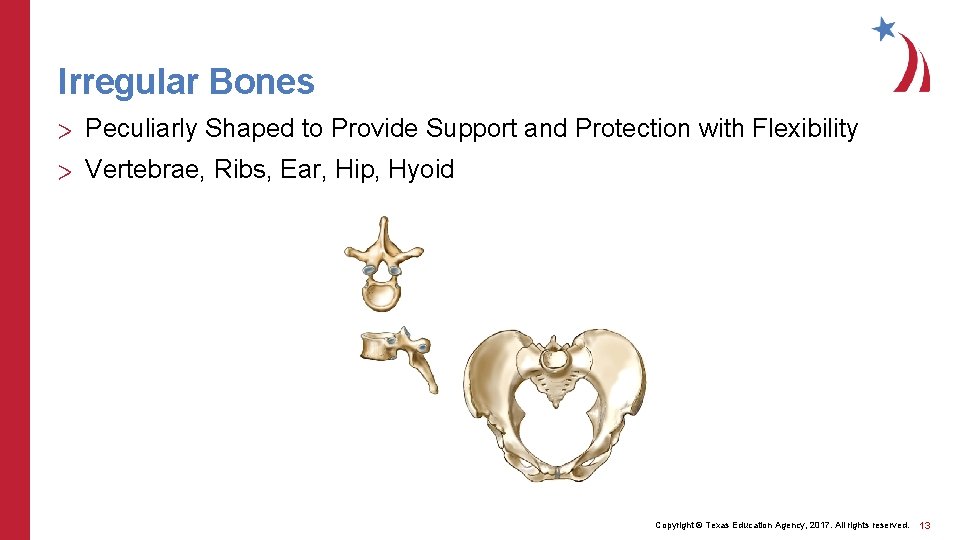
Irregular Bones > Peculiarly Shaped to Provide Support and Protection with Flexibility > Vertebrae, Ribs, Ear, Hip, Hyoid Copyright © Texas Education Agency, 2017. All rights reserved. 13
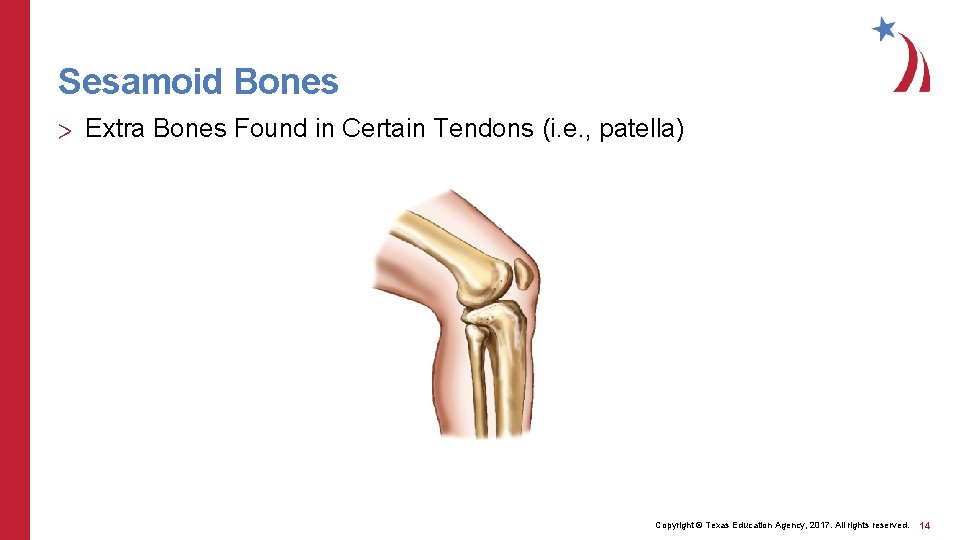
Sesamoid Bones > Extra Bones Found in Certain Tendons (i. e. , patella) Copyright © Texas Education Agency, 2017. All rights reserved. 14
Bone Formation > Initially collagen fibers secreted by fibroblasts > Cartilage deposited between the fibers > Skeleton fully formed by 2 nd month of fetal development (all cartilage) > Ossification begins after 8 th week of fetal development > Childhood and adolescence: ossification exceeds bone loss > Early adulthood through middle age: ossification equals bone loss > After age 35: bone loss exceeds ossification Copyright © Texas Education Agency, 2017. All rights reserved. 15
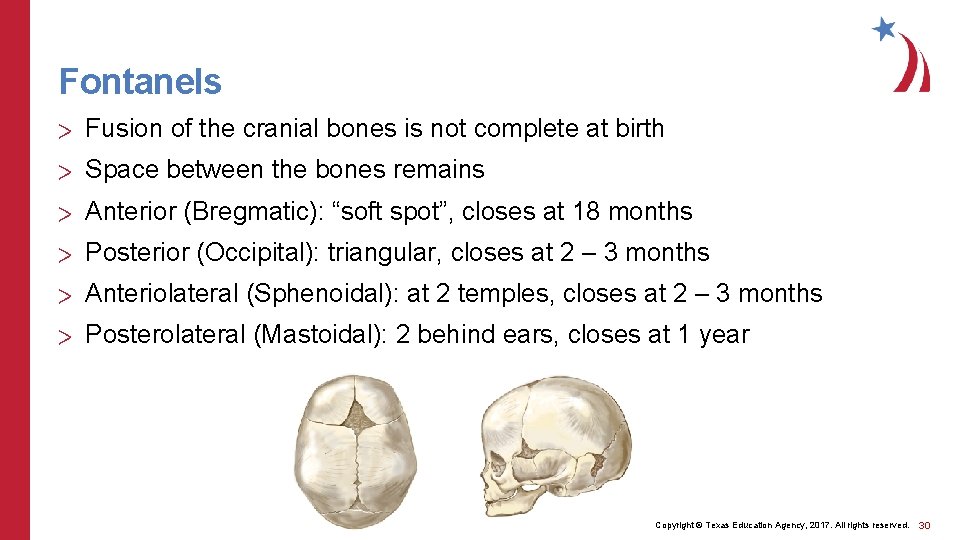
Skull Bone Formation > Begins as fibrous membrane > Ossification center in the middle of the membrane > Ossification begins in the middle and radiates out > Ossification not complete at birth > Fontanels (soft spots): molding of head during birth and allow for brain growth Copyright © Texas Education Agency, 2017. All rights reserved. 16
Formation of Other Bones > Begin as hyaline cartilage > Short bones: one ossification center in middle and proceeds to periphery > Long bones: three ossification centers (at each end and in the middle); ossification from each end toward the center and from the center towards each end Copyright © Texas Education Agency, 2017. All rights reserved. 17
Bone Growth > Grow in length at the epiphyseal line > Grow in width by addition of bone to the surface > Controlled by anterior pituitary (GH) Copyright © Texas Education Agency, 2017. All rights reserved. 18
Bone Markings - Purpose > Join one bone to another > Provide a surface for attachment of muscles > Create an opening for passage of blood vessels and nerves > Use as landmarks Copyright © Texas Education Agency, 2017. All rights reserved. 19
Bone Markings > Process: bony prominence or projection > Condyle: a rounded knuckle-like prominence usually at a point of articulation > Epicondyle: small projection > Head: rounded articulating process at the end of a bone > Spine: a sharp, slender projection > Tubercle: a small rounded process > Tuberosity: a large rounded process Copyright © Texas Education Agency, 2017. All rights reserved. 20
Bone Markings > Trochanter: a large process for muscle attachment > Fossa: a depression or a hollow > Foramen: a hole > Crest: a sharp ridge > Line: a less prominent ridge of a bone than a crest > Meatus: a tube-like passage > Sinus/antrum: a cavity within a bone Copyright © Texas Education Agency, 2017. All rights reserved. 21
Bone Markings > Depression: a hollow-region or opening > Fissure: narrow, slit-like opening > Sulcus: a groove > Facet: a small area on a bone Copyright © Texas Education Agency, 2017. All rights reserved. 22
Bone Marrow - Yellow > Medullary Cavity of Long Bones > Fat Storage Copyright © Texas Education Agency, 2017. All rights reserved. 23
Bone Marrow - Red > Hematopoietic Tissue > In cancellous bone in children > In adults: cancellous bone of vertebrae, hips, sternum, ribs, cranial bones, proximal ends of femur and humerus > Forms RBCs, platelets, some WBCs and destroys old RBCs and some foreign materials Copyright © Texas Education Agency, 2017. All rights reserved. 24
Axial Skeleton > Skull (22 Bones) > Ear (12 Bones) & Hyoid > Vertebral Column (26 Bones) Copyright © Texas Education Agency, 2017. All rights reserved. 25
Skull - Cranium > Houses and protects the brain > Frontal: forms forehead and orbits of eyes > Ethmoid: forms roof of nasal cavity > Parietal: right & left; form sides and roof of skull > Temporal: right & left; forms temple, cheek, ear openings Copyright © Texas Education Agency, 2017. All rights reserved. 26
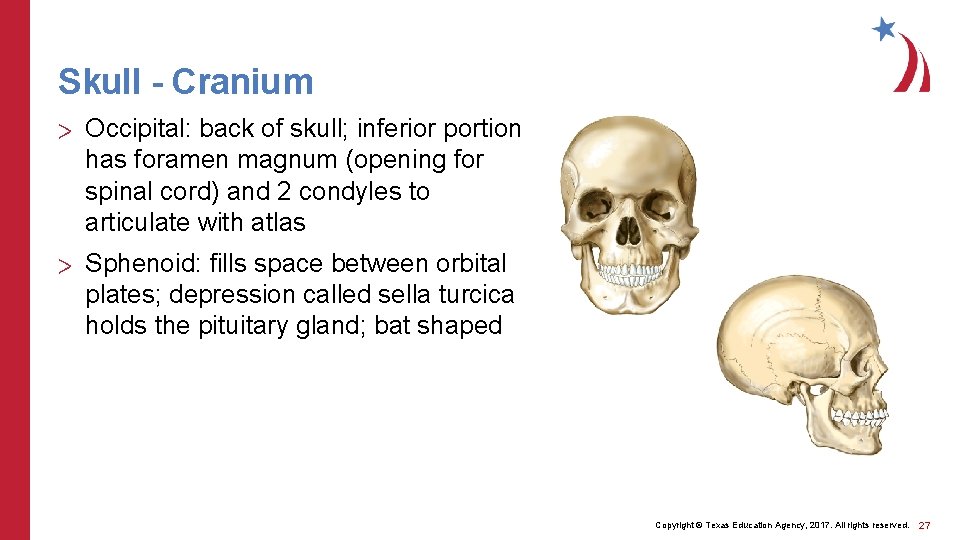
Skull - Cranium > Occipital: back of skull; inferior portion has foramen magnum (opening for spinal cord) and 2 condyles to articulate with atlas > Sphenoid: fills space between orbital plates; depression called sella turcica holds the pituitary gland; bat shaped Copyright © Texas Education Agency, 2017. All rights reserved. 27
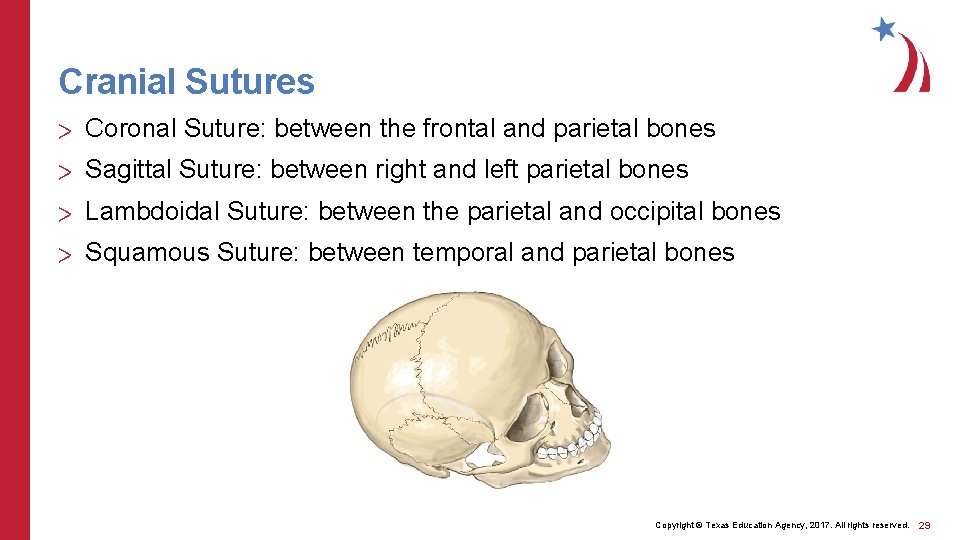
Cranial Sutures > Unite the bones of the cranium > As the child grow, irregular bands of connective tissue ossifies and turns into hard bone > Abnormalities: microcephalus (premature fusion), hydrocephalus (delayed fusion increases intracranial pressure) Copyright © Texas Education Agency, 2017. All rights reserved. 28
Cranial Sutures > Coronal Suture: between the frontal and parietal bones > Sagittal Suture: between right and left parietal bones > Lambdoidal Suture: between the parietal and occipital bones > Squamous Suture: between temporal and parietal bones Copyright © Texas Education Agency, 2017. All rights reserved. 29
Fontanels > Fusion of the cranial bones is not complete at birth > Space between the bones remains > Anterior (Bregmatic): “soft spot”, closes at 18 months > Posterior (Occipital): triangular, closes at 2 – 3 months > Anteriolateral (Sphenoidal): at 2 temples, closes at 2 – 3 months > Posterolateral (Mastoidal): 2 behind ears, closes at 1 year Copyright © Texas Education Agency, 2017. All rights reserved. 30
Facial Bones > Guard and support eyes, ears, nose, mouth > Nasal bones (2): form bridge of nose > Vomer: forms central nasal septum > Maxillary (2): upper jaw bone; fusion before birth; forms roof of mouth, walls of nose, floor of orbitals > Mandible: lower jaw bone; largest bone of face Copyright © Texas Education Agency, 2017. All rights reserved. 31
Facial Bones > Zygoma (2): cheek bones > Lacrimal (2): small bones form medial wall of each eye socket > Palatine (2): forms back roof of mouth and floor of nose > Inferior turbinate (2): forms curved ledge inside wall of nose Copyright © Texas Education Agency, 2017. All rights reserved. 32
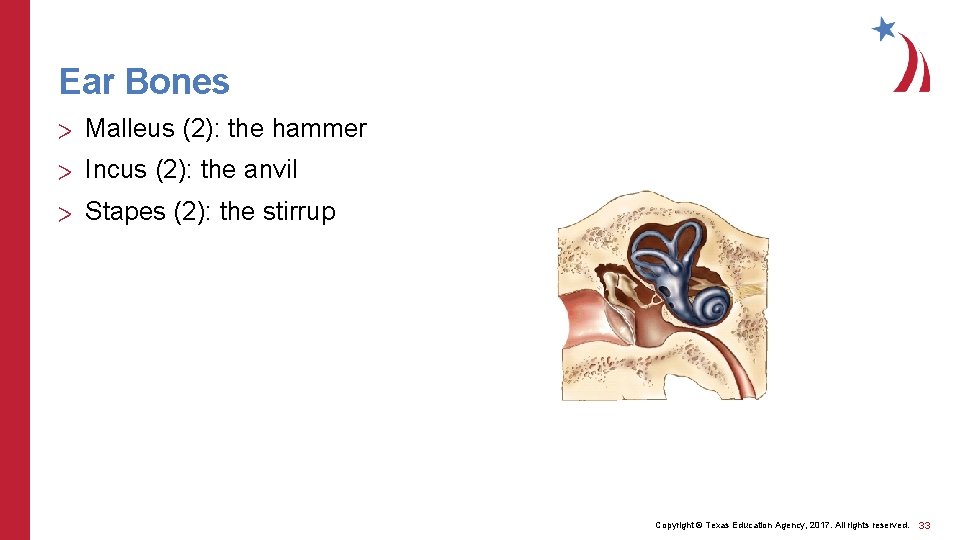
Ear Bones > Malleus (2): the hammer > Incus (2): the anvil > Stapes (2): the stirrup Copyright © Texas Education Agency, 2017. All rights reserved. 33
Hyoid Bone > U-shaped bone > In neck > At base of tongue > Only bone in body that does NOT articulate with another bone Copyright © Texas Education Agency, 2017. All rights reserved. 34
Cranial Sinuses > Cavities within the cranium > Resonance chambers for voice > Decrease weight of skull > Lined with mucous membrane > Frontal sinuses (2): above eyebrows, open into nasal cavity > Ethmoid sinuses (2): between the eyes > Spenoidal sinus (1): posterior to ethmoidal sinus, opens into nasopharynx > Maxillary sinus (2): on either side of the nose, opens into the lateral wall of the nasal cavity Copyright © Texas Education Agency, 2017. All rights reserved. 35
Vertebral Column - Functions > Supports trunk and neck > Protects spinal cord > Multiple joint spaces allow for bending and twisting Copyright © Texas Education Agency, 2017. All rights reserved. 36
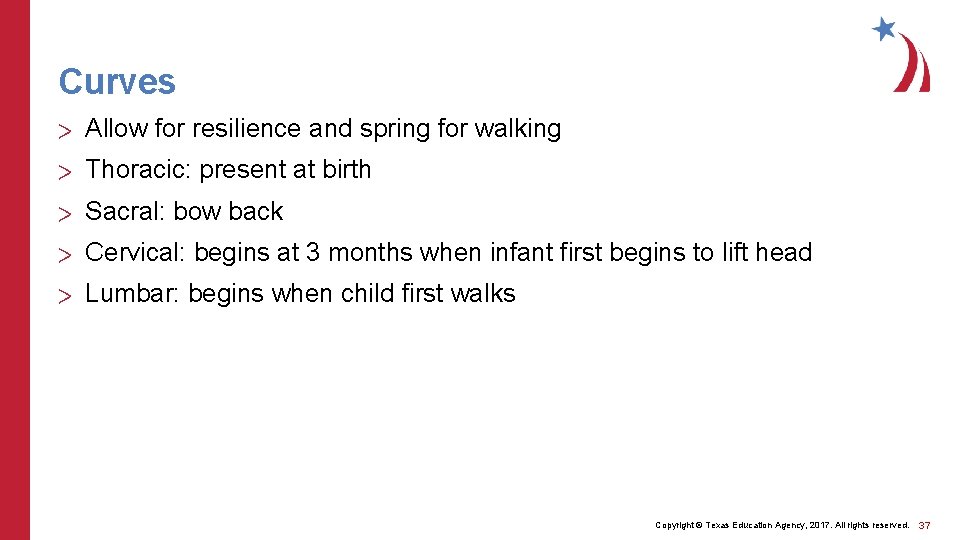
Curves > Allow for resilience and spring for walking > Thoracic: present at birth > Sacral: bow back > Cervical: begins at 3 months when infant first begins to lift head > Lumbar: begins when child first walks Copyright © Texas Education Agency, 2017. All rights reserved. 37
Vertebrae > 26 > Separated by intervertebral disk to cushion joints for movement > Body: thick, disk-shaped anterior portion > Arch: encloses space for spinal cord; 3 processes for muscle attachment (spinous process – dorsally directed, 2 transverse processes) > Articular processes: provide for articulation with other vertebrae (2 superior and 2 inferior) > Pedicles (2): originate from body of vertebrae notched to allow spinal cord nerves to pass > Lamina: posterior wall of vertebrae, weakest point Copyright © Texas Education Agency, 2017. All rights reserved. 38
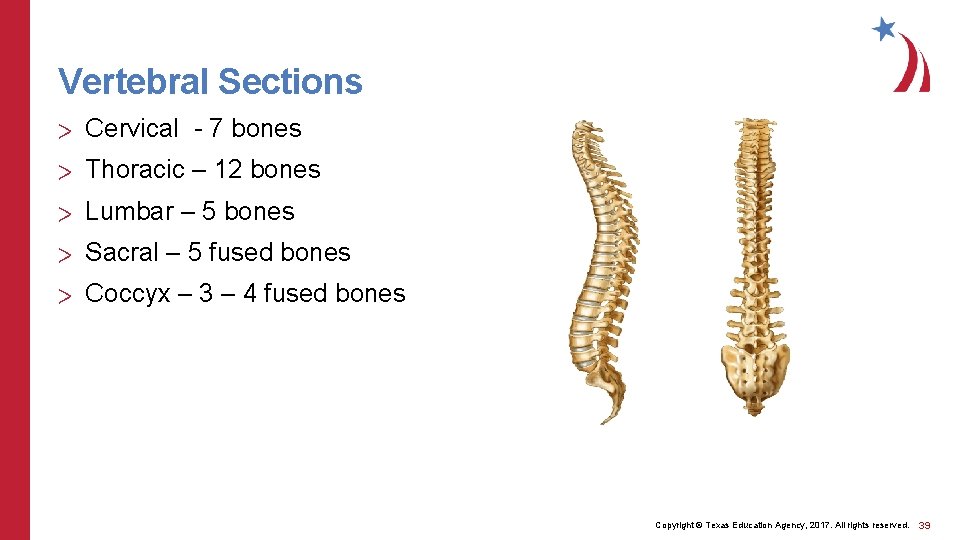
Vertebral Sections > Cervical - 7 bones > Thoracic – 12 bones > Lumbar – 5 bones > Sacral – 5 fused bones > Coccyx – 3 – 4 fused bones Copyright © Texas Education Agency, 2017. All rights reserved. 39
Thorax > 25 bones and cartilage > Sternum, costal cartilage, ribs > Walls covered by skin and muscles > Floor formed by the diaphragm Copyright © Texas Education Agency, 2017. All rights reserved. 40
Functions > Protect and support heart and lungs > Supports bones of pectoral girdle > Plays leading role in respiration > Ribs and sternum aid in RBC formation Copyright © Texas Education Agency, 2017. All rights reserved. 41
Sternum > Breast bone > Sword and handle shaped > Manubrium: handle, notched for 1 st 7 costal cartilages, articulates with acromium end of clavicle and 1 st rib > Body: blade, notched for 1 st 7 costal cartilages > Xiphoid process: tip, attachment site for diaphragm Copyright © Texas Education Agency, 2017. All rights reserved. 42
Costal Cartilage > Hyaline cartilage > Connect ribs to sternum in 1 – 7 and to anterior ribs in 8 - 10 Copyright © Texas Education Agency, 2017. All rights reserved. 43
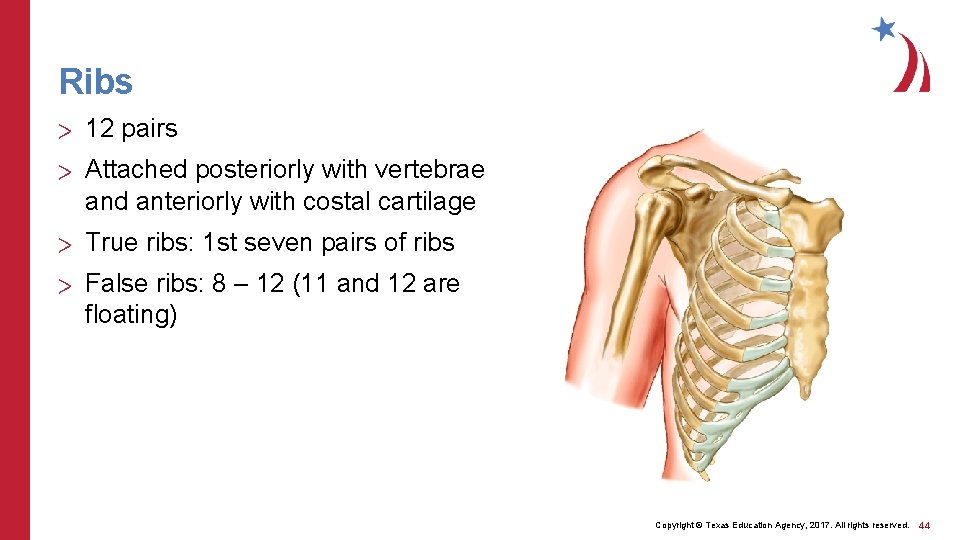
Ribs > 12 pairs > Attached posteriorly with vertebrae and anteriorly with costal cartilage > True ribs: 1 st seven pairs of ribs > False ribs: 8 – 12 (11 and 12 are floating) Copyright © Texas Education Agency, 2017. All rights reserved. 44
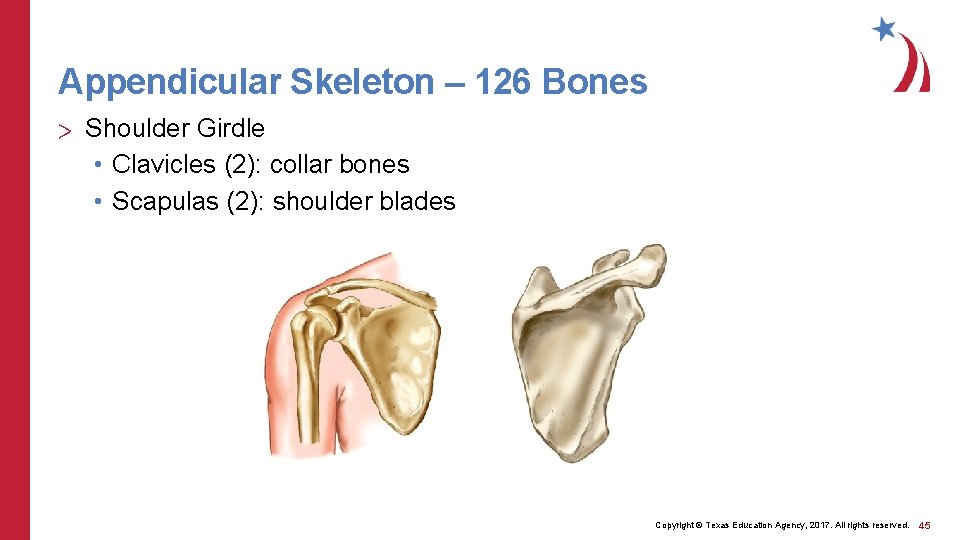
Appendicular Skeleton – 126 Bones > Shoulder Girdle • Clavicles (2): collar bones • Scapulas (2): shoulder blades Copyright © Texas Education Agency, 2017. All rights reserved. 45
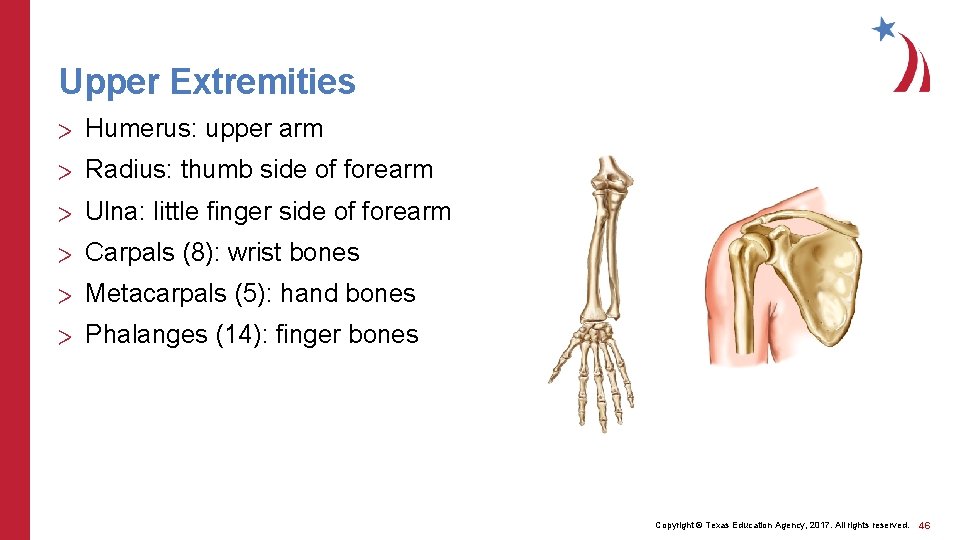
Upper Extremities > Humerus: upper arm > Radius: thumb side of forearm > Ulna: little finger side of forearm > Carpals (8): wrist bones > Metacarpals (5): hand bones > Phalanges (14): finger bones Copyright © Texas Education Agency, 2017. All rights reserved. 46
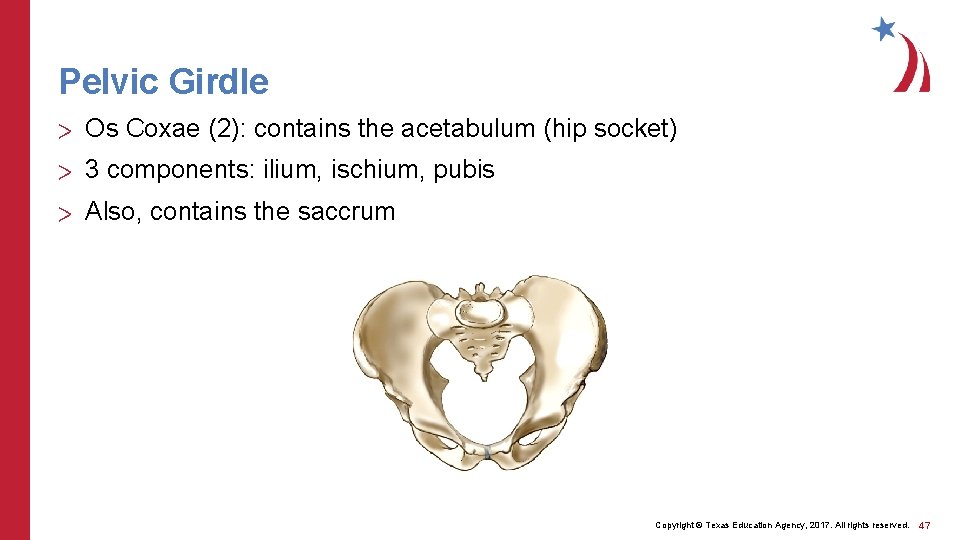
Pelvic Girdle > Os Coxae (2): contains the acetabulum (hip socket) > 3 components: ilium, ischium, pubis > Also, contains the saccrum Copyright © Texas Education Agency, 2017. All rights reserved. 47
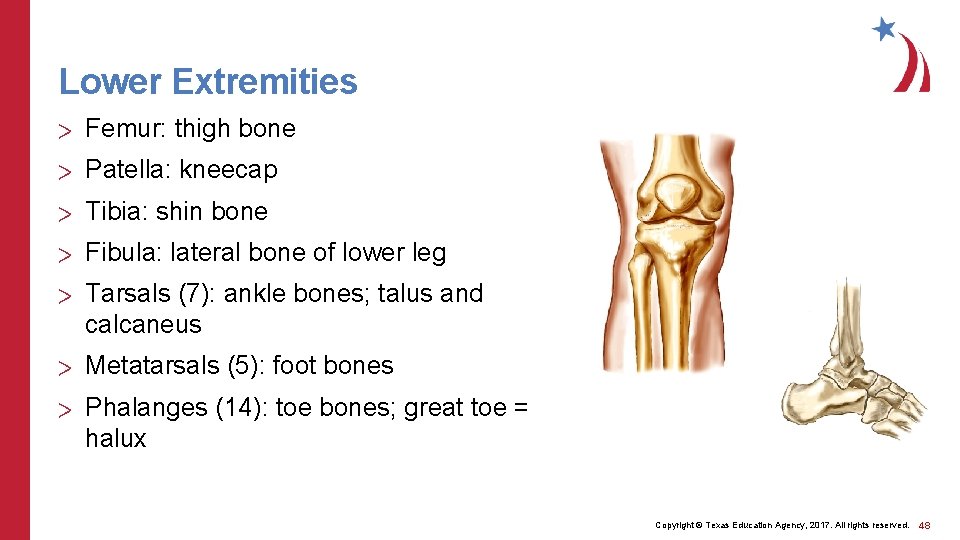
Lower Extremities > Femur: thigh bone > Patella: kneecap > Tibia: shin bone > Fibula: lateral bone of lower leg > Tarsals (7): ankle bones; talus and calcaneus > Metatarsals (5): foot bones > Phalanges (14): toe bones; great toe = halux Copyright © Texas Education Agency, 2017. All rights reserved. 48
Articulations > Synarthrotic: immovable > Amophiarthrotic: limited movement i. e. pubic symphysis, vertebral joints, sacroiliac joint > Diarthrotic: freely movable Copyright © Texas Education Agency, 2017. All rights reserved. 49
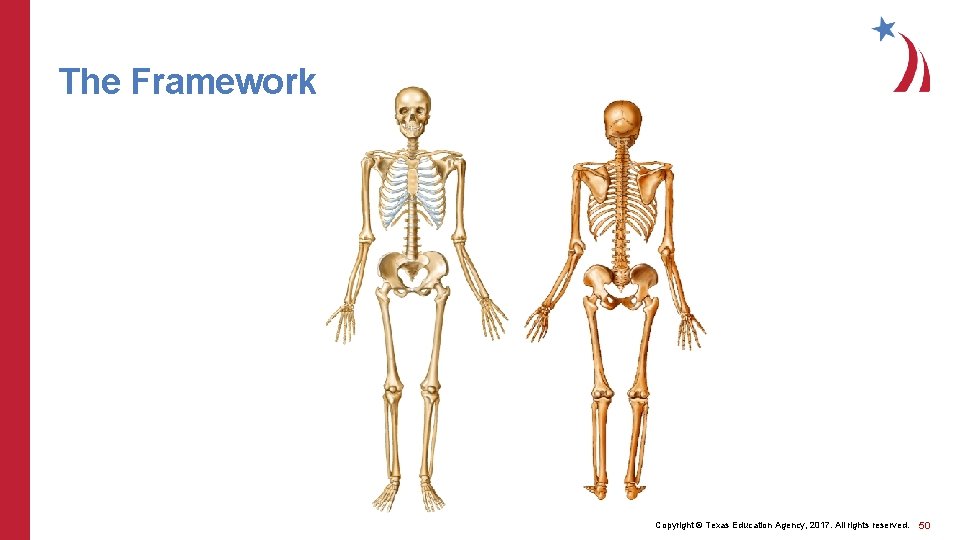
The Framework Copyright © Texas Education Agency, 2017. All rights reserved. 50