
SKELETAL SYSTEM Reading Chapter 7 1 A FUNCTION
- Slides: 46
SKELETAL SYSTEM Reading: Chapter 7 1
A. FUNCTION - 206 bones important for: * Shape & support * Movement * Protection of soft tissues * Blood cell production * Mineral storage Reading: Chapter 7 2
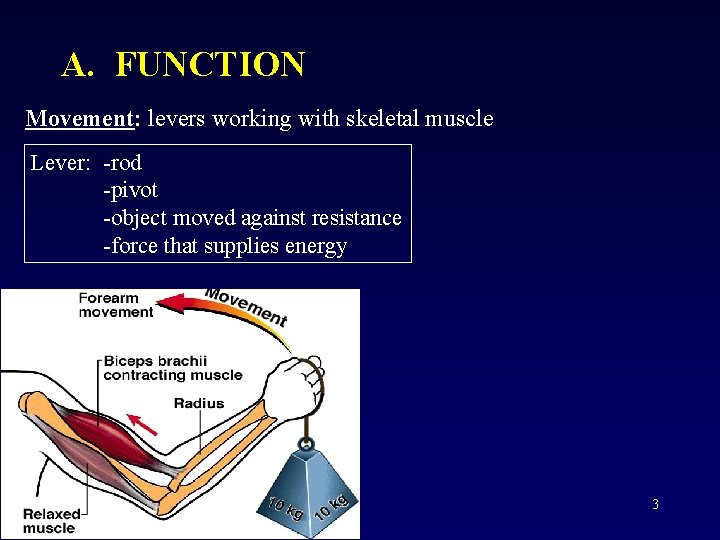
A. FUNCTION Movement: levers working with skeletal muscle Lever: -rod -pivot -object moved against resistance -force that supplies energy Reading: Chapter 7 3
A. FUNCTION 1. Protection: (of soft tissue) examples: skullribs & sternumvertebrae- 4
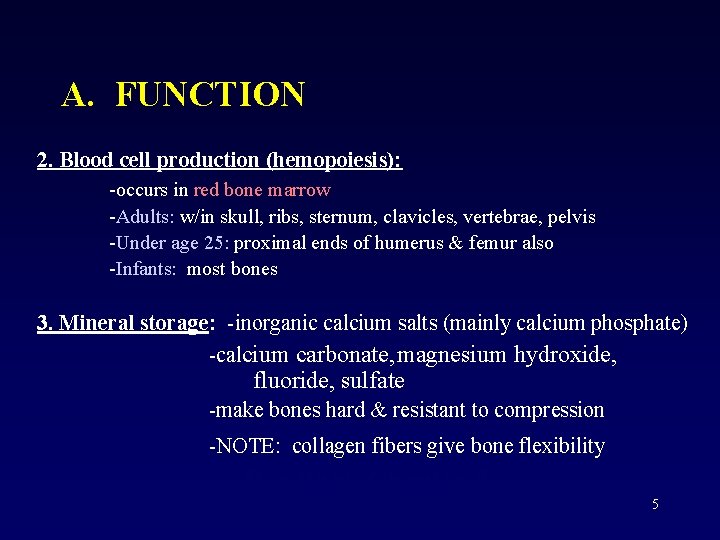
A. FUNCTION 2. Blood cell production (hemopoiesis): -occurs in red bone marrow -Adults: w/in skull, ribs, sternum, clavicles, vertebrae, pelvis -Under age 25: proximal ends of humerus & femur also -Infants: most bones 3. Mineral storage: -inorganic calcium salts (mainly calcium phosphate) -calcium carbonate, magnesium hydroxide, fluoride, sulfate -make bones hard & resistant to compression -NOTE: collagen fibers give bone flexibility Reading: Chapter 7 5
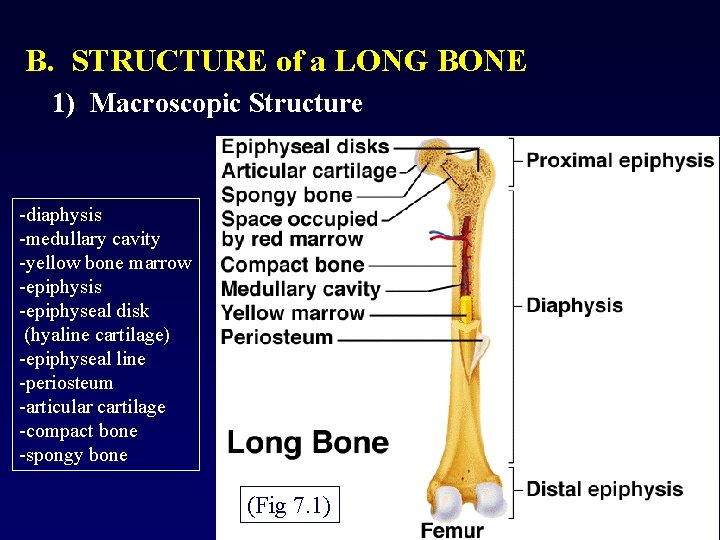
B. STRUCTURE of a LONG BONE 1) Macroscopic Structure -diaphysis -medullary cavity -yellow bone marrow -epiphysis -epiphyseal disk (hyaline cartilage) -epiphyseal line -periosteum -articular cartilage -compact bone -spongy bone (Fig 7. 1) 6
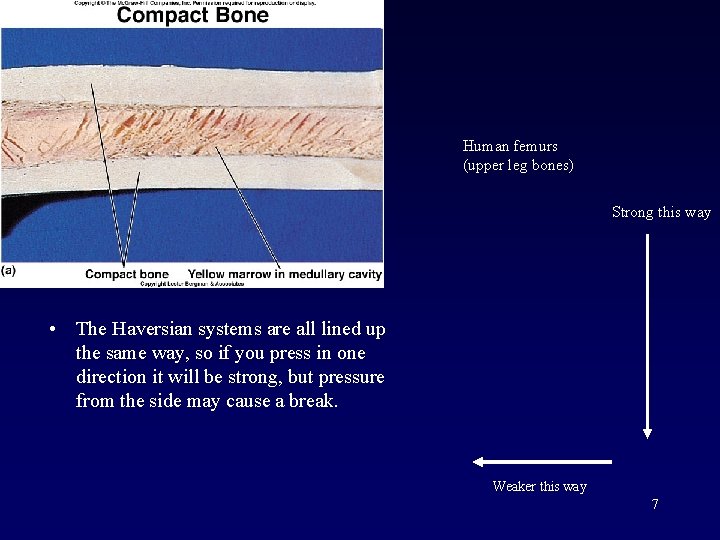
Human femurs (upper leg bones) Strong this way • The Haversian systems are all lined up the same way, so if you press in one direction it will be strong, but pressure from the side may cause a break. Weaker this way 7
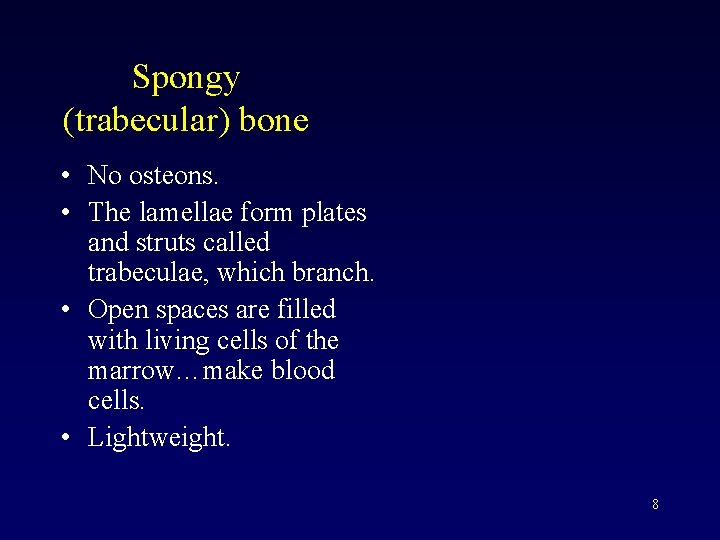
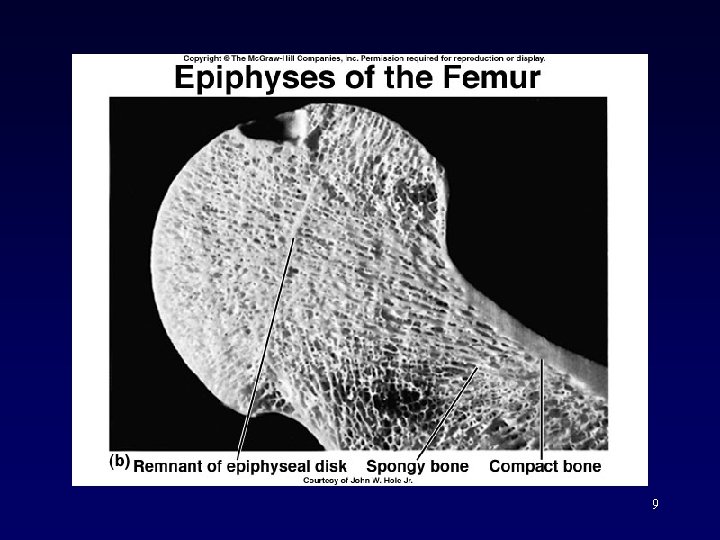
Spongy (trabecular) bone • No osteons. • The lamellae form plates and struts called trabeculae, which branch. • Open spaces are filled with living cells of the marrow…make blood cells. • Lightweight. 8
9
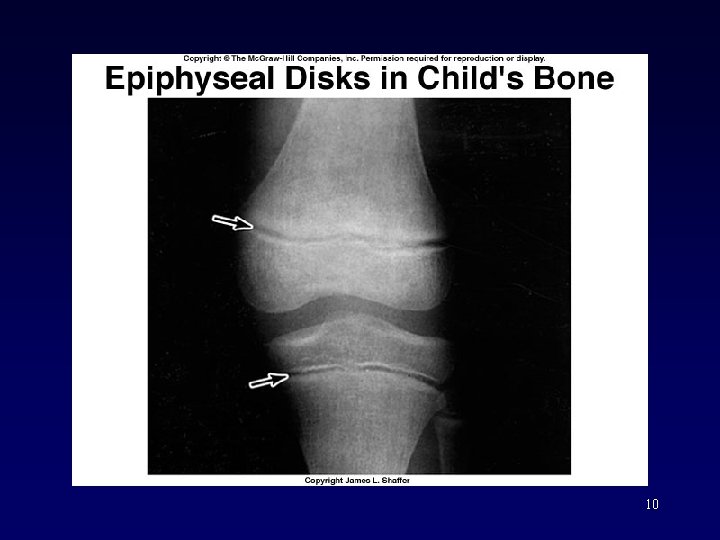
10
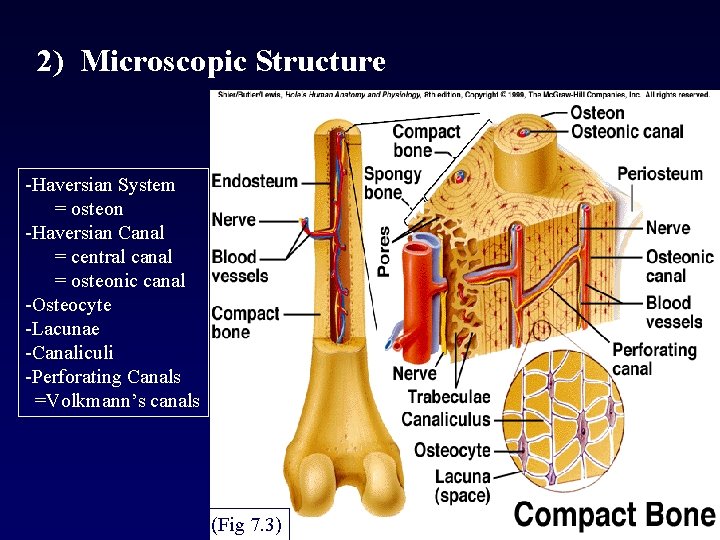
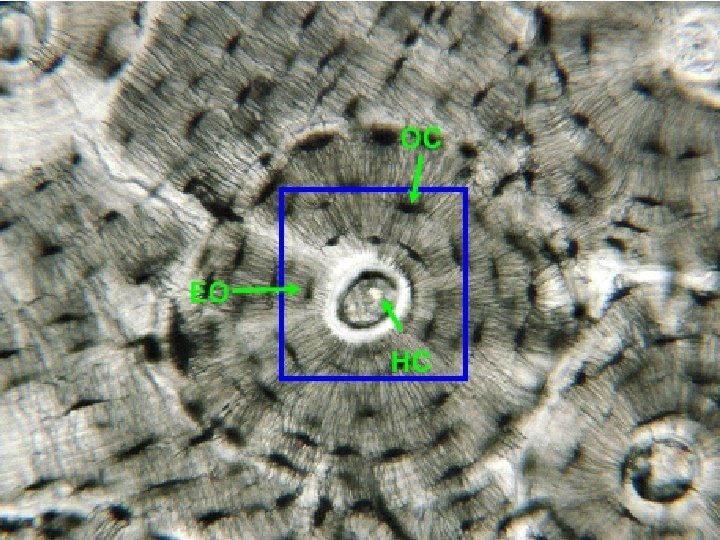
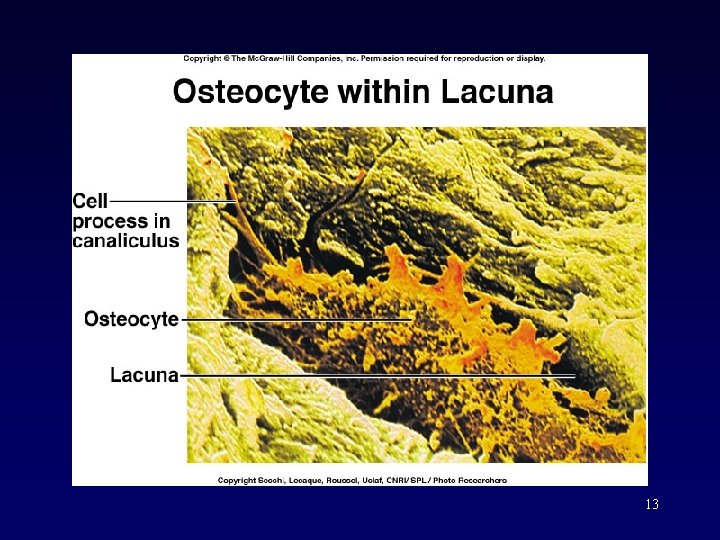
2) Microscopic Structure -Haversian System = osteon -Haversian Canal = central canal = osteonic canal -Osteocyte -Lacunae -Canaliculi -Perforating Canals =Volkmann’s canals 11 (Fig 7. 3)
12
13
3) BONE CELLS a) osteocytes - mature bone cells b) osteoblasts - immature bone cells - make new bone, “bone formers” c) osteoclasts - “bone eaters” - secrete acid that dissolve calcified matrix 14
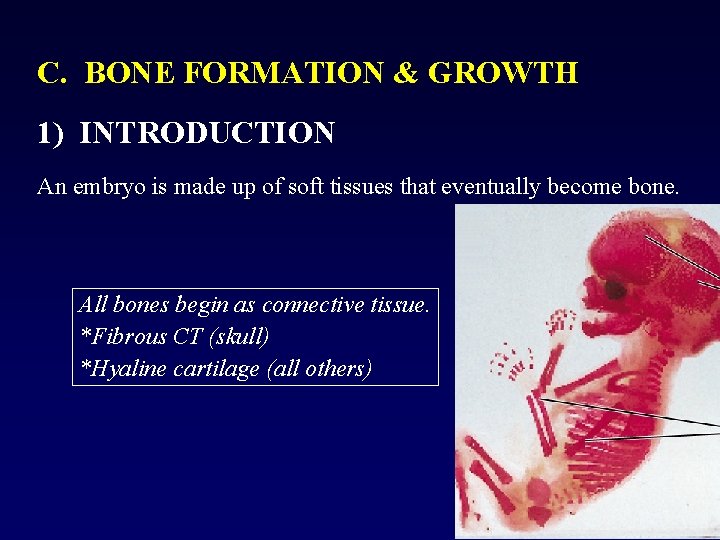
C. BONE FORMATION & GROWTH 1) INTRODUCTION An embryo is made up of soft tissues that eventually become bone. All bones begin as connective tissue. *Fibrous CT (skull) *Hyaline cartilage (all others) 15
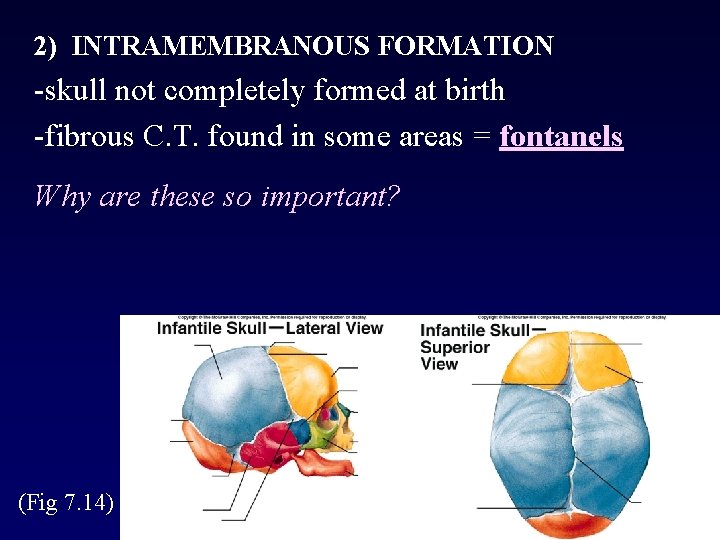
2) INTRAMEMBRANOUS FORMATION -skull not completely formed at birth -fibrous C. T. found in some areas = fontanels Why are these so important? (Fig 7. 14) 16
3) ENDOCHONDRAL FORMATION • Endochondral bones = the long bones. • In the fetus = cartilage • The cartilage is broken down and replaced with bone. • The epiphyses remain cartilaginous and continue to grow throughout childhood. 17
Some Hormones stimulate Osteoblasts • -Growth hormone & thyrocalcitonin ( from thyroid gland) • -Calcitonin stimulates osteoblasts to form How does this affect blood calcium levels? – Blood calcium levels DROP How does this affect bone density? Bone density INCREASES 18
Some Hormones Stimulate Osteoclasts: Parathyroid gland-releases parathyroid hormone (PTH) -inhibits osteoblasts & stimulates osteoclasts - causes kidneys to conserve calcium -How does this affect blood calcium levels? blood calcium levels INCREASES -How does this affect bone density? Bone density DECREASES 19
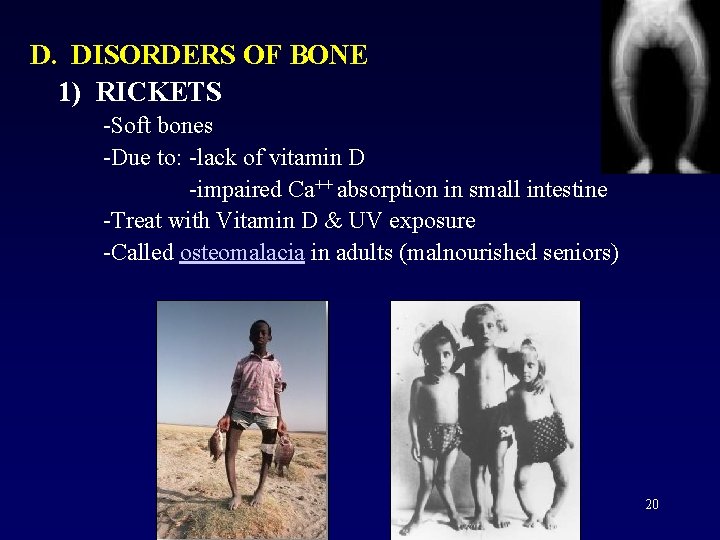
D. DISORDERS OF BONE 1) RICKETS -Soft bones -Due to: -lack of vitamin D -impaired Ca++ absorption in small intestine -Treat with Vitamin D & UV exposure -Called osteomalacia in adults (malnourished seniors) 20
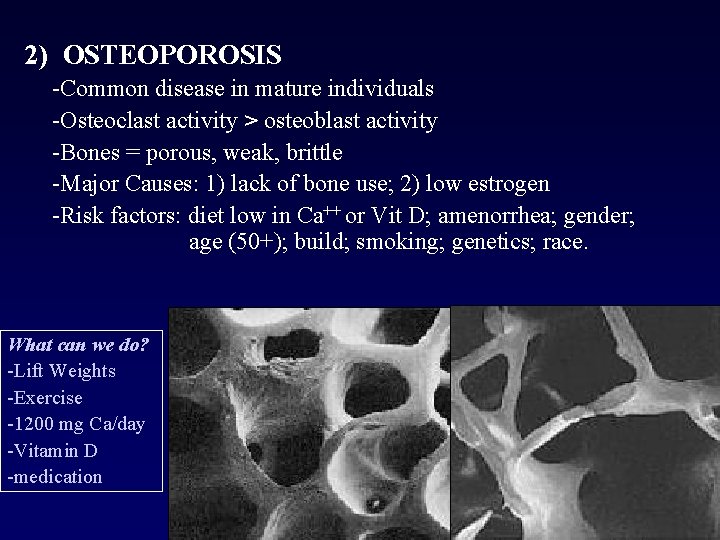
2) OSTEOPOROSIS -Common disease in mature individuals -Osteoclast activity > osteoblast activity -Bones = porous, weak, brittle -Major Causes: 1) lack of bone use; 2) low estrogen -Risk factors: diet low in Ca++ or Vit D; amenorrhea; gender; age (50+); build; smoking; genetics; race. What can we do? -Lift Weights -Exercise -1200 mg Ca/day -Vitamin D -medication 21
3) OSTEOMYELITIS (“Osteo”=bone; “Mye”=marrow; “-itis” = inflammation) -Inflammation of the bone marrow -Due to trauma which allows bacteria to enter -Or, due to bacterial invasion from an internal site via blood -Treatment: ___________ 22
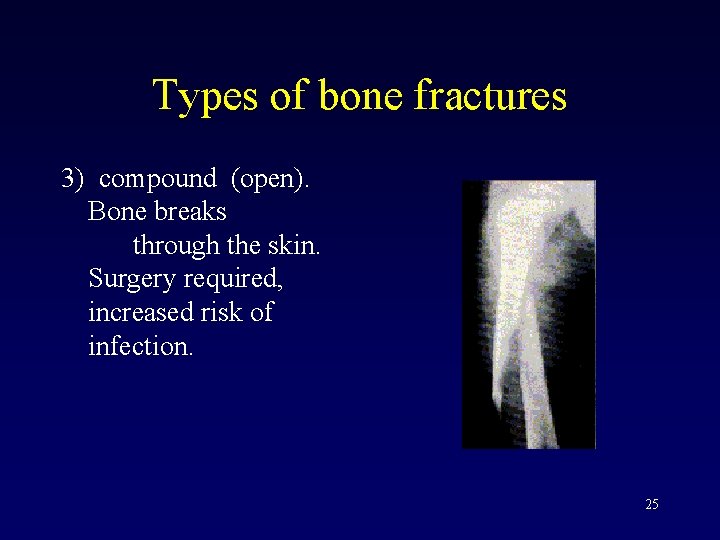
4) FRACTURES Can be classified as: 1) simple – no skin puncture 2) compound - bone breaks through the skin 3) incomplete - “cracked” bone 4) complete – bone broken 23
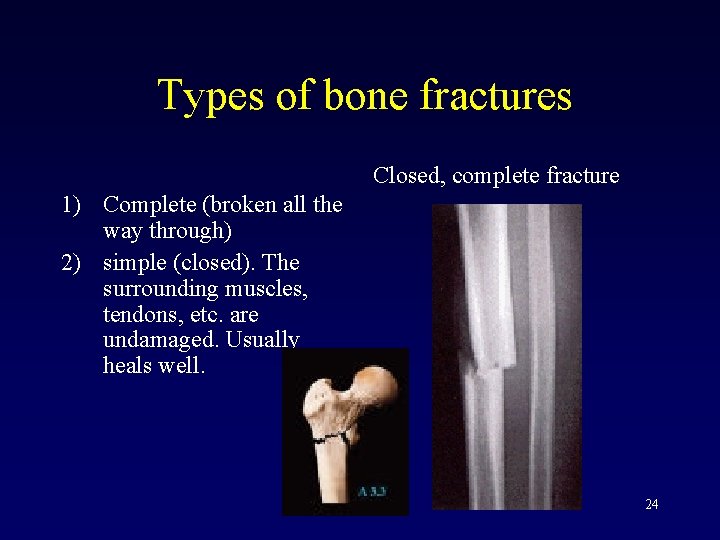
Types of bone fractures Closed, complete fracture 1) Complete (broken all the way through) 2) simple (closed). The surrounding muscles, tendons, etc. are undamaged. Usually heals well. 24
Types of bone fractures 3) compound (open). Bone breaks through the skin. Surgery required, increased risk of infection. 25
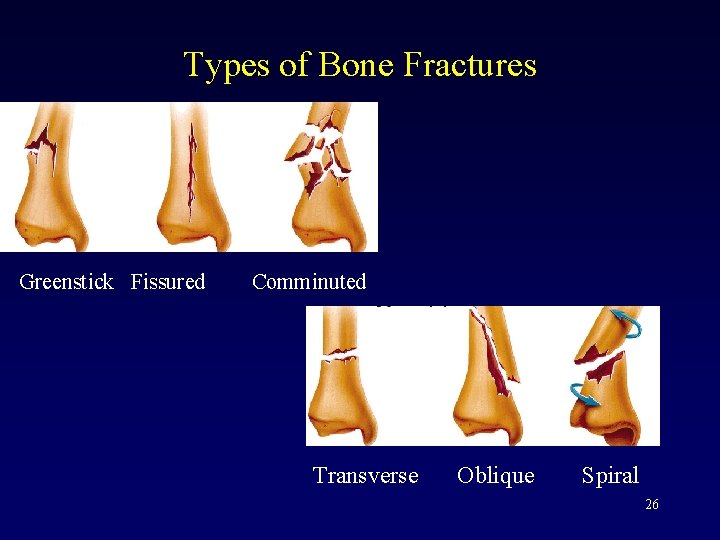
Types of Bone Fractures Greenstick Fissured Comminuted Transverse Oblique Spiral 26
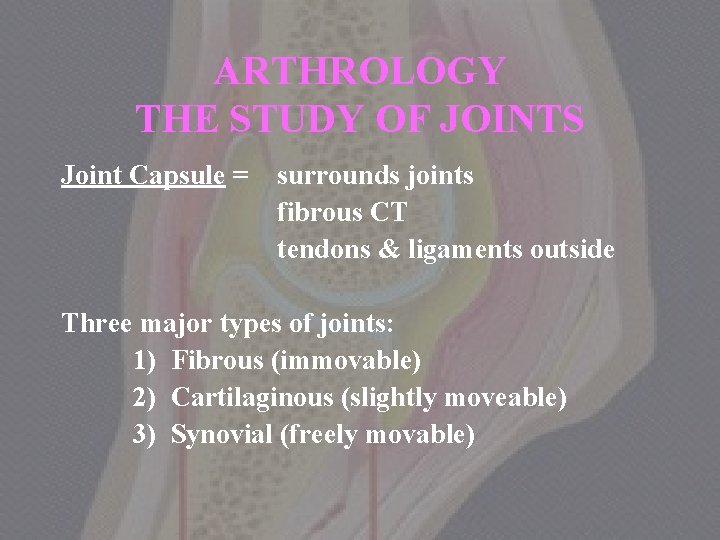
ARTHROLOGY THE STUDY OF JOINTS Joint Capsule = surrounds joints fibrous CT tendons & ligaments outside Three major types of joints: 1) Fibrous (immovable) 2) Cartilaginous (slightly moveable) 3) Synovial (freely movable) 27
Reminder • Ligaments: connect bone to bone at joints. • Tendons: connect bone to muscle. 28
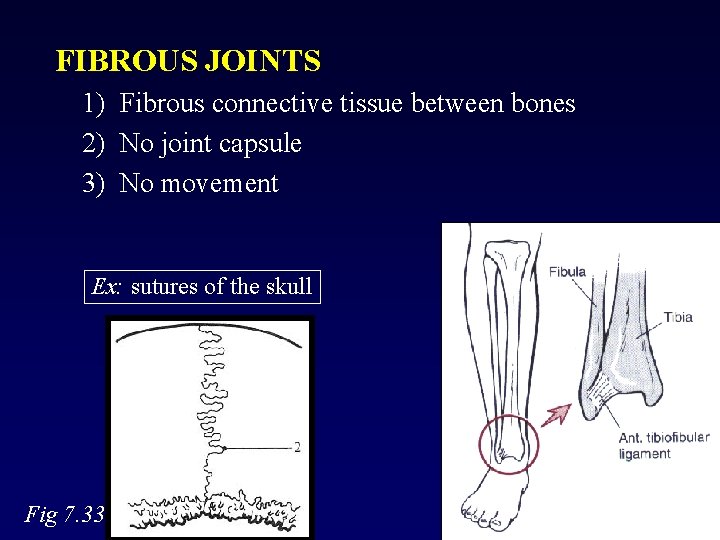
FIBROUS JOINTS 1) Fibrous connective tissue between bones 2) No joint capsule 3) No movement Ex: sutures of the skull Fig 7. 33 29
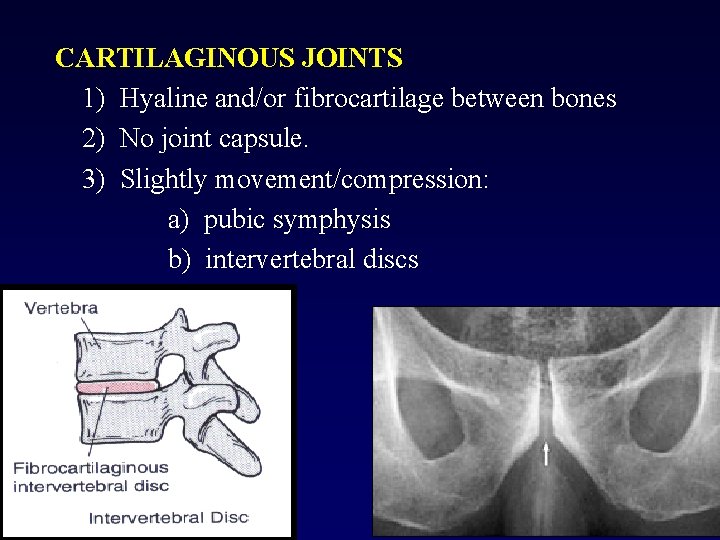
CARTILAGINOUS JOINTS 1) Hyaline and/or fibrocartilage between bones 2) No joint capsule. 3) Slightly movement/compression: a) pubic symphysis b) intervertebral discs 30
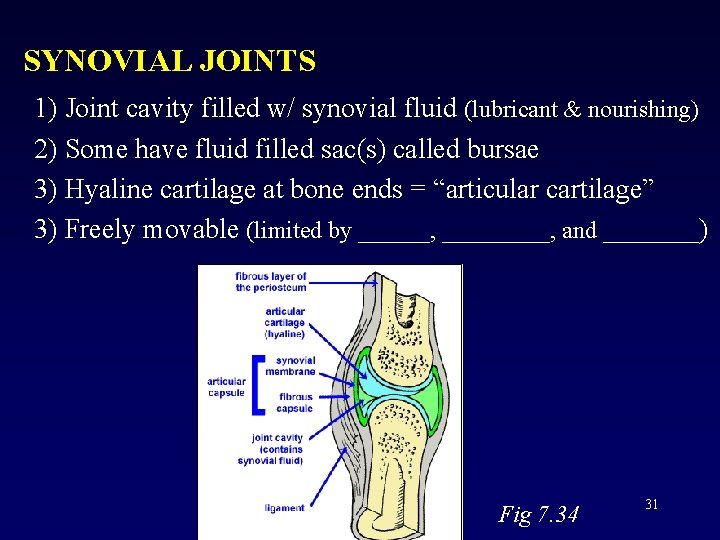
SYNOVIAL JOINTS 1) Joint cavity filled w/ synovial fluid (lubricant & nourishing) 2) Some have fluid filled sac(s) called bursae 3) Hyaline cartilage at bone ends = “articular cartilage” 3) Freely movable (limited by ______, and ____) Fig 7. 34 31
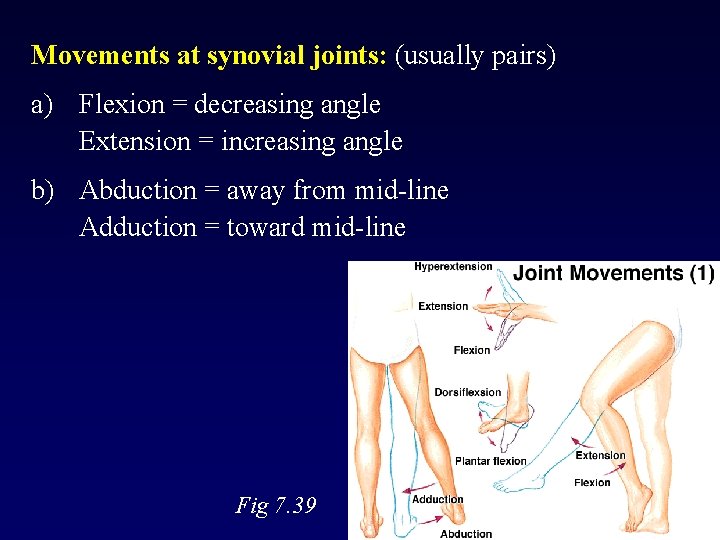
Movements at synovial joints: (usually pairs) a) Flexion = decreasing angle Extension = increasing angle b) Abduction = away from mid-line Adduction = toward mid-line Fig 7. 39 32
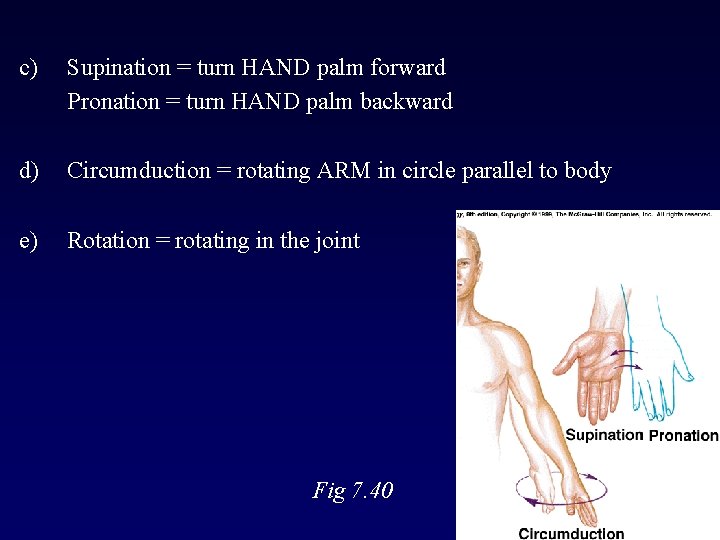
c) Supination = turn HAND palm forward Pronation = turn HAND palm backward d) Circumduction = rotating ARM in circle parallel to body e) Rotation = rotating in the joint Fig 7. 40 33
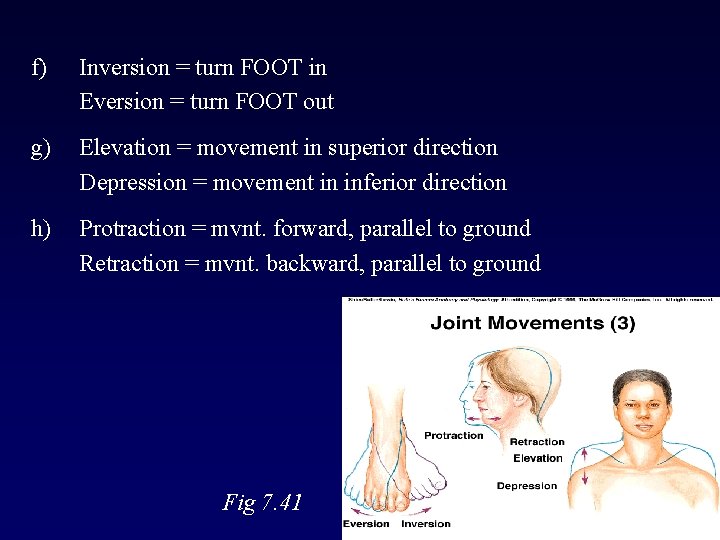
f) Inversion = turn FOOT in Eversion = turn FOOT out g) Elevation = movement in superior direction Depression = movement in inferior direction h) Protraction = mvnt. forward, parallel to ground Retraction = mvnt. backward, parallel to ground Fig 7. 41 34
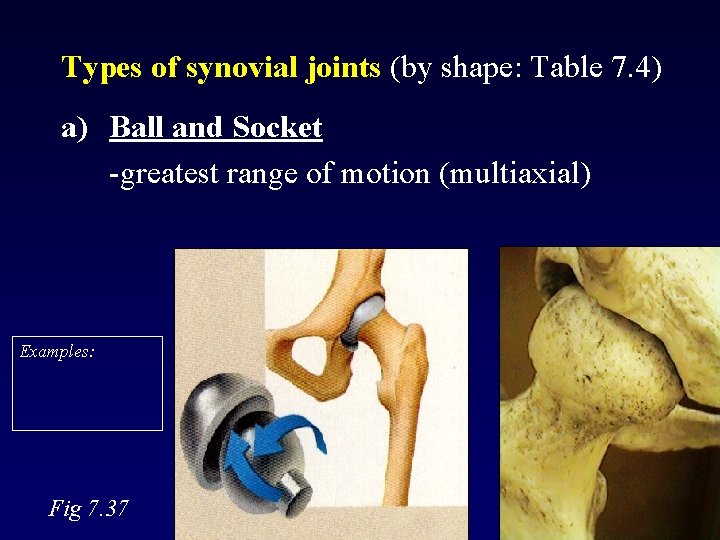
Types of synovial joints (by shape: Table 7. 4) a) Ball and Socket -greatest range of motion (multiaxial) Examples: Fig 7. 37 35
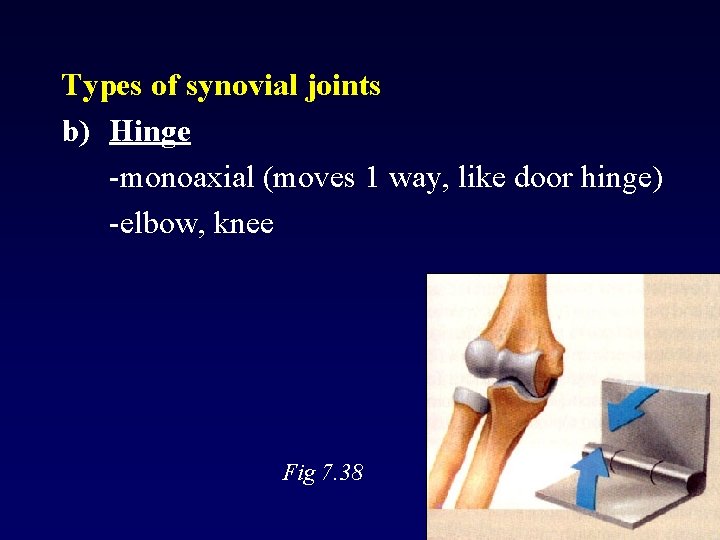
Types of synovial joints b) Hinge -monoaxial (moves 1 way, like door hinge) -elbow, knee Fig 7. 38 36
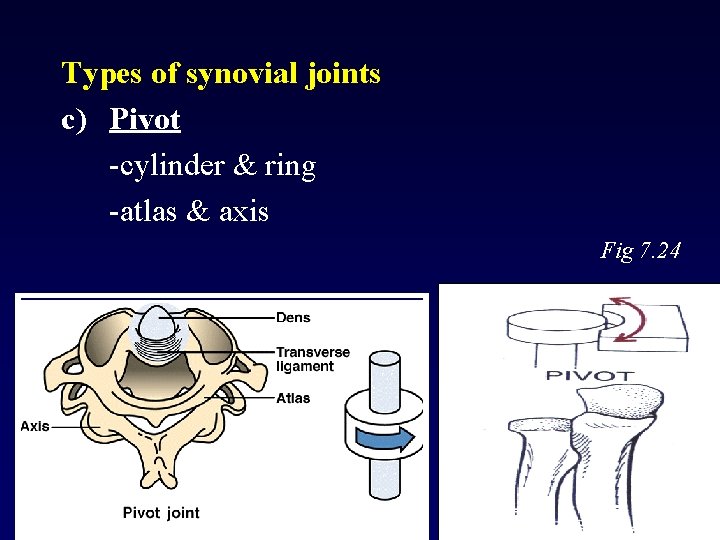
Types of synovial joints c) Pivot -cylinder & ring -atlas & axis Fig 7. 24 37
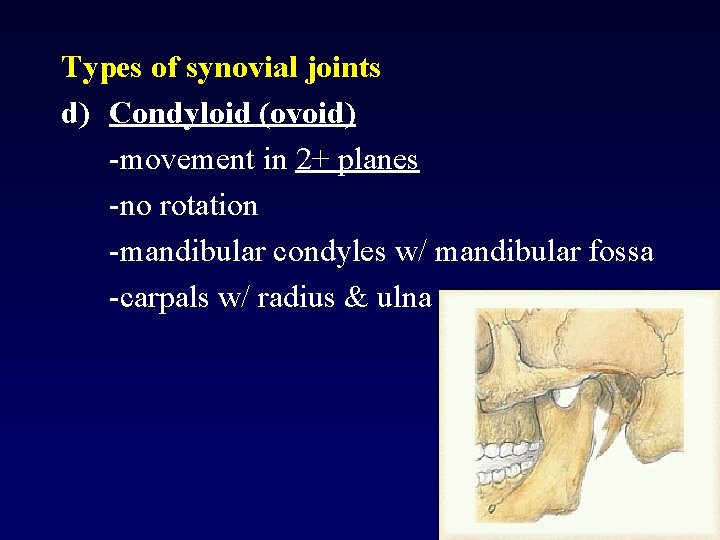
Types of synovial joints d) Condyloid (ovoid) -movement in 2+ planes -no rotation -mandibular condyles w/ mandibular fossa -carpals w/ radius & ulna 38
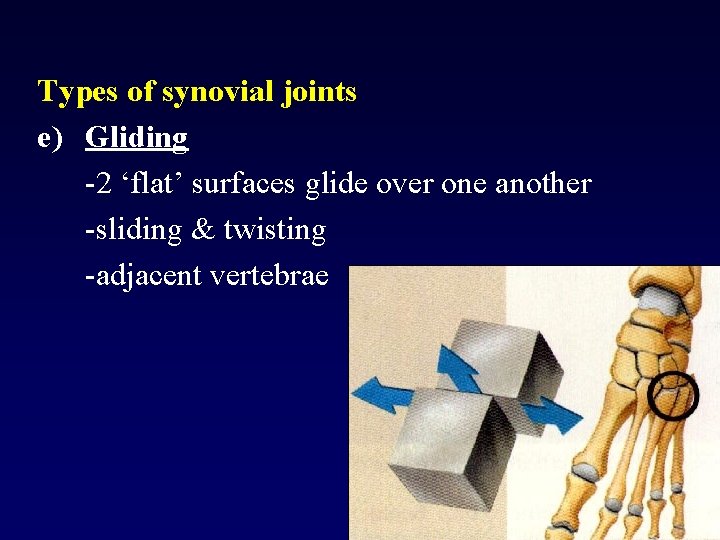
Types of synovial joints e) Gliding -2 ‘flat’ surfaces glide over one another -sliding & twisting -adjacent vertebrae 39
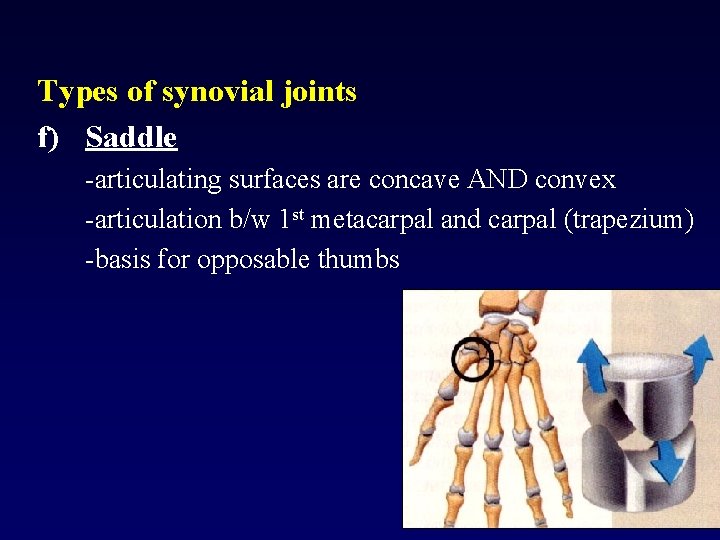
Types of synovial joints f) Saddle -articulating surfaces are concave AND convex -articulation b/w 1 st metacarpal and carpal (trapezium) -basis for opposable thumbs 40
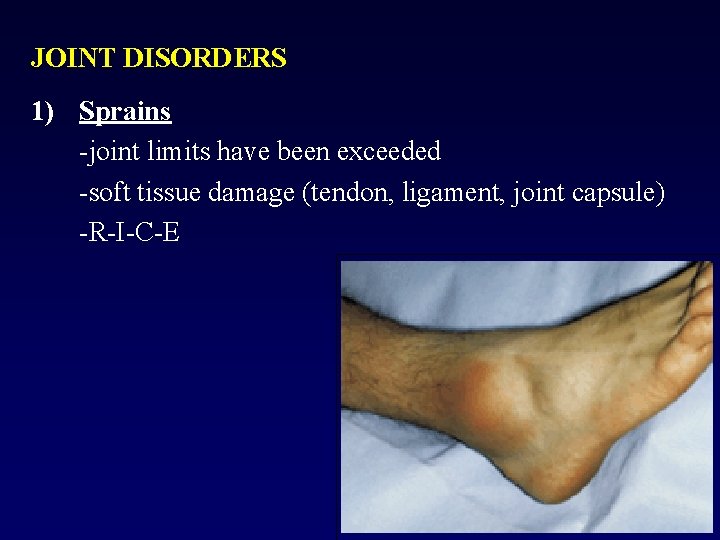
JOINT DISORDERS 1) Sprains -joint limits have been exceeded -soft tissue damage (tendon, ligament, joint capsule) -R-I-C-E 41
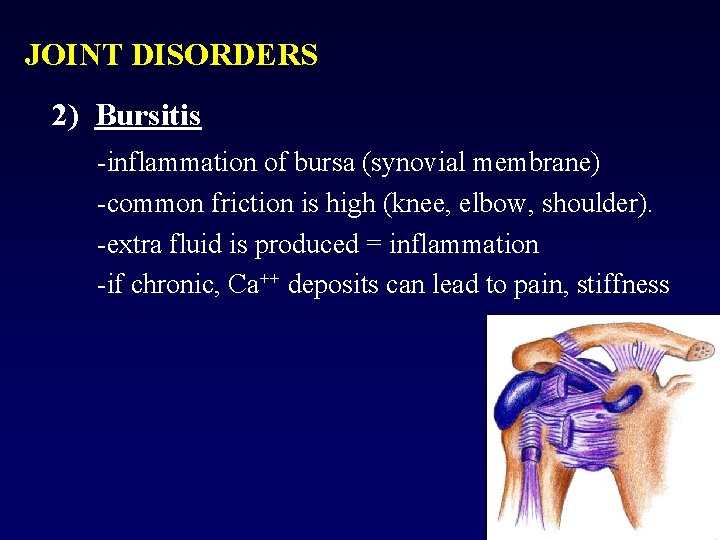
JOINT DISORDERS 2) Bursitis -inflammation of bursa (synovial membrane) -common friction is high (knee, elbow, shoulder). -extra fluid is produced = inflammation -if chronic, Ca++ deposits can lead to pain, stiffness 42
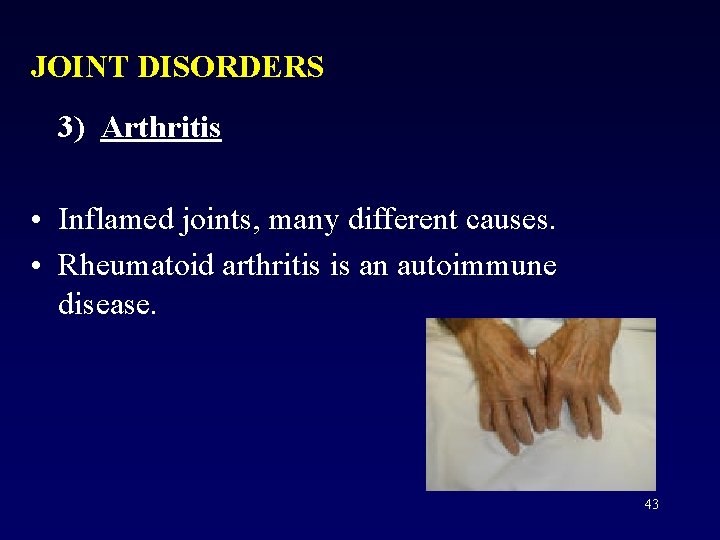
JOINT DISORDERS 3) Arthritis • Inflamed joints, many different causes. • Rheumatoid arthritis is an autoimmune disease. 43
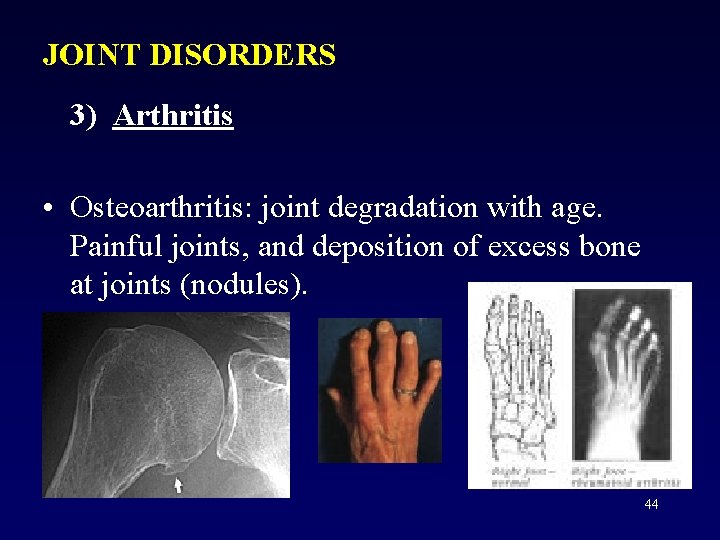
JOINT DISORDERS 3) Arthritis • Osteoarthritis: joint degradation with age. Painful joints, and deposition of excess bone at joints (nodules). 44
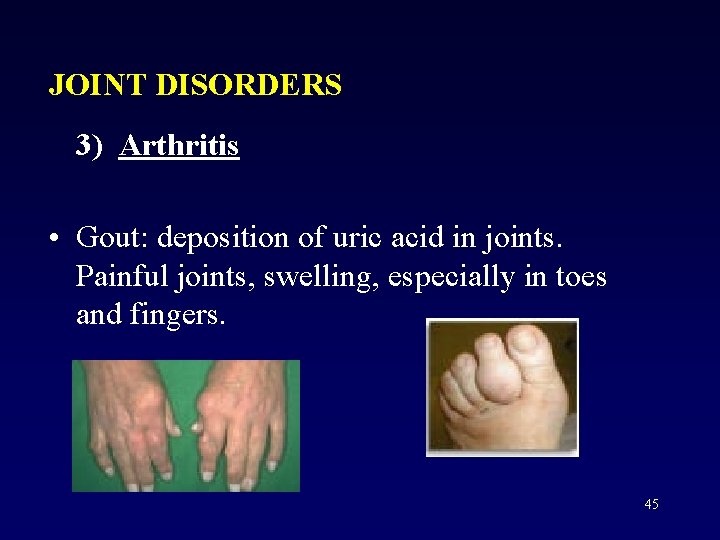
JOINT DISORDERS 3) Arthritis • Gout: deposition of uric acid in joints. Painful joints, swelling, especially in toes and fingers. 45
END of ARTICULATIONS 46