
SKELETAL SYSTEM Chapter 7 Functions of Bones l
SKELETAL SYSTEM Chapter 7
Functions of Bones l Serve as body framework l Protect organs (brain, spinal cord) l Serve as levers for movement l Serve as attachment for tendons l Store calcium salts l Form blood cells
Bones l Skeletal system is composed of 206 bones of the body. Skeletal system includes bones, ligaments, tendons, and cartilage l Bone is a specialized type of connective tissue l Bone cells are osteocytes.
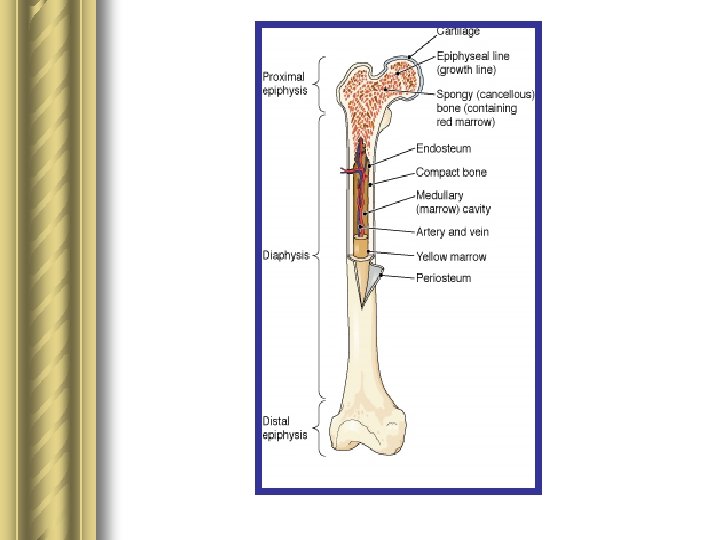
Types of Bone l Cortical or Compact Bone – surrounds the bone marrow cavity and comprises the majority of bone. l Cancellous or Spongy Bone – in end of long bones and lines the medullary marrow cavity

Normal Bone Healing l Inflammatory Process-begins when the fracture occurs and lasts for two days (fracture hematoma) l Cellular Proliferation Stage-begins on 3 rd day l Callus Formation-about 3 -4 weeks l Ossification Stage-longest stage-lasts 34 months l Remodeling-signifies homeostasis; new bone is mature and resumes all normal functions.
Bone Healing Pathology l Nonunion-fractured bone ends do not unite; infection and movement of the fracture site are primary reasons. l Delayed union-abnormal increase in the amount of time it takes for a fracture to heal; osteomalacia, osteoporosis, poor immobilization, distraction l Malunion-fracture heals in an abnormal position that does not represent the original anatomic form-can alter weightbearing and mechanics of the bone.
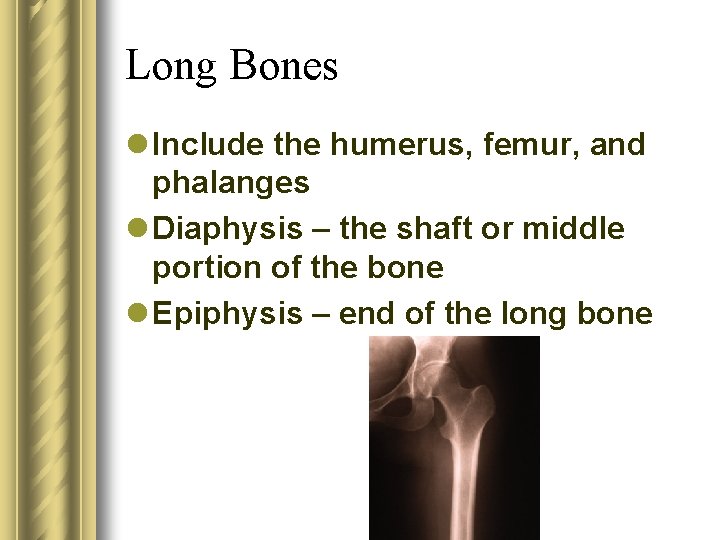
Long Bones l Include the humerus, femur, and phalanges l Diaphysis – the shaft or middle portion of the bone l Epiphysis – end of the long bone
Bone Marrow l Red Bone Marrow- located in spongy bone. -Functions in the production of erythrocytes, leukocytes, and platelets. l Yellow Bone Marrow – in the central cavity of long bones (contains fat) -Highly vascular and supplies the cortex of the bone.
Bone Membranes l Contain bone-forming cells l Periosteum – covers bone -provides a layer of defense to protect the bone from infection - inner elastic layer is the area where new bone is formed -is permeated with nerves and blood vessels, which aid in nourishing the underlying bone -outer collagenous layer serves as an area of attachment that merges with those of the tendons and ligaments l Endosteum – line marrow cavity

Bone Growth and Repair l Osteoblasts – bone forming cells l Osteocytes – mature bone cells that maintain bone l Osteoclasts – cells that break down (reabsorb) bone; derived from monocytes (types of WBC’s) l Formation of long bone – begins in center of shaft and continues at epiphyseal plate

Bone Markings l Projections -Head – the enlarged, rounded, proximal portion of a bone usually a long bone. -Process – Natural growth that projects from a bone (Condyle). -Condyle – Rounded projection/process at the epiphysis of a bone that articulates with another bone and serves as the point of attachment for ligaments. -Crest – a distinct border or ridge, often rough (over the top of the hip bone). -Spine – a sharp projection from the surface of a bone (shoulder blade).

Bone Markings Continued l Depressions and Holes -Foramen – a hole that allows a vessel or a nerve to pass through or between bones. -Sinus – an air space found in some skull bones. -Fossa – a depression on a bone surface. -Meatus – a short channel or passageway.
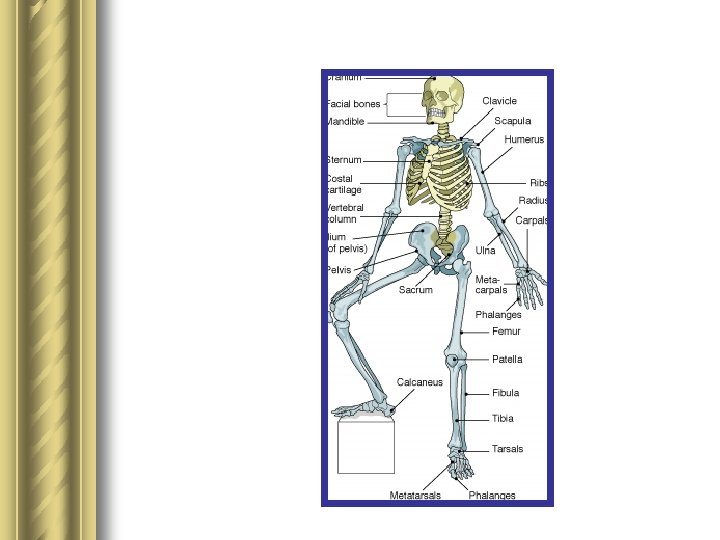
Two Main Groups of Bones l Axial Skeleton consists of 80 bones; includes the bony framework of the head and trunk l Appendicular skeleton consists of 126 bones; forms the framework for the extremities (limbs) and for shoulders and hips
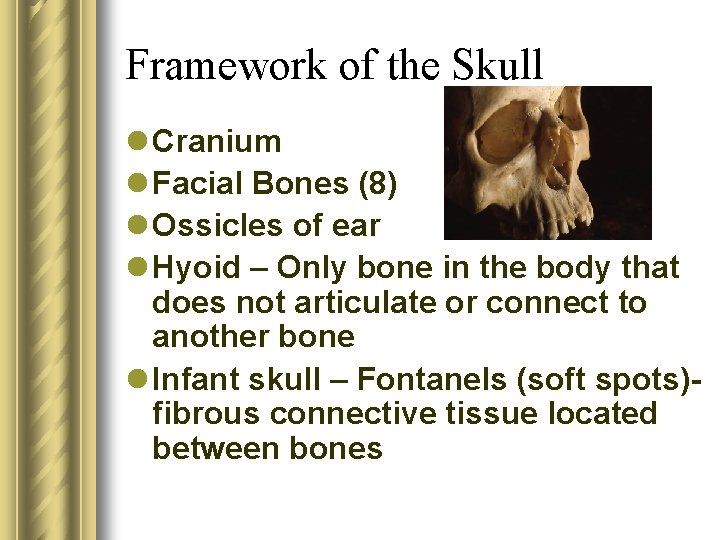
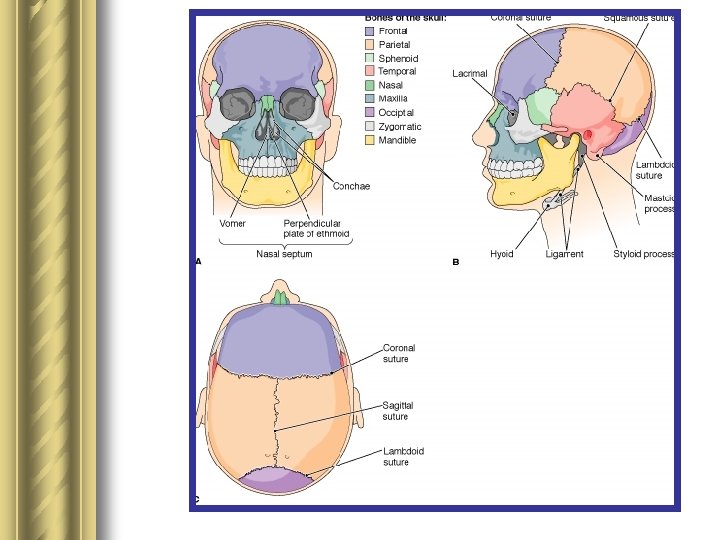
Framework of the Skull l Cranium l Facial Bones (8) l Ossicles of ear l Hyoid – Only bone in the body that does not articulate or connect to another bone l Infant skull – Fontanels (soft spots)fibrous connective tissue located between bones
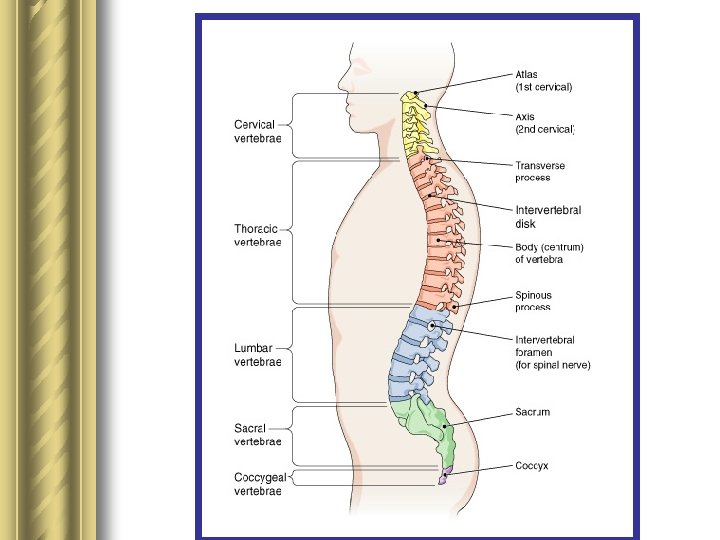
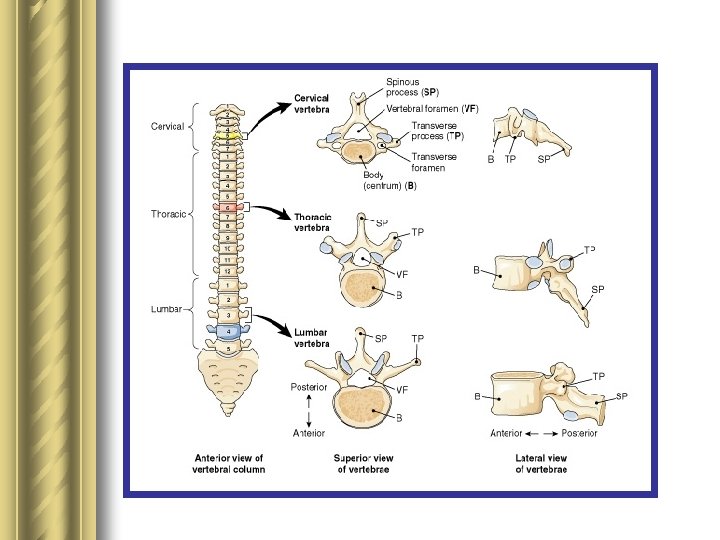
Framework of the Trunk l Vertebral Column- begins close to the foramen magnum of the skull and extends posteriorly to the pelvis. - Cervical – 7 (Convex) C 1 -C 7 - Thoracic – 12 (Concave)T 1 -T 12 - Lumbar – 5 (Convex)L 1 -L 5 - Sacral – 5 fused (Concave) - Coccygeal – 3 -4
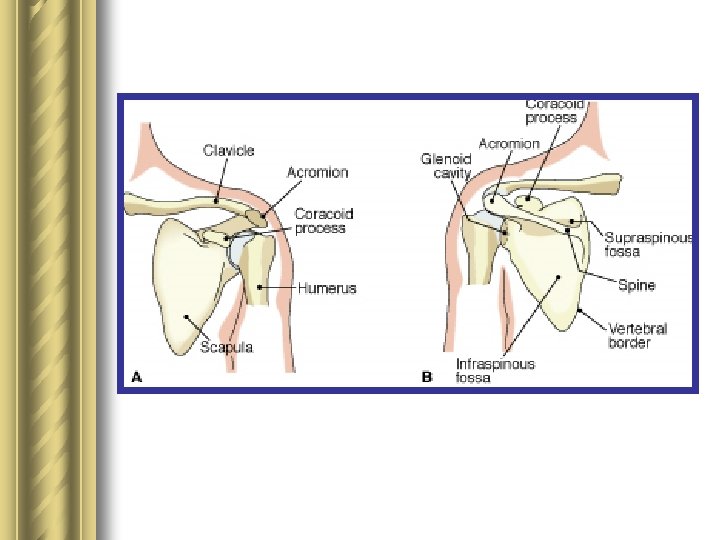
Bones of Upper Division l Shoulder girdle – clavicle or collarbone, scapula l Upper extremity – humerus (largest bone in the upper trunk), ulna, radius, carpals, metacarpals, phalanges Olecranon is the end of the ulna that forms the elbow. Carpal bones 8 in two rows of four Metacarpal bones (5) form the framework for the palm; distal ends are knuckles Phalanges (14) finger bones; identified as first (proximal), second (middle) or third (distal)
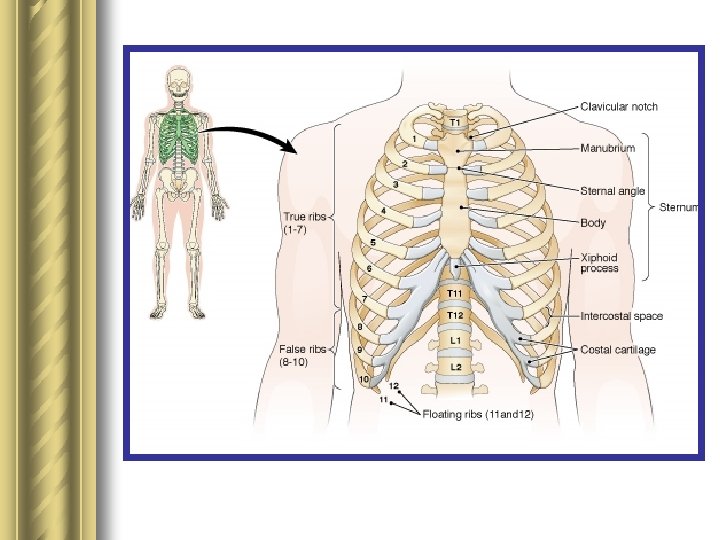
Framework of the Trunk continued: l Thorax Sternum – manubrium, body xiphoid process Ribs -True ribs – First seven pairs -False ribs – Remaining five pairs, of which two are floating pairs Intercostal spaces – spaces between ribs, which contains muscles, blood vessels, and nerves.
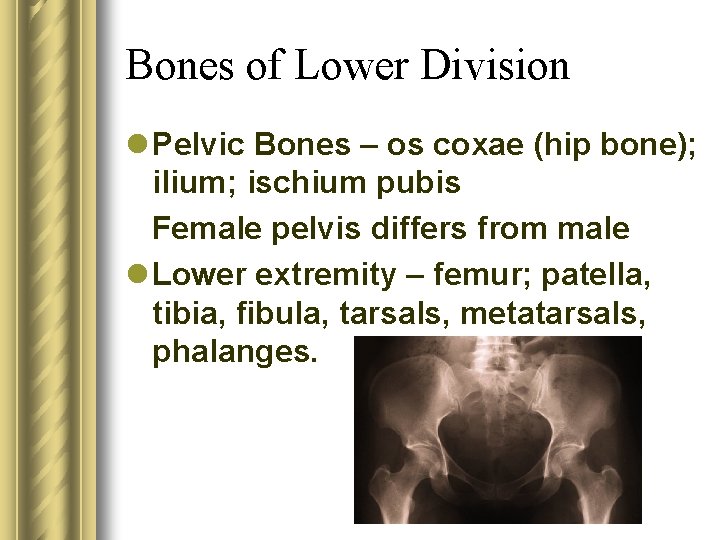
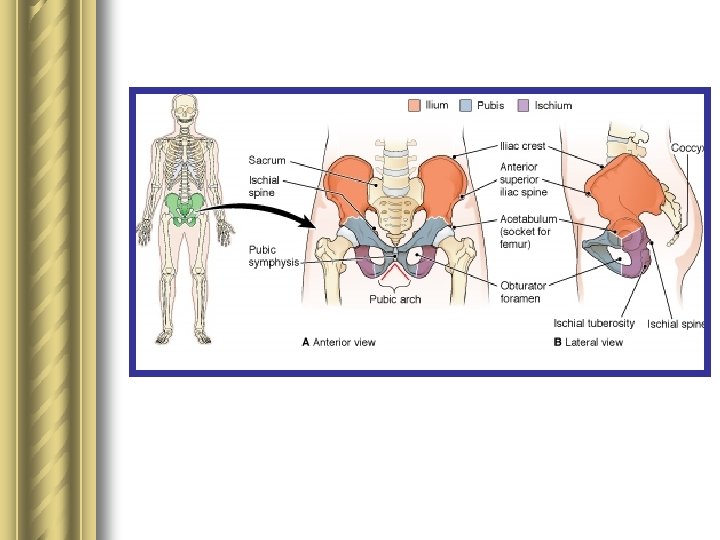
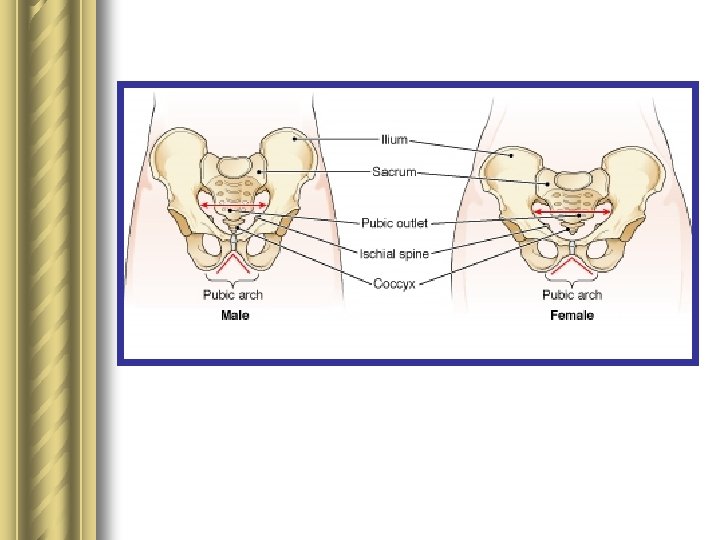
Bones of Lower Division l Pelvic Bones – os coxae (hip bone); ilium; ischium pubis Female pelvis differs from male l Lower extremity – femur; patella, tibia, fibula, tarsals, metatarsals, phalanges.
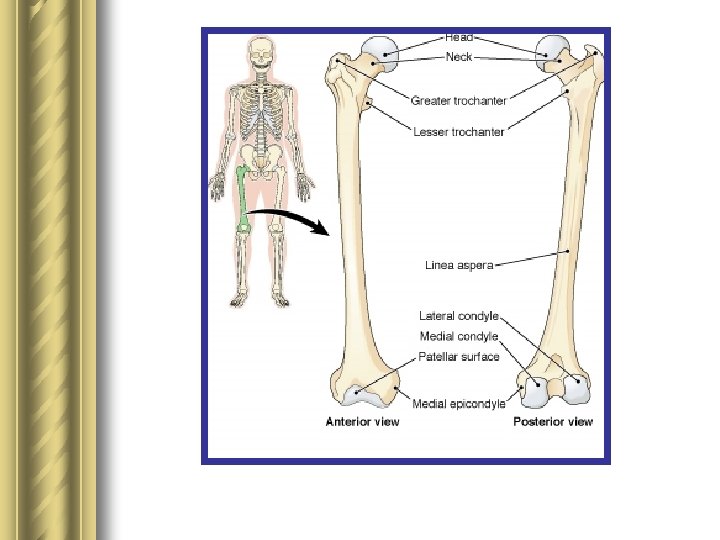
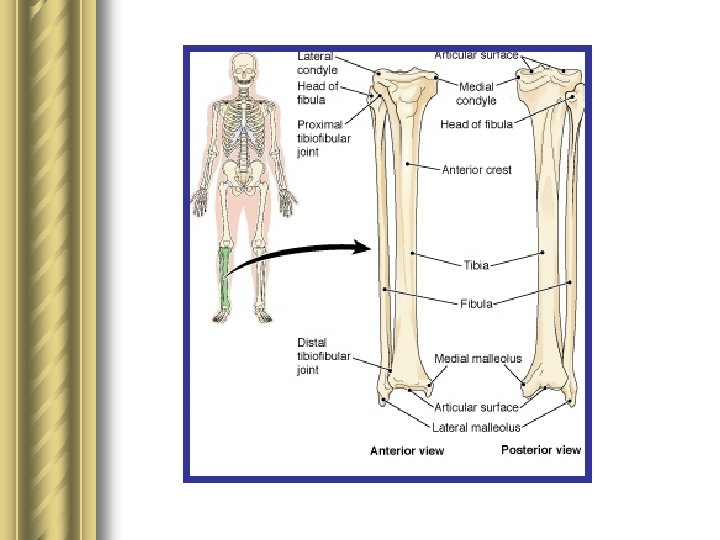
Lower Extremity Femur – longest and strongest bone in the body; large ball-shaped head that joins the hip bone. Large lateral projection near the head of the femur – greater trochanter (surface landmark) Smaller elevation located on the medial side – lesser trochanter Patella – sesamoid bone – develops within a tendon or joint capsule. Tibia - medial side (great toe side) shin bone and is the longer weight bearing bone. Fibula – lateral; is not weight bearing Tarsals- 7; largest is the calcaneus or heel bone Metatarsals – 5; framework of the instep
Disorders of Bone l Lack of normal bone formation or excess loss of bone tissue = metabolic disorders l Tumors l Infections l Structural problems – malformation or fractures
Metabolic Disorders l Osteoporosis – fragile and break easy – spine, pelvis, long bones l Osteopenia – bone lose (decrease bone density) l Paget’s disease (osteitis deformans) – deformed bones due to calcium deposits and calcium loss l Osteomalacia (in children, rickets) – soft bone – Vitamin D deficiency, liver, renal and certain intestinal disorders
Tumors Two types found in bone tissue l Benign - cysts l Malignant – Osteosarcomas – young people – bone growing region (knee) – Chondrosarcomas – midlife - cartilage
Infection Two types found in bone tissue l Osteomyelitis – Inflammation of the bone caused by pyogenic bacteria l Tuberculosis – Pott disease (tuberculosis of the spine)
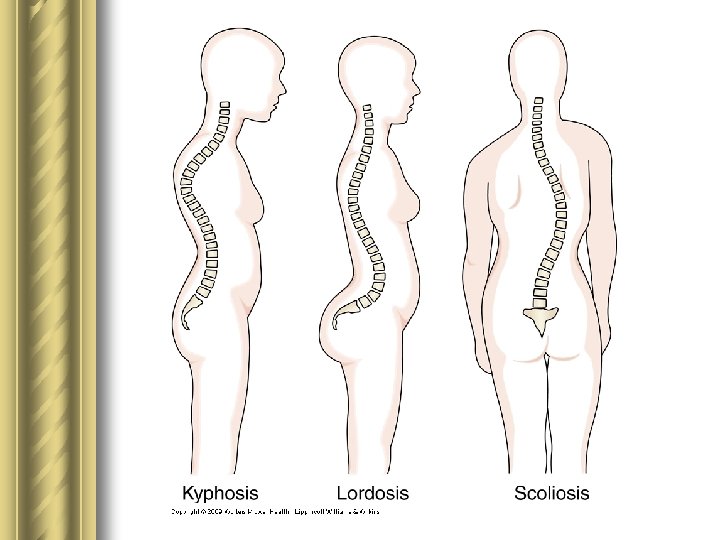
Structural Disorders l Curvatures of the spine – Kyphosis (hunchback) – Lordosis (swayback) – Scoliosis (curvature) l Cleft palate l Flatfoot
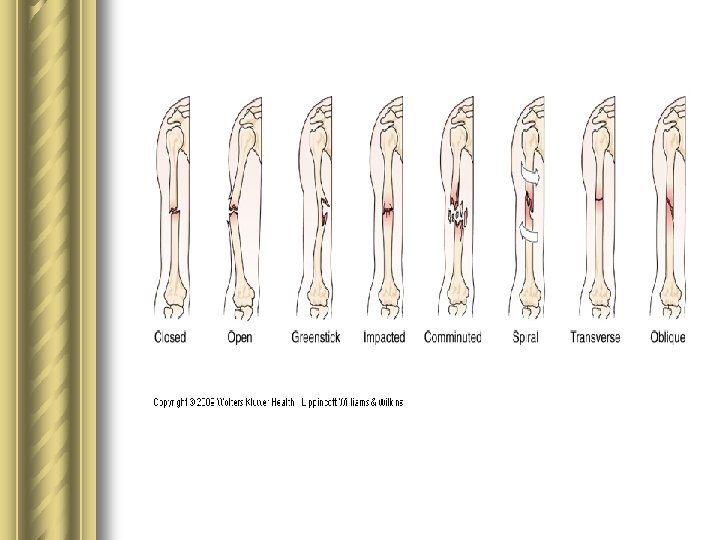
Fractures Types of fractures l Closed l Open l Greenstick l Impacted l Comminuted l Spiral l Transverse l Oblique
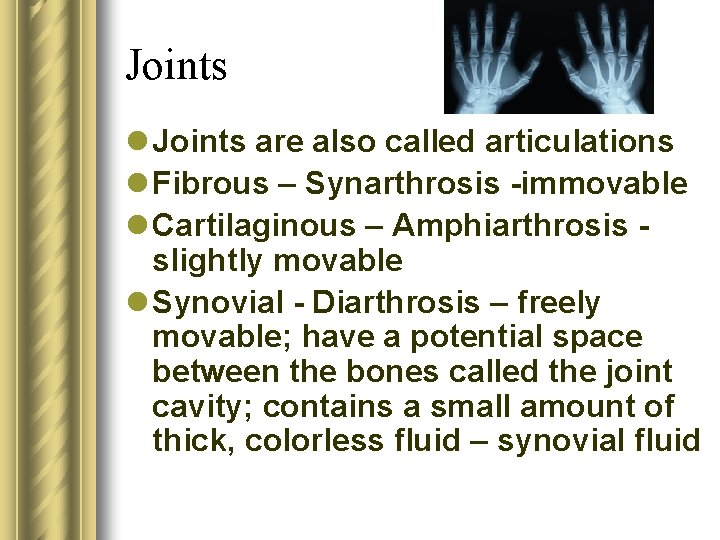
Joints l Joints are also called articulations l Fibrous – Synarthrosis -immovable l Cartilaginous – Amphiarthrosis slightly movable l Synovial - Diarthrosis – freely movable; have a potential space between the bones called the joint cavity; contains a small amount of thick, colorless fluid – synovial fluid
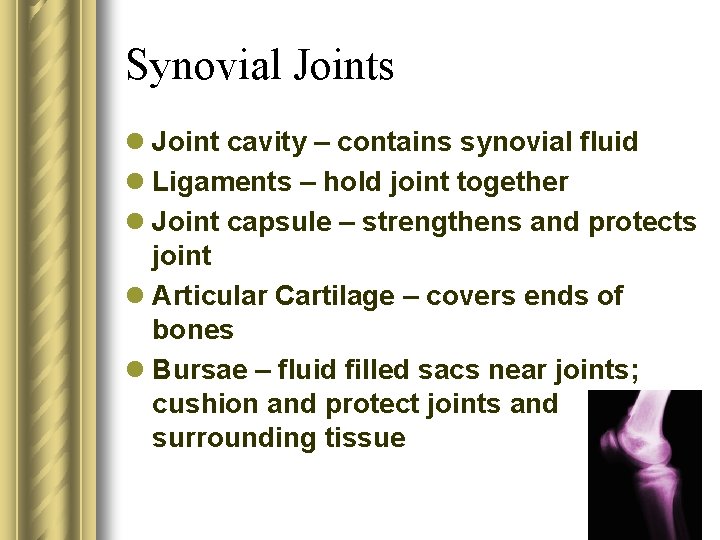
Synovial Joints l Joint cavity – contains synovial fluid l Ligaments – hold joint together l Joint capsule – strengthens and protects joint l Articular Cartilage – covers ends of bones l Bursae – fluid filled sacs near joints; cushion and protect joints and surrounding tissue
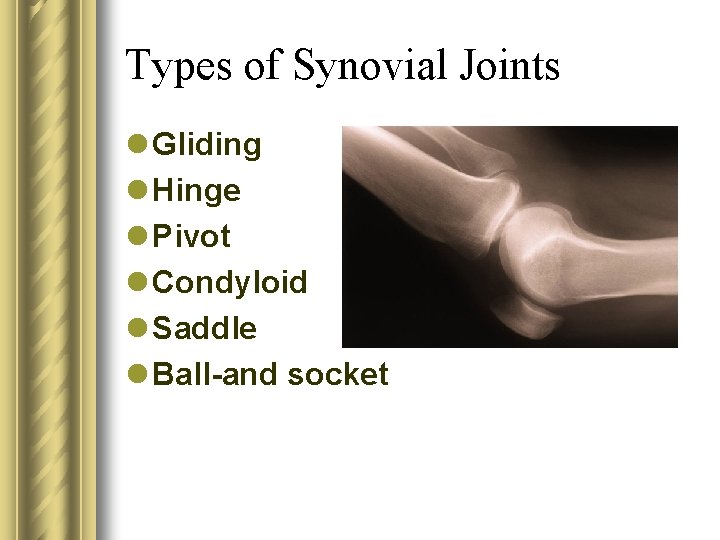
Types of Synovial Joints l Gliding l Hinge l Pivot l Condyloid l Saddle l Ball-and socket
Movement of Synovial Joints l Angular – flexion, extension, abduction, adduction l Circular – circumduction, rotation l Special at forearm – supination, pronation l Special at ankle – inversion, eversion, dorsiflexion, plantar flexion
Disorders of Joints l Mechanical disorders – Dislocation – Sprain l Herniated disk l Arthritis – – Osteoarthritis (degenerative joint disease [DJD]) Rheumatoid arthritis Septic (infectious) arthritis Gout – type of arthritis caused by metabolic disorder l Backache – – – Vertebrae diseases Intervertebral disk disorders Supporting structure abnormalities Abdominopelvic disorders Lumbosacral joint strains
Joint Repair l Arthroscope – type of endoscope for joints (knees, ankles, shoulders) l Arthrocentesis – withdrawing fluid from joint cavity l Arthroplasty – Joint replacement
Don’t Forget: l Word Anatomy – pages 154 -155
- Slides: 45