
Skeletal Muscle Functions Produce movement Maintain posture Stabilize
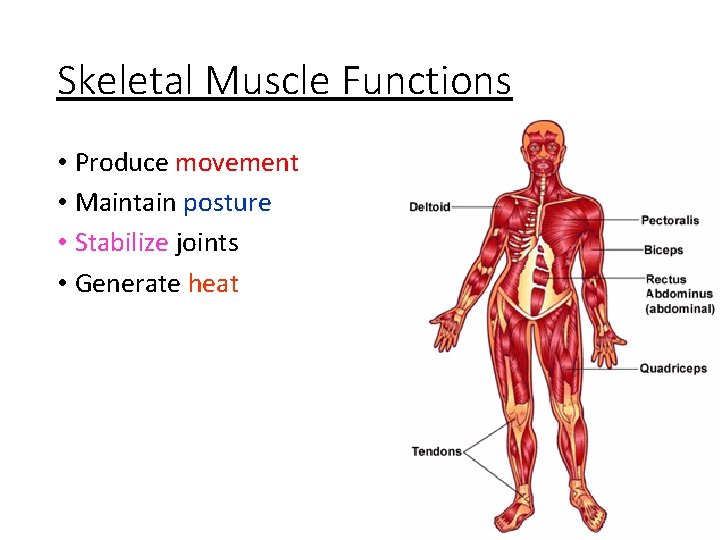
Skeletal Muscle Functions • Produce movement • Maintain posture • Stabilize joints • Generate heat
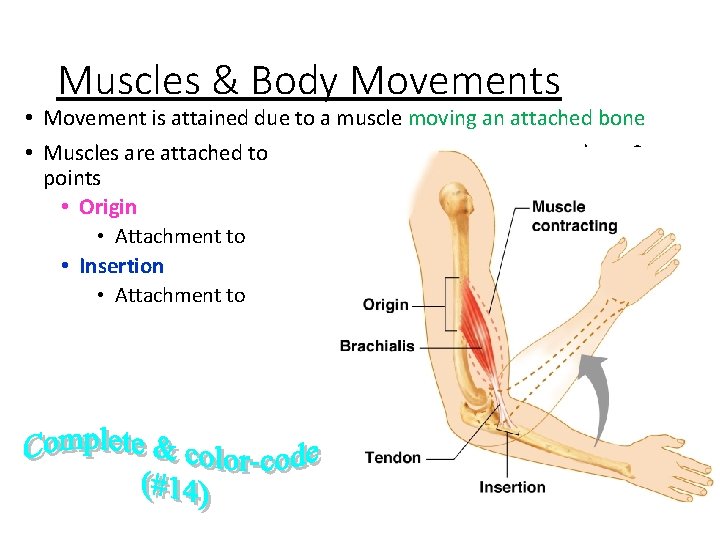
Muscles & Body Movements • Movement is attained due to a muscle moving an attached bone • Muscles are attached to at least 2 points • Origin • Attachment to immoveable bone • Insertion • Attachment to movable bone
Types of Muscles • Prime mover—muscle with major responsibility for a certain movement • Antagonist—muscle that opposes or reverses a prime mover • Synergist—muscle that aids a prime mover in a movement & helps prevent rotation • Fixator—stabilizes origin of a prime mover
Naming Skeletal Muscles • By direction of muscle fibers • Examples • Rectus (straight) • Transverse (horizontal) • Oblique (angle) • By relative size of the muscle • Examples • Maximus (largest) • Minimus (smallest) • Longus (longest) • By location of the muscle • Examples • Temporalis (temporal bone) • Occipitalis (occipital bone) • By number of origins • Examples • Triceps (3 heads) • Biceps (2 heads) • Quadriceps (4 muscles in group)
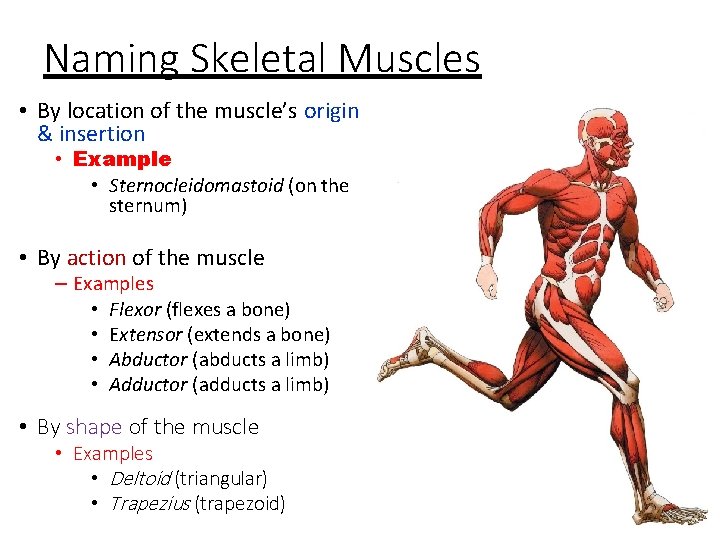
Naming Skeletal Muscles • By location of the muscle’s origin & insertion • Example • Sternocleidomastoid (on the sternum) • By action of the muscle – Examples • Flexor (flexes a bone) • Extensor (extends a bone) • Abductor (abducts a limb) • Adductor (adducts a limb) • By shape of the muscle • Examples • Deltoid (triangular) • Trapezius (trapezoid)
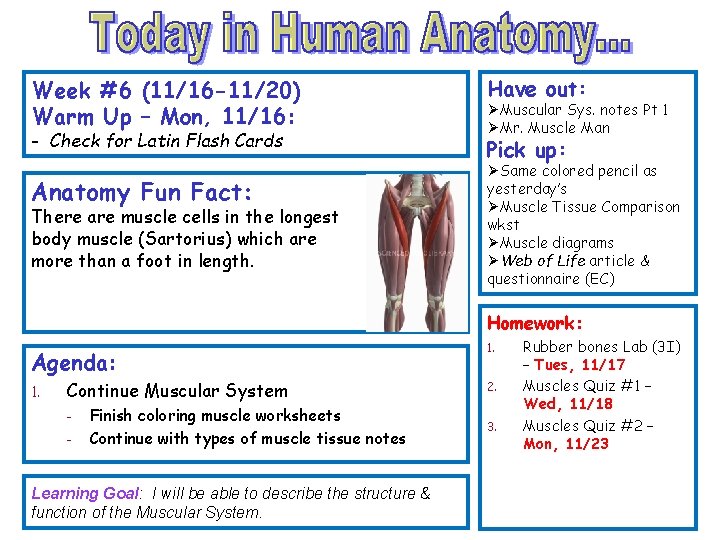
Week #6 (11/16 -11/20) Warm Up – Mon, 11/16: - Check for Latin Flash Cards Anatomy Fun Fact: There are muscle cells in the longest body muscle (Sartorius) which are more than a foot in length. Have out: ØMuscular Sys. notes Pt 1 ØMr. Muscle Man Pick up: ØSame colored pencil as yesterday’s ØMuscle Tissue Comparison wkst ØMuscle diagrams ØWeb of Life article & questionnaire (EC) Homework: Agenda: 1. Continue Muscular System - Finish coloring muscle worksheets Continue with types of muscle tissue notes Learning Goal: I will be able to describe the structure & function of the Muscular System. 1. 2. 3. Rubber bones Lab (3 I) – Tues, 11/17 Muscles Quiz #1 – Wed, 11/18 Muscles Quiz #2 – Mon, 11/23
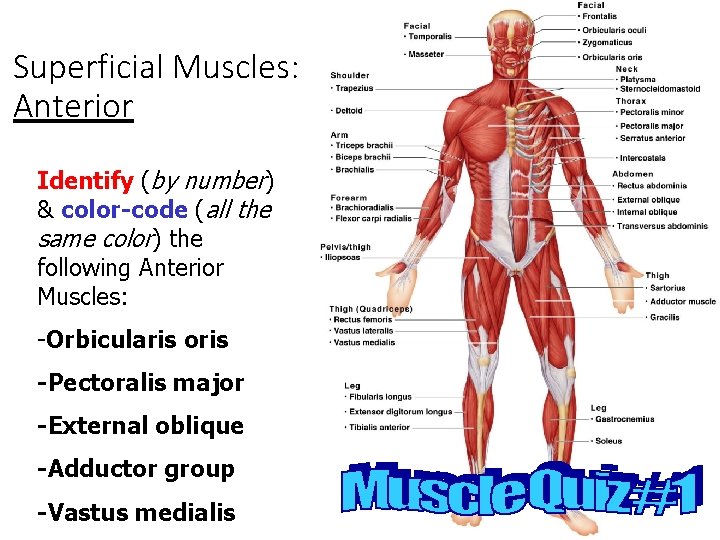
Superficial Muscles: Anterior Identify (by number) & color-code (all the same color) the following Anterior Muscles: -Orbicularis oris -Pectoralis major -External oblique -Adductor group -Vastus medialis
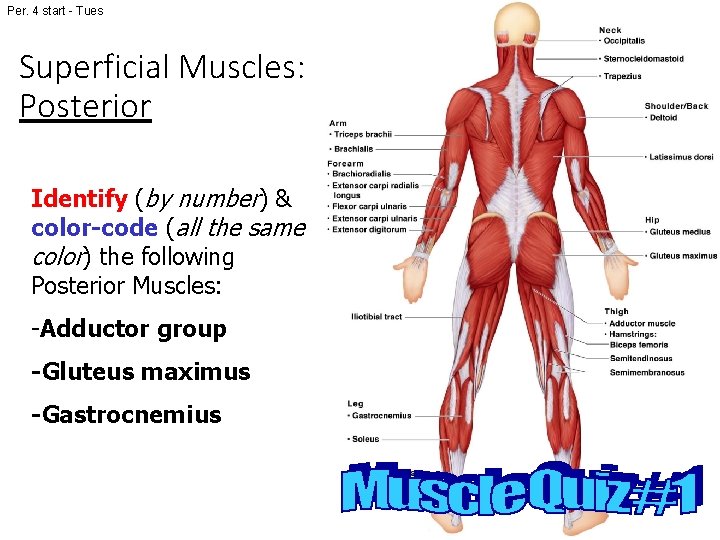
Per. 4 start - Tues Superficial Muscles: Posterior Identify (by number) & color-code (all the same color) the following Posterior Muscles: -Adductor group -Gluteus maximus -Gastrocnemius
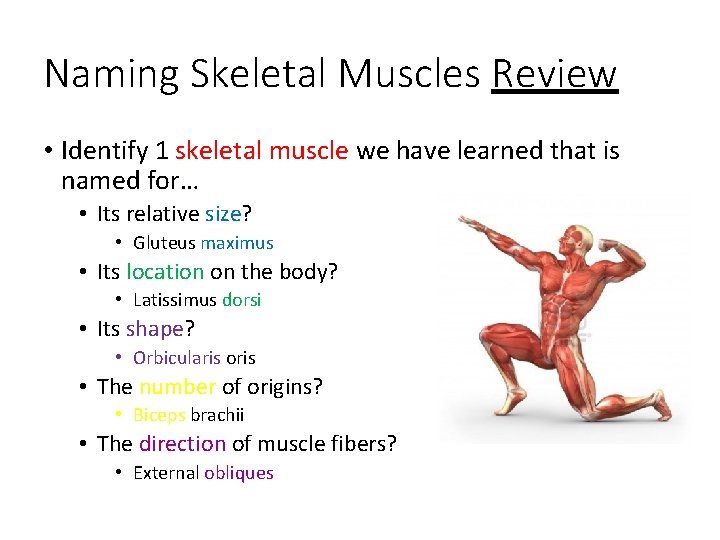
Naming Skeletal Muscles Review • Identify 1 skeletal muscle we have learned that is named for… • Its relative size? • Gluteus maximus • Its location on the body? • Latissimus dorsi • Its shape? • Orbicularis oris • The number of origins? • Biceps brachii • The direction of muscle fibers? • External obliques
Have out your Muscle Tissue Comparison checklist… 3!
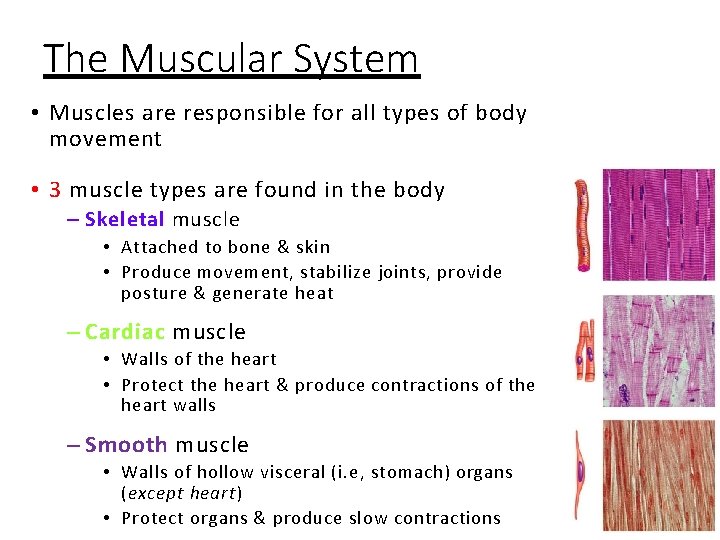
The Muscular System • Muscles are responsible for all types of body movement • 3 muscle types are found in the body – Skeletal muscle • Attached to bone & skin • Produce movement, stabilize joints, provide posture & generate heat – Cardiac muscle • Walls of the heart • Protect the heart & produce contractions of the heart walls – Smooth muscle • Walls of hollow visceral (i. e, stomach) organs (except heart) • Protect organs & produce slow contractions
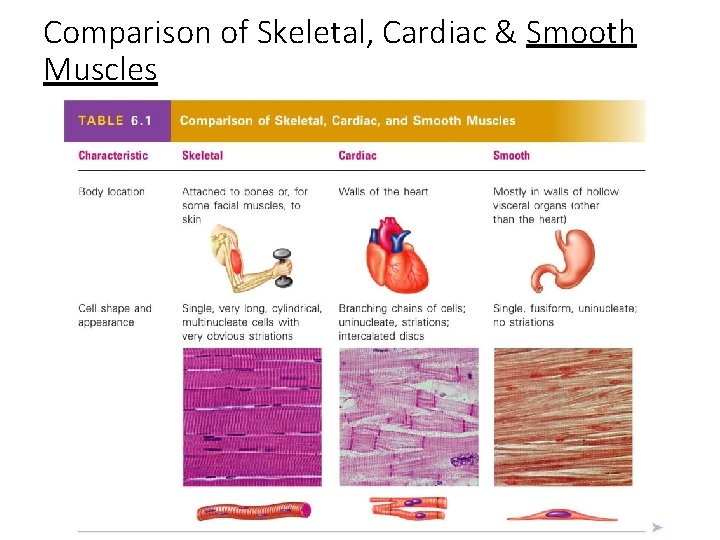
Comparison of Skeletal, Cardiac & Smooth Muscles
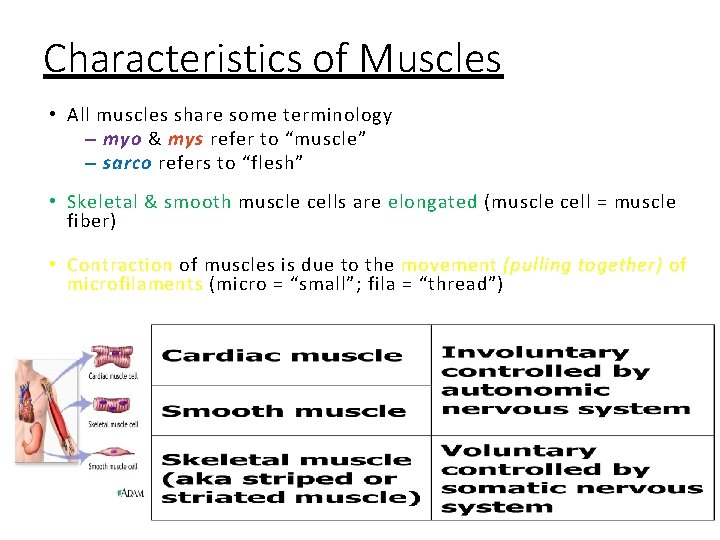
Characteristics of Muscles • All muscles share some terminology – myo & mys refer to “muscle” – sarco refers to “flesh” • Skeletal & smooth muscle cells are elongated (muscle cell = muscle fiber) • Contraction of muscles is due to the movement (pulling together) of microfilaments (micro = “small”; fila = “thread”)
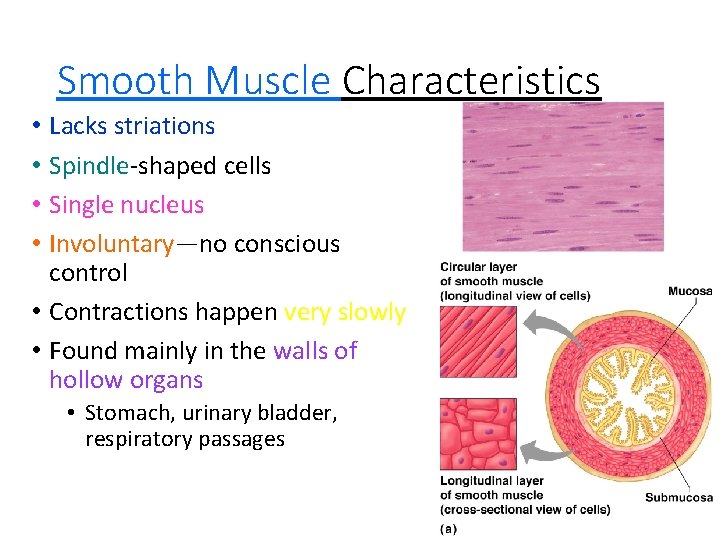
Smooth Muscle Characteristics Lacks striations Spindle-shaped cells Single nucleus Involuntary—no conscious control • Contractions happen very slowly • Found mainly in the walls of hollow organs • • • Stomach, urinary bladder, respiratory passages
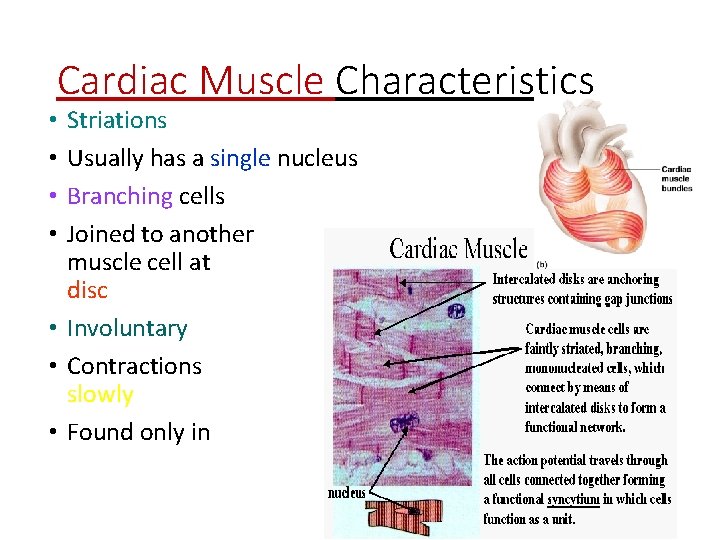
Cardiac Muscle Characteristics Striations Usually has a single nucleus Branching cells Joined to another muscle cell at disc • Involuntary • Contractions slowly • Found only in • • an intercalated happen the heart
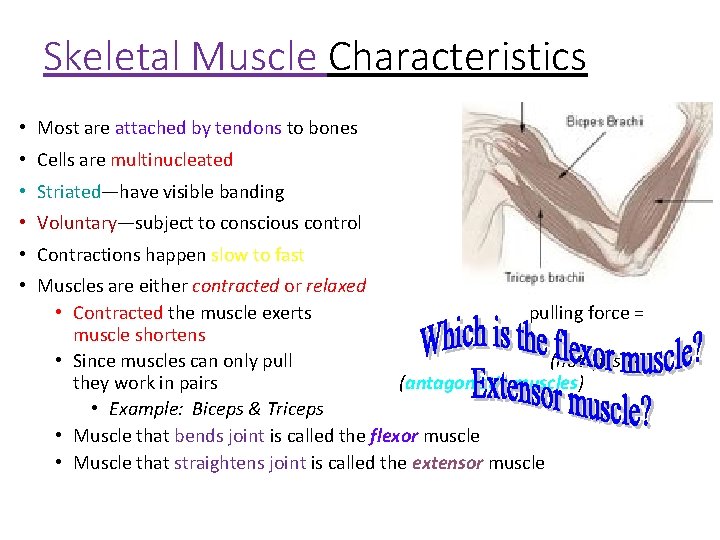
Skeletal Muscle Characteristics • Most are attached by tendons to bones • Cells are multinucleated • Striated—have visible banding • Voluntary—subject to conscious control • Contractions happen slow to fast • Muscles are either contracted or relaxed • Contracted the muscle exerts pulling force = muscle shortens • Since muscles can only pull (not push), they work in pairs (antagonistic muscles) • Example: Biceps & Triceps • Muscle that bends joint is called the flexor muscle • Muscle that straightens joint is called the extensor muscle
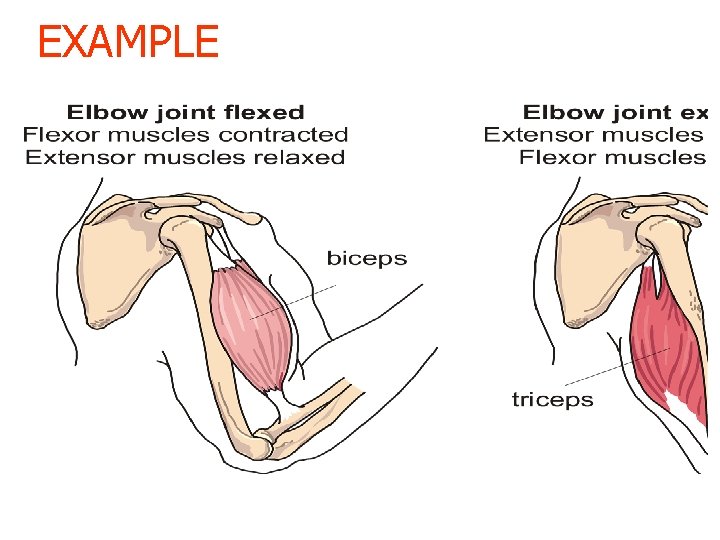
EXAMPLE
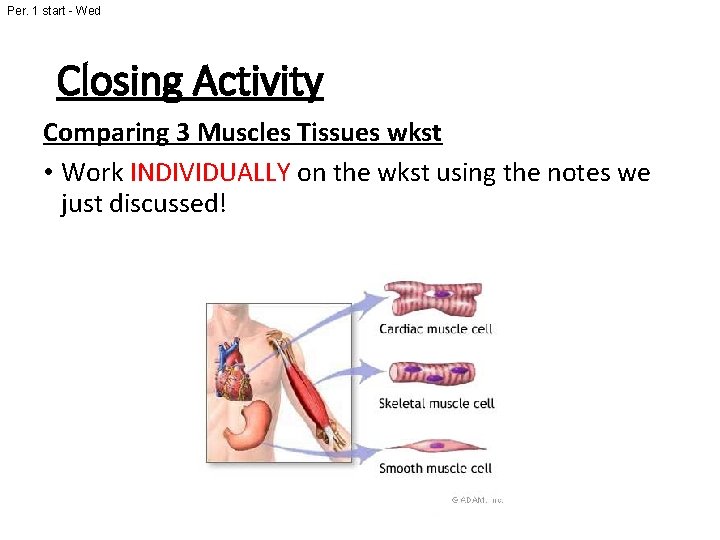
Per. 1 start - Wed Closing Activity Comparing 3 Muscles Tissues wkst • Work INDIVIDUALLY on the wkst using the notes we just discussed!
Week #6 (11/17 -11/21) Warm Up – Wed, 11/18: - Review Quiz #1 Muscle Group Anatomy Fun Fact: Muscles in the middle of the ear are the smallest muscles present in the human body. Turn in: ØNothing Pick up: ØComparing the 3 muscles tissues wkst Ø 4 colored pencils ØMuscle Worksheets Agenda: 1. 2. 3. 4. Muscles Quiz #1 Identify Muscle Quiz #2 Muscles Notes: Finish Types of Muscle Tissue Microscope Activity: Types of Muscle Tissue Learning Goal: I will be able to describe the structure & function of the Muscular System. Homework: 1. Muscles Quiz #2 – Mon, 11/23
Muscles to Identify Quiz #1 • Pick up 1 colored pencil (ALL muscles will be color-code with 1 color). • QUIETLY take the quiz & turn it in to the Hmwk Bin when finished. • Take out Mr. Muscles, your other muscle diagrams & flashcards for your next set of muscles (Quiz #2)!
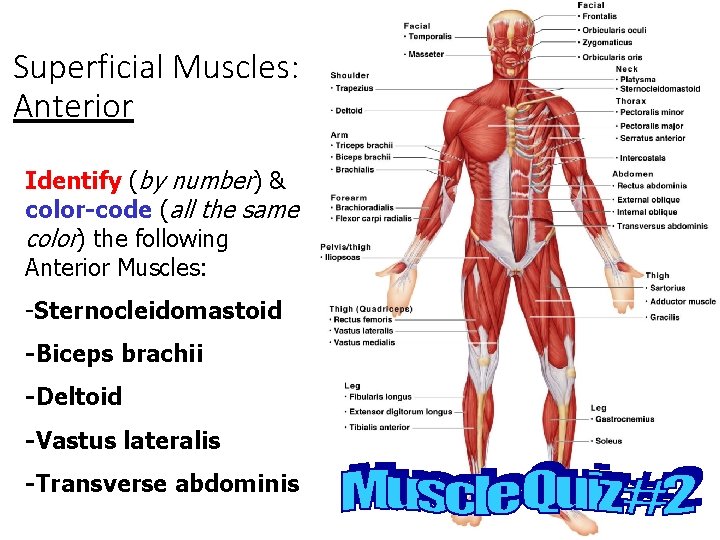
Superficial Muscles: Anterior Identify (by number) & color-code (all the same color) the following Anterior Muscles: -Sternocleidomastoid -Biceps brachii -Deltoid -Vastus lateralis -Transverse abdominis
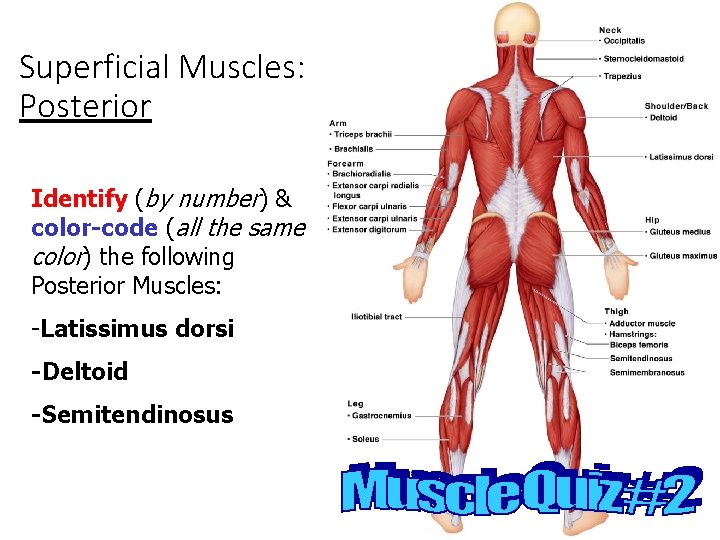
Superficial Muscles: Posterior Identify (by number) & color-code (all the same color) the following Posterior Muscles: -Latissimus dorsi -Deltoid -Semitendinosus
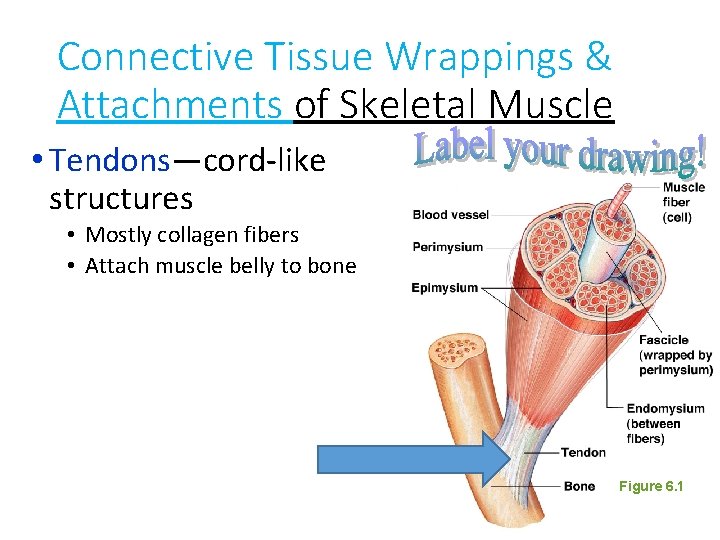
Connective Tissue Wrappings & Attachments of Skeletal Muscle • Tendons—cord-like structures • Mostly collagen fibers • Attach muscle belly to bone Figure 6. 1
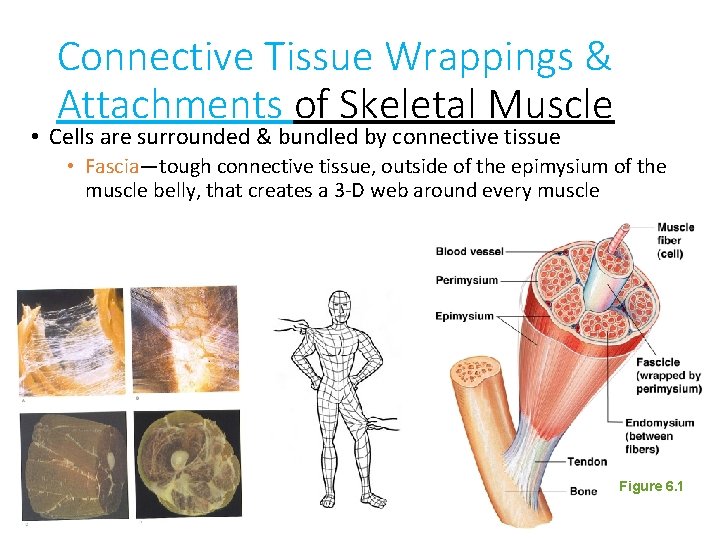
Connective Tissue Wrappings & Attachments of Skeletal Muscle • Cells are surrounded & bundled by connective tissue • Fascia—tough connective tissue, outside of the epimysium of the muscle belly, that creates a 3 -D web around every muscle Figure 6. 1
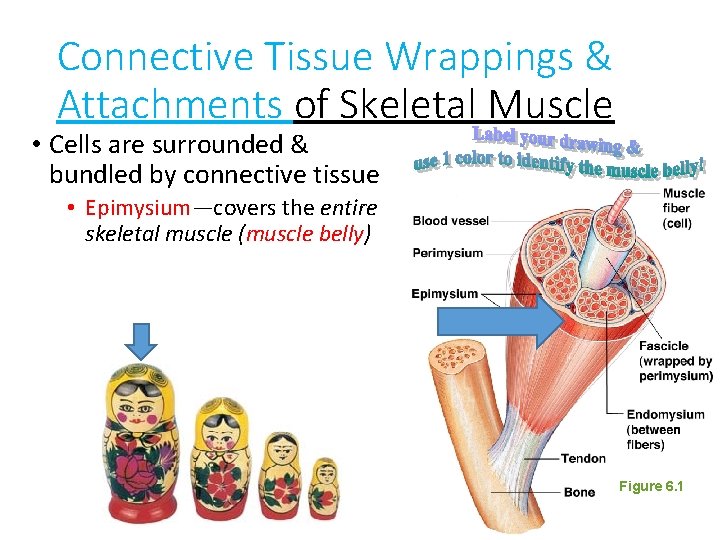
Connective Tissue Wrappings & Attachments of Skeletal Muscle • Cells are surrounded & bundled by connective tissue • Epimysium—covers the entire skeletal muscle (muscle belly) Figure 6. 1
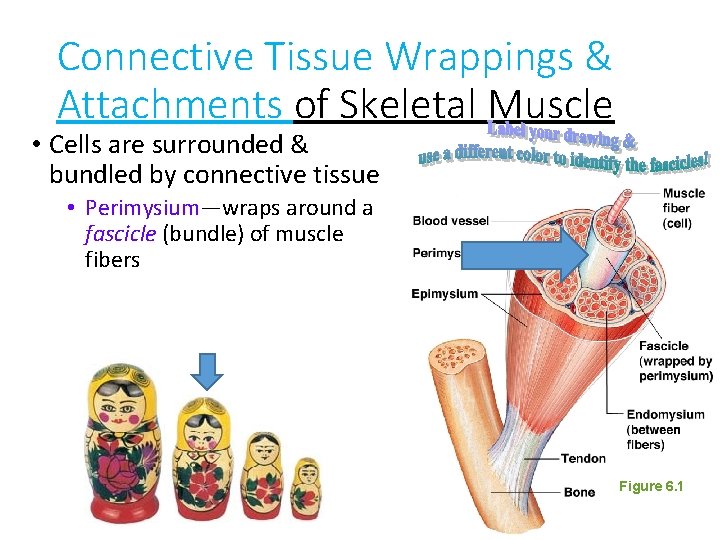
Connective Tissue Wrappings & Attachments of Skeletal Muscle • Cells are surrounded & bundled by connective tissue • Perimysium—wraps around a fascicle (bundle) of muscle fibers Figure 6. 1
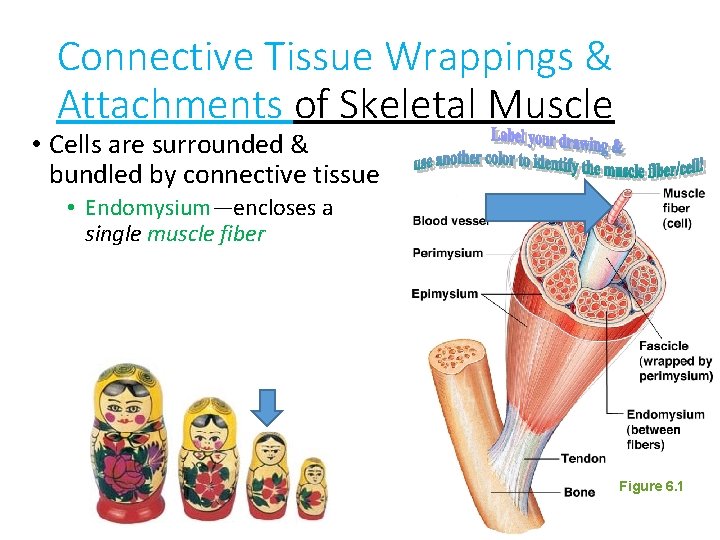
Connective Tissue Wrappings & Attachments of Skeletal Muscle • Cells are surrounded & bundled by connective tissue • Endomysium—encloses a single muscle fiber Figure 6. 1
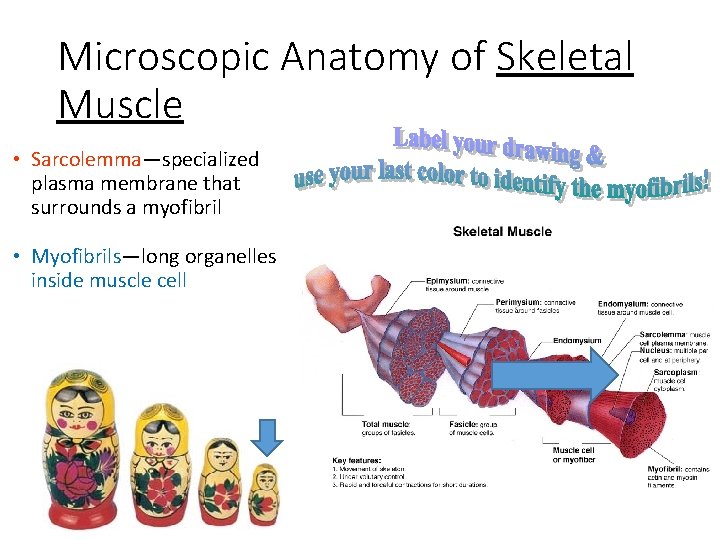
Microscopic Anatomy of Skeletal Muscle • Sarcolemma—specialized plasma membrane that surrounds a myofibril • Myofibrils—long organelles inside muscle cell
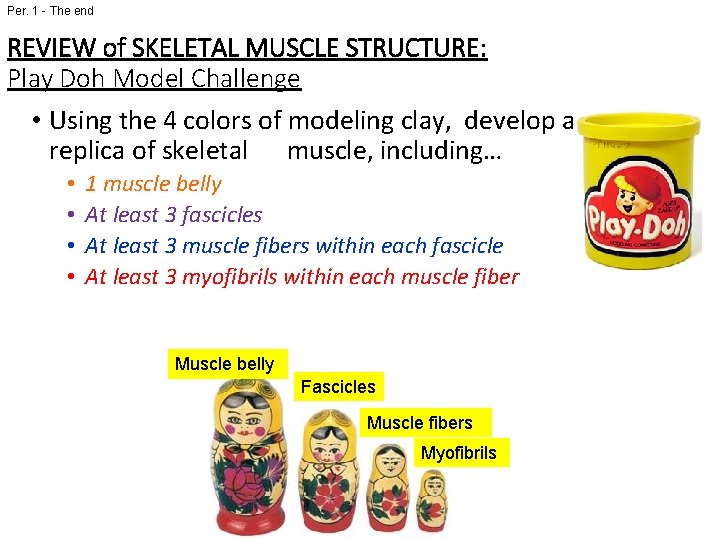
Per. 1 - The end REVIEW of SKELETAL MUSCLE STRUCTURE: Play Doh Model Challenge • Using the 4 colors of modeling clay, develop a mini replica of skeletal muscle, including… • • 1 muscle belly At least 3 fascicles At least 3 muscle fibers within each fascicle At least 3 myofibrils within each muscle fiber Muscle belly Fascicles Muscle fibers Myofibrils
- Slides: 29